Polymethyl Methacrylate Market Snapshot

Key Players

  • Arkema (France)
  • Mitsubishi Chemical Corporation (Japan)
  • Sumitomo Chemical Co. Ltd (Japan)
  • Chi Mei Corporation (Taiwan)
  • Kuraray Co. Ltd. (Japan)
  • Evonik Industries (Germany)
  • ALTUGLAS INTERNATIONAL (United States)
  • Asahi Kasei Corporation (Japan)
  • LG MMA (South Korea)
  • Kolon Industries Inc (South Korea)

Market Size

Base Year 2024
$5.48 Bn
CAGR
5.42%
Forecast 2034
$9.29 Bn

Market Segments

By Form
  • Extruded Sheets
  • Pellets
  • Cast Acrylic Sheets
  • Beads
  • Others
By End Use
  • Signs & displays
  • Lighting Fixtures
  • Construction
  • Automotive
  • Healthcare
  • Electronics
  • Marine
  • Agriculture
  • Consumer Goods
  • Others

Market Dynamics

Drivers
  • Rising demand in electronics industry
  • Advancements in healthcare sector
Restraints
  • High production costs
  • Strict environmental regulations
Opportunities
  • Rising demand in automotive sector
  • Growing applications in electronics industry

Market Size

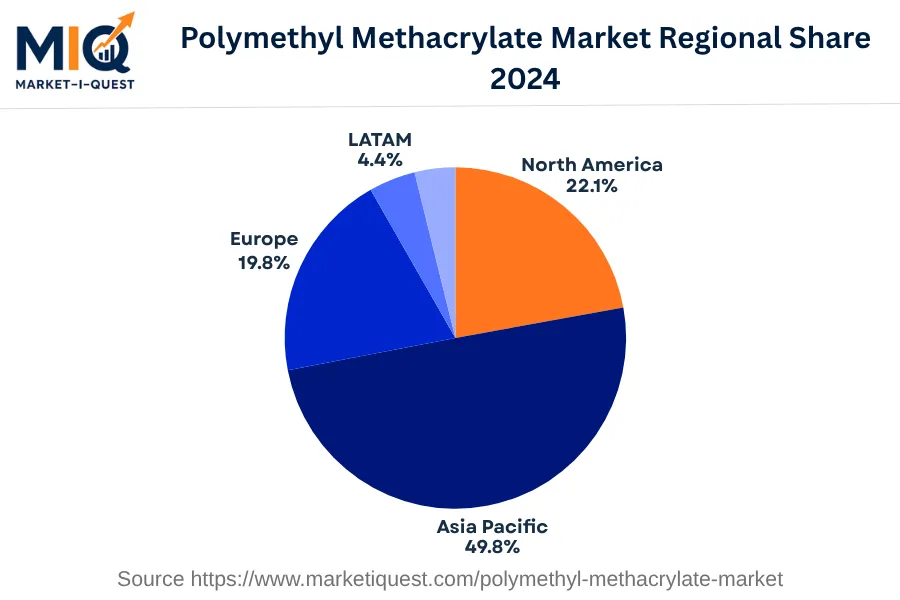
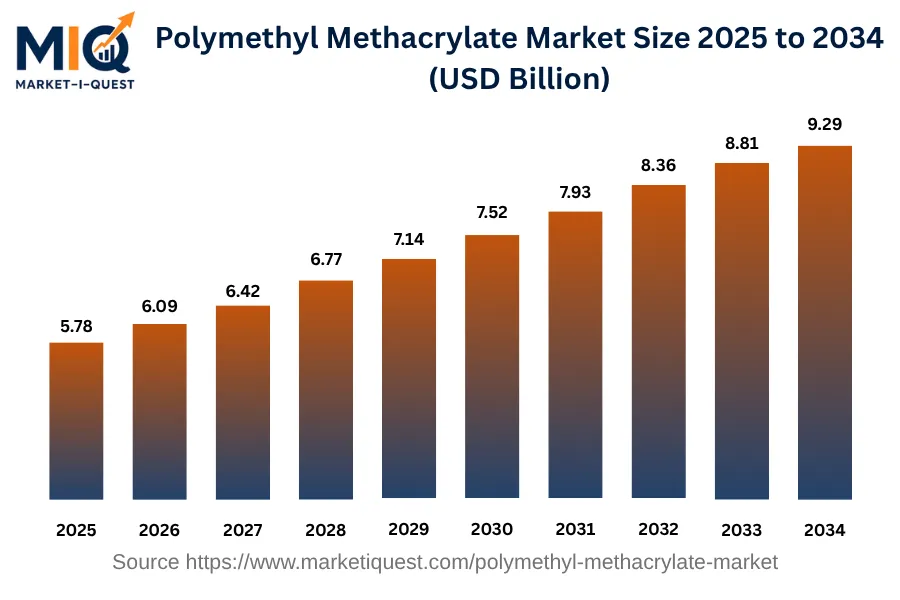
The Polymethyl Methacrylate market was valued at 5.48 billion USD in 2024 and increased marginally to 5.78 billion USD in 2025. Over the next nine years, it's projected to nearly double, reaching a size of 9.29 billion USD by the year 2034. This represents a steady compound annual growth rate of 5.42% over the span of a decade from 2025 to 2034. The significant growth over this period is attributed to an increase in demand for durable, lightweight, and transparent material in various applications across different industries. The regional share mix in 2024 consisted of North America holding a 22.1% stake, followed by Europe with 19.8%. The largest segment was the Asia Pacific region, which dominated with a hefty 49.8% market share, while Latin America and the Middle East and Africa held smaller portions at 4.4% and 3.9% respectively.

Key Takeaways

  • By Form - Extruded Sheets led the market accounting for a significant share in 2024.
  • By End Use - Automotive subsegment held a dominant position of the segment in 2024.
polymethyl-methacrylate-market market size

Key Driving Factors

Expanding LED Market

One of the main driving elements in the Polymethyl Methacrylate market is the expanding use of Light Emitting Diodes (LEDs) in several industries. Polymethyl Methacrylate (PMMA) is prominently used in the manufacturing of LED and flat panel displays due to its excellent properties such as high transparency, UV tolerance, and weather resistance. The consistently increasing consumer preference for energy-efficient LEDs in applications like televisions, laptops, mobile devices, and lighting in both residential and commercial sectors is thus promoting increased adoption and spend in the PMMA market.

Government Regulations on Reducing Greenhouse Gas Emissions

Polymethyl Methacrylate is also seeing substantial market growth due to more stringent government regulations worldwide meant to reduce greenhouse gas emissions. Authorities and corporations are implementing these regulations as part of their environmental sustainability efforts. PMMA, compared to traditional materials like glass, holds a significant advantage in this regard. PMMA's lightweight characteristic can help decrease the weight of vehicles, which subsequently lowers fuel consumption and mitigates carbon emissions. Therefore, the automotive industry has been switching to PMMA for applications such as windows, sunroofs, and light covers, which has resulted in increased demand for PMMA in the market.

Market Evolution by Timeline

2019-2023
During this period, the demand for Polymethyl Methacrylate (PMMA) significantly increased in the Asia-Pacific region, driven by sectors like automotive, electronics, and construction. The trend of replacing conventional materials with PMMA in automotive industries was prominent due to its lightweight and high transparency. Rising standards for energy efficiency pushed construction industries to use PMMA for solar applications. However, supply challenges arose due to limited availability of raw materials, such as propylene, which constrained the production of PMMA. Regulations played a significant role, with RoHS and REACH standards causing shifts towards PMMA in the electronics industry. Commercially, fluctuations in raw material prices led to altered pricing strategies. The main risk identified was dependence on non-renewable resources for raw materials.
2024
In 2024, the medical industry emerged as a significant buyer due to increased use of PMMA in the production of medical implants and devices. Europe showed a significant demand driven by strict environmental regulations pressuring industries to adopt sustainable alternatives. On the supply side, companies like Evonik started using bio-based methods to produce PMMA, addressing the sustainability challenge and raw material dependence. Purchasing tended to move towards longer-term supply contracts to secure pricing stability due to ongoing raw material price volatility. The risk that persisted was the high cost of adopting environmentally friendly production methods.
2025-2029
From 2025 to 2029, implementation of 5G technology created new demand for PMMA in manufacturing of 5G-related devices across the globe, particularly in the US and China. Widespread adoption of biodegradable PMMA hit strides among major manufacturers such as Arkema, as raw material constraints were eased. Policies supporting renewable energy use increased the market penetration of PMMA in solar panel production. Shrinking profit margins caused a shift towards strategic alliances and consolidated supply chains. The potential risk in this period was the high capital investment required to adopt advanced, sustainable production technologies.
2030-2034
During these years, increased consumer awareness about biodegradability largely affected the PMMA demand especially in European markets. Biodegradable PMMA became widely integrated within the industry, reducing the reliance on traditional raw materials. The EU's Circular Economy Action Plan and Single-use Plastics Directive influenced the rapid market acceptance of biodegradable PMMA. Due to the increasing environmental consciousness, there was a notable move towards green procurement models. The risk factor of these years was the reluctance of small and medium companies to invest in the high initial cost for biodegradable production technology.

Future Market Outlook

Future Opportunities

The future of the PMMA market appears promising, especially with recent legislative actions and industry trends emphasizing sustainability and energy efficiency. As of 2023, reaching net-zero emissions has become a priority for many countries, with the European Union introducing regulations that encourage the use of low-impact materials in construction. PMMA, being lightweight and recyclable, has the potential to fulfill these requirements, particularly in green building initiatives. Furthermore, ongoing research initiatives in North America aim to enhance the biodegradability of PMMA, potentially leading to new product lines that align with circular economy principles. Companies like Arkema are exploring biobased PMMA as alternatives to traditional sources, paving the way for innovation in sustainable materials. In addition, the rise of smart technologies in automotive applications is driving interest in PMMA for multifunctional displays and advanced lighting systems. This demand is supported by the ongoing development of connected vehicles, which need durable and aesthetically appealing materials for dashboards and lighting. The increasing focus on aging infrastructure in countries such as India presents further opportunities for PMMA-based solutions in retrofitting projects. Such initiatives require materials that offer both safety and design flexibility, solidifying PMMA's role in enhancing urban renewal efforts. Overall, these conditions indicate a growing trajectory for PMMA applications across numerous sectors, influenced by legislative and societal shifts toward sustainability and innovation.

Segmentation Analysis

By Form

The market is divided into subsegments including Extruded Sheets, Pellets, Cast Acrylic Sheets, Beads, and Others. Among these, Extruded Sheets accounted for the largest revenue share while Pellets are expected to grow at the fastest CAGR during the forecast period.

Largest Revenue Share

Extruded Sheets

Market Share Leader

Extruded sheets leads the revenues not only due to high demand in a wide range of applications but also due to their ease of manufacturing and low production costs. These sheets find substantial use in various end-use industries, including construction, automotive and packaging, owing to their exceptional durability, light weight, and ease of customization. In addition, they are preferred for their high aesthetic appeal and superior clarity, thus enhancing visibility in applications such as signage and displays. Further, leading manufacturers have established raw material contracts and a wide distribution network, ensuring consistent and affordable supply. Lastly, favourable regulatory policies, particularly in developed geosystems towards eco-friendly materials, are associated with the high revenue generation of extruded sheets subsegment.

Fastest CAGR

Pellets

Forecast Period Growth Leader

Pellets are projected to grow at the fastest rate during the forecast period. This dynamic growth can be attributed to the rising demand for sustainable and energy-efficient materials, as well as their applicability in wide-ranging sectors such as automotive, medical and aerospace. The compact nature of pellets makes them easy to transport and store, driving their popularity among manufacturers. Furthermore, technological advances aim to maximize production efficiency and yield of pellets, propelling the sector's growth. In addition, collaborations between raw material suppliers and end-user industries could act as a catalyst for the segment's growth. However, near-term risks include volatility in raw material prices and potential supply chain disruptors.

By End Use

The market is divided into subsegments including Signs & displays, Lighting Fixtures, Construction, Automotive, Healthcare, Electronics, Marine, Agriculture, Consumer Goods, and Others. In the base year 2024, the Automotive subsegment accounted for the largest revenue share while the Electronics subsegment is expected to grow at the fastest CAGR during the forecast period.

Largest Revenue Share

Automotive

Market Share Leader

The Automotive subsegment's revenue leadership in 2024 is predominantly attributed to the huge automotive market globally and the expanding integration of technology within the industry. The rising innovative technological advancements in vehicles and the increasing adoption of electric, hybrid and connected cars are driving the growth of this subsegment. Automotive manufacturers are now committed to investment in, and production of, next-generation tech-integrated vehicles. Furthermore, regulatory directives around the world leaning towards fuel efficiency and carbon emissions reductions have strongly affected the demand patterns in the automotive subsegment. Additionally, the relatively high purchasing power of the customers in this market allows the demand for advanced technologies to remain stable, thereby ensuring robust revenue streams for this subsegment.

Fastest CAGR

Electronics

Forecast Period Growth Leader

The Electronics subsegment is anticipated to see the most substantial CAGR in the forthcoming years. This prediction is rooted in the context of widening consumer electronics adoption globally, the need for more advanced technologies, and the evolution of Internet of Things (IoT) applications in consumer, industrial, and commercial areas. The trend of digitalization and 'smart' everything has catalyzed both the demand and the supply for advanced, durable, and efficient electronic components and systems. Key catalysts for growth include outsourced R&D and strategic partnerships between tech companies. However, the near-term risks center around manufacturing interruptions and global supply chain disruptions due to unpredictable factors, like geopolitical events and pandemics, that can potentially affect its anticipated accelerated growth.

Competitive Analysis

Key Market Players

Manufacturers / OEMs

Mitsubishi Chemical Corporation
Japan
Altuglas International
France
Evonik Industries AG
Germany

Key Suppliers & Raw Materials

Lucite International
UK
Kuraray Co., Ltd.
Japan
GEO Specialty Chemicals
US

Distributors, Integrators & Channel Partners

Hennecke Gmbh
Germany
Amari Plastics
UK
Blackfriars
US

Porter’s Five Forces Analysis

This analysis digs deep into the competitive landscape of the Polymethyl Methacrylate market.

Supplier Bargaining Power

Medium

Power of suppliers is moderate due to limited number of raw material providers.

Buyer Bargaining Power

Low

Buyers have low negotiating power owing to the technicalities and specifications of PMMA.

Threat of Substitutes

High

Alternative materials like Polycarbonate poses a high threat of substitution.

Threat of New Entrants

Low

High capital cost, technical know-how and stringent regulations limit new entrants.

Competitive Rivalry

High

Market exhibits high rivalry due to presence of multiple global and local players.

Regional Analysis

Geographic market dynamics and growth opportunities across key regions

Global Market Outlook

polymethyl-methacrylate-market market regional share

North America

In 2024, the North American market for Polymethyl Methacrylate (PMMA) displayed robust momentum, driven by a fusion of demand factors, regulatory implications, and adoption of advanced technology. The upsurge in demand for sustainable and lightweight materials in the automotive and construction industries, coupled with positive pricing dynamics, stimulated constant growth. Shifts in regulations, particularly in the U.S. and Canada, promoting energy-efficient materials further propagated market expansion.

A dominant trend witnessed was the widespread adoption of specialty grades PMMA in sectors such as electronics and healthcare, driven by their superior characteristics conforming to industry-specific standards. The transition towards e-commerce channels for procurement indicated the evolving buyer behavior seeking convenience and cost-effectiveness. Moreover, collaborative endeavors across key players, as observed in cross-sector partnerships and M&As, redefined supply chain dynamics. Consumer Electronics, a prominent customer segment, exhibited a steep demand for PMMA in the manufacturing of LED and LCD screens. Simultaneously, healthcare facilities ramped up use of this thermoplastic in the production of medical devices, thanks to its biocompatibility. Reflecting technological adoption, manufacturing businesses in the U.S., Canada, and Mexico increasingly turned to advanced extrusion techniques for mass production. Yet, the policy enforcement concerning waste management, specifically in Canada, imbued the necessity of recycling methodologies in PMMA production, shaping the North American market's sustainable approach.

Asia Pacific

In 2024, the Polymethyl Methacrylate (PMMA) market in the Asia Pacific demonstrated solid performance, primarily driven by rapidly-growing economies like China, India, and South Korea. Increased demand was seen in sectors such as automotive, construction, and electronics where PMMA's durability and aesthetic qualities were in high demand for manufacturing energy-efficient vehicles, sophisticated consumer electronics, and modern infrastructure. Governmental regulations promoting sustainable and energy-efficient materials further propelled PMMA adoption across these industries. Additionally, the regions' focus on developing high-tech industries stimulated investments in advanced manufacturing technologies favoring PMMA use.

Noteworthy market trends included a shift towards locally-produced PMMA in large markets like China and India, spurred by their concerted efforts to reduce reliance on imported materials. Japan and South Korea's emphasis on high-value, specialized PMMA applications shaped the market, particularly in the electronics sector, as consumer preferences leaned towards more lightweight and high-end electronic products. Partnerships among manufacturers in Australia and ASEAN markets enhanced PMMA production capacities to meet rising domestic needs. Enforcement of stringent product quality standards by governments across the region further influenced market dynamics. To sum up, the PMMA market in 2024 in the Asia Pacific region was shaped by potent growth drivers and specific trends tied to demand in various sectors, policy regulations, and economic strategies.

Europe

In 2024, the Polymethyl Methacrylate (PMMA) Market demonstrated dynamic growth and continued industrialization in Europe, particularly in Germany, the U.K., France, Italy, Spain, the Nordics, Benelux, and Central & Eastern Europe. This growth was driven by burgeoning demand in the automotive and electronics sectors, with heightened investment in PMMA sheet manufacturing to cater to the wear-resistance and high-transparency needs. A pronounced drive towards energy-efficient solutions, chiefly in the housing sector, also increased the demand for PMMA, particularly as it fulfils regulations outlined by the European Union for improved insulations.

Key market trends emerged in 2024, including a notable shift in buyer's preference towards bio-based PMMA due to its environmental advantages, reflected in new product developments from prominent manufacturers. Additionally, strategic partnerships for technology transfers and merger & acquisitions, as exemplified by the collaboration between Altuglas International and Mitsubishi Chemical, manifested in this timeframe. Other trends included stricter enforcement of European directives on hazardous substances in electrical and electronic equipment, pushing consumer electronics manufacturers towards PMMA. Lastly, digitization in the retail sector promoted the use of PMMA-based display panels, further stimulating the market. Altogether, the PMMA market thrived in Europe, as industries continuously adapted to the demand factors and evolving regulations.

Latin America

In 2024, the Polymethyl Methacrylate (PMMA) market in Latin America (LATAM) experienced significant changes influenced by various factors. Legal regulations supporting green initiatives and sustainability led to increased PMMA usage in the automotive and construction sectors, specifically in Brazil and Chile, for its lightweight and energy-efficient attributes. Furthermore, the widespread adoption of PMMA in healthcare sectors in Mexico and Peru for creating protective screens and healthcare equipment supplies due to its transparency and resistance attributes impacted positively to the market growth.

Additionally, a shift in consumer behavior towards higher-grade aesthetics paved the way for PMMA in retail and advertising sectors in Argentina and Colombia, due to its glass-like characteristics. Technology leaps, notably in LED lighting adoption, propagated PMMA usage for its light-diffusing properties, especially in manufacturing sectors. Moreover, numerous partnerships and M&As within regional PMMA manufacturers intensified competition, creating a more dynamic supplier landscape.

Brazil's strict enforcement of energy efficient policies set a trend for other LATAM countries, favoring PMMA use for renewable energy applications. The contribution of LATAM's PDVSA to the PMMA market also remained noteworthy in the base year, as the impact of Venezuela's state-owned oil and gas company positively influenced the PMMA market.

Middle East & Africa

In the base year 2024, the Polymethyl Methacrylate (PMMA) Market in the Middle East and Africa saw noticeable expansion. High demand for PMMA in sectors such as healthcare and automotive, specifically in Saudi Arabia and the United Arab Emirates, largely drove growth. Technological innovation in PMMA production techniques also benefited the market, with Israel and South Africa leading in adoption. Fluctuating raw material prices and supply chain disruptions, mainly seen in Nigeria and Kenya, posed challenges yet opened opportunities for domestic production capacity enhancement.

In terms of trends, the use of PMMA in renewable energy sector, specifically in solar panels, grew immensely, notably in Qatar and Egypt. In Israel, as environmental regulations tightened, a shift towards eco-friendly PMMA variants was highly evident. Mergers and acquisitions were also notable, particularly among UAE-based petrochemical companies for PMMA production optimization. South Africa saw the introduction of stricter quality standards, driving advancements in PMMA production technology.

Consumer behaviour shifted towards energy-efficient and sustainable products, encouraging PMMA adoption in the automotive and construction sectors in Saudi Arabia. In healthcare, the increased use of PMMA in orthopaedic procedures in Nigeria and Kenya fuelled market growth. Overall, the PMMA market in the Middle East and Africa in 2024 experienced significant growth driven by demands, advancements, and regulatory changes across several sectors.

Recent Industry Developments

Latest market innovations, product launches, and strategic initiatives

June 2026

Röhm reached full-scale operations at its new manufacturing plant, which produces the core raw material required to manufacture PMMA. Opened in June 2026, this facility produces 250,000 tons annually and is the first in the world to use a new production method designed to drastically cut water and energy consumption.

May 2026

Asahi Kasei formally announced it is completely exiting the PMMA market to restructure its focus toward its energy division. The company is permanently shutting down its Kawasaki City plant, a move that will officially remove 40,000 tons of annual PMMA production capacity from the global market by September 2026.

January 2026

Mitsubishi Chemical Corporation partnered with Ambica Corporation Limited to officially open a massive new storage facility dedicated entirely to PMMA. Becoming operational in January 2026, this site holds a 10,000-ton annual capacity, physically shifting the supply chain to provide immediate local availability for buyers in the region rather than relying on delayed imports.

Frequently Asked Questions