Polymer Modified Cementitious Coatings Market Snapshot

Key Players

  • RPM International Inc. (United States)
  • Sika AG (Switzerland)
  • Mapei Spa (Italy)
  • Fosroc International Limited (United Kingdom)
  • Akzo Nobel N.V. (Netherlands)
  • BASF SE (Germany)
  • PPG Industries
  • Inc. (United States)
  • The Sherwin-Williams Company (United States)
  • Hempel A/S (Denmark)
  • Asian Paints Ltd. (India)

Market Size

Base Year 2024
$1.24 Bn
CAGR
5.6%
Forecast 2034
$2.14 Bn

Market Segments

By Polymer Type
Acrylic Polymer, SBR Latex
By Flexibility
Flexible, Non-flexible
By Composition
One-component, Two-component
By Application
Non- Residential Buildings, Residential Buildings, Public Infrastructure

Market Dynamics

Drivers
  • Increasing infrastructural developments
  • Rising demand in waterproofing applications
Restraints
  • High production costs
  • Strict environmental regulations
Opportunities
  • Increasing construction activities
  • Rising demand for durable coatings

Market Size

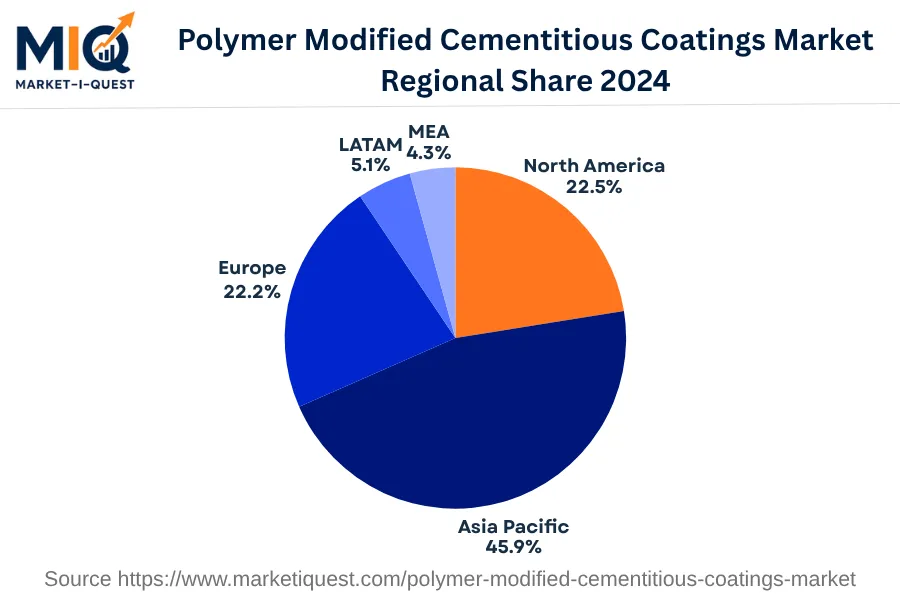
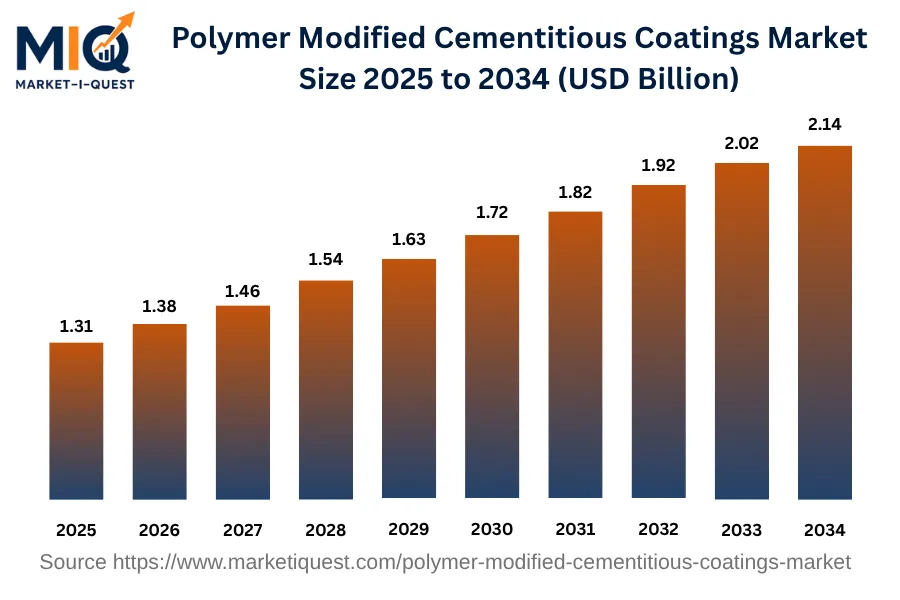
The Polymer Modified Cementitious Coatings Market was valued at $1.31 billion in 2025 and is expected to grow to $2.14 billion by 2034, with a CAGR of 5.6%. This growth is reflected over the years as the market value was slightly lower at $1.24 billion in 2024. The growth can be attributed to continuous developments in the polymer modified cementitious coatings field and expanding end-user applications. Regionally, in 2024, the Asia Pacific region held the largest share of the market at 45.93%, followed closely by North America with 22.47% and Europe with 22.18%. The remaining market share was held by LATAM with 5.11% and MEA with 4.31%. This demonstrates a significant market potential across various regions globally.

Key Takeaways

  • By Polymer Type - Acrylic Polymer segment held a significant position in recent years.
  • By Flexibility - Non-Flexible segment led the market share in 2024.
  • By Composition - One-component segment held the largest revenue share of the segment.
  • By Application - Residential Buildings accounted for a largest market share in 2024.
polymer-modified-cementitious-coatings-market market size

Key Driving Factors

Adoption of Sustainable Construction Practices

One clear catalyst for growth in the Polymer Modified Cementitious (PMC) Coatings market is the rising adoption of sustainable construction practices worldwide. Policymakers, industry leaders, and engineers are highly focused on reducing the environmental impact of structures throughout their lifecycle, as embodied in green building standards such as LEED and BREEAM. PMC coatings allow constructors to meet these stringent environmental codes, boasting improved longevity and reduced maintenance requirements compared to traditional materials. As construction sectors in developed nations continue to be subject to tighter sustainability standards, the market for PMC coatings is likely to expand.

Increased Emphasis on Infrastructure Durability

An increased emphasis on infrastructure durability, particularly in regions exposed to harsh environmental conditions, is spurring demand for Polymer Modified Cementitious Coatings. These regions are facing escalating maintenance and repair costs due to corroding infrastructure. As a solution, PMC coatings are now being used, given their inherent properties such as superior bond strength, flexibility, and resistance to water, chemical damage, and abrasion. They provide additional protection to structures in these challenging environments, thus extending their service lives and reducing maintenance costs. This is particularly appealing for government bodies and corporations aiming to optimize their long-term infrastructure investments.

Market Evolution by Timeline

2019-2023
In these years, polymer modified cementitious coatings are primarily bought by infrastructure and commercial construction industries but witness an emerging demand from residential construction segments. High adoption is observed in Asia as they experience rapid urbanization. Real-world application results demonstrate their ability to provide enhanced durability and resilience to structures. Limitations in manufacturing processes and application techniques are common, restricting market scalability. Regulatory standards such as ISO 14021 and ISO 21930, focusing on environmental considerations, influence industry practices. Fixed pricing models prevail, often set by large manufactures like BASF and Sika AG. Supply interruptions hold potential risk due to raw material shortages disrupting production.
2024
In 2024, focus shifts from Asia to drawn-demand from reconstruction efforts in regions affected by climate change, especially in North America. Application processes are refined, improving product consistency and expanding usage. Standards like LEED v4 BD+C BAU continue to encourage responsible use of materials in construction. Introduction of flexible negotiated pricing models based on product customization and volume of orders is observed. However, inconsistencies in the supply chain due to climate-related disruptions persist as a risk factor.
2025-2029
Things change as applications of polymer modified cementitious coatings reach beyond construction and into sectors like automotive and marine. The U.S., China, Japan, and Germany are leading in adoption, reflecting their extensive manufacturing industries. Industrial integration and collaborations between manufacturers and end-users increase. Adoption of advanced production mechanisms to reduce the carbon footprint, conforming to ISO 21930 emerge. Cost-based pricing models gain popularity due to competition. The primary risk factor remains the sustainability and availability of raw materials involved in production.
2030-2034
This period sees an elevated demand for polymer modified cementitious coatings from developing regions and economies; Africa, South Asia, and South America emerge as key players. Significant incorporation of technology into production, application, and tracking of the material improves efficiency. Standards focusing on circular economy like EN 15804+A2 apply pressure on manufacturers to rethink their product lifecycle. Subscription-based or pay-per-use commercial models surface, driven by software integration in construction. Raw material price fluctuations and trade uncertainties emerge as potential risks.

Future Market Outlook

Future Opportunities

The global polymer modified cementitious coatings market exhibits potential for growth, particularly as infrastructure upgrades become a priority in many nations. In the United States, the 2021 bipartisan infrastructure bill earmarked substantial funds for the repair of highways, bridges, and transit systems, creating an increased demand for high-performance coatings that ensure durability. Similarly, Asia-Pacific countries, such as India, are intensifying their infrastructure development efforts, driven by the Smart Cities Mission initiated in 2015, which aims to improve urban environments using advanced materials. There is also a growing emphasis on energy efficiency across several regions, as reflected in Australia’s attempt to enhance building codes since 2022 that require the use of eco-friendly construction materials. Furthermore, the rising awareness of climate resilience is prompting governments and businesses to adopt coatings that can withstand extreme weather conditions, seen in the increasing use of polymer modified coatings for flood-prone areas across Southeast Asia. Collaboration between construction firms and coating manufacturers is set to expand, as illustrated by partnerships that leverage the latest advancements in material science. With the rising prevalence of sustainable building certifications such as the WELL Building Standard, opportunities will likely arise for companies developing innovative yet compliant coatings. The growing trend of retrofitting older structures presents another avenue for market expansion, particularly as more regions focus on renovating existing buildings to meet modern safety and environmental standards established post-2020.

Segmentation Analysis

By Polymer Type

The market is divided into subsegments including Acrylic Polymer and SBR Latex. Acrylic Polymer accounted for the largest revenue share while SBR Latex is expected to grow at the fastest CAGR during the forecast period.

Largest Revenue Share

Acrylic Polymer

Market Share Leader

Acrylic Polymer being the largest revenue generating subsegment can be attributed to its exceptional qualities and versatility in application. It is extensively used across a diverse range of industries like automotive, construction, packaging, and adhesives. The booming construction sector plays a significant role in driving up the demand for Acrylic Polymers due to its application in coatings, sealants, and adhesives. Construction firms prefer Acrylic Polymers because of their durability, resistance to ultraviolet radiation, and elasticity. Another significant growth driver stems from Acrylic Polymer’s ability to efficiently bind diverse materials in packaging, textiles, and nonwoven applications. Several countries have regulations in place supporting the use of eco-friendly products, further speeding up the growth of Acrylic Polymers due to its bio-based nature. However, a potential challenge could be the fluctuating raw material costs affecting the price of Acrylic Polymers. Still, as long as the demand outweights the potential price increase, one can expect a stable growth in the revenue of the Acrylic Polymer market.

Fastest CAGR

SBR Latex

Forecast Period Growth Leader

SBR Latex is projected to be the fastest-growing subsegment in the polymer market. Several factors work in favor of this growth. SBR Latex is primarily used in adhesives, non-woven fabrics, paper coatings, and carpet backing. The rapid expansion of these industries, particularly in developing countries, is a key driver for the increased demand for SBR Latex. Advancements in technology and the capability to form environmentally friendly products have further increased its applications, catalyzing its overall market growth. Additionally, heavy investments in R&D and strategic partnerships aimed at broadening application scope are poised to accelerate its growth further. However, despite the positive outlook, there are near-term risks, most notably the fluctuations in raw material costs that often lead to a price increase of the product. Also, there's a potential of adoption barriers due to an increasingly regulated environment that strictly controls chemical use, and this could significantly influence its growth rate.

By Flexibility

The market is divided into subsegments including flexible and non-flexible, with non-flexible accounting for the largest revenue share while flexible is expected to grow at the fastest CAGR during the forecast period.

Largest Revenue Share

Non-flexible

Market Share Leader

The non-flexible market segment demands a significant revenue share in the market. This is primarily due to its inherent benefits over its counterpart. The non-flexible products offer durability and long lifespan, which are considered extremely important by a majority of users. Additionally, they boast a superior ability to resist wear and tear, making them ideal for heavy-duty applications across several sectors. Geographic regions with rigid regulations advocating the use of durable products also contribute to this segment's revenue prominence. Moreover, a considerable base of consumers is resistant to change, showing a comfort with maintaining status quo in product use, which benefits the non-flexible market segment. High switching costs, coupled with strong ties with established distribution channels, also underline this segment's commanding revenue position. As such, while newer innovations may capture attention, they may struggle to translate this interest into market share gains due to these indicative market barriers.

Fastest CAGR

Flexible

Forecast Period Growth Leader

The flexible segment, despite contributing less to the market's revenue currently, holds the mantle of the fastest-growing segment. A combination of technological advancements, shifting consumer preferences, and policy levers are driving increased adoption rates. The flexible products are seen as the avant-garde, appreciated for their adaptability and compatibility with a variety of use-cases. Additionally, the lowering capital expenditure (capex) required for flexible units, due to technological advancements, is attracting price-sensitive consumers and small-to-medium organizations. Partnerships between flexible product manufacturers and high-value applications are expected to act as catalysts for the segment's growth, promoting further adoption. However, near term risks include resistance due to the reliability concerns and potential regulatory changes affecting the flexibility-driven offerings. Despite these potential challenges, the segment's future growth potential remains robust.

By Composition

The market, by composition, is divided into subsegments including one-component and two-component. Among these, the one-component subsegment accounted for the largest revenue share, while the two-component subsegment is expected to grow at the fastest CAGR during the forecast period.

Largest Revenue Share

One-component

Market Share Leader

The one-component subsegment dominates the market due to its wide range of applications and simplicity of use. This segment benefits from the fact that these products generally have a lower production cost and are easier to use, which is appealing to a wider demographic. Industries that demand efficient and more cost-effective solutions tend to lean towards the One-component segment. Additionally, emerging markets with price-sensitive customer bases are contributing to the growth of the one-component subsegment. Furthermore, these markets are witnessing rapid industrialization which in turn has led to an increase in demand for one-component products. However, it is important to mention that, although the base year 2024 positions the one-component segment as the largest revenue holder, market dynamics could fluctuate in response to technological and economic developments.

Fastest CAGR

Two-component

Forecast Period Growth Leader

On the other hand, the two-component subsegment is expected to experience the fastest growth. This is largely due to its superior performance characteristics and long-term durability, which makes it desirable for sectors demanding high-performing materials. While they are a bit more complex to use than their one-component counterparts, their benefits often outweigh this minor inconvenience. Advances in technology and materials science are driving the adoption of two-component systems thanks to improved performance and a broader range of potential applications. The growth of the two-component subsegment is also being fueled by rising demand in industries such as construction, automotive, and aerospace, whose complex and demanding applications require the strength and durability these materials can offer. That being said, high costs and supply chain complexity could slow down their adoption to some extent.

By Application

The market is segmented by application, broken down into Non-Residential Buildings, Residential Buildings, and Public Infrastructure. In 2024, the Residential Buildings subsegment accounted for the largest revenue share, while Public Infrastructure is projected to experience the steepest growth during the forecast period.

Largest Revenue Share

Residential Buildings

Market Share Leader

Residential buildings presented the largest revenue in the application segment in our base year of 2024. The growth in the residential building's subsegment is primarily driven by the increasing urban population and rising income levels across emerging economies. These demographic patterns result in more disposable income being channelled towards housing, leading to a boom in the residential construction market. Moreover, regulatory frameworks promoting the construction of residential buildings such as affordable housing, incentives, and tax credits, further spur the demand in this subsegment. However, purchasing criteria usually depend on the quality and cost of construction, ease of access, and life-cycle costs of the residential units. These aspects may influence the acquisition decision and eventually, the demand for residential buildings. Switching costs are relatively high in this subsegment due to the substantial capital investment and regulatory constraints.

Fastest CAGR

Public Infrastructure

Forecast Period Growth Leader

Meanwhile, the Public Infrastructure subsegment is projected to grow at the fastest rate. Key growth drivers include increasing urbanization, which necessitates improvements and expansion of public facilities such as transportation avenues, public utilities, and health services infrastructure. Adoption barriers to this growth include limited availability of public funds, regulatory hurdles, and often, environmental concerns. However, technological advancements in construction and infrastructure planning are progressively offsetting these limitations. Policy initiatives and public-private partnerships can act as significant catalysts for growth, enabling a more streamlined execution of public infrastructure projects. On the risk front, political uncertainty or changes in government policies may affect the planned capital expenditure and timelines of these public infrastructure projects, thereby impacting the market outlook.

Competitive Analysis for Polymer Modified Cementitious Coatings

Key Market Players

Manufacturers / OEMs

BASF SE
Germany
Cementaid (UK) Ltd
UK
Arkema SA
France

Key Suppliers & Raw Materials

Dow Chemical Company
US
Ashland Global Holdings Inc.
US
Saint-Gobain Weber
France

Distributors, Integrators & Channel Partners

McMaster-Carr
US
LATICRETE International, Inc.
US
Rawlins Paints
UK

Porter’s Five Forces Analysis

Analysis of the Polymer Modified Cementitious Coatings Market using Porter's Five Forces.

Supplier Bargaining Power

Medium

Suppliers gain leverage by manipulating raw material prices for coatings production.

Buyer Bargaining Power

High

Buyers have many options with competitive pricing, given the numerous market players.

Threat of Substitutes

Low

Limited substitutes exist due to the unique, composite nature of these coatings.

Threat of New Entrants

Medium

Industry requires high capex and technical know-how, but growth opportunities attract new players.

Competitive Rivalry

High

Rivalry is intense due to presence of multiple large-scale and emerging market players.

Regional Analysis

Geographic market dynamics and growth opportunities across key regions

Global Market Outlook

polymer-modified-cementitious-coatings-market market regional share

North America

In 2024, the North American market for polymer modified cementitious coatings experienced significant traction, driven by a range of complex factors. High demand in the construction sector, particularly for commercial and residential infrastructure in the U.S., Canada, and Mexico, fueled the market growth. This was coupled with stringent government regulations on durability and sustainability construction practices, incentivizing the usage of these coatings. Additionally, increased investment in research and development, coupled with the adoption of advanced technology, contributed to improved product quality on the supply side.

The market saw a trend of increased consumer preference for high-performance and eco-friendly products, which further stimulated the demand for this type of coatings. Concurrently, the market underwent a shift towards e-commerce distribution channels, owing to its convenience factor. Volatility in raw material prices, however, impacted the market, inducing fluctuations in price points across the region. Strategic partnerships between local and international manufacturers were also observed to facilitate technology transfer and product expansion.

The primary consumers for these coatings remained the enterprise and government sectors, with the healthcare, utilities, manufacturing, and retail sectors also demonstrating increased uptake of these materials. It's noteworthy that a part of this demand came from government infrastructure projects, driven by policy enforcement for sustainable practices.

Asia Pacific

In 2024, the Polymer Modified Cementitious Coatings market in the Asia Pacific witnessed significant momentum driven by varied factors and trends. Rapid industrialization in developing economies like China and India propelled the demand for these coatings, substantially driving the market. Infrastructure investment in these regions, particularly in public utilities and residential projects, was a notable contributor. Technological adoption also played a key role, with South Korea and Japan displaying considerable interest in advanced, high-performance coatings. Additionally, supply dynamics, highlighting Australia's increased manufacturing capabilities, influenced the market.

Trending in the market was a shift in buyer preference towards eco-friendly coatings, pushing manufacturers to innovate and diversify their portfolio. Digitization in retail channels boosted product accessibility and customer outreach, especially in key ASEAN markets like Indonesia and Thailand. Partnerships and mergers were prevalent, with firms striving to enhance their competitive standing. Notably, stricter policy enforcement around environmental standards occurred across the board, impacting product design and manufacturing practices.

The primary customers for polymer modified cementitious coatings encompassed sectors like construction, manufacturing, and government projects. Specifically, demand surged from the utilities sector, in response to increased public infrastructure development. By adhering to strict quality and environmental standards, the market ensured robust growth within the Asia Pacific arena in 2024.

Europe

In 2024, the polymer modified cementitious coatings market in Europe demonstrated vigorous dynamics. Key drivers included increased demand for these coatings in the construction industry, particularly in Germany, the UK and France, where infrastructure upgrades were prioritised. The EU’s strategy for sustainable infrastructure also led to heightened market activity, encouraging manufacturers to produce more eco-friendly coatings. Additionally, technological innovation in Italy and Spain boosted product differentiation and adoption rates.

The core trends shaping the polymer modified cementitious coatings market in 2024 centered on sustainability, digitization, and consolidation. Consumers across Europe, especially in the Nordics and Benelux region, showed a growing preference for sustainable coatings that meet stringent environmental standards. Digitization also emerged as a transformative force in the industry, with manufacturers in Central & Eastern Europe, particularly leveraging digital tools to streamline production processes and enhance product quality. Another significant trend was the rise of collaborations and mergers amongst manufacturers, aiming to expand their regional presence and diversify their product range. Lastly, stricter policy enforcement led to an evolvement in market standards, with all sectors, including enterprise, government, healthcare, utilities, manufacturing, and retail, having to comply with enhanced product quality and sustainability requirements.

Latin America

In 2024, the Polymer Modified Cementitious Coatings market in Latin America reflected robust growth and dynamic shifts in its landscape. The market growth was primarily driven by an increase in construction activities, especially in Brazil and Mexico, spurred by government investments in infrastructure development. Also, an upsurge in renovation projects in Argentina, Colombia, Chile, and Peru triggered market expansion. Regulatory framework favoring environment-friendly and energy-efficient buildings led to the adoption of these coatings in the residential and commercial sectors, especially in manufacturing and retail.

Trends witnessed in the market involved a shift in buyer preference toward high-quality and durable coatings boosting demand for polymer modified options. Additionally, advancements in technology led to the introduction of innovative products with enhanced features, boosting their uptake in the construction sector. There was a notable increase in partnerships and M&A activities, with market players aiming to expand their footprint and product portfolio. There was an observed enforcement of building standards and policies, particularly in Brazil, which mandated the use of sustainable construction materials, influencing market dynamics significantly. Consequently, the government and healthcare sectors emerged as significant customers, given the requirement for upgraded infrastructure facilities. In 2024, these trends and drivers in the LATAM Polymer Modified Cementitious Coatings market forecasted a promising outlook for market growth.

Middle East & Africa

In 2024, the Polymer Modified Cementitious Coatings market in Middle East and Africa witnessed significant growth, particularly driven by increased investment and infrastructure development. The robustness of the oil and gas sector, particularly in countries such as Saudi Arabia, United Arab Emirates, and Qatar, created a need for more durable, efficient, and weather-resistant protective coatings for pipelines and industrial facilities. This, coupled with stricter government regulations in Nigeria and South Africa to ensure infrastructure longevity and sustainability, fueled the demand.

Simultaneously, widespread adoption of advanced coating technologies in industries such as telecommunications, manufacturing, and healthcare added momentum to market expansion. Specifically, the rise of mega-scale construction projects in Egypt and Israel led to incorporation of advanced materials, including Polymer Modified Cementitious Coatings.

In terms of trends, the push towards product innovation witnessed a surge, steered by buyer demand for versatile, high-quality products with longer lifespan. Mergers and acquisitions in the sector also shaped market dynamics, with focus on expanding portfolio and market reach. Finally, increasing enforcement of construction and environmental standards boosted demand for durable, high-standard coatings and moulded the sector direction in Kenya and other emerging markets. In general, the increased demand for Polymer Modified Cementitious Coatings in Middle East and Africa can be attributed to the region's dynamic infrastructure development, technological advancements, and tightening regulatory environment in the base year 2024.

Recent Industry Developments

Latest market innovations, product launches, and strategic initiatives

August 2025

Ramco Cements launched the "Hard Worker" construction chemicals brand, rolling out 20 specialized products that include targeted cementitious waterproofing solutions designed specifically for the evolving commercial construction sector.

Frequently Asked Questions