Polymer Modified Bitumen Market Snapshot

Key Players

  • TotalEnergies (France)
  • ExxonMobil (USA)
  • Royal Dutch Shell Plc (Netherlands)
  • Bharat Petroleum (India)
  • Rosneft (Russia)
  • Nynas AB (Sweden)
  • Hindustan Colas Private Limited (India)
  • Vitol (Netherlands)
  • Macismo Solutions LLC (USA)
  • Guangdong Qingyuan Yuxing New Materials Technology Co. Ltd. (China)

Market Size

Base Year 2024
$12.85 Bn
CAGR
4.7%
Forecast 2034
$20.34 Bn

Market Segments

By Product Type
  • Thermoplastic Elastomers
  • Thermoplastic Polymers
  • Thermosetting Polymers
  • Crumb Rubber Modified Bitumen
  • Others
By Application
  • Roofing & Piping
  • Road Construction
  • Emulsions
  • Others

Market Dynamics

Drivers
  • Increasing road construction activities
  • Growing waterproofing requirements in buildings
Restraints
  • High production cost
  • Environmental concerns
Opportunities
  • Emerging road construction projects
  • Increasing roofing applications

Market Size

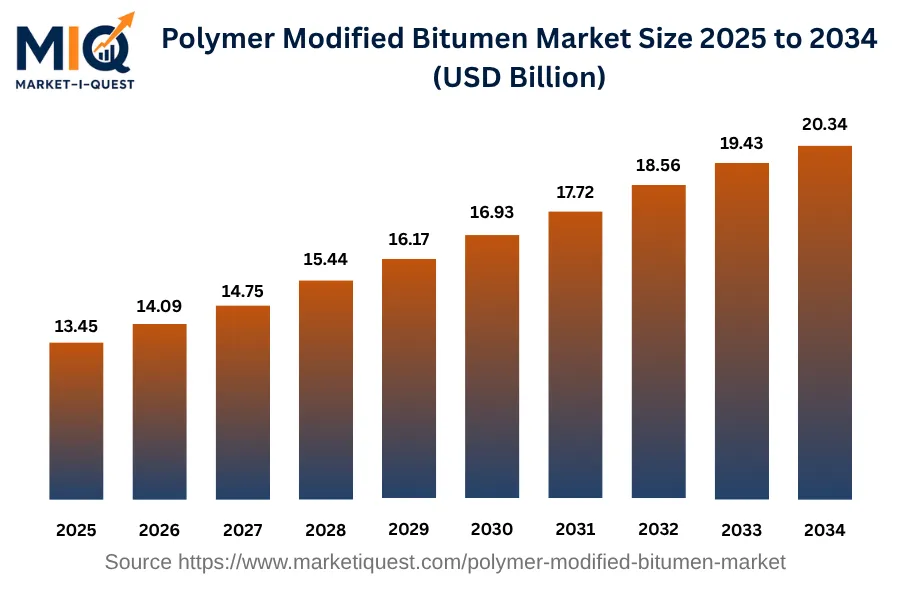
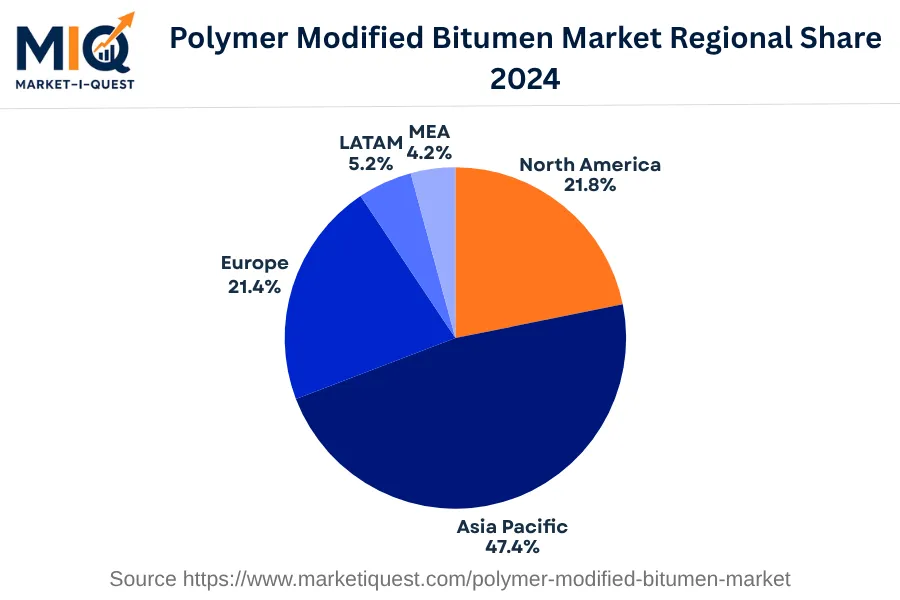
The Polymer Modified Bitumen Market was valued at $13.45 billion in 2025 and it is forecasted to reach $20.34 billion by 2034, with a CAGR of 4.7%. This growth is particularly pronounced in the decade between 2025 and 2034. This growth manifests across various regions. In 2024, the regional share of the Polymer Modified Bitumen Market was distributed as follows: North America accounted for a 21.8%, Asia Pacific was the largest with 47.4%, Europe accounted for 21.4%, LATAM contributed 5.2%, and MEA accounted for the remaining 4.2% of the market share. The values clearly indicate that the market is growing steadily with an increasing demand in all these regions, with Asia Pacific leading the group.

Key Takeaways

  • By Product Type - Thermoplastic Elastomers led accounting for the highest market share in 2024.
  • By Application - Roofing and Piping subsegment dominated the Market in the 2024.
polymer-modified-bitumen-market market size

Key Driving Factors

Highway and Roadway Infrastructure Investment

Growth of the polymer modified bitumen market is strongly tied to global trends in highway and roadway infrastructure development. In countries with burgeoning economies, such as India and China, governments are significantly investing in infrastructure improvements to facilitate local and international trade. Polymer modified bitumen is a key material for constructing and repairing roads due to its superior waterproofing properties and high resistance to thermal cracking and rutting. Therefore, as governments increasingly invest in highway projects, the need for durable materials like polymer modified bitumen will parallelly rise, impacting the market positively.

Climate Change and Infrastructure Resilience

The current shift towards sustainability and climate resilience in building and construction techniques worldwide is another driving factor. Climate change predictions have catalyzed an urgency to construct infrastructure that can sustain severe weather conditions. Polymer modified bitumen, due to its elasticity, durability and resistance to heavy loads, fits well into the picture as it can endure harsh weather extremes, high temperature variations, and heavy vehicular traffic. Consequently, the global need to develop resilient infrastructure to cope with climate change has brought increased momentum to the polymer modified bitumen market.

Market Evolution by Timeline

2019-2023
During this period, the automotive and construction industries in Asia-Pacific significantly propelled demand for Polymer Modified Bitumen (PMB). This was primarily driven by infrastructure development in countries like India and China. At the supply end, suppliers primarily offered Styrene-Butadiene-Styrene (SBS) type PMBs due to easy processability and superior performance at high temperatures. Structurally, contracts were primarily long-term to manage price volatility in crude oil, the base raw material. The California Department of Transportation (Caltrans) began implementing PG grading standard for PMB. This regulation increased the compatibility and performance of PMB, fostering its adoption. However, the major challenge has been the high cost compared to other binder materials, limiting its widespread use.
2024
In 2024, market dynamics were influenced by the surge in road paving applications in North America and Europe. The use of PMB in pavement construction improved durability, reducing the frequency of road repairs. Suppliers continued their preference toward SBS due to its high-temperature resistance and cost-effectiveness. Large scale road infrastructure projects in these regions led to fixed-price contracts with manufacturers. The implementation of strict European standards, like EN 14023, assured the quality of PMB, thereby enhancing its implementation. Nevertheless, procuring recyclable polymers was a challenge, pushing companies towards strategic partnerships with waste management firms.
2025-2029
Over the next several years, the shift towards green concepts and recycled polymers reshaped the PMB market. The Middle East witnessed increased demand due to the region's extreme climate conditions, favoring PMB due to its superior heat and water resistance properties. Technological advancements made it possible to blend recycled plastics with bitumen, leading to the production of eco-friendly PMB. Government incentives, under programs like Green Roads Australia, facilitated production of such variants. However, the relative novelty of such products restricted long-term contracts. To overcome low availability of recyclable polymers, joint ventures with recycling firms became a popular strategy.
2030-2034
This phase saw an increased adoption of PMB in waterproofing applications, especially in developing economies in Africa and South America. Suppliers introduced more advanced PMB variants, such as SBR and APP, to cater to different application requirements. Rising crude oil prices pressed manufacturers to adopt cost-plus pricing models. More governments started adopting regulations similar to the Eurobitume Performance Framework for PMBs, ensuring consistency in product quality. A major issue was the severe shortage of raw materials, causing manufacturers to explore alternative supply chains. Price volatility of crude oil posed a risk to manufacturers, leading to more partnerships in this period.

Future Market Outlook

Future Opportunities

The growing focus on sustainable construction practices presents numerous opportunities within the polymer modified bitumen market. Several countries, notably the Netherlands and Sweden, are implementing stricter regulations that favor environmentally friendly materials in public infrastructure, pushing manufacturers to adapt. Companies like Sika AG and Penray have begun investing in innovative polymer technologies to respond to these regulatory shifts. As cities around the globe, including Seattle and Melbourne, commit to upgrading their roadways, the demand for high-performance, modified bitumen is expected to increase. The potential for integrating recycled materials into bitumen formulations could not only support circular economy principles but also reduce costs for construction agencies. The global push towards reducing carbon emissions aligns with these developments, as polymer modified bitumen manufactured with bio-based polymers presents a compelling alternative. Collaborative research efforts, such as the partnership between the University of Southern California and industry leaders, aim to create durable pavements with lower ecological footprints. Moreover, as smart city initiatives gain traction, there will likely be greater demand for modified bitumen that accommodates advanced sensing technologies for road performance monitoring. Increasing awareness of climate change and its impacts on infrastructure may promote further research in polymer modification techniques. Such developments underscore the importance of adaptation in the polymer modified bitumen market to future-proof against evolving regulatory and societal expectations.

Segmentation Analysis

By Product Type

The market is divided into subsegments including Thermoplastic Elastomers, Thermoplastic Polymers, Thermosetting Polymers, Crumb Rubber Modified Bitumen, and Others. Thermoplastic Polymers accounted for the largest revenue share while Crumb Rubber Modified Bitumen is expected to grow at the fastest CAGR during the forecast period.

Largest Revenue Share

Thermoplastic Polymers

Market Share Leader

Thermoplastic Polymers have a significant share due to its broad application base in the industry. Their versatility, durability, and recyclability make it desirable for manufacturers. It is used widely in packaging, automotive, construction, and consumer goods, among others. Key markets such as Asia, Europe, and North America, where the demand for flexible and highly resilient materials in industries is high, have contributed significantly to its dominant position. Furthermore, regulatory support in many developed countries for the use of recyclable materials has given an extra push to this subsegment. The purchasing criteria include factors such as performance, price, and environmental impact. The high switching cost associated with changing manufacturing processes and low competition in supply channels have further helped Thermoplastic Polymers to maintain their leading position.

Fastest CAGR

Crumb Rubber Modified Bitumen

Forecast Period Growth Leader

Crumb Rubber Modified Bitumen is projected to be the fastest-growing subsegment in the market. This can be attributed to a multi-tiered driving force. Firstly, the increasing adoption of Crumb Rubber Modified Bitumen in road construction and waterproofing solutions has driven its demand. This performance-based material is quickly being recognized for its superior binding capabilities and enhanced durability. Additionally, it has gained governments' attention because of its environmental friendliness since it uses recycled tires. In terms of catalysts, technological advancements in application methods, improved product capabilities, and rising partnerships between local governments and manufacturers for sustainable infrastructure are further propelling its growth. The near-term risks include the potential increase in raw material costs and supply chain disruptions. However, the emphasis on environmental sustainability and improved infrastructure quality is likely to continue driving its growth.

By Application

The market can be categorized into several applications such as Roofing & Piping, Road Construction, Emulsions and others. In the base year of 2024, Roofing & Piping brought in the largest revenue while the Emulsions subsegment is projected to showcase the fastest growth in the period under consideration.

Largest Revenue Share

Roofing & Piping

Market Share Leader

The Roofing & Piping subsegment arguably holds a stronghold in the market due to its indispensability across multiple industries. The versatility and robustness of products in this category make them applicable across a wide assortment of applications, from housing to industrial construction. Moreover, as the base material for buildings and infrastructure, this subsegment has a steady, widespread demand, propelled by consistent growth in the construction sector. It's also driven by ongoing urban development projects in emerging economies. Clients in this segment are both private and government-dominated, split evenly across developed and urbanizing areas. The purchasing criteria typically revolve around long-lasting durability, efficiency, and cost-effectiveness, thereby adding to the subsegment's sustained demand. On the supply side, advancement in manufacturing technology and the abundance of raw material keep the costs down, allowing higher penetration in price-sensitive markets.

Fastest CAGR

Emulsions

Forecast Period Growth Leader

Although currently not commanding the largest share of the market, the Emulsions subsegment is expected to register the fastest growth in the coming years. The growth is mainly driven by the rising trends in sustainable and environmental construction practices. Emulsions offer the benefits of easy recyclability and lower environmental impact, making them an attractive option amidst the growing regulatory and social pressures to curtail greenhouse gas emissions. Their enhanced properties including high elasticity, adhesion, and resistance to water make them increasingly popular among traditional and novel applications, thereby expanding customer base. Near-term risks may involve potential technology shifts or cost pressures that could impact adoption rates. Nonetheless, with steady investment in R&D, partnerships with major players, and government policies favoring green building materials, the Emulsions subsegment is poised for a higher trajectory growth.

Competitive Analysis

Key Market Players

Manufacturers / OEMs

Soprema Group
France
Total
France
BASF
Germany

Key Suppliers & Raw Materials

Imperial Oil
Canada
Indian Oil Corporation
India
ExxonMobil
US

Distributors, Integrators & Channel Partners

Nynas
Sweden
Royal Dutch Shell
Netherlands
Hindustan Colas
India

Porter’s Five Forces Analysis

This is an analysis of the Polymer Modified Bitumen market's competitive dynamics using Porter's Five Forces.

Supplier Bargaining Power

Medium

Limited number of raw material suppliers makes supply-side dynamics quite influential.

Buyer Bargaining Power

Low

OEM lock-ins limit the buyer's negotiating leverage over price and terms.

Threat of Substitutes

Medium

Emerging sustainable technologies pose a moderate threat to traditional products.

Threat of New Entrants

Low

High capex and complex technical requirements deter new entrants.

Competitive Rivalry

High

Intense market competition exists among numerous well-established players.

Regional Analysis

Geographic market dynamics and growth opportunities across key regions

Global Market Outlook

polymer-modified-bitumen-market market regional share

North America

The Polymer Modified Bitumen (PMB) market in North America during 2024 was characterized by a growth driven by several key factors. Firstly, increasing investment in road infrastructure across the U.S., Canada, and Mexico led to a surge in demand for PMB due to its enhanced durability and resistance properties. Secondly, technological advancements spurred the development of highly efficient PMB products, fostering its adoption in various applications. Moreover, favorable regulations regarding road safety standards impelled a robust supply chain dynamic to cater to the escalating PMB needs.

Notable trends impacting the PMB market in 2024 included a shift in buyer preferences toward high-performance yet cost-effective PMB products. This was particularly observed among government departments responsible for road infrastructure. The rise of e-commerce channels also shaped the PMB market, enhancing its accessibility for various customers such as construction and manufacturing companies. Furthermore, strategic partnerships and mergers & acquisitions was a common approach among major market players for strengthening their position and expanding their customer base across North America. Key sectors driving the demand for PMB in 2024 were government agencies, primarily those overseeing transportation and infrastructure, followed by the building and construction sector. PMB was largely used in these sectors for making roads, highways, and other heavy-duty applications due to its superior binding properties, resistance to deformation, and water-proofing capabilities. Capitalizing on these factors, manufacturers focused their efforts on producing PMB products tailored to the specific needs of these customers.

Asia Pacific

In 2024, the Polymer Modified Bitumen (PMB) market in Asia Pacific demonstrated strong market dynamics and changing trends. Driving forces included rising investment in infrastructure development in emerging economies like India and China, increased demand for durable and weather-resistant construction materials in tropical ASEAN markets, and favorable governmental regulations promoting PMB use in road construction across Japan and South Korea. Moreover, advancements in technology bolstered production capabilities and efficiency, particularly in Australia, further fueling market growth.

Trends shaping the PMB market included the increasing adoption of PMB in water-proofing applications in China’s residential construction sector and a discernible shift towards eco-friendly manufacturing processes across all major markets. Additionally, supply chain optimization was evident, with manufacturers exploring direct-to-customer sales channels. Key partnerships and M&A activities were instrumental in expanding market presence and enhancing product offerings, as noted in the collaboration between South Korean and Japanese firms. Enforcement of regional standards in PMB production and application, particularly in Australia and ASEAN markets, shaped policy frameworks and consumer decisions. Broadly, the PMB market growth was rooted in construction, particularly in government-backed infrastructure projects and private residential and commercial developments.

Europe

In 2024, the Polymer Modified Bitumen (PMB) market in Europe showed a steady evolution due to increasing demand for durable and refurbished roads. Government regulations for improving road safety standards have propelled the use of PMB for its superior properties. Investments from countries like Germany and the United Kingdom have strengthened the supply dynamics. Rapid adoption of new technologies such as thermo-resistant PMBs in Italy and Spain has further optimized the manufacturing process.

An emerging trend in this year is the shift towards eco-friendly PMBs, notably in France and the Nordic countries, in response to growing environmental concerns. The year has also seen a surge in M&A activities, particularly in Benelux and Central & Eastern Europe, aiming at business expansion and technology sharing. Enforcement of regulation EU6/2018 for the utilization of PMB to minimize carbon emissions is playing a critical role in shaping the market landscape. The prime customers in this market come primarily from the government sector and enterprises engaged in road transportation, infrastructure development, and utilities. For instance, Highways England in the UK adopted PMB for highway maintenance due to its enhanced resistance to deformation. The rising demand for PMB in these sectors signifies its potential market in the future.

Latin America

In 2024, the Polymer Modified Bitumen (PMB) market in Latin America was shaped predominantly by infrastructure development and regulatory reforms. The focus on road improvement projects fueled the demand for PMB in key countries like Brazil, Mexico, and Argentina, driven by government investments. Sanguine industrial growth led to heightened demand for PMB from the manufacturing sector, particularly in Colombia. The adoption of innovative technologies such as styrene-butadiene-styrene block copolymer modified bitumen, spurred by supply dynamics, began to positively impact the market, particularly in Chile. Meanwhile, Peru bore witness to the influence of fluctuating crude oil prices affecting pricing in the PMB market.

Changing customer preferences steered the PMB market trends in 2024. There was a noticeable shift among Latin American buyers towards high-performance products, in compliance with national infrastructure standards. Increased environmental consciousness among governments saw an uptick in the demand for eco-friendly PMB products. The growth of online sales channels broadened the market reach, specifically in Brazil and Mexico. Additionally, strategic partnerships took center stage, especially in Argentina's industrial sector, to secure premium their PMB provision. Policy enforcement played a crucial role in Chile's market dynamics, as the government aimed to enhance road safety and durability by promoting PMB usage.

Middle East & Africa

In 2024, the Polymer Modified Bitumen (PMB) market in the Middle East and Africa witnessed a significant surge. Increasing road construction projects in Saudi Arabia and the United Arab Emirates initiated by the government, coupled with the growing need for enhanced road durability and resistance to rutting in hot climates, propelled this demand. Enhanced investment in infrastructural development in countries like Egypt and South Africa also bolstered PMB uptake. Additionally, technological advances in the manufacturing process that have improved bitumen’s properties have increased PMB's viability in the region.

Major trends included a significant shift in buyer behavior towards PMB because of its superior durability compared to traditional bitumen. This shift is particularly noticeable in countries like Kenya and Israel with an increased focus on sustainable and long-lasting infrastructure. In Nigeria, the proliferation of private-public partnerships in the road construction sector is aiding the uniform adoption of PMB. However, in Qatar, delays in policy enforcement have slightly hampered PMB market growth. Moreover, an increasing number of collaborations across the region, especially in the manufacturing sector, have facilitated the production of high-quality PMB, reinforcing its market position in the Middle East and Africa.

Recent Industry Developments

Latest market innovations, product launches, and strategic initiatives

November 2025

The company inaugurated a new manufacturing plant specifically built to produce polymer-modified bitumen for major highway infrastructure projects.

Frequently Asked Questions