Plant Biotechnology Equipment Market Snapshot

Key Players

  • Thermo Fisher Scientific Inc. (United States)
  • Agilent Technologies Inc. (United States)
  • Danaher Corporation (United States)
  • Illumina Inc. (United States)
  • Bio-Rad Laboratories Inc. (United States)
  • PerkinElmer Inc. (United States)
  • Merck KGaA (Germany)
  • QIAGEN N.V. (Netherlands)
  • Takara Bio Inc. (Japan)
  • Becton Dickinson and Company (United States)

Market Size

Base Year 2024
$8.46 Bn
CAGR
10.25%
Forecast 2034
$22.45 Bn

Market Segments

By Product
  • DNA Sequencers
  • PCR Equipment
  • Bioreactors
  • Microscopes
  • Others
By Application
  • Genetic Engineering
  • Plant Tissue Culture
  • Molecular Breeding
  • Others
By End User
  • Research Institutes
  • Biotechnology Companies
  • Academic Institutions
  • Others

Market Dynamics

Drivers
  • Increasing adoption of biofuels
  • Growing demand for transgenic crops
Restraints
  • High equipment costs
  • Regulatory approval challenges
Opportunities
  • Rising GMO product demand
  • Innovation in plant genetic engineering

Market Size

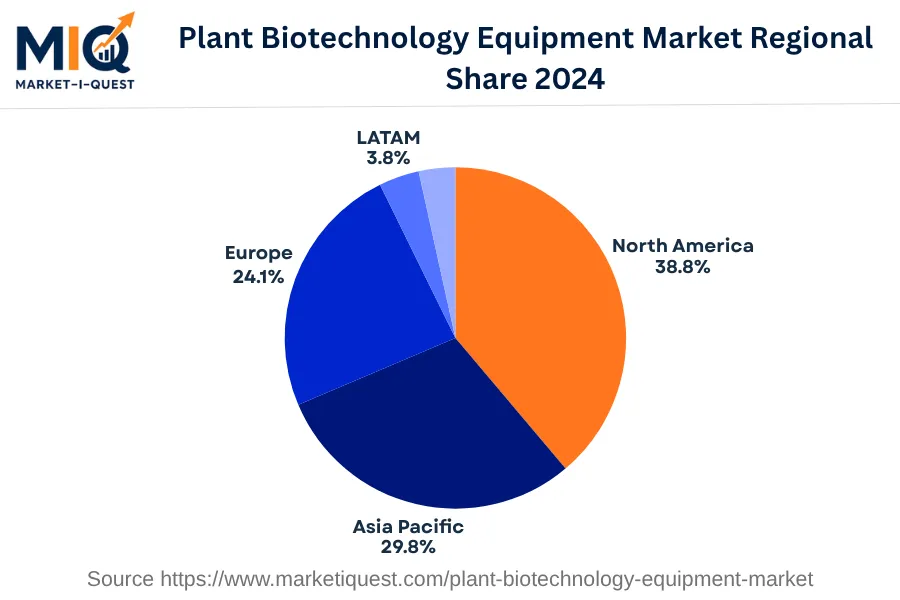
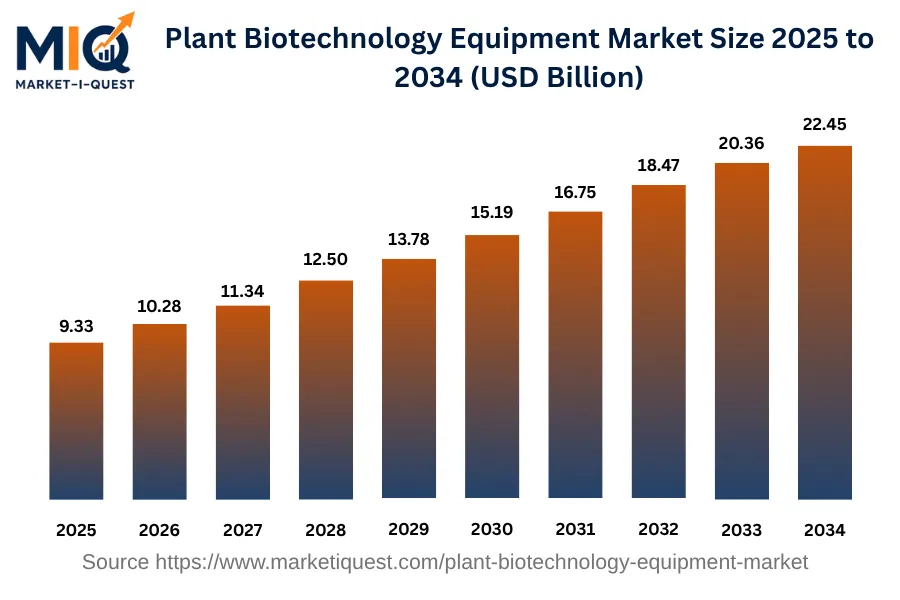
The Plant Biotechnology Equipment Market was valued at 9.33 billion USD in 2025 and is projected to reach 22.45 billion USD in 2034, expanding at a CAGR of 10.3%. The firm footing in 2025 was a substantial increase from its 2024 value of 8.46 billion USD. Growth trajectory spans from the established market presence in 2024, escalating year by year to the anticipated high in 2034 with contributing factors including an escalating rise in demand, an expansion of applications and adaptation into new sectors driving the consistent annual growth over the years. Regarding geographical spread, the regional shares in the market portfolio for the year 2024 were as follows: North America came on top with 38.8%, followed by Asia Pacific at 29.8%, Europe accounted for 24.1%, while LATAM and MEA held minor shares of 3.8% and 3.5% respectively. These figures underline the broad geographical distribution of the market across the globe.

Key Takeaways

  • By Product - DNA Sequencers in this market segment has the highest revenue in the base year 2024.
  • By application - Molecular Breeding was the dominant segment in 2024.
  • By End User - Biotechnology companies are the leading revenue generators in the market.
plant-biotechnology-equipment-market market size

Key Driving Factors

Surge in precision farming practices

Increasing operational efficiency in agriculture is a key aim of farmers globally. This is pushing the adoption of precision farming practices, which use plant biotechnology equipment to gather precise data about soil conditions, temperature, humidity, and plant health. Farmers seek these tools to make informed decisions about seeding, harvesting, and fertilizing. The precision farming approach optimizes use of resources, minimizes waste, and boosts overall crop yield. As agriculture continues to integrate technology for better productivity, the demand for plant biotechnology equipment vital to precision farming is anticipated to increase.

Initiatives supporting sustainable agriculture

Sustainable agriculture is a growing concern for governments and environmental organizations worldwide. This has led to several initiatives, such as the United Nations' Sustainable Development Goals, that encourage agricultural methods reducing environmental harm. These initiatives promote the use of plant biotechnology equipment, as it often allows for more sustainable, efficient farming methods. For instance, tools for genetic modification can help create farm crops resistant to pests, diseases, or harsh environmental conditions, reducing dependence on harmful pesticides and enhancing farm productivity in a sustainable manner. Consequently, the push for sustainable agriculture strongly drives the plant biotechnology equipment market.

Market Evolution by Timeline

2019-2023
During this period, dominant buyers in North America and Europe leveraged plant biotechnology equipment to accelerate development of disease-resistant crop varieties and biofuel production. The released products mainly featured simpler equipment suitable for small-scale laboratories. Supply technology largely hinged on integrated genetics and nanotechnology solutions. Regulatory influence came through guidelines like the Coordinated Framework for Regulation of Biotechnology in the U.S. and EU's GMO Directive, modifying demand and supply trends. In a largely supply-lead market, pricing steered towards premium models to cover advanced tech costs. Common deal structures favored long-term rental contracts mitigating high upfront costs. On the risks front, debates over GMO safety and ethical issues posed adoption barriers but were addressed via rigorous testing protocols.
2024
In 2024, the interest in precision agriculture expanded the buyer segment, specifically in the APAC region where China and India became noteworthy markets seeking to increase crop yield and address food security. Gene-editing technology like CRISPR gained prominence, feeding into mainstream equipment supply. AI integration began to mature, enabling operations like plant phenotyping. U.S. Bioengineered Food Disclosure Standard came into full implementation affecting product labeling and consumer acceptance. Pricing started reflecting value-based models factoring AI and gene-editing capabilities. Equipment leasing gained momentum as a preferred procurement model. However, low public awareness and acceptance of bio-engineered products remained a risk, tackled by transparent communication and public outreach programs.
2025-2029
This period saw a shift in customer base towards commercial growers as bio-technology innovations filtered down to mainstream markets, especially in water-scarce areas and regions with extreme weather patterns. Supply expanded to include environmental monitoring equipment, plant bioreactors, and automated tissue culture systems. AI and IoT became a standard part of equipment, facilitating data-driven farming practices. Regulatory standards like the United Nation's Nagoya Protocol influenced resource-sharing practices. Subscription-based pricing models emerged, unlocking affordability. Collaborations between tech providers and agricultural institutes were significant, aiding knowledge transfer. Risks included logistical complications tied to large-scale equipment deployment, typically addressed through localized manufacturing hubs.
2030-2034
The demand by 2030 was dominated by developing countries striving to adopt sustainable farming practices and tackle challenges like climate change and population growth. With genomics-optimized plant varieties, the supply saw a shift towards precision planting and harvesting tools. The International Treaty on Plant Genetic Resources influenced global sharing of plant genetic resources. Commercial models leaned towards bundled services integrating hardware, software, and consultation. Partnerships grew between biotech firms, equipment manufacturers, and farming cooperatives. Despite growth, issues like intellectual property rights concerning bioengineered plants and strains remained a critically debated risk factor dealt with via international trade agreements.

Future Market Outlook

Future Opportunities

The future of the plant biotechnology equipment market is strongly influenced by current trends in sustainability and regulatory frameworks. As the global focus on sustainable agriculture intensifies, evidenced by initiatives such as the European Union's Farm to Fork Strategy unveiled in 2020, the demand for efficient biotechnological tools is likely to increase. This aligns with partnerships between seed companies like Bayer and biotech firms aimed at developing sustainable crop varieties using advanced equipment. The ongoing evolution of consumer preferences toward non-GMO products has sparked interest in precision agriculture technologies, particularly within North America. As highlighted by the USDA's focus on enhancing food security through biotechnological advancements, potential opportunities for growth are emerging in the development of novel crops resistant to pests and environmental stresses. Furthermore, the increasing integration of artificial intelligence into plant biotechnology, as demonstrated by collaborations between Syngenta and tech firms in 2022, offers significant future potential for optimizing plant breeding processes and enhancing decision-making. Countries like India are actively pursuing biotechnology policies, such as the National Biotechnology Development Strategy launched in 2021, facilitating an environment conducive to investment and innovation. As these trends converge, the plant biotechnology equipment market is positioned to advance rapidly, with opportunities arising from enhanced consumer awareness, supportive policies, and technological collaboration on the horizon.

Segmentation Analysis

By Product

The market is divided into subsegments including DNA Sequencers, PCR Equipment, Bioreactors, Microscopes, and Others. The DNA Sequencers accounted for the largest revenue share while the Bioreactors subsegment is expected to grow at the fastest CAGR during the forecast period.

Largest Revenue Share

DNA Sequencers

Market Share Leader

DNA Sequencers forms the subsegment in this market segment that has the highest revenue in the base year 2024. This is largely because of the advancements in genomics which have led to a surge in the demand for DNA sequencing, thus driving the revenue for DNA sequencers. Businesses, researchers, and clinical practices are increasingly adopting DNA sequencing technologies for precision medicine, diagnoses, and personalized treatments making DNA sequencers indispensable in the healthcare sector. Additionally, the entry of numerous new products and brands has also created a favorable market scenario. There is a surge in demand for DNA Sequencers from geographies with advanced healthcare infrastructure and promisingly growing genomics research landscape. Moreover, the government's encouraging regulations facilitating the growth of genomics research coupled with the favorable funding scenario are contributing to the robust revenue stream for this subsegment.

Fastest CAGR

Bioreactors

Forecast Period Growth Leader

The Bioreactors subsegment is expected to witness the fastest CAGR during the forecast period. Bioreactors are increasingly being adopted in the biopharmaceutical industry for the production of biologics, vaccines, and other therapeutic proteins. The growth of the bioreactors market is driven by the shift towards personalized medicine and cellular therapies, which requires bioreactors for production at both clinical and commercial scales. Moreover, strategic partnerships and capital investments by key market players are also catalyzing this growth. However, the high upfront capital expenditure for bioreactors is the primary adoption barrier. The increasing willingness among pharmaceutical and biotechnological companies to invest in bioprocessing equipment, particularly bioreactors, is a promising trend that could overcome this barrier. Near-term risks include regulatory uncertainties and changing guidelines for the production of biologics.

By Application

The Application market is divided into subsegments including Genetic Engineering, Plant Tissue Culture, Molecular Breeding and Others. Of these, Molecular Breeding accounted for the largest revenue share while Genetic Engineering is expected to grow at the fastest CAGR during the forecast period.

Largest Revenue Share

Molecular Breeding

Market Share Leader

Molecular breeding continues to generate the most revenue in the application market, primarily due to the growing demand and high adoption rates in agriculture industries, especially in developing economies. Its popularity stems from its ability to create high-quality and disease-resistant plant varieties, significantly enhancing crop yields and reducing dependency on pesticides and fertilizers. This simultaneously lowers production costs and increases profit margins for farmers. The broad applicability of molecular breeding in diverse crop species and the emergence of advanced technologies in genome mapping and marker identification have also contributed to the revenue growth. Additionally, favorable government policies and funding toward agricultural development have reinforced industry growth. However, this segment's growth might be moderately impacted by complexity and high costs of breeding technologies, which could slow down market penetration in certain regions with lower income levels.

Fastest CAGR

Genetic Engineering

Forecast Period Growth Leader

Expected to show the fastest growth is Genetic Engineering, driven by emerging applications in sectors like agriculture, medicine, and industrial biotechnology. Recent advancements in technology such as CRISPR/Cas9 have facilitated precise edits to genomes, opening up novel possibilities for genetic manipulation. This is catalyzing the interest and investment in genetic engineering. However, adoption faces barriers such as ethical concerns, regulatory complexities, and public perceptions about genetic modifications. These factors could impede the pace of growth in some markets. Developing technologies should also be alert to potential barriers: overemphasis on rapid innovation could risk compromising safety measures, which could lead to serious backlash or even regulatory sanctions. Conversely, strategic partnerships with academia and increased capital expenditure on R&D could help tackle these hurdles and fuel further expansion in the next few years.

By End User

The end user market is segmented into Research Institutes, Biotechnology Companies, Academic Institutions, and Others, with Biotechnology Companies holding the most significant revenue share while Academic Institutions is expected to grow at the fastest rate during the forecast period.

Largest Revenue Share

Biotechnology Companies

Market Share Leader

Biotechnology companies are the leading revenue generators in this segment chiefly because of their diverse operations and widespread application areas. Biotech companies invest heavily in research and development of new products, and the fruits of these investments translate to their substantial revenue shares. Demand for such products tends to be high, thanks to their innovation-driven approach that frequently introduces new, regulated offerings to the world markets. Additionally, these companies work throughout the product lifecycle, from early-stage development to commercial sale, thus ensuring the inflow of funds at every stage. Their global presence, given that they work across multiple geographic markets, also contributes to their high revenue. Collaborations and partnerships with other entities in the healthcare ecosystem further bolster their financial performance.

Fastest CAGR

Academic Institutions

Forecast Period Growth Leader

Academic institutions are projected to grow at the fastest rate among end users. This subsegment growth is fueled several key factors. First, the increasing interest in innovative research in biotechnology and related fields at universities and research organizations accelerates growth. This is especially significant given the surge in funding for such research initiatives. Secondly, collaborations between academic institutions and companies in the form of academic-industry partnerships are becoming more commonplace. This often results in the transfer of technology from research facilities to industries, fostering an environment conducive to the growth of the sector. Finally, increased government support in the form of grants and subsidies to these institutions contributes to the increase in their growth rate, but near-term policy changes could pose some risk.

Competitive Analysis

Key Market Players

Manufacturers / OEMs

Thermo Fisher Scientific Inc.
US
Promega Corporation
US
Agilent Technologies, Inc.
US

Key Suppliers & Raw Materials

Sigma-Aldrich Co. LLC
US
Roche Diagnostics Corporation
Switzerland
QIAGEN N.V.
Germany

Distributors, Integrators & Channel Partners

Bio-Rad Laboratories, Inc.
US
Beckman Coulter, Inc.
US
Becton, Dickinson and Company
US

Porter’s Five Forces Analysis

This analysis reflects the competitive dynamics in the Plant Biotechnology Equipment Market.

Supplier Bargaining Power

Medium

Hardware suppliers can exert influence, but market has multiple sources for raw materials.

Buyer Bargaining Power

Low

Limited players, high switching costs, and technological complexities reduce buyers' negotiation power.

Threat of Substitutes

Medium

Existing traditional farming methods can limit demand, but increasing biotech adoption trends mitigate this.

Threat of New Entrants

Low

High entry barriers due to significant technological expertise, patents, and regulatory compliance requirements.

Competitive Rivalry

High

Intense between established firms, driven by technology advancements, price, and global reach.

Regional Analysis

Geographic market dynamics and growth opportunities across key regions

Global Market Outlook

plant-biotechnology-equipment-market market regional share

North America

In the base year, 2024, North America experienced an appreciable growth in the Plant Biotechnology Equipment Market.
This was driven by increased demand for improved yield in agricultural produce, particularly in the U.S and Canada, which saw a substantial investment in the latest plant biotech equipment. Simultaneously, regulations favoring improved crop quality, especially in Mexico, created a supportive environment for market expansion. Major advancements in technology and its adoption by the farming community also generated increased interest in the market.

The year marked significant trends in the market. A shift towards precision agriculture in the U.S saw technology-laden equipment playing a central role in farming practices. Multinational corporations engaged in strategic partnerships and conducted M&As to increase their market presence, significantly affecting the market dynamic. Policy enforcement in Canada led to an increased focus on sustainable farming practices thereby favoring the use of plant biotechnology equipment. Key sectors that significantly channeled resources into this market included the government, primarily in Mexico, and large-scale farming enterprises across North America. The drive for higher productivity and improved crop quality propelled the burgeoning growth of the Plant Biotechnology Equipment Market in 2024.

Asia Pacific

In 2024, the Plant Biotechnology Equipment Market in the Asia Pacific region displayed a significant upsurge. Among the drivers were increased investments in the biotech sector by both government and private entities, notably in China and India. Regulatory changes promoting biotech adoption in Japan and South Korea also spurred market growth. Furthermore, advancements in plant biotechnology equipment, coupled with competitive pricing strategies, considerably impacted supply dynamics across the region.

Various trends shaped the market landscape during this period. In China and key ASEAN markets, consumer preference shifted towards genetically modified crops, influencing buying behaviors and product development. Technological evolution, such as CRISPR technology, was increasingly adopted in countries like Australia, revolutionizing the plant biotech sector. Distribution channels expanded too, with a rising prominence of e-commerce platforms in India and South Korea. Additionally, strategic partnerships and mergers among biotech companies were a prevalent trend in Japan. The primary sectors involved in the application of this market included agricultural enterprises, healthcare, manufacturing industries, and government bodies. For instance, healthcare in Australia leveraged plant biotech equipment for medicinal plant development. Simultaneously, governmental bodies across the area, particularly in China and India, employed such equipment for developing climate-resilient crops, contributing to food security and sustainable agriculture.

Europe

In 2024, Europe's Plant Biotechnology Equipment Market registered a substantial growth. The drivers for this uptick include increased investment in biotechnology across the region, particularly from Germany and the United Kingdom. The industries leading the charge comprise healthcare and agriculture, as they adopted plant biotech equipment to improve their products and processes. Moreover, benign government regulations–spearheaded by the likes of France and Italy–fostered a conducive environment for market growth with Italy even implementing tax incentives for biotechnological advancements. Demand was also bolstered by a proliferation of local suppliers offering competitive pricing, notably in Central and Eastern Europe.

The market exhibited several distinct trends. There was a noticeable shift towards genetically engineered seeds by agri-businesses, specifically in Spain and Benelux. This was due to their increased yield and disease resistance. Additionally, buyer behavior changed with a preferential lean toward smart farming equipment, primarily in the Nordics, as it helped increase technical efficiency across operations. Partnerships and Mergers & Acquisitions activities were also prominent, enabling market consolidation. For example, certain UK companies acquired Nordic counterparts to secure their position in the market. Moreover, the market's evolution was colored by strict policy enforcement, with European Union ensuring an ethical and responsible adoption of plant biotechnological developments.

Latin America

In 2024, the Plant Biotechnology Equipment market in Latin America was succinctly influenced by targeted technological advances, enabling regulations, and expanding investment scope. High global demand and adoption of genetically modified crops, particularly in Brazil and Mexico, fueled the market growth. A favorable regulatory landscape, seen in Argentina's pro-biotechnology policies, supercharged new developments. Furthermore, the burgeoning investment spirit marked by Chile's heavy investment in agritech research and development further drove the market.

Shifts in buyer behavior toward eco-friendly and innovative farming methods were significant trends in the region, with Colombia's agricultural sector leading the way. Furthermore, technologies such as CRISPR, tissue culture, and DNA sequencing emerged as key facilitators of innovation within the industry. The market witnessed strategic alliances and mergers, notably between tech giants and agricultural entities in Peru, emphasizing shared technology and product development. On the policy front, stringent quality control norms and an insistence on better standards were enforced across the region, underpinning these trends. The market's primary beneficiaries in the base year included agriculture-driven enterprises, government bodies, utilities, and research institutions. However, the healthcare and retail sectors also demonstrated interest in plant biotechnologies due to their potential for pharmaceutical applications and sustainable product offerings.

Middle East & Africa

In 2024, the Plant Biotechnology Equipment market in the Middle East and Africa garnered significant attention due to rapid technological adoption and favorable policy environment. Chief market drivers included increased investment in biotechnology research, particularly in nations such as Saudi Arabia, UAE, and Israel, along with robust policies encouraging technological advancement in the plant biotechnology sector. The growing demand for genetically modified crops in order to ensure food security in countries such as Kenya, Nigeria, and South Africa further propelled the market.
A major trend was the growing public-private partnerships in biotechnology research, exemplified by collaborations between academic institutions and corporations. The Middle Eastern oil-rich nations were increasingly diverting their resources towards alternative sectors, with plant biotechnology being a primary focus. Adoption of advanced technologies such as genetic engineering and tissue culturing by farmers was also observed, especially in Egypt and South Africa.

Further, governments' efforts to enforce stringent regulations to manage genetically modified organisms led to an increased demand for high-quality plant biotechnology equipment. For instance, Israel's Plant Breeders’ Rights Law and South Africa’s GMO Act directly influenced the market trajectory. The increased trend among end-user sectors such as agri-business corporations, research institutions, and government agencies towards integrating advanced plant biotechnology equipment in their operations added a significant thrust to the market in the base year.

Recent Industry Developments

Latest market innovations, product launches, and strategic initiatives

May 2026

Hudson River Biotechnology and Pairwise signed a licensing agreement giving Hudson River access to the Fulcrum® plant gene editing platform, which will be integrated into its editing services for crop improvement customers working in vegetable, soft fruit, and other species.

January 2026

The Plant Biotechnology Equipment Market was valued at USD 15.90 billion in 2025 and is projected to grow to USD 17.91 billion in 2026, with a CAGR of 12.84%, reaching USD 37.05 billion by 2032.

Frequently Asked Questions