Pharmaceutical Drug Delivery Market Snapshot

Key Players

  • Pfizer Inc. (United States)
  • Johnson & Johnson (United States)
  • Becton
  • Dickinson and Company (United States)
  • Novartis AG (Switzerland)
  • AstraZeneca plc (United Kingdom)
  • Sanofi S.A. (France)
  • Gerresheimer AG (Germany)
  • 3M Company (United States)
  • Sun Pharmaceutical Industries Ltd. (India)
  • Ypsomed Holding AG (Switzerland)

Market Size

Base Year 2024
$ 1465.82 Bn
CAGR
4.7%
Forecast 2034
$ 2324.75 Bn

Market Segments

By Route of Administration
  • Oral
  • Ocular
  • Pulmonary
  • Nasal
  • Injectable
  • Topical
  • Others
By Application
  • Cardiovascular
  • Diabetes
  • Cancer
  • Infectious Diseases
  • Others
By End User
  • Hospitals
  • Ambulatory Services
  • Home Healthcare

Market Dynamics

Drivers
  • Growing chronic disease prevalence
  • Rising demand for self-administration
Restraints
  • Stringent regulatory compliance requirements
  • High development and manufacturing costs
Opportunities
  • Biologic therapeutics demand surge
  • Advanced transdermal delivery systems

Market Size

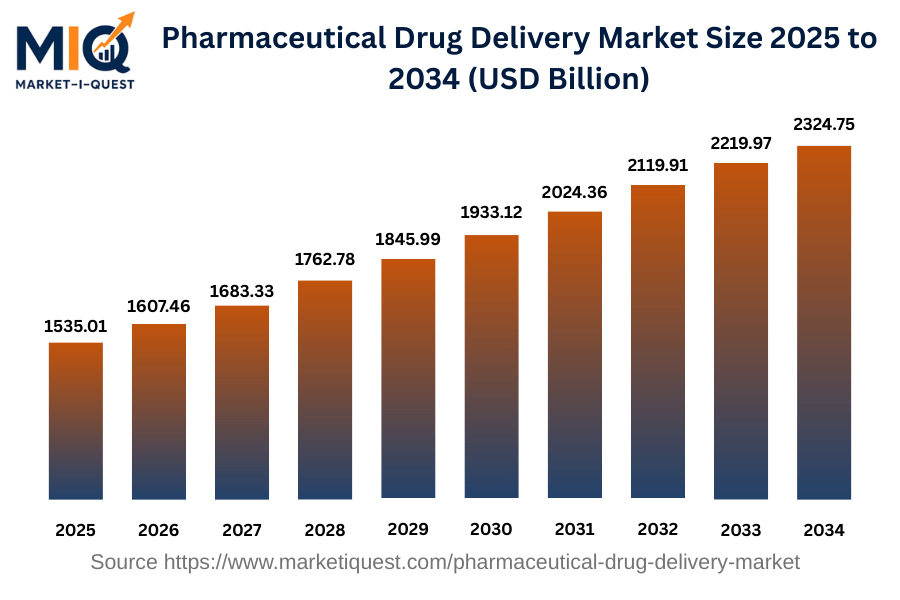
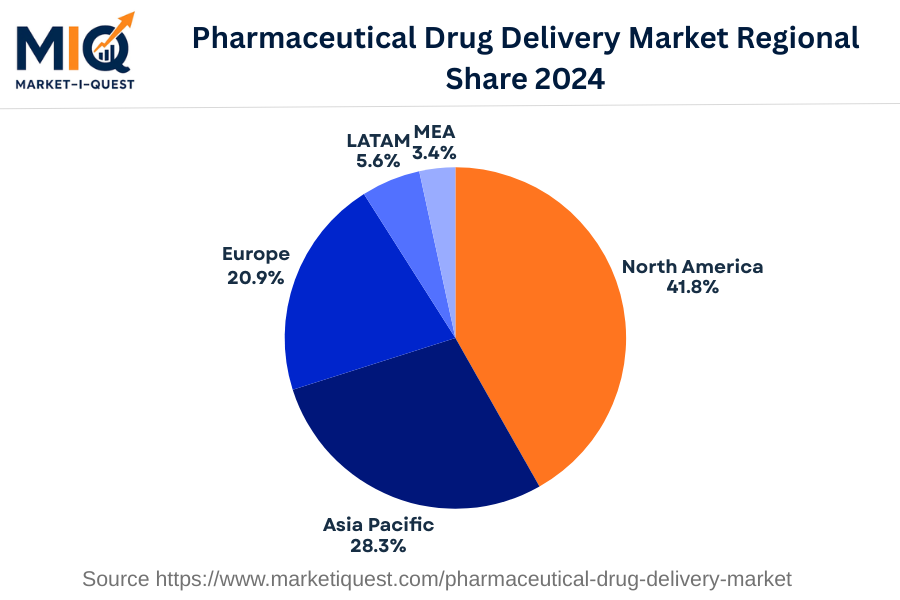
The Pharmaceutical Drug Delivery Market size is projected at USD 1,535.01 billion in 2025, increasing to approximately USD 2,324.75 billion by 2034, with a CAGR of 4.7%. The market starts at USD 1,465.82 billion in 2024 and shows consistent growth, reflecting a steady demand for advanced drug delivery systems. The increase is attributed to ongoing innovations in drug formulation and delivery mechanisms, along with a rising global population that requires effective medication solutions. In 2024, the regional share mix is distributed as follows: North America at 41.8%, Asia Pacific at 28.3%, Europe at 20.9%, LATAM at 5.6%, and MEA at 3.4%.

Key Takeaways

  • By Route of Administration - Injectable led the market accounting for a significant share in 2024.
  • By Application - Cancer held a notable position as the leading category in 2024.
  • By End User - Hospitals dominated the market representing the largest segment in 2024.
pharmaceutical-drug-delivery-market market size

Key Driving Factors

Evolution of Patient-Centered Treatments

Pharmaceutical drug delivery systems have recently taken a realistic turn towards patient centered treatment. An increased interest in personalized medicines has significantly pushed the boundary of conventional drug delivery systems and led to the development of unique patient driven approaches. This factor is driving the pharmaceutical drug delivery market growth because personalized drug delivery systems can ensure whether the given dose is suitable or not, improving the efficiency of the treatment and reducing potential side effects. This not only enhances patient compliance but also provides a emerging market opportunities for pharmaceutical companies to develop their segmentation in a highly competitive market.

Prevalence of Chronic Diseases

The high urgency in addressing the increasing dominance of chronic diseases such as diabetes and cancer is driving the pharmaceutical drug delivery market demand. The need for efficient drug delivery solutions for chronic diseases is essential to provide a significant positive impact on patient outcomes. These conditions often require routine and structured drug administration, and any efficiency enhancing modifications in drug delivery can significantly improve a patient's well-being. Hence, pharmaceutical companies see a rising demand for innovative drug delivery technologies that would deliver drugs more efficiently to the chronic disease affected spots in the human body. Thus, there is increasing shift towards escalation in research and developments in this market.

Market Evolution by Timeline

2019-2023
Between the period 2019 and 2023, a significant growth was experienced by the drug delivery market in pharmaceutical industry driven by the increasing frequency of chronic diseases such as diabetes and cancer. In North America within the period from 2019-2023 the pharmaceutical drug delivery market accounted for focused market share with major emphasis on Injectable drug delivery innovations. Key players introduced innovative insulin delivery systems also gained popularity among hospitals and doctors mainly countries like in the US and Canada. The industry saw the emerging collaborations within pharmaceutical companies and biotechnology firms for enhancing the efficiency of drug delivery systems. Such agreements were in form of sharing revenue. Pharmaceutical drug delivery companies in Europe followed to diverse pricing structures depending on complexity and enhancement of the drugs. Pricing was higher for drugs with enhance delivery systems. The European Medicines Agency introduced guidelines for regulating drug delivery technologies. Regulations and lack in consistent reimbursement landscape caused challenges. Hospitals and clinics encountered challenges in adopting new drug delivery systems into existing practices.
2024
In 2024, the market began to see a shift towards personalization of medicine, with customized drug delivery systems emerging as steadily preferred. The trend was prominent in regions like Asia-Pacific, where countries such as Japan and South Korea invested in R&D for smart delivery systems. With introduction to FDA and the Real-World Evidence program, promoting the use of patient data to establish delivery systems. Pharmaceutical manufacturing providers gained importance, leading to growth in outsourcing among pharmaceutical companies. Pricing models shifted towards result driven contracts, based on treatment effectiveness rather than the volume of products sold. Regulatory analysis increased as authorities, requirement for more transparency in delivery mechanisms, mainly with biologics. Supply chain barriers, driven by geopolitical tensions, causing threat to production timelines. Companies adjusted according the diversification of supplier bases and investments in inventory management systems to reduce these risks.
2025-2029
The period from 2025 to 2029 indicated a phase of growth for advanced drug delivery technologies, also in gene therapy and nanomedicine. North America dominated the market, where emerging economies like Brazil and India will start adopting these technologies as well. The FDA's acceleration of designation for innovative drug delivery systems encouraged rapid development and distribution. Companies considered partnerships more than traditional pharmaceutical players, including collaborations with technological organization for the integration of Artificial Intelligence in drug delivery guidelines. Models based on subscription will emerge, enabling patients to receive medications with integrated delivery systems at a fixed cost. Regulation with the International Organization for guidelines within the standard will become essential, approach for product validation will be affected. Advancements, concerns regarding patient privacy in relation to data usage in smart delivery systems created a need for reliable data security measures. Supply chain sustainability will become essential focus while companies are trying to reduce the environmental impact.
2030-2034
From 2030 to 2034, the pharmaceutical drug delivery market will be likely to evolve significantly, priotizing patient-related models. By this time, the market will likely see regulatory frameworks from the World Health Organization being designed to regulate global practices within drug delivery. In Europe, the demand for biodegradable drug delivery systems is likely to be increased aligning with EU sustainability directives. There will be certain growth in the use of digital tools for real-time monitoring the performance of drug, allowing for adjustable dosing protocols. Pricing strategies are expected to drive towards models based on outcomes, increasing effectiveness for real world over traditional fixed pricing. Partnerships with healthcare providers might become essential to boost accessibility and education surrounded by new drug delivery technologies. Risks may arise for maintaining data integrity within digital ecosystems, with increasing potential for data breaches essential requirement for companies to strengthen their cybersecurity protocols. Market segmentation may occur, necessitating solid competitive analysis with new competitors might emerge with innovative solutions.

Future Market Outlook

Future Opportunities

The pharmaceutical drug delivery market is in position to explore number of future market opportunities, due to the recent advancements in several fields such as therapeutics and technology. Recently, collaboration between Novartis and Microsoft established in 2023 is aiming in the integration of artificial intelligence with drug delivery systems for optimizing processes of treatment. The growing focus on biologics such as monoclonal antibodies for presentation of substantial experimental approaches. Especially in regions like North America and Europe where regulatory frameworks are accelerating approvals for such products. Sustenance is growing as focus in organizations like GSK who are contributing towards environment friendly drug packaging solutions introduced in 2022. Creating various opportunities in market for new delivery models that are much sustainable. In Asia Pacific regions various markets are rising and witnessed increasing investment in healthcare sector. Driving market demand for advanced drug delivery processes personalized for wide range populations. Partnerships between leading tech firms and pharmaceutical firms. In 2023 a collaboration of Pfizer with 3D Systems for the production of 3D-printed drug dosages. Highlights the growth in customization of therapies in complex healthcare environments. Regulatory trends favoring acceleration in opportunities for innovative drug delivery technologies reflecting to market dynamics to likely lead in increasing collaboration opportunities.

Segmentation Analysis

The pharmaceutical drug delivery market is segmented by Route of Administration (Oral, Ocular, Pulmonary, Nasal, Injectable, Topical, Others), by Application (Cardiovascular, Diabetes, Cancer, Infectious Diseases, Others), and by End User (Hospitals, Ambulatory Services, Home Healthcare).The pharmaceutical drug delivery market is segmented by Route of Administration (Oral, Ocular, Pulmonary, Nasal, Injectable, Topical, Others), by Application (Cardiovascular, Diabetes, Cancer, Infectious Diseases, Others), and by End User (Hospitals, Ambulatory Services, Home Healthcare).

By Route of Administration

The market is divided into subsegments including Oral, Ocular, Pulmonary, Nasal, Injectable, Topical, and Others. Injectable accounted for the largest revenue share while Pulmonary is expected to grow at the fastest CAGR during the forecast period.

Largest Revenue Share

Injectable

Market Share Leader

Injectables dominates the market due to their favourable rate of absorption and effective delivery of medications direct circulation within the body. Key drivers includes a wide range of therapeutic applications especially in chronic disease management and the preference among healthcare professionals for increased precision in dosing. North America leads the segment driven by advanced healthcare systems and high frequency rates of treatments for conditions with injectables. Regulatory agencies has been accelerating approvals for formulation of innovative injectable, promoting new competitors in the market. The growing shift toward injectables self-administration is boosting market growth significantly. In treatment programs patients are increasingly seeking convenience and autonomy. By the efficiency and delivery speed the purchasing criteria is heightened. Thereby making it convenient for both providers and patients with low switching costs. Moreover for the improvement in forming stability and options for needle less administration various collaboration between pharmaceutical and tech firms are arising.

Fastest CAGR

Pulmonary

Forecast Period Growth Leader

With increasing frequency of respiratory diseases including developments in drug delivery technologies are the key drivers for positioning Pulmonary as rapid growing segment. Diseases such as Asthma and COPD are mainly driving demand for efficient inhalation devices that can deliver medications directly to the affected areas with ensuring faster relief and enhanced compliance. Key growth drivers includes various technological innovations such as smart inhalers that provides features such as reminders for dosage and tracking usage aiming to improve patient adherence. With, favorable policy shifts aiming for increasing healthcare contribution in this growth. Various adoption barriers like lack of education and awareness in patients and complexities within the delivery systems, could be the key factors for restricting widespread of acceptance. For addressing these barriers various partnerships between pharmaceutical firms and healthcare organizations are focused on effective strategies such as education and accessibility. In the near term, risks include fluctuations in regulatory systems and several pressures in competition from alternative drug delivery methods, which might be a key influencer for growth trajectories in this segment. With, continuous frequency of investment in research and development, combined with a patient-focused healthcare solutions, indicates a promising outlook for pulmonary drug delivery systems.

By Application

The market is divided into subsegments including Cardiovascular, Diabetes, Cancer, Infectious Diseases, and Others. The Cancer subsegment accounted for the largest revenue share while the Diabetes subsegment is expected to grow at the fastest CAGR during the forecast period.

Largest Revenue Share

Cancer

Market Share Leader

The Cancer subsegment leads in revenue due to the increasing frequency of cancer globally, demanding for advanced diagnostics and therapeutics. Rising aging population is the major drivers this population is more affected to various forms of cancer and developments in oncology research leading to more effective treatments. North America and Europe dominates the market regionally due to their reliable healthcare infrastructure and with numerous pharmaceutical companies investing extensively in cancer research and drug development increasing the dominance in the segment. Regulatory factors also favor this segment, with governments increasingly prioritizing cancer treatment with various grants and incentives for innovative therapies. Purchasing criteria in this segment is often dependent on efficiency, safety, and regulatory approvals of treatments. Leading healthcare providers often prefer the high-quality and proven solutions regardless their higher prices. In comparison to higher switching costs related with established therapies as well contributing in a stable revenue, as healthcare professionals and patients are unlikely to shift to newer and yet to be proven treatments without substantial evidence.

Fastest CAGR

Diabetes

Forecast Period Growth Leader

The Diabetes subsegment is estimated to experience the fastest growth. Driven by the global rise in obesity and sedentary lifestyles while significantly increases the frequency in diabetes. Key drivers for growth include technological advancements with solutions for diabetes management, such as continue monitoring for glucose and insulin delivery systems, while enhancing patient compliance and results. Collaboration between various tech firms and healthcare organization with increased services and improved access towards innovative solutions. Various adoption barriers including advanced equipment with higher cost and also lack in reimbursement policies within certain region which can prevent usage in widespread. Policy changes and increasing public health initiatives are significant focused on preventive medicine may serve as a drivers for overcoming these barriers. Risks include various regulatory difficulties for new devices and therapies with potentially delay entry in the market and also limiting potential growth as well. Stakeholders may have to address various crucial challenges aiming to capitalize on this growing segment as the demand as the acceleration continues for the demand for effective diabetes management solution.

By End User

The market is divided into subsegments including Hospitals, Ambulatory Services, and Home Healthcare. Hospitals accounted for the largest revenue share while Home Healthcare is expected to grow at the fastest CAGR during the forecast period.

Largest Revenue Share

Hospitals

Market Share Leader

Hospitals subsegment is positioned as the largest revenue share mainly due to role in providing complete healthcare services including several services including emergency care, surgical procedures, and critical care. Hospitals are equipped with advanced medical technologies and specialized staffing professionals in healthcare. Such broad capability attracts a wide patient base, leading to significant revenue production and higher patient volumes. Hospitals benefits from various revenue streams, including inpatient admissions, outpatient services, and diagnostic procedures. Various regulatory support, including reimbursement policies for various treatments, also enables hospitals in stabilization of revenue flows. Hospitals in developed regions often lead, due to their access to various advanced infrastructures and larger patient populations. Hospitals are adapting to trends such as value-based care, for encouraging efficient and cost-effective patient management, for driving their revenue further. The shift for integration in healthcare through various mergers and acquisitions creating larger bodies more efficient for negotiating contracts with suppliers and payers with a better approach ultimately enhancing profitability. As patient needs to evolve, even hospitals are strategically investing in technology and facilities, ensuring sustained demand and keeping them at the leading position of the healthcare market.

Fastest CAGR

Home Healthcare

Forecast Period Growth Leader

Home Healthcare is positioned for the fastest growth due to several factors. Aging population is a key driver as more individuals require ongoing medical care, home healthcare provides a cost-effective and patient-preferred substitute to conventional facility-based care. Advancements in digital healthcare technologies have further accelerated adoption, making it easier for patients to receive services and comfort of their homes. Regulatory shifts that highlights the patient outcomes are promoting growth as well, as increasing payers are recognizing the effectiveness of home-based care with improving quality and reducing costs. Major challenges such as ensuring the quality of care and managing a distributed workforce can be a potential barriers in the growth. With initial investments in technology and training can be significant, long-term savings are projected to dominate these initial costs. Strategic partnerships with technology firms and healthcare providers can enhance capacity and growth potential, enabling more comprehensive service offerings. Various risks, including potential policy changes could impact reimbursement models, may cause several challenges. However, the demand for home healthcare remains a significant demand driven by consumer preferences and healthcare policies focused on decentralized care models.

Competitive Analysis

Key Market Players

The pharmaceutical drug delivery industry is competitive, with a mix of large established companies and smaller regional players. Most companies focus on improving their products/services, keeping prices attractive, and strengthening relationships with key customers. They also use partnerships, acquisitions, and new launches to expand their presence in existing and new markets. Overall, players compete on quality, reliability, and value, and competition is expected to remain strong over the forecast period.

Manufacturers / OEMs

Johnson & Johnson
US
Baxter International
US
Roche Holding AG
Switzerland

Key Suppliers & Raw Materials

3M Company
US
BASF SE
Germany
Amgen Inc.
US

Distributors, Integrators & Channel Partners

Thermo Fisher Scientific
US
McKesson Corporation
US
Cardinal Health Inc.
US

Porter’s Five Forces Analysis

This analysis evaluates the competitive dynamics within the Pharmaceutical Drug Delivery Market. It highlights the forces shaping market competition and profitability.

Supplier Bargaining Power

Medium

Suppliers hold moderate power due to the specialized nature of raw materials and technology.

Buyer Bargaining Power

High

Buyers leverage high bargaining power through volume purchases and demand for cost-effective solutions.

Threat of Substitutes

Medium

Moderate threat from alternative therapies and advanced drug delivery systems that can disrupt traditional methods.

Threat of New Entrants

Low

High barriers to entry exist due to regulatory requirements and substantial capital investment.

Competitive Rivalry

High

Intense competition driven by innovation, pricing pressures, and a diverse array of established players.

Regional Analysis

Geographic market dynamics and growth opportunities across key regions

Global Market Outlook

pharmaceutical-drug-delivery-market market regional share

North America

In 2024, the Pharmaceutical Drug Delivery Market in North America is defined by various innovation and evolving healthcare by the behaviour of market. The increasing demand in personalization of medicines remains one of the key driver for the investment in advanced drug delivery systems with allowing more precise treatments. Various regulatory frameworks such as the FDA's review procedures for advanced therapies. Whereas, quick access for new drugs to patients is also promoting market growth. The rising frequency of chronic diseases in various countries such as U.S., Canada, and Mexico is demanding the development in effective delivery procedures, improving patient adherence and outcomes.

A noticeable shift in trends is seen towards patient-preferred drug delivery systems, with healthcare organization increasingly favoring various self-administrative devices, such as prefilled syringes and inhalers. As the partnerships between pharmaceutical companies and technological firms are increasing, innovations with IoT integration like smart delivery devices are becoming frequent. Price demands from government bodies and private payers are driving the cost-effective solutions, influencing manufacturers to adopt more efficient production processes. Policy enforcement regarding drug safety and efficiency standards shape product development, ensuring compliance with health regulations across the region. These factors together outline the landscape of the Pharmaceutical Drug Delivery Market in North America.

Trends are evident in the shift towards patient-centric drug delivery systems, with healthcare providers increasingly favoring devices that allow self-administration, such as prefilled syringes and inhalers. As partnerships between pharmaceutical companies and technology firms intensify, innovations like smart delivery devices integrating IoT are becoming commonplace. Price pressures from government entities and private payers are pushing for cost-effective solutions, influencing manufacturers to adopt more efficient production processes. Furthermore, policy enforcement regarding drug safety and efficacy standards shapes product development, ensuring compliance with health regulations across the region. These factors collectively outline the landscape of the Pharmaceutical Drug Delivery Market in North America for the year 2024.

Asia Pacific

In 2024, the Pharmaceutical Drug Delivery Market in the Asia Pacific region is marked by a significantly increased in driving demand for advanced drug delivery systems. The rising frequency of chronic diseases in aging population is driving the growth rate, majorly in regions like China and India due to the frequent needs for healthcare. Regulatory support is noticeable in countries like Japan with frequent increase in adoption of several policies is encouraging the innovative drug delivery technologies, India is promoting local manufacturing with several initiatives like Make in India. Increasing investments in biotechnology and pharmaceutical research is boosting the technology adoption across the region with enhancing drug delivery efficiency.

Market trends are indicating a shift towards patient-preferred delivery systems as healthcare providers focus on personalized medicine for the improvement in adherence and results. The emerging digital health technologies are influencing buyer behaviour and the patients are increasingly preferring connected devices to monitor medication intake. Growing partnerships among pharmaceutical companies and technology firms are aiming for integration of new delivery methods such as nanoformulations and microneedles. Various market dynamics are shaped by several stringent regulatory standards regarding product efficacy and safety with requirement for compliance from both established and emerging players.

Trends within the market indicate a shift towards patient-centric delivery systems, as healthcare providers focus on personalized medicine to improve adherence and outcomes. The emergence of digital health technologies influences buyer behavior, with patients increasingly seeking connected devices that monitor medication intake. Partnerships and mergers among pharmaceutical companies and technology firms are rising, aimed at integrating new delivery methods such as nanoformulations and microneedles. Moreover, stringent regulatory standards regarding product efficacy and safety shape market dynamics, requiring compliance from both established and emerging players. Overall, the interplay of these drivers and trends reinforces a robust landscape for pharmaceutical drug delivery in the Asia Pacific region.

Europe

In 2024, the Pharmaceutical Drug Delivery Market in Europe is defined by a growing demand for innovative delivery systems driven by various advancements in biotechnology and with increasing frequency of chronic diseases. Regulatory support from agencies such as the European Medicines Agency has been contributing in encouragement for developing more efficient drug delivery methods. With increased investment in personalization medicine and for enhancing outcomes of patient the companies are constantly focusing on tailored drug formulations. The rise of injectable biologics has made a demand for improvements in delivery systems with pushing manufacturers to adopt more advanced technologies.

Trends include a shift toward patient-preferred delivery systems indicating change in behaviour of buyer and patients increasingly seeking for easier and more effective options for medication adherence. Noticeable increase is seen in strategic partnerships and mergers within the industry with more collaborations within companies for combining technological resources and expanding their reach within the market. The evolution in distribution channels of e-pharmacies are gaining prominence in various countries with offering convenient access of medications to patients and driving the demand for integration in logistics solutions. Regulatory frameworks have become more stringent and with convincing manufacturers to meet with higher standards with concern for safety and efficacy in drug delivery systems across Germany, the UK, France, Italy, Spain, the Nordics, Benelux, and Central & Eastern Europe.

Trends include a shift toward patient-centric delivery systems, reflecting changing buyer behavior as patients increasingly seek easier and more effective options for medication adherence. There is a notable increase in strategic partnerships and mergers within the industry, as companies collaborate to combine technological resources and expand their market reach. Furthermore, distribution channels are evolving; e-pharmacies are gaining prominence in many countries, offering patients convenient access to medications and driving the need for seamless logistics solutions. Regulatory frameworks are becoming more stringent, compelling manufacturers to comply with higher standards concerning safety and efficacy in drug delivery systems across Germany, the UK, France, Italy, Spain, the Nordics, Benelux, and Central & Eastern Europe.
Latin America

In 2024, the Pharmaceutical Drug Delivery Market in Latin America is defined by an increasing dependence on advanced technologies and regulatory frameworks for enhancing access of healthcare and outcomes of patient. Key drivers include increase in demand for biologics and biosimilars causing by rise in frequency of chronic diseases, notably in Brazil and Mexico. Various regulatory support represented by the adoption of the ANVISA guidelines for optimization of drug approval processes, boosting the market entry for innovative delivery systems. Government incentive have fueled the research and development in Argentina and Colombia while the adoption of digital health solutions is helping to reshape delivery methods across the region.

Trends are indicating that healthcare providers are favoring personalization of medicine, leading to increased interest in targeted drug delivery systems in Chile and Peru. Rising collaborations between pharmaceutical companies and technology firms are enabling advancements in formulation of drug and delivery technologies. The emerging telehealth platforms are influencing customer behaviour with reshaping the interactions between patient-physician with expansion in access to pharmaceutical products. With increasing enforcing policies by local government for mandating compliance within international standards for enhancing the safety and efficacy in drug delivery by impacting supply chains and market dynamics across LATAM.

Trends indicate that healthcare providers are favoring personalized medicine, leading to heightened interest in targeted drug delivery systems in Chile and Peru. Collaboration between pharmaceutical companies and technology firms is on the rise, facilitating advancements in drug formulation and delivery technologies. The emergence of telehealth platforms is influencing customer behavior, reshaping patient-physician interactions and expanding access to pharmaceutical products. Additionally, local governments are increasingly enforcing policies that mandate compliance with international standards to enhance safety and efficacy in drug delivery, impacting supply chains and market dynamics across LATAM. As a result, the pharmaceutical sector is adapting to meet evolving healthcare demands and regulatory expectations.

Middle East & Africa

In 2024, the Pharmaceutical Drug Delivery Market in the Middle East and Africa is defined by rapid growth in drug administration technologies with increasing frequency of chronic diseases. Several primary drivers include a growing demand for innovative drug delivery systems due to rising needs in healthcare majorly in countries like Saudi Arabia and South Africa, with improving healthcare infrastructure. Regulatory support such as enhanced processes for approval by the Gulf Cooperation Council is fueling market growth by enabling access of faster market for novel delivery methods. With increased foreign direct investment in healthcare technology is leading to local pharmaceutical companies to adopt advanced delivery systems.

Various key trends including a shift towards personalization of medicine, majorly in countries like UAE and Israel with integration of biotechnology into processes of drug formulation. The rise of e-pharmacies is adjusting buyer behaviour, particularly in urban patients favoring online prescriptions and medicines, particularly in urban areas. The frequency is significantly increasing in collaborations between pharmaceutical companies and tech startups, with aiming to develop innovative delivery methods that enhance patient adherence. Several governments across the region are constantly prioritizing the improvements in healthcare, as an indication by Egypt's National Health Insurance Law, aiming at improving drug access and efficient deliveries.

Key trends include a shift towards personalized medicine, particularly in the UAE and Israel, where biotechnology is integrated into drug formulation processes. The rise of e-pharmacies is altering buyer behavior, with patients favoring online prescriptions and medicines, particularly in urban areas. Collaborations between pharmaceutical companies and tech startups are becoming more prevalent, aimed at developing innovative delivery methods that enhance patient adherence. Furthermore, governments across the region are prioritizing healthcare reforms, as demonstrated by Egypt's National Health Insurance Law, aimed at improving drug access and delivery efficiencies. These factors collectively shape the evolving landscape of the pharmaceutical drug delivery market in the region.

Recent Industry Developments

Latest market innovations, product launches, and strategic initiatives

July 2025

Eli Lilly closed its $1 billion (up to $1.3 billion milestone) acquisition of Verve Therapeutics, adding in vivo gene editing programs like VERVE-102 for cardiovascular disease, which utilize advanced nanoparticle delivery systems for precise PCSK9 targeting.

March 2025

Argenx received FDA approval for VYVGART Hytrulo, a subcutaneous formulation of efgartigimod using hyaluronidase adjuvant technology for large‑volume delivery in generalized myasthenia gravis, marking a breakthrough in high‑volume subcutaneous drug delivery.

January 2025

The FDA’s Center for Drug Evaluation and Research approved 46 novel drugs in 2025, many featuring advanced delivery systems like nanoparticles, sustained‑release implants, and targeted injectables to improve bioavailability and patient adherence.

Frequently Asked Questions