
Patient Temperature Monitoring Market Snapshot

Key Players

  • 3M Company (US)
  • Koninklijke Philips N.V. (Netherlands)
  • Dragerwerk AG & Co. KGaA (Germany)
  • Cosinuss GmbH (Germany)
  • Cardinal Health Inc (US)
  • Becton Dickinson and Company (US)
  • Terumo Corporation (Japan)
  • American Diagnostic Corporation (US)
  • Hill-Rom Holdings Inc. (US)
  • Medtronic plc (Ireland)

Market Size

Base Year 2024
$2.61 Bn
CAGR
6.91%
Forecast 2034
$5.09 Bn

Market Segments

By Product Type
  • Forehead Thermometers
  • In-Ear Thermometers
  • Oral Thermometers
  • Rectal Thermometers
By Technology
  • Digital Thermometers
  • Infrared Thermometers
  • Disposable Thermometers
  • Electronic Thermometers
By End User
  • Hospitals
  • Home Care Settings
  • Ambulatory Surgical Centers (ASCs)

Market Dynamics

Drivers
  • Rising prevalence of infectious diseases
  • Increasing demand for continuous monitoring
Restraints
  • High device costs
  • Regulatory challenges
Opportunities
  • Technological Advancements in Monitoring Devices
  • Increase in Geriatric Population

Market Size

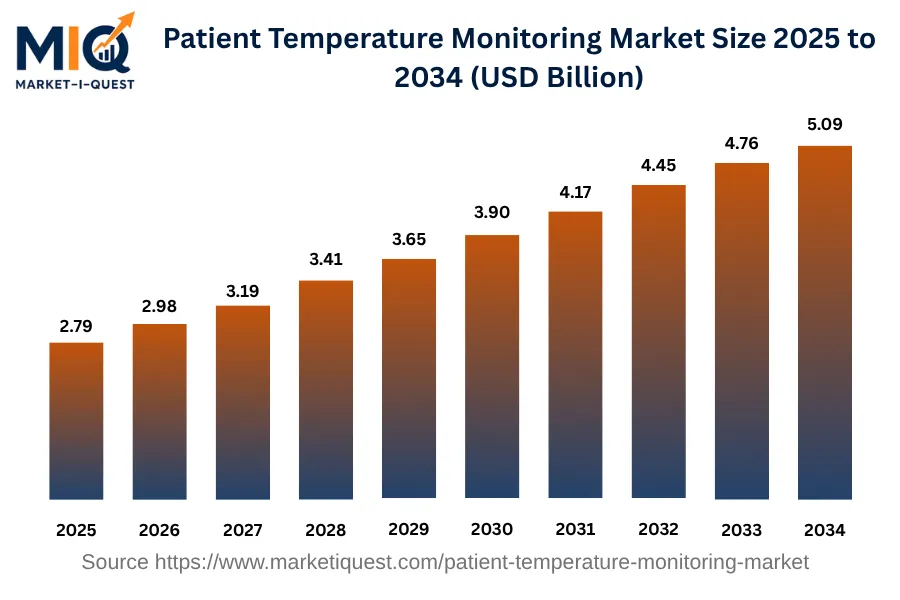
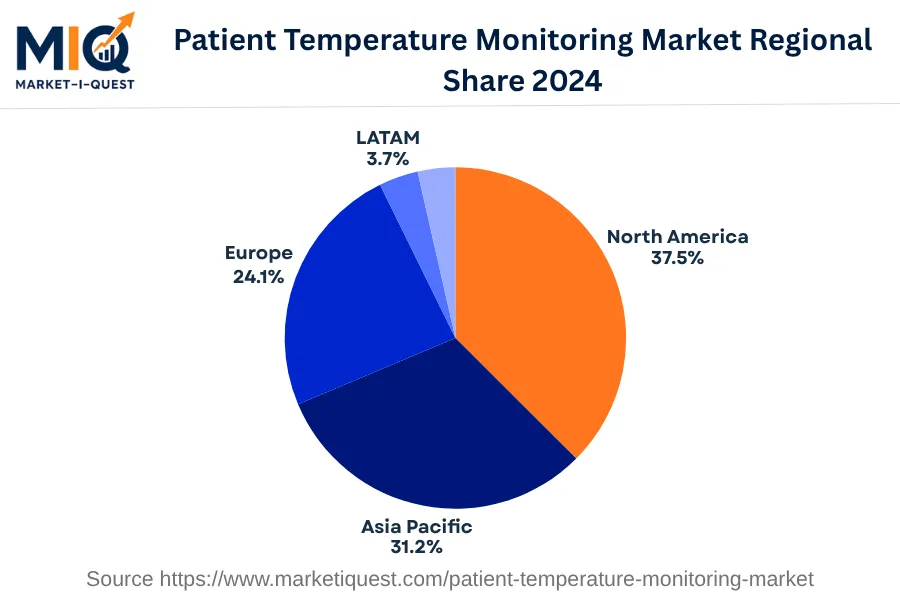
The Patient Temperature Monitoring Market size was valued at 2.79 billion USD in 2025 and is expected to grow to 5.09 billion USD by 2034, exhibiting a CAGR of 6.91%. This upsurge from a valuation of 2.61 billion USD in 2024 to the 2034 market size reflects a constant increase over the decade. The driving factor for this market advancement is the sustained rise in the demand for accurate patient temperature monitoring. Fragments of growth can be traced throughout this period, underpinning a steady growth chart. Meanwhile, regional market shares in 2024 were distributed as follows: North America held 37.4%, Asia Pacific accounted for 31.2%, Europe occupied 24.1%, LATAM made up 3.7%, and MEA contributed the remaining 3.6%. These shares indicate the market concentration during this growth phase, with North America leading the pack.

Key Takeaways

  • By Product Type - Oral Thermometers held a prominent position accounting for the highest market share.
  • By Technology - Digital Thermometers expanded rapidly with the fastest growth rate during the last fiscal year.
  • By End User - Hospitals were the leading segment accounting for the majority of the market share.
patient-temperature-monitoring-market market size

Key Driving Factors

Adoption of Telemedicine amid Concerns Over Cross-Infections

The upsurge in the onset of healthcare-associated infections places an emphasis on maintaining sterility in healthcare settings. This has highlighted the need for remote patient monitoring devices, which reduce physical contact and subsequent risk of cross-infection among hospital patients. Notably, the risk multiplies in the case of temperature monitoring as it traditionally requires close contact. Amidst the COVID-19 pandemic, this concern has been further magnified. To reduce these risks, healthcare providers are increasingly adopting telemedicine practices that rely heavily on remote patient monitoring technologies, including temperature monitoring systems. As such, concerns over cross-infection in healthcare premises are gaining traction as a leading driving factor for the Patient Temperature Monitoring Market.
Strict Regulatory Compliance for Patient Safety

The Patient Temperature Monitoring Market is significantly influenced by stringent regulatory requirements aiming to ensure patient safety. Institutions such as the US Food and Drug Administration (FDA) and the European Medicines Agency (EMA) enforce rigorous regulations on manufacturers of patient temperature monitoring devices. These regulations require devices to be highly accurate, safe, and reliable. For instance, FDA's Title 21 of the Code of Federal Regulations (CFR) Part 820 lays down Quality System Regulations that manufacturers must comply with. Such technicalities ensure the production and distribution of superior quality temperature monitoring devices and spur growth in the market.

Market Evolution by Timeline

2019-2023
In this period, hospitals and clinics were key buyers of patient temperature monitors, primarily attributed to high transmission rates of several fever-related diseases and regulatory standards like the International Patient Safety Goals (IPSG). North America, Europe, and Asia-Pacfic regions noticed heightened demand due to their sophisticated healthcare infrastructure. Technology development brought disposable probe covers and infrared-based systems to curb cross-infection risks. Wearable technology was adopted, but integration issues with existing systems were often a hindrance. Standardisation with ISO 80601-2-56:2017 was widespread to ensure safety and effectiveness. Fixed pricing model was common, with hospitals engaging in long-term contracts due to recurrent needs. A significant risk was inaccurate readings due to device limitations, tackled using methodical validation processes.
2024
This year was notable for the rise in at-home patient temperature monitoring due to the global health crisis. The US and China were at the forefront of high demand. Rapid delivery infrastructures ensured supply chain fluidity, shipping advanced monitors with contactless measurement technologies like ear canal sensors and forehead thermometer strips. These devices followed the ASTM E1965-98(2016) standard, solidifying user confidence. Predictive pricing models were established due to sudden demand surge, leading to contracts with shorter turnaround periods. Device shortage was a significant risk during this period, managed by pre-order mechanisms and order volume restrictions.
2025-2029
In this period, demand poured from corporate premises and elderly care homes. Countries like India, UK, and Brazil were leading in terms of growth. The supply of smart temperature monitors that integrated with mobile apps and IoT devices were more pronounced, notwithstanding the existing interoperability concerns. Voluntary standardisation with EN ISO 80601-2-56:2017 marked technological maturity. Partnerships between healthcare tech companies and software providers were noticed for application-enabled devices offering personalised alerts. Per-use or subscription-based pricing model was common due to the convenience, flexibility, and variability of use. Risk of data privacy and security breaches became imminent; consequently, investments in cybersecurity increased.
2030-2034
By this period, solutions shifted towards embedded systems in smart homes and vehicles. Middle East and African regions showed uplifting demand due to the digitisation of healthcare and growing awareness. Advanced AI-based and self-calibrating temperature monitoring systems saw an increase in supply. Common adherence to standards like IEC 80601-2-59:2017 demonstrated product reliability. Rather than standalone purchases, bundled services involving not just monitors, but complete health tracking solutions, became frequent. Risk-based pricing made headway, considering the diverse applications and specific requirements. Issues of device lifespan and compatibility with rapidly evolving digital ecosystems became significant, handled through periodic software updates and upgrades.

Future Market Outlook

Future Opportunities

The future of the patient temperature monitoring market presents numerous opportunities as the demand for effective health management continues to rise globally. Increased recognition of preventive healthcare, especially post-2020, has prompted healthcare providers in the United States to actively seek technologies that facilitate remote monitoring. Partnerships between technology firms and healthcare institutions, such as the collaboration between Abbott and the Mayo Clinic, are exemplifying how integrated systems can enhance patient outcomes and streamline workflow. Continuous advancements in telemedicine infrastructure are also encouraging hospitals in regions like Asia-Pacific to adopt temperature monitoring solutions that integrate seamlessly with existing platforms. The aging population across countries such as Japan and Italy further underscores the need for efficient remote monitoring systems capable of tracking vital signs, including temperature, to manage chronic conditions. With ongoing research from organizations like the World Health Organization emphasizing the importance of early detection in disease management, there is a growing focus on developing predictive analytics tools. Startups specializing in healthtech, like Kinsa Health, are working on innovative temperature monitoring solutions that leverage real-time data to provide actionable insights. Moreover, regulatory efforts, such as the FDA's ongoing updates to digital health guidance, signify a favorable environment for companies innovating in this sector, thus paving the way for enhanced patient care models globally.

Segmentation Analysis

By Product Type

The market is divided into subsegments including Forehead Thermometers, In-Ear Thermometers, Oral Thermometers, and Rectal Thermometers. Oral Thermometers accounted for the largest revenue share while Forehead Thermometers are expected to grow at the fastest CAGR during the forecast period.

Largest Revenue Share

Oral Thermometers

Market Share Leader

Oral Thermometers hold the largest market share primarily because of their widespread use in various atmospheres. These devices are indispensable in homes, clinics, and hospitals, which keep the demand steady. Their elevated use can be attributed to their simplicity and affordability. It does not require a high skill level to use an oral thermometer, making it the preferred choice in most settings. Given the ongoing scenario, it's reasonable to assume the increased usage in homes has surged due to the Covid-19 pandemic. An oral thermometer's ease of use, combined with its ability to provide relatively accurate readings, has made it a stalwart amongst its counterparts. Moreover, the convenience with which it can be located in local pharmacies and online platforms drives the high market share of this segment. Lastly, historical dependence and established trust add to the reason why this subsegment leads today.

Fastest CAGR

Forehead Thermometers

Forecast Period Growth Leader

Despite not leading in terms of revenue, Forehead Thermometers are projected to register the fastest growth in the coming years. This can be attributed to an array of factors. Firstly, the improved technological aspect of these thermometers facilitates a seamless, non-intrusive approach to taking temperature readings, thus increasing their popularity among parents, caregivers, and healthcare professionals. Moreover, the ongoing Covid-19 pandemic has further cemented the need for non-contact temperature measurement devices in public places like malls, airports, and offices to limit the spread of the virus. Regulation, in this case, has served as a driver, prompting businesses to invest in such devices. However, barriers to adoption might exist in terms of higher cost when compared to traditional thermometers. Potential near-term risks present in this market segment include market saturation and tech obsolescence. Yet the overall market trend for forehead thermometers remains positive, driven primarily by enhanced user comfort and rapid technological advancements.

By Technology

The market is divided into subsegments including Digital Thermometers, Infrared Thermometers, Disposable Thermometers, and Electronic Thermometers. The Infrared Thermometers accounted for the largest revenue share while Digital Thermometers are expected to grow at the fastest CAGR during the forecast period.

Largest Revenue Share

Infrared Thermometers

Market Share Leader

Infrared thermometers are leading the way in terms of revenue, backed by their rising adoption across various sectors. These thermometers are crucial for various industrial applications for temperature measurement, gaining significantly from safety advantages, as they can measure temperature from a distance. The non-contact form of measurement reduces the risks of contamination, making them the ideal choice in the medical field especially during the flu and pandemic seasons. In addition to the healthcare sector, they are also essential in food service and production, where temperature control is vital for safety. The automotive and manufacturing industries are also significant consumers of this technology for temperature monitoring of machine parts. Moreover, regulations stipulating compulsory temperature checks in different settings have also been instrumental in driving the demand for these thermometers. Geographically, advanced economies with better healthcare infrastructure and industries are the significant purchasers of these thermometers.

Fastest CAGR

Digital Thermometers

Forecast Period Growth Leader

Digital thermometers are projected to be the fastest-growing subsegment in the forecast period. The growth trajectory of this subsegment is powered by its cost-effectiveness and ease of use. The accuracy is another major catalyst further driving its adoption. These factors have encouraged households to keep these thermometers at home for regular health checks and monitoring. Additionally, technology improvements such as smartphone integration are expected to further boost the adoption rates, making digital thermometers even more convenient to use. However, potential near-term risks could be import-export regulations and supply chain disruptions caused by unforeseen events. Partnerships with healthcare and tech companies could be a winning strategy for thermometer manufacturers to reach various markets and customers. Potential barriers to adoption could be related to customer perception of traditional mercury thermometers and lack of awareness about technological advancements.

By End User

The market is divided into subsegments including hospitals, home care settings, and ambulatory surgical centers. Based on the base year of 2024, hospitals accounted for the largest revenue share while home care settings are expected to grow at the fastest CAGR during the forecast period.

Largest Revenue Share

Hospitals

Market Share Leader

Hospitals, as a subsegment, lead the market in revenues primarily due to the extensive procedures, treatments, and care services they provide. In many regions, hospitals are the primary points of healthcare access, making them critical to the reach and effectiveness of medical services. These facilities are generally well-resourced and have a wide range of healthcare equipment, thereby driving the demand for medical products and services. Also, hospitals often benefit from consistent funding from government and private entities, which bolsters their purchasing capabilities even further. Furthermore, the need for specialized and quality care services in hospitals often necessitates the use of advanced technologies and solutions, which also contributes to their large revenue generation. However, it is worth mentioning that while hospitals remain the leading segment, we clearly see shifts towards other care settings due to increasing focus on cost efficiencies, patient convenience, and advancements in home care technologies.

Fastest CAGR

Home Care Settings

Forecast Period Growth Leader

The subsegment with the fastest growth rate is expected to be home care settings. This accelerated growth is driven by a combination of demographic, economic, and technological factors. An aging population, coupled with an increasing preference for home-based care, especially in developed regions, is pushing the demand for home healthcare services. From a technological perspective, the advancements in remote patient monitoring facilities and telehealth solutions are making home care a viable option for many. Policies supporting home care services are another facilitating factor, given the potential for cost savings and improved patient satisfaction. However, home care settings also face challenges. These chiefly include the lack of trained healthcare professionals for home care and some reluctance from patients over technology adoptions. Addressing these barriers effectively could further speed up the growth of this subsegment.

Competitive Analysis

Key Market Players

Manufacturers / OEMs

3M
US
Cardinal Health
US
Drägerwerk
Germany

Key Suppliers & Raw Materials

Microchip Technology
US
Nissha Co.
Japan
Maxim Integrated
US

Distributors, Integrators & Channel Partners

Medline Industries
US
Thermo Fisher Scientific
US
Henry Schein
US

Porter’s Five Forces Analysis

The patient temperature monitoring market is impacted by various factors such as buyer power, supplier power, threat of new entrants, threat of substitutes, and competitive rivalry.

Supplier Bargaining Power

Low

Abundant suppliers and standardized products reduce supplier bargaining power.

Buyer Bargaining Power

High

Buyers, mainly healthcare institutions, have significant bargaining power due to multiple available choices.

Threat of Substitutes

Medium

Innovation in remote and home diagnostics poses medium threat of substitutes.

Threat of New Entrants

Low

Strict regulations and strong branding from existing players limit the entry of new competitors.

Competitive Rivalry

High

The market has intense competition due to the presence of several established international and local players.

Regional Analysis

Geographic market dynamics and growth opportunities across key regions

Global Market Outlook

patient-temperature-monitoring-market market regional share

North America

In 2024, the Patient Temperature Monitoring Market in North America showed substantial activity due to several driving factors and emerging trends. The increasing prevalence of infectious diseases necessitated the demand for continuous patient temperature monitoring. Technological advancements in the healthcare sector, such as telemedicine and remote patient monitoring, further drove this demand, particularly in the U.S. Regulatory actions, such as the FDA's compliance frameworks, encouraged industries to invest in reliable, high-performance temperature monitoring devices.

Simultaneously, clear market trends were observed. There was a shift towards non-invasive temperature monitoring devices due to their improved patient comfort and reduced risk of cross-infection. Digital solutions in healthcare gained traction, with increasing adoption of AI-driven predictive analytics for patient monitoring in Canada and Mexico. The market also witnessed partnerships between tech firms and healthcare providers to develop advanced temperature monitoring solutions, like wearable tech.

The primary sectors contributing to these developments were healthcare providers, both private and government-funded, along with tech firms specializing in digital health solutions. The retail sector also showed interest, with many pharmacies and supermarkets sourcing home-use temperature monitoring devices. The presence of abundant regulations, such as HIPAA in the U.S., ensured standardization and policy enforcement across all sectors. The year 2024, thus, marked significant growth and transformation in North America's Patient Temperature Monitoring Market.

Asia Pacific

In the base year 2024, the Patient Temperature Monitoring Market in the Asia Pacific exhibited significant changes propelled chiefly by evolving healthcare standards and increased technology adoption. Upsurges in infections and fever-related illnesses, especially in populous nations like China and India, enhanced demand for accurate and efficient patient monitoring systems. Besides, regulatory compliance to standardize healthcare procedures in Australia and Japan stimulated investments in advanced monitoring technologies.

A pronounced trend was seen in improved user-end experience, with buyers, mainly from hospitals and healthcare centers, showing preference for non-invasive and remote monitoring devices. The increased penetration of digital platforms and smartphone apps for healthcare services also influenced the market dynamics noticeably, specifically in South Korea and key ASEAN markets.

The major tech-shift witnessed was towards wearable and wireless devices, aimed at continual patient monitoring. We have also seen the strategy of partnerships and M&As, notably between device manufacturers and technology providers, emerging as an essential market trend. This approach aimed at advanced product innovation and expansion of product portfolio, especially in the mature markets of Japan and Australia. Also, strong policy enforcements and standard protocols like the 'Regulations on Supervision and Administration of Medical Devices' in China further shaped the market’s course in the base year.

Europe

In 2024, the Patient Temperature Monitoring Market in Europe presented a critical facet of the healthcare sector. Increased prevalence of infectious diseases, enhancements in technology, and numerous investments in healthcare infrastructures notably drove market growth. Regulatory agencies like the European Medicines Agency further facilitated market expansion by mandating temperature monitoring in healthcare institutions, paving an interest in technologically advanced equipment. As for supply dynamics, the market witnessed heightened competition and strategic pricing among prominent market players to secure a substantial market share.

Buyer behavior significantly swayed towards non-invasive temperature monitoring devices and wearable monitors, showcasing a paradigm shift in product preferences. In terms of channel dynamics, digital sales channels witnessed an upsurge as the pandemic urged a contact-free sales environment. The market saw collaboration among healthcare and tech companies to develop AI-powered temperature monitoring systems, precipitating a tangible impact on M&A activities. Furthermore, adherence to safety standards governed by the European Union was noticeably rigorous in the medical device sector, promoting the use of medically approved devices.

Key demand sectors included hospitals, clinics, and home care settings, seeking both preventive and diagnostic utility from temperature monitoring devices. Therefore, the 2024 Patient Temperature Monitoring Market was shaped and bolstered by numerous drivers and trends, with technological advancements and regulatory standards at the forefront.

Latin America

In 2024, the Patient Temperature Monitoring Market depicted a dynamic and accelerating landscape in Latin America, built on the rising demands for home healthcare solutions and increasing awareness of preventive care in countries like Brazil, Mexico, Argentina, Colombia, Chile, and Peru. The market was driven by a bolstering aging population accompanied by chronic illnesses demanding constant temperature monitoring. Expansion of healthcare infrastructure in these key regions further fueled the market, while technological advancements in digital databases enabled a seamless patient temperature monitoring experience, enhancing the overall market growth.

Moreover, the trend of remote patient monitoring owing to the constant need for social distancing served as a significant undercurrent. The rise of e-health services and telemedicine also defined the market trend, with healthcare providers and patients welcoming this digital transformation. Partnerships shaped the sector, as companies like Biofourmis and GTX Medical collaborated to offer advanced solutions in patient temperature monitoring.

The predominant customers were the healthcare sector, including hospitals, homecare settings, and outpatient clinics, influenced by the need for accurate, real-time monitoring of patients’ health status. The emergence of well-defined policy enforcement by LATAM’s healthcare regulation authorities also led to an increase in compliance, thereby positively shaping the patient temperature monitoring market in the region. Overall, the LATAM patient temperature monitoring market was characterized by the fusion of technological innovations and heightened healthcare demands.

Middle East & Africa

In 2024, the patient temperature monitoring market in the Middle East and Africa experienced dynamic growth due to crucial drivers and specific trends. Driving this market were advancements in technology adoption among healthcare providers , demand for non-invasive temperature monitoring solutions, and favorable government regulations, such as those in South Africa and Nigeria promoting telehealth. In Saudi Arabia and Qatar, increased government investment in healthcare infrastructure and digitalization significantly boosted market growth. Additionally, the expansion of retail pharmacies and online sales channels supplied thermometers and devices to a wider consumer base.

The trend of leveraging artificial intelligence for predictive analysis of patient data played a key role in the market. In contrast, the shifting preference of patients towards home care and self-monitoring, particularly in urban regions of UAE, Egypt, and Israel, changed conventional buyer behavior. Another significant market trend was the collaboration of healthcare enterprises with technology firms; for instance, innovative patient-monitoring systems are developed from partnerships within the telecom and healthcare sectors. The strict enforcement of quality standards and policies by health ministries across these regions also influenced product development and patient safety protocols. This growth trajectory strongly depicts the potential of effective temperature monitoring as a tool for early disease detection and better patient care solutions across these geographies.

Recent Industry Developments

Latest market innovations, product launches, and strategic initiatives

May 2026

HealthQuad completed a strategic investment in LifeSigns to support the expansion of its AI-powered remote patient monitoring platform across Southeast Asia and the Middle East, advancing continuous wireless vital sign and temperature tracking in outpatient and home settings.

April 2024

Koninklijke Philips N.V. entered into a strategic partnership with SmartQare to integrate the viQtor continuous wireless monitoring solution with Philips' clinical patient monitoring ecosystem, enabling automated multi-parameter vital signs and temperature tracking across European hospitals and home environments.

Frequently Asked Questions