
Patient Positioning Systems Market Snapshot

Key Players

  • Allen Medical Systems (United States)
  • C-RAD (Sweden)
  • Getinge AB (Sweden)
  • Innomedic GmbH (Germany)
  • Leoni AG (Germany)
  • Medifa-hesse GmbH & Co. KG (Germany)
  • Schaerer Medical AG (Switzerland)
  • Elekta AB (Sweden)
  • Stryker Corporation (United States)
  • STERIS plc (Ireland)

Market Size

Base Year 2024
$1.84 Bn
CAGR
6.48%
Forecast 2034
$3.45 Bn

Market Segments

By Product
  • Tables
  • Surgical Tables
  • Radiolucent Imaging Tables
  • Examination Tables
  • Accessories
  • Other Patient Positioning Systems
By Application
  • Surgeries
  • Disease Diagnosis
  • Cancer Therapy
By End User
  • Hospitals
  • Ambulatory Surgery Centers (ASCs)
  • Diagnostic Laboratories
  • Others

Market Dynamics

Drivers
  • Advancements in medical imaging
  • Aging population surge
Restraints
  • High equipment costs
  • Limited product awareness
Opportunities
  • Rising global population aging trend
  • Advancements in surgical procedures

Market Size

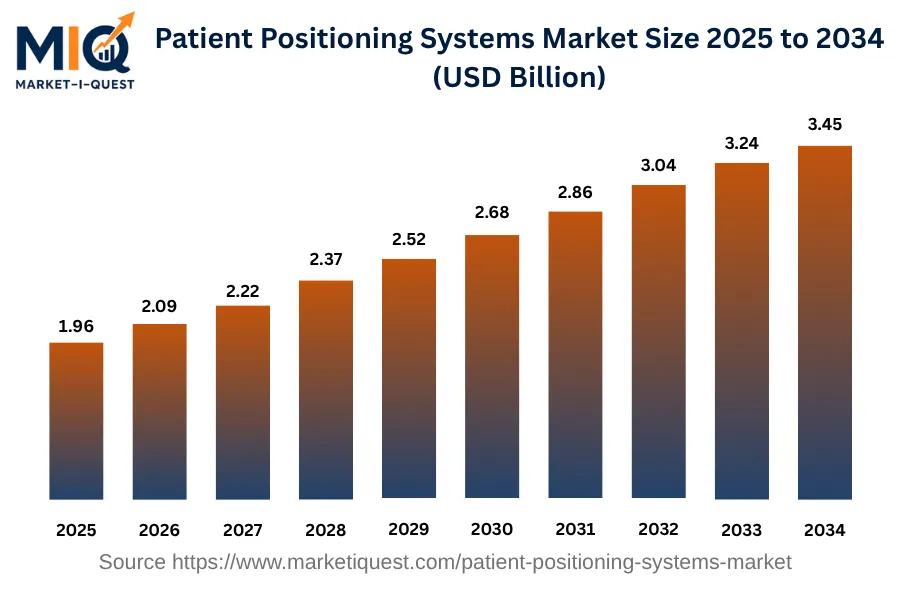
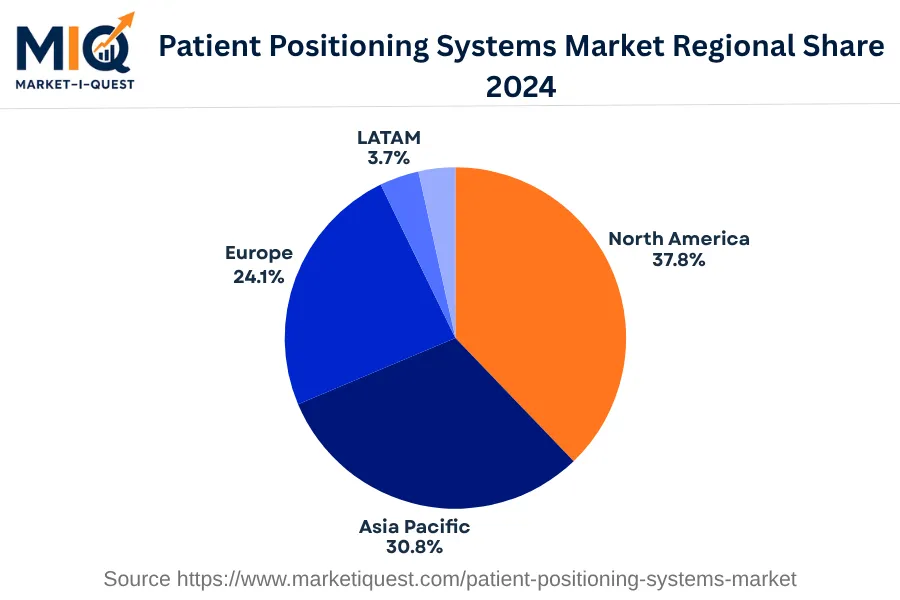
The Patient Positioning Systems Market value was 1.96 billion USD in 2025 and is projected to grow to 3.45 billion USD by 2034. This represents a CAGR of 6.5% over the period. This steady growth from 2024's market size of 1.84 billion USD reflects an increasing demand for patient positioning systems. The improvement in market value from 2024 to 2025 and continuing to 2034 suggests a consistent enhancement in the market's performance over the years. In terms of regional market distribution in 2024, North America held the largest share of the market at 37.8%, followed by the Asia Pacific at 30.8%, then Europe at 24.1%. The remaining market shares were held by Latin America (LATAM) at 3.7% and Middle East & Africa (MEA) at 3.5%, making them regions with minimal market shares in comparison.

Key Takeaways

  • By Product - Surgical Tables held a significant share commanding major attention in 2024.
  • By Application - Surgeries led the course with substantial contribution in 2024.
  • By End User - Hospitals held a paramount position accounting for the highest usage in 2024.
patient-positioning-systems-market market size

Key Driving Factors

Adoption of Minimal Invasive Surgeries

In recent times, there has been a steady increase in the adoption of minimal invasive surgeries, which rely heavily on the use of patient positioning systems. Precise positioning allows a surgeon to access the operating site without causing undue harm to surrounding tissues. As doctors and patients recognize the benefits of these procedures - lower risk of complications, faster recovery times, and shorter hospital stays - the demand for patient positioning systems has grown. Surgeons specializing in orthopedics, cardiology, and neurology, among others, are particularly reliant on these systems. With the aging population leading to a rise in chronic diseases that necessitate surgical interventions, the trend towards minimal invasive surgeries, and consequently, patient positioning systems, is projected to rise in the modern healthcare industry.
Stringency in Regulatory Norms and Standards

Government and healthcare regulatory bodies like the U.S. Food and Drug Administration (FDA) and the European Medicines Agency (EMA) are implementing stricter norms and safety standards related to medical procedures, which directly impact the patient positioning systems market. These standards govern the accuracy, safety, and efficacy of medical devices, including patient positioning systems. The stricter guidelines compel healthcare facilities to upgrade their existing equipment to conform to the updated criteria. Failure to comply with these regulations can result in hefty fines or even suspension of practice licenses, thereby exerting pressure on hospitals and clinics to invest in specialized patient positioning systems that meet the norms.

Market Evolution by Timeline

2019-2023
In North America and Europe, large hospital chains have been primary buyers, especially for treating patients with immobilization or limited mobility. During surgeries, they are often used as an anesthetic drug administration platform. Technological breakthroughs mark this period with companies like Mizuho OSI shipping hybrid operating tables integrated with patient positioning systems. However, delivery failure, due to defective components or assembly errors pose supply constraints. The implementation of EU MDR in 2020, setting higher regulatory standards impacted market dynamics in Europe. Cost-wise, customers prefer leasing models over capital purchases due to high upfront cost. Nevertheless, long term collaborations with manufacturers like Medline Industries, facilitated discounted deals for bulk purchases amidst tight funding environment.
2024
In 2024, Asia Pacific region witnessed an uptake, with India and China leading in purchases due to their growing healthcare infrastructure. The key technological shift was towards AI-enabled systems, like HoverMatt SPU, which automatically adjusts patient positioning. However, the novel technology faced integration issues with previously installed equipments, slowing its uptake. To regulate this, new standard IEC 60601-2-52:2024 was passed, specifically focusing on patient positioning systems. Subsequently, a price surge was observed following the standardization. Also, healthcare organizations began seeking multi-year service contracts, inclusive of maintenance and updates, to better manage the complex integrations. Power outage during surgeries surfaced as a key risk, prompting hospitals to seek backup power solutions.
2025-2029
Middle-East region emerged as a promising market, due to expansion of healthcare facilities in countries like Saudi Arabia. Electro-mechanical systems like the TransMotion TMM6 Surgical Stretcher-Chair gained popularity because of their precision. But, their high energy requirements proved a hindrance in economically weaker regions. Recognition of patient positioning as a separate category in ISO13485:2027, increased the regulatory scrutiny. Thus, manufacturers added 'compliance cost' as a line item in pricing calculations. Flexible Payment options became norm, providing ease to customers in economically challenging environments. Maintaining hygiene while using these systems posed a major challenge, leading to increased spending on reusable covers and disposable protective gears.
2030-2034
By 2030–34, South America had also joined the demand bandwagon, with medically advanced countries like Brazil and Argentina leading the front. Systems with IoT capability became popular as they allowed healthcare professionals to remotely adjust patient positioning. However, IoT integration required considerable IT infrastructure, causing slowdown in adoption. The introduction of 'Patient Care and Safety Act 2031' forced manufacturers to upgrade systems. This change placed upward pressure on prices but encouraged insurance tie-ups to enable patient affordability. Surprisingly, recurrent cyber threats were noticed with IoT enabled systems. Hence, cybersecurity services became part of the supply package.

Future Market Outlook

Future Opportunities

Current trends suggest numerous opportunities within the patient positioning systems market as healthcare systems adapt to demands for quality patient care. In 2023, partnerships between technology companies and healthcare providers are prevalent, such as the collaboration between Siemens Healthineers and local hospitals to develop tailored patient positioning solutions. Such partnerships are focused on enhancing workflow efficiencies while satisfying current regulatory requirements like ISO 13485:2016 for quality management in medical devices. The recent rise in telehealth services due to the pandemic, particularly in the United States, has accelerated the need for advanced patient positioning systems that support remote operation and monitoring. Companies like Philips have recognized this shift, investing in systems that optimize patient positioning for surgical procedures that may later require remote guidance. Moreover, the increasing prevalence of outpatient surgeries across Europe indicates a movement towards patient-centric care, creating demand for portable and user-friendly positioning systems. Additionally, ongoing clinical trials, particularly those related to robotic surgeries, highlight the necessity for innovative positioning solutions that improve accessibility and surgical accuracy. This landscape presents opportunities for the development of new products that can cater to various surgical specialties while maintaining compliance with regulatory standards. Thus, significant market shifts are anticipated as technological advancements continue to progress in alignment with healthcare industry trends.

Segmentation Analysis

By Product

The market is divided into subsegments including Tables, Surgical Tables, Radiolucent Imaging Tables, Examination Tables, Accessories, Other Patient Positioning Systems. Surgical Tables accounted for the largest revenue share while Radiolucent Imaging Tables are expected to grow at the fastest CAGR during the forecast period.

Largest Revenue Share

Surgical Tables

Market Share Leader

Surgical Tables have proved to be the leading revenue-generating subsegment in the current market. This can be attributed to the pivotal role that these tables play within operating rooms across health facilities worldwide. High demand is largely driven by their need in complex surgeries requiring precision and stability. The necessity for better patient positioning to ensure optimum surgical outcomes has led to constant demand, creating a sustained boost in revenues. Furthermore, advancements in surgical procedures and the complexity of operations undertaken require more specialized tables, enhancing their appeal, and escalating their prices. These products are not a 'one-size-fits-all' as different surgeries demand different tables, thus multiplying their demand. Their pivotal role in healthcare systems across developed and developing countries has solidified their prominent position. However, it's worth mentioning that a foreseeable challenge presents itself in form of the high costs and lack of skilled personnel, especially in resource-limited settings.

Fastest CAGR

Radiolucent Imaging Tables

Forecast Period Growth Leader

Radiolucent Imaging Tables are projected to grow at the fastest CAGR in the forecasted period. The primary drivers of this growth are the advancements in radiology imaging technologies, increasing demand in precise imaging procedures, and the rise in minimally invasive surgeries. With the advent of higher-resolution imaging modalities, the clarity and accuracy of diagnosis have improved tremendously, spurring the demand for radiolucent imaging tables. These tables allow for clear, unimpeded images, thereby reducing the chances of repeated exposure to radiation. Demand is also being fuelled by the trend towards minimally invasive surgeries which often rely on accurate imaging during procedure. Additionally, the expansion of healthcare infrastructure across the globe and the increase in healthcare spending, particularly in emerging economies are providing impetus to this growth. However, the high cost of these tables could potentially limit their adoption rate, especially in developing regions. But with collaborations and funding in healthcare, it's a barrier that's likely to be overcome.

By Application

In terms of application, the market is divided into subsegments including surgeries, disease diagnosis, and cancer therapy. In the base year of 2024, surgeries account for the largest revenue share, while cancer therapy holds the promise of the fastest CAGR during the forecast period.

Largest Revenue Share

Surgeries

Market Share Leader

The surgery subsegment dominates the market in terms of revenue generation. This is attributable to several factors majorly including the increasing prevalence of chronic diseases and conditions that require surgical interventions. Technological advancements in surgical procedures, such as the advent of minimally invasive surgeries and robotics-assisted surgeries, have significantly expanded the scope and volume of surgeries, contributing to its large revenue. Besides, the growing geriatric population, which is highly susceptible to various diseases needing surgeries further fuels the market. Geographically, developed regions with higher healthcare expenditures and access to advanced medical treatments account for a considerable share of this segment. On the supply side, increasing investments in healthcare facilities and surgical infrastructure has increased the number of surgeries conducted, driving the growth in revenue. Regulatory policies also support this by ensuring timely and affordable access to necessary surgical procedures.

Fastest CAGR

Cancer Therapy

Forecast Period Growth Leader

The cancer therapy subsegment is projected to grow at the fastest compound annual growth rate during the forecast period. This robust growth is driven primarily by the surging incidence of cancer globally and the continuous development of innovative and effective cancer treatment techniques. Enabling technologies such as targeted therapy, immunotherapy, and personalization of medicine have opened new horizons for cancer treatment, propelling the adoption rate. Yet, barriers to adoption include high treatment costs and lack of access in developing regions, posing short-term risks. However, governmental policies favoring healthcare access, health insurance coverage, and partnerships between pharmaceutical companies are providing the push for increased capital investment in cancer therapy. Furthermore, emerging trends such as combination therapies and advancements in gene therapy present promising growth avenues for this subsegment.

By End User

The market is divided into subsegments including Hospitals, Ambulatory Surgery Centers (ASCs), Diagnostic Laboratories, Others. The Hospitals subsegment accounted for the largest revenue share while Ambulatory Surgery Centers (ASCs) is expected to grow at the fastest CAGR during the forecast period.

Largest Revenue Share

Hospitals

Market Share Leader

Hospitals represent the subsegment with the highest revenue in the base year 2024. This is primarily driven by heavy dependence on the hospitals for a wide range of healthcare facilities ranging from regular consultations and treatments to crucial and advanced procedures. Hospitals, in general, house various departments and offer extensive services which make them the primary source for a diversified patient base. Consequently, they enjoy a larger share of customer footfall compared to other entities such as ASCs and Diagnostic Laboratories. Additionally, the regulatory framework and funding mechanisms often favor hospitals, particularly public ones, making them leading entities in terms of revenue generation. Key factors like the geographical presence of hospitals, emergent hospital infrastructure in developing regions, and the purchasing power of these establishments despite the high switching costs also contribute to their substantial market shares.

Fastest CAGR

Ambulatory Surgery Centers (ASCs)

Forecast Period Growth Leader

While hospitals generate the most revenue, Ambulatory Surgery Centers (ASCs) are projected to have the fastest CAGR during the forecast period. Key growth drivers include lower costs and increased convenience for patients, which are aiding in wider adoption of this model over traditional hospital settings for minor surgeries and treatments. The advancement in outpatient surgical technology has permitted more procedures to be done in ASCs, expanding their patient base. Policy reforms in several countries promoting ambulatory care models over in-patient hospital care are another significant catalyst accelerating the ASCs' growth. Notwithstanding, near-term risks include the initial capex required for setting up ASCs and a limited scope of treatments that can be offered. That said, partnerships with hospitals and healthcare chains might mitigate this issue and further propel the growth in this subsegment.

Competitive Analysis

Key Market Players

Manufacturers / OEMs

Getinge AB
Sweden
Hill-Rom Services Inc.
US
STERIS plc
Ireland

Key Suppliers & Raw Materials

Invacare Corporation
US
Anetic Aid
UK
Midmark Corporation
US

Distributors, Integrators & Channel Partners

Stryker
US
Medline Industries, Inc.
US
Koninklijke Philips N.V.
Netherlands

Porter’s Five Forces Analysis

Analysis of the competitive environment within the Patient Positioning Systems Market.

Supplier Bargaining Power

Medium

Supplier powers are moderate due to the requirement of specialised medical components.

Buyer Bargaining Power

High

The large number of healthcare facilities boosts buyer power.

Threat of Substitutes

Low

Unique product nature combined with regulatory constraints limit substitute availability.

Threat of New Entrants

Medium

High entry barriers due to regulatory requirements and advanced technology.

Competitive Rivalry

High

Intense competition among established healthcare equipment vendors.

Regional Analysis

Geographic market dynamics and growth opportunities across key regions

Global Market Outlook

patient-positioning-systems-market market regional share

North America

In 2024, the North American market for patient positioning systems showed substantial vitality. Key demand drivers have stemmed from escalating investments in healthcare infrastructure across the U.S., Canada, and Mexico, alongside the adoption of advanced technologies in imaging and surgical procedures. Regulatory requirements for patient safety and comfort during medical procedures also played a significant role in energizing this sector. Demand variability and pricing dynamics remained intricately linked to the supply of new, innovative products and investment in research and development.

The trend landscape in 2024 displayed an accelerating shift towards integrated and digital patient positioning systems in North American hospitals, surgical centers, and clinics. Increased emphasis on improving diagnostic accuracy and operational efficiency encouraged healthcare providers to adopt state-of-the-art systems. A noticeable trend was the proliferation of partnerships between medical device manufacturers and tech firms to enhance product designs and functionality. Standards and regulations in patient care and safety continued to enforce the adoption of high-quality patient positioning systems across the region. This market primarily served sectors like hospitals, ambulatory surgical centers, and diagnostic labs in the U.S., Mexico, and Canada. The adoption of innovative patient positioning solutions was particularly noticeable within the radiology and surgery departments due to their dependency on precise patient positioning.

Asia Pacific

In 2024, the Patient Positioning Systems Market in Asia Pacific was characterized by strong demand and technological adoption. Key drivers were the region's aging population, heightened healthcare investment, and advanced technology adoption. Aging demographics, particularly in China and Japan, led to increased demand for patient positioning systems. Additionally, India and key ASEAN markets experienced increased healthcare investment, stimulating market growth. Technological advancements in South Korea and Australia, most notably the adoption of automated patient positioning systems, further propelled the market.

The buying behavior in 2024 leaned towards technologically seamless and user-friendly systems, with healthcare providers in China and Japan prioritizing automated and precise positioning systems. Government policies enforced stricter standards on patient safety during surgical procedures in India and ASEAN markets, pushing for high-quality patient positioning systems. Channel dynamics saw a rise in online sales, with major market players leveraging e-commerce for sales. An evident trend in Australia and South Korea was the increased use of disposable patient positioning systems in the healthcare sector. The market witnessed significant partnerships and M&A activity, particularly in China and Japan, with local manufacturers seeking international expertise to advance product quality.

Europe

In 2024, Europe's Patient Positioning Systems Market shows notable growth momentum owing to several key drivers and emerging trends. Demand for these systems has increased significantly, primarily driven by the ageing population's increasing need for effective healthcare services. Technological innovations catering to specific patient needs, such as advanced features for patient comfort and safety, have spurred market growth. Enhanced healthcare investment across the region, specifically in countries like Germany, France and the United Kingdom, has acted as a catalyst, enabling providers to adopt these systems widely.

A notable trend in this market is the shift towards automated patient positioning systems, propelled by the integration of digital technology into healthcare operations across the region. Concurrently, growing emphasis on minimally invasive surgeries in countries like Italy, Spain and the Nordics has encouraged the use of precise positioning systems to improve surgical outcomes. Strategic partnerships and mergers among key players have further fueled this evolution. An increase in regulatory compliance, particularly in the Central & Eastern Europe and Benelux regions, enforces the application of high-quality patient positioning systems, thereby raising the industry standards. Product usage spans across healthcare sectors predominantly, including hospitals, clinics, and outpatient surgery centres.

Latin America

In the 2024 base year, the Patient Positioning Systems Market in Latin America (LATAM) demonstrated an observable growth trajectory. This growth is primarily driven by increasing healthcare investments, particularly noticeable in Brazil and Mexico, leading to the advance of medical infrastructure. New health regulations in Argentina and Colombia pushed for the adoption of high-precision positioning devices in surgical procedures, further stimulating market expansion. A rising geriatric population facing chronic ailments in these countries also increased the demand for patient positioning systems.

Change in this market was chiefly shaped by buyer behavior, primarily focused on technologically advanced and user-friendly platforms. Chile's shift towards digitization, noticed in its healthcare sector reform, encouraged significant technology adoption like AI-based positioning systems. Meanwhile, Mexico saw increased M&A activities in the healthcare tech space, influencing market dynamics. A newfound emphasis on patient's comfort and safety in Peru's health policies directed market trends towards models favoring ergonomics.

Predominantly, large healthcare establishments, like hospitals, have been the main consumers in this market across LATAM. However, growing government funding towards enhancing healthcare accessibility to rural and semi-urban areas, as seen in Brazil and Colombia, broadened the customer base to smaller clinics and outpatient centers.

Middle East & Africa

In 2024, the Patient Positioning Systems Market in the Middle East and Africa experienced significant growth due to several driving factors. Enhanced healthcare infrastructure through government investment notably in Saudi Arabia and United Arab Emirates triggered an increase in demand for sophisticated patient positioning systems. Technological advancement and adoption also spurred the market, with countries like Israel and South Africa reflecting a higher uptake of modern healthcare equipment. Moreover, regulatory policies geared towards improving patient safety and care quality in healthcare sectors across these regions necessitated systems for proper patient positioning, particularly for surgical procedures.

Key trends during the base year included a shift in buyer behavior with a stronger preference for technologically advanced systems for improved patient outcomes. The growing alliances among health tech firms across the region such as the notable partnership between Kenyan healthcare facilities and international healthcare technology companies in 2024, also facilitated the market expansion. Policy enforcement in patient safety standards required state-of-the-art positioning systems, especially in the tertiary healthcare facilities in Egypt and Nigeria. The market's expansion was also facilitated by the increased outsourcing of patient positioning systems by several hospitals as a cost reduction strategy, especially in countries battling economic challenges like South Africa.

Recent Industry Developments

Latest market innovations, product launches, and strategic initiatives

July 2025

STERIS plc introduced an advanced surgical patient positioning system featuring automated motorized adjustments and dynamic stability controls engineered to optimize surgical access and reduce physical strain on operating room personnel.

May 2025

Hillrom (a Baxter International Inc. company) expanded its surgical portfolio with integrated radiolucent tables and modular positioning accessories specifically designed for minimally invasive, robotic-assisted, and hybrid operating room procedures.

Frequently Asked Questions