Patient Handling Equipment Market Snapshot

Key Players

  • Hill-Rom Holdings Inc (United States)
  • Stryker Corporation (United States)
  • Invacare Corporation (United States)
  • ArjoHuntleigh (Sweden)
  • Handicare (Sweden)
  • Etac AB (Sweden)
  • Guldmann Inc (Denmark)
  • LINET Group SE (Czech Republic)
  • Joerns Healthcare (United Kingdom)
  • Paramount Bed Co Ltd (Japan)

Market Size

Base Year 2024
$15.73 Bn
CAGR
8.18%
Forecast 2034
$34.53 Bn

Market Segments

By Type
  • Patient Lifts
  • Medical Lifting Slings
  • Wheelchairs
  • Transport Chairs
  • Stretchers
  • Medical Beds
  • Bathroom & Toilet Assist Devices
By Application
  • Bariatric Care
  • Acute Care
  • Long-Term Care
  • Rehabilitation
  • Others
By End Use
  • Hospitals
  • Homecare
  • Elderly Care
  • Other Healthcare

Market Dynamics

Drivers
  • Rising geriatric population
  • Increasing prevalence of disabilities
Restraints
  • High equipment costs
  • Lack of skilled professionals
Opportunities
  • Increasing elderly population
  • Technological advancements in equipment

Market Size

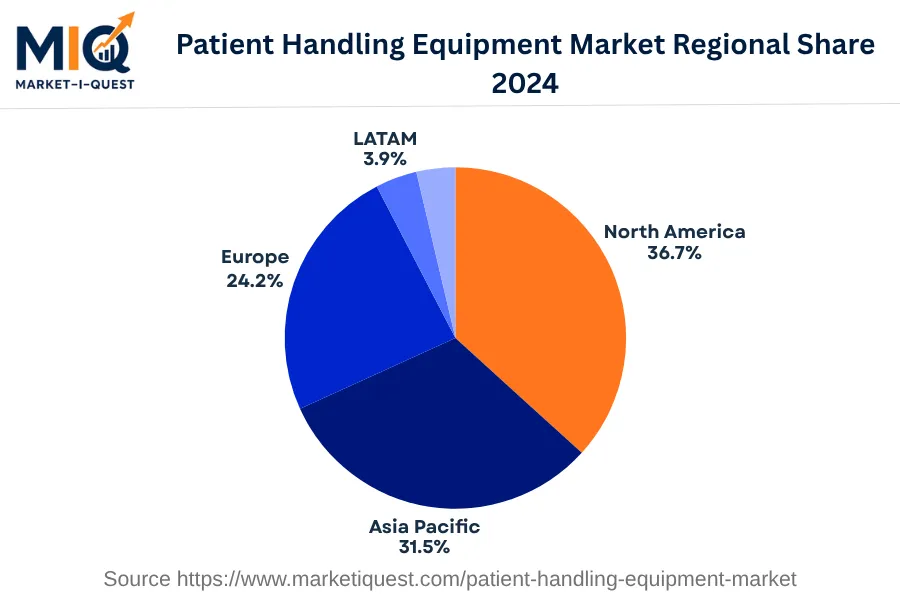
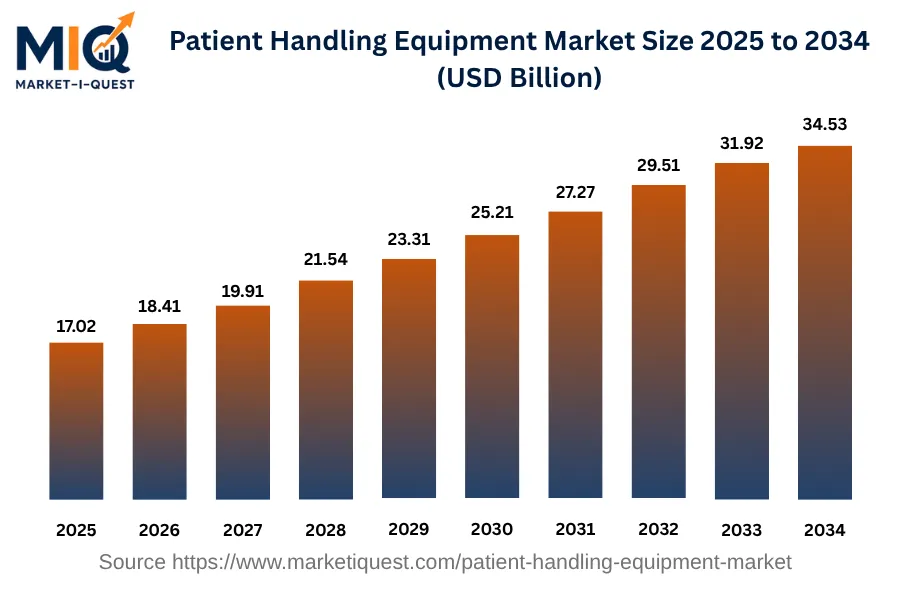
The Patient Handling Equipment Market was valued at approximately USD 17.02 billion in 2025 and is expected to grow to USD 34.53 billion by the year 2034, demonstrating a Compound Annual Growth Rate (CAGR) of 8.18%. The growth over this timeframe indicates a consistent expansion pattern in the sector, with the market size nearly doubling over the course of a decade. Notably, this growth can be partially attributed to the sector's robust regional distribution. As of 2024, North America held the largest regional share at 36.74%, followed by Asia Pacific region with a share of 31.46%, and Europe at 24.18%. Furthermore, the Latin America and Middle East & Africa regions also indicate market presence with lesser contributions to the total market share, at 3.94% and 3.68% respectively. The variation in market shares underlines the global scale of the Patient Handling Equipment Market, with a notable presence across multiple geographies.

Key Takeaways

  • By Type - Wheelchairs led accounting for notable market share in 2024.
  • By Application -Long-Term Care held a dominant position in the year 2024.
  • By End Use - Hospitals emerged as a key contributor in 2024.
patient-handling-equipment-market market size

Key Driving Factors

Increasing Adoptation of Safe Patient Handling Policies

The adoption of Safe Patient Handling (SPH) policies is one of the significant drivers for the patient handling equipment market. Healthcare institutions are proactively implementing these policies to reduce the risk of injuries in a patient-interactive environment. Primarily, these policies mandate the use of mechanical lifting equipment, such as hoists and slings, for patient transfers. Regulatory agencies worldwide, such as the Occupational Safety and Health Administration (OSHA) in the U.S., have guidelines advocating the use of such policies. As a result, hospitals, nursing homes, and home healthcare providers are increasingly adopting patient handling equipment to comply with these standards, thus driving the market expansion.

Rising Prevalence of Musculoskeletal Disorders among Healthcare Workers

Healthcare workers frequently suffer from musculoskeletal disorders (MSDs) due to the physical strain involved in the manual handling and transfer of patients. According to the Bureau of Labor Statistics, MSDs account for a considerable percentage of workplace injuries in healthcare settings. High incidence of MSDs has led to a drive towards ergonomics in the healthcare industry. As a result, healthcare institutions are investing more in patient handling equipment, which can ease the strain on workers, reducing the risk of injury. In addition, the workers' compensation insurer and other stakeholders are encouraging these investments, recognizing the long-term benefits in reduced healthcare costs and increased productivity.

Market Evolution by Timeline

2019-2023
During this period, hospitals emerged as the primary buyers of patient handling equipment due to an increased focus on patient safety, specifically in North America and Europe. Higher adoption of ceiling lift and medical beds was seen. However, integration with existing health facilities posed a challenge. The U.S. Department of Labor's Occupational Safety and Health Administration (OSHA) guidelines promoted proper patient handling. Price competition intensified, favoring bulk purchase contracts. However, risk of injuries to caregivers during the operation of these equipment resulted in increased training costs.
2024
In 2024, demand from home care settings grew likely driven by an aging population and increased healthcare expenditure in developing countries like India and China. Medical beds became technologically advanced integrating safety features like automatic height adjustment. Budget constraints of home care givers led to increased interest in rental service providers. Medicare's Competitive Bidding Program influenced the pricing of this equipment. The lack of skilled professionals to operate advanced equipment remained a challenge.
2025-2029
Increased demand was seen from rehabilitation centers and old age homes across Asian countries. Powered sit-to-stand lifts saw greater innovation and adoption due to their enhanced patient comfort. Due to government initiatives, such as China's 'Healthy China 2030', suppliers had to comply with stricter safety standards. Transparency in pricing was prioritized. Partnerships with rehabilitation centers for customized solutions emerged. Liability issues regarding patient injuries posed a significant risk.
2030-2034
More personalized and home-based care led to a demand surge for compact and easy-to-use patient handling equipment in high-income countries. Introduction of robotic technology to reduce caregiver strain became widespread. Regulations became more stringent, with the EU enforcing the Medical Devices Regulation (MDR) 2017/745. This encouraged companies to build in-house capabilities to comply with standards. Under the value-based pricing model, pricing was linked more directly to the outcome of the treatment. However, the high cost of technologically advanced equipment was a barrier to uptake in low-income countries.

Future Market Outlook

Future Opportunities

The patient handling equipment sector is well-positioned for opportunities driven by demographic changes and technological advancements. As the global population ages, particularly in regions such as North America and Europe, the demand for efficient and safe patient handling solutions is expected to rise. Initiatives like the U.S. National Institute for Occupational Safety and Health's recommendations for safe patient handling practices highlight the need for addressing workplace safety. Companies like Invacare and Medline are already exploring collaborations to develop adaptive equipment that meets the needs of an aging population. The increasing prevalence of chronic diseases, reported by the Centers for Disease Control and Prevention in 2023, will further augment the demand for specialized patient handling devices. In addition, advancements in Internet of Things (IoT) technology allow for better tracking of equipment utilization and maintenance, leading to more informed decision-making for healthcare facilities. Moreover, training programs and certifications, such as those from the American Nurses Association, underline the importance of safe handling practices. Partnerships between technology firms and healthcare providers are likely to create opportunities for innovative solutions tailored to specific patient demographics. Therefore, existing trends indicate that focusing on customized, user-friendly, and compliant equipment could significantly result in growth avenues in the near future.

Segmentation Analysis

By Type

The market is divided into subsegments including Patient Lifts, Medical Lifting Slings, Wheelchairs, Transport Chairs, Stretchers, Medical Beds, and Bathroom & Toilet Assist Devices. Out of these, Wheelchairs accounted for the largest revenue share, while Bathroom & Toilet Assist Devices is expected to grow at the fastest CAGR during the forecast period.

Largest Revenue Share

Wheelchairs

Market Share Leader

As of base year 2024, the highest contribution to revenue comes from the Wheelchair subsegment. This can likely be attributed to the pervasive need for autonomous mobility solutions among individuals suffering from severe mobility impairments. Populations with such needs are expanding, driven by increasing incidence of conditions such as spinal cord injuries, spina bifida, cerebral palsy and other ailments that result in permanent lower limb paralysis. In addition, aging populations, particularly in developed economies, generate a constant demand for wheelchairs, further buoying market revenues. These wheelchairs are predominantly purchased through medical supply stores and online platforms, with a higher preponderance for the former given the importance of fitting and customization in wheelchair purchases. The relative steadiness of this supply-demand situation ensures a consistent revenue stream, thereby leading to the dominant share of wheelchairs in the overall market.

Fastest CAGR

Bathroom & Toilet Assist Devices

Forecast Period Growth Leader

Bathroom & Toilet Assist Devices are projected to experience the fastest CAGR in the coming period. This growth is fuelled primarily by the increasing focus on occupational safety for caregivers and independent living standards for individuals with mobility impairments. Caregiver injuries linked to manual handling during common activities like bathing and toileting are becoming a pressing issue in many healthcare and home settings. As a reaction, safety devices like bath lifts, shower chairs, and toilet lifts are now in high demand. These devices give individuals the autonomy to perform their daily routines with minimum assistance, improving quality of life and easing caregiver duties. However, adoption barriers include high costs and a lack of awareness about such assistive options, particularly in emerging economies. The anticipation is that increased efforts to overcome these challenges will result in accelerated growth rates for this subsegment in the near future.

By Application

The market is divided into subsegments including Bariatric Care, Acute Care, Long-Term Care, Rehabilitation, and Others. Among these, Long-Term Care accounted for the largest revenue share while Rehabilitation is expected to grow at the fastest Compound Annual Growth Rate (CAGR) during the forecast period.

Largest Revenue Share

Long-Term Care

Market Share Leader

In 2024, the Long-Term Care subsegment was the leading revenue generator. This can be attributed to an aging population worldwide and the subsequent increase in chronic illnesses which require ongoing care. Such demographic shifts put pressure on the healthcare system and intensify the demand for long-term care services. Similarly, due to the high cost associated with hospital stays, there has been a steady shift toward home health care which falls under this segment. Additionally, enhanced focus by government health departments across developed countries on providing cost-effective care also contributes to the growth of this segment. Take for instance, the strict regulations in America that promote long-term care, ranging from residential care communities, home healthcare, nursing homes to assisted living facilities. It's also important to note that the purchasing decision for these services is mainly influenced by the service quality, regulatory compliance, price, and the availability of skilled professionals.

Fastest CAGR

Rehabilitation

Forecast Period Growth Leader

While Long-Term Care leads in terms of revenue, Rehabilitation is projected to grow at the fastest CAGR. The rise in traumatic injuries, surgeries, and the growing population of geriatric individuals and people with disabilities are key drivers for this subsegment. These patients often require an extensive rehabilitation program, demanding specialized care services ranging from physiotherapy to speech and occupational therapy. Adoption of rehabilitation services is faced with a few barriers, which include the relatively high cost of therapy sessions, lack of technical expertise in remote areas, and limited insurance coverage in several geographies. However, the proliferation of technological advancements such as virtual reality, robotics, and wearable devices has a catalytic effect on the growth of rehabilitation services, making therapy more efficient and accessible. Partnerships among rehabilitation centers and hospitals or insurance companies also pave the way for growth. The only near-term risks relate to the low adoption in underdeveloped areas due to accessibility and affordability issues.

By End Use

The end-use market comprises various subsegments including Hospitals, Homecare, Elderly Care, and Other Healthcare facilities. In 2024, Hospitals account for the largest revenue share while Homecare services are anticipated to grow at the fastest CAGR during the forecast period.

Largest Revenue Share

Hospitals

Market Share Leader

Hospitals hold the lion's share in terms of revenue within the end-use market. This domination can be accredited to a multitude of factors. First, hospitals in both urban and rural areas remain the primary points of patient care, offering a diverse range of services not typically available in other healthcare settings. Second, increasing investments in the healthcare infrastructure globally, particularly in developing economies, have boosted the revenue uptake of hospitals. This includes factors such as the construction of new hospitals and modernization of existing facilities. Furthermore, regulatory frameworks, in many cases, mandate certain medical procedures and treatments to be conducted only within a hospital setting, which further ensures a steady flow of revenue. Another significant contributing factor has been the purchasing power of hospitals. Unlike homecare and elderly care which often cater to single individuals, hospitals procure medical supplies in larger quantities, amplifying their purchase value and thus their contribution to market revenue.

Fastest CAGR

Homecare

Forecast Period Growth Leader

Homecare services, although not the leading revenue contributor, are expected to exhibit the fastest growth rate over the coming periods. This can be primarily attributed to the rising shift towards home-based healthcare solutions driven by patient comfort, cost-effectiveness, and comparative ease of access. The high demand for homecare services stems from the growing elderly population who prefer aging in place over institutional care. Moreover, advanced telehealth technologies and digital health platforms have made remote patient care more accessible, boosting the growth potential of this sector. Nevertheless, barriers such as regulatory hurdles and high capital expenditures remain. However, strategic partnerships among healthcare providers and tech companies are helping to overcome these challenges, paving the way for a faster adoption of homecare services. There are risks associated with data security in the digital health space, and ensuring patient confidentiality will be a critical aspect to tackle in the near term. Overall, the homecare segment is set on a fast-paced growth track, backed by demand, technological advancements, and strategic collaborations.

Competitive Analysis

Key Market Players

Manufacturers/OEMs

Hill-Rom Holdings, Inc.
US
Stryker Corporation
US
Prism Medical
UK

Key Suppliers & Raw Materials

Invacare Corporation
US
Linet spol. s r.o
Czech Republic
Drive Devilbiss Healthcare
US

Distributors, Integrators & Channel Partners

HERDEGEN
France
Arjo
Sweden
Handicare
Sweden

Porter’s Five Forces Analysis

Analysis of the competitive forces governing the Patient Handling Equipment Market.

Supplier Bargaining Power

Low

Commodity nature of raw materials gives limited power to the suppliers.

Buyer Bargaining Power

Medium

Demand from large healthcare systems provides moderate negotiation power to the buyers.

Threat of Substitutes

Medium

Technological advancements can lead to potential substitutes, posing a moderate threat.

Threat of New Entrants

High

Low capital requirement and increasing demand make the market attractive to new entrants.

Competitive Rivalry

High

Competition is fierce with several major players and continuous technological advancements.

Regional Analysis

Geographic market dynamics and growth opportunities across key regions

Global Market Outlook

patient-handling-equipment-market market regional share

North America

In 2024, the Patient Handling Equipment Market in North America saw substantial activity reinforced by demand, technology, and policy shifts. Regulatory enforcement in healthcare sectors, particularly in the US and Canada, mandated improvements in patient handling protocols enhancing equipment sales. Increased capital investment, especially in the US healthcare sector, fueled the procurement of sophisticated handling equipment. The incorporation of innovative technologies like automation and robotics by manufacturers also played a pivotal part in driving the market.

A significant trend in North America was the growing consumer sensitivity towards improved patient comfort and mobility, influencing healthcare facilities to invest in advanced patient handling equipment. Digital innovation pivotally shaped product development, resulting in height-adjustable beds, lift slings, and automated wheelchairs replacing traditional equipment. Furthermore, partnerships between manufacturers and healthcare providers flourished, primarily in the US, to address specific patient handling needs with custom-designed equipment. Emphasis on policy enforcement in the healthcare sector, mostly in Canada, assured adherence to patient handling standards, catalyzing the demand for compliant equipment.

The market constituents retailing patient handling equipment witnessed surge in sales, reflecting increased consumption across enterprise and government sectors. Multi-specialty hospitals and old-age homes, notably in Mexico, significantly contributed to the consumption of patient handling equipment.

Asia Pacific

In 2024, improvement in healthcare infrastructure and services meant a robust Patient Handling Equipment (PHE) market in the Asia Pacific region. Driving this market were regulations boosting healthcare safety and medical tourism, spurring demand for advanced patient handling solutions. Growing investments from both the private and public sectors also underpinned the market. For instance, China and India's initiatives in healthcare modernization led to a surge in the adoption of innovative PHE.

The trend in 2024 was preferring state-of-the-art tech solutions over traditional manual methods. This shift towards automated equipment reflected in customer purchasing behaviors in Japan, South Korea, Australia, and key ASEAN markets. Additionally, a surge in partnerships and M&A deals took place reinforcing the market dynamics. Explicitly in China, where multi-national corporations and local enterprises joined forces, fostering the overall sector growth. A reinforced policy enforcement was also a notable trend across all sectors—including healthcare, government, utilities, and manufacturing—aiming to improve employees' working conditions and patients' safety.

Overall, rapid development and healthcare utilities standardization generated increased demand and positive trends in the PHE market across the Asia Pacific region in 2024. Primarily, the key markets were China, India, Japan, South Korea, Australia, and relevant ASEAN regions, attributing to advanced healthcare infrastructures and strategic partnerships.

Europe

In 2024, the Patient Handling Equipment Market in Europe saw robust growth due to various drivers and evolving trends. Key demand factors such as an aging population, increasing hospital admissions, and frequent injuries to healthcare workers led to a surge in the need for patient handling equipment. European directives, particularly the 90/269/EEC, mandating employer obligations towards the safety and health of workers further bolstered the market. Significant technological advancements in the health tech sector and comparable healthcare infrastructure investments such as the Horizon 2020 program propelled the adoption of this equipment. Also, favorable pricing strategies by manufacturers contributed to increased market penetration.

Trends that shaped the market involved a notable shift towards home healthcare, especially in the UK, Germany, and the Nordic countries, prompting demand for portable and user-friendly equipment. Companies focused on integrated tech solutions accelerated the adoption of IoT and AI-based devices. We witnessed a rise in strategic partnerships and mergers, with prominent examples including Hill-Rom and Medline Industries, to expand product portfolios. Enforcement of high-standard quality norms, in line with CE marking regulations, ensured top-notch product offerings. Key consumers of these products primarily spanned government and private healthcare sectors, which encompassed hospitals, care homes, home healthcare providers, and emergency medical services.

Latin America

In 2024, the Patient Handling Equipment Market in Latin America was strongly affected by healthcare policies, demographics, and technological advancement. Key drivers included regulations on patient safety and healthcare personnel injury prevention, such as those in Mexico and Brazil mandating safer patient lift practices. The increasing elderly population across LATAM also influenced the demand, notably in Argentina, Chile and Peru. Investment in healthcare infrastructure developments encouraged availability and accessibility of diverse patient handling equipment.

The trend towards digitization and automated technology influenced both supply and demand dynamics. Brazil and Mexico saw a shift in buyer behavior with increased preference for tech-integrated equipment like power-assisted transfer devices. Colombia experienced a surge in online sales-channels as a response to the growing digital habits of their healthcare institutions. Partnerships and mergers also shaped the LATAM market landscape. For instance, the tie-up between key manufacturers and healthcare settings drove the availability of advanced solutions across many countries.

The main sectors drawing on patient handling equipment were healthcare facilities, both government-backed and private. This includes hospitals, nursing homes, and home healthcare services. Government strategies to reduce the risk of injuries in healthcare settings played a significant role in policy enforcement and standards setting across the region.

Middle East & Africa

In 2024, the market for patient handling equipment in Middle East and Africa stood defined by a burgeoning healthcare sector and investment in technology. Strengthening regional healthcare infrastructures, specifically in countries like Saudi Arabia, UAE, Qatar, and South Africa, served to drive demand for advanced patient handling equipment. Regulatory emphasis on patient safety and injury prevention consistently upheld this market, with guidelines from health boards across Egypt, Nigeria, and Kenya necessitating the use of such equipment. Investments in healthcare tech-adoption, particularly in Israel, bolstered supply dynamics with an array of advanced, cost-effective solutions.

Concurrently, buyer behavior trends showed a distinct preference for technologically sophisticated patient handling equipment, due to increasing awareness of patient comfort and safety. In regions like UAE and Saudi Arabia, an upsurge was noted in partnerships between hospitals and equipment manufacturers, a trend catalyzed by efforts to align with stringent safety regulations. Meanwhile, the growing popularity of home healthcare services across Nigeria and South Africa stimulated demand for mobile patient handling equipment. Renewed policy enforcement aimed at preventing musculoskeletal disorders in healthcare workers engendered a clear shift towards ergonomically designed equipment. The market dynamic across Middle East and Africa was thus dominated by a symbiotic relationship between demand factors and technology adoption, shaped by regional regulations and consumer preferences.

Recent Industry Developments

Latest market innovations, product launches, and strategic initiatives

January 2026

Baxter International Inc. (incorporating Hill-Rom) introduced its Dynamo Series smart stretcher at the J.P. Morgan Healthcare Conference. The fully electric stretcher incorporates a powered drive system, automated fall-prevention alarms, and direct wireless integration into hospital Electronic Medical Record (EMR) systems.

February 2025

Stryker Corporation launched its next-generation AI-integrated smart hospital bed platform featuring predictive fall detection sensors, integrated scales, and continuous weight monitoring. The systems stream live telemetry to hospital nursing stations to prevent unassisted bed exits.

Frequently Asked Questions