
Passive Optical Network Market Snapshot

Key Players

  • Huawei Technologies Co. Ltd. (China)
  • ZTE Corporation (China)
  • Nokia Corporation (Finland)
  • Calix Inc. (USA)
  • Fiberhome Telecommunication Technologies Co. Ltd. (China)
  • Adtran Inc. (USA)
  • Cisco Systems Inc. (USA)
  • Mitsubishi Electric Corporation (Japan)
  • Alcatel-Lucent S.A. (France)
  • DASAN Zhone Solutions Inc. (USA)

Market Size

Base Year 2024
$18.46 Bn
CAGR
18.92%
Forecast 2034
$104.42 Bn

Market Segments

By Structure
  • Gigabit Passive Optical Network (GPON)
  • Ethernet Passive Optical Network (EPON)
  • Wavelength Division Multiplexing Passive Optical Network (WDM-PON)
By Component
  • Wavelength Division Multiplexer/De-Multiplexer
  • Optical Filters
  • Optical Power Splitters
  • Optical Cables
  • Optical Line Terminal (OLT)
  • Optical Network Terminal (ONT)
By Application
  • FTTx
  • Mobile Backhaul

Market Dynamics

Drivers
  • Rising demand for high speed internet
  • Innovative technological advancements
Restraints
  • High installation cost
  • Evolving wireless technologies
Opportunities
  • Rising demand for high bandwidth solutions
  • Emergence of smart city projects

Market Size

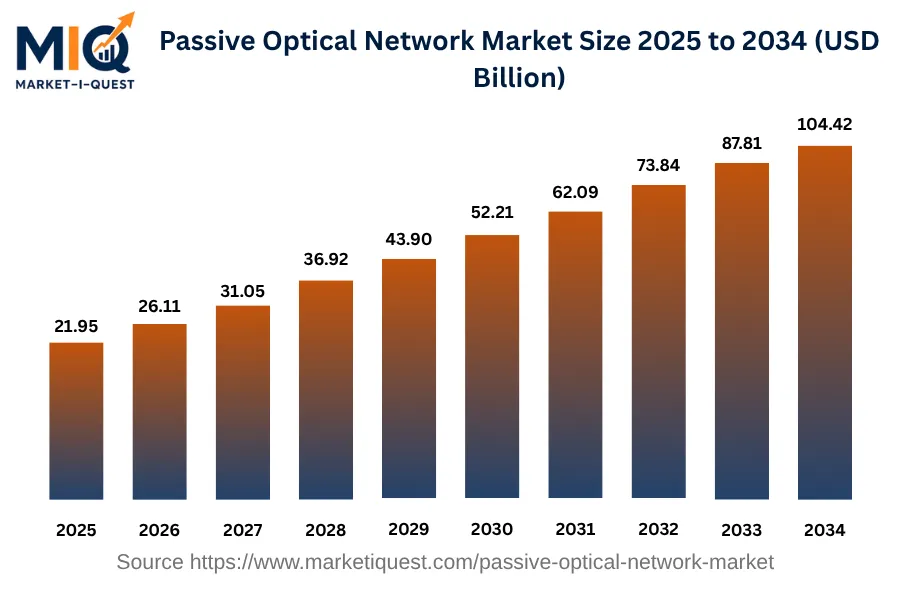
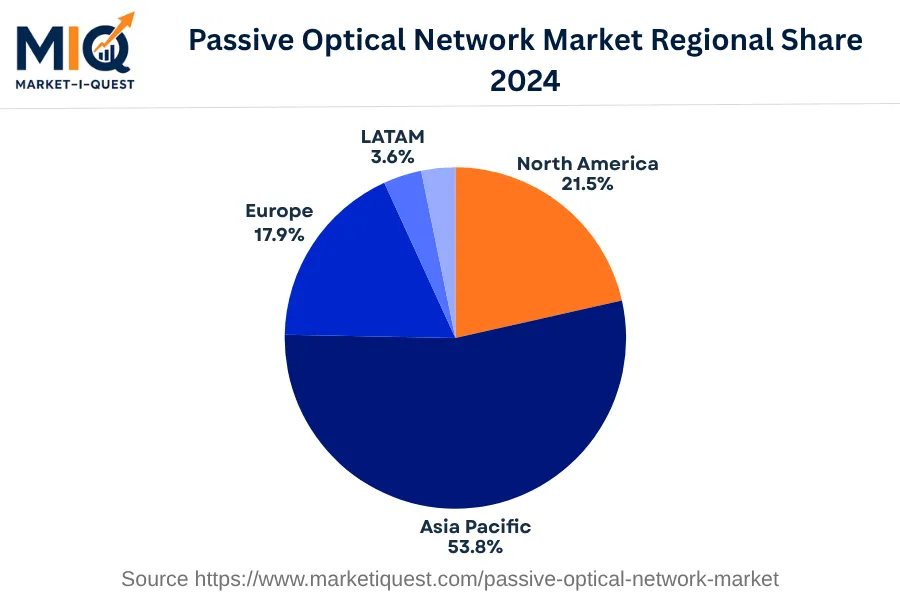
The Passive Optical Network Market was sized at 21.95 billion USD in 2025, up from 18.46 billion USD in 2024, and is expected to reach 104.42 billion USD by 2034, charting a CAGR of 18.92%. The jump from 2024 to 2025 marked the start of an upward trajectory, with the market nearly quintupling over the following nine years. This massive growth over the forecast period from 2025 to 2034 signifies an ongoing and increasing demand for Passive Optical Network technologies. The geographical market share in 2024 was distributed as follows: North America at 21.5%, Asia Pacific at 53.8%, Europe at 17.9%, LATAM at 3.6%, and MEA at 3.2%. This suggests the majority of the market demand for Passive Optical Network technologies was centred in the Asia Pacific region.

Key Takeaways

  • By Structure - Gigabit Passive Optical Network (GPON) held the top spot with a significant market share in 2024.
  • By Component - Optical Cables was the leading segment accounting for a major share in 2024.
  • By Application - FTTx was the fastest-growing segment during the forecast period from 2025 to 2034.
passive-optical-network-market market size

Key Driving Factors

Enforced Emission Standards by Regulatory Bodies

As climate concerns escalate, regulatory bodies around the world are imposing strict emissions standards on telecom sectors. This effort is mainly to reduce the carbon emissions coming from this industry. Passive Optical Networks (PONs) offer environmentally friendly networking solutions because of their lower power consumption compared to traditional copper-based networks. The energy-efficient nature of PONs has compelled telecom organizations to adopt them in an effort to meet the strict carbon emission standards. Companies like AT&T, Deutsche Telekom, and others have been shifting towards PONs, to not only comply with these regulations but also due to increased consumer preference for sustainable solutions. As a result, this has become a major contributing factor to the growth of the PON market.
Increasing Telecommuting and Remote Work Trends

Telecommuting and remote work have become an established trend particularly amplified by the recent global events like the COVID-19 pandemic. This has led to a sharp increase in the demand for robust and reliable residential internet connectivity. PONs play a significant role here due to their inherently high bandwidth capacity and capability of managing larger data load, qualities that are desirable for video conferencing, data sharing, streaming media, and other remote work necessities. Various Internet Service Providers (ISPs) are seeking to upgrade their networks to PONs, as they provide an effective solution to cater to this increased demand for high-speed internet from home-based users. This shift by ISPs is driving forward momentum in the passive optical network market.

Market Evolution by Timeline

2019-2023
During 2019-2023, the significant buyers of Passive Optical Network (PON) equipment were telecommunications providers, largely from Asia-Pacific (especially China and India) and North America. These were driven by the need to expand broadband networks to support growing data traffic. Manufacturers focused on delivering GPON technology, which offered advantages in cost, bandwidth, and efficiency over older EPON technology. However, integration into existing network infrastructure remained a complex challenge. Regulatory support came in the form of the FCC's Rural Digital Opportunity Fund targeting expansion of high-speed internet access. Pricing dynamics included both up-front equipment purchase and ongoing operation costs, with large-scale deployments in countries like China giving suppliers economies of scale. The major risk was the technical complexity and high initial investment required for deployment.
2024
In 2024, interest from Middle East and South American telecommunications providers highlighted a geographical shift. The focus was still on GPON tech, with notable improvement in their integration capabilities with existing networks. The EU's 'Digital Agenda for Europe 2020', which aimed to achieve broadband coverage for all European citizens, influenced adoption. The pricing model showed signs of maturing, with services pricing gradually becoming the dominant commercial strategy over equipment pricing. However, financing hurdles, particularly for smaller providers and in less developed markets, were a significant deterrent for wider adoption.
2025-2029
During the period 2025-2029, an increase in adoption by cable operators and internet service providers was noted, particularly in emerging markets like Africa. The industry saw a shift from GPON to next-generation technologies like XGS-PON, offering higher bandwidth capacities. Issues with integration persisted, especially with legacy systems. Policies like Nigeria's National Broadband Plan 2020-2025 encouraged PON expansion while also enforcing increased national coverage levels. Vendors started offering flexible payment options and partnership models, with a focus on service delivery rather than standalone equipment sales. The evolution presented ongoing challenges, mainly financial and technical, which had to be overcome for wider adoption.
2030-2034
Between 2030-2034, more private businesses, educational institutions, and government organizations started leveraging PONs for private network applications as they sought to future-proof their infrastructure. Next-gen tech took center stage, most notably the Terabit Passive Optical Network (T-PON). Integrating these networks with wireless technologies like 5G was a common practice. Conditions were influenced by initiatives like the World Bank's Broadband Infrastructure Project. As 'service bundling' matured, providers packaged PONs with additional services to attract new customers. The severe challenge was keeping up with the rapid pace of technological advancement, especially for providers with limited funds or network modernization capability.

Future Market Outlook

Future Opportunities

Opportunities in the passive optical network (PON) market are emerging as organizations prioritize digital transformation initiatives. For example, the broadband initiatives outlined in the U.S. Infrastructure Investment and Jobs Act of 2021 signal a growing need for reliable internet connectivity. Entities such as the Federal Communications Commission are actively promoting fiber infrastructure to bridge the digital divide. In 2023, telecommunications providers in Canada, like Bell Canada, have increased their commitments to expanding fiber networks for residential and business customers in urban and rural areas. Moreover, the rise of applications requiring high bandwidth, particularly in sectors like healthcare and education, demonstrates a sustained demand for improved telecommunications infrastructure. The deployment of 5G networks is aligning with optical technologies, as fiber lays the groundwork for robust service delivery. In countries like Singapore, regulators are backing initiatives that integrate PON with 5G, enhancing both speed and service reliability. Additionally, partnerships between technology vendors and utility companies are exploring the use of existing power lines for dual functions, which could reduce deployment costs. The need for sustainable practices within the telecommunications industry also aligns with green initiatives, prompting operators to seek energy-efficient PON solutions. In summary, the combination of regulatory incentives, market demand, and technological partnerships presents numerous opportunities for growth and expansion within the PON market landscape.

Segmentation Analysis

By Structure

The market is divided into subsegments including Gigabit Passive Optical Network (GPON), Ethernet Passive Optical Network (EPON), and Wavelength Division Multiplexing Passive Optical Network (WDM-PON). Among them, Gigabit Passive Optical Network (GPON) accounted for the largest revenue share while Wavelength Division Multiplexing Passive Optical Network (WDM-PON) is expected to grow at the fastest CAGR during the forecast period.

Largest Revenue Share

Gigabit Passive Optical Network (GPON)

Market Share Leader

Gigabit Passive Optical Network (GPON) has been leading in revenue predominantly due to its high efficiency and capacity. It offers higher bandwidth compared to other subsegments which enables end users to access a variety of applications including voice, data, and video. Furthermore, GPON is notable for its cost-effectiveness. It generally requires less equipment and maintenance than other comparable services, thus being chosen as a preferred choice for many service providers. Additionally, GPON is widely adopted in both urban and rural areas, expanding its customer base across the globe. The regulatory landscape also favors GPON as numerous countries push for the enhancement of their telecommunications infrastructure, which invariably drives the demand and adoption of high-speed networks such as GPON. Despite its already leading position, further growth may well continue by evolving market dynamics and increased digital needs.

Fastest CAGR

Wavelength Division Multiplexing Passive Optical Network (WDM-PON)

Forecast Period Growth Leader

Wavelength Division Multiplexing Passive Optical Network (WDM-PON) brings together the advantages of WDM and PON and is anticipated to have the fastest growth rate out of these subsegments. The increasing demand for high-speed internet and developments in the telecommunication industry serve as primary growth drivers. Furthermore, the advent and proliferation of various tech innovations, like Internet of Things (IoT) and cloud services, create a surge in data traffic. This surge necessitates the requirement for high-capacity networks. WDM-PON, with its ability to offer high-capacity connections by simultaneously transmitting multiple wavelengths over the same fiber, is an ideal solution. Adoption barriers, such as high initial investment and complex deployment, have been mitigated in recent years through industry partnerships and governmental policies promoting the development and adoption of advanced network technologies. Though slower to take off than its competitors at first, WDM-PON has turned that into an advantage, offering next-generation technology that can handle modern data requirements, thus predicting a quicker adoption rate and speedier growth in the coming years.

By Component

The market is divided into sub-segments including Wavelength Division Multiplexer/De-Multiplexer, Optical Filters, Optical Power Splitters, Optical Cables, Optical Line Terminal (OLT), and Optical Network Terminal (ONT). Among these, Optical Cables accounted for the most substantial revenue share, whereas Optical Filters are expected to grow at the fastest CAGR during the forecast period.

Largest Revenue Share

Optical Cables

Market Share Leader

Optical cables claimed the largest share in the revenue in the base year of 2024. This prevalence can be attributed to the key role they play in modern data communication networks. Optical cables provide a higher bandwidth over long distances compared to traditional copper cables. Their immunity to electromagnetic interference, boost in speed, and capacity secures their demand in core sectors such as telecom, broadband networking, military and aerospace, oil and gas, and medical industries. Furthermore, these cables tend to dominate in densely populated urban regions where the demand for high-speed internet is sky high. Additional expansions in smart city projects and high speed communication infrastructure developments supplement the growth of the optical Cable subsegment, which continues to maintain the largest revenue generation.

Fastest CAGR

Optical Filters

Forecast Period Growth Leader

Despite not being the segment with the largest revenue, Optical Filters are projected to showcase the quickest growth. The rising need for dense wavelength division multiplexing (DWDM) systems in data communication networks acts as a driving force for optical filters. These components are essential in managing and optimizing wavelength signals, making them integral to the current demand for high-speed and high-capacity networks. Additionally, industries are capitalizing on the advancements in optical communication technology, including 5G, which intensifies the demand for optical filters. However, their high implementation costs and complex design could pose barriers to their adoption. Nevertheless, the growing partnerships among major players and a push for research and development activities are expected to mitigate these challenges and fuel the growth in the segment. Certain risks, such as the occasional supply-demand gap and rapidly changing technology, could impact growth but are manageable with strategic planning and foresight.

By Application

The Application market is divided into subsegments including FTTx and Mobile Backhaul. In 2024, Mobile Backhaul accounted for the largest revenue share while FTTx is expected to grow at the fastest CAGR during the forecast period.

Largest Revenue Share

Mobile Backhaul

Market Share Leader

In the base year of 2024, the Mobile Backhaul subsegment holds the largest revenue in the Application market. This is primarily due to the growing demand for high-speed internet and the expansion of telecom networks worldwide. Mobile backhaul is a critical aspect of cellular networks, providing data connectivity from the cell site to the overall network, and it is becoming increasingly crucial as we move towards 5G networks. The push for better connectivity and higher bandwidth drives the need for efficient and robust mobile backhaul solutions. Furthermore, the increase in mobile data traffic, fueled by the growth of data-intensive applications and services, has also led to significant revenue generation in this subsegment. Another driver for mobile backhaul's large revenue share is the industry-wide shift towards C-RAN architecture from traditional base station-centric architecture, necessitating an effective backhaul solution. This shift is driven by factors such as cost-effectiveness, energy efficiency, and scalability.

Fastest CAGR

FTTx

Forecast Period Growth Leader

While Mobile Backhaul holds the largest revenue share in 2024, FTTx (Fiber to the x) is predicted to grow at the fastest CAGR in the ensuing years. The primary growth driver for this subsegment is the need for high-speed internet and the ongoing shift from traditional broadband networks to fiber-optic networks globally. This transition is powered by the numerous advantages of fiber-optic over traditional broadband, such as superior bandwidth, reliable connection, and low latency. Rising urbanization and demand for quality internet in urban areas are causing a surge in FTTx installations. Besides, several governments have initiated national broadband plans promoting fiber connectivity, further pushing FTTx adoption. Potential barriers to the growth of this segment include high installation costs and the presence of other high-speed internet solutions, but industry partnerships, policy support, tech advancements, and increased capex are expected to overcome these hurdles, propelling fast-paced growth.

Competitive Analysis

Key Market Players

Manufacturers / OEMs

Huawei Technologies Co., Ltd.
China
ZTE Corporation
China
Nokia Corporation
Finland

Key Suppliers & Raw Materials

Broadcom Inc.
US
Adtran, Inc.
US
Fujitsu Ltd.
Japan

Distributors, Integrators & Channel Partners

Commscope Inc.
US
Corning Inc.
US
AFL Telecommunications LLC
US

Porter’s Five Forces Analysis

This analysis examines the competitive landscape and market dynamics of the Passive Optical Network Market.

Supplier Bargaining Power

Medium

Suppliers' power is moderated by the availability of multiple component manufacturers for passive optical networks.

Buyer Bargaining Power

High

Purchasers have significant power due to the variety of service package options and providers in the market.

Threat of Substitutes

Medium

Wireless broadband technologies pose a considerable substitution threat to passive optical network technologies.

Threat of New Entrants

Low

Significant capital expenditures and technical know-how constitute serious entry barriers for new competitors.

Competitive Rivalry

High

Intense competition exists among established players like Huawei, Nokia, ZTE, with competition primarily based on price and technological innovation.

Regional Analysis

Geographic market dynamics and growth opportunities across key regions

Global Market Outlook

passive-optical-network-market market regional share

North America

In 2024, the passive optical network (PON) market in North America was characterized by sustained growth primarily rooted in increased regional demand, improved supply dynamics, and strategic regulatory impetus.

Firstly, advancements and greater adoption of fiber-to-the-home (FTTH) and fiber-to-the-building (FTTB) infrastructures drove demand, particularly in populated U.S areas, boosting the PON market. Furthermore, Canadian and Mexican utilities, healthcare, and governmental sectors also heavily invested in PON technology, attracted by its capacity to deliver high-speed broadband services. Price reductions on PON devices, spurred by industry competition and more efficient supply chains, further fueled market growth.

Simultaneously, the PON market landscape transformed with evolving buyer behaviors and tech shifts. Network operators progressively migrated to 10 Gbps PON to meet user demand for increased bandwidth, shaping an important trend. Market consolidation through partnerships and strategic M&A, notably within the U.S and Canada, facilitated greater market penetration and service optimization. Enforcement of stricter quality standards by telecom regulators across the region brought about improved network architecture and performance, thus encouraging further PON adoption.

In summary, enhanced demand for high-bandwidth services, strategic sector investment, friendly regulatory environment, and market-driven price reductions were key drivers of the North American PON market in 2024, while tech adoption, M&A activity, and policy enforcement contributed to its most notable trends.

Asia Pacific

In 2024, the Passive Optical Network (PON) market in Asia Pacific region exhibited a vibrant expansion, stimulated by an amalgamation of factors and trends. Demand was driven, on one hand, by the increasing utilization of these networks in sectors such as healthcare, utilities, retail, and most prominently, government and enterprise sectors. Governments were actively promoting the digitalization of public services, while enterprises were deploying PON for better data management, thus uplifting the market in countries like China, India, Japan, South Korea, and Australia.

Technological adoption contributed as a robust driver, due to more internal investments in PONs, mirroring especially in India and Japan. Similarly, favorable regulatory policies in China endorsed domestic supply dynamics. However, pricing varied across the region, showing the effects of diverse economic realities.

Trend-wise, buyer behavior in key ASEAN markets gravitated towards PONs due to greater bandwidth and energy efficiency, creating a shift in purchase decisions. Several partnerships and M&As were observed among suppliers, particularly in South Korea, broadening product offerings and enhancing competitiveness. In China and Australia, strict policy enforcement was seen concerning environmental impact and sustainability, steering the market towards greener PON options. Nevertheless, the simultaneous push for standardized network structures created challenges to the weaved intricate of unique market trends.

Europe

In 2024, the European Passive Optical Network (PON) Market took significant strides in innovations and technology upgrades. Driving factors were the increasing need for bandwidth due to rising digital content consumption, government-led initiatives propelling broadband penetration, and operators seeking cost-effective solutions to maintain pace with technology developments. For instance, Germany launched a nationwide gigabit internet access plan, and the UK's Gigabit Voucher Scheme facilitated increased deployment in rural areas.

Industry trends displayed a preference for gigabit-capable Passive Optical Networks (GPON), with enterprises, government, and healthcare sectors at the forefront of adoption. Market players’ partnerships, such as Nokia's alliance with Openreach in the UK for GPON roll-out, shaped the competitive landscape. Shifts towards virtualization necessitated amendments to PON standards, demonstrated by the enhanced development of software-defined PONs in Benelux nations.

Across sectors, utilities, healthcare, retail, and manufacturing sectors saw amplified demand for secure and high-speed data communication. In contrast, Central and Eastern Europe observed a slow but steady growth buoyed by government-led fibre network expansion. However, Italy and Spain lagged due to legacy infrastructural issues.

In essence, demand and adoption patterns - backed by regulatory framework and partnerships in the UK, Germany, Benelux, and the Nordics - are molding the European PON market landscape for 2024.

Latin America

In 2024, the Passive Optical Network (PON) Market in Latin America showcased substantial growth due to increasing adoption of optical fiber technologies. Investment from businesses and governments in high-speed broadband infrastructure, particularly in Brazil and Mexico, has been a primary driver for this expansion. Additional demand has stemmed from regulations encouraging network modernization in countries such as Argentina and Chile. Lastly, falling prices for optical networking equipment have made them more accessible, further accelerating the supply dynamics.

Trends in the LATAM PON Market were heavily influenced by digital transformation efforts across various sectors. An increase in remote working policies led enterprises to adopt PON solutions for enhanced connectivity and bandwidth. Technological advancements, such as the rise in 5G connectivity, have resulted in shifts toward faster and more reliable networks. Partnerships and M&A activities, notably in Colombia and Peru, have facilitated widespread adoption of PON technologies. Finally, stricter policy enforcements on data security and privacy have driven organizations across healthcare, retail, and manufacturing sectors to upgrade their networks, contributing to increased demand for PON solutions in the region.

Middle East & Africa

In 2024, the Passive Optical Network (PON) market in the Middle East and Africa significantly expanded due to a rise in data traffic and the ongoing digital transformation in the region. Increased demand for high bandwidth connectivity, predominantly from government, telecom, and healthcare sectors, drove the growth of the PON market. Further acceleration was seen due to heightened investment in fiber-optic infrastructure by major countries like Saudi Arabia, UAE, and South Africa. Regulatory initiatives, particularly in nations like Nigeria and Kenya, also reinforced this growth by promoting digital inclusivity.

Noteworthy trends were the shift towards GPON technology, which responded to the increased data traffic and need for greater bandwidth. This push for better connectivity led telecom companies in Egypt and Israel to rethink their infrastructure and led to potential partnerships aimed at technology augmentation. In the UAE and Qatar, digital transformation policies like 'Smart Dubai' and 'Qatar National Vision 2030’ influenced buyer behavior, creating a surge in the adoption of digital platforms in various sectors. Additionally, an evident consolidation trend in the region's PON market suggested a future shift towards mergers and acquisitions as key growth strategy among leading market players.

Recent Industry Developments

Latest market innovations, product launches, and strategic initiatives

April 2025

Huawei Technologies, in partnership with China Unicom, launched China's first commercial 10G-tier residential broadband network in Sunan County, Hebei Province. Built on Huawei’s 50G-PON equipment architecture, the deployment achieved download speeds up to 9,834 Mbps with sub-3 millisecond latency.

March 2025

Semtech Corporation commercialized the industry’s first ITU-T compliant asymmetric 50G-PON Optical Line Terminal (OLT) chipset series (featuring the GN7161 and GN7153BW), giving equipment vendors the silicon hardware required to construct low-latency 50-Gigabit access nodes.

Frequently Asked Questions