Parking Management Market Snapshot

Key Players

  • Indigo Park Services (France)
  • SP Plus Corporation (United States)
  • Park24 Co. Ltd. (Japan)
  • Amano Corporation (Japan)
  • T2 Systems (United States)
  • Conduent Incorporated (United States)
  • Q-Free ASA (Norway)
  • Nex Valet (Brazil)
  • Cleverciti Systems GmbH (Germany)
  • SKIDATA AG (Austria)

Market Size

Base Year 2024
$6.91 Bn
CAGR
11.82%
Forecast 2034
$21.12 Bn

Market Segments

By Parking Type
On-Street Parking, Off-Street Parking, Multi-Level Parking
By Deployment Type
Cloud-Based, On-Premises, Hybrid
By Application
Parking Guidance System, Parking Reservation System, Parking Meter Management, Others
By End User
Government, Commercial, Residential

Market Dynamics

Drivers
  • Rising urbanization rate
  • Advancements in parking solutions
Restraints
  • High installation costs
  • Regulatory compliance challenges
Opportunities
  • Smart parking solutions
  • Urbanization growth

Market Size

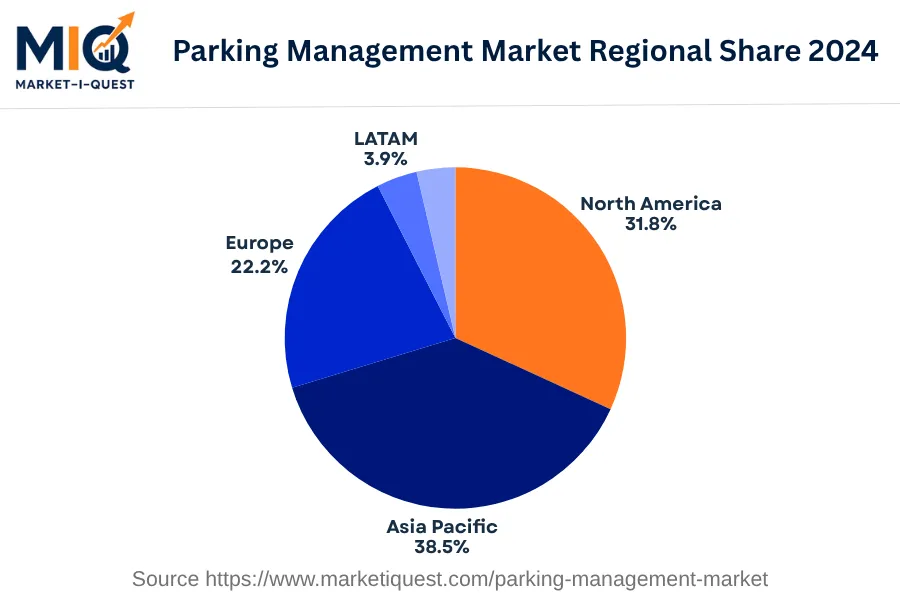
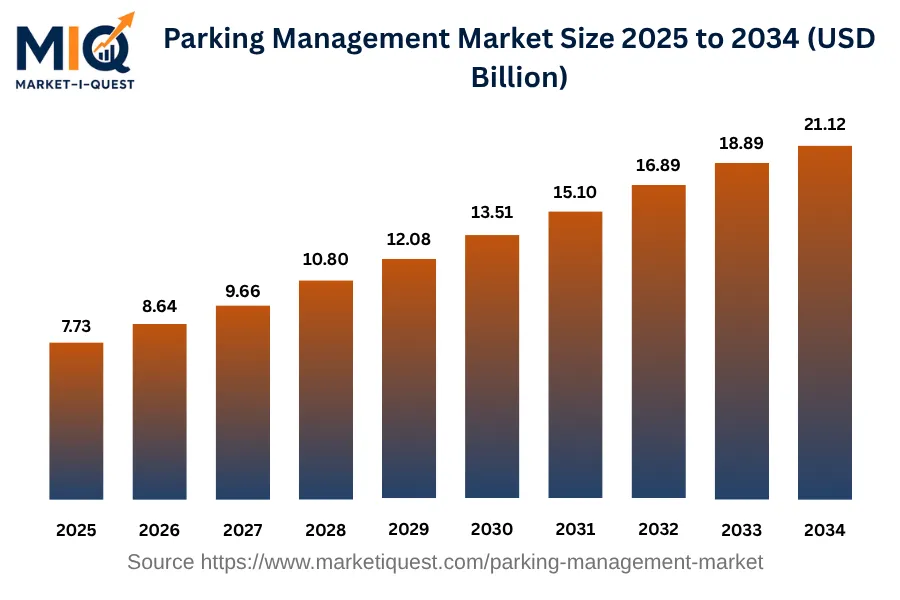
The Parking Management Market, valued at $7.73 billion in 2025, is expected to grow to $21.12 billion by 2034, a CAGR of 11.82%. In 2024, the market was worth $6.91 billion, indicating an initial growth leading up to 2025, and this growth trajectory is expected to continue over the forecast period until 2034. The growth of the market is attributable to an increase in the need for parking management solutions due to rising vehicle parc, the establishment of smart cities globally, increasing investments in parking management technology and solutions, and high demographic rates. In terms of geographical distribution in 2024, the Asia Pacific held the highest share of 38.46%, followed by North America at 31.84%, Europe at 22.18%, Latin America at 3.86%, and Middle East and Africa (MEA) at 3.66%.

Key Takeaways

  • By Parking Type - Off-Street Parking accounted the largest share in the Parking Management Market.
  • By Deployment Type - On-Premises held the majority stake showing a prominent preference among users.
  • By Application - Parking Meter Management took a leading role covering a significant portion of the market.
  • By End User - Commercial segment demonstrated the highest demand in parking management solutions.
parking-management-market market size

Key Driving Factors

Smart City Initiatives

One of the key factors driving the parking management market is the growing number of smart city initiatives worldwide. Cities across the globe are increasingly adopting smart technologies in order to optimize urban services, such as parking. These technologies come in various forms, such as sensor-based parking guidance systems, but one of the most popular trends is the use of mobile applications. Through these apps, drivers can identify available parking spots, make payments, and even extend parking time remotely. This not only enhances the driver's experience by saving time and reducing stress, but also increases city revenues and helps organize urban traffic flow. As more cities embark on digital transformation journeys, the adoption of smart parking solutions is anticipated to propel the market further.

Escalation of Parking Problems in Urban Areas

A second main driver of the parking management market is the escalating issue of parking in urban areas. Rapid urbanization and population growth have led to an increase in the number of vehicles on the road, resulting in severe parking problems in most metropolises. These issues include but are not limited to congestion, increased CO2 emissions, and massive time waste. City governments and private entities alike are addressing these problems by integrating advanced parking management systems that not only help manage parking spaces efficiently but also reduce the environmental footprint. Such systems offer real-time information about parking availability and streamline ticketing and enforcement processes. As these urban parking challenges persist, so too will the demand for efficient parking management solutions, thus driving the market.

Market Evolution by Timeline

2019-2023
In this period, the Parking Management Market experienced a surge driven primarily by increased urbanization and the accompanying pain points of limited parking spaces, especially in metropolitan areas like New York City and Beijing. Novel solutions such as smart parking systems using IoT and AI began to find traction, despite constraints in technology interoperability and scalability. Government regulations such as the EU's 'Intelligent Transport Systems Directive' forced many companies to adopt these advanced parking management systems. Typical commercial models involved the sale of hardware && software as a package, often with a subscription-based service for ongoing maintenance and updates. Key risks were inadequate infrastructure and user resistance to technology.
2024
In 2024, buyers such as corporate parks and municipalities demonstrated a higher acceptance for parking management solutions, mainly due to demonstrated benefits like reduced congestion and increased revenue. System integrations and interoperability had improved, enabling multi-vendor parking solutions. A noteworthy policy was California's Assembly Bill 43 that adjusted parking fines to income making parking management crucial for municipalities. Large contracts became more common, often involving large-scale implementation projects and long-term maintenance contracts. The primary commercial risk in this period was potential disruption from autonomous vehicles.
2025-2029
Between 2025 and 2029, parking management measures were increasingly adopted by emerging economies like India and Brazil, driven by rapid urbanization. On the supply side, parking solutions saw major improvements in machine learning algorithms that enabled better prediction of parking behavior patterns. Local government initiatives such as Smart City Paris played a catalytic role in adoption, encouraging 'green parking' initiatives. Demand-based pricing models became more prevalent, with dynamic pricing based on real-time parking demand. The competition intensified within this period, posing a risk to new entrants to the market.
2030-2034
By 2030, the Parking Management Market had shifted significantly towards precinct and citywide scale solutions, catering to an even wider buyer segment that included smart city developers and large real estate conglomerates. Key technology focus shifted towards the collection and analysis of big data to streamline operations and facilitate dynamic pricing. Strong policy frameworks like Boston's 'Go Boston 2030' vision for a technologically advanced and interconnected transport system underpinned market confidence. Regular upgrades and maintenance subscriptions became a dominant commercial model. Potential regulatory changes and evolving technology presented possible risks.

Future Market Outlook

Future Opportunities

As urbanization accelerates, particularly in regions like Southeast Asia, the parking management market is poised for substantial evolution. The integration of autonomous vehicles, expected to become mainstream by 2030, will necessitate advanced parking solutions to accommodate self-parking functions. Major companies such as Waymo and Tesla are already piloting autonomous vehicle services in several American cities, paving the way for redefined parking methodologies. Moreover, the growing acceptance of shared mobility models, evidenced by initiatives such as the California Rideshare Pilot Program initiated in 2021, creates opportunities for flexible parking solutions that cater to dynamic demand. Sustainable practices and green initiatives are also on the rise; with regulatory bodies like the EU instituting measures for reducing carbon emissions, parking facilities may need to adapt by incorporating greener technologies such as solar-powered charging stations. Furthermore, the increasing prevalence of smart city projects globally, including Singapore's Smart Nation initiative, emphasizes the integration of parking management within broader urban mobility strategies. Partnerships between municipal authorities and tech companies like Siemens are likely to enhance the development of data-driven solutions that optimize parking capacity and user experience. As consumer preferences shift towards seamless mobility experiences, innovative parking management technologies, including app-based platforms and smart sensors, are expected to emerge, aligning with contemporary trends in urban transport services.

Segmentation Analysis

By Parking Type

The market is divided into subsegments including On-Street Parking, Off-Street Parking, and Multi-Level Parking. Off-Street Parking accounted for the largest revenue share while Multi-Level Parking is expected to grow at the fastest CAGR during the forecast period.

Largest Revenue Share

Off-Street Parking

Market Share Leader

Off-Street Parking generates the most revenue in the Parking Type market, given the sheer convenience and security it offers. Consumer preference strongly veers towards this segment as it typically ensures the safety and security of vehicles. The high demand is mostly from urban areas where finding on-street parking spaces is challenging due to the increasing number of vehicles and limited space availability. Simplified parking processes, reduced instances of vehicle damage and theft, and enhanced regulation compliance are all factors that play a pivotal role in driving revenue for Off-Street Parking. Pertinently, municipal laws in many cities are increasingly favoring off-street parking, further bolstering its growth. Also, businesses most often prefer off-street parking for their customers to provide convenience and improve customer experience. Thus, superior security, regulatory framework, convenience, and customer preference make Off-Street Parking the subsegment with the highest revenue.

Fastest CAGR

Multi-Level Parking

Forecast Period Growth Leader

Multi-Level Parking is the fastest growing subsegment in the market, given its immensely efficient spatial utilization, vital in today's urban contexts with their burgeoning vehicle populations and dwindling space. High costs associated with land acquisition, especially in urban areas, act as a significant driver for Multi-Level Parking's growth. Multi-Level Parking structures epitomize the future of parking, being technologically advanced and highly efficient. The proliferation of smart cities and advancement in technology act as primary catalysts. However, high initial capex could be an adoption barrier. Yet, strategic partnerships and joint ventures with governments and even private entities can offset this barrier to a large extent. Also, the easing of zoning regulations in several regions is contributing to the subsegment's growth. Despite this, near-term risks could include possible slowdowns in construction due to economic or environmental factors.

By Deployment Type

The market can be categorized by deployment type, which includes Cloud-Based, On-Premises, and Hybrid options. The On-Premises subsegment accounted for the largest revenue, while the Cloud-Based subsegment is expected to exhibit the fastest growth rate during the forecast period.

Largest Revenue Share

On-Premises

Market Share Leader

The On-Premises approach in the recent past has a major share in the market due to the traditionally established preference of organizations to have direct control over their applications and data. These firms are likely to have large physical infrastructure assets and an existing, sizable IT team. The users for On-Premises deployment can control all their data and can maintain levels of security they deem fit, thus creating its demand and substantial revenue contribution. Providers also often offer extensive customization options, providing another attractive factor. On-Premises deployments are predominant in industries which prefer complete control or whose regulatory environment necessitates more direct control, such as government, finance, and healthcare.

Fastest CAGR

Cloud-Based

Forecast Period Growth Leader

The Cloud-Based subsegment demonstrates the fastest Compound Annual Growth Rate (CAGR) due to its various benefits that drive growth. Lower initial capital expenditure and predictable ongoing expenses are among the key benefits, permitting smaller enterprises the ability to adopt advance technology solutions. Businesses are also drawn to the superior scalability and flexibility offered by the cloud-based deployment model, allowing for easy adjustment to workload demands. Cloud technologies permit businesses to operate virtually, which has become increasingly important given the recent shift towards remote workforces as a result of global events. Partnerships with cloud technology providers and favorable government policy towards digitization in emerging economies will further catalyze growth. However, the risk of data breaches and regulatory uncertainties represent near-term barriers to adoption.

By Application

The market is divided into subsegments including Parking Guidance System, Parking Reservation System, Parking Meter Management, and Others. In 2024, the Parking Meter Management subsegment accounted for the largest revenue share while the Parking Reservation System is projected to grow at the fastest CAGR during the forecast period.

Largest Revenue Share

Parking Meter Management

Market Share Leader

In 2024, the Parking Meter Management system leads the market in terms of revenue, propelled primarily by a combination of regulatory guidelines and consumer demand. The urbanisation and expansion of cities have led to increased use of vehicles, bringing parking management to the forefront of urban planning. Regulatory authorities now enforce strict rules on parking management, creating a broad marketplace for parking meter management systems. Such systems provide efficient use of parking spaces, reduce illegal parking, and generate substantial municipal revenue. The driving factor for adoption amongst customers is the convenience and time efficiency provided by these systems. Municipalities and city councils represent the primary customer base, with the main geographic markets being densely populated urban areas. Nonetheless, the market does face switching barriers due to the capital-intensive nature of replacing existing parking meter systems.

Fastest CAGR

Parking Reservation System

Forecast Period Growth Leader

While Parking Reservation System was not the leading subsegment in 2024, it has the fastest projected compound annual growth rate. There's a definitive pivot towards digital solutions due to the rise in smart city initiatives and the push for digitisation. These systems offer numerous advantages such as efficient use of resources, tailored customer experiences, and smoother traffic flow, which are proving to be major growth drivers. However, there are adoption barriers to overcome, centreing primarily around data privacy concerns and the challenge of integrating such systems into existing infrastructures. Technology partnerships are proving instrumental in overcoming these hurdles, with synergies between parking system providers and tech companies driving innovation and reducing capital expense. To achieve higher adoption rates, the industry needs to effectively address near-term risks such as cybersecurity threats and potential system failures.

By End User

The market segment 4 is divided into subsegments which include Government, Commercial, and Residential users. The Commercial sector accounted for the largest revenue share, while the Residential segment is expected to grow at the fastest CAGR during the forecast period.

Largest Revenue Share

Commercial

Market Share Leader

The Commercial sector has secured the spot for having the largest revenue in the market, and it has multiple drivers to support this fact. The commercial sector broadly includes businesses and corporations which often require large quantities of services and products, leading to higher revenues. Additionally, businesses often require more sophisticated or high-end versions of products and services, which typically have higher price points and thus contribute to larger revenues. Geographically, the concentration of commercial businesses in urban centers and wealthy regions contributes to the high revenue share. Regulatory support like business tax incentives also plays a part in driving revenue for this subsegment. The purchasing criteria in this segment often prioritize the quality, durability, and efficiency of products and services over cost, as businesses look long-term investments and reliability. Switching costs in the commercial sector may be high, with businesses often entering long-term contracts for products and services, further securing future revenue. The channels through which businesses purchase or engage with products and services are diverse, ranging from direct sales to digital platforms, contributing to larger market coverage.

Fastest CAGR

Residential

Forecast Period Growth Leader

Although the Residential sector does not hold the banner for the largest revenue share, it outperforms all other subsegments in terms of growth. The residential sector has demonstrated a high compound annual growth rate, driven primarily by technological advancements, changing lifestyles, and policy catalysts. As technology continues to evolve and become more accessible to residential consumers, adoption rates are rising, driving growth in this sector. Barriers to adoption are continuously being tackled, with clear and simple consumer instructions and more user-friendly product designs. An important catalyst for growth in the residential sector has been the implementation of policies favoring residential users, such as incentives for adopting sustainable practices or boosting internet connectivity. Finally, the increasing ability of residential users to afford and invest in premium services and products acts as a growth driver. Near term risks, including economic downturns or policy alternations, may impact the growth of this subsegment. Despite these, the outlook for the residential segment remains robust and promising, forming the backbone of its future expansion.

Competitive Analysis

Key Market Players

Manufacturers / OEMs

TIBA Parking Systems
US
Amano Corporation
Japan
Siemens AG
Germany

Key Suppliers & Raw Materials

Bosch Security Systems
Germany
Orion Entrance Control
US
Metro Infrasys Pvt. Ltd.
India

Distributors, Integrators & Channel Partners

Nortech Control Systems Ltd.
UK
Flash Parking, Inc.
US
SKIDATA AG
Austria

Porter’s Five Forces Analysis

A comprehensive analysis of the competitive forces influencing the parking management market.

Supplier Bargaining Power

Medium

Suppliers control proprietary parking technology, influencing costs and integration.

Buyer Bargaining Power

High

Many suppliers and customizable solutions allow buyers to negotiate on price.

Threat of Substitutes

Low

Few alternatives exist for comprehensive parking management systems.

Threat of New Entrants

Medium

High initial investment and regulatory barriers can deter new entrants.

Competitive Rivalry

High

Rapid technological advancements lead to intense competition between established firms.

Regional Analysis

Geographic market dynamics and growth opportunities across key regions

Global Market Outlook

parking-management-market market regional share

North America

In 2024, the North American Parking Management Market experienced marked growth, underpinned by technological advancements, regulatory changes, and shifting market dynamics. Increased urbanization led to higher demand, pushing both public entities and private businesses in the U.S., Canada, and Mexico to invest heavily in innovative parking solutions. Smart parking technology adoption accelerated, fueled by advancements in IoT equipment and digital payment systems, mitigating the stress of navigating urban landscapes and facilitating expedient parking processes.

Simultaneously, evolving regulations put pressure on parking operators, especially in metropolitan areas, to optimize their usage of parking spaces, paving the way for more automated and data-driven systems. Conversely, in Canada, high land and infrastructure costs furthered the tendency to exploit available space more efficiently, incorporating multi-level car parking facilities.

The trend of shifting consumer preference towards conveniences like contactless payments and pre-booking parking via smartphone applications influenced business models significantly. Sectors like healthcare and retail further promoted these facilities to improve customer experience. In response, parking management firms embarked on strategic partnerships and mergers to aggregate resources, tech compatibility, and innovate in their service offerings. Furthermore, increased policy enforcement for environmental sustainability and reduction in urban congestion influenced the design of parking systems, promoting the adoption of energy-efficient and space-saving strategies. This changing landscape reaffirms the evolvement of the Parking Management Market in North America as an essential element of urban planning.

Asia Pacific

In 2024, the Asia Pacific Parking Management Market thrived on the strong interplay of demand dynamics, technology adoption, and policy enforcement across major economies such as China, India, Japan, South Korea, Australia and key ASEAN markets. Driving this growth was an increase in urban vehicle volumes demanding efficient parking solutions, particularly in China and India. Governments initiated stringent regulations to control traffic congestion, with South Korea’s city-scale deployment of smart parking sensors being notable. Investments flooded in the market, especially from the Japanese conglomerates targeting the installation of AI-powered parking systems.

A pivotal trend witnessed was shifting buyer preferences towards parking systems that offered technologically advanced services like pre-booking and real-time availability notification. Following this, product innovation witnessed a leap, with Australia championing the commercial utilization of automated parking systems. Digitization of the parking industry picked up pace, led by evolving channel dynamics that advocated user-friendly apps and real-time digital payment methods over conventional coin-based parking meters. Customer sectors included enterprises, healthcare, government and retail with manufacturing facilities prioritizing smart parking systems' deployment for efficient logistics. Furthermore, an upward trajectory was noticed in public-private partnerships aimed at addressing the parking muddle in metro cities. Regulatory policies enforced by ASEAN governments promoted the market, inviting further investments and sparking market competition.

Europe

In 2024, the Parking Management Market in Europe showed significant prevalence and influence. Several drivers were apparent, including institutional efforts to mitigate congested public parking spaces, prompting an uptake in technology-enabled solutions. Regulatory support for environmentally friendly parking, especially in Germany and the United Kingdom, further stimulated the market as investors capitalized on this green initiative. Rapid adoption of digital payment systems within countries like France, Italy, Spain promoted dynamic pricing models improving parking service efficiency.

Trends notably observed embraced changing consumer behavior towards contactless and convenient services. Advanced parking solutions equipped with near-field communication (NFC) and radio-frequency identification (RFID) witnessed major adoption across retail centers and healthcare facilities. A shift in channel dynamics was seen in Central & Eastern Europe, leaning more towards direct-to-consumer parking management applications. An increase in partnerships and mergers were noted, particularly within the automotive and tech sectors, to enhance intelligent parking systems, with brands like Benelux leading the way. The enforcement of strict urban parking policies in the Nordics further shaped market trends.

Germany's manufacturing sector displayed a specific interest in parking management solutions due to the high automotive industry presence. Similarly, in government and enterprise domains across Europe, the utility of functional and efficient parking systems was recognized, contributing to a robust market landscape in 2024.

Latin America

In 2024, the Parking Management Market in Latin America (LATAM) witnessed significant growth due to different factors impacting demand, regulation, and technology adoption. Urbanization and the increasing number of vehicles in LATAM countries, particularly in Brazil, Mexico, and Argentina, boosted the demand for efficient parking management solutions. Regulatory changes in Colombia, specifically aimed at curbing illegal parking, further drove the requirement for advanced parking systems, while government-led initiatives in Mexico and Peru to modernize urban infrastructure resulted in an increase in investments in smart parking technologies. The adoption of electric vehicles across LATAM, particularly in Chile, necessitated the incorporation of EV-charging capabilities into parking management systems.

Trends in the LATAM parking management market were largely shaped by changing consumer behaviour and technological advancements. An increased preference for hands-free, automated parking systems was observed, primarily influenced by heightened safety concerns and the need for convenience in densely populated areas. Parking management providers in Argentina and Brazil began adopting AI and machine learning technologies for predictive analysis and improved capacity management. Strategic partnerships, with a focus on joint technology development, notably in Mexico and Colombia, were seen as a prevailing trend. Lastly, stricter enforcement of parking regulations by local authorities across LATAM, especially in Chile and Peru, resulted in greater end-user compliance, driving demand for compliant parking solutions.

Middle East & Africa

In 2024, the Parking Management Market in the Middle East and Africa demonstrated significant growth, driven by various factors. Government policies across Saudi Arabia, UAE, Egypt and South Africa favoring digitization increased demand for technological adoption in the parking management sector. This includes automation machinery, smart payment solutions and vehicle recognition systems. Additionally, rapid urbanization, particularly in Nigeria and Kenya, intensified the need for efficient parking solutions, resulting in substantial market expansion. Furthermore, increasing investment from private firms, such as Qatari Diar in Qatar, stimulated market growth through the establishment of advanced parking facilities.

There was a shift in buyer behavior towards preference for contactless payment methods amidst health concerns, resulting in app-based services gaining popularity for their convenience and safety assurance. Integration of Internet of Things (IoT) technology in parking management was a notable trend, due to its efficiency and improved user experience. Partnerships like the one between Israel's Get My Parking and UAE's Robot Labor Force to create smart parking systems, were seen developing across the region. Strict enforcement of parking regulations, particularly in urban zones of Saudi Arabia and South Africa, led more establishments seeking professional parking management services. Key customers included various sectors, predominantly government institutions, healthcare facilities, commercial spaces, and retail centers that required organized parking solutions to supplement their operations.

Recent Industry Developments

Latest market innovations, product launches, and strategic initiatives

February 2026

Smart municipal infrastructure initiatives, such as the New Delhi Municipal Corporation (NDMC) project converting over 1,500 urban sites into IT-enabled parking zones, established major precedents for contactless ticketless entry, automated payment processing, and mobile reservations.

Frequently Asked Questions