Paperboard Market Snapshot

Key Players

  • International Paper Company (United States)
  • Stora Enso (Finland)
  • Svenska Cellulosa Aktiebolaget (Sweden)
  • UPM-Kymmene (Finland)
  • Mondi Group (UK)
  • Oji Holdings (Japan)
  • WestRock (United States)
  • Smurfit Kappa (Ireland)
  • Nippon Paper Industries (Japan)
  • DS Smith (UK)

Market Size

Base Year 2024
$168.84 Bn
CAGR
4.96%
Forecast 2034
$273.98 Bn

Market Segments

By Type
  • White Lined Chipboard
  • Virgin Fiber-Based Board
  • Coated Unbleached Kraft Board (CUK)
  • Liquid Packaging Board
  • Cup Stock Board
  • Others
By Application
  • Packaging
  • Graphic Printing
  • Others

Market Dynamics

Drivers
  • Increasing eCommerce activities
  • Sustainable packaging demand
Restraints
  • Increased digitization trends
  • Sustainability concerns
Opportunities
  • Increasing sustainable packaging demand
  • Expansion in e-commerce

Market Size

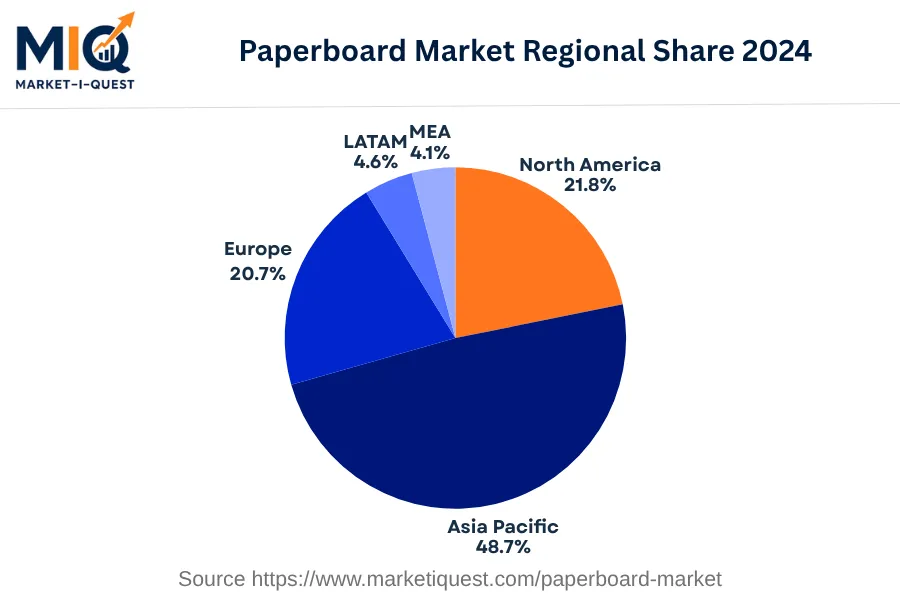
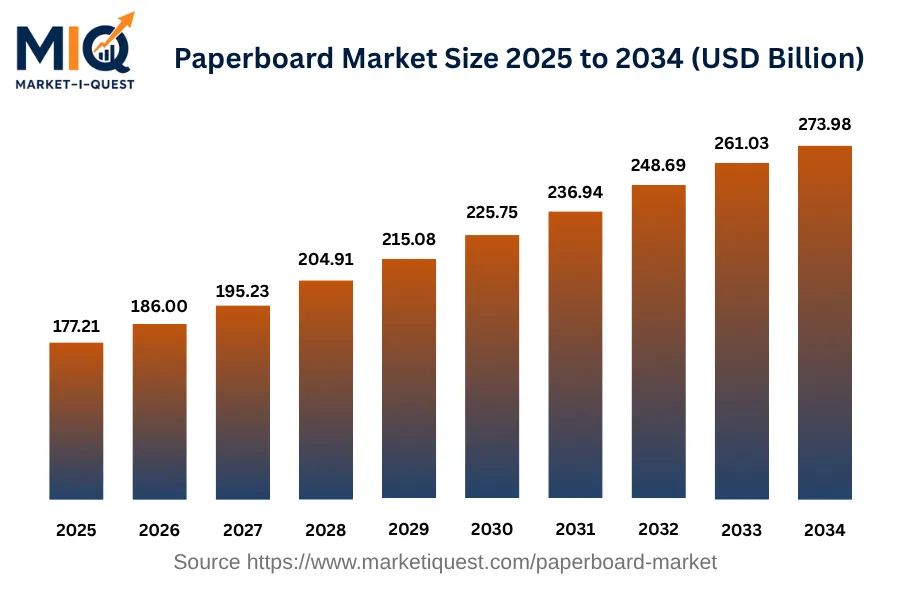
The Paperboard Market size in 2025 is estimated to be USD 177.21 billion, up from USD 168.84 billion in 2024. By 2034, the market size is projected to further increase to approximately USD 273.98 billion, reflecting a CAGR of 4.96%. The market is expected to experience a steady expansion over the 2025-2034 period, as illustrated by its substantial growth from USD 177.21 billion in 2025 to USD 273.98 billion in 2034. This growth trajectory highlights a continuous upsurge in the paperboard market within the defined ten-year time frame. A break down of the regional market share for the year 2024 shows that the Asia Pacific region held the highest proportion, sitting at 48.7%, followed by North America and Europe with 21.8% and 20.7% respectively. The remaining share is distributed among the LATAM and MEA regions, accounting for 4.6% and 4.1% respectively.

Key Takeaways

  • By Type - Liquid Packaging Board is the fastest-growing projected to register a high CAGR.
  • By Application - Graphic Printing is foreseeably the fastest-growing segment.
paperboard-market market size

Key Driving Factors

Shift towards Eco-Friendly Packaging

One of the main driving factors of the paperboard market is the global shift towards sustainable and eco-friendly packaging solutions. Due to increasing environmental awareness, companies across multiple sectors - including food and beverage, consumer goods, and pharmaceuticals - are opting for paperboard packaging. The material is biodegradable and recyclable, and thus seen as a green alternative to plastics and other non-renewable materials. Key sustainability regulations like the European Packaging and Packaging Waste Directive are encouraging companies to adopt more sustainable packaging strategies, further propelling the demand for paperboard.

Increasing E-commerce Industry

Another factor propelling the paperboard market is the exponential growth of the e-commerce industry. Online retailers heavily rely on paperboard packaging for its durability and lightweight features, ensuring their goods reach customers in perfect condition. The boom in online shopping, particularly during the recent COVID-19 pandemic, has markedly increased the need for paperboard. Inherent features of paperboard like product protection, cost-effectiveness, and easy customization based on product size and shape have made it an especially attractive choice for e-commerce businesses.

Market Evolution by Timeline

2019-2023
In this period, the major buyers of paperboard were the packaging industry, predominantly food and beverage companies in North America and Asia Pacific regions due to the rise in online food sales. Most of the supply came from Europe, with Finland and Sweden leading in the production, adhering strictly to PEFC standards. China was another dominant force due to inexpensive labour, but often lacked in environmental regulations. Common commercial model was long-term contracts with suppliers for ensuring stable pricing. However, fluctuating raw material costs created uncertainties in supply prices. Additionally, concerns about deforestation and its connection to paperboard production created reputational risks for companies.
2024
2024 saw a trend where ecommerce companies across the world became significant buyers due to their packaging demands. Manufacturers in North America and Europe started using more sustainable ways to procure and process raw materials, promoting FSC certification. Technology integration for cost-cutting and efficiency in production became a commonality. The commercial model continued to favor long-term contracts but started to include sustainability clauses. The most notable challenge was the regulations on deforestation in several countries, encouraging shift to sustainable sources for raw materials and creating a supply gap that threatened to increase prices.
2025-2029
In this period, we saw further increase in demand from ecommerce as well as retail sectors across the globe, particularly in developing regions like Southeast Asia and Latin America. Technological advancements lead to the widespread adoption of automation in the factories, reducing production time. Stricter environmental regulations led to innovative procurement strategies such as recycled paper and wood from certified forests. Contracts typically had green mandates, stressing on low carbon footprints. However, unpredictability of raw material prices and increased global scrutiny on the environmental impact of paperboard production continued to be a challenge.
2030-2034
The demand of the paperboard market is projected to continue the upward trend, fueled by ecommerce, food, and retail industries primarily in developing economies. The use of artificial intelligence in sorting and recycling processes is likely to mature and become a norm in many paperboard production plants. Stringent environmental regulations enforcing the use of more recycled material in production process typically come into play. Commercial models are expected to heavily involve performance-based contracts with suppliers. Challenges lie in managing the high demand of paperboard alongside the falling supply due to strict regulations on deforestation and raw material procurement.

Future Market Outlook

Future Opportunities

The ongoing transition towards sustainable practices within the paperboard market presents multiple future opportunities. Regulatory mandates, such as the Single-Use Plastics Directive introduced by the European Union in 2019, have heightened demand for paperboard alternatives in packaging applications. Companies are responding to this demand; for instance, in August 2023, International Paper announced partnerships with food brands to develop compostable paperboard packaging that meets regulatory standards. Additionally, the rising popularity of e-commerce, particularly following the pandemic, opens opportunities for customized and branded packaging solutions. Logistics providers like DHL have reported increasing requests for sustainable packaging solutions, indicating a growing market segment. Moreover, advancements in biodegradable coatings and finishes are expected to surface, building on active projects, including those funded by the U.S. Department of Agriculture aimed at enhancing product durability and performance. In Asia, particularly in China, the government has initiated policies encouraging the adoption of sustainable materials in packaging due to increasing environmental concerns. As competition drives innovation, paperboard manufacturers may explore collaborations with technology firms to integrate smart packaging solutions that provide traceability and consumer engagement. Overall, market dynamics suggest a significant shift towards sustainable, innovative packaging options that align with both regulatory frameworks and consumer expectations.

Segmentation Analysis

By Type

The market is divided into subsegments including White Lined Chipboard, Virgin Fiber-Based Board, Coated Unbleached Kraft Board (CUK), Liquid Packaging Board, Cup Stock Board, and others. The Coated Unbleached Kraft Board (CUK) accounted for the largest revenue share while the Liquid Packaging Board is expected to display the fastest CAGR during the forecast period.

Largest Revenue Share

Coated Unbleached Kraft Board (CUK)

Market Share Leader

The Coated Unbleached Kraft Board (CUK) occupies the largest revenue share within this market segment. This is mainly due to its broad range of applicability, such as in the packaging of foods, drinks, pharmaceuticals, cosmetics, and other consumer goods. The robustness and durability of CUK, alongside its versatility, makes it an appealing choice for multiple business sectors. This type of board has a high-end, premium feel, which earns it preference from luxury brands, thereby fueling its market share. Geographically, the CUK enjoys substantial demand in both developed and developing markets, thanks to its robustness and sustainability features. Its popularity is also driven by increasing environmental awareness among consumers and stringent regulations, pushing companies towards more sustainable packaging solutions. Another contributing factor to CUK’s leading revenue position is the lack of switching costs, making it an enticing option for businesses across different sectors.

Fastest CAGR

Liquid Packaging Board

Forecast Period Growth Leader

The Liquid Packaging Board segment is expected to grow at the fastest CAGR during the foreseeing years. Growth can be attributed to an increased demand for liquid packaging in the beverage industry. Innovations in packaging, such as the drive to improve packaging sustainability, weight, and appeal to the end consumer, are some of the main growth drivers. Brand owners and package producers are establishing partnerships to leverage these advancements. Regulatory changes are also influencing the growth of this segment. Stricter regulations on plastic usage in many countries indirectly promote increased usage of liquid packaging boards. However, the high capital expenditure associated with producing and converting liquid packaging board represents a significant barrier. High costs are related to process control technology and specific coating materials necessary for board production, impacting companies’ decisions to enter into or stay competitive within the market. Even though the capital expenditure could initially seem inhibitory, in the long run, the substantial market growth potential should outweigh these initial costs.

By Application

The market is divided into subsegments including Packaging, Graphic Printing, and Others. In 2024, Packaging accounted for the largest revenue share while Graphic Printing is expected to grow at the fastest compound annual growth rate (CAGR) during the forecast period.

Largest Revenue Share

Packaging

Market Share Leader

The Packaging subsegment is driving the bulk of the revenue in 2024, due largely to the high demand and growth in industries such as e-commerce, FMCG, and pharmaceuticals, among others. These industries have a persistent requirement for robust, sophisticated packaging solutions that are economically viable, recyclable, and compliant with increasing global sustainability standards. Additionally, advancements in smart and interactive packaging technologies, such as tracking mechanisms, temperature control, and real-time monitoring, are further bolstering the revenue potential in this sector. Supply chain complexities, regulation updates, and the continuous search for cost optimization are also major factors behind the high revenue of the packaging subsegment. Geographically, the Asia-Pacific region, with its enormous manufacturing base and fast-growing e-commerce sector, contributes significantly to this revenue stream. In essence, the surge in demand for advanced, sustainable packaging solutions across various industry verticals is the primary driver for the leading revenue share of Packaging in the base year of 2024.

Fastest CAGR

Graphic Printing

Forecast Period Growth Leader

Graphic Printing holds the potential for the fastest growth in the forecast period. The prime drivers for this growth are technological advancements, new business models, and changing consumer preferences. Novel technologies like 3D printing and digital printing are enabling more customized, flexible, and efficient printing, capturing the interest of a broad range of industries. Also, rapid digitization trends are driving businesses to incorporate more visually engaging graphics into marketing and promotional content - a change that directly fuels demand for graphic printing. Currently, adoption barriers related to high initial capital expenditure and lack of skilled labor serve as obstacles. Still, partnerships between tech companies and printing companies are expected to overcome these barriers, facilitating faster growth. However, the risk of digital media overshadowing print media remains a near-term concern. Therefore, continued innovation, promoting the unique tangible benefits of printed materials, will be crucial for sustaining the growth trajectory.

Competitive Analysis

Key Market Players

Manufacturers / OEMs

International Paper Company
US
Stora Enso Oyj
Finland
Mondi Group
UK

Key Suppliers & Raw Materials

Georgia-Pacific Corporation
US
Sappi Limited
South Africa
Domtar Corporation
US

Distributors, Integrators & Channel Partners

Veritiv Corporation
US
Mac Papers Inc
US
Antalis SA
France

Porter’s Five Forces Analysis

This analysis explores the competitive intensity and attractiveness of the Paperboard market.

Supplier Bargaining Power

Medium

Power is moderated by the availability of numerous suppliers, but occasionally hindered by raw material scarcity.

Buyer Bargaining Power

High

High demand and multiple suppliers lend considerable bargaining power to the buyers.

Threat of Substitutes

Low

Lack of viable alternatives sustains strength of the paperboard market.

Threat of New Entrants

Medium

While initial investment and operational know-how pose challenges, profitability lures potential market entrants.

Competitive Rivalry

High

Intense competition due to multiple established players vying for market share.

Regional Analysis

Geographic market dynamics and growth opportunities across key regions

Global Market Outlook

paperboard-market market regional share

North America

In 2024, the North American paperboard market experienced considerable growth due to various key drivers and trends. Drivers included increased demand from the food and beverage and pharmaceutical industries as companies opted for eco-friendly packaging options to meet sustainability goals. Strict regulations, especially across the U.S., favored the use of recyclable materials, bolstering investment from paperboard manufacturers. Moreover, there was accelerated technology adoption in production processes for better efficiency and reduced carbon footprint.

Simultaneously, buyer behavior exhibited a significant shift towards sustainable packaging due to heightened environmental awareness. In the retail sector, there was a surge in e-commerce, necessitating more paperboard packaging to safely transport goods. New partnerships formed between paperboard manufacturers and companies in diverse sectors, from tech enterprises to healthcare providers, to supply customized, responsible packaging solutions. Consequently, the paperboard market saw increased standards enforcement as companies, adhering to consumer and regulatory pressures, aspired to match the sustainability standards set by leading players.

Sectors like manufacturing and utilities navigated the major share of their packaging requirements towards paperboard due to its cost-effectiveness and recyclability. Thereby, they significantly contributed to the market's growth. Government policies in countries like Canada and Mexico to encourage the use of sustainable materials provided an additional boost to the North American paperboard market in 2024.

Asia Pacific

In 2024, the Asia-Pacific paperboard market experienced notable changes and growth. A boom in e-commerce, particularly in China and India, significantly increased demand for paperboard packaging. Additionally, government regulations in China, Japan, and key ASEAN countries to reduce plastic use led consumers and manufacturers to favor paperboard alternatives. Technology adoption, especially in Australia and South Korea’s advanced manufacturing sectors, also drove up demand, as paperboard facilitated revolutionary package designs and operational efficiencies.

Simultaneously, pricing dynamics shifted, with increased investments in paperboard production, especially in India and China, lowering costs and thus boosting market growth. On the supply side, the depletion of raw materials in some areas caused volatile price trends signaling a need for alternative sources or advanced recycling methodologies.

Buyer behavior reflected an accelerated shift towards eco-consciousness, significantly benefiting sustainably-sourced or recycled paperboard. The retail sector, especially among multinational corporations operating in China and India, showed increased adoption of paperboard for its packaging needs. Partnerships and mergers and acquisitions flourished, with Japan seeing a surge in intra-industry collaborations to meet rising domestic and international demand. Lastly, enhanced policy enforcement, primarily in the ASEAN markets, strengthened quality and environmental standards for paperboard products, raising the market’s competitiveness regionally and globally.

Europe

In 2024, the European paperboard market displayed dichotomous dynamics due to varied regulatory and demand factors across the region. Drivers for market growth included enhanced demand from the e-commerce sector - specifically in the UK and Germany, where online shopping continued to gain traction. Conversely, strict environmental regulations in countries like France and the Nordics curtailed the usage of non-recycled paperboard, forcing companies to invest in sustainable production techniques. Additionally, technology adoption in Italy and Spain improved supply chain efficiency, fueling paperboard production despite pricing challenges.

Market trends in 2024 centered around buyer behaviour and product shifts. A significant trend was the transformation of customer preference toward sustainable packaging solutions, particularly evident in the retail sector. Europe's commitment to green policies also enforced the use of post-consumer waste (PCW) paperboard in government and healthcare sectors. Changes in partnerships and M&A activities, particularly in Central & Eastern Europe and Benelux, further shifted channel dynamics, promoting the local production of paperboard. Modernization and digitization also induced standards amendment, creating a ripple effect on policy enforcement.

In terms of sectors, the enterprise market was heavily influenced by these shifts, particularly in France and the UK, driving a higher demand for sustainable, recyclable paperboard materials. Governmental and healthcare organizations across Europe were also significant customers, adapting to the push towards more environmentally friendly packaging regulations.

Latin America

In 2024, the Paperboard Market in Latin America remained active, particularly influenced by Brazil, Mexico, Argentina, Colombia, Chile, and Peru demands. Resource-driven economies in these nations necessitated sustainable packaging options, driving Paperboard Market growth. Moreover, tighter regulations on plastic usage fostered a demand surge in eco-friendly paperboard alternatives. Significant investment in recycling facilities across these nations boosted paperboard supply.

Consumer behavior reflected an escalating preference toward paperboard packaging due to its recyclability and low environmental footprint. Technology adoption witnessed the market leaning toward digital print technologies for innovative print designs on paperboard packaging. E-commerce, the primary channel, amplified paperboard sourcing due to its effective protection and durability during transit. Additionally, these countries experienced company consolidations streamlining supply chains to meet the soaring demand efficiently.

In terms of sectors, food and beverage, followed by healthcare, pharmaceuticals, and cosmetics sectors, recorded robust consumption due to their preference for sustainable packaging. Furthermore, retail industries, including high-street brands, played a key role, utilizing paperboard for product packaging, communicating brand values and information to consumers. Lastly, the fostering of local production by government policy enforcement promoted the paperboard industry in the base year.
Middle East & Africa

In the base year of 2024, the Paperboard market in the Middle East and Africa experienced significant dynamism. Key drivers included growing environmental awareness that spiked demand for biodegradable packaging, especially in countries such as Saudi Arabia and the United Arab Emirates; the rapid expansion of the e-commerce sector in Egypt and South Africa further fueled paperboard demand for packaging material. The Kenyan government's regulations promoting plastic substitutes led to an investment surge in the paperboard sector, while in Israel the adoption of recycling technology boosted the supply chain's efficiency.

Trends shaping the market in 2024 prominently included a shift towards more sustainable paperboard solutions as major telecom firms in Qatar and Nigeria sourced green packaging materials. Increased development in the food and beverage sector sparked innovation in paperboard packaging designs, particularly in Saudi Arabia and South Africa. M&A activities were observed in the manufacturing sector, with Egypt's pharmaceutical companies joining hands with paperboard providers for streamlined supply. Enforced standards for paperboard production in Israel led to improved product quality, enhancing customer satisfaction across sectors – from healthcare to retail. The policy enforcement for sustainable practices significantly impacted the paperboard market in the Middle East and Africa during 2024.

Recent Industry Developments

Latest market innovations, product launches, and strategic initiatives

July 2025

Smurfit Kappa and WestRock completed their strategic mega-merger, creating Smurfit Westrock, the world’s largest integrated paperboard and corrugated packaging producer, significantly streamlining global kraftliner and folding boxboard (FBB) mill capacity.

Frequently Asked Questions