
Outdoor Surveillance Cameras Market Snapshot

Key Players

  • Arlo Technologies Inc. (United States)
  • Hikvision Digital Technology Co. Ltd. (China)
  • Axis Communications AB (Sweden)
  • Bosch Security Systems (Germany)
  • Dahua Technology Co. Ltd. (China)
  • Canon Inc. (Japan)
  • Honeywell International Inc. (United States)
  • Panasonic Corporation (Japan)
  • Sony Corporation (Japan)
  • Flir Systems Inc. (United States)

Market Size

Base Year 2024
$13.64 Bn
CAGR
9.12%
Forecast 2034
$32.65 Bn

Market Segments

By Product Type
Bullet Cameras, Dome Cameras, PTZ Cameras, Box Cameras, Others
By Technology
Analog, IP
By Resolution
HD, Full HD, 4K, Others
By Distribution Channel
Online Stores, Offline Stores
By Application
Residential, Commercial, Industrial, Government, Others

Market Dynamics

Drivers
  • Rising security concerns
  • Increasing smart home adoption
Restraints
  • High installation costs
  • Stringent government regulations
Opportunities
  • Increasing security concerns
  • Smart city initiatives

Market Size

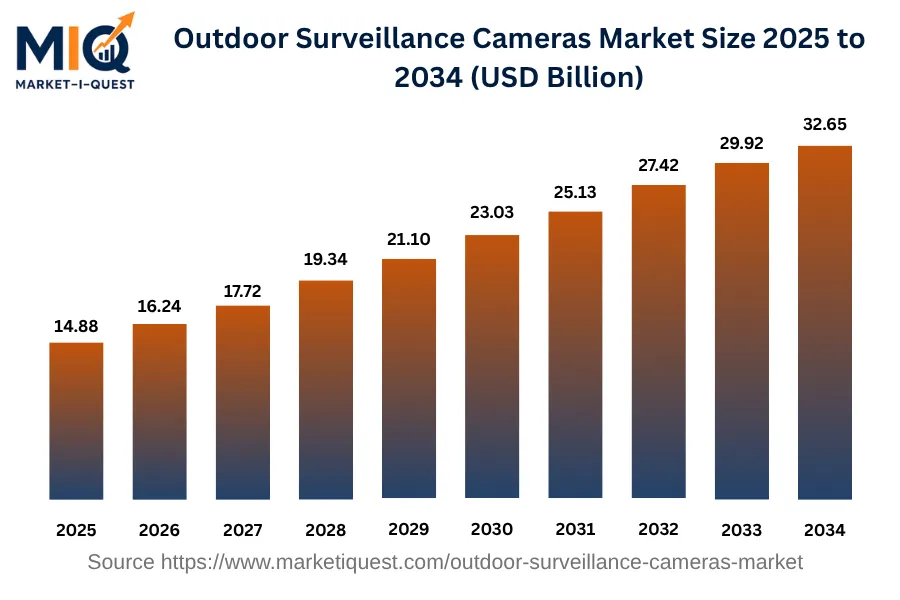
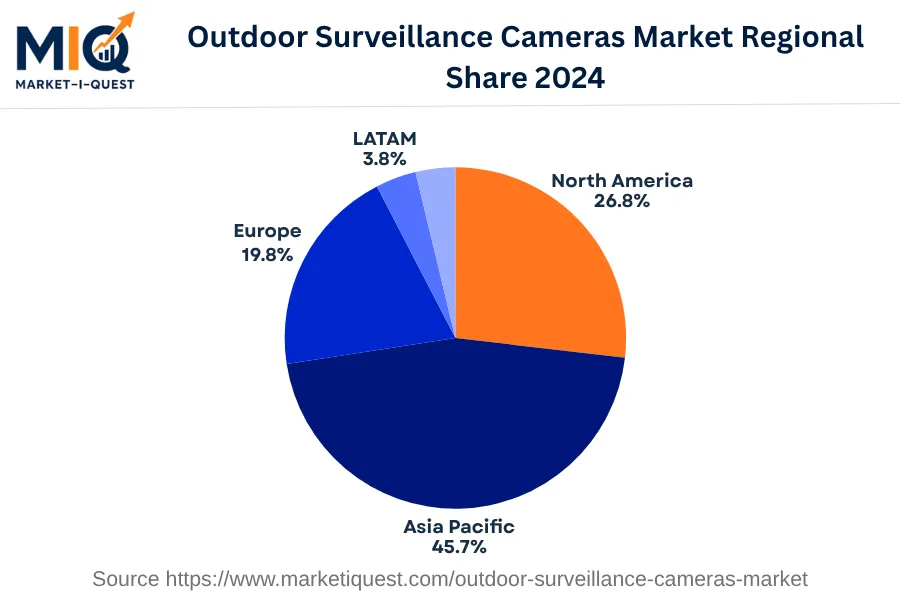
The Outdoor Surveillance Cameras Market was valued at 14.88 billion USD in 2025 and is expected to increase to 32.65 billion USD by 2034, with a CAGR of 9.12%. This substantial upsurge signals a substantial over two-fold increase in the market from the base year 2024, where the market was 13.64 billion USD. This escalation exemplifies a steady annual increase over a period of nine years, notwithstanding the already considerable market size in 2025. The regional shares of the market in 2024 were distributed as follows: Asia Pacific accounted for the largest proportion of the market with 45.72%, followed by North America at 26.84%, and Europe at 19.84%. Regions with smaller market shares included LATAM and MEA, which held 3.84% and 3.76% of the market, respectively.

Key Takeaways

  • By Product Type - Dome Cameras dominated accounting for the largest market share in 2024.
  • By Technology - Analog held the lead with an overwhelming majority of market share in 2024.
  • By Resolution - Full HD Surveillance Cameras were the prevailing segment with significant market share in 2024.
  • By Distribution Channel - Offline Stores were the leading channel holding a vast majority of the market share in 2024.
  • By Application - Commercial sector emerged as the top consumer accounting for the highest market share in 2024.
outdoor-surveillance-cameras-market market size

Key Driving Factors

Increasing Adoption of Smart Home Technologies

Smart home technologies are gaining traction globally, with homeowners increasingly adopting automation solutions to enhance safety and convenience. Outdoor surveillance cameras are a significant component of these systems, providing round-the-clock security for residential properties. These devices can be remotely accessed and controlled via smartphones or tablets, offering real-time alerts of suspicious activities. Their integration with other smart devices, like alarms or smart doorbells, provides a comprehensive home security solution. This interoperability requirement, fueled by the growing consumer preference for interconnected, smart home system, is a significant driving force for the outdoor surveillance cameras market. Moreover, device manufacturers are constantly developing innovative features, such as face recognition and motion detection, making these cameras a more attractive security option for homeowners.
Stringent Municipal Regulations on Public Safety

In many regions, municipal bodies and local government agencies are enforcing stringent regulations that require surveillance systems in public places, commercial establishments, and residential communities. As part of these regulations, outdoor surveillance cameras are often required to maintain safety and monitor potential unlawful activities. These measures help deter crime, resolve disputes, and aid law enforcement agencies in investigating incidents more efficiently. In response to this regulatory push, businesses, public institutions, and community associations are increasingly adopting outdoor surveillance cameras, contributing to the market's growth. As security concerns persist in both urban and suburban locations, the demand for outdoor surveillance cameras are expected to continue to climb.

Market Evolution by Timeline

2019-2023
In this period, buyers were largely households and businesses, particularly in urban areas like Tokyo and New York City where security concerns were high. Major manufacturers such as Hikvision and Dahua Technology shipped models with wireless technologies and night vision capabilities. However, integration options with existing security systems were still maturing. EU's General Data Protection Regulation (GDPR) imposed constraints on data usage, causing manufacturers to add usage consents to camera software. Common commercial model involved direct sales or via third-party retail outlets. Pricing varied depending on features, with premium models being significantly more expensive. Main risks included hacking and non-compliance with GDPR.
2024
In 2024, institutions such as schools and hospitals were significant buyers, with higher uptake in countries like Canada and Germany. New entrants shipped cameras equipped with facial recognition technology, yet restrictions expressed in the facial recognition policy posed a challenge. Moreover, 'pay per usage' model emerged as an alternative to the upfront payment model. Demand for cloud storage solutions also grew, leading to partnerships between camera manufacturers and cloud providers. The main risk continued to be compliance with data protection regulations.
2025-2029
Between 2025 and 2029, governments in cities like London and Sydney invested in outdoor surveillance cameras for public safety. 5G technology enhanced the transmission of high-quality videos, but infrastructure limitations outside urban areas were fences. An updated GDPR imposed new requirements for data management, influencing camera product designs to include privacy shields. Subscription services for additional features or storage became more popular, resulting in collaborations with service providers. As a mitigation against cyber threats, manufacturers often shipped cameras with embedded security software.
2030-2034
In the period of 2030–2034, developers of smart cities, like Dubai and Singapore, incorporated this technology for traffic management. Solar-powered cameras were introduced but were subject to weather conditions. The shift towards the Internet of Things (IoT) standards influenced how cameras were integrated with other devices. Subscription-based contracts became the norm, with tiered pricing based on features. One persistent risk was the susceptibility of cameras to hacking and manufacturers continued to invest in cybersecurity measures to protect against this.

Future Market Outlook

Future Opportunities

The future of the outdoor surveillance camera market is closely linked to the ongoing advancements in connectivity and IoT technologies. With 5G networks continuing their rollout worldwide, particularly in regions like North America and parts of Asia, low-latency data transfer is expected to facilitate the deployment of more sophisticated surveillance systems. Partnerships between technology companies and municipalities are emerging, such as those seen in Los Angeles with a focus on improving public safety through integrated surveillance networks. Additionally, the trend towards home automation presents significant opportunities, as connectivity through platforms like Amazon Alexa or Google Home becomes commonplace. Companies like Lorex are already integrating surveillance cameras with smart home systems, paving the way for comprehensive security solutions. The demand for enhanced cybersecurity measures also presents opportunities, particularly with regulatory frameworks like the California Consumer Privacy Act urging companies to prioritize data security in their offerings. The rise in urbanization and corresponding safety concerns may drive investments in surveillance technologies for urban environments, especially in regions grappling with crime rates. Furthermore, as environmental sustainability becomes a priority, manufacturers are encouraged to develop energy-efficient devices, which could lead to innovations in solar-powered cameras, offering both efficiency and sustainability to consumers. These factors collectively point towards a dynamic evolution of the outdoor surveillance camera market in the coming years.

Segmentation Analysis

By Product Type

The market is divided into subsegments including Bullet Cameras, Dome Cameras, PTZ Cameras, Box Cameras, and Others. Dome Cameras accounted for the largest revenue share while PTZ Cameras are expected to grow at the fastest CAGR during the forecast period.

Largest Revenue Share

Dome Cameras

Market Share Leader

Dome Cameras dominate the market revenue due to their versatile functionality and widespread application in different venues. These cameras provide a broad variety of visual coverage options, facilitating indoor and outdoor security. Dome Cameras are preferable by many businesses due to their discreet appearance and high-resolution image quality. Especially in geographic regions with significant commercial construction activities, such as Asia Pacific, the uptake of Dome Cameras has been substantial. In this segment, the demand escalation is driven by the increasing adoption in retail stores, offices, and educational institutions where comprehensive surveillance helps enhance security and mitigate risks. The purchasing criteria for Dome Cameras majorly orbit around image quality, coverage range, durability, and cost-efficiency, making them the chosen type for a variety of customer segments. Lower switching costs and broad availability through various distribution channels also contribute to their largest revenue share.

Fastest CAGR

PTZ Cameras

Forecast Period Growth Leader

Projected to grow at the fastest CAGR, PTZ (Pan-Tilt-Zoom) Cameras are becoming the preferred solution in specific, high-security requirement scenarios. Key drivers for this subsegment's growth include its distinct feature of remote directional and zoom control, a capability that is significantly enabling advanced surveillance, especially in critical sectors like military and law enforcement. Additionally, advancements in camera technology and incorporation of AI are acting as growth catalysts by enabling autonomous detection and tracking features in PTZ Cameras. Despite their higher upfront cost, the total cost of ownership is often justified by their superior functionality. It is also noteworthy, however, that the transition from traditional surveillance solutions to PTZ Cameras might witness some friction due to adoption barriers, rooted in cost and operational complexity of these cameras. With the constant evolution in technology and capacity collaborations, these barriers are expected to lower, boosting the subsegment's growth further.

By Technology

The market is divided into subsegments including Analog and IP. Analog accounted for the largest revenue share while IP is expected to grow at the fastest CAGR during the forecast period.

Largest Revenue Share

Analog

Market Share Leader

The Analog subsegment leads the market in terms of revenue primarily due to its historical presence and deep-rooted establishment in a wide variety of sectors. Analog technology has existing infrastructure in various industries, which includes manufacturing, healthcare, and transportation, ensuring its continued utilization. Moreover, analog-based devices have proven to be robust and reliable for long-term use, which continues to attract consumers and industries alike. Key geographic regions, particularly developing economies, have significant investments in the analog domain due to lower costs and higher accessibility. Regulatory environments in some regions also favor analog due to its security features and tested functioning. Analog's enduring relevance is dictated by purchasing criteria based primarily on cost-efficiency and dependability. The delivery channels for analog are well defined with minimal switching costs, adding to the segment's attractiveness. Despite technological advancements, the foundational status of analog technology positions it as the subsegment with the most substantial revenue share in the base year 2024.

Fastest CAGR

IP

Forecast Period Growth Leader

Looking at future projections, IP is positioned as the fastest-growing technology subsegment in the market. This rapid growth is mainly attributed to the rapid adoption of internet-based services and the digital transformation across many industries. As companies continue to seek efficiency and scalability, IP technology, with its superior features such as higher speed and capacity, is becoming increasingly favorable. Technology developments, such as IoT and cloud-based services, are catalysts, further promoting the shift towards IP. However, adoption barriers exist, primarily related to the required capital expenditure and the challenge of integrating IP into existing systems. Regulatory changes, aiming towards digitalization, are expected to support the IP subsegment's growth. Partnerships between tech companies and businesses looking to digitize operations are becoming increasingly prevalent, providing a substantial push for the IP market. However, near-term risks such as cyber-security and data privacy concerns could potentially impede the pace of growth, but the overall outlook remains significantly positive.

By Resolution

The market is divided into subsegments including HD, Full HD, 4K, and Others. Full HD accounted for the largest revenue share while 4K is expected to grow at the fastest CAGR during the forecast period.

Largest Revenue Share

Full HD

Market Share Leader

Full HD, otherwise known as 1080p, is the most prevalent resolution used by consumers in 2024. Its dominance is primarily driven by its widespread adoption due to the perfect balance it provides between cost and quality. As this technology has matured, the cost of manufacturing Full HD displays has significantly gone down, making it the go-to option for customers wanting superior quality at a reasonable price. Moreover, customers who are upgrading from standard HD find Full HD to be a considerably noticeable improvement, further stimulating its demand. The presence of Full HD content is abundant across all media platforms, again making it a prime choice amongst users. Additionally, regulatory environments in several geographies encourage broadcasting in digital formats, which often implies Full HD resolution. Despite the emergence of higher resolutions like 4K and 8K, the ubiquity of Full HD across all types of media and devices ensures its leading position in revenue terms.

Fastest CAGR

4K

Forecast Period Growth Leader

4K, or Ultra HD, is projected to witness the fastest growth in the upcoming years. This growth is underpinned by a number of catalysts. Technological advancements are undoubtedly a major driver, providing significantly better clarity and detail. Improved internet speeds and data capacities have enabled easier streaming of 4K content, which has become increasingly popular on platforms like YouTube and Netflix. The higher capital expenditures on 4K technology by major manufacturers illustrate the buoyant future the technology holds. As technology companies continue to push the boundaries of visual fidelity, partnerships have formed with content creators to produce more 4K content, further driving the uptake. However, the higher price points and the limited availability of 4K content present immediate adoption barriers. It is also worth noting that while demand for 4K is rising, any adverse events affecting economies could defer non-essential expenses like upgrading to 4K, posing a near-term risk.

By Distribution Channel

The market is divided into subsegments including Online Stores and Offline Stores. In 2024, Offline Stores accounted for the largest revenue share while Online Stores are expected to grow at the fastest CAGR during the forecast period.

Largest Revenue Share

Offline Stores

Market Share Leader

Offline Stores continue to dominate the market owing to several factors. Despite the rise of e-commerce, consumers still appreciate the tangible shopping experience offered by brick-and-mortar stores. The ability to physically inspect products before purchase, immediate gratification of carrying the product home, and face-to-face customer service are some major drivers propelling the offline stores revenues. In addition, offline establishments can provide instant access to products for consumers not inclined to wait for shipping. Geographic regions where internet penetration is still low also contribute to the greater revenues of offline stores. The regulatory landscape also favors offline retailers in some regions, where online sales face more complex compliance obligations. Purchasing criteria that favor offline stores include convenience, immediate product availability, and aftersales services. Many consumers demonstrate a preference for buying from stores where they've had positive past experiences, leading to significant switching costs for the online competitors in these cases.

Fastest CAGR

Online Stores

Forecast Period Growth Leader

Online Stores are projected to grow at the fastest CAGR in the forecast period. The dominant growth drivers for this segment include the rising internet penetration globally and increased comfort among consumers in making online purchases. Online stores provide customers with wider product choices, convenience of shopping from home, and often, better prices than physical stores. Improvements in payment infrastructure and logistics have reduced barriers to e-commerce adoption. Technology has also acted as a significant growth catalyst, with advances in digital marketing and AI-powered recommendations driving more traffic to online stores. Partnerships with delivery and logistics providers have expanded the reach of online retailers, increasing their customer base. However, near-term risks such as cybersecurity threats and privacy concerns are challenges that online stores need to continuously address. Finally, significant investments in customer experience and personalization technologies are expected to drive the growth of this segment.

By Application

The market is divided into subsegments including residential, commercial, industrial, government, and others. Among these, the commercial sector was found to account for the largest revenue share, while the industrial sector is expected to grow at the fastest CAGR during the forecast period.

Largest Revenue Share

Commercial

Market Share Leader

The commercial sector led the market in terms of revenue in 2024. A few reasons why the commercial sector is the revenue leader include the high volumes of operating processes running simultaneously, which demand efficient solutions. Coupled with mass consumer engagement and commercial transactions, these activities often generate significant revenue. Furthermore, technological advancements and the adoption of progressive strategies to enhance customer experience play a pivotal role in this segment's growth. Developed geographies with thriving business climates facilitate more commercial activities, contributing to the subsegment's leading revenues. Also, regional regulatory norms incite businesses to adopt efficient workflow processes, which subsequently lead to increased market returns. Understanding customer purchasing decision criteria and reducing potential switching costs by providing value-added services could also lead to revenue growth in this sector. The widespread utilization of direct and indirect distribution channels optimizes operations in the commercial sector, facilitating the high revenue generation.

Fastest CAGR

Industrial

Forecast Period Growth Leader

The industrial sector is projected to record the fastest growth, given its rapid adoption of innovative technologies and its massive capital expenditure capacity. The introduction of advanced manufacturing technologies and a surging focus on digital transformation across industries act as pivotal growth drivers. While initial adoption flow may be hindered by reluctance to change traditional operating processes or the high initial capital investment, strategic partnerships, and collaborations with technology providers could ease these entry barriers. As we move forward, the industrial segment bears potential risks related to the management of technological advancements and maintaining regulatory compliance. Nonetheless, these risks could be managed with strong process control and regulatory adherence systems. Thus, the prospects of exponential growth within the industrial sector, driven by technological evolution, policy directives, and capital investments, remain promising.

Competitive Analysis: Outdoor Surveillance Cameras Market

Key Market Players

Manufacturers / OEMs

Hikvision
China
Dahua Technology
China
Axis Communications
Sweden

Key Suppliers & Raw Materials

Sony Semiconductor Solutions
Japan
Bosch Security Systems
Germany
Seagate Technology
US

Distributors, Integrators & Channel Partners

ADT
US
Convergint Technologies
US
Stanley Black & Decker
US

Porter’s Five Forces Analysis

Analysis of the competitive forces impacting the outdoor surveillance cameras market.

Supplier Bargaining Power

Medium

Diverse supplier base, but dependency on specialized components can increase power.

Buyer Bargaining Power

High

Increasing consumer awareness and product standardization enhance bargaining power of buyers.

Threat of Substitutes

Low

Few alternatives available that can match the functionality of outdoor surveillance cameras.

Threat of New Entrants

Medium

Advancing technology lowers entry barriers, but capital-intensive nature of production and marketing can deter new entrants.

Competitive Rivalry

High

Intense competition due to the presence of several key players and rapid technological advancements.

Regional Analysis

Geographic market dynamics and growth opportunities across key regions

Global Market Outlook

outdoor-surveillance-cameras-market market regional share

North America

In 2024, the North American Outdoor Surveillance Cameras Market was defined by heightened safety concerns, technology progression, and robust investment.

Several key drivers shaped the market. Rising crime rates, particularly in urban areas in the U.S., Canada, and Mexico, increased demand for outdoor surveillance systems. Government regulations, such as the U.S. Federal Trade Commission's guidelines for security camera installations, also drove market growth. Additionally, rapid technology adoption, with advancements in artificial intelligence and video analytics, propelled the need for more advanced surveillance systems. Infusion of capital into the development of smarter, more efficient security systems was another significant driver. Finally, the increase in supply of high-definition cameras and falling prices, due to economies of scale and intense competition, contributed to market expansion.

Trends within this market included changes in buyer behavior, with a shift toward wireless and solar-powered cameras for their environmental benefits and ease of installation. A shift in channel dynamics was also apparent, with online sales surging over conventional retail sales. Increased partnerships and mergers among leading companies, including Honeywell and Bosch, to enhance product capabilities was a prominent trend. The enforcement of stringent policies by governing bodies, ensuring high picture quality and minimum distortion for evidence gathering, influenced the standards in the market.

Major customers included sectors with a critical need for security, such as government properties, healthcare institutions, and large-scale manufacturing industries.

Asia Pacific

In 2024, the outdoor surveillance camera market in Asia Pacific exhibited substantial dynamism. Drivers included increased security concerns in China, Japan, India, South Korea, Australia, and key ASEAN markets, which boosted the demand for advanced surveillance systems. Chinese businesses and municipalities' massive investment in artificial intelligence technology resulted in rising adoption of AI-integrated surveillance cameras. In India, strict government regulations pertaining to public space surveillance facilitated market expansion. Meanwhile, competitive pricing strategies, particularly in China and Japan, underpinned supply dynamics.

Trends in the market foregrounded a shift towards wireless technology for better integration and ease of use. The increased prevalence of e-commerce channels, especially in China and India, influenced buyer behavior, prompting many enterprises to enhance their security infrastructure. Notable was the surge in acquisitions and strategic partnerships as leading players sought to consolidate market presence. Standards for outdoor surveillance devices gained more rigorous enforcement, particularly in Japan and South Korea.

Overall, sectors such as retail, manufacturing, and government were significant consumers of outdoor surveillance cameras as part of their security measures. Applications in healthcare and utilities were also prevalent, particularly in developed markets such as Australia, Japan, and South Korea. Despite diverse market environments across these countries, the commonality was an intensified demand for outdoor surveillance cameras in 2024.

Europe

In 2024, Europe's outdoor surveillance cameras market experienced significant advancements. Drivers influencing the market included heightened security concerns across sectors like government, retail, and manufacturing, that bolstered demand. The adoption of advanced technological solutions, particularly AI-based analytics, fueled the sector's growth. European nations saw an increased infrastructure investment, especially in Germany, the UK, and France, stimulating demand for high-end surveillance systems. Additionally, regulatory mandates for enhanced security measures, particularly in the UK and Benelux regions, provided a significant impetus.

Trends observed in 2024 were largely dictated by evolving buyer behavior and technological shifts. The proliferation of smart cities in Central and Eastern Europe increased the adoption of IP-based surveillance systems, while in Spain and Italy, the demand soared for solar-powered and wireless cameras for easy installation and minimal maintenance. A significant trend was the rise of partnerships and M&A activities, particularly in Nordic countries, aiming to enhance product capabilities. With GDPR enforcement, greater emphasis was placed on data privacy and protection, reshaping surveillance norms, particularly in sectors handling sensitive information. Lastly, the shift towards cloud-based storage solutions was noticeable, aiding in efficient data management and remote accessibility.

Latin America

In 2024, the Outdoor Surveillance Cameras Market witnessed a solid growth in Latin America, driven primarily by public safety requirements and rapid urbanization. Governments investing heavily in smart city projects, particularly in Brazil and Mexico, played a massive role, endorsing a surge in surveillance infrastructure. Additionally, stringent regulation enforcement in countries like Argentina and Chile to counter criminal activities propelled the demand. The lowering costs of surveillance technology, coupled with advancements in Wi-Fi, 4G, and artificial intelligence, enabled widespread adoption, further energizing market growth.

The year noticed an upsurge in buyer preference towards intelligent surveillance solutions as continuous tech transformations marked an evident shift from traditional security systems. Efficient channel dynamics were observed in retail and manufacturing sectors due to increased partnership and merger activities to leverage integrated solutions. Furthermore, the rise in policies emphasizing data protection and privacy profoundly impacted the market, causing an evident shift towards secure and encrypted surveillance systems, especially within government, healthcare, and utility sectors. Companies offered solutions that integrated facial recognition, motion detection, and automatic reporting, highlighting the prominence of innovation in product features, that noticeably influenced customer purchase patterns. Overall, 2024 saw the LATAM outdoor surveillance cameras market positively responding to technology integration and regulatory landscapes.

Middle East & Africa

In 2024, the Outdoor Surveillance Cameras Market in the Middle East and Africa experienced a surge in demand, driven by several factors. Firstly, heightened security concerns in countries like Israel and Nigeria propelled the use of these cameras, particularly in government, oil and gas, and telecom sectors. Secondly, regulatory changes in Saudi Arabia and the United Arab Emirates, which enforced stricter surveillance standards in healthcare facilities and commercial establishments, boosted the market. Lastly, increased foreign and domestic investment in smart cities across Qatar and the UAE led to advanced technology adoption, improving supply dynamics and camera performance.

Trends in 2024 were shaped by several shifts, including changes in buyer behavior and technological advancements. In regions like South Africa and Kenya, the demand for high-resolution surveillance cameras saw a significant rise due to the increasing crime rates. There was also a noticeable shift towards IP-enabled technology in Egypt and Saudi Arabia in an effort to enable seamless monitoring of large areas. Partnerships between technology providers and local firms flourished due to the enforcement of data localization policies in countries like UAE. Finally, due to rigorous policy enforcement, surveillance in sensitive sectors, such as financial services in Israel and retail in Nigeria, increasingly relied on high-quality outdoor surveillance cameras.

Recent Industry Developments

Latest market innovations, product launches, and strategic initiatives

January 2026

Market concentration metrics confirmed that global security leaders—including Hikvision, Dahua Technology, Axis Communications, Hanwha Vision, and Motorola Solutions—controlled over 80% of the commercial IP camera sector.

September 2025

Dahua Technology introduced its WITHS wireless surveillance camera series, featuring edge-AI object classification, solar-rechargeable power options, and IP67 weather-rated enclosures designed for commercial and municipal outdoor security.

Frequently Asked Questions