Outdoor LED Display Market Snapshot

Key Players

  • Barco (Belgium)
  • Daktronics (United States)
  • Leyard Optoelectronic (China)
  • LG Electronics (South Korea)
  • Sony (Japan)
  • Panasonic (Japan)
  • Samsung Electronics (South Korea)
  • Unilumin (China)
  • Lighthouse Technologies (Hong Kong)
  • AOTO Electronics (China)

Market Size

Base Year 2024
$9.28 Bn
CAGR
8.43%
Forecast 2034
$20.85 Bn

Market Segments

By Technology
  • Individually Mounted
  • Surface Mounted
By Color Display
  • Monochrome Display
  • Tri-Color Display
  • Full Color Display
By Application
  • LED Billboards
  • Perimeter LED Boards
  • LED Mobile Panels
  • LED Traffic Lights
  • LED Video Walls
  • Others

Market Dynamics

Drivers
  • Rising outdoor advertising trends
  • Increasing technological advancements
Restraints
  • High installation costs
  • Lack of standardization
Opportunities
  • Increasing eco-conscious consumer base
  • Technological advancements in LED technology

Market Size

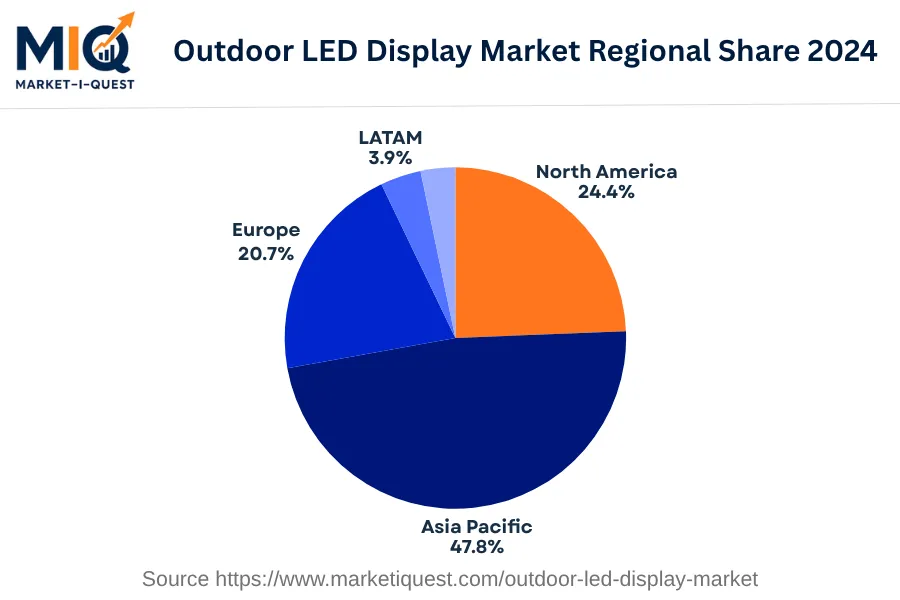
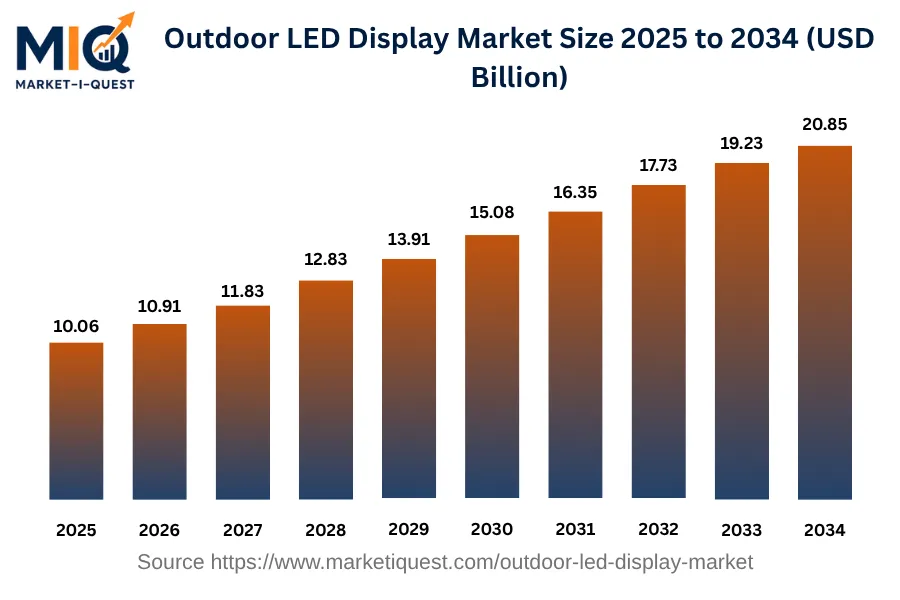
The Outdoor LED Display Market in 2025 is projected to be worth $10.06 billion, a notable increase from the value of $9.28 billion in 2024. The market is expected to continue growing, reaching $20.85 billion by 2034. This corresponds to a CAGR of 8.43% over the period from 2025 to 2034. The growth in the market size can be attributed to the advancements in technology over the years and the rising demand for high-resolution, large-screen displays. Furthermore, the rising popularity of digital outdoor advertising is also contributing to the expansion of the market size. As for the regional market share in 2024, Asia Pacific held the largest share at 47.82%, followed by North America at 24.36%, and Europe at 20.68%. The shares of Latin America and the Middle East and Africa were lower, standing at 3.86% and 3.28% respectively.

Key Takeaways

  • By Technology - Surface Mounted led the Outdoor LED Display Market accounting for a significant share in 2024.
  • By Color Display - Full Color Display held a dominant position in 2024 covering a major part of the market.
  • By Application - LED Traffic Lights were the fastest-growing expanding at a notable rate in the period 2025-2034.
outdoor-led-display-market market size

Key Driving Factors

Increasing Adoption of Outdoor Advertising

One of the prominent factors that spur the growth of the outdoor LED display market is the escalating adoption of outdoor advertising among businesses. With high brightness, vivid colors, and adaptability to varying weather conditions, LED displays have become an optimal choice for many firms aiming to improve their outdoor advertising strategies. These displays grab attention from pedestrians and motorists in high-traffic areas, serving as a constant reminder of the company's products or services. With more businesses recognizing this value, the demand for outdoor LED displays is projected to continue its upward trajectory.

Integration of Enhanced Features in LED Displays

Another factor contributing to the growth of the outdoor LED display market is the integration of advanced features into these LED displays. Manufacturers are now incorporating interactive interfaces, touch screens, motion sensors, and high-definition resolutions in their offerings. These enhancements not only improve customer engagement and content visibility but also promote adaptability and functionality of displays across different environments and lighting conditions. As businesses seek ways to stand out in a competitive market, these upgraded outdoor LED displays provide them with a differentiated and memorable advertising platform, which subsequently drives the demand.

Market Evolution by Timeline

2019-2023
During this period, sporting arenas, entertainment establishments, and transport sectors were the primary buyers of outdoor LED displays. One key reason driving their adoption was the increased visibility provided, even under substantial ambient lighting. Asia-Pacific, specifically China, dominated the market due to its strong manufacturing capacity. Single-color displays were more common as they were more economical. Pricing majorly was influenced by the pixel pitch value and the display size. However, manufacturing constraints such as the need for high initial investment and complex fabrication process tempered growth. Regulations like Europe's RoHS regulated the usage of harmful substances in manufacturing. Risks during this period majorly constituted of sourcing raw materials and managing high initial investment.
2024
In 2024, advertising companies emerged as key buyers, leveraging outdoor LED displays for urban marketing. Reduced manufacturing costs led to increased adoption, especially in regions like North America and Europe. Technological innovation saw the emergence of multi-color pixel displays, introducing new complexity to the integration process. Energy consumption standards forced manufacturers to look for energy-efficient solutions. Prices started being more variable due to diverse configuration options. Raw material supply became less of an issue, while optimizing energy efficiency in line with regulatory requirements remained a challenge.
2025-2029
During these years, retail buyers joined the market, lured by the latter's increased customizability and efficiency. Innovations like touch-screens and interactive LED displays were introduced during this period. South America's market share grew notably with rising tourism, which fueled demand for displays in attractions and hospitality industry. Environmental regulations got stricter, leading to increased use of eco-friendly, low-power-consuming displays. The common procurement model included comprehensive after-sales service contracts. A major risk was the potential for market saturation, prompting manufacturers to look for distinctive product features.
2030-2034
From 2030 to 2034, digital billboards and smart city projects contributed to the demand for outdoor LED displays. Majorly adopted in densely populated urban regions, these displays were preferred due to their ability to disseminate information effectively. Africa experienced a surge in demand, spurred by multiple smart city projects in this period. Technological advancements saw the introduction of AI-powered LED displays, which significantly improved the display experience. Procurement models leaned towards leasing options owing to the high upfront cost of these advanced displays. The increased complexity of these displays posed a challenge for manufacturers in meeting regulatory norms.

Future Market Outlook

Future Opportunities

Future opportunities in the outdoor LED display market are poised to emerge from the evolving landscape of urban advertising and public information systems. As cities worldwide embrace digitization, municipalities are increasingly targeting modernized infrastructures, which presents growth avenues for outdoor displays. For instance, in 2023, New York City initiated a partnership with several tech firms to deploy smart billboards that display real-time transit information. The uptake of 5G networks is expected to propel content streaming capabilities on outdoor displays, as telecommunications providers roll out upgrades that will enable faster data transmission. In Australia, local councils are exploring the integration of LED displays into public transport systems for enhanced communication with commuters. Moreover, sustainability trends are prompting companies to invest in recyclable materials and energy-efficient displays, as seen with Philips and their latest eco-friendly models launched in 2023. Regulatory frameworks such as the European Union's Green Deal pave the way for environmentally responsible manufacturing practices, which create market demand for eco-conscious products. There is ongoing interest in incorporating data analytics into outdoor advertising strategies, leveraging consumer behavior insights to maximize advertising impact. Additionally, advancements in AR technology are likely to enrich the user experience, as firms like ARHT Media focus on interactive holographic displays. Through these directions, the outdoor LED display market can position itself at the forefront of technological integration and sustainable development in urban environments.

Segmentation Analysis

By Technology

The market is divided into subsegments including Individually Mounted and Surface Mounted technologies. The Surface Mounted technology accounted for the largest revenue share while Individually Mounted technology is expected to grow at the fastest CAGR during the forecast period.

Largest Revenue Share

Surface Mounted

Market Share Leader

The Surface Mounted technology subsegment leads the market in terms of revenue generation. This can majorly be attributed to the technology's cost-effectiveness, flexibility, and superior performance characteristics. Surface Mounted technology offers a higher degree of automation which translates into fewer errors during assembly, increased production rates, and ultimately lower costs. This makes it a preferred choice for electronics manufacturers requiring high production volume. Additionally, the compact design of Surface Mounted devices enables higher circuit densities, thus enhancing the functionality of devices. Geographically, the adoption of this technology has been widespread, with particularly high uptake in economies with strong electronics manufacturing sectors such as China and South Korea. Other factors driving its revenue dominance include regulations encouraging energy-efficient technologies, robust supply chains, and the increasing incorporation of electronics in varied sectors, from healthcare to automotive. Although the market is competitive, firms leveraging this technology have managed to sustain their margins owing to factors like technologically advanced products, strong distribution channels, and long-term customer relationships.

Fastest CAGR

Individually Mounted

Forecast Period Growth Leader

The Individually Mounted technology subsegment is anticipated to register the fastest growth during the forecast period. This segment's growth will be bolstered by its wide application in bespoke, high-performance electronics systems. Individually Mounted technology ensures higher precision and customization, thereby making it a fitting choice for design-intensive industries such as aerospace, military and healthcare. However, initial adoption barriers such as the need for greater manual assembly and potential for higher error rates could slow down the uptake. Nevertheless, technology advances are expected to mitigate these issues, making it more attractive for manufacturers seeking to differentiate their offering. Moreover, capital investments in machinery and workforce training will likely become more feasible as growth prospects and returns become more evident. Policymakers could also support this growth through initiatives fostering innovation and technical skills development. The next few years may contain some unanticipated challenges, but the long-term outlook for this subsegment is unequivocally positive.

By Color Display

The Color Display market is divided into three subsegments, Monochrome Display, Tri-Color Display, and Full Color Display, with Full Color Display accounting for the largest revenue share while Tri-Color Display is expected to grow at the fastest CAGR during the forecast period.

Largest Revenue Share

Full Color Display

Market Share Leader

Full Color Display subsegment takes the lead in generating revenue within the Color Display market in 2024. A key driver for this subsegment's dominance is the increasing demand for high-quality display screens across various industries such as consumer electronics, automotive, and entertainment sector. Specifically, the growth in the sale of devices such as smartphones, televisions, computers, digital signage, and car display systems employing Full Color Display technology significantly contributes to this growth. Furthermore, customer preference for vibrant and lifelike display quality, coupled with increasing applications in augmented reality (AR) and virtual reality (VR) technologies, have led to a surge in the uptake of Full Color Displays. Geographically, markets with high consumer purchasing power and robust consumer electronics industries, such as North America and Asia Pacific, provide substantial revenue. While regulatory factors do not significantly impact this market, manufacturing and supply chain efficiencies remain crucial for maintaining cost competitiveness.

Fastest CAGR

Tri-Color Display

Forecast Period Growth Leader

The Tri-Color Display subsegment is expected to witness the fastest growth within the Color Display market. Key growth drivers of this subsegment include its optimal balance between visual quality and power consumption, making it a preferred choice for many battery-operated devices. Further, the hybrid nature of Tri-Color Displays, offering reasonable color variety without the complexity and cost associated with Full Color Displays, positions it as a cost-effective alternative for medium-range devices. Despite initial adoption barriers due to its less vibrant display compared to Full Color Displays, advancements in display technology and strategic partnerships in the industry are anticipated to boost the adoption of Tri-Color Displays. The need for energy-efficient display solutions in growing applications such as wearable devices and Internet of Things (IoT) products will act as additional catalysts for growth. However, potential risks include significant competition from monochrome and full color display technologies and price sensitivity among budget-conscious consumers.

By Application

The market is divided into subsegments including LED Billboards, Perimeter LED Boards, LED Mobile Panels, LED Traffic Lights, LED Video Walls, and Others. In 2024, LED Billboards accounted for the largest revenue share while LED Traffic Lights is expected to grow at the fastest CAGR during the forecast period.

Largest Revenue Share

LED Billboards

Market Share Leader

The LED Billboard subsegment accounted for the largest share of revenue in 2024 primarily due to their significant demand in advertising and promotional activities. In a world that's increasingly digital, LED Billboards offer bright, dynamic displays that can grab attention in ways traditional billboards can't. This can boost the visibility of brands or messages, driving consumer interaction and engagement. The audience's response to these displays is high, with many people recalling the brand or offer displayed. Furthermore, LED billboards' prominence in high traffic areas such as highways or city centers also contributes to their revenue dominance. Their larger-than-life presence ads cannot easily be ignored or overlooked by passers-by, further solidifying their position as a high revenue generator in the LED market.

Fastest CAGR

LED Traffic Lights

Forecast Period Growth Leader

Expected to grow at the fastest CAGR over the forecast period, LED Traffic Lights has several growth drivers. Firstly, there's increasing awareness and adoption of energy-efficient solutions on a global scale. LED traffic lights use less electricity than incandescent counterparts, leading to lower operational costs and a smaller carbon footprint. This is extremely attractive to city planners and governments. Secondly, the durability and longevity of LED lights, which reduces maintenance costs, could make them a sought-after choice for traffic management systems. Regulatory changes encouraging the use of energy-efficient solutions can be a significant catalyst driving future demand. The transition to LED lights in traffic signals, however, may face barriers due to the initial set-up costs, especially in developing and underdeveloped markets. But the long-term cost savings and environmental benefits would likely drive their adoption in the years to come.

Competitive Analysis

Key Market Players

Manufacturers / OEMs

LianTronics
China
Daktronics
US
Unilumin
China

Key Suppliers & Raw Materials

Cree Inc.
US
San'an Optoelectronics
China
Nichia Corporation
Japan

Distributors, Integrators & Channel Partners

NEC Display Solutions, Ltd.
Japan
Barco NV
Belgium
Ingram Micro Inc.
US

Porter’s Five Forces Analysis

This is an analysis of the competition, customers, suppliers, and threats in the Outdoor LED Display Market.

Supplier Bargaining Power

Medium

Suppliers influence is decent since the raw materials needed are not scarce but critical.

Buyer Bargaining Power

High

Abundance of sellers and increasing technological advancements grants buyers immense leverage.

Threat of Substitutes

Medium

Though other display technologies exist, outdoor LED displays have unique advantages.

Threat of New Entrants

Low

High capital expenditure and technological complexity serve as barriers to entry.

Competitive Rivalry

High

Numerous competitors with similar products intensify the level of competition.

Regional Analysis

Geographic market dynamics and growth opportunities across key regions

Global Market Outlook

outdoor-led-display-market market regional share

North America

In 2024, the Outdoor LED Display Market in North America was characterized by notable activity primarily in the U.S, Canada, and Mexico.

Driving factors for the market included increased demand for energy-efficient lighting systems as government regulations pushed for greener technology. Furthermore, considerable investment in infrastructure projects, particularly in the U.S., reciprocated into augmented demand for outdoor LED displays. Adoption of such technology had also grown due to its durability and better visibility features, resulting in a tightening of the supply and subsequent uptick in pricing.

Consumer patterns reflected a preference for high-quality displays, prompting technological shifts towards 4K resolution outdoor LED systems. The retail sector was particularly receptive to these changes, implementing such displays for creative outdoor advertising campaigns. Additionally, the era saw momentum in partnerships between LED manufacturers and tech firms such as Intel and Phillips, further consolidating the market. Changes in standards resulted in the production of LEDs that were all-weather resistant, while strict policy enforcement in manufacturing safe and secure outdoor LED displays also marked the year.

Thus, in 2024, the North American Outdoor LED Display Market saw a dynamic interplay between regulatory push, technological advancements, and consumer trends driving the market trends and determining the demands.

Asia Pacific

In 2024, the Outdoor LED Display Market in the Asia Pacific experienced significant growth. Drivers propelling this growth include heightened demand for energy-efficient and cost-effective advertising solutions across sectors like retail, hospitality, and government. Regulations promoting energy conservation, especially in China and Japan, further favored LED display adoption. Moreover, investments in digital infrastructure in India and ASEAN markets, alongside rapid technology adoption across the region, amplified LED demand.

Key trends observed in 2024 involve shifts in buyer behavior with increased preference for high-definition, interactive, and customizable LED displays, particularly in Australia's entertainment industry and South Korea’s retail sector. In China, there is a move towards integrating AI and IoT with LED displays in outdoor advertising. Notably, partnerships and M&A activities were prevalent in Japan and India as companies sought to consolidate market presence and enhance technical capabilities. Lastly, policy enforcement pertaining to screen brightness, energy consumption, and safety standards especially in ASEAN markets, gave a new direction to the industry, emphasizing environmental sustainability and user safety.

This year marked a pivotal point for the Asia Pacific outdoor LED display market, shaped by dynamic demand factors, progressive regulatory environment, and a shift towards smarter, multifunctional advertising solutions.

Europe

In 2024, Europe's outdoor LED display market experienced significant growth, driven predominantly by factors such as increased advertising expenditures, heightened awareness of energy efficiency, and rigorous legislation.

Specifically, companies across Germany, the UK, France, Spain, Italy, the Nordics, Benelux, and Central & Eastern Europe ramped up their investments in LED display technology to bolster brand visibility in an increasingly competitive market. Simultaneously, government initiatives promoting energy efficiency (like the UK's Carbon Budget) encouraged businesses to switch to LED displays over traditional options, positively influencing the supply dynamics. Moreover, stricter European regulations regarding outdoor lighting pollution further fueled the adoption of these displays.

With regards to trends, the market witnessed a surge in the demand for customized LED displays, primarily from sectors such as retail, hospitality, sports, and transportation. Businesses focused on enhancing customer engagement through personalized, interactive content. Additionally, the shift toward smart technologies led to the integration of software like AI in these displays, a trend particularly prevalent in the enterprise and manufacturing sectors. Despite the strong presence of direct sales channels, partnerships and mergers between LED display manufacturers and software providers clearly dominated the market sphere in 2024, driven by the omnipresent endeavor to efficiently capitalize on the capabilities of LED technology and software integration.

Latin America

In the base year of 2024, the Outdoor LED Display Market in Latin America (LATAM) experienced significant growth, spurred by varying factors. Increased investment in outdoor advertising led to higher demand for LED displays across areas such as Brazil, Mexico, Argentina, Colombia, Chile, and Peru. Government regulations encouraging energy-efficient technology adoption also prompted businesses, particularly in the retail and manufacturing sectors, to switch to Outdoor LED displays.

Technological advancements, particularly in display resolution, and competitive supplier pricing, further enhanced market attractiveness. However, high import tariffs and supply chain disruptions due the global situation posed challenges to market growth.

In terms of trends, buyers in enterprise and government sectors increasingly favored LED displays over traditional advertising mediums, driving market expansion. In Brazil and Mexico, partnerships and mergers & acquisitions amongst local and international vendors were noted, aimed at consolidating market share and forging strong supply chains. Standards for energy efficiency and eco-friendly materials were enforced strictly in most LATAM countries, leading to a shift towards LED displays in the public utilities and healthcare sections as well.

The Outdoor LED Display Market in LATAM thus experienced robust growth in 2024, driven by heightened demand, favorable regulations, and technology adoption, despite challenges such as high import costs and supply chain disruptions.

Middle East & Africa

In 2024, the Outdoor LED Display Market in the Middle East and Africa demonstrated dynamic growth due to various factors. Key drivers included increasing advertising expenditures in Saudi Arabia, digital transformation initiatives in the United Arab Emirates benefiting sectors such as retail and financial services, and high growth in smartphone penetration in South Africa, which altogether encouraged technology adoption. Additionally, the infrastructure development boom in Qatar for the FIFA 2024, as well as the shift toward digital billboards in prominent Egyptian cities, amplified regional demand.

Trends observed during the year were dominated by technological advancements and strategic collaborations. In Israel, the launch of government mandates for smart city initiatives fueled the installation of outdoor LED displays for public information. Meanwhile, integrated IoT capabilities in LED outdoor displays became more prevalent, spearheaded by technology-adaptive markets like Nigeria and Kenya. UAE's massive digital out-of-home (DOOH) advertising investments indicated a shift towards more interactive and personalized consumer engagement. Moreover, partnerships among LED display providers and telecom operators in the region such as Saudi Telecom Company's collaboration with Leyard were evident, enhancing local market competitiveness. Lastly, stricter policy enforcement for energy-efficient appliances was noticed across regions, pushing industries towards adopting LED displays, thus transforming the Outdoor LED Display Market landscape in the Middle East and Africa in 2024.

Recent Industry Developments

Latest market innovations, product launches, and strategic initiatives

September 2025

LG Electronics launched its LG MAGNIT ProAV Series MicroLED displays (LSAP series) integrated with Megapixel’s HELIOS® processing platform. The system features high-resolution MicroLED rendering, real-time pixel mapping, multi-user control, and auto-seam correction designed for large-scale outdoor and broadcast environments.

July 2025

Daktronics partnered with collegiate and professional sports venues—including a multi-screen installation across the University of Tennessee's sports complexes—to deploy perimeter LED boards and ribbon displays powered by live fan-engagement analytics engines.

Frequently Asked Questions