
Orthopedic Bone Cement Market Snapshot

Key Players

  • Stryker Corporation (US)
  • Zimmer Biomet Holdings Inc. (US)
  • Johnson & Johnson (US)
  • Smith & Nephew (UK)
  • Arthrex Inc. (US)
  • Medacta International (Switzerland)
  • CONMED Corporation (US)
  • Tecres S.p.A. (Italy)
  • Heraeus Holding (Germany)
  • DJO Global (US)

Market Size

Base Year 2024
$1.43 Bn
CAGR
5.67%
Forecast 2034
$2.48 Bn

Market Segments

By Product
  • Bone Cement Without Antibiotics
  • Antibiotic-Loaded Bone Cement
By Material
  • Polymethyl Methacrylate (PMMA)
  • Calcium Phosphate
  • Glass Polyalkeonate
By End Use
  • Hospitals
  • Outpatient Facilities

Market Dynamics

Drivers
  • Aging global population
  • Technological advancements in bone cements
Restraints
  • Risk of cement-associated complications
  • Regulatory compliance difficulties
Opportunities
  • Rising global geriatric population
  • Increasing incidence of orthopedic surgeries

Market Size

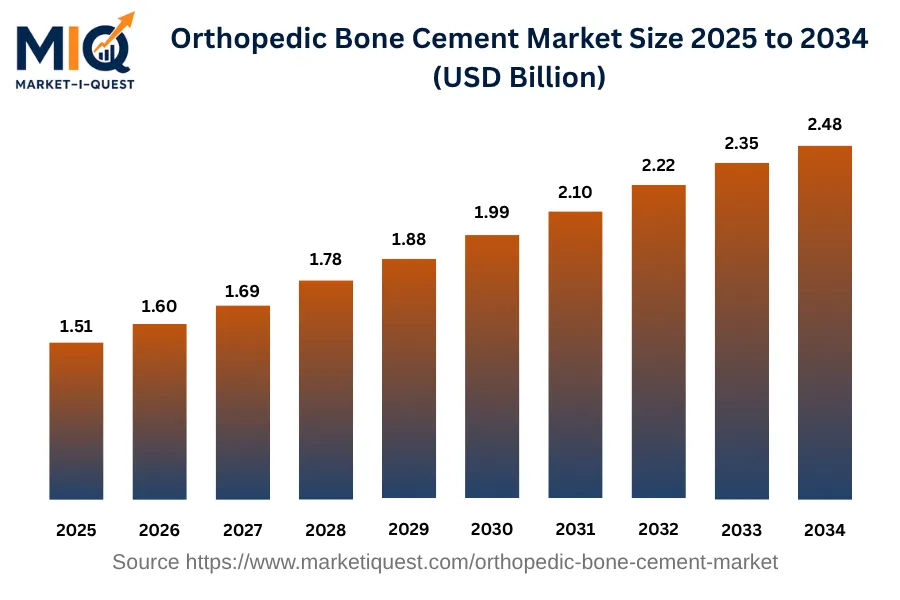
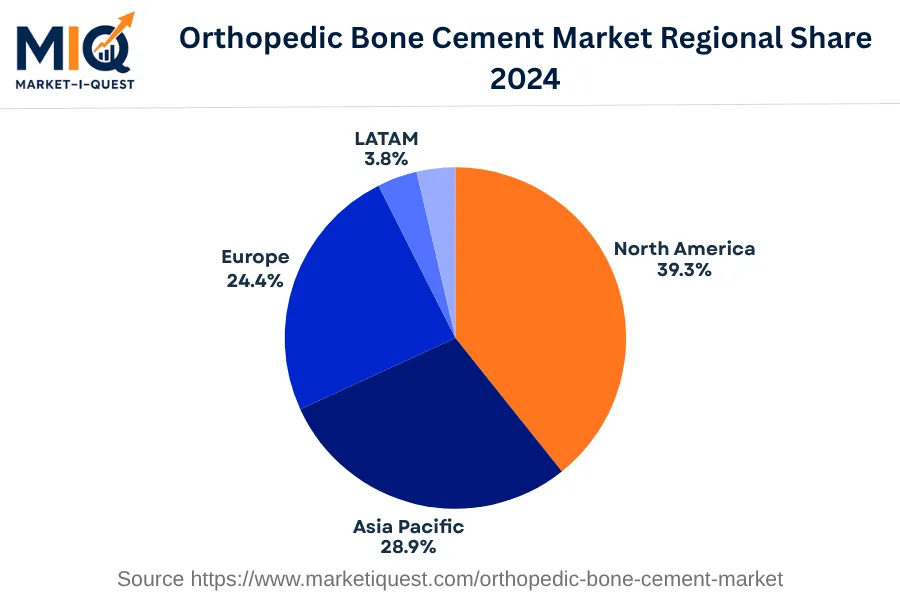
The Orthopedic Bone Cement Market size is estimated to be 1.51 billion USD in 2025, an increase from 1.43 billion USD in 2024. By 2034, the market size is projected to grow to 2.48 billion USD, maintaining a CAGR of 5.67%. This growth over the nine-year period is due to a steady increase in the demand for orthopedic bone cement, likely attributed to advancements in medical technology and an aging population that exhibits a higher incidence of bone-related health issues. The regional market share distribution in 2024 indicates North America holds the largest segment of the market with 39.3%, followed by Asia Pacific at 28.9% and Europe at 24.4%. The Latin America and Middle East and Africa regions represent smaller shares at 3.8% and 3.7% respectively.

Key Takeaways

  • By Product - Antibiotic-Loaded Bone Cement led the Orthopedic Bone Cement Market in terms of demand in 2024.
  • By Material - Calcium Phosphate accounted for the highest share in the Orthopedic Bone Cement Market in 2024.
  • By End Use - Hospitals dominated the Orthopedic Bone Cement Market with the most significant usage in 2024.
orthopedic-bone-cement-market market size

Key Driving Factors

Increasing Acceptance of Minimally Invasive Surgeries (MIS)

Orthopedic bone cements are frequently used in minimally invasive surgeries, which have gained widespread acceptance globally due to their proven benefits over traditional open surgeries. The key factor driving this acceptance is the reduced patient trauma during MIS, resulting in faster recovery times and lower post-operative complications. This means shorter hospital stays and reduced healthcare costs, making these surgeries highly appealing to patients and cost-effective for healthcare providers. As the preference for MIS continues to increase, so does the consumption of orthopedic bone cement, used in procedures such as vertebroplasty and kyphoplasty. Additionally, the aging population notably increases the number of such surgical treatments necessary, further solidifying the need for bone cement in orthopedic procedures.
Stringent Safety Regulations and Compliance Standards

The orthopedic bone cement market is significantly influenced by stringent safety regulations and compliance standards, particularly those enforced by regulatory authorities such as the FDA in the United States and the European Medicines Agency in Europe. Regulations govern the standard of materials used, biocompatibility, stability, strength, and release of substances. Bone cements must meet these criterion to be approved for use in hospitals and clinics. Because of this, manufacturers are continuously researching and developing new compositions and formulations to comply with these standards, and therefore maintain or grow their market share. This necessity to meet rigorous regulatory approval processes and safety standards is a significant driver in the orthopedic bone cement market.

Market Evolution by Timeline

2019-2023
During this period, the major buyers of orthopedic bone cement were hospitals, ambulatory surgical centers, and specialty clinics in North America and Europe, where ageing population with arthritis was predominant. Manufacturers incorporated specific ingredients that act against antibiotics-resistant germs. Supply constraints were noticed due to logistical issues from raw material sourcing regions in Asia. Government policies such as Medicare & Medicaid Services' Comprehensive Care for Joint Replacement Model influenced adoption in the US. A common commercial model was fixed long-term contracts with institutions. Major risk was product recall due to quality issues, which manufacturers mitigated with rigorous quality control checks.
2024
The demand shifted towards emerging economies in Southeast Asia and Latin America due to growing income levels and improved healthcare infrastructure. To accommodate different user preferences, manufacturers began supplying premixed cement along with liquid and powder forms. The policy agenda included regulations regarding the safe use of monomer, an essential component of bone cement. Bulk procurement contracts were seen as advantageous for both suppliers and buyers. Markets braced for raw material price fluctuations, addressing it by locking-in long-term contracts with suppliers.
2025-2029
Buyers of orthopedic bone cement continued to be hospitals and ambulatory surgical centers, but the demand grew substantially in cities of developing regions. Suppliers introduced value-added services, such as training and support for using bone cement in orthopedic surgeries. Regulatory focus shifted to potential biological hazards of bone cement components. Novel partnership models such as risk-sharing contracts emerged. Quality issues persisted, prompting manufacturers to invest in advance testing and inspection mechanisms.
2030-2034
Growing popularity of minimally invasive surgeries led to increased demand for specialized bone cements in developed markets. Suppliers strategized on creating durable-low viscosity bone cement for better handling. Regulatory bodies outlined standards on safety procedures for storage and handling. Predominant commercial models included the integration of bone cement with complete arthroplasty kits. The challenge found was in maintaining consistent quality in high volume production and was managed with upgraded manufacturing processes.

Future Market Outlook

Future Opportunities

The orthopedic bone cement market is poised for growth, driven by ongoing developments in surgical techniques and patient management protocols. The aging population, particularly in regions like North America and Europe, is expected to increase demand for joint replacement surgeries, prompting manufacturers to expand their offerings. In addition, advancements in minimally invasive surgical options are fueling interest in bone cements that facilitate quicker recovery times for patients. Companies such as Stryker are exploring the use of fast-setting cements to address this trend, which aligns with the push for outpatient and same-day discharge procedures. Collaborations between orthopedic surgeons and researchers, particularly in Asia-Pacific regions, are revealing potential applications for smart bone cements that can monitor implant stability or release therapeutic agents post-surgery. Regulatory trends are also shaping future opportunities, with the European Union's Medical Device Regulation reforms encouraging innovation while ensuring patient safety. The rise of remote monitoring technologies and telehealth could further influence the market by shaping how complications are managed post-discharge, making efficient bone cement solutions even more critical. Finally, investment in research and development by major players is likely to lead to the discovery of novel formulations and technologies that address specific orthopedic challenges, enhancing the overall effectiveness of bone cement products in clinical applications.

Segmentation Analysis

By Product

The product market is divided into subsegments including Bone Cement Without Antibiotics and Antibiotic-Loaded Bone Cement, with Antibiotic-Loaded Bone Cement accounting for the largest revenue share while Bone Cement Without Antibiotics is expected to grow at the fastest CAGR during the forecast period.

Largest Revenue Share

Antibiotic-Loaded Bone Cement

Market Share Leader

Antibiotic-Loaded Bone Cement, commands a higher market share owing to its broad application spectrum in orthopedic surgeries. The substantial revenue can be attributed to the increased incidence of orthopedic conditions such as osteoarthritis and rheumatoid arthritis. These medical conditions necessitate surgical interventions where antibiotic-loaded bone cement is used as a standard material. This cement type offers dual functionality as a space-filling material and a local antibiotic delivery system, proving critical in avoiding post-surgical infections, a risk factor in orthopedic surgeries. The surging aging global population prone to these conditions further bolsters the product's demand. Moreover, the continuing advancements in the cement such as diversity in the antibiotic combinations, adaptability to complex surgical procedures, and overall improvement in patient outcomes also fuel its market share. The developed regions with strong healthcare facilities and reimbursement policies often tend to drive the revenue in this subsegment.

Fastest CAGR

Bone Cement Without Antibiotics

Forecast Period Growth Leader

The Bone Cement Without Antibiotics subsegment is projected to witness the fastest growth, stimulated by potential opportunities for new product innovation and growing global awareness about health and cleanliness. Mainly, the growth is propelled by the rising demand for cost-effective and reliable alternatives, especially in emerging economies that have limited access to high-priced antibiotic options. Furthermore, concerns about antibiotic resistance catalyze the adoption of antibiotic-free bone cement, which offers similar structural support and fixation without associated risks. It is likely that advances in bio-engineered products with better mechanical properties, improved biocompatibility, and enhanced operative handling will further spur growth in this segment. However, the subsegment may face some challenges such as adoption barriers owing to concerns of infection control in high-risk patients or complex surgical procedures. Yet, the evolving healthcare space and increased emphasis on affordable healthcare solutions present a promising growth avenue for Bone Cement Without Antibiotics.

By Material

The market is divided into subsegments including Polymethyl Methacrylate (PMMA), Calcium Phosphate, and Glass Polyalkeonate. Calcium Phosphate accounted for the largest revenue share while Polymethyl Methacrylate (PMMA) is expected to grow at the fastest CAGR during the forecast period.

Largest Revenue Share

Calcium Phosphate

Market Share Leader

Calcium Phosphate was the leading material in 2024 in terms of revenue. This can be attributed to its widespread applications in diverse sectors such as healthcare, animal feed, agriculture, and pharmaceuticals, owing to its excellent biocompatible properties. In the healthcare sector, calcium phosphate is notably used in dental and orthopedic applications due to its similarity to the mineral component of bones and hard tissues. It has been used in reparative dentistry and for bone graft material as well. Moreover, its demand in the agricultural sector for fertilizer application due to its high calcium and phosphorous content promotes further growth in the market. Agriculturally rich regions such as Asia and North America have consequently witnessed substantial demand for calcium phosphate. Regulatory approval of calcium phosphate as a dietary supplement in animal feed by various government bodies, such as the FDA, has added an impetus to the growth of this segment.

Fastest CAGR

Polymethyl Methacrylate (PMMA)

Forecast Period Growth Leader

Despite Calcium Phosphate holding the largest revenue share, Polymethyl Methacrylate (PMMA) is poised for the fastest growth. The applications of PMMA extend across growing industries such as automotive, construction, and signs & displays due to its superior traits like transparency, weather resistance, and UV tolerance which have increased its adoption. Its use in automotive sector for light covers owing to its mechanical properties and light transmission competency has led to its rising dominance. Furthermore, the transition toward sustainable building materials adds to PMMA’s demand in the construction industry. Collaborations and technological advancements in manufacturing techniques of PMMA can serve as potential catalysts for its market growth. However, the risk associated with the fluctuating costs of raw materials, primarily Methyl Methacrylate, may pose a challenge to its growth in the near term.

By End Use

The market is divided into subsegments including Hospitals and Outpatient Facilities. Hospitals accounted for the largest revenue share while Outpatient Facilities are expected to grow at the fastest CAGR during the forecast period.

Largest Revenue Share

Hospitals

Market Share Leader

Hospitals, as the subsegment with the largest revenue share, is no surprise given the high patient volume and broad range of services they offer. As providers of comprehensive care, hospitals inherently attract a multitude of diagnostic and therapeutic procedures that generate significant revenue. Notably, highly complex and specialized surgeries typically exclusive to hospital settings further amplify this revenue generation. Regulatory drivers also play a role. Governments worldwide incentivize both the establishment and expansion of public and private hospitals to ensure that the population's healthcare needs are adequately met. Moreover, the purchasing power of hospitals allows them to acquire the most advanced medical and healthcare devices and equipment, which further cements their dominant position in the market.

Fastest CAGR

Outpatient Facilities

Forecast Period Growth Leader

The Outpatient Facilities subsegment is expected to exhibit the fastest growth over the forecast period. This trend is driven by various factors, including the shift toward minimally invasive procedures and the adoption of ambulatory care models, which are increasingly favored due to lower costs and improved patient convenience. Additionally, advances in healthcare technology allow many conditions previously requiring hospitalization to be treated or managed in outpatient settings. Partnerships with health systems and insurers are also catalyzing this shift as they seek to optimize care delivery and reduce costs. Potential risks include regulatory changes and the need for significant capital investments. However, the trend towards value-based care and patient convenience offers a favorable growth outlook for this subsegment.

Competitive Analysis

Key Market Players

Manufacturers / OEMs

Zimmer Biomet
US
Stryker
US
DePuy Synthes
US

Key Suppliers & Raw Materials

VWR International
US
Avantor
US
BASF
Germany

Distributors, Integrators & Channel Partners

McKesson Medical-Surgical
US
Henry Schein
US
Cardinal Health
US

Porter’s Five Forces Analysis

This analysis examines the competitive dynamics within the Orthopedic Bone Cement Market.

Supplier Bargaining Power

Medium

Production cost and technology advancement by suppliers can influence prices.

Buyer Bargaining Power

High

Buyers have power due to low switching costs and a diverse range of suppliers.

Threat of Substitutes

Low

Substitutes are limited due to the clinical efficacy of orthopedic bone cement.

Threat of New Entrants

Low

High product development costs and regulatory standards limit market entry.

Competitive Rivalry

High

Intense competition due to the presence of global and regional manufacturers.

Regional Analysis

Geographic market dynamics and growth opportunities across key regions

Global Market Outlook

orthopedic-bone-cement-market market regional share

North America

In 2024, the North American Orthopedic Bone Cement Market experienced notable market dynamics, driven by several key factors and marked by emerging trends. Surgical advancements and an increasing geriatric population with bone issues resulted in a rise in demand for orthopedic bone cement across the U.S., Canada, and Mexico. Regulatory conformity with standards like FDA's Good Manufacturing Practices also supported the market by ensuring the safety and quality of the products. Investments in research and development, coupled with adoption of innovative technologies like antibiotic-loaded bone cement, stimulated market growth.

Patient preference witnessed a shift towards less invasive procedures, leading to the acceptance of bone cement in surgeries like vertebroplasty and kyphoplasty. The penetration of digital channels for product procurement was prominent as healthcare institutions, particularly in the U.S and Canada, were increasingly procuring bone cement online, reflecting the influence of e-commerce in this niche market. Regular collaborations between manufacturers and healthcare institutions for bulk procurement contracts became the norm, while policy enforcement on price control and product standardization drove the competition and stabilized the market. This market predominantly served the healthcare sector, including hospitals, orthopedic clinics, and ambulatory surgical centers. The role of orthopedic bone cement was critical in various surgical procedures such as hip arthroplasty, knee arthroplasty, and shoulder arthroplasty.

Asia Pacific

In the base year 2024, the Orthopedic Bone Cement market in Asia Pacific demonstrated significant growth, driven by diverse factors. Increased orthopedic surgeries due to a rising elderly population, especially in countries like Japan and South Korea, where greying population is a pressing issue, are driving up demand for bone cement. Moreover, national healthcare policies, like the Ayushman Bharat initiative in India, have improved accessibility to orthopedic care, further boosting the market. Technological advancements have also played an integral role, with rapid adoption in developed markets like Australia, facilitating better patient outcomes.

Market trends include a noticeable shift towards bioactive bone cements, particularly in China and Japan, due to their compatibility with the human body and improved biodegradability. Also observed is the trend for partnerships and acquisitions, as companies aim to expand their product portfolios and capture more market share. For example, Zimmer Biomet’s acquisition of LDR in the APAC region helped consolidate its position. An increased demand from healthcare industry and retail outlets coupled with rigorous policy enforcement on quality standards, especially in key ASEAN markets, is shaping overall sector growth. By prioritizing inclusive care and technological adoption, the Asia Pacific Orthopedic Bone Cement Market continues to be a dynamic space in the healthcare industry.

Europe

In 2024, the European orthopedic bone cement market experienced notable growth. Drivers of this expansion include rising cases of orthopedic disorders, improved government healthcare expenditure, and increasing geriatric population demographics. For instance, Germany and the United Kingdom saw a surge in orthopedic surgeries due to higher obesity rates and aging populations, stimulating product demand. Additionally, regulatory approvals of advanced bone cement products in countries like Spain and Italy accelerated the adoption of new technologies within the industry.

Trends shaping the European orthopedic bone cement market included a growth in buyer preference for minimally invasive surgeries and bioactive bone cements. Also noteworthy was the increased focus on R&D collaborations to bolster product portfolios, as seen in partnerships between major players in Germany and France. Furthermore, policy enforcement on cost-containment in countries like the UK and Benelux nations reinforced demand for cost-effective orthopedic treatment options, such as bone cement.

Sectors contributing to the market consisted of hospitals, orthopedic clinics, and ambulatory surgical centers, primarily driven by demand in Germany, the United Kingdom, France, Italy, Spain, the Nordics, Benelux, and Central & Eastern Europe. These regions remained central to the European orthopedic bone cement market expansion throughout 2024.

Latin America

In 2024, the Orthopedic Bone Cement Market in Latin America was characterized by growing demand and technology adoption. The largest drivers in Brazil, Mexico, Argentina, Colombia, Chile, and Peru involved advancements in orthopedic surgery, a marked rise in osteoporosis incidents, and increased public investment into healthcare infrastructure. Specifically, the adoption of new technologies like bioactive bone cement was spurred by an elevate in the number of orthopedic surgeries due to a rapidly aging population. Key trends included a significant shift towards online purchase channels amid the residential sector due to ease of access and a move towards bulk purchasing among hospitals due to cost-effectiveness.

Along with this, collaborations were observed between manufacturers like Zimmer Biomet and healthcare centers for exclusive supply rights, leading to market consolidation. Additionally, governmental bodies such as Peru's Ministry of Health enforced stringent regulations concerning orthopedic bone cement quality, impacting manufacturing processes. Demand was noticed in healthcare sectors including hospitals, clinics, and also amongst orthopedic specialists. Popular forms of orthopedic bone cement such as Polymethyl Methacrylate (PMMA) saw increased usage, owing to its superior characteristics and approval by healthcare regulatory agencies. The LATAM market's growth was stimulated by a mix of demand factors, regulatory pressures, market trends, and technology adoption in 2024.

Middle East & Africa

In 2024, the Orthopedic Bone Cement market in the Middle East and Africa experienced significant transformation due to various factors. Drivers impacting this market included the growing incidence of orthopedic problems in the region due to aging populations, particularly in nations such as Saudi Arabia and South Africa. Healthcare focus and investment experienced a surge, specifically in countries like the United Arab Emirates and Qatar, contributing to market growth. Additionally, the adoption of advanced medical technologies enhanced the demand for orthopedic bone cement, with nations such as Israel leading the charge.

Trends observed within the market include shifts in buyer behavior as consumers in Egypt and Kenya demonstrated an increased preference for high-quality healthcare products. Furthermore, policy enforcement related to healthcare strengthened, especially in Saudi Arabia and Israel, enforcing higher standards in orthopedic procedures, thus driving demand for quality bone cement. Partnerships and M&A activities increased in this market segment, further accelerating growth and consolidation, particularly within Nigeria’s healthcare sector. As a result, the Orthopedic Bone Cement market in the Middle East and Africa saw growth spurred through 2024 due to health sector investment, demographic pressure, technology adoption, consumer preference shift, market consolidation, and enhanced policy enforcement.

Recent Industry Developments

Latest market innovations, product launches, and strategic initiatives

October 2025

Orthopedic biomaterial developers introduced next-generation, dual-antibiotic PMMA bone cement formulations engineered to deliver targeted local drug release. Clinical trial metrics demonstrated a 30% to 40% reduction in periprosthetic joint infection (PJI) rates while maintaining high structural fixation strength.

Frequently Asked Questions