Orthodontic Adhesives Market Snapshot

Key Players

  • 3M (United States)
  • GAC International Inc. (United States)
  • Adhesives Research Inc. (United States)
  • American Orthodontics (United States)
  • Ormco Corporation (United States)
  • Dentsply Sirona (United States)
  • Ultradent Products Inc. (United States)
  • Pulpdent Corporation (United States)
  • Danaher Corporation (United States)
  • GC Corporation (Japan)

Market Size

Base Year 2024
$9.38 Bn
CAGR
9.47%
Forecast 2034
$23.18 Bn

Market Segments

By Product Type
Resin Adhesives, Glass Ionomer, Composite Adhesives
By Curing Type
Light Cure, Self Cure
By Application
Metal Brackets, Ceramic Brackets, Lingual Brackets
By Distribution Channel
Dental Dealers, Direct Sales
By End User
Dental Clinics, Hospitals

Market Dynamics

Drivers
  • Increasing orthodontic procedures globally
  • Advancements in adhesive technology
Restraints
  • High product costs
  • Stringent regulatory standards
Opportunities
  • Rising dental health awareness
  • Technological advancements in adhesives

Market Size

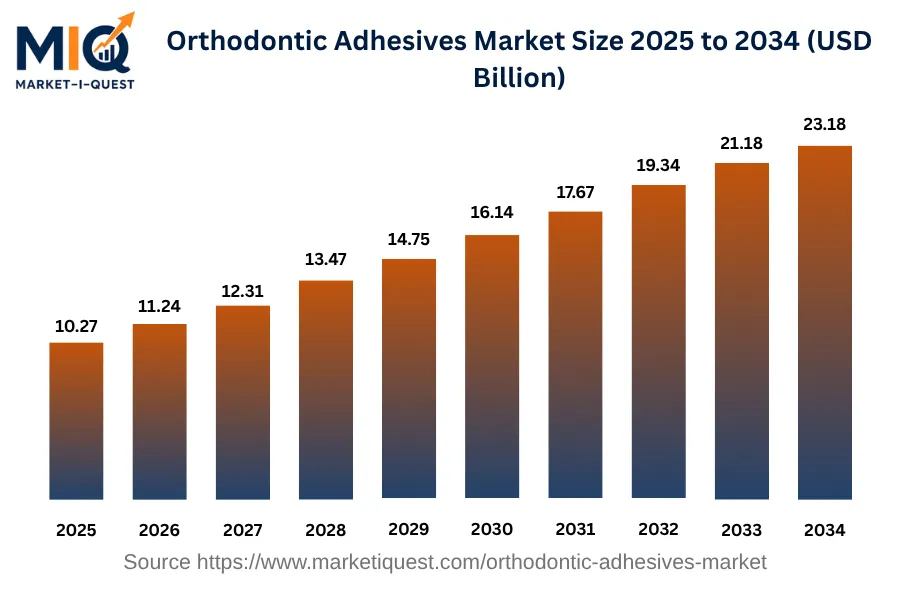
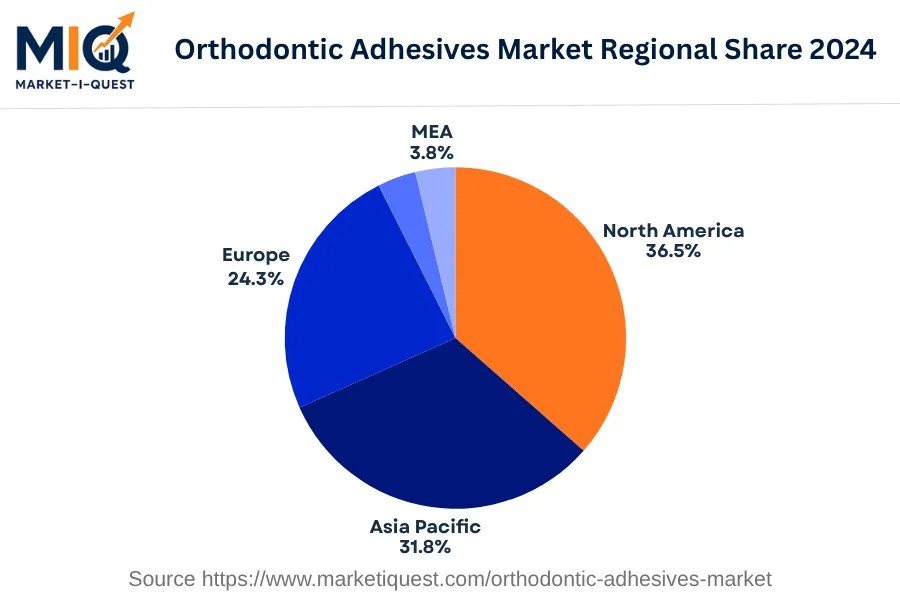
The Orthodontic Adhesives Market is projected to grow from a size of USD 10.27 billion in 2025 to USD 23.18 billion by 2034. This growth represents a CAGR of 9.47%. The primary reason for this expansion is the increasing demand for orthodontic adhesives globally. On a regional basis in 2024, North America held the largest share of the orthodontic adhesives market at 36.5%. Followed by the Asia Pacific region, which accounted for 31.8% share. Europe also maintained a significant hold on the market in 2024 with a 24.3% share, while Latin America and the Middle East and Africa with shares of 3.6% and 3.8% respectively.

Key Takeaways

  • By Product Type - Resin Adhesives subsegment recorded the largest revenue in 2024 due to several commercial factors.
  • By Curing Type - Self Cure subsegment commanded the highest revenue in 2024.
  • By Application - Ceramic Brackets subsegment is projected to witness the fastest CAGR during the forecast period.
  • By Distribution Channel - Dental Dealers subsegment emerged as a revenue leader in the market in 2024.
  • By End User - Dental Clinics are expected to record the fastest CAGR during the forecast period.
orthodontic-adhesives-market market size

Key Driving Factors

Increasing Prevalence of Dental Disorders

Increasing dental disorders worldwide escalating the demand for orthodontic adhesives. This affects dental clinics and healthcare providers. As they are primary decision-makers when it comes to purchasing these adhesives. The increase in dental problems, such as misaligned teeth and malocclusions, leads to a surge in orthodontic treatments. As result, there is high demand for orthodontic adhesives. Investing in quality adhesives is certain for these providers, as maintaining treatment effectiveness is important for patient satisfaction and treatment success. The current business problem faced by healthcare providers is the increasing rate of orthodontic problems which necessitates immediate attention and quality orthodontic adhesives for treatment. Postponing the purchase would hamper their ability to provide timely and effective treatments which could lead to a degradation in their service quality.
Rise in Cosmetic Dentistry and Aesthetics

Another factor contributing to the demand for orthodontic adhesives is the growing interest in cosmetic dentistry and a strong emphasis on aesthetics. This trend primarily affects dental clinics, cosmetic dentists, and individual clients who place significant importance on dental aesthetics. The rise in aesthetics-driven decisions has led to an increase in orthodontic treatments aimed at enhancing dental appearance. This surge in cosmetic orthodontic treatments directly translates to an increased requirement for orthodontic adhesives. The business problem arising here is the need to meet the growing aesthetic demand which can only be addressed with quality dental treatments involving orthodontic adhesives. Here, immediate investment in adhesives is vital, deferring the purchase would mean missing out on serving potential clients seeking immediate aesthetic dental enhancement.

Market Evolution by Timeline

2019-2023
During the period 2019-2023, dental clinics were the primary purchasing block of orthodontic adhesives. They invested cash for increasing demand for orthodontic procedures, dealing with crooked teeth, malocclusions, in the US and in Europe these were the common procedures followed. The manufacturers’ response was increased in supply light-cure and self-cure adhesives. Adhesives which offer secure bond handle with ease and with tolerance towards saliva or moist area are Popular. The demand was met by European and FDA regulations to improve the quality and safety of the adhesives manufactured. A few, directly from the manufacturers to dental clinic or through dental supply distributors were widespread and the orders were on as-needed basis. Manufacturers typically addressed the market by increasingly investing in cost-efficient production techniques.
2024
In 2024, demand for orthodontic adhesives further surged as health insurance companies started covering orthodontic treatments. This encouraged more patients to undergo orthodontic procedures. The Asia-Pacific region, led by countries like China and India, emerged as a significant market. Manufacturers responded by expanding their operations to this region and diversifying their supplier base. The market also saw a shift towards resin-based adhesives that promised less plaque accumulation and fewer instances of bracket detachment. Regulations became strict in the Asia-Pacific region with stricter quality and safety standards.
2025-2029
Between 2025 and 2029, advancements in orthodontics and increasing patient awareness about oral health further increased the demand for orthodontic adhesives. Medical institutes and teaching hospitals began large scale purchases, citing a growing demand for dental education. The trend of matching orthodontic adhesive color with that of the patient's teeth started catching up. Biocompatible adhesives with low toxicity were in the spotlight, primarily in countries with strong environmental regulations like Germany and the United Kingdom. Manufacturers responded by increasing the production of colored and biocompatible adhesives. The digital integration of dental practices brought about online ordering and on-call supply of adhesives.
2030-2034
In the period 2030-2034, the demand for orthodontic adhesives remained stable. Though the focus shifted towards new-gen adhesives that could self-repair and avoid bacterial colonization. Advanced dental hospitals became the prime buyers looking for these innovative products in developed countries like the United States, Canada, and Western European countries. Companies worked on creating these new glues, but building the factories was a big challenge. Governments strict policies to improve oral health while insurance companies updated coverage rules for orthodontic treatments, positively impacting the market. Regulatory bodies focused on ensuring the safety and effectiveness of the new-gen adhesives. This period saw manufacturers engaging in long-term contracts with dental hospitals to supply these new innovative adhesives.

Future Market Outlook

Future Opportunities

The Orthodontic Adhesives Market is poised for growth through regional manufacturing expansion in Asia-Pacific, particularly in countries like India and China, where demand is rising. Increased efforts to find products which are compatible encourages invention from suppliers and has been a prompt for innovation on more beneficial adhesives. As practices look to secure a nearer supply line following the latest events, opportunities present themselves for smaller scale producers and suppliers to establish beneficial relationships. Trends such as personalised orthodontics also means the potential for customised products which would be targeted towards particular patient groups is high, again creating scope for various products. Orthodontic material obsolescence can generate sales. As practices upgrade from out dated systems with current materials to meet the latest innovations and techniques this means old orthodontic products are discarded and replaced. Service to the aftermarket will take advantage of the trend towards orthodontic maintenance and aftercare services and products.
There is a measurable interest among orthodontists in lifecycle management systems that include adhesive recommendations based on treatment history, which will further enhance service offerings. By responding to these present trends, companies can successfully navigate emerging opportunities within the orthodontic adhesives arena.

Segmentation Analysis

By Product Type

The market is segmented by Product Type into Resin Adhesives, Glass Ionomer, and Composite Adhesives. Resin Adhesives accounted for the largest revenue share in 2024, while Glass Ionomer is expected to register the fastest CAGR during the forecast period.

Largest Revenue Share

Resin Adhesives

Market Share Leader

Resin Adhesives subsegment recorded the largest revenue in 2024 due to several commercial factors. It has a broad market adoption, thanks to the diverse range of applications this product type can fulfil, providing it with a healthy customer base. Furthermore, the customer preference for Resin Adhesives was strong, driven by the product's operational advantages and compatibility with existing infrastructure. There is also a developed distribution channel for Resin Adhesives which makes the product readily available to customers, bolstering its market dominance. Another contributing factor is the product's pricing position that appeals to a wide range of buyers, adjusting for differences in geographical concentration and local purchasing power. The commercial availability of Resin Adhesives is further enhanced by a mature manufacturing system, meeting a high supply availability requirement. With lower switching costs than competitive products, this subsegment also benefitted from solid regulatory acceptance, meeting qualification and certification requirements in many jurisdictions.

Fastest CAGR

Glass Ionomer

Forecast Period Growth Leader

Despite the current dominance of Resin Adhesives, Glass Ionomer is expected to record the fastest CAGR during the forecast period. This success is largely attributed to changing customer demand trends and changes that continue to take place in the process product innovation. There are shifts in customer behaviors and there are customer demands that indicate they prefer alternative solutions such as Glass Ionomer. An expansion in Glass Ionomer production and supply networks, plus wider distribution coverage has created accessibility in to a large addressable marketplace of new users, who’s work life styles using adhesives are rapidly changing as. An expanded area of new regulations and access to new forms of reimbursement are further key elements. Furthermore, Glass Ionomer has demonstrated remarkable operational capabilities and deployment flexibility, gaining traction to surpass other sub-segments in growth rate by 2034.

By Curing Type

The market is segmented by Curing Type into Light Cure and Self Cure. Self Cure accounted for the largest revenue share in 2024, while Light Cure is expected to register the fastest CAGR during the forecast period.

Largest Revenue Share

Self Cure

Market Share Leader

The Self Cure subsegment commanded the highest revenue in 2024, primarily due to the extensive customer base it possesses. This is attributed to its integral role in a myriad of applications, thus broadening its market adoption. There was also a high frequency of purchase and preference by customers for Self Cure options owing to its ease of use and robust performance. These traits were crucial in deciding the purchasing behavior of the customers, reflecting the influence of market maturity. Comprehensive distribution channels and a stable regulatory environment further propelled Self Cure. Its alignment with certain qualifications needed for deployment within the industry played a significant role in its revenue generation. Moreover, its compatibility with the existing infrastructure further solidifies its leading position. This specific type was widely available and well-tested, making it more popular than Light Cure.

Fastest CAGR

Light Cure

Forecast Period Growth Leader

Despite not leading in terms of revenue, Light Cure is projected to record the fastest CAGR during the forecast period. Its potential for growth is largely driven by its emerging customer demand and evolving purchasing behavior - factors supported by progress in technology and commercialization. Moreover, there is an expansion in its distribution, which further fuels its adoption. Regulatory changes contributing to its faster growth include the gradual acceptance of Light Cure solutions due to their performance attributes. Furthermore, product innovation was another influential factor in the rapid growth of this subsegment. The development of its ecosystem, new deployment models, and adjacent applications within the scope of this market are expected to underpin the future growth of the Light Cure subsegment. Despite Self Cure being a strong competitor, Light Cure will grow faster in the future.

By Application

The market is segmented by Application into Metal Brackets, Ceramic Brackets, and Lingual Brackets. Metal Brackets accounted for the largest revenue share in 2024, while Ceramic Brackets is expected to register the fastest CAGR during the forecast period.

Largest Revenue Share

Metal Brackets

Market Share Leader

Metal Brackets, as a part of the Application segmentation, demonstrated significant commercial performance during the base year 2024. The wider adoption of this subsegment is primarily driven by its lower price point, durability, and strength compared to other subsegments. Metal brackets are often favored by customers owing to their reliability and established performance over the decades. Their robust construction traditionally leads to fewer instances of breakages, thereby reducing the need for repeated doctor visits, making them an economical choice. Their compatibility with a diverse set of orthodontic tools and features, such as elastics or rubber bands, further boosts their popularity among orthodontists. High acceptance among the industry, coupled with established production and distribution channels, has allowed Metal Brackets to capture the largest revenue share. Moreover, the existing infrastructure around Metal Brackets supports refinement efforts, fueling the subsegment's continuous growth. Though other materials have been introduced, they often fail to compete with the price-to-performance ratio offered by Metal Brackets.

Fastest CAGR

Ceramic Brackets

Forecast Period Growth Leader

Despite Metal Brackets leading the revenue generation in 2024, the Ceramic Brackets subsegment is projected to witness the fastest CAGR during the forecast period till 2034. This growth can be attributed to a combination of market-specific changes and evolving customer preferences. Ceramic Brackets, although priced higher than their metal counterparts, are rapidly gaining popularity due to their aesthetic appeal. They seamlessly blend in with the teeth, making them less noticeable and a favorite choice for adult customers. There's a growing demand among consumers for discrete orthodontic treatment options contributing to this subsegment's calculated surge. Moreover, advancements in ceramic material technology have improved these brackets' durability and stain resistance, eliminating earlier criticisms. Increased awareness about these benefits, coupled with an expanding distribution network stemming from advancement in manufacturing practices, is expected to drive the CAGR of Ceramic Brackets during the forecast period, outperforming the growth of other subsegments.

By Distribution Channel

The market is segmented by Distribution Channel into Dental Dealers and Direct Sales. Dental Dealers accounted for the largest revenue share in 2024, while Direct Sales is expected to register the fastest CAGR during the forecast period.

Largest Revenue Share

Dental Dealers

Market Share Leader

The Dental Dealers subsegment emerged as a revenue leader in the market in 2024. This dominance is largely attributable to its expansive customer base, extensive market adoption, and frequent purchasing patterns among customers. Dental Dealers also benefit from an established distribution maturity, implying that they have a comprehensive, well-connected network distributing dental products and services to end-users. Regulatory acceptance and qualification requirements further contribute to Dental Dealers' revenue leadership. Given the specialized nature of dental products, regulatory bodies often require stringent qualification protocols that favor established dealers in the market. Plus, it costs too much for buyers to change, so they probably won't switch to Direct Sales. Dental Dealers are also advantaged by an ecosystem compatibility wherein their products and services are well integrated and compatible with the needs of dental practitioners, enhancing their commercial appeal. Accounting for these factors, the dental dealers clearly led the market in terms of revenue generation in 2024.

Fastest CAGR

Direct Sales

Forecast Period Growth Leader

Despite not generating the highest revenue in 2024, the Direct Sales subsegment is expected to record the fastest CAGR during the forecast period. This expansion isn't the result of new segmentation but of substantial market disruption. There's been a switch among customers towards a direct-to-consumer sales models due to its affordability and increased transparency and convenience. Also, new online sales and marketing tools make it easier for companies to reach out and sell directly to buyers. Direct Sales can reach more customers than ever before as we as it will evolve with the evolution commercialization, as this model of selling products eliminates its past geographical and delivery problems. Customers are adopting it due to government initiatives and the widening of routes to reimbursement by enabling individuals to purchase high-quality dental materials directly from the product source without the mediation of dealers. Based on these expected commercial trends, it is projected that Direct Sales will register the fastest CAGR during the forecast period.

By End User

The market is segmented by End User into Dental Clinics and Hospitals. Hospitals accounted for the largest revenue share in 2024, while Dental Clinics are expected to register the fastest CAGR during the forecast period.

Largest Revenue Share

Hospitals

Market Share Leader

For the year 2024, hospitals held the most substantial revenue share in the market. They are often frequented by a wide range of patients for diverse medical needs, including dental care. Because hospitals offer complete dental care, they are able to make more money. Such establishments typically have advanced equipment and more skilled personnel, boosting the adoption of their services and their contribution to overall market revenue. Furthermore, hospitals are often better equipped to handle complex cases and emergencies. As a result, they're more likely to receive cases that demand high-value care, subsequently driving up their revenue in the process. The ability to accommodate more patients due to their larger facilities compared to dental clinics enhances hospital capacity thereby increasing their service penetration within the market.

Fastest CAGR

Dental Clinics

Forecast Period Growth Leader

Dental Clinics are expected to record the fastest CAGR during the forecast period. This assumption is based on dynamic changes in market behaviors, which favor the decentralization of dental services from hospitals to clinics. Dental clinics are typically more accessible to a broad spectrum of the population and can provide exceptional specialized care. An increase in local dental clinics' operational sophistication could also contribute to faster growth, as improvements in technology and equipment can make these establishments more attractive to patients and enhance service delivery. Furthermore, the trend towards preventive care and regular dental check-ups can increase patient visits to clinics rather than hospitals. An expanding base of dental professionals setting up independent practices might also boost this segment's growth.

Competitive Analysis

Key Market Players

Manufacturers / OEMs

3M Unitek
US
Gestenco International AB
Sweden
Ormco Corporation
US

Key Suppliers & Raw Materials

Arkema
France
Mitsui Chemicals
Japan
Dow Chemical Company
US

Distributors, Integrators & Channel Partners

Henry Schein
US
Patterson Dental
US
Dental Health Products
US

Porter’s Five Forces Analysis

This analysis explores the competitive forces influencing the Orthodontic Adhesives market.

Supplier Bargaining Power

Medium

Potential of raw material price fluctuation moderates supplier power.

Buyer Bargaining Power

High

Large numbers of suppliers and simple switching increase buyer power.

Threat of Substitutes

Low

Specialized nature of adhesive products limits substitute threats.

Threat of New Entrants

Medium

R&D investment requirement and regulations moderate entry threat.

Competitive Rivalry

High

Fierce competition among existing firms due to product similarity.

Regional Analysis

Geographic market dynamics and growth opportunities across key regions

Global Market Outlook

orthodontic-adhesives-market market regional share

North America

In 2024, the orthodontic adhesives market in North America witnessed definite influences primarily from the United States, Canada, and Mexico. The increased consumer health awareness and inclination towards dental aesthetics led to a surge in orthodontic procedures in the U.S., thereby driving the demand for orthodontic adhesives. In response to this, leading adhesives manufacturers like 3M and Henkel expanded their distribution channels, partnering with various dental clinics and hospitals to bolster their market foothold. This growth was further supported by stringent American Dental Association standards that bolstered product quality and consequently, consumer trust. Canada saw a similar pattern; however, the growth was primarily driven by government initiatives promoting oral health and reimbursement policies that reduced the financial burden of orthodontic procedures on consumers. Conversely, in Mexico, the market landscape was shaped by the localization of adhesive manufacturing units by major players, bolstering supply chain efficiency and catering to the growing demand. This localization strategy was reinforced through partnerships with local manufacturers, enabling quicker response to market changes and ensuring consistent adhesive supply. These developments spurred technological adoption for the creation of adaptable, effective, and efficient bonding agents for orthodontic applications across the region. Overall, highly conscious consumer behavior, robust regulatory frameworks and dynamic corporate strategies were key in steering the North American orthodontic adhesives market during 2024.

Asia Pacific

The Orthodontic Adhesives Market in the Asia Pacific region in 2024 stood distinctively influenced by a surge in dental deformities and healthcare infrastructure expansion, pushing countries like China, India, and Japan to the forefront. Dental disorders in these countries marked a significant rise, making a broader customer group reliant on orthodontic treatments, hence driving demand for adhesives. Subsequent local production of orthodontic adhesives in India and China catered to this demand extensively, strengthening their hold on market dynamics. Simultaneously, regulatory frameworks across Asia Pacific urged the inclusion of more biocompatible and non-toxic adhesives, affecting production strategies and investment decisions of manufacturers. The need for adhesives grew further by the wide adoption of advanced orthodontic treatments like invisible braces and 3D dental scanning among both medical practitioners and patients. To ensure product safety and follow the rules, suppliers and hospitals completely changed their buying and shipping processes. Not just influenced by the regulatory and healthcare landscape, but also driven by regional economic conditions, organizations in these markets procured adhesive solutions to meet the operational requirements of providing efficient, cost-effective, and wide-ranging orthodontic treatments. Thus, the Orthodontic Adhesives Market in 2024's Asia Pacific region was shaped by a blend of increased patient volumes, progress in healthcare infrastructure, regulatory transformations, and shifting supplier-distributor relationships.

Europe

In 2024, the European orthodontic adhesives market experienced significant transformation due to a variety of factors. The prevalent use of clear aligners, together with the increasing adoption of CAD/CAM technology in dental practices, altered procurement behaviors. In countries with strong dental product manufacturing activity such as France, Germany, and Italy, firms that took advantage of these operational workflows witnessed an upswing in their market positions. Also, European health and dental companies joined forces, making it easier to sell and ship dental adhesives to more places. In the UK, these changes precipitated by advancements in manufacturing activities and digital technologies amplified enterprise purchasing. Amid these market trends, the application of the European Union's Medical Device Regulation (MDR) played a decisive role. The new CE marking requirements for orthodontic adhesives pushed manufacturers to reevaluate their practices and offer products that adhered to the harmonized standards for safe and effective use. Although the MDR imposed stringent controls on manufacturers, it advanced the prominence of high-quality, certified orthodontic adhesives across Europe. This change, along with new business buying habits and better shipping methods, greatly affected the European dental adhesives market in 2024.

Latin America

In 2024, the Orthodontic Adhesives Market in Latin America experienced significant changes largely driven by specific government initiatives and the work of regulatory agencies such as ANVISA in Brazil and COFEPRIS in Mexico that introduced new guidelines for product safety and certification. Dental practitioner groups, a major buyer group in this market, along with hospitals and orthodontic clinics across key countries like Brazil, Mexico, and Argentina, had to adapt their procurement behavior to adhere to these guidelines. This often involved a shift in deployment practices towards those adhesives that complied with the new regulations, influencing the variety and type of orthodontic adhesives in demand. Localization initiatives also played a role, as regional companies expanded their manufacturing capacity to produce compliant adhesives, reducing previous import dependence. Key local manufacturers, such as Brazil's FGM Dental Group, responded by accelerating their production and certification processes of orthodontic adhesives. In parallel, established companies in Mexico and Argentina revamped their supply chains and distributor networks to ensure wide availability for regulatory-compliant products, leading to more enterprise purchasing and distributor growth. These commercial-scale changes, induced by regulatory rulings and modified by businesses' operational response, substantially altered the Latin American Orthodontic Adhesives Market in 2024.

Middle East & Africa

During 2024, the orthodontic adhesives market within the Middle East & Africa saw significant developments due to various key factors. A noteworthy distributor network expansion occurred as prominent manufacturers partnered with local pharmacies in Saudi Arabia for wider reach, given the rising public awareness on oral care spurred by initiatives from Saudi Vision 2030 and SFDA. This increased accessibility, particularly in remote areas, positively influenced procurement behavior. Then, the UAE, under Operation 300bn, emphasized the localization of orthodontic adhesive production, actively supporting the strengthening of domestic manufacturing activity for related healthcare supplies. In response, numerous local enterprises upgraded their operational workflows and, remarkably, their product categories incorporated a greater variety of orthodontic adhesives. Meanwhile, due to the strict standards of the GSO and DHA, firms notably improved product quality compliance, which, in turn, fostered trust among consumer industries like private orthodontic clinics. Over in South Africa, the introduction of new regulatory requirements by SAHPRA on the chemical components of orthodontic adhesives induced a shift towards safer, more eco-friendly adhesives.

Recent Industry Developments

Latest market innovations, product launches, and strategic initiatives

February 2026

Solventum (formerly 3M Health Care) and Ormco Corporation expanded global deployment of light-cure orthodontic adhesives featuring color-change moisture indicators. The composite resins display a distinct color during placement for precise flash removal and cure completely clear upon UV/LED light exposure.

November 2024

Align Technology, Inc. and Dentsply Sirona commercialized high-tack resin adhesives engineered for clear aligner attachment buttons. Optimized for 3D-printed templates and thermoplastic aligner materials, the formulation provides high bond retention on enamel while resisting discoloration from daily food and beverage exposure.

Frequently Asked Questions