Oriented Strand Board Market Snapshot

Key Players

  • Georgia-Pacific LLC (United States)
  • Norbord Inc. (Canada)
  • Louisiana-Pacific Corporation (United States)
  • Weyerhaeuser Company (United States)
  • Kronospan (Austria)
  • Swiss Krono Group (Switzerland)
  • Martco (United States)
  • Roseburg Forest Products (United States)
  • Egger Group (Austria)
  • Ainsworth Lumber Co. Ltd. (Canada)

Market Size

Base Year 2024
$28.57 Bn
CAGR
6.13%
Forecast 2034
$51.80 Bn

Market Segments

By Resin Type
  • Phenolic Resin
  • Urea-Formaldehyde Resin
  • Polyurethane Resin
  • Modified Isocyanate Resin
By Application
  • Flooring
  • Wall Sheathing
  • Roofing
  • Industrial Packaging
By End Use Sector
  • Residential Construction
  • Commercial Construction
  • Industrial Construction

Market Dynamics

Drivers
  • Growth in construction sector
  • Demand for affordable housing materials
Restraints
  • High production costs
  • Volatile raw material prices
Opportunities
  • Growing construction industry
  • Emerging economies' infrastructure development

Market Size

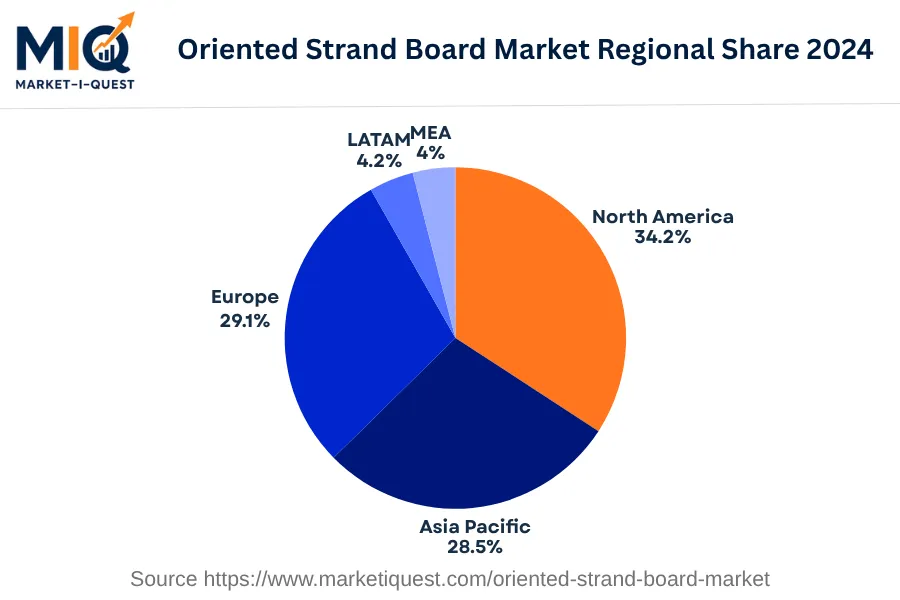
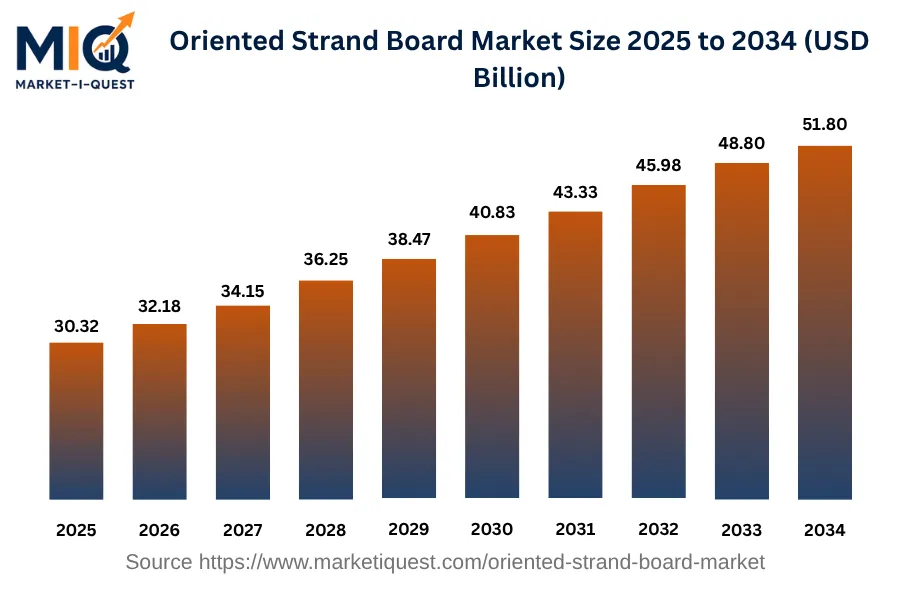
The Oriented Strand Board Market is projected to increase from a market size of $30.32 billion in 2025 to $51.80 billion by 2034, with a CAGR of 6.13%. This substantial growth over the course of nine years can be attributed to several factors. Since the beginning of the decade when the market was valued at $28.57 billion in 2024, there has been consistent growth in the use and acquisition of oriented strand boards. By 2025, it reached $30.32 billion, setting the stage for its ascending trajectory towards the expected value by the end of 2034. The regional market shares in 2024 were distributed with North America accounting for 34.2%, followed closely by Europe with a 29.1% share. Asia Pacific region held 28.5% of the shares, while LATAM and MEA accounted for 4.2% and 4.0% respectively.

Key Takeaways

  • By Resin Type - Polyurethane Resin held a significant position in the Oriented Strand Board Market in 2024.
  • By Application - Flooring led the market accounting for a substantial share in 2024.
  • By End Use - Residential Construction dominated the Oriented Strand Board Market during the base year.
oriented-strand-board-market market size

Key Driving Factors

Implementation of stringent environmental regulations

There has been increased environmental regulation worldwidemandating the reduction of waste from traditional wood manufacturing industries. Oriented Strand Boards (OSBs) are manufactured from fast-growing, underutilized, and less expensive varieties of wood such as Aspen or Southern yellow pine, making them an ecologically friendly choice. Their production process is designed to use nearly 100% of every log, significantly reducing wood waste compared to conventional lumber manufacturing. These environmentally focused regulations boost the OSB market, as companies opt for more ecological methods in their operations.

Increase in preference for off-site construction

In recent years, there has been a significant shift in the construction industry towards off-site construction due to its benefits including reduced construction time, cost-efficiency, and minimal waste generation. Oriented Strand Boards (OSBs), with their structural robustness and ease of use, are a popular choice in off-site manufacturing techniques, such as panelized and modular construction. Moreover, their dimensional stability and performance under variable weather conditions make OSB a preferred material in these applications. Consequently, the surge in off-site construction techniques has been a key driving factor for the growth of the OSB market.

Market Evolution by Timeline

2019-2023
In this period, the primary demand for Oriented Strand Board (OSB) in construction and furniture industries was notable in the Asia Pacific region, steered by urbanization and the rise of infrastructure projects in countries like China and India. The North American market saw slow growth due to the recovery from the 2008 crisis. Supply was majorly driven by large-scale manufacturers like Norbord Inc. and Georgia-Pacific. Technology-wise, thermal treatment of OSB to improve resistance against moisture was gaining traction. Commercially, long-term contracts with sizable minimum order quantities were typical. Still, regulatory requirements surrounding formaldehyde emissions (EPA's Formaldehyde Standards for Composite Wood Products Act) affected manufacturing processes. Risks often involved inconsistency in raw material quality and availability.
2024
This year saw an increased demand for eco-friendly and high-performance materials in Europe, influencing the OSB market. The introduction of OSB panels with improved moisture and fire resistance features was a significant tech innovation. Quebec's Matériaux Blanchet Inc. announced plans to rebuild its Amos OSB plant with an increased 40% capacity, boosting supply. Pricing mostly centered on purchase volume and quality grading. The European Standard EN 300 established performance requirements and lead to wider product acceptance. The real estate slowdown due to economic instability presented a risk, influencing lower project investments.
2025-2029
OSB registered high demand in renovation projects in the US and Europe, as buyers preferred it for its cost-effectiveness over plywood. On the supply side, manufacturers like Kronospan and Weyerhaeuser used sustainable forestry practices and collaborated with environmental organizations. Technological advancements saw the introduction of self-repairing OSBs. Price negotiations were common based on project scale. The CARB Phase 2 and EPA TSCA Title VI standards tightened restrictions around formaldehyde emissions within the market. The rise in raw wood cost was a potential risk, leading companies to seek recycling and reclaiming options.
2030-2034
During this time, the Oriented Strand Board market observed a shift in demand towards specialized applications in various industries including packaging and automotive, particularly in Asia. On the supply side, producers worked on increasing the reuse and recyclability of OSB, developing new products with higher environmental benefits. Technological progress leading to high-performance and lightweight OSB complemented this trend. Contracts often included sustainability clauses and certifications. As for regulation, certification programs like FSC and PEFC were adopted widely, impacting procurement patterns. The risk of wood supply interruptions due to climate change led to the exploration of alternative raw material sources.

Future Market Outlook

Future Opportunities

Current trends indicate significant growth potential in the OSB market driven by heightened construction activity in regions such as Asia-Pacific, particularly in countries like China, where urbanization continues unabated. As of 2023, the government of Australia has initiated programs to promote the use of sustainable building materials, openly endorsing OSB's benefits for residential construction. Simultaneously, the solidification of eco-labeling practices, such as the Forest Stewardship Council certification, presents opportunities for OSB producers that meet stringent sustainability criteria. A notable example is the collaboration between Weyerhaeuser and the Green Building Initiative, which launched the Sustainable Communities program to facilitate the integration of eco-friendly materials into construction projects in 2021. Furthermore, the increasing shift toward modular construction and prefabricated structures offers a significant avenue for OSB usage, with companies like Sekisui House in Japan leveraging this approach for efficient residential building in urban areas. There is also a growing interest in the North American market where home renovation initiatives have spurred demand for OSB, reflecting changing consumer preferences since the COVID-19 pandemic. The push for diversified applications also provides a channel for OSB's use in industrial settings. With regulatory incentives supporting sustainable practices and the ongoing evolution of building codes worldwide, the OSB market stands poised for notable advancements in a landscape shaped by contemporary consumer demands and environmental considerations.

Segmentation Analysis

By Resin Type

The market is divided into subsegments including Phenolic Resin, Urea-Formaldehyde Resin, Polyurethane Resin, and Modified Isocyanate Resin. The Polyurethane Resin subsegment accounted for the largest revenue share while the Modified Isocyanate Resin is expected to grow at the fastest CAGR during the forecast period.

Largest Revenue Share

Polyurethane Resin

Market Share Leader

Polyurethane resin reigns supreme in terms of revenue generation within the market landscape. Several factors underpin its dominance, ranging from its versatile application to its enhanced performance characteristics. Polyurethane resin is popularly used across various industries, including the automotive, construction, and furniture sectors, due to its unique properties such as flexibility, durability, and resistance to heat, chemicals, and wear, which endears it to manufacturers and customers alike. Its usage in insulation and sealing applications also contributes to its strong market performance. In fact, the surging demand for energy-efficient solutions, in particular, is giving a significant boost to this segment as polyurethane-based insulation is employed widely to reduce energy consumption. Furthermore, the supply chain dynamics also favor polyurethane resin. The global suppliers are well-established, which ensures smooth production and distribution routes, thus making it a reliable choice for various end-use applications. Hence, a combination of desirable material properties, increased application areas, and sound supply chain infrastructure contributes to polyurethane resin leading the market in terms of revenue.

Fastest CAGR

Modified Isocyanate Resin

Forecast Period Growth Leader

Modified Isocyanate Resin, though not the dominant subsegment in terms of revenue, is projected to enjoy the fastest growth in the coming years. This resin type has witnessed significant advancements over recent years, with new modification techniques improving its properties and broadening its usage scope. This improved version of the traditionally used isocyanate resin displays enhanced compatibility and performance metrics, ideal for several end-use industries such as textiles, automobiles, and paints and coatings. One key driver for its rapid growth is the stricter environment regulations which propel the need for sustainable product alternatives. Modified Isocyanate Resin, due to its improved functionality and lower VOC emission, is considered a viable choice addressing the green revolution concerns. Furthermore, advancements in technologies and quick adoption of these upgraded resins are also evident in developed countries, making it the catalyst to this growth. However, the high production cost could pose as a barrier to its increased adoption. Any development to lower these costs, perhaps through industry partnership, efficient production techniques or capex allocation, can potentially increase its market share in the near future and ensure continued rapid growth.

By Application

The market is divided into subsegments including Flooring, Wall Sheathing, Roofing, and Industrial Packaging. Flooring accounted for the largest revenue share while Industrial Packaging is expected to grow at the fastest CAGR during the forecast period.

Largest Revenue Share

Flooring

Market Share Leader

Flooring is leading the market application in terms of revenue in 2024. This could be attributed to its versatility and necessity in all types of constructions. Whether in residential, commercial, or industrial settings, the demand for the flooring application is consistent and broad-based. There is a wide variety of materials, aesthetics, and resilience preferences, driving a continual product development and differentiation, enabling higher margins. Moreover, comprehensive regulations governing construction safety and quality, particularly in developed geographies, support the demand for high-grade flooring products. Moreover, advanced technology has created a market for innovative flooring solutions that offer improved durability, increased lifespan, and enhanced visual appeal. This trend can be a substantial factor that justifies the leading position of flooring in terms of market share by 2024.

Fastest CAGR

Industrial Packaging

Forecast Period Growth Leader

Industrial Packaging is expected to grow at the fastest rate among the subsegments. Despite being a smaller subsegment compared to flooring and roofing, industrial packaging is seeing a rapid uptake due to the ascent of e-commerce and the need for sturdy, resilient packaging for a wide array of goods being transported and handled frequently. Investments in this space are primarily driven by online retail companies that are looking for efficient, sustainable, and cost-effective packaging solutions. The growth trajectory is also aided by the ongoing trend of automation in warehouses and fulfillment centers, requiring packaging solutions designed for machine handling. However, pricing pressure and sustainability concerns, especially around single-use packaging, could pose growth constraints. Despite these challenges, the unmistakable trend of increasing e-commerce penetration and supply chain automation is poised to provide a tailwind for growth in this subsegment.

By End Use Sector

In the end use sector, the market is divided into subsegments including Residential Construction, Commercial Construction, and Industrial Construction, with Residential Construction accounting for the largest revenue share while Commercial Construction is expected to grow at the fastest Compound Annual Growth Rate (CAGR) during the forecast period.

Largest Revenue Share

Residential Construction

Market Share Leader

Residential Construction emerged as the subsegment with the highest revenue generation in the base year 2024. This leadership position can be attributed to a surge in urbanization and population growth, which instigates the demand for more housing units and, in turn, drives the residential construction market. The subsegment's growth can also be associated with rising disposable income levels that allow people to invest in property. Moreover, favorable government policies, including tax benefits and subsidies for residential construction to cater to the escalating housing demand, further bolster its revenue generating capacity. The residential construction subsegment also benefits from an expansive range of customers, including first-time home buyers, property investors, and developers. Despite the growth potential in emerging markets, this subsegment's revenue is also heavily concentrated in developed regions with high property values. Supply chain efficiency is another factor that enhances revenue, with most residential construction firms having strong relationships with material suppliers.

Fastest CAGR

Commercial Construction

Forecast Period Growth Leader

Commercial Construction is the fastest growing subsegment, led by increased private investment in commercial real estate and ongoing urban development initiatives. Businesses are rapidly scaling up their operations, leading to a heightened need for commercial spaces such as offices, malls, hotels, and hospitals. Technological advances in construction processes, environmental sustainability trends, and the increasing influence of modern architectural designs are driving adoption and growth in the commercial construction subsegment. To meet the stringent building regulations and to create energy-efficient and innovative structures, significant capital investments are made in this subsegment. Potential risks could be in the form of economic slowdowns, which often result in reduced investments in commercial projects. However, strategic partnerships between construction companies and real estate developers, along with government initiatives promoting infrastructural development, seem likely to sustain the subsegment's growth momentum in the near term.

Competitive Analysis

Key Market Players

Manufacturers / OEMs

Norbord Inc.
Canada
Louisiana-Pacific Corporation
US
Weyerhaeuser Company
US

Key Suppliers & Raw Materials

Georgia-Pacific Wood Products
US
Glatfelter
US
Canfor Corporation
Canada

Distributors, Integrators & Channel Partners

Builder's FirstSource
US
Beacon Roofing Supply, Inc.
US
HD Supply White Cap
US

Porter’s Five Forces Analysis

This analysis explores the competitive forces within the Oriented Strand Board Market.

Supplier Bargaining Power

Medium

Power is moderated by the availability of raw materials and propagation of suppliers.

Buyer Bargaining Power

High

Diverse customer base and relatively low switching costs provide buyers with high bargaining power.

Threat of Substitutes

Low

Low threat due to the product's unique properties and lack of viable alternatives.

Threat of New Entrants

Medium

Capital intensity and regulatory requirements moderate entry but aggressive competition may attract new players.

Competitive Rivalry

High

The market is highly competitive with numerous established brands.

Regional Analysis

Geographic market dynamics and growth opportunities across key regions

Global Market Outlook

oriented-strand-board-market market regional share

North America

In 2024, the North American market for Oriented Strand Board (OSB) experienced significant transformation. Market drivers included increased demand from the construction industry, particularly in the United States, catalyzed by booming residential and commercial projects. Regulatory reforms mandating more eco-friendly building materials also propelled the market as OSB is recognized for its environmentally sustainable attributes. In Canada, significant investments in OSB production enhanced supply dynamics, while in Mexico, rapid technology adoption advanced production efficiency and quality.

Emerging trends in 2024 encompassed shifts in buyer behavior, with increased preference for high-quality, environmentally sustainable products. For instance, large-scale manufacturers and retailers in the United States and Canada demonstrated pronounced preference for OSB due to its durability and affordability. There was a noticeable increase in partnerships and mergers among OSB manufacturers, aimed at expanding production capacity and market share. This was especially notable in the manufacturing and construction sectors. Lastly, stringent enforcement of environmental regulations across the continent had a profound influence on the market, promoting significant shifts toward sustainable production techniques. In summary, the North American OSB market in 2024 was notably driven by growing demand from the construction industry, regulatory reforms, production investments, and changing buyer preferences towards sustainability.

Asia Pacific

In 2024, the Oriented Strand Board (OSB) market maintained a significant presence across the Asia Pacific region, with key markets including China, India, Japan, South Korea, Australia, and the ASEAN region. Increasing construction activities drove the market as the demand for affordable, eco-friendly building materials rose. China's renovation wave, coupled with India's Pradhan Mantri Awas Yojana scheme, stimulated the OSB industry. Further, technology advancements like automated production lines improved efficiency and fueled market expansion.

Simultaneously, fluctuating wood supply and import restrictions, particularly in Australia, affected pricing and availability, compelling manufacturers to explore alternative materials. However, foreign direct investments in construction sectors, especially in ASEAN economies, steered stability.

Trends reveal a shift towards green building standards embracing OSB as a sustainable choice, evident from the market embracement in Japan and South Korea's residential construction sectors. The consumer sentiment leaned towards flat-packed furniture, endorsing OSB. E-commerce penetration altered buying patterns, influencing manufacturers and distributors to strengthen their online presence. Moreover, there was an increased merger and acquisition activity among manufacturers to consolidate their market position. Adoption of stricter building codes necessitated the use of high-performance OSB, driving market differentiation.

In summary, the OSB market in the Asia Pacific in 2024 reflected dynamic growth, primarily centered around construction demand, regulatory framework, technology acceptance, supply dynamics, and evolving purchase behaviors.

Europe

In the base year of 2024, the Oriented Strand Board (OSB) market in Europe exhibited a stable growth pattern buoyed by a healthy construction sector. Key drivers included strong demand from the residential housing sector in Germany and the United Kingdom, fuelled by low-interest rates and favourable housing policies. Simultaneously, in France and Italy, investment in green building initiatives stimulated the market, emphasizing the use of OSB for its environmentally-friendly attributes. While in Spain, Benelux, the Nordics, and Central & Eastern Europe, the adoption of advanced manufacturing technologies spurred OSB production efficiency and cost-effectiveness.

Market trends illustrated an increased buyer preference for OSB in retail and commercial construction, reflecting its affordability, durability, and versatility. Meanwhile, enhanced product offerings integrating fire-resistant and moisture-resistant technologies gained traction in the residential sector, particularly in the UK and Germany. Channel dynamics saw a rise in e-commerce sales in countries like France and Italy, due to convenience and competitive pricing. Policy enforcement in line with the European Union's sustainable development goals encouraged the adoption of OSB in government and utility projects. The market also witnessed a trend toward consolidation, with a series of strategic mergers and acquisitions aimed at streamlining supply chain dynamics. These developments shaped the European OSB market landscape in 2024.

Latin America

In 2024, the Oriented Strand Board (OSB) market in Latin America (LATAM) predominantly encompassed the construction industry along with minor interests from the home furniture sector. Demand surged, driven by factors such as escalating construction activities in countries like Brazil and Mexico, which saw an increase in both residential and commercial projects. Efforts by governments, specifically in Argentina and Colombia, to promote sustainable building materials also stimulated demand for OSB. Coupled with favorable investment trends and rapid technology adoption in these countries, this created an effective supply chain network that ensured the availability of OSB at competitive prices.

Trends in the LATAM OSB market exhibited significant changes in buyer behavior as quality and durability became pivotal purchasing considerations. The increasing shift to eco-friendly products further fueled the demand for OSB in the region. Technological advancements in product engineering were also evident, resulting in higher quality OSB attracting more customer attention. An increase in strategic partnerships and mergers among local and international players was observed, transforming the competitive landscape and leading to a more efficient distribution system. Regulatory standards were also increasingly enforced in countries like Chile and Peru, prompting greater adherence to specifications outlined in policy documents. These policies were not only significant accelerators of OSB market growth but also essential instruments in shaping sustainable practices in the region.

Middle East & Africa

In 2024, the Oriented Strand Board (OSB) market in the Middle East and Africa experienced significant activity, fueled by various demand-driven factors and trends. Structural reforms and urbanisation in Saudi Arabia and the United Arab Emirates led to an upsurge in construction activities, driving demand for OSB products. In South Africa and Kenya, governmental support to local manufacturers in Nigeria stimulated investments in OSB production technology, enhancing market competitiveness.

High penetration of off-grid solar systems in remote outskirts of Egypt and Algeria influenced OSB supply dynamics, spurring demand for OSB in the utility sector. Adoption of environmentally friendly practices in Israel's manufacturing sector impacted the OSB pricing model, prompting a move towards sustainably sourced products.

Consumer preference for versatile, lightweight and affordable construction materials characterized the buying behaviour in this region, particularly in Qatar's burgeoning retail sector. As a response to this trend, manufacturers sought to optimize OSB properties for energy efficiency and thermal insulation. Growing partnerships between OSB manufacturers and the oil and gas industry marked a prominent trend in this region, with OSB increasingly adopted for rig mats and containment walls due to its strength and durability. Lastly, Uniform Building Code revisions consecrating OSB as a standard building material in the Middle East contributed to market expansion in the region.

Recent Industry Developments

Latest market innovations, product launches, and strategic initiatives

December 2025

Industry giant West Fraser announced the decision to permanently halt production operations at its High Level, Alberta OSB mill. Scheduled for a systematic wind-down through spring 2026, the structural closure removes approximately 860 million square feet ($3/8$-inch basis) of annual manufacturing capacity from North America.

Frequently Asked Questions