
Opto Semiconductors Market Snapshot

Key Players

  • Osram Opto Semiconductors (Germany)
  • Cree Inc. (United States)
  • Nichia Corporation (Japan)
  • EPISTAR Corporation (Taiwan)
  • Samsung Electronics Co. Ltd. (South Korea)
  • Sony Corporation (Japan)
  • LG Innotek (South Korea)
  • Sharp Corporation (Japan)
  • Lumileds Holding B.V. (Netherlands)
  • Everlight Electronics Co. Ltd. (Taiwan)

Market Size

Base Year 2024
$55.98 Bn
CAGR
8.96%
Forecast 2034
$132.04 Bn

Market Segments

By Type
Light Emitting Diodes, Laser Diodes, Photodiodes, Optical Sensors, Display Panels
By Material
Inorganic, Organic, Polymer, Silicon, Gallium Nitride
By Application
Consumer Electronics, Automotive, Industrial, Telecommunications, Healthcare
By End Use
Residential, Commercial, Industrial

Market Dynamics

Drivers
  • Advancements in technology
  • Increasing digitalization trends
Restraints
  • High manufacturing costs
  • Technological complexities
Opportunities
  • Expanding telecommunication infrastructure
  • Emerging smart city projects

Market Size

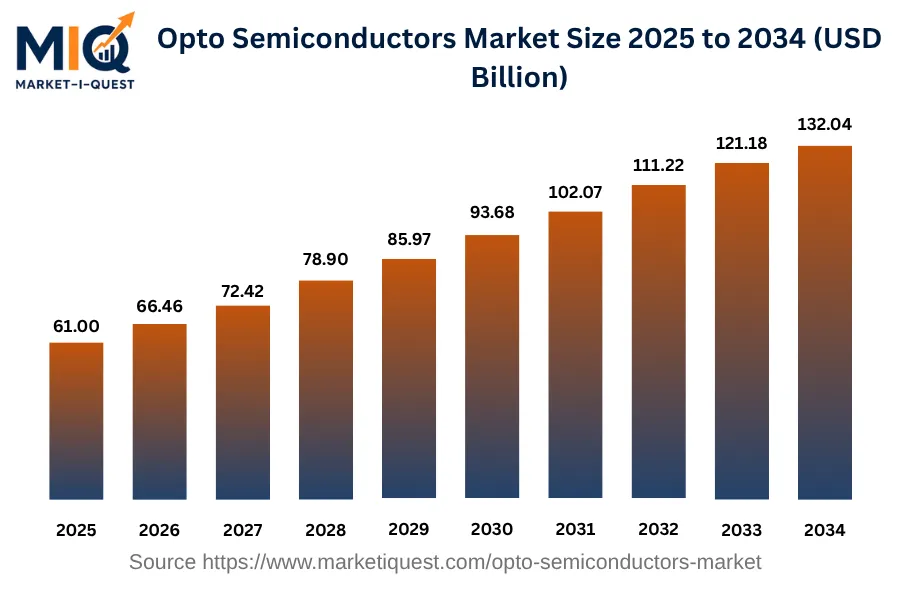
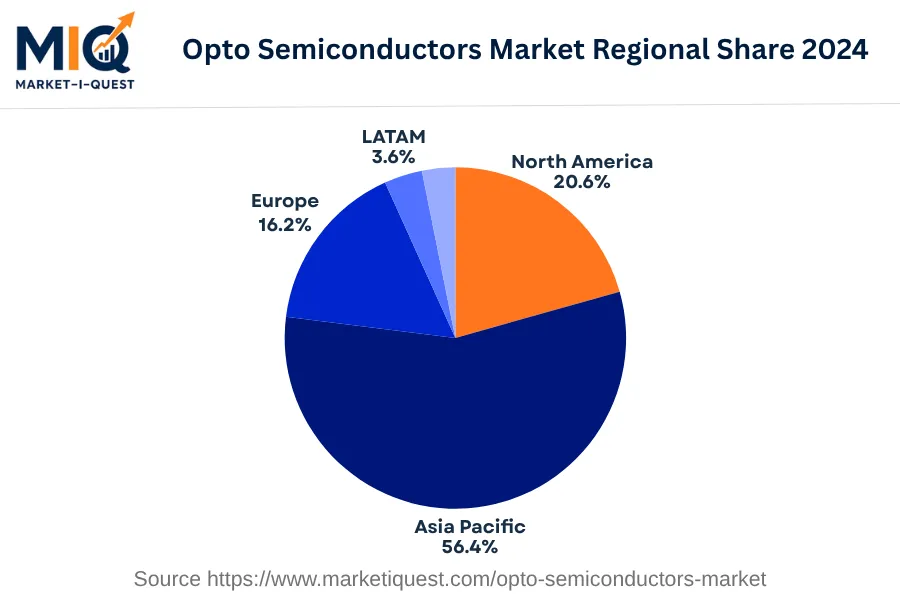
The Opto Semiconductors market is expected to grow significantly over the next decade. Beginning with a market size of 60.99 billion USD in 2025, the market is estimated to reach a value of 132.04 billion USD by 2034. This marks an impressive Compound Annual Growth Rate (CAGR) of 8.96% over the examined period. The primary catalysts for the growth of the Opto Semiconductors industry involve various advancements and enhancements in technology and their successful incorporation in a plethora of applications. In 2024, the industry has a wide geographical dispersion, with the Asia Pacific region dominating the market share at 56.38%. Following that, North America holds a 20.62% stake, Europe comes in at 16.24%, while Latin America and the Middle East and Africa hold smaller shares of 3.61% and 3.15% respectively. This data quantitatively showcases the scale and prospective expansion of the Opto Semiconductors market, and how different regions around the world contribute to this growth.

Key Takeaways

  • By Type - Light Emitting Diodes led the Opto Semiconductors Market accounting for a substantial share in 2024.
  • By Material - Silicon substances held a significant market position in the Opto Semiconductors Market in 2024.
  • By Application - Consumer Electronics dominated as the leading segment in the Opto Semiconductors Market in the base year.
  • By End Use - Industrial sector held a noteworthy position in the Opto Semiconductors Market in 2024.
opto-semiconductors-market market size

Key Driving Factors

Adoption of Electric Vehicles and Renewable Energy

A critical driver for the opto semiconductors market is the accelerating adoption of Electric Vehicles (EVs) and Renewable Energy Solutions. In both industries, opto semiconductors—capable of converting light into an electric signal—are used extensively. For example, in electric vehicles, they're applied in system controls, safety systems, and energy conservation measures to ensure performance efficiency. On the renewable energy front, Solar Photovoltaic (PV) systems rely heavily on the technology for the conversion of sunlight into electricity. As governments worldwide push for greener solutions and consumers become more environmentally conscious, these sectors are experiencing meteoric growth, thereby boosting demand for opto semiconductors.
Implementation of 5G and Internet of Things (IoT)

The rapid pace of 5G network implementation and Internet of Things (IoT) technology adoption is another significant driver for the opto semiconductors market. Opto semiconductors are central to high-speed data communication and wireless connectivity, as they play a vital role in managing data traffic, enhancing signal strength, and reducing energy consumption. As the telecommunication industry upgrades its infrastructure to 5G networks, the demand for opto semiconductors is set to increase. Additionally, the pervasiveness of IoT devices—from home automation systems to smart city infrastructures—creates an expansive market, as these devices require opto semiconductors to facilitate effective communication and ensure smooth operation.

Market Evolution by Timeline

2019-2023
During this period, the main buyers of opto semiconductors were predominantly from the consumer electronics and automotive sectors. These buyers primarily hailed from regions such as North America and Asia. Regarding technology, the provisioning of micro LED technology for sophisticated display systems and automotive lighting dominated shipments. However, the production capacity of micro LED opto semiconductors was strained due to complex manufacturing processes. Key policies like the EU's 'Ecodesign for Energy-Related Products' regulations positively influenced market adoption as they encouraged energy-efficient semiconductor products. Common commercial models included long-term supply contracts with electronic and automobile manufacturers. Market risks were predominantly associated with the high cost and complexity of production, leading some manufacturers to outsource production to countries like Taiwan and China.
2024
In 2024, sectors like renewable energy and data centers started expressing significant interest in opto semiconductors. This shift in buyers was because of their need for more efficient power conversion and data transmission. The semiconductor shipments in this year were mainly silicon carbide (SiC) and gallium nitride (GaN) based components due to their excellent optical and power handling properties. U.S's 'Semiconductors in America Coalition' bill was a significant influencer in this period, spurring increased research and investment in the sector. This year also saw the rise of partnerships between semiconductor manufacturers and university research labs for product development. The primary risk associated with this time was potential supply chain disruption due to geopolitical tensions affecting the sourcing of raw materials.
2025-2029
Moving forward, the demand started shifting towards high-speed data transmission applications and renewable energy generation during these years. The regions of focus included Europe, North America, and parts of the Middle East. Quantum dot LEDs (QLEDs) became a significant product, competing favorably with organic LEDs in terms of energy efficiency and color quality. The Chinese government's 'Made in China 2025' plan promoted development and adoption of locally made semiconductors. Market pricing during this period leaned towards competitive pricing models bolstered by increased production. However, the key risk during this timeframe was the patent infringements among the market players, potentially leading to legal disputes and implications.
2030-2034
The period marked significant growth in the industrial and telecommunication sectors as key buyers. The regions with high demand were Asia, North America, and Africa. VCSEL (Vertical-Cavity Surface-Emitting Laser) technology prevailed due to its proficiency in low-energy, high-speed data transmission ideal for 5G networks. The International Telecommunications Union's standards and policies highly influenced adoption and standardization. Strategic alliances between semiconductor companies and telecom service providers became common. The spot market trading of semiconductors emerged as a preferred commercial model. A key risk during this period was the increasing cyber threats to semiconductor design and infrastructure which necessitated robust security measures and policies.

Future Market Outlook

Future Opportunities

Future opportunities within the opto semiconductors market are expected to be shaped primarily by current trends in renewable energy and smart technology integration. As countries like Germany implement stricter regulations aimed at carbon neutrality by 2045, there will be growing opportunities for opto semiconductors within solar energy systems. A noteworthy example includes the collaboration between First Solar and various semiconductor firms to optimize photovoltaic technologies, thereby enhancing solar panel performance. The expansion of smart cities worldwide also presents significant potential, particularly concerning smart lighting systems that utilize opto semiconductor technology for energy-efficient public infrastructure. Furthermore, as healthcare continues to embrace telemedicine solutions, the need for optoelectronic devices in medical imaging systems grows. In this regard, partnerships between semiconductor manufacturers and medical technology companies could foster advancements that enhance diagnostic capabilities. Additionally, the automotive industry's transition towards autonomous driving solutions is expected to open up avenues for opto components used in advanced driver-assistance systems. Companies such as Valeo are already investing in this area, indicating a growing recognition of the essential role opto semiconductors play in future transport solutions. This multi-faceted development landscape underscores the potential for opto semiconductor technologies to play a crucial role in various industries in the coming years.

Segmentation Analysis

By Type

The market is divided into subsegments including Light Emitting Diodes, Laser Diodes, Photodiodes, Optical Sensors, and Display Panels. Light Emitting Diodes accounted for the largest revenue share while Optical Sensors are expected to grow at the fastest CAGR during the forecast period.

Largest Revenue Share

Light Emitting Diodes

Market Share Leader

With regards to revenue, Light Emitting Diodes (LEDs) lead the pack. The primary drivers fueling the widespread use of LEDs are their efficiency and longer lifespan compared to conventional lighting systems. Users appreciate these benefits as they result in significant energy and cost savings in the long run. Additionally, LEDs are versatile and can be utilized in various industries, ranging from residential and commercial lighting to automotive, aviation, and even medical equipment. Geographically, Asia-Pacific, specifically China, plays a massive role in this subsegment due to its vast manufacturing capabilities and growing middle-class population with an increasing purchasing power. The region has become a significant market for LED products, thus increasing demand. Regulations promoting energy-efficient lighting solutions further bolster the revenue of this subsegment, with many countries phasing out incandescent bulbs in favor of LEDs. High switching costs for alternative lighting technologies also play a role in the dominance of LEDs.

Fastest CAGR

Optical Sensors

Forecast Period Growth Leader

Despite not being the subsegment with the largest revenue, Optical Sensors are projected to exhibit the quickest growth in the coming years. The high growth of optical sensors can be attributed to rapid technological advancements and its integration in an extensive range of applications. They are essential in autonomous cars, smart appliances, and they also play a critical part in industrial automation. These applications are driving the adoption of optical sensors at a great rate. However, high initial costs and lack of awareness can impede the adoption rate, posing as barriers. As the automotive and electronics sectors continue to invest substantially in automation and smart technologies, a surge in adoption is expected in these areas. Still, lack of standardization and sensitive nature of optical sensors expose the subsegment to some near-term risks, which should be resolved with further technological advancements.

By Material

The market is divided into subsegments including Inorganic, Organic, Polymer, Silicon, and Gallium Nitride. Silicon accounted for the largest revenue share while Polymer is expected to grow at the fastest CAGR during the forecast period.

Largest Revenue Share

Silicon

Market Share Leader

Silicon emerged as the segment winner in terms of revenue in 2024. Central to its revenue dominance is the widespread utilization of silicon across a multitude of industries such as electronics, automotive, and manufacturing. Silicon plays a crucial role in the manufacturing of integrated circuits and microchips, staples of modern electronic devices. Beyond electronic applications, silicon also finds usage in the production of solar panels, reinforcing its market relevance. Furthermore, the burgeoning electronic industry in Asia, particularly in China and South Korea, contributed significantly to the demands in the silicon subsegment. Robust government policies favor domestic manufacturing capabilities, thereby amplifying the demand for silicon. Also, the supply of silicon is assisted by well-established mining and distribution channels, globally, with substantial reserves ensuring price stability and consistent supply.

Fastest CAGR

Polymer

Forecast Period Growth Leader

Polymer holds the most promise towards recording the fastest CAGR in the coming years. This can be attributed to the increasing adoption of polymers in various sectors due to their versatility, resistance to chemicals, and durability. The pace of innovation in polymer sciences has given birth to numerous applications that have scaled quickly, disrupting traditional material use in a variety of industries. Regulations are pushing companies toward sustainable alternatives for traditional materials, and polymers can often meet these sustainability criteria, further accelerating adoption. However, any fluctuations in raw material costs could potentially threaten sustained polymer growth. Alliances between polymer manufacturers and their end-user industries could help to mitigate potential raw material price swings and encourage consistent market growth. The rapid scientific advancements in the polymer industry are likely to navigate it through potential challenges, while significantly contributing to its healthy growth rate.

By Application

The application-based market is segmented into Consumer Electronics, Automotive, Industrial, Telecommunications, and Healthcare, with Consumer Electronics generating the highest revenue, while Telecommunications exhibits the fastest growth prospect.

Largest Revenue Share

Consumer Electronics

Market Share Leader

Consumer Electronics in 2024 hold the largest share in terms of revenue. The key drivers behind this are the burgeoning demand for upgraded gadgets and the continuous roll-out of technologically advanced consumer electronics products. The Internet of Things, artificial intelligence, and machine learning have further augmented the need for tech-savvy products, fueling sales in this sector. High product replacement rates continue to act as a growth stimulator, as customers remain fascinated by newer technologies and enhanced features. The flourishing e-commerce industry and growing purchasing power of consumers in emerging regions such as Asia Pacific have a significant impact on the growth of this sector. The sector is adequately regulated, with set standards ensuring that market participants adhere to the stipulated norms, keeping the market competitive and consumer-friendly.

Fastest CAGR

Telecommunications

Forecast Period Growth Leader

In relation to Compound Annual Growth Rate (CAGR), the telecommunications sector indicates the fastest growth prospects. This is driven by the global digital transformation spree and the rapid integration of advanced technologies like 5G and artificial intelligence into telecommunication infrastructures. Government policies and increasing investment in internet connectivity, especially in developing countries, are propelling the sector on a fast-growth track. Telecommunications companies are also forming key partnerships to boost their capability to provide enhanced services, thereby stimulating growth. Though a promising market, there are speed bumps such as high capex costs, regulatory risks and technology adoption barriers in certain areas that can impact the growth trajectory. However, the overall growth outlook for the telecommunications sector remains positive, owing to the inevitable need for robust communication networks to support the tech-focused world.

By End Use

The market is divided into subsegments including Residential, Commercial, and Industrial. Industrial accounted for the largest revenue share while Residential is expected to grow at the fastest CAGR during the forecast period.

Largest Revenue Share

Industrial

Market Share Leader

The Industrial subsegment leads in revenue generation for various reasons. First, industries require higher investments which translate into higher revenue generation. They often need complex and costly equipment and services, resulting in a high total expenditure. Second, industries operate on a large scale basis, consuming more products and services than Residential and Commercial segments. Enterprises in the industrial sector such as manufacturing, construction and processing plants have a continuous need for new machinery, maintenance, repairs and upgrades. These consumption behaviors drive higher revenue in this subsegment. Industries also operate on a wider geographical scale than other segments, meaning they reach more markets and have a wider customer base. Stringent regulation in industrial sectors push for compliance, leading to mandatory expenditure, another driver for higher revenue in this subsegment. High switching costs in industrial operations discourage enterprises from frequently changing suppliers, therefore creating consistent revenue sources for businesses serving this segment.

Fastest CAGR

Residential

Forecast Period Growth Leader

The Residential segment is expected to grow at the fastest pace. Main catalysts for this growth are the advancements in technology and increasing consumer purchasing power. The rise of smart homes technology has provided a significant boost to the residential market, as consumers look to automate their homes and make them more efficient. More affordable technology and increased access to financing options have also been significant contributors to the market growth. Additionally, policy support in the form of housing incentives and rebates for energy-efficient appliances are further driving growth. However, the segment also faces challenges that can hinder growth. These include the high initial investment cost for smart home technologies and the complex installation process. Partnering with housing developers and offering bundled smart home packages might be a viable solution to overcome these barriers. At the same time, stakeholders should be aware of risks such as the rapid technological obsolescence and rising cybersecurity concerns in smart home technologies.

Competitive Analysis

Key Market Players

Manufacturers / OEMs

Osram Licht AG
Germany
Nichia Corporation
Japan
Stanley Electric Co., Ltd.
Japan

Key Suppliers & Raw Materials

Rohm Semiconductor
Japan
EPISTAR Corporation
Taiwan
Everlight Electronics Co., Ltd.
Taiwan

Distributors, Integrators & Channel Partners

Arrow Electronics, Inc.
US
Avnet, Inc.
US
RS Components Ltd.
UK

Porter’s Five Forces Analysis

This analysis gauges the competitiveness and attractiveness of the Opto Semiconductors Market.

Supplier Bargaining Power

Medium

Concentration of suppliers and unique raw material requirement elevates their power.

Buyer Bargaining Power

High

Large buyers and standard products give buyers significant bargaining power.

Threat of Substitutes

Medium

Constant technology advancements can result in potential substitutes.

Threat of New Entrants

Low

High technological competency and capital investment act as barriers to entry.

Competitive Rivalry

High

High competition due to presence of many large international players.

Regional Analysis

Geographic market dynamics and growth opportunities across key regions

Global Market Outlook

opto-semiconductors-market market regional share

North America

In 2024, the North American opto semiconductors market experienced strong growth, buoyed by favorable technological, investment, and regulatory trends. Significant advancements in electronics and automotive manufacturing increased demand for energy-efficient opto semiconductors. Various regulations promoting energy efficiency and reduced carbon emissions in the US, Canada, and Mexico drove businesses to adopt opto semiconductors in their operations - in sectors including utilities, healthcare, and retail. Concurrently, rising investment in smart cities and IoT infrastructure, especially in prominent tech hubs like Connecticut and Ontario, expanded the regional market.

Consumer trends too significantly shaped the landscape of the opto semiconductors market. The push for automation and connected devices created a clear shift towards high-performing opto semiconductors in consumers' buying behavior. Important channel dynamics emerged as tech giants, including Intel and AMD, engaged in partnerships and acquisitions aiming to capitalize on this market growth. Moreover, the enforcement of stringent quality standards on opto semiconductor products reinforced consumer trust in the market. Overall, the North American opto semiconductors market in 2024 was characterized by robust growth attributable to regulatory direction, investment influx, dynamic consumer behavior, and strategic corporate actions.

Asia Pacific

In 2024, the Asia-Pacific Opto Semiconductors Market thrived primarily due to burgeoning technology adoption and supportive government policies. The market was substantially driven by the soaring demand for energy-efficient lighting solutions in key sectors including manufacturing, retail, and utilities, accelerating the uptake of Opto semiconductors in markets like China, India and ASEAN countries. Intensified investments in research and development, particularly in South Korea and Japan, fostered advancements in light-emitting and photonic devices, reinforcing supply dynamics positively. Simultaneously, the implementation of stringent environmental regulations in Australia pushed the shift towards opto semiconductors. However, the fluctuating prices of raw materials constituted a significant challenge.

In terms of trends, an evident shift was noticed among buyers favoring integrated devices over standalone products, prompting manufacturers to rethink their strategies. The rise of Internet of Things (IoT) in enterprise and healthcare sectors notably increased the demand for advanced Opto semiconductor components, instigating substantial technological shifts. The market also witnessed an uptick in partnerships and M&A activities, most noticeably in China, as companies sought to expand their capabilities and market reach. The enforcement of new industry standards and policies geared towards quality and performance standardization further influenced market dynamics, shaping the robust landscape of the Asia-Pacific Opto Semiconductors market in 2024.

Europe

In 2024, Europe’s Opto semiconductors market thrived, stimulated by a blend of regulatory, investment, and technological drivers. Stricter environmental norms, especially in Germany and the United Kingdom, provided a significant push towards energy-efficient semiconductor solutions. Investment in high-tech infrastructure across France, Italy, Spain, and Benelux, such as smart grids, led to escalating demand for advanced opto devices. Rapid technology adoption, particularly in the Nordics, bolstered the shift towards silicon photomultipliers and single-photon avalanche diodes.

Emerging trends mirrored shifts in purchasing habits, product evolution, and collaborative activities. Enterprise buyers, primarily in manufacturing and retail, showcased a growing penchant for customised opto solutions, driving suppliers to diversify their offerings. Product enhancements led to the proliferation of Organic Light Emitting Diodes, fundamentally transforming display technology, particularly in Central & Eastern Europe. Another notable development was the rise of strategic partnerships and M&A activities, for instance, between leading semiconductor companies, healthcare institutions, and utilitarian companies, aiming to harness the power of opto semiconductors in diagnostics and energy management. Concurrently, European governments increased their focus on establishing and enforcing opto semiconductor standards, ensuring product safety and efficiency.

Latin America

In 2024, the Opto semiconductors market in Latin America (LATAM) witnessed significant evolution driven by robust technology adoption and regulatory support. Intensified demand for energy-efficient lighting solutions from sectors like manufacturing and utilities bolstered the market growth. Brazil, in particular, stood out, propelled by the government's policy to support energy-saving technology. Aggressive investments from multinational corporations in Argentina and Mexico geared toward enhancing infrastructure helped expand the market. Trends shaping the Opto semiconductors market involved shifts in buyer behavior and product technology. In Colombia and Peru, buyers showed inclinations towards opto semiconductors with better longevity and higher durability, a clear indication of increasing consumer awareness. In Chile, the shift towards sustainable, eco-friendly technologies triggered an uptick in the demand for opto semiconductors.

Partnerships and M&A activities garnered attention, with enterprises seeking to leverage synergies for R&D and distribution. Stringent policy enforcement, particularly around electronic waste management, pushed companies towards the thoughtful design and use of recyclable or less damaging components. In conclusion, 2024 marked an influential year for the LATAM Opto semiconductors market, with demand dynamics, technology adoption, policy support, and buyer behavior trends shaping the industry's trajectory.

Middle East & Africa

In 2024, the Opto Semiconductors market in the Middle East and Africa experienced significant growth underpinned by various drivers and trends. Regulatory facilitation for innovation such as Saudi Arabia's Vision 2030 spurred demand for Opto Semiconductors, impacting industries such as manufacturing, telecom, and financial services. Investments in the region's digital transformation strategies, as seen in UAE's Strategy for the Fourth Industrial Revolution, also augmented market expansion. Additionally, the prevalent adoption of advanced technologies including AI and IoT increased the supply dynamics of Opto Semiconductors in nations like Israel and South Africa.

On trend aspects, a shift in buyer behavior was observed as there was increased preference for energy-efficient and smart lighting solutions predominantly in Nigeria and Egypt's retail and utilities sectors. There was a noticeable technology shift as well, with a move towards Visible Light Communication in industries like healthcare and government in Kenya and Qatar, endorsing the use of Opto Semiconductors. The market also saw partnerships between local and foreign entities such as the M&A between Israel-based Innoviz Technologies and American Collective Growth Corporation, indicating a burgeoning market maturity. Lastly, enforcement of energy conserving policies by governments underscored the requisite for advanced, energy-efficient solutions like Opto Semiconductors.

Recent Industry Developments

Latest market innovations, product launches, and strategic initiatives

June 2026

PicoJool introduced 200G VCSEL products with bandwidth exceeding 37GHz, with sampling beginning in the next quarter and a clear roadmap to 800G, 1.6T, and 3.2T.

May 2026

GlobalFoundries acquired semiconductor startup InfiniLink, an Egyptian optical transceiver chiplet designer, complementing its earlier acquisition of Advanced Micro Foundry (AMF) to provide an end-to-end photonics solutions platform.

Frequently Asked Questions