Optical Imaging Market Snapshot

Key Players

  • St. Jude Medical Inc. (USA)
  • Carl Zeiss Meditec AG (Germany)
  • Agfa Healthcare (Belgium)
  • Bioptigen Inc. (USA)
  • Optovue Inc. (USA)
  • Topcon Medical Systems Inc. (USA)
  • Canon Inc. (Japan)
  • Heidelberg Engineering GmbH (Germany)
  • PerkinElmer Inc (USA)
  • Headwall Photonics (USA)

Market Size

Base Year 2024
$2.94 Bn
CAGR
11.84%
Forecast 2034
$9.00 Bn

Market Segments

By Product Type
Imaging Systems, Imaging Software, Accessories
By Imaging Technique
Fluorescence Imaging, Phase Contrast Imaging, Near-Infrared Imaging, Optical Coherence Tomography, Diffuse Optical Imaging
By Application
Diagnostics, Therapeutic Guidance, Surgical Planning, Research Development, Preclinical Imaging
By End User
Hospitals, Research Laboratories, Academic Institutions, Diagnostic Centers

Market Dynamics

Drivers
  • Technological advancements in imaging
  • Increasing healthcare expenditure
Restraints
  • High equipment costs
  • Lack of skilled professionals
Opportunities
  • Technological advances in healthcare
  • Increasing prevalence of eye disorders

Market Size

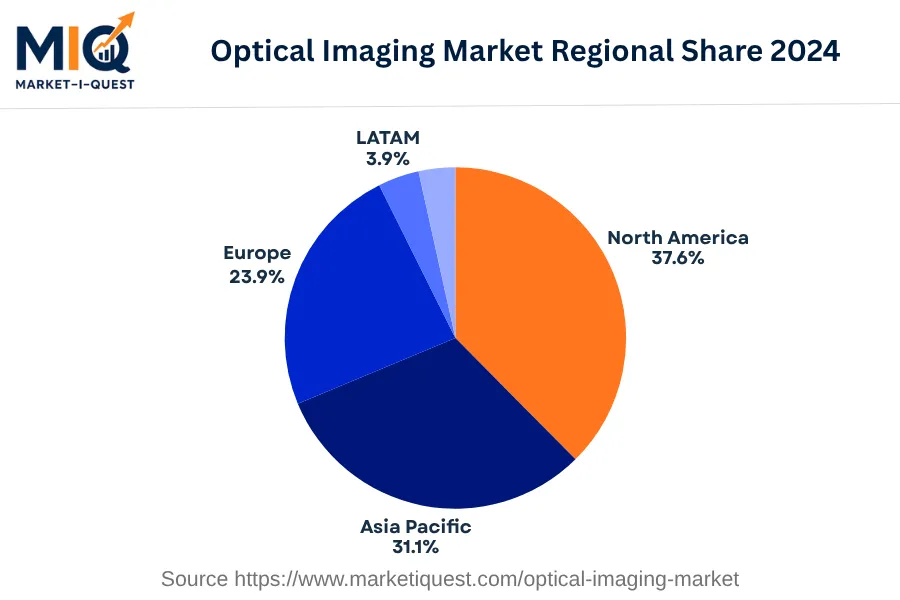
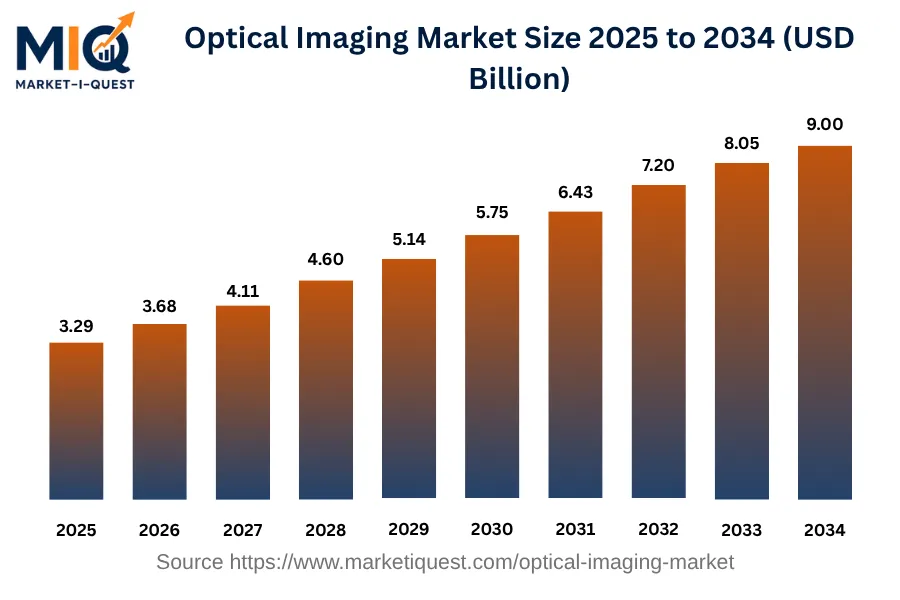
The Optical Imaging Market was valued at $3.29 billion in 2025 and is projected to escalate to $9.00 billion in 2034, marking a Compound Annual Growth Rate (CAGR) of 11.8%. The market witnessed steady progress throughout the forecast period, thanks to the increasing demand for non-invasive procedures and advancements in healthcare technology. The market starts from a base value of $2.94 billion in 2024, demonstrating a marked increase in the following years. This growth was also driven by the increasing prevalence of neuro, ophthalmic and dental diseases. Regionally, in 2024, North America held the largest share in the market at 37.6%, followed by the Asia Pacific with a share of 31.1%. Europe recorded a market share of 23.9%, while the Middle East and Africa (MEA) accounted for 3.5% and Latin America (LATAM) held a 3.9% share.

Key Takeaways

  • By Product Type - Imaging Systems held the majority share in the Optical Imaging Market.
  • By Imaging Technique - Optical Coherence Tomography led accounting for a significant share in the market.
  • By Application - Diagnostics was the leading segment in the Optical Imaging Market.
  • By End User - Hospitals were the dominant players in this market.
optical-imaging-market market size

Key Driving Factors

Implementation of favorable government regulations

The optical imaging market is witnessing an expanded adoption due to increased implementation of favorable government regulations across the globe. Notably, the FDA's approval of optical coherence tomography (OCT) for clinical diagnostics has led to broader acceptance and use of optical imaging techniques. This non-invasive imaging technology, which provides high-resolution, three-dimensional insights into the human anatomy, has seen high approval for uses in ophthalmology and cardiology. The regulatory approval not only legitimizes the technology but also encourages more extensive research and development leading to new applications in medical diagnostics and treatment monitoring which are driving the market.

Rise in prevalence of ocular diseases

Considering population health globally, the rise in the prevalence of ocular diseases, including age-related macular degeneration, diabetic retinopathy, and cataracts, among others, significantly pushes the needs for advanced diagnostic techniques. Optical imaging techniques, specifically using optical coherence tomography, have proven to be highly effective in early diagnosis and management of these diseases. Ophthalmologists are increasingly adopting these tools to obtain detailed images of the retina and other eye structures, thereby enabling accurate diagnosis and precise monitoring of disease progression and response to treatment. Given that the occurrence of these diseases is expected to surge due to an aging population and rising diabetes incidence, the demand for optical imaging in ophthalmology is similarly projected to increase significantly.

Market Evolution by Timeline

2019-2023
During this period, the primary buyers of optical imaging technology were medical facilities, predominantly in the United States, Europe, and Japan. This demand was driven by the need for better diagnosis and therapeutic monitoring tools. Optical coherence tomography which produces real-time cross-sectional images was widely adopted. The device integration with new technologies like AI was in infancy. Key constraints included high costs of imaging technologies and lack of skilled professionals. Regulatory environment was supportive, characterized by FDA's approval of handheld OCT devices. The prevalent commercial model was outright purchases with the average price of an OCT device around $50,000. Optical imaging market faced major risks such as acceptance among healthcare practitioners due to high costs.
2024
In this year, optical imaging technologies like OCT angiography gained traction, enabling detailed imaging of blood vessels and blood flow. The technology usage extended to ophthalmology, oncology and cardiology fields in major markets such as India and China where healthcare infrastructures got evolved. Technological maturity was still limited, and industry faced supply chain issues caused by disruptions due to pandemic. No significant policy changes occurred. There was a shift towards renting optical imaging equipment as compared to outright purchasing due to cost concerns. Major risks during this period included barriers to entry for new players due to high costs of technology, market penetration and commercialization of these technologies.
2025-2029
During these years, there was an increased adoption of optical imaging for non-invasive procedures. Hospitals and diagnostic centers in emerging economies in Africa and Latin America showed interest. Concurrently, technology use-cases broadened to include pharmaceutical and biotechnology industries for drug formulation and tissue engineering. A rush in hospital digitalization helped further tech integration. Lack of reimbursement policies continued to be a major challenge. AHIMA's standards like CDI proved crucial in adoption of digital health records. Typical contract pattern included long-term service agreements with vendors. Device miniaturization and improved spectral resolution helped in reducing the costs of these devices. Key risk factors were dealing with stringent regulatory approvals and cybersecurity threats.
2030-2034
The demand for optical imaging further expanded to include regular screenings for preventive healthcare. Particularly, in Middle East and Southeast Asia, demand increased for improved healthcare delivery. Hybrid technologies featuring optical imaging and ultrasound or MRI became common. Yet, device complexity posed manufacturing challenges. Governments boosted adoption by facilitating partnerships between hospitals and tech companies. Data interoperability standards played a key role in technology implementation. Affordability and successful deployments led to a surge in device leasing. A genuine risk was data security with increased technology reliance, prompting the stringent HIPAA rules implementation for patient data protection.

Future Market Outlook

Future Opportunities

The ongoing developments in optical imaging technologies present numerous opportunities for various sectors. In 2023, the adoption of telehealth solutions due to the COVID-19 pandemic has led healthcare providers to seek advanced imaging solutions that support remote consultations. Companies like Philips Healthcare are already integrating optical imaging features within their telehealth platforms, allowing specialists to make more accurate diagnoses from a distance. Similarly, the automotive industry is increasingly leveraging optical imaging for advanced driver-assistance systems. In August 2023, a partnership between Tesla and Samsung demonstrated the integration of optical sensors with optical imaging to enhance vehicle safety features. The agricultural sector is another area poised for growth; precision farming solutions utilizing optical imaging for crop monitoring were highlighted in a study published by the International Conference on Agricultural Engineering in June 2023. In addition, optical imaging applications in security and surveillance are expanding, driven by the need for enhanced monitoring systems. Organizations such as UNESCO are promoting global standards for security technologies that include optical imaging features, as articulated in their 2023 strategy document. Furthermore, emerging markets in Southeast Asia are witnessing increased investment in optical imaging technologies for healthcare and industrial applications, driven by local governments' initiatives to modernize infrastructure. Consequently, these opportunities reflect strategic trends that are likely to shape the optical imaging market in the coming years.

Segmentation Analysis

By Product Type

The market is divided into subsegments including Imaging Systems, Imaging Software, and Accessories. The Imaging Systems category accounted for the largest revenue share while Accessories are expected to grow at the fastest CAGR during the forecast period.

Largest Revenue Share

Imaging Systems

Market Share Leader

Imaging Systems, a significant segment of the trinity, generated the largest revenue in 2024. The extensive application of these systems across various industries, including healthcare and automotive, contribute substantially to their high-revenue generation capacity. Demand for Imaging Systems is growing, especially in the healthcare industry, owing to the rise in need for medical imaging to diagnose and monitor numerous health conditions. The automotive industry is not lagging far behind either, with the increasing integration of imaging systems in vehicles for enhanced safety and driving assistance. Moreover, advancing technology and continuous product innovation are central to driving the demand for imaging systems. Imaging Systems, being at the higher end of the cost spectrum, also carry a bigger ticket size than other segments, leading to a higher revenue share. Despite intense competition and over flooding of cheaper alternatives, the overall quality, durability, and the superior output from these systems make them a preferred choice among consumers, retaining their dominant position in the market.

Fastest CAGR

Accessories

Forecast Period Growth Leader

Despite generating less revenue than Imaging Systems, the Accessories segment is positioned to grow at the fastest CAGR in the coming years. This growth is driven by numerous factors. First, the intense competition in the market has led manufacturers to differentiate their products by offering innovative and improved accessories, boosting overall product sales. Secondly, the continuous technological advancements and enhancements in imaging systems are creating a demand for compatible accessories, acting as a catalyst for the segment's growth. However, the market faces adoption barriers due to high pricing and the increasing presence of alternative solutions. The cost of developing technologically advanced accessories often translates into higher pricing for the end-users, slowing down the rate of adoption. Regulatory requirements and the risk of rapid technological obsolescence also constitute risk factors for this segment. Yet, with the right strategies, partnerships, and capital investments, manufacturers can capitalize on the current market dynamics and further boost growth.

By Imaging Technique

The market is divided into subsegments including Fluorescence Imaging, Phase Contrast Imaging, Near-Infrared Imaging, Optical Coherence Tomography, and Diffuse Optical Imaging. Optical Coherence Tomography accounted for the largest revenue share while Near-Infrared Imaging is expected to grow at the fastest CAGR during the forecast period.

Largest Revenue Share

Optical Coherence Tomography

Market Share Leader

Optical Coherence Tomography (OCT) plays a considerable role in the market. It has demonstrated its value within clinical settings for optical biopsy, which is a less invasive alternative to traditional biopsy methods, thus reducing patient risk and discomfort while improving the rate of diagnosis. The versatile use of OCT in various medical fields, such as ophthalmology, dermatology, and cardiology, is driving its market revenue. Furthermore, developed markets like North America and Europe have regulatory environments supportive of innovative medical imaging techniques, thereby fueling the adoption of OCT. Factors such as considerable purchasing power, increased patient awareness, and established medical infrastructure contribute to this subsegment's significant revenue. Its precision and non-invasive characteristics make it a preferred technique in the imaging sector.

Fastest CAGR

Near-Infrared Imaging

Forecast Period Growth Leader

Near-Infrared Imaging holds the distinction of being the fastest-growing segment. The market is being driven by its unique ability to facilitate non-invasive visualization and quantification of biological processes in real-time. Advanced molecular probes and sophisticated algorithms are aiding the growth of this imaging technique. Furthermore, breakthroughs in technological aspects, such as miniaturization and imaging sensitivity, are cutting down its initial Capex costs and encouraging wider adoption. Policymakers are also progressively acknowledging the importance of Near-infrared imaging in modern healthcare, facilitating regulatory approvals and fostering partnerships between academia and industry. However, high initial costs and the need for technically trained personnel for analysis may pose short-term adoption barriers. Critical assumptions in this analysis include a continuation of the current technological, policy, and market trends.

By Application

The application market segment is divided into subsegments including Diagnostics, Therapeutic Guidance, Surgical Planning, Research Development, and Preclinical Imaging. In the base year of 2024, Diagnostics accounted for the largest revenue share while Preclinical Imaging is expected to grow at the fastest CAGR during the forecast period.

Largest Revenue Share

Diagnostics

Market Share Leader

The Diagnostics subsegment holds the leading position in revenue generation due to its critical role in healthcare. Accurate and early diagnosis plays a key part in any treatment plan, making it a highly sought-after service. It is driving the demand for innovative diagnostic tools and techniques, increasing the revenue growth. Its necessity across all patient demographics further broadens its customer base. Regulators around the world are supporting advancements in this field, enabling quicker and broader market approval for innovative diagnostic solutions. Strong regulatory support, in turn, feeds into the increasing supply and adoption of these diagnostic solutions. Its indispensability also makes it less sensitive to price fluctuations, providing consistent revenue. Unlike other areas, switching cost is limited, as accurate and early diagnosis is in the best interest of the patient, and the choice of diagnostic tools usually lies with the healthcare provider, not the patient.

Fastest CAGR

Preclinical Imaging

Forecast Period Growth Leader

Preclinical Imaging is set to be the fastest-growing subsegment in the application market. This substantial growth rate is driven by rising investments in research and development activities in the healthcare industry, specifically biomedical research. Biomedical research organizations are continually seeking advanced imaging techniques for research animals to ascertain the safety and effectiveness of novel medication before clinical trials - boosting the adoption of preclinical imaging. Technological advancements such as the integration of AI and IoT with imaging devices are acting as significant catalysts in streamlining and enhancing the imaging process. However, high capital expenses, arising from the sophisticated technology and necessary skilled personnel, might be a barrier. Partnerships with technological firms and government funding towards research activities are mitigating these barriers to promote growth in this subsegment. There might be near-term risks related to data security and privacy with the use of advanced technology, but it isn't overshadowing the growth drivers.

By End User

The market splits into subsegments including Hospitals, Research Laboratories, Academic Institutions, and Diagnostic Centers. In this division, Hospitals hold the largest revenue portion, while Research Laboratories are projected to experience the highest growth rate in the foreseeable future.

Largest Revenue Share

Hospitals

Market Share Leader

Hospitals, as an end-use category, generated the most revenue in 2024. This is primarily due to the substantial patient inflow, diverse health issues treated, and the scale of medical services provided. Hospitals are often better equipped with sophisticated therapeutic and diagnostic devices compared to other healthcare entities, which warrant higher product demand and hence more substantial purchases than other subsegments. Additionally, they frequently engage in bulk purchases, which add to their considerable share in the overall market spend. Geographically, revenue generated in developed countries is usually high due to the presence of advanced healthcare systems. Regulatory changes have also been driving this trend, with stricter patient safety norms leading hospitals to invest in higher-quality medical devices and services. Finally, the bargaining power and consistent supply-chain structures allow hospitals to procure goods with beneficial pricing and credit terms, further increasing their share in overall spending.

Fastest CAGR

Research Laboratories

Forecast Period Growth Leader

Research Laboratories are forecasted to be the fastest-growing segment in the market. The primary drivers for this growth are the increasing investments in medical and scientific research, booming biotechnology sector, and innovations in clinical trials. Policies that support research and development have also helped to funnel more funds into laboratories, catalyzing their expansion and thereby the need for equipment and services. Advances in technologies such as genomics, personalized medicine, and bioinformatics have led to an increase in demand for unique laboratory equipment that can provide precision and accuracy. However, capital expenditure required for new technologies may pose some barriers for growth. Partnerships with academic institutions and corporates may facilitate the necessary funding to alleviate this barrier. Meanwhile, uncertainties related to regulatory norms and intellectual property rights can present near-term risks. Nevertheless, the long-term outlook remains robust due to relentless advancements in biotechnology and medicine research.

Competitive Analysis - Optical Imaging Market

Key Market Players

Manufacturers / OEMs

Carl Zeiss Meditec AG
Germany
Leica Microsystems
Germany
Topcon Corporation
Japan

Key Suppliers & Raw Materials

Schott AG
Germany
Corning Incorporated
US
Hoya Corporation
Japan

Distributors, Integrators & Channel Partners

Photonics, Inc.
US
Ultrafast Systems LLC
US
Hamamatsu Photonics K.K.
Japan

Porter’s Five Forces Analysis

This analysis assesses the competitive environment of the optical imaging market.

Supplier Bargaining Power

Medium

Limited suppliers of imaging lens and high-tech components increase their bargaining power.

Buyer Bargaining Power

High

Wide variety of imaging techniques and technologies provide buyers with selection power.

Threat of Substitutes

Low

Sophisticated imaging methods provide unique insights, reducing potential for direct substitutes.

Threat of New Entrants

Medium

High R&D costs present a barrier, but rapid technological advancements may invite new entrants.

Competitive Rivalry

High

Intense competition between established brands to innovate and improve technologies and techniques.

Regional Analysis

Geographic market dynamics and growth opportunities across key regions

Global Market Outlook

optical-imaging-market market regional share

North America

In 2024, North America's optical imaging market displayed robust activity due to technological advancements, regulatory standards, and rising healthcare demands. An aging population and increased prevalence of eye ailments, supported by strong healthcare infrastructures in the U.S., Canada, and Mexico, led to greater demand for advanced diagnostic technologies. Government regulations, such as the U.S. FDA’s support for novel imaging technologies, further drove market growth by enhancing product acceptability. Moreover, significant investment flowing into the optical imaging sector promoted research and development activities, fostering technological advancements and product innovation.

Simultaneously, evolving buyer behaviors conformed to more sophisticated diagnostic procedures, prompting healthcare providers to adopt advanced optical imaging systems. The advent of AI integration in optical imaging brought heightened precision and faster diagnosis, resulting in rapid adoption by healthcare facilities throughout North America. A noticeable trend was the rising alliances among tech firms and healthcare providers, advancing the product pipeline and distribution channels. Regulatory bodies enforced stringent standards for optical imaging devices, ensuring patient safety and product efficacy. The customer base, predominantly healthcare facilities, included major hospitals, ophthalmology clinics, and research institutes. The manufacturing sector also embraced optical imaging technologies for quality control and intricate assembly processes, contributing to a versatile, dynamic market landscape in 2024.
Asia Pacific

In 2024, the Asia Pacific optical imaging market saw intense activity, led by demand accelerations in nations including China, India, Japan, South Korea, Australia, and key ASEAN markets. Drivers of this activity included escalating healthcare infrastructure investment, primarily in China and India. Evolving government regulations, notably in Japan and South Korea, advanced optical imaging adoption by making it more financially viable for healthcare providers. Recent technological advancements also expanded optical imaging applications, thereby stimulating demand from the healthcare and medical research sectors.

Trends in the optical imaging market demonstrated a strong consumer inclination towards minimally invasive procedures. Moreover, manufacturers, like those based in Australia and ASEAN countries, prioritized shifting their product offerings towards more compact and portable devices to accommodate this shift. Additionally, partnerships and M&A activities increased, especially within Chinese and Indian markets, solidifying supply dynamics and broadening end-user reach. Furthermore, stricter policy enforcement was observed in relation to regulatory standards on optical imaging devices, primarily from South Korean and Japanese governments, shaping the market's trajectory by ensuring product safety and reliability. This blend of market drivers and trends emphasized the region's developing focus on integrating premium health technology into their growing healthcare framework.

Europe

In 2024, Europe's Optical Imaging Market experienced significant growth, spurred by key drivers and evolving trends. Regulatory mandates bolstering the use of non-invasive procedures in healthcare increased the demand. Moreover, the adoption of advanced imaging technologies expanded in fields like biotechnology and pharmacology, while investment in research and development in healthcare sectors of countries such as Germany and the U.K. strengthened supply infrastructure. Additionally, cost-effective imaging solutions, facilitated by technology advances, induced positive pricing dynamics.

Regarding trends, a clear shift was noted towards the adoption of optical imaging in diagnostics, mainly within healthcare enterprises, due to heightened sensitivity and resolution capabilities. Real-time imaging demands grew, particularly in France and Italy, driven by increasing applications for intraoperative procedures. Partnerships and M&A activities surged, evident in the collaborations between healthcare providers and optical imaging device manufacturers in Spain and the Benelux region. Policy enforcement also played a vital role, as seen through EU-wide regulations, enforcing stricter standards for medical imaging technologies. The primary sectors involved included healthcare institutions, biotechnology and pharmacology companies, with the government playing a crucial role in implementing regulatory norms. Manufacturing and retail followed closely, harnessing optical imaging for quality control and inventory management, respectively. Retail in the Nordics and manufacturing facilities in Central and Eastern Europe notably benefited from these developments.

Latin America

In 2024, the optical imaging market in Latin America (LATAM) experienced robust expansion. The market has been primarily driven by increased investment in the healthcare sector by countries such as Brazil and Mexico to foster the adoption of advanced imaging technologies. Regulatory changes in Argentina and Colombia to streamline compliance for medical devices also stimulated market growth. Further, demand for cost-effective optical imaging equipment rose in response to growing populations and aging demographics in Chile and Peru. Evolving trends included a noticeable shift towards non-invasive optical imaging solutions in healthcare, driven by their efficiency in providing detailed anatomical insights. The adoption of artificial intelligence in optical imaging became increasingly popular in corporate and technical sectors, as the demand for precision and accuracy escalated. The LATAM market also witnessed strategic partnerships and mergers to expand product portfolios and promote innovation, with a significant alliance between regional pharmaceutical enterprises and imaging equipment manufactures.

The market's primary customers were the healthcare sector, government entities investing in public health infrastructure, and private businesses using optical imaging for quality control purposes in manufacturing and retail industries. In the corporate sector, both national and multinational enterprises in LATAM moved towards the incorporation of optical imaging technologies for their high-resolution, detailed, and non-contact characteristics, further driving market demand in 2024.

Middle East & Africa

In 2024, the Middle East and Africa's Optical Imaging Market saw substantial growth, driven by several key factors. The demand for optical imaging technology was on the rise due to the increased need for effective diagnostic tools in healthcare, boosted by significant investments in healthcare infrastructure in countries such as Saudi Arabia, UAE, and Israel. Regulatory frameworks across the region also became more conducive to advanced medical technologies, encouraging increased adoption of optical imaging systems.

The optical imaging market saw several notable trends, primarily driven by changes in buyer behavior and technological advancements. The increasing prevalence of chronic diseases in the region boosted the demand for optical imaging, with a shift towards non-invasive imaging techniques observed in healthcare facilities. Partnerships between local and international healthcare providers, such as Saudi Arabia's Ministry of Health's collaboration with GE Healthcare, were also pivotal in enhancing technology outreach and application knowledge. Furthermore, a growing push for digitization and data-driven solutions in the healthcare sector blossomed; particularly in South Africa and Israel, promoting use of high-resolution optical imaging systems. The market's consumer base was predominantly in the healthcare sector, although utilities and manufacturing industries also started integrating optical imaging into their maintenance and quality control workflows, reinforcing the market's robustness.

Recent Industry Developments

Latest market innovations, product launches, and strategic initiatives

June 2026

Cognex Corporation agreed to acquire Moritex Corporation from Trustar Capital for ¥40 billion (approximately $275 million) in an all-cash transaction, marking Cognex's largest acquisition in 42 years to integrate machine vision optics components.

January 2026

Dendrite Imaging received FDA 510(k) clearance for its Dendrite Imaging System, a first-of-its-kind nerve imaging surgical camera designed to help surgeons visualize peripheral nerves in real time during procedures.

Frequently Asked Questions