Optical Coatings Market Snapshot

Key Players

  • PPG Industries (United States)
  • Zeiss Group (Germany)
  • Iridian Spectral Technologies (Canada)
  • Shin-Etsu Chemical (Japan)
  • Schott AG (Germany)
  • Abrisa Technologies (United States)
  • Janos Technology (United States)
  • Jenoptik (Germany)
  • Syntec Optics (United States)
  • Optics Balzers (Liechtenstein)

Market Size

Base Year 2024
$19.53 Bn
CAGR
8.37%
Forecast 2034
$43.63 Bn

Market Segments

By Product
  • Anti-Reflective Coatings
  • Reflective Coatings
  • Filter Coatings
  • Conductive Coatings
  • Electrochromic Coatings
  • Others
By Application
  • Consumer Electronics
  • Solar
  • Medical
  • Architecture
  • Aerospace & Defense
  • Automotive
  • Telecommunication
  • Others

Market Dynamics

Drivers
  • Rising demand for consumer electronics
  • Increased military expenditure on advanced optical systems
Restraints
  • High production costs
  • Technical application challenges
Opportunities
  • Emerging sustainable technologies
  • Increasing demand in telecommunication industry

Market Size

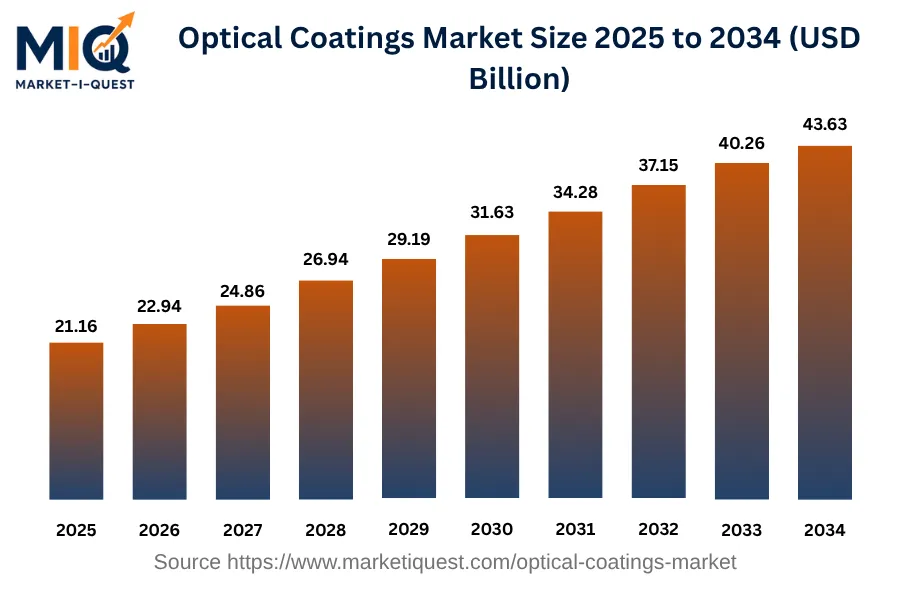
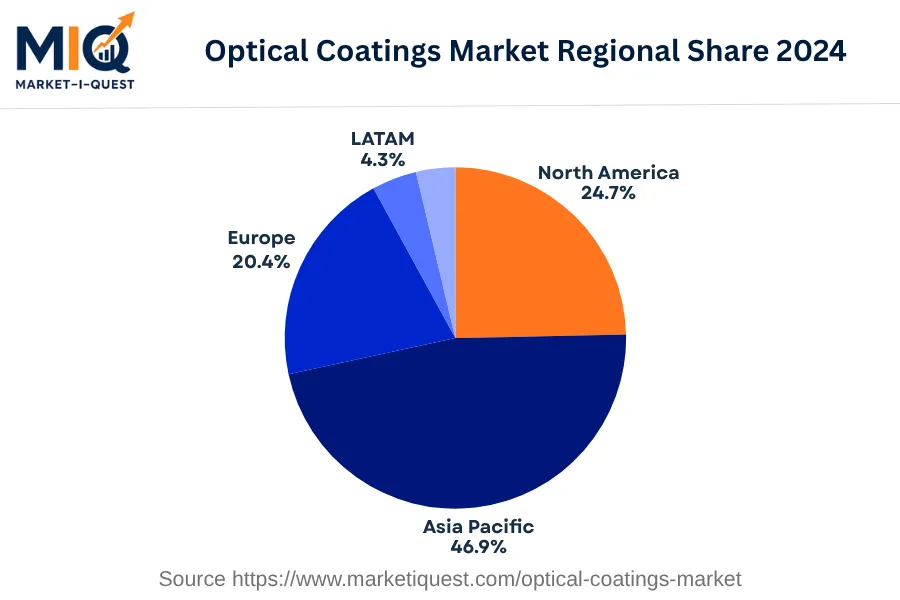
The Optical Coatings Market was sized at $21.16 billion in 2025 and is projected to reach $43.63 billion by 2034, marking a growth with a compound annual growth rate (CAGR) of 8.37%. The decade between 2025 and 2034 indicates a steady rate of expansion, nearly doubling the market size from its value. The progression of the market growth is anchored by continued global interest and investment in the optical coatings sector, an essential component of varied industrial applications and consumer products, providing an impetus to the upward trend. The regional distribution of the market in 2024 had Asia Pacific holding the largest share at 46.92%, followed by North America at 24.68% and Europe with a share of 20.43%. Regions such as Latin America and the Middle East & Africa had comparatively smaller shares, pegged at 4.26% and 3.71% respectively.

Key Takeaways

  • By product - Conductive Coatings held the largest share in 2025.
  • By Application segment - Consumer Electronics had a strong presence with a substantial market share in 2025.
optical-coatings-market market size

Key Driving Factors

Stringent Regulatory Obligations for Optical Emission

Regulatory bodies, including the American National Standards Institute (ANSI) and International Organization for Standardization (ISO), have established strict rules relating to optical emissions. Manufacturers of products with light emission properties must adhere to these regulations, which call for high-quality optical coatings, to prevent harmful emissions. The need for optical coatings arises when manufacturers need to enhance the security and performance of their optical devices to be in compliance. This regulatory requirement is one of the driving factors influencing the optical coatings market, specifically prompting companies to invest in advanced functional coatings that offer low light reflection and high light transmission.
Increased Adoption of Solar Power Solutions

With global energy demands escalating, the adoption of alternative power sources, such as solar energy, is growing rapidly. The key to the efficiency of these solar panels resides in their ability to absorb maximum light. Optical coatings play a crucial role in this regard by improving the light absorption capacity of solar panels and reducing light reflection. In consequence, they enhance the overall efficiency of these panels. This growing demand for solar panels is consequently driving the optical coatings market, as manufacturers seek to equip their panels with high-quality optical coatings to optimize performance.

Market Evolution by Timeline

2019-2023
During this period, automotive and defense sectors emerged as major demand contributors for the Optical Coatings Market, particularly from developed economies like the US, Germany, and Japan. Anti-reflective and filter coatings were commonly used due to their various applications in laser systems and displays. From a supply side perspective, companies like Novotech Inc. and Newport Corp. actively shipped products, despite being in the early phase of supply chain maturity. Regulatory influence was moderate, with no major policies or standards in place impacting market dynamics. Commercial arrangements typically involved long term contracts with fixed pricing, along with partnerships formed for shared technology development. Key market risks involved potential fluctuations in raw material prices and trade uncertainties.
2024
The year 2024 saw increased interest in optical coatings from the emerging market of augmented reality devices, driving demand alongside traditional sectors like automotive and defense. USA, Japan and the EU continued to lead in demand. Newly launched products included scratch-resistant coatings from manufacturers like Schott AG. Technological integration remained at an early to intermediate level. Industry was awaiting the introduction of any regulatory standards governing coating performance or production. Residential customers began adopting these coatings for interior decoration and sunglasses, resulting in diverse contract types from bulk deals to individual retail purchases. The continued risk of cost fluctuations for coating materials remained.
2025-2029
Demand for optical coatings grew from sectors like aerospace, robotics, and virtual reality devices, with majority usage from USA, China and India. Advanced filter and anti-reflection coatings increased in variety and availability. Coordination amongst manufacturers, suppliers, and retailers improved, leading to an intermediate maturity level in supply chain integration. The introduction of ISO/TC 172 surmounted as a significant policy, impacting the adoption of certain products. Business trends witnessed a shift towards flexible contracts and price negotiation. This period marked the increasing role of partnerships not only for technology sharing, but for achieving greater market reach. The industry faced potential risks of unmet demand due to inadequate manufacturing capacity.
2030-2034
This period saw steady demand for optical coatings by industries like telecommunication, military, renewable energy, and biomedical in countries like USA, China, Germany, India and South Korea. Advanced hydrophilic and oleophobic coatings dominated the market supply. The supply chain showed high integration maturity, facilitating efficient order fulfillment. The enforced ASTM standards regulated the optical coatings production, increasing market transparency and customer trust. Procurement often included 'right-to-audit' clauses for contract assurance. Continuous pressure to innovate gave rise to strategic alliances secured through mergers and acquisitions. High commodity prices and the integration of increasingly complex technologies represented potential risk factors.

Future Market Outlook

Future Opportunities

The future growth of the optical coatings market may stem from the increasing demand for high-performance optical systems across multiple industries. In 2023, automotive manufacturers, including Tesla, are emphasizing advanced driver-assistance systems (ADAS) that utilize sophisticated sensors requiring specialized optical coatings. Additionally, the ongoing proliferation of renewable energy technologies, particularly solar panels, presents opportunities for optical coatings designed to enhance solar energy conversion. Partnerships, such as the 2022 collaboration between First Solar and various coating manufacturers, focus on developing solutions to improve the efficiency of photovoltaic cells. Regulatory bodies, including the U.S. Environmental Protection Agency (EPA), are also pushing for eco-friendly coatings, indicating growing market demand for sustainable options. The medical device sector is witnessing increased adoption of optical coatings for diagnostic equipment, necessitating compliance with health regulations set by governing entities like the U.S. Food and Drug Administration (FDA). Research initiatives are underway to explore novel materials, such as nanostructured coatings, which could improve performance in challenging environments. The integration of coatings into consumer electronics, particularly in displays and lenses, highlights another potential growth area, driven by companies like Samsung focusing on enhancing user experiences via superior display technologies.

Segmentation Analysis

By Product

The market is divided into subsegments including Anti-Reflective Coatings, Reflective Coatings, Filter Coatings, Conductive Coatings, Electrochromic Coatings and Others. Among them, Conductive Coatings accounted for the largest revenue share while Electrochromic Coatings is expected to grow at the fastest CAGR during the forecast period.

Largest Revenue Share

Conductive Coatings

Market Share Leader

Conductive Coatings holds the largest revenue share in the product market. This dominance can be attributed to their wide range of applications across various industries such as electronics, automotive, and aerospace. The growth in these industries is leading to an increased demand for Conductive Coatings. For instance, in electronics, Conductive Coatings are used extensively for effective emission of heat. Furthermore, the automotive industry uses them for preventing corrosion in various parts. The increasing demand for electric vehicles, where the application of conductive coatings is high, is also giving a boost to the segment. Many newer markets like wearable technology and flexible electronics are also embracing Conductive Coatings, adding to its dominance. Globally, Asia is the largest consumer of conductive coatings driven by its large electronics and automobile industries.

Fastest CAGR

Electrochromic Coatings

Forecast Period Growth Leader

Expected to record the highest CAGR, Electrochromic Coatings are poised for rapid growth. These coatings can change color when an electrical charge is applied, offering optimal control over the amount of light and heat that passes through a window. This makes them highly suitable for applications that require energy efficiency, such as smart windows in green buildings and automotive industries. Governments around the world are implementing strict regulations related to energy efficiency, thereby driving the growth of Electrochromic Coatings. The high initial cost and complexity associated with Electrochromic Coatings are the key barriers to adoption. However, ongoing research aimed at reducing cost through improvements in the manufacturing process, and strong investment in the sector suggests potential for high growth. Despite the risk of competition from other advanced coatings, the unique properties and growing implications of Electrochromic Coatings promise a positive outlook.

By Application

The market is divided into subsegments including Consumer Electronics, Solar, Medical, Architecture, Aerospace & Defense, Automotive, Telecommunication and Others. In 2024, Consumer Electronics accounted for the largest revenue share while the Solar subsegment is expected to grow at the fastest CAGR during the forecast period.

Largest Revenue Share

Consumer Electronics

Market Share Leader

The Consumer Electronics subsegment holds the largest revenue share due to the omnipresence of these devices in everyday life. This widespread presence is further amplified by an increasing demand for smart devices and IoT products. As consumers continuously upgrade and replace devices, companies often enjoy repeat business, significantly driving up revenue. Geographically, consumers in developed economies, especially in regions like North America and Europe, spend more on these products due to a higher disposable income. From a regulation perspective, there is generally less red tape in this sector, encouraging more innovation and product variety. Customer preferences tend to lean towards premium brands that are perceived to offer better quality, features, and after-sales service. As such, market leaders in this segment often control significant revenue shares. The purchasing decision is heavily influenced by factors such as brand reputation, product features, design, and price. There are generally low switching costs for consumers, but strong brands often maintain a loyal customer base, providing stable revenues.

Fastest CAGR

Solar

Forecast Period Growth Leader

The Solar subsegment is projected to grow at the fastest pace in the coming years. This rapid growth is mainly driven by numerous factors such as favorable government policies and subsidies that promote solar energy adoption due to environmental concerns. Increased capital investment in renewable energy infrastructure is enabling the rapid development of technologies that make solar panels more efficient and affordable. Partnerships amongst industry giants and startups are catalyzing innovation in solar technology, facilitating its faster adoption. On the demand side, there is increasing public awareness about climate change, sparking interest in renewable energy sources like solar. However, the sector may face near-term risks including potential changes in policy, supply chain setbacks, and fluctuating commodity prices. Despite these challenges, the prospects for growth in the solar sector are high, making it a key segment to watch.

Competitive Analysis

Key Market Players

Manufacturers / OEMs

PPG Industries
US
Zeiss Group
Germany
Schott AG
Germany

Key Suppliers & Raw Materials

Thorlabs, Inc.
US
Edmund Optics
US
Newport Corporation
US

Distributors, Integrators & Channel Partners

Cascade Optical Corporation
US
Reynard Corporation
US
Optical Coatings Japan Co., Ltd.
Japan

Porter’s Five Forces Analysis

This analysis outlines the competitive forces shaping the Optical Coatings Market.

Supplier Bargaining Power

Low

Abundance of raw material suppliers reduces supplier bargaining power.

Buyer Bargaining Power

High

Variety of suppliers increases buyer bargaining power and reduces switching costs.

Threat of Substitutes

Medium

Increasing technology innovation poses a moderate threat of substitutes.

Threat of New Entrants

Low

High capital expenditure and technology expertise act as entry barriers.

Competitive Rivalry

High

OEM lock-ins and a multitude of established players intensify competition.

Regional Analysis

Geographic market dynamics and growth opportunities across key regions

Global Market Outlook

optical-coatings-market market regional share

North America

The North American optical coatings market in 2024 was characterized by robust demand and technological innovation. Rapid growth was driven by the expanding adoption of advanced optical technologies in various sectors, including healthcare, manufacturing and government. Regulatory changes in the U.S., advocating for low-emission standards, also stimulated the need for efficient optical coatings in renewable energy utilities. Increased investments in research and development led to significant breakthroughs in coating technology like anti-reflective and filter coatings. From the supply side, a stable pricing environment supported market growth, while in Mexico and Canada, expansion was accelerated by the growing manufacturing and telecommunication sectors respectively.

In terms of trends, customer preference moved towards high-quality, durable coatings leading to a spike in demand for scratch-resistant and anti-glare coatings. In the U.S., technological advancements led to a rise in the usage of smart glass and photovoltaic applications, driving the demand for specialized optical coatings. Mergers and acquisitions were prevalent, as companies sought to strengthen their market presence and capitalize on the increasing demand. Government policies prioritized the adoption of energy-efficient products, encouraging significant growth in the optical coatings market. Specific sectors highlighting exceptional growth included healthcare, driven by the need for optical coatings in medical devices and manufacturing, propelled by the demand in the automotive industry for advanced coating technologies.

Asia Pacific

In the base year of 2024, the Optical Coatings Market witnessed robust growth in the Asia Pacific region. Key factors driving this growth include burgeoning telecom infrastructure, demanding higher efficiency in optical fiber networking, especially in China, India, and ASEAN markets. A consistent influx of investments facilitated advanced technology adoptions resulting in enhanced supply dynamics. Also, government regulations pushing for energy-efficient electronics, particularly in Japan and South Korea, stimulated market growth. Distinct market trends have been observed too. The enhanced awareness towards environment-friendly products shifted buyer behavior towards purchasing lead-free optical coatings, impacting manufacturers' focus areas. There was a notable emphasis on research and development for better product innovation across the region. Increased enforcement of manufacturing standards particularly in China and progressive industry alliances, like those in Australia's renewable energy space, amplified the market landscape.

Optical Coatings catered to various sectors, including healthcare, where high-performance optical coatings became prevalent in medical imaging and diagnostics. In the manufacturing sector, there was a heightened demand for anti-reflective and filter coatings for efficient operations. Rapid digitalization drove the retail sector, necessitating optical coatings for display systems and scanners. Lastly, the upsurge in optical networking requirements by government and enterprise customers alike across the Asia Pacific further spiked the market demand.

Europe

In 2024, Europe's optical coatings market has shown significant vibrancy driven by specific factors and unfolding trends. High demand from key sectors like healthcare, manufacturing, and retail played a crucial role in driving the market. Regulations facilitating the use of these products in the telecom sector, specifically in Germany and the United Kingdom, propelled the market further. Technological advancement in optical coating techniques, including ion-assisted deposition, magnetron sputtering, and electron beam evaporation, has also been a substantial driver, notably in France and Italy’s industrial sectors.

In terms of trends, the adoption of environmentally friendly production processes has been evident in the European context, particularly the Nordics and Benelux region. There has also been a pronounced shift towards application-specific optical coatings in Spain and Central & Eastern Europe, indicating focused market expansion efforts. The pattern of partnerships and mergers and acquisitions to consolidate resources and strengthen market presence, exemplified by the major optical coating players in the United Kingdom and Germany, is a remarkable phenomenon. Moreover, stringent policy enforcement related to quality standards in countries such as Italy and France has been instrumental in shaping the optical coatings market in Europe.

Latin America

In the base year 2024, the Optical Coatings Market in Latin America (LATAM) experienced remarkable growth and transformation largely owing to evolving technological advancements and industry-specific developments. Key market drivers included increased investment in optical technology innovation in nations such as Brazil and Mexico, elevated demand for superior optical products in Argentina and Colombia, and shifting regulations that favored optical technology adoption in Chile and Peru. Moreover, cost-effective pricing of high-quality optical materials led to a surge in supply dynamics, enabling the market to expand across several sectors including healthcare, manufacturing, and retail.

A notable trend in the LATAM market in the base year was the change in buyer behavior; consumers exhibited an increasing preference for technologically advanced optical products, a factor considerably boosting market growth. Additionally, a shift towards digitalization in optical technology was observed, marking a significant transition in the market. Partnerships and mergers significantly impacted the market as industry giants sought alliances to solidify their market presence. Regulatory policies mandated the use of standard protocols in the production of optical products, thereby influencing manufacturers to maintain superior quality. Thus, the LATAM Optical Coatings Market navigated through various technological, regulatory, and consumer shifts in 2024, marking potential avenues for future growth.

Middle East & Africa

In 2024, the optical coatings market in the Middle East and Africa was a dynamic sector influenced by numerous drivers and trends. Robust demand from sectors such as telecom, oil and gas, healthcare, and manufacturing propelled growth. Specifically, in countries such as Saudi Arabia and the United Arab Emirates, increased investments in advanced technology adoption and infrastructure improvements heightened the need for optical coatings. In South Africa and Egypt, government regulations promoting the use of energy-efficient optical solutions boosted the market. Additionally, favourable supply dynamics, such as the abundance of raw materials in Nigeria and Kenya, made these countries potential growth areas.

The market witnessed several key trends. Technological shifts towards nanotechnology-based optical coatings, particularly in healthcare settings in Israel, resulted in the surge of innovative product developments. In Qatar, buyer behaviour indicated a preference for durable and efficient optical coatings, mirroring a wider trend observed across the Middle East. Partnerships and merger activities were prevalent, providing companies with the ability to expand their market reach and enhance product offerings, particularly noticeable in Saudi Arabia's manufacturing sector. However, strict policy enforcement regarding environmental concerns and manufacturing processes affected operations, posing a challenge to market players. Despite this, the optical coatings market in the region continued to see progress and development.

Recent Industry Developments

Latest market innovations, product launches, and strategic initiatives

January 2026

ZEISS Vision Care launched the ZEISS DuraVision Plus coating portfolio, with all coatings now standard with ZEISS CleanGuard technology, making lenses up to three times faster to clean.

August 2025

Apogee Enterprises acquired UW Solutions, a leading provider of high-performance coated substrates, integrating it into its Large-Scale Optical segment to create a scalable growth platform in specialty coatings and materials.

Frequently Asked Questions