
Optical Brighteners Market Snapshot

Key Players

  • BASF SE (Germany)
  • Clariant International Ltd. (Switzerland)
  • RPM International Inc. (United States)
  • AkzoNobel N.V. (Netherlands)
  • Daikaffil Chemicals India Ltd. (India)
  • CCA SpA (Italy)
  • Aron Universal Limited (India)
  • Chemex Corporation (United States)
  • Huntsman Corporation (United States)
  • Meghmani Dyes and Intermediates Ltd (India)

Market Size

Base Year 2024
$1.84 Bn
CAGR
5.17%
Forecast 2034
$3.05 Bn

Market Segments

By Application
  • Paper
  • Detergents & Soaps
  • Fabrics
  • Synthetics & Plastics
  • Others
By End Use
  • Consumer Products
  • Security & Safety
  • Textiles & Apparel
  • Packaging
  • Others

Market Dynamics

Drivers
  • Increasing demand in paper industry
  • Growing textile sector
Restraints
  • High production costs
  • Strict environmental regulations
Opportunities
  • Growing textile industry
  • Technological advancements in formulas

Market Size

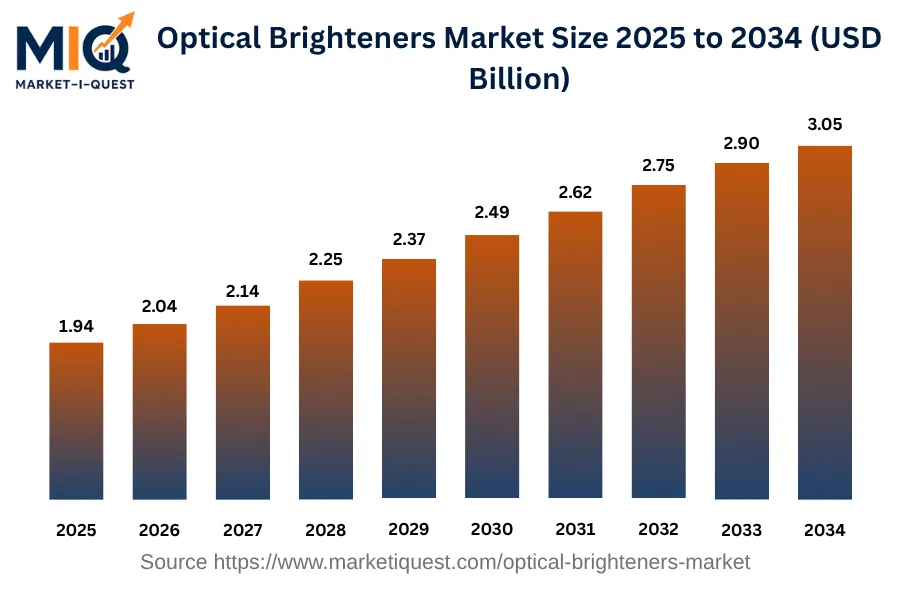
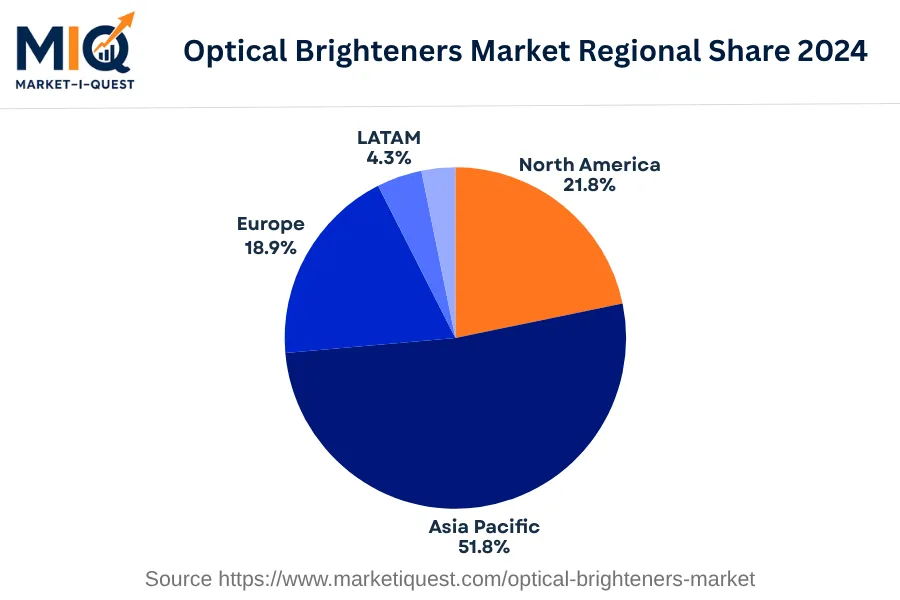
The Optical Brighteners Market is estimated to have been valued at USD 1.94 billion in 2025 and is anticipated to grow to USD 3.05 billion by 2034, with a Compound Annual Growth Rate (CAGR) of 5.2%. This consistent increase is attributed to a rise from USD 1.84 billion in 2024 to USD 1.94 billion in 2025. Growth will continue at a steady pace for the duration of the 10-year time frame. From a geographical standpoint, in 2024, the market was dominated by Asia Pacific, which accounted for 51.8% of the total market. North America followed with a 21.8% market share, then Europe with 18.9%. The least shares were found in LATAM and MEA, owning 4.3% and 3.2% of the market, respectively. This regional distribution is indicative of the predominance of Asia Pacific in the optical brighteners market.

Key Takeaways

  • By Application - Detergents & Soaps led the market taking a substantial share in 2024.
  • By End Use - Consumer Products is projected to be the fastest-growing from 2025 to 2034.
optical-brighteners-market market size

Key Driving Factors

Expansion of the Textile Industry

Global expansion of the textile industry is a significant driving factor for the optical brighteners market. As countries worldwide industrialize and their populations increase, so does the demand for textiles. To meet this demand, the textile industry continually expands, making use of optical brighteners to enhance the brightness and vividness of dyed and natural fabrics. Optical brighteners, also known as fluorescent whitening agents, are commonly used in the dyeing process for textiles to achieve desired shades of white or to enhance the brightening effect of colors. The extension of the textile industry, especially in regions such as Asia-Pacific, with its thriving clothing and fashion market, is anticipated to boost the demand for optical brighteners.
Increasing Use in Detergents and Soaps

The second primary driver is the rising usage of optical brighteners in the detergent and soap industry. As household consumption burgeons, the usage of laundry detergents and soaps that contain optical brighteners also escalates. Optical brighteners are included in these products due to their unique ability to make fabrics appear whiter and brighter. When applied through detergents and soaps, the brighteners absorb UV light and re-emit it in the visible spectrum, lending a radiant 'whiteness' to the washed fabric. Given the continuous zoom in household consumption of these products, particularly in developing regions where standards of living are swiftly improving, this application of optical brighteners is projected to contribute significantly towards increased market demand.

Market Evolution by Timeline

2019-2023
During this period, increased demand for optical brighteners was noted from North American textile and paper industries, driven predominantly by their utility in enhancing the perceived whiteness of fabrics and papers. Simultaneously, Asian markets shipped significant volumes of stillbenic optical brighteners due to their production cost advantage. Legally, the use of these products was regulated by the European REACH program, limiting the adoption in certain applications due to environmental concerns. Commercially, most transactions were negotiated contracts, with bulk purchases earning a discount. The main risks associated with this period included the reliance on petroleum-based raw materials, making the industry susceptible to fluctuations in oil prices.
2024
In 2024, a typical pattern evolved where advanced economies leveraged optical brighteners in high-performance sportswear. Notably, the governments in Europe re-evaluated their restrictions on the usage of certain brighteners under REACH, triggering innovation in production technology. Small-scale manufacturers in India and China experienced supply chain disruptions due to compliance requirements, reflecting the increasing scrutiny in this sector. Pricing tendencies now favored long-term supply agreements, and partnerships between producers and buyers intensified. However, dependency on petroleum-derived inputs remained a major risk, with potential disruptions in the global oil market posing possible supply constraints.
2025-2029
During the latter half of this decade, eco-friendly optical brighteners gained positivity for its reduced environmental impact, and potential users expanded to include various personal and home care product manufacturers. Simultaneously, development of multi-dye compatible brighteners in the US and Germany elevated the technology to next-level integration maturity. Policy amendments by the European Union further encouraged the adoption of these eco-friendly variants. Commercial models tilted towards plant-based inputs, thus creating new partnership opportunities between agro-industries and manufacturers. Production risks, nevertheless, migrated more towards agricultural yield unpredictability.
2030-2034
From 2030-2034, the demand for optical brighteners continued to rise, particularly from Latin American countries, where the textile industry was booming. Products with multi-dye compatibility were in high demand globally, and major shipments were observed from mature markets like the US and Germany. Prominent regulations were enforced by the Environmental Protection Agency in the US and the European Union, promoting the development of more environmentally-friendly options. The commercial model evolved around the adoption of renewable energy sources in production and green procurement policies. Agricultural uncertainty and changing climate patterns remained potential risks impacting raw material supply.

Future Market Outlook

Future Opportunities

The optical brighteners market is poised for various growth opportunities, particularly due to increasing applications in the personal care and household sectors. In 2023, major brands like Procter & Gamble began incorporating optical brighteners in laundry detergents to enhance fabric appearance and consumer satisfaction. This trend is reinforced by consumer preferences shifting towards products that provide visible cleanliness, as indicated by a survey conducted by Nielsen in 2020. Regulatory bodies are tightening standards on textile and paper products, pushing manufacturers to adopt new formulations, which could lead to expanded product lines. In Asia, the rapid growth of e-commerce platforms has prompted companies to explore digital marketing strategies to promote specialty optical brightening agents, thereby reaching a broader audience. Additionally, advancements in nanotechnology and engineered formulations are opening avenues for high-performance optical brighteners in electronics, with companies like Merck KGaA developing solutions tailored for this market segment. This diversification indicates a shift towards multifunctional products, prompting collaborations across different sectors. Looking ahead, the increasing demand for sustainable and biodegradable optical brighteners represents a significant opportunity for market players, especially in regions like Europe, where consumers prioritize sustainable practices in their purchasing decisions. Thus, fostering innovation through collaboration and focusing on compliance will likely be critical for companies aiming to capitalize on emerging trends in the optical brighteners market.

Segmentation Analysis

By Application

The market is divided into subsegments including paper, detergents & soaps, fabrics, synthetics & plastics, and others. Among these, Detergents & Soaps accounts for the largest revenue share while Synthetics & Plastics is anticipated to witness the fastest growth rate during the forecast period.

Largest Revenue Share

Detergents & Soaps

Market Share Leader

The Detergent and Soaps subsegment dominates the market revenue share presently – a trend primarily driven by household consumption, commercial cleaning needs, and increasing hygiene consciousness worldwide. The ubiquitous necessity of cleaning supplies in domestic environments, restaurants, schools, hospitals, and numerous other institutions augments demand steadily, resulting in substantial revenue generation. Moreover, the frequent and regular purchase pattern of detergents and soaps, due to their intrinsic use-case, reinforces this subsegment's dependably high revenue inflows. Big retail chains, local supermarkets, and e-commerce platforms have become primary sales channels promoting easy access to various customer groups. Stricter health and safety regulations globally also necessitate particularly thorough cleanliness standards, thereby boosting the Detergents & Soaps subsegment's market share. However, it is important to beware of the rising environmental concerns and subsequent regulatory changes, which may require brands to adapt in terms of product formulation.

Fastest CAGR

Synthetics & Plastics

Forecast Period Growth Leader

The Synthetics & Plastics subsegment is poised to grow at the most rapid pace in the forecast period, primarily driven by their expanding application in various industries such as automotive, packaging, construction, and consumer goods. Innovative breakthroughs in plastic technologies, coupled with new product launches, are catalyzing growth further. Additionally, the burgeoning demand for lightweight materials in the automobile industry to improve fuel efficiency and lower greenhouse gas emissions serves as a substantial growth driver. With an increase in capital expenditure on construction and infrastructure due to urbanization globally, the demand for durable, high-performance plastic materials will surge. However, environmental concerns and sustainability issues can act as hurdles for this subsegment's growth, prompting it to navigate towards reusable and recycled plastics. Despite the challenges, this sector's intrinsic versatility and adaptability ensure its robust growth trajectory.

By End Use

The market is divided into subsegments including Consumer Products, Security & Safety, Textiles & Apparel, Packaging, and Others. Out of these, Consumer Products accounted for the largest revenue share while Security & Safety is expected to grow at the fastest CAGR during the forecast period.

Largest Revenue Share

Consumer Products

Market Share Leader

The Consumer Products subsegment leads in terms of revenue due to the ubiquity and continuous demand for consumer goods. Consumer products are an integral part of daily life, encompassing items such as personal care products, food & beverages, household items, electronics, and more. High population growth rates in developing regions are driving the demand for consumer products further. Along with population growth, improvements in purchasing power and lifestyle changes have also significantly contributed to the expansion of this market segment, particularly in rapidly developing economies. Consumer behavior trends and preferences are significant determinants of the demand patterns in this subsegment. Customers are increasingly moving towards environmentally friendly, organic, and sustainable products which has induced manufacturers to diversify and innovate. While product availability across multiple sales channels including online and offline modes bolsters consumption, regulatory interventions related to manufacturing and packaging practices can impact the sector’s performance.

Fastest CAGR

Security & Safety

Forecast Period Growth Leader

The Security & Safety subsegment is expected to express the fastest growth in the coming years. This growth is driven by an increased focus on safety measures in both residential and commercial sectors, technological advancements offering efficient security solutions, and rising security concerns across the globe. The rising number of thefts, assaults, and terrorist activities have led various government and non-government organizations to deploy advanced safety measures to protect their assets, employees, and citizens. Emerging technologies like the internet of things (IoT), artificial intelligence (AI), and cloud-based services are now being integrated with security and safety systems, notably improving their efficiency. However, high installation costs and privacy concerns related to surveillance devices may hamper growth. Partnerships with tech companies and increased investment in research and development strategies can serve as significant catalysts for growth in this segment.

Competitive Analysis

Key Market Players

Manufacturers / OEMs

Archroma
Switzerland
RPM International Inc.
US
BASF SE
Germany

Key Suppliers & Raw Materials

Huntsman Corporation
US
Dow Inc.
US
Clariant
Switzerland

Distributors, Integrators & Channel Partners

Kao Corporation
Japan
Evonik Industries AG
Germany
Lanxess
Germany

Porter’s Five Forces Analysis

Analysis of the Optical Brighteners market considering the power of suppliers and buyers, threat of substitutes and new entrants, and competitive rivalry.

Supplier Bargaining Power

Medium

Suppliers are limited but sizeable, with essential chemical industry expertise and logistical networks.

Buyer Bargaining Power

High

Buyers possess strong bargaining power due to the availability of several manufacturers and high price sensitivity.

Threat of Substitutes

Low

Few viable substitutes available due to the specific chemical properties optical brighteners provide.

Threat of New Entrants

Medium

Entry requires significant chemical industry knowledge and capital but is possible with enough resources.

Competitive Rivalry

High

Competition is intense with several established players vying for market share.

Regional Analysis

Geographic market dynamics and growth opportunities across key regions

Global Market Outlook

optical-brighteners-market market regional share

North America

In 2024, the North American market for optical brighteners experienced heavy demand driven by diverse sectors. The textile industry's widespread adoption of optical brighteners drove significant market growth, made further potent by the household detergents sector which favored these products for their enhanced whitening efficacy. Moreover, stringent environmental regulations in the United States fostered the development and adoption of eco-friendly optical brighteners, stimulating innovation in the market. Commercial investment in technology and production facilities, particularly in Canada and Mexico, optimized supply dynamics.

Changing consumer preferences shaped market trends, with a clear inclination towards products offering enhanced brightness and durable effects. Advances in technology facilitated the commercial production of longer-lasting optical brighteners. Spurred by these innovations, partnerships and mergers and acquisitions proliferated, stimulating the market’s product portfolio. Enhancements in online sales platforms, alongside efficient logistics, catalyzed market penetration and product accessibility. Furthermore, tighter policy enforcement around chemical safety standards in North America induced improvements in product formulations. Key beneficiaries of these market dynamics were the healthcare and utilities sectors, which have specific requirements for brightness and cleanliness. Retail outlets, particularly e-commerce platforms, also profited from improved product availability and accessibility. Manufacturing sectors engaged with optical brighteners navigated the dynamic landscape with strategic partnerships and technology adoption, contributing to the robust market performance in 2024.

Asia Pacific

In the base year 2024, the Optical Brighteners Market in the Asia Pacific region exhibited notable growth, attributed to various key drivers and emerging trends. Significant industrial expansion in China and India, accompanied by regulatory support in areas of textile, paper, and detergent production, increased the demand for optical brighteners. Japan's technological advancement also played a vital role, with optical brightening agents heavily used in advanced printing techniques. Trends influencing the market dynamics in 2024 included heightened environmental consciousness among consumers leading to a demand for eco-friendly brighteners, particularly in Australia. The adoption of online sales channels by manufacturers and suppliers to reach a broader customer base was prevalent in key ASEAN markets like Indonesia and Vietnam. Mergers and acquisitions strategy were observed extensively in South Korea where domestic and foreign companies consolidated their market positions.

From a sectoral perspective, the bulk of the demand for optical brighteners came from the retail industry, specifically consumer goods manufacturers, catering to large populations in India and China. The utilities and manufacturing industries, particularly in Japan and Australia, also demonstrated robust demand. Despite a relatively strong market performance, challenges loomed in the form of stringent environmental regulations enforcing changes in chemical compositions of optical brighteners, which had a bearing on the market dynamics in 2024.

Europe

In 2024, the Optical Brighteners Market in Europe demonstrated remarkable growth and dynamism. Drivers of this development included evolving customer preferences for high-quality visual aesthetics, escalating demand from the textiles industry, especially in Germany and Italy, and stringent quality control regulations in the European Union. Increased investment in novel technologies, particularly in the United Kingdom, bolstered the production and application of these brightening agents. Additionally, supply chain optimization in Spain and Central & Eastern Europe reduced time-to-market, while competitive pricing strategies helped manufacturers maintain an edge in a saturated market.

The prevalent trends in the market indicated a shift set by buyer behavior, preference for sustainable and environmentally friendly products gained momentum, particularly in the Nordics and Benelux. This was complemented by diligent policy enforcement across Europe, ensuring rigorous standards for optical brighteners. The market also witnessed a surge in strategic partnerships, particularly mergers and acquisitions, among key players across various sectors such as manufacturing and retail. For example, leading French retail enterprises sought collaborations with manufacturers, bringing optical brighteners directly to the consumer market. Meanwhile, emerging digital channels made business operations more efficient and facilitated product sales, further reinforcing the growth and position of Europe's Optical Brighteners Market in 2024.

Latin America

In 2024, the Latin American optical brighteners market saw notable changes due to varying factors. Key drivers included increased demand from the textile industry as fashion and home decoration trends shifted towards brighter fabrics, especially in Brazil and Mexico. Stricter environmental regulations in Argentina and Colombia fueled the adoption of more eco-friendly optical brighteners. Technology advancements also played a role, with suppliers introducing novel, cost-effective products that boosted overall market penetration.

In terms of trends, consumer preference for environmentally friendly products grew, prompting manufacturers to use optical brighteners that meet these standards, particularly in the clothing and paper industries in Peru and Chile. Furthermore, technical innovations such as self-cleaning fabrics surged in popularity, heightening demand for optical brighteners. In the retail sector, the dominance of online sales channels increased, facilitating the wide distribution of products containing optical brighteners. Partnership agreements and acquisitions between companies were also a trend, helping to expand market reach and enhance production capabilities. The most significant sectors for the Latin American optical brighteners market in 2024 were textiles, paper, detergents, and plastics, with the textile and paper industries notably driving demand in Brazil and Mexico due to the growing consumer interest in brighter and more vivid colors.

Middle East & Africa

The Optical Brighteners Market in the Middle East and Africa displayed a dynamic growth in 2024. This was largely attributed to increasing demand in the textile and detergent industries, with countries such as United Arab Emirates, Saudi Arabia, and Egypt at the forefront of consumption. The surge in investment by these nations was driven by an embracing of advanced technological solutions to reduce production costs and improve end-product quality. Pricing was highly competitive, pushing manufacturers to seek efficient production methods. A trend emerged typified by a shift in buyer's preference towards environmentally friendly products. As a reaction, manufacturers introduced optical brighteners compatible with organic compounds. In Saudi Arabia and Nigeria, government policies promoted the use of such products in textile manufacturing units to reduce environmental impact. The mobility sector, particularly automotive production in South Africa, witnessed increasing usage of optical brighteners, induced by regional standards for high visual appeal.

Another trend observed was the growing channel dynamics. E-commerce platforms have played a major role in reaching customers in remote areas, especially in Kenya and Nigeria. In the United Arab Emirates, partnerships between detergent manufacturers and retail giants were evident, with optical brightener enhanced products taking prominent space on the shelves. Israel's high-tech healthcare and pharmaceutical industries also showed signs of absorbing optical brighteners in their operations due to intrinsic properties such as fluorescence and whitening ability.

Recent Industry Developments

Latest market innovations, product launches, and strategic initiatives

April 2026

Catexel completed the acquisition of BASF's Optical Brightener business. Following the acquisition, Azelis was appointed as the UK distributor for Catexel's CBS‑X optical brightener grade.

January 2026

Novonesis successfully scaled its Luminous brightener line, which gained wide adoption in premium detergents due to superior stability compared to traditional stilbene-based brighteners.

Frequently Asked Questions