
Neuromorphic Computing Market Snapshot

Key Players

  • Intel Corporation (United States)
  • IBM (United States)
  • General Vision (United States)
  • Brainchip Holdings Ltd (Australia)
  • Hewlett Packard Enterprise (United States)
  • Qualcomm (United States)
  • Applied Brain Research Inc. (Canada)
  • Brainomix Limited (United Kingdom)
  • HRL Laboratories (United States)
  • Samsung Electronics (South Korea)

Market Size

Base Year 2024
$5.4 Bn
CAGR
23.65%
Forecast 2034
$45.12 Bn

Market Segments

By Component
Hardware, Software, Services
By Technology Type
Analog Neuromorphic Computing, Digital Neuromorphic Computing, Hybrid Neuromorphic Computing
By Application
Robotics, Natural Language Processing, Computer Vision, Automotive Applications
By End-use
Consumer Electronics, Healthcare, Aerospace and Defense, Industrial Automation

Market Dynamics

Drivers
  • Increasing demand for artificial intelligence
  • Advancements in neurology and electronics
Restraints
  • High development costs
  • Technical complexities
Opportunities
  • Increasing AI adoption
  • Untapped potential in healthcare sector

Market Size

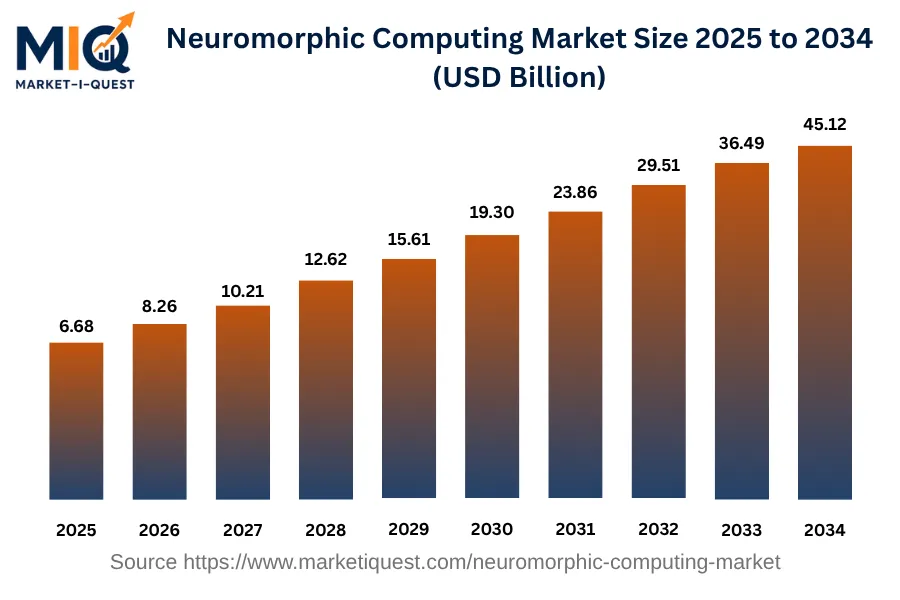
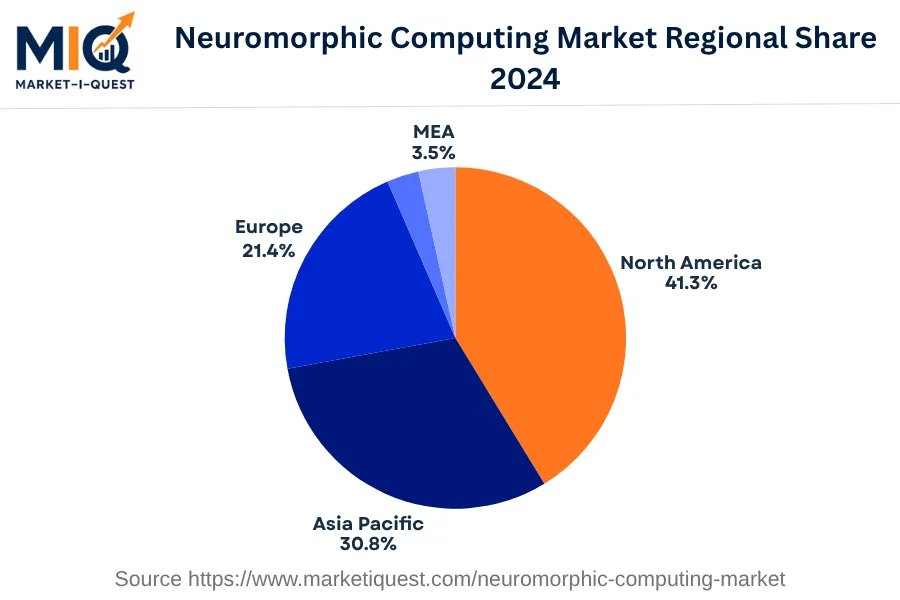
The Neuromorphic Computing Market, sized at USD 6.68 billion in 2025, expanded dramatically over a period of nine years. By 2034, the market size had increased substantially, reaching a total value of USD 45.12 billion. This exhibited a Compound Annual Growth Rate (CAGR) of 23.65%. Starting from a base value of USD 5.4 billion in 2024, the growth journey involved a steady rise year-on-year, resulting in a sevenfold increase by the end of the period in 2034. This substantial growth was a reflection of advancements in the field and the increasing adoption of neuromorphic computing technologies across various industries. In terms of regional distribution in the base year of 2024, North America held the majority share of 41.3%, followed by the Asia Pacific at 30.8%. Europe also contributed significantly with a share of 21.4%, while Latin America and the Middle East & Africa (MEA) had smaller shares of 3.0% and 3.5% respectively.

Key Takeaways

  • By Component - Hardware held a dominating position in the Neuromorphic Computing Market in the base year.
  • By Technology Type - Digital Neuromorphic Computing led in terms of market share for the corresponding year.
  • By Application - Natural Language Processing was the leading segment in the Neuromorphic Computing Market for the base year.
  • By End-use - Consumer Electronics segment accounted for the largest market share in the given year.
neuromorphic-computing-market market size

Key Driving Factors

Investigative Scope in AI Predictive Models

Neuromorphic computing emulates the neuronal structure of the human brain, contributing to increased computational speed and power efficacy in AI predictive models. Specifically, sectors like healthcare, financial services, and autonomous vehicles are actively seeking to enhance their use of AI-driven predictive analytics. In healthcare, for instance, the use of neuromorphic computing in predicting disease patterns can ensure earlier intervention and improved patient outcomes. In finance, it can provide better assessment of credit risk and investment strategies. For autonomous vehicles, it could mean enhanced navigational accuracy and safety measures. These industry-specific needs are driving extensive exploration, experimentation, and adoption of neuromorphic computing in business operations.
Uptake in Data Centers and Cloud Computing

Data centers and cloud service providers are increasingly exploring the use of neuromorphic computing. This market wide interest is due to neuromorphic technology's potential to significantly reduce power consumption and enhance performance efficiencies in processing large data sets. With the explosion of big data requiring efficient storage and processing, the rising energy costs and associated carbon footprint are becoming major considerations for businesses. These concerns are pushing data centers and cloud service providers to invest in neuromorphic technology that offers a more sustainable, cost-effective solution to data handling. As such, the sustainability and cost-efficiency concerns of these players drive the uptake of neuromorphic computing in their operations.

Market Evolution by Timeline

2019-2023
During this period, neuromorphic computing was primarily used in automation, robotics, and machine learning applications. Buyers were mostly tech companies in regions like North America and Western Europe. Intel's Loihi and IBM's TrueNorth chips were the key products shipped, demonstrating high integration with existing systems. Yet, they faced constraints due to the low maturity of neuromorphic design standards. Pricing models were often based on hardware and software costs, but Innovation Initiatives Partnership Programme pushed for accessible neuromorphic computing for research institutes. The major risk was low market awareness about the technology's potentials.
2024
By 2024, neuromorphic computing saw increased use in the detection and reduction of power system disturbances, attracting buyers from the energy sector. Products released this year, such as HP's Dot Product Engine, showed increased computational efficiency. Integration became seamless with advanced IoT devices, although challenges related to device-non-specific standards persisted. Partnerships with academic institutions for research purposes became more common. The risk surrounding high production costs and lack of sufficient knowledge among prospective users remained.
2025-2029
In this period, neuromorphic computing found extensive uses in predictive maintenance and health monitoring systems, opening up the healthcare sector as a dominant buyer segment. Companies like Neuromem Inc. and BrainChip Holdings Ltd offered neuromorphic chips with improved computational capabilities. The US DoD's ERD Programs aided the regulation of neuromorphic computing and its advancement. The procurement model shifted to Software as a Service (SaaS) as organizations preferred to lease neuromorphic solutions. The lingering risk was the growing knowledge gap among potential users.
2030-2034
Neuromorphic computing solidified its position in industries like healthcare and energy by providing solutions for complex predictive analyses. Tech giants like Intel and IBM emerged as market leaders with their advanced neuromorphic chips. Customized integration options offered more flexibility to users. The adoption of IEEE standards for neuromorphic computing improved technology performance. Flat-rate pricing models became prevalent as organizations opted for long-term contracts ensuring exclusive services. To counter the knowledge gap risk, comprehensive training as an integral part of the product offerings medium became common.

Future Market Outlook

Future Opportunities

The landscape of neuromorphic computing offers substantial opportunities, particularly as industries explore AI applications. Notably, Nvidia has been integrating neuromorphic concepts into its platforms for autonomous vehicles, illustrating the applicability in the automotive sector. With the global push for smarter cities, governments, including those in the European Union, are examining how neuromorphic systems can enhance urban management systems, as announced in their 2022 digital strategy. The use of neuromorphic chips in healthcare for real-time patient monitoring, as demonstrated in pilot projects at hospitals in Singapore, shows promise in providing advanced diagnostics and decision-making support. Cybersecurity is another area ripe for development, as companies investigate how neuromorphic algorithms can detect anomalies in network traffic patterns effectively. The educational sector is also tapping into these technologies, with institutions such as MIT establishing neuromorphic engineering programs to prepare talent for future market demands. In addition, collaborations between tech giants and academic institutions, such as the partnership between IBM and the University of California in 2023 to research spiking neural networks, will likely foster innovation. As industries increasingly shift towards AI-integrated solutions, the distinctive advantages of neuromorphic computing—including energy efficiency and speed—position it as a promising pathway for evolving technology-centric applications across multiple sectors.

Segmentation Analysis

By Component

The market is divided into subsegments including Hardware, Software, Services. Out of these, Hardware accounted for the largest revenue share, while Software is expected to grow at the fastest CAGR during the forecast period.

Largest Revenue Share

Hardware

Market Share Leader

The Hardware subsegment's leading position can be attributed to a few key factors. Firstly, hardware forms the foundation of any IT operation, ranging from servers to storage infrastructure to networking components; these are indispensable assets that are usually high in cost. Companies worldwide continue to invest significant capital to upgrade and replace their existing hardware to keep up with technological advancements, hence driving up the demand. Secondly, emerging sectors such as AI, IoT, and Big Data are creating new opportunities for the hardware market. Companies now require advanced hardware that can support processing of large data volumes and complex computations. Thirdly, with the surge in remote working due to the pandemic, there has been an increased need for virtual hardware to support remote office infrastructure. Lastly, geographical expansion plays a role, with the continual growth in developing regions pushing sales. It's assumed that with sustained technological developments, the demand for sophisticated hardware is here to stay.

Fastest CAGR

Software

Forecast Period Growth Leader

The Software segment, while not currently the segment earning the most revenue, is predicted to be the fastest-growing in the coming years. The industry is increasingly shifting towards software and platform services, driven mainly by the proliferation of cloud computing and the advantages it offers including reduced costs, increased speed, and improved efficiency. This trend is expected to fuel the adoption of software services globally. Furthermore, advancements in technology such as AI and machine learning have taken software capabilities to novel domains, extending potential growth. Barriers to software adoption such as setup costs and resistance to operational changes are gradually being overcome with innovative pricing strategies and increased awareness about the benefits of digital transformation. There is a caveat that the near-term risks such as data security and regulatory compliance may slow down this growth, but the overall trajectory for the software segment remains upward.

By Technology Type

The market is divided into sub-segments including Analog Neuromorphic Computing, Digital Neuromorphic Computing, and Hybrid Neuromorphic Computing. Digital Neuromorphic Computing accounted for the largest revenue share while Hybrid Neuromorphic Computing is expected to grow at the fastest CAGR during the forecast period.

Largest Revenue Share

Digital Neuromorphic Computing

Market Share Leader

The dominance of Digital Neuromorphic Computing in terms of revenue can be attributed to its wide-ranging applications across various industries like healthcare, automotive, cybersecurity, and even aerospace. Its ability to imitate the human brain’s functionalities and provide instant responses to complex tasks provides operational efficiency, making it a preferred choice for these industries. Even geographically, the adoption of digital neuromorphic computing has been prominent in developed regions like North America and Europe due to the high concentration of tech companies and willingness to invest in advanced technologies. An advantage associated with digital neuromorphic computing is the flexibility it offers in system design, allowing users to specify computing functions. Industry regulations favoring data privacy and increasing demand for high-speed data processing have also boosted the market for digital neuromorphic computing.

Fastest CAGR

Hybrid Neuromorphic Computing

Forecast Period Growth Leader

Despite not being the largest revenue generator, Hybrid Neuromorphic Computing presents the most promising growth outlook owing to its potential for advanced computing capabilities. It combines the best of both the analog and digital neuromorphic computing, optimizing computing efficiency and power. Major growth drivers for this segment include the escalating demand for artificial intelligence and machine learning capabilities across industries, from manufacturing to services. The rapid rate of technological advancements, significant investments in R&D, and strategic partnerships are acting as catalysts for its growth. However, some barriers to its adoption include high initial setup costs and lack of sufficient skilled personnel. The sector also faces risks like regulation changes and technological obsolescence. Careful monitoring and strategic planning are recommended for potential investors looking to capitalize on the growth opportunities offered by Hybrid Neuromorphic Computing.

By Application

The market is divided into subsegments including Robotics, Natural Language Processing, Computer Vision, and Automotive Applications. Among them, Natural Language Processing accounted for the largest revenue share while Computer Vision is expected to grow at the fastest CAGR during the forecast period.

Largest Revenue Share

Natural Language Processing

Market Share Leader

Natural Language Processing (NLP) holds the highest revenue share in 2024. The main drivers for the substantial revenue of this segment are the evolution of efficient algorithms, the surge in online data generation, and the enormous growth in smart device adoption. These factors have fueled the use of NLP in various applications such as search engines, spam filtering, and market intelligence. Also, growing trends like smart homes, virtual assistants, and other artificial intelligence applications are prominently driving the growth of NLP. Governments and corporations worldwide are developing smart cities and IoT-based applications, where NLP is a key enabling technology. Thus, due to these massive implementations across multiple sectors, the NLP segment is spearheading in revenue shares.

Fastest CAGR

Computer Vision

Forecast Period Growth Leader

Computer Vision is predicted to grow at the fastest CAGR during the forecast period. Industry 4.0 revolution, tighter regulations for quality inspection and routine monitoring, and increasing need for automation across sectors are pushing its growth. Computer vision's potential to enhance efficiency and accuracy across wide areas, especially in manufacturing, automotive, and security applications, is driving its increased adoption. Tech advancements such as deep learning, artificial intelligence, and machine learning are further enabling more intricate and diverse applications of computer vision. Partnerships between computer vision software startups and established manufacturers are accelerating development and implementation, offering enormous growth potential. On the other hand, challenges like data privacy norms and the high cost of installation could impact its near-term growth.

By End-use

The market is divided into subsegments including Consumer Electronics, Healthcare, Aerospace and Defense, and Industrial Automation. In the base year of 2024, Consumer Electronics accounted for the largest revenue share while Aerospace and Defense is expected to grow at the fastest CAGR during the forecast period.

Largest Revenue Share

Consumer Electronics

Market Share Leader

Consumer electronics dominate the end-use segment by a significant margin in terms of revenue. This is primarily driven by the ubiquity of electronic items in households across the globe. The burgeoning consumer demand for advanced electronic goods, amplified by the continuous release of innovative products, is a primary factor fueling this segment's robust performance. Rapid urbanization and a growing middle-class population, particularly in emerging economies, offer a favorable market circumstance for consumer electronics. Geographically, the Asia Pacific region leads in revenue generation due to the presence of several major consumer electronics manufacturers. Furthermore, regulatory policies that support manufacturing and encourage exports, particularly in countries like China, contribute substantially to the revenue of this subsegment. The widespread distribution channels, both offline and online, also enhance the purchase and availability of these products, thus driving the consumer electronics subsegment.

Fastest CAGR

Aerospace and Defense

Forecast Period Growth Leader

Despite not holding the largest market share, the Aerospace and Defense sector shows the fastest Compound Annual Growth Rate. This rapid growth can mainly be attributed to technological advancements, increased defense spending by governments, rising global tensions and the necessity for military modernization programs. The integration of Artificial Intelligence and Machine Learning technologies into aerospace and defense systems is a major growth catalyst for this subsegment, promising improved efficiency and capabilities. In terms of policy, frameworks and budgets that prioritize national security and defense contribute significantly to the growth of this sector. On the flip side, adoption barriers such as high capital expenditure and regulatory issues pose risks to the pace of its growth. However, strategic partnerships between companies and government departments are aiding in overcoming these hurdles and facilitating growth in the Aerospace and Defense subsegment.

Competitive Analysis

Key Market Players

Manufacturers / OEMs

IBM Corporation
US
Intel Corporation
US
BrainChip Holdings Ltd
Australia

Key Suppliers & Raw Materials

Samsung Electronics Co. Ltd
South Korea
Qualcomm Inc
US
Nvidia Corporation
US

Distributors, Integrators & Channel Partners

Arrow Electronics, Inc
US
Tech Data Corporation
US
Avnet, Inc
US

Porter’s Five Forces Analysis

This analysis digs into the competitive structure and attractiveness of the Neuromorphic Computing Market.

Supplier Bargaining Power

Medium

Specialized components, diverse suppliers, and technological advancements moderate supplier power.

Buyer Bargaining Power

Medium

Strong demand, but high technical knowledge and alternative solutions affect buyers' bargaining power.

Threat of Substitutes

High

Advancements in AI and machine learning technologies present high substitute threats.

Threat of New Entrants

Low

High capital investments, technical expertise, and intellectual property barriers restrict new entries.

Competitive Rivalry

High

Competition is intense due to technological advancements and the presence of major tech giants.

Regional Analysis

Geographic market dynamics and growth opportunities across key regions

Global Market Outlook

neuromorphic-computing-market market regional share

North America

In 2024, the Neuromorphic Computing Market in North America was shaped by technology adoption, strategic investment, and regulatory shifts. Rapid advancements in AI and machine learning drove demand, particularly in sectors like healthcare, utilities, and manufacturing. Promotion of artificial intelligence research by leading tech companies further fuelled market growth. Adoption rates were also enhanced by increased government funding for cognitive and neuromorphic research, particularly in the U.S. and Canada.

Simultaneously, various trends shaped the Neuromorphic Computing market. Consumer demands for smarter, faster, and more power-efficient devices triggered product evolution at hardware and software levels, with major technology firms pioneering these changes. Channel dynamics experienced a shift as the open-source movement gained traction, leading to broader access and sharper competition. Furthermore, strategic mergers, acquisitions, and partnerships were prominent, contributing to market consolidation and innovation acceleration. In respect to sectors, enterprise and government use of Neuromorphic Computing witnessed a significant expansion. Healthcare was a key adopter, leveraging the technology for patient data analysis and predictive diagnosis. Similarly, the manufacturing industry integrated it in quality control systems and production line automation. In the retail sector, it contributed to enhanced customer experience through personalized advertising. Thus, market dynamics in North America were motivated by varied drivers and transformed by evolving trends in 2024.

Asia Pacific

In 2024, the Neuromorphic Computing Market in the Asia Pacific saw significant growth due to various factors. Driver factors included increased investment from tech giants in China, accelerating demand for cognitive computing in India and rising interest in Artificial Intelligence and Machine Learning avenues in Japan and South Korea. These investments were seen across sectors such as enterprise, healthcare, and manufacturing. Moreover, favorable regulations in Australia and several ASEAN markets further encouraged the adoption of neuromorphic computing technologies.

Trend-wise, there was a notable shift in buyer behavior, particularly in China and India, towards more energy-efficient and faster computing systems. This was echoed in the aggressive partnerships and M&A activities seen in these regions. In addition, there was enhanced emphasis on setting industry standards for neuromorphic computing in Japan, South Korea, and Australia, indicating a matured market environment. Furthermore, policy enforcement in these regions greatly supported R&D in utilities and retail sectors further solidifying the market foothold. In conclusion, robust investment, favorable regulations, and changing market trends catalyzed the growth of the Neuromorphic Computing Market in the Asia Pacific region in 2024. The increased emphasis on advanced computing systems across sectors reinforced the market's potential for significant future growth.

Europe

In 2024, the Neuromorphic Computing Market in Europe witnessed significant growth, driven by various factors and marked by emergent trends. The adoption of neuromorphic computing saw a surge driven by increasing demand in data-intensive applications among enterprises across Germany, the United Kingdom, France, Italy, Spain, the Nordics, Benelux, and Central & Eastern Europe. Stringent data regulations, such as the General Data Protection Regulation, necessitated the need for superior data processing, fuelling the market growth. Increased investment in Artificial Intelligence (AI) and machine learning technologies also accelerated market expansion.

Simultaneously, a trend towards the digitalization of businesses across sectors such as healthcare, utilities, manufacturing, and retail was observed, encouraging the integration of neuromorphic computing. A shift to neuromorphic hardware from traditional von Neumann architecture indicated a significant product-tech evolution, driven by the need for energy-efficient AI chips amidst escalating environmental concerns. The market witnessed significant partnerships and M&A activity, with tech giants like ARM and Intel making strategic moves. Stringent policy enforcement on energy-efficient electronics reinforced this tech-shift. From a customer perspective, governments, academics, and industries focused on the immense potential neuromorphic computing holds for optimizing computational tasks, further contributing to the growth and evolution of the market.

Latin America

In 2024, the Neuromorphic Computing Market in Latin America witnessed a significant evolution. Propelled predominantly by growing demand in data-heavy industries, business leaders recognized the need for neuromorphic computing applications to enhance efficiency and speed of data processing, especially in Brazil, Mexico, and Argentina where digital transformations are rampant. Regulations and standards encouraging technology adoption acted as another driver, particularly in countries like Colombia where government-backed initiatives prioritized AI and machine learning development. Despite initial setup costs, investment in neuromorphic computing grew, stimulated by the promise of long-term savings, and a more stable supply of these advanced technologies. Moreover, lowered component pricing encouraged widespread adoption within sectors such as healthcare, manufacturing, and retail.

One of the noticeable trends last year was the growing collaboration between technology providers, effectively pushing neuromorphic computing into mainstream business operations. M&As in the sector were common, facilitating the transfer of technologies and expertise. Policy enforcement in Chile and Peru emphasized data security, thus fuelling the uptake of neuromorphic computing solutions that offer superior data encryption capabilities. Buyer behavior also shifted significantly as enterprises began recognizing the advantages of neuromorphic computing in handling complex computational-based tasks. These dynamics propelled technology adoption and market growth in the specified base year.

Middle East & Africa

In the base year 2024, the Neuromorphic Computing Market in Middle East and Africa showed significant growth. This surge occurred due to increased investments in technological advancements by countries such as Saudi Arabia and the United Arab Emirates, as well as favorable government policies in Israel that support computing technology adoption. Infrastructure development in sectors including oil, gas, utilities, and telecom in Qatar and Egypt also fueled growth. Prices of computer hardware fell throughout the year, incentivizing more companies to buy and integrate this advanced technology. Increased access to technology, particularly in South Africa and Kenya, resulted from improved supply chain dynamics, escalating the use of neuromorphic computing.

There was a noticeable shift toward adopting artificial intelligence and machine learning technologies in sectors like healthcare, manufacturing, retail, and financial services. This shift was primarily driven by the recognition of the efficiency and accuracy these evolving technologies provide. Mergers and acquisitions were common as smaller enterprises sought to leverage the strength of established industry leaders. They were particularly noticeable in Nigeria, where many startups emerged, eager to tap into the rise of the digital economy. In Israel, stricter enforcement of technology standards and policies also became a significant trend, underscoring the country's commitment to maintaining a robust and secure digital landscape.

Recent Industry Developments

Latest market innovations, product launches, and strategic initiatives

January 2026

Innatera and VLSI EXPERT announced a partnership to integrate Innatera's Pulsar neuromorphic processors into VLSI EXPERT's semiconductor training curriculum across India and the United States.

November 2025

DorsaVi Ltd completed the acquisition of a "Process-In-Memory" Neuromorphic IP technology portfolio from Technion Research & Development Foundation Ltd. and Neurofabrica Pty Ltd for $2.65 million.

Frequently Asked Questions