
Neurodiagnostics Market Snapshot

Key Players

  • Natus Medical Incorporated (United States)
  • GE Healthcare (United Kingdom)
  • Siemens Healthcare GmbH (Germany)
  • Philips Healthcare (Netherlands)
  • Hitachi Medical Corporation (Japan)
  • Toshiba Medical Systems Corporation (Japan)
  • ESAOTE SPA (Italy)
  • Hydro Med Sciences (India)
  • Dr. Langer Medical GmbH (Germany)
  • NeuroWave Systems Inc. (United States)

Market Size

Base Year 2024
$9.85 Bn
CAGR
7.56%
Forecast 2034
$20.41 Bn

Market Segments

By Product Type
  • Diagnostic Imaging Systems
  • Clinical Diagnostic Instruments
  • Reagents and Consumables
By Condition
  • Neurodegenerative Diseases
  • Stroke
  • Epilepsy
  • Headache Disorders
  • Sleep Disorders
  • Others
By End User
  • Hospitals and Surgical Centers
  • Diagnostic Laboratories and Imaging Centers
  • Neurology Centers
  • Ambulatory Care Centers
  • Research Laboratories and Academic Institutes

Market Dynamics

Drivers
  • Increasing neurological disorders
  • Advancements in neuroimaging technologies
Restraints
  • High cost of neurodiagnostic tools
  • Limited awareness in developing regions
Opportunities
  • Emerging neurotechnological advancements
  • Increasing neurological disease prevalence

Market Size

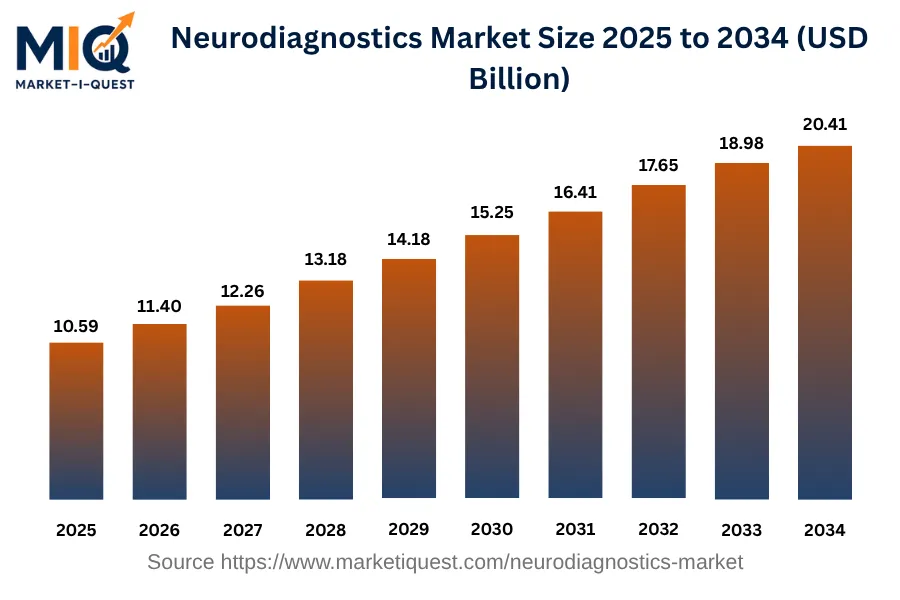
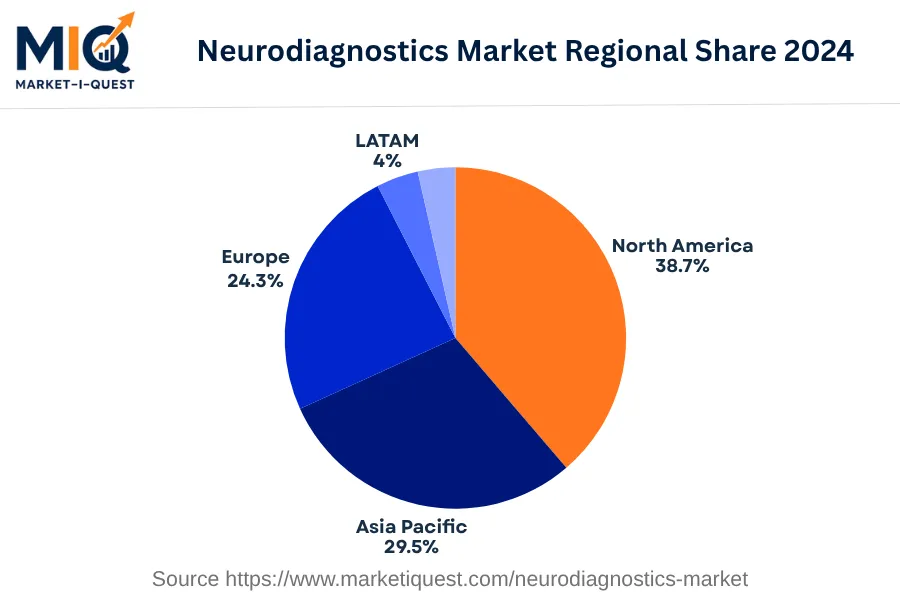
The Neurodiagnostics market size in 2025 is projected to be $10.59 billion, up from $9.85 billion in 2024. By the year 2034, the market is expected to reach $20.41 billion, representing a CAGR of 7.56% over this period. This growth pattern is consistent in the anchor years, gradually gaining momentum year over year. The reason behind this ascension in market size may be due to an increased awareness of the benefits of Neurodiagnostics technology in healthcare, as well as a rise in the prevalence of neurological disorders. Finally, the regional share mix in 2024 showed North America contributing to 38.7% of the total market, followed by Asia Pacific with 29.5%, Europe at 24.3%, LATAM at 3.98%, and MEA at 3.5%. Each region plays a critical role in shaping the landscape of the Neurodiagnostics market, the market thus reflecting a globally diversified growth rate.

Key Takeaways

  • By Product Type - Clinical Diagnostic Instruments held the largest segment accounting for a significant share in 2024.
  • By Condition - Stroke dominated as the most prevalent taking a major share in 2024.
  • By End User - Hospitals and Surgical Centers led the market making up for a remarkable percentage of the total share in 2024.
neurodiagnostics-market market size

Key Driving Factors

Implementation of Digital Pathology in Neurodiagnostics

In recent years, the adoption of digital pathology in the neurodiagnostics market has been growing significantly. Digital pathology is offering easy and quick access to high-quality digital images of brains, enabling more efficient diagnosis and treatment. This is primarily driven by various healthcare facilities and research and development institutions that are constantly utilizing the technology for improving their diagnostic accuracy. The abilities such as enhanced visualization, image analysis, image sharing for remote consultation and education opportunities provided by digital pathology are acting as a powerful drivers for the market. This shift towards digital pathology in neurodiagnostics is streamlining the diagnostic workflow and allowing faster therapeutic decisions.
Increasing Adoption of Portable Neurodiagnostic Devices

A rise in the adoption of portable neurodiagnostic devices is a significant factor contributing to the market growth. These devices are easily operable, cost-effective and time-efficient allowing healthcare professionals for monitoring neurological activity of patients remotely. Major healthcare providers and clinical diagnostic centers, pressured by the ongoing demand for streamlining diagnostic procedures and increase patient comfort, are integrating this technology into their practice. Moreover, remote patient monitoring, which has been made possible by the portability of these devices, has gained momentum during the COVID-19 pandemic as it mitigates the risk of virus transmission. As these utility factors continue to influence the market, the prevalence of portable neurodiagnostic devices is projected to drive the market growth even further.

Market Evolution by Timeline

2019-2023
Global buyers comprised of neurologists and healthcare clinics increased usage of neurodiagnostics for ailments such as Alzheimer's and Parkinson's disease. Higher demands arise from regions with aging population such as Japan and Western Europe. Supply included MRI and CT scanners launching with advanced features. Simultaneously, integration with applications such as telemedicine still immature and affected by bandwidth constraints. Increasing health standards, such as the IEC 60601 series, fostered adoption. Commercial models typically had installment-based pricing. Partnership between equipment manufacturers and healthcare providers witnessed for streamlining distribution.
2024
A rise in hospitals, particularly in developing regions such as India and Africa, demanded neurodiagnostics. Neurodegenerative diseases, especially among the elderly, remained the main driver. Deployment of advanced neuroimaging such as Diffusion Tensor Imaging (DTI) met some needs. A typical setback was the lack of skilled operators for these devices. HIPAA compliance necessary for data generated from these devices. Affordability for latest technology favored leasing agreements over outright purchase. Manufacturers such as GE and Siemens collaboratively worked with healthcare providers.
2025-2029
Greater utilization of neurodiagnostics is expected to be witnessed with integration in insurance coverage, primarily in North America. Dementia and rising mental health disorders might be considered as key factors for demand. Supply will likely offer more integrated devices, capable of communicating with electronic health records. However, cybersecurity concerns may be limited device connectivity. Enforcements of GDPR in Europe ensures data security, but limits telemedicine approach. Per-device pricing model might be prevalent. Software vendors and device manufacturers are expected to partner for improving device usability.
2030-2034
Worldwide usage of neurodiagnostics might increase after WHO guidelines included comprehensive neurological assessment. Demand reasons will likely remain for including Parkinson's disease, with strong demand in Asia. 5G technology which might enable smooth function of neurodiagnostic devices might integrate with telemedicine. However, remote areas will still constrained with technology access. Value-based healthcare adopters are expected to favor bundling pricing model. MedTech firms will likely work with insurance providers for ensuring device cost coverage. Single-use device waste management might emerge as a new concern, typically managed through recycling agreements.

Future Market Outlook

Future Opportunities

As the neurodiagnostics market evolves, several strategic opportunities are emerging for stakeholders. The ongoing collaboration between technology firms and healthcare institutions is paving the way for comprehensive digital solutions. Startups such as Cortera Neurotechnologies announced partnerships with leading hospitals to pilot systems that enhance neurodiagnostic accuracy and streamline workflows. Moreover, nations such as the United States and Canada are investing in research initiatives for exploring biomarkers related to neurological diseases, with significant funding allocated in their healthcare budgets. The focus on mental health is gaining traction, as highlighted by the increase in diagnostic solutions targeting conditions such as anxiety and depression. There is also a notable push for AI-driven tools that support clinical decision-making, with companies such as Zebra Medical Vision developing algorithms for analyzing EEG data. Regulations, such as the implementation of GDPR policies in Europe, shaping data privacy standards in neurodiagnostics, which could lead to increased demand for compliant solutions.

Segmentation Analysis

By Product Type

The market is divided into subsegments including Diagnostic Imaging Systems, Clinical Diagnostic Instruments, Reagents and Consumables, with Clinical Diagnostic Instruments accounting for the largest revenue share and Reagents and Consumables projected to grow at the fastest CAGR during the forecast period.

Largest Revenue Share

Clinical Diagnostic Instruments

Market Share Leader

Clinical Diagnostic Instruments indicates the subsegment with the most revenue, driven by several factors. These instruments play a crucial role in the delivery of healthcare services due to their ability for providing accurate and timely medical test results. Advancements in technology have led to the development of more advanced devices capable of detecting diseases at an early-on stage. The pervasiveness of these instruments across various healthcare settings, such as hospitals, clinical laboratories, and home care settings signifies their importance in the healthcare chain. Regionally, the revenue generation is particularly strong in regions with advanced healthcare systems such as North America and Europe. Notably, regulatory policies, purchasing power and adoption rates among end-users significantly impact the revenue of this subsegment.

Fastest CAGR

Reagents and Consumables

Forecast Period Growth Leader

Reagents and Consumables are projected to be the fastest-growing subsegment. The growth can be attributed to constant technological improvements and advances in diagnostic procedures. The increasing prevalence of diseases such as cancer, diabetes, infectious diseases require regular monitoring and testing. Policies supporting early diagnosis and prevention are also driving the growth of this market subsegment. However, the market expansion might face some barriers, including stringent and variable regulations globally, impacting the development and approval of new reagents and consumables. The relative novelty, combined with the increasing adoption of reagents and consumables in different healthcare settings imply strong growth projections for this subsegment.

By Condition

The market is segmented by condition into Neurodegenerative Diseases, Stroke, Epilepsy, Headache Disorders, Sleep Disorders and Others. Of these, Stroke accounted for the largest revenue share while Sleep Disorders is expected to grow at the fastest CAGR during the forecast period.

Largest Revenue Share

Stroke

Market Share Leader

Stroke disorders hold the largest market revenue due to various factors. High incidence of strokes and increasing geriatric population globally heavily contribute towards this high revenue share. With increasing age, the risk for stroke increases significantly, accelerating market demand. Furthermore, strong prevalence data on stroke leads to enhanced focus by government and regulatory bodies on stroke management and therapy. Innovations in treatment alternative, such as thrombectomy devices and clot-dissolving medication, also boost segment revenue. Moreover, increased awareness among people regarding early stroke symptoms ensures timely treatment. Regulatory bodies push for stroke prevention and post-stroke management fuels more comprehensive and hence higher-value treatments, contributing to this segment's large revenue share.

Fastest CAGR

Sleep Disorders

Forecast Period Growth Leader

Sleep Disorders is projected to witness the fastest CAGR during the forecast period. An rising global burden of sleep disorders such as insomnia and sleep apnea is driving market growth. Factors such as increasing stress levels, lifestyle changes and erratic work schedules result in several sleep disorders. The emergence of new technologies and devices for diagnosing and treating sleep disorders also acts as a significant growth catalyst. Regulatory bodies growing recognition of sleep's importance to health drives increased investments in effective treatments and monitoring technologies. However, near-term risks might include high treatment costs and lack of accessibility in remote locations.

By End User

The market is divided into subsegments including Hospitals and Surgical Centers, Diagnostic Laboratories and Imaging Centers, Neurology Centers, Ambulatory Care Centers, Research Laboratories and Academic Institutes. In 2024, Hospitals and Surgical Centers accounted for the largest revenue share, while Research Laboratories and Academic Institutes is expected to grow the fastest during the coming years.

Largest Revenue Share

Hospitals and Surgical Centers

Market Share Leader

Hospitals and Surgical Centers hold the most significant revenue share as they act as the primary focal point of healthcare delivery. Their comprehensive, multi-specialty nature means they serve to various patient demands, ranging from preventive care to critical care. Another important factor is the scale and volume of procedures performed in these settings, which, due to higher cost brackets, contribute greater revenues. With the growing prevalence of chronic diseases and an aging population, the demand for hospital and surgical center services is expected to continue growing. The geographical spread of these establishments, the range of services, and regulatory pressures mandating quality health care services have all played crucial roles in supporting this segment’s revenue generation.

Fastest CAGR

Research Laboratories and Academic Institutes

Forecast Period Growth Leader

Research Laboratories and Academic Institutes are projected to experience the fastest growth in the coming years. The primary growth drivers include technological advancements and increased focus on research activities. The global drive for personalized medicine and genomics, powered by machine learning and the increased availability of patient data, is also expected to positively impact growth in this subsegment. These organizations are often at the frontier of medical breakthroughs, leading to substantial increases in both private and public funding. However, adoption barriers could include high capital expenditures and the need for partnerships to deploy advanced research technologies effectively. Overall, growth outlook for this subsegment remains strong due to increased demand and technological advancements.

Competitive Analysis: Neurodiagnostics Market

Key Market Players

Manufacturers / OEMs

GE Healthcare
US
Siemens Healthineers
Germany
Koninklijke Philips N.V.
Netherlands

Key Suppliers & Raw Materials

Fujifilm Holdings
Japan
Hitachi Medical
Japan
Esaote S.p.A
Italy

Distributors, Integrators & Channel Partners

Canon Medical Systems
Japan
Medtronic Plc
Ireland
Nihon Kohden
Japan

Porter’s Five Forces Analysis

This analysis provides a detailed examination of the competitive dynamics within the neurodiagnostics market.

Supplier Bargaining Power

Medium

Power is balanced due to the presence of few suppliers for complex neurodiagnostic equipment.

Buyer Bargaining Power

Low

Neurodiagnostic products' high switching costs and specificity reduce buyer bargaining power.

Threat of Substitutes

Low

Few substitutes due to technical specificity and precision requirements in neurodiagnostics.

Threat of New Entrants

Low

High barriers to entry caused by regulatory requirements and significant R&D costs.

Competitive Rivalry

High

Strong competition due to technological advancements and substantial market consolidation.

Regional Analysis

Geographic market dynamics and growth opportunities across key regions

Global Market Outlook

neurodiagnostics-market market regional share

North America

In 2024, the North American Neurodiagnostics market experienced significant growth due to various drivers and trends. Emerging technologies like AI and ML in healthcare and increasing investments in R&D fueled its expansion. The prevalence of neurological disorders in the U.S., combined with the population's aging, significantly increased demand for Neurodiagnostics services, mainly EEG and neuroimaging. Furthermore, changes in U.S. healthcare policies encouraged a broader adoption of Neurodiagnostics solutions by care providers.

The adoption of telehealth due to the COVID-19 pandemic in both the U.S. and Canada resulted in more remote neurological assessments, contributing to market growth. Additionally, there was a surge in strategic partnerships among key players in the U.S, such as Philips and Medtronic, to strengthen their product offerings. The implementation of standardized practice guidelines for neurological disorder diagnosis in Canada played an essential role in shaping the market. In the enterprise sector, companies like Ge Healthcare and Siemens Healthineers pursued aggressive strategies to enhance their market share in the U.S. and Canada. In Mexico, government initiatives to improve healthcare infrastructure and adopt advanced technologies provided an impetus to market growth. The North American Neurodiagnostics market in 2024 was dynamic and full of opportunities, driven by the convergence of healthcare, technology, and policy.

Asia Pacific

The Neurodiagnostics market in Asia Pacific in the base year 2024 demonstrated solid performance, driven by an increasing prevalence of neurological disorders and a surge in healthcare expenditures. Technological advancements in neuroimaging and neuroinformatics significantly influenced market dynamics. Key countries like China and India witnessed substantial investment in upgrading healthcare infrastructure, promoting diagnostic capabilities. In Japan and South Korea, regulatory agencies fostered the market by streamlining product approvals, coupled with funding into neuro-disease research.

A pronounced trend was observed in the increasing adoption of portable neurodiagnostic devices, driven by their availability and affordability across Asia Pacific. Predominantly in Australia's healthcare and retail sectors, a shift towards digital neurodiagnostic platforms was recorded in 2024. M&A activities were prominent in China's enterprise sector, due to attempts to extend product portfolios and capitalize on the growing demand for advanced diagnostic tools. Policy enforcement on device standardization and testing from healthcare regulators predominantly in ASEAN markets like Singapore and Thailand had a significant influence on market players. In terms of customer segmentation, healthcare and enterprise sectors emerged as the major contributors for the demand, while the participation of the government was critical in the supply and regulation of neurodiagnostic devices. Notably, academic and research institutions also played a crucial role in expanding the neurodiagnostics market across the Asia Pacific region in 2024.

Europe

In 2024, the European neurodiagnostics market experienced key changes driven by various factors. Firstly, increased prevalence of neurological disorders increased demand for neurodiagnostic procedures. Secondly, regulatory improvements like France's strengthened legislation for quicker diagnosis and treatment of neurological disorders amplified support for neurodiagnostic tools. Furthermore, technology adoption rose as Germany invested heavily in next-generation neuroimaging technologies, bolstering supply dynamics. Lastly, competitive pricing in Spain due to increased players in the market influenced the buying decisions.

On the trend front, there was a shift towards minimally invasive neurodiagnostic procedures, predominantly in the UK's healthcare sector, driven by emerging technological advancements. Moreover, Italy witnessed a significant surge in tele-neurodiagnostic services due to the need for remote patient monitoring. Partnership activities flourished, with Benelux healthcare firms collaborating with tech companies to enhance neurodiagnostics. Besides, policy enforcement in Central & Eastern Europe echoed a rise in stringent quality controls in neurodiagnostic procedures. Significant uptake in sectors such as healthcare, government-sponsored research institutions, and utilities characterized 2024's market landscape. For instance, Nordic countries' public-funded healthcare systems heavily adopted neurological diagnosis tools, reflecting the overall market sentiment. Therefore, innovation, robust regulation, and competitive pricing characterized the European neurodiagnostics market of 2024.

Latin America

In 2024, the Neurodiagnostics market in Latin America witnessed substantial growth due to various factors. Drivers of this expansion included increased prevalence of neurological disorders such as Alzheimer's in aging populations across Brazil and Mexico, prompting greater demand for effective diagnostic solutions. Argentina's government funding in healthcare sector encouraged investment in neurodiagnostic facilities, leading to improved access to such services. Rapid adoption of advanced neuroimaging technology in Colombia's medical institutions significantly contributed to market growth, while pricing competitive to international standards drove the neurodiagnostics market in Chile and Peru.

Following the market growth, discernible trends emerged. Consumers throughout LATAM exhibited a greater inclination towards non-invasive neurodiagnostics procedures, such as EEGs and MEGs. Moreover, a notable shift towards AI-based diagnostic technologies was observed across Brazil and Mexico's healthcare sectors. Distribution channels strengthened in Argentina with more medical institutions procuring from manufacturers directly. Strategic partnerships and mergers and acquisitions were prevalent, particularly in Colombia where healthcare providers sought to expand their capabilities. Finally, rigorous policy enforcement in Chilean and Peruvian neurodiagnostic markets ensured adherence to predefined standards, promising reliable and authentic diagnostics. The enterprise and healthcare sectors were primary users of these services. The Neurodiagnostics market in LATAM, principally in Brazil, Mexico, Argentina, Colombia, Chile, and Peru, experienced significant advancement in 2024 amidst these potent drivers and trends.

Middle East & Africa

In 2024, the neurodiagnostics market in the Middle East and Africa showcased heightened activity, driven by several influential factors. Investment in technological advancement notably spiked in countries such as Saudi Arabia, United Arab Emirates, and Qatar due to the recognition of brain health as a significant aspect of overall health. Increased adoption of neurodiagnostic technologies was observed in the healthcare sectors of these three countries, indicating a supply surge. Additionally, in Egypt and South Africa, regulatory policies favored the expansion of neurodiagnostic services, thus creating favorable market conditions.

A noticeable trend in this year was the shift towards digital neurodiagnostics in the region. Israel, a leader in health tech innovation, saw a significant increase in the adoption of digital platforms for neurodiagnostic services. Simultaneously, the implementation of comprehensive healthcare coverage in Kenya and Nigeria ushered in an increased buyer engagement with the neurodiagnostic market in these countries. Numerous partnerships and M&A activities occurred, primarily in the healthcare sector, which demonstrated the region’s commitment to enhance access to neurodiagnostics. The financial services sector also played a key role in driving demand among consumers. Despite the soaring need for neurodiagnostic services, the challenge remained in maintaining cost-effective delivery while sustaining quality and accessibility.

Recent Industry Developments

Latest market innovations, product launches, and strategic initiatives

May 2026

NeuroVision Imaging acquired Durin Life Sciences, combining blood-based biomarker diagnostics with retinal imaging and a telehealth platform for earlier detection and management of neurodegenerative diseases.

September 2025

Natus Medical acquired the remaining shares of Holberg EEG, securing full ownership of the company developing the first AI model capable of automatic and comprehensive clinical EEG interpretation with accuracy on par with medical experts.

Frequently Asked Questions