Neobanking Market Snapshot

Key Players

  • Revolut (United Kingdom)
  • N26 (Germany)
  • Chime (United States)
  • Up (Australia)
  • Simple (United States)
  • WeBank (China)
  • Atom Bank (United Kingdom)
  • Neo (Canada)
  • NuBank (Brazil)

Market Size

Base Year 2024
$118.24 Bn
CAGR
25.61%
Forecast 2034
$1156.13 Bn

Market Segments

By Account Type
  • Business Account
  • Savings Account
By Application
  • Enterprises
  • Personal
  • Others

Market Dynamics

Drivers
  • Rapid digitalization trend
  • Increasing smartphone penetration
Restraints
  • Regulatory challenges
  • Consumer trust issues
Opportunities
  • Rising digital literacy
  • Underserved banking populations

Market Size

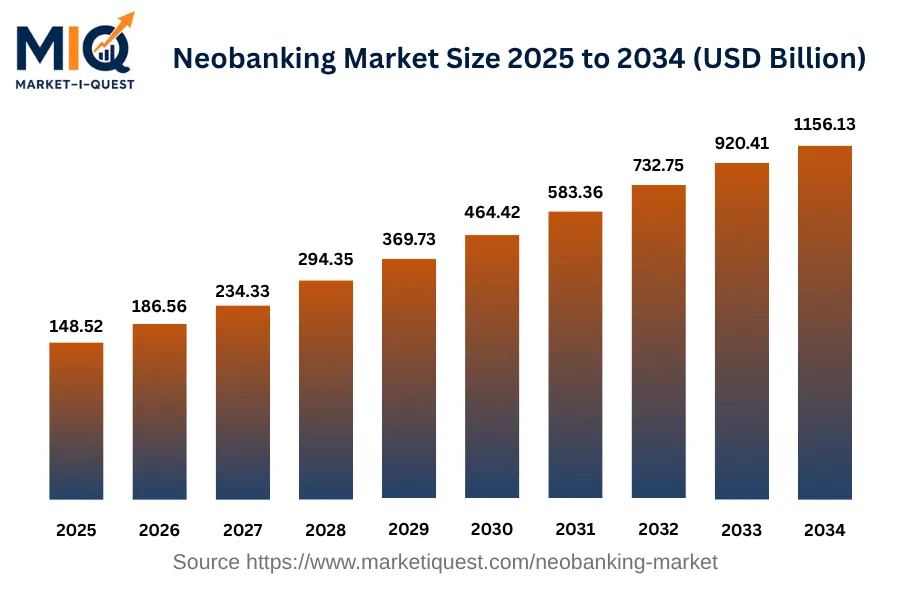
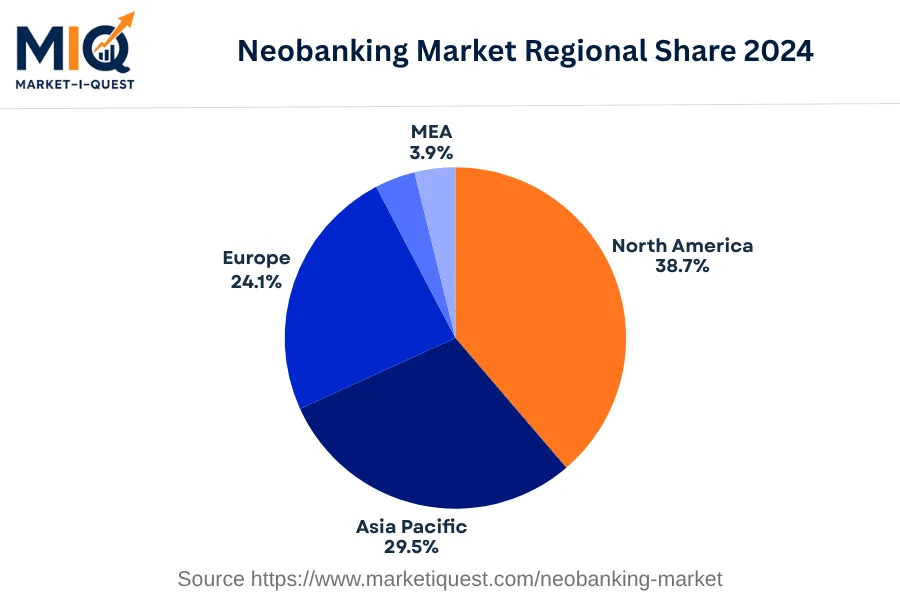
The Neobanking market is projected to grow from USD 148.52 billion in 2025 to USD 1,156.13 billion by 2034, with a compound annual growth rate (CAGR) of 25.61%. The growth between 2024 and 2025 involved an increase from USD 118.24 billion to USD 148.52 billion. The following nine years are anticipated to witness a nearly tenfold hike, reaching USD 1,156.13 billion by 2034. This growth trajectory primarily results from the steady upswing in the adoption of neobanking services during this period due to the increased emphasis on digital transactions and online banking. Inspecting the regional share in the year 2024, North America dominated with a 38.74% share, followed by Asia Pacific at 29.46%, Europe at 24.12%, while LATAM and MEA held minor fractions with 3.82% and 3.86% respectively.

Key Takeaways

  • By Account Type - Business Account led in the Neobanking Market asserting a significant share.
  • By Application - Enterprises held the top spot in the Neobanking Market dominating a large portion of the segment.
neobanking-market market size

Key Driving Factors

Increased Need for Remote Banking Capabilities

The neobanking market is being significantly driven by the strengthened need for remote banking capabilities stemming from societal shifts towards digital-first interactions in the wake of global events such as the COVID-19 pandemic. The effect is particularly pronounced among consumer segments like millennials and digital-savvy customers, who prefer online transactions as part of their fundamental banking needs. This preference is not only because of online transactions' convenience over traditional banking methods but also due to real-time transaction alerts, analytics, and other personalized services that neobanks offer. This accessibility and personalized features are challenging traditional banking structures and pushing the expansion of the neobanking market.
Implementation of the Revised Payment Services Directive (PSD2) in the European Union

Implementation of regulatory frameworks such as the Revised Payment Services Directive (PSD2) in the European Union is another major driving factor for the neobanking market growth. This directive requires banks to open up their customer data to third-party providers (subject to customers' consent), thus creating an interoperability requirement for traditional banking institutions. This regulation has paved the way for neobanks, enabling them to provide innovative financial services based on the data acquired from traditional banks. As a result, neobanks have earned an integral position in the digital transformation of the banking industry, providing seamless, scalable, and customer-centric solutions which have not only attracted customers but have also attracted venture capital, driving the growth of the neobanking market.

Market Evolution by Timeline

2019-2023
During this period, the buyer community primarily centered around millennials in developed countries, particularly in Europe and Australia, reflecting a shift towards receiving financial services on digital platforms. Challenge banks such as Monzo, Revolut, and N26 pioneered the technology shift, offering banking services, predominantly through mobile apps. Their services were compliant with PSD2 regulations in the EU that promotes financial technology innovation. A subscription model was typically adopted for monetization, with an increase in freemium services. The primary obstacle was the skepticism and lack of trust among the public on digital-only banks, which were countered through transparencies in their policies and security protocols.
2024
By this year, neobanking expanded towards small and medium enterprises (SMEs) in South America and Africa. Neobanks such as Nubank began offering services designed for SMEs. Technically, Application Programming Interface (API) banking came to the fore, enabling easier integration with businesses. Regulatory support saw gradual growth, especially with Brazil's instant payment system, PIX. The pricing strategy witnessed a shift to tier-based pricing, depending largely on the number and type of services used. A significant challenge was the integration with traditional banking systems, which was mitigated through collaborations with established banks.
2025-2029
This period saw the Asian market, especially India and China, becoming significant demand drivers with a rise in fintech friendly policies like the Digital India initiative. Big tech firms like Google, Facebook, and Tencent started investing heavily in Neobanks like Chime and Paytm. Supply-side innovations included integrating advanced Artificial Intelligence (AI) for personalized banking experiences and augmenting cybersecurity. The procurement model shifted to partnerships between neobanks and retail companies for better reach. The increasing data security breaches posed a risk, which was tackled by stringent data safety policies and secure software development practices.
2030-2034
In this phase, less technologically advanced regions like sub-Saharan Africa emerged as significant demand drivers. The technology focus shifted to blockchain applications in banking for secure, traceable transactions. Regulatorily, Central Bank Digital Currency (CBDC) regulation began to influence Neobanking operations. The commercial model leaned towards collaborations with blockchain start-ups for seamless monetary transactions. High compliance requirements due to CBDCs created a challenge, which was addressed by employing dedicated compliance teams within Neobank organizations.

Future Market Outlook

Future Opportunities

Given current technological advancements and regulatory developments, significant opportunities exist for neobanks over the next few years. The 2022 implementation of the PSD2 directive in Europe has created a legal framework that supports the development of new financial products, allowing neobanks to cater to underserved markets. Neobanks can capitalize on this by creating tailored financial solutions for small and medium-sized enterprises (SMEs), which often face barriers in traditional banking. For example, Fintechs like Tide have already begun providing bookkeeping and accounting services alongside banking solutions. Additionally, as the demand for financial inclusivity increases, neobanks have the opportunity to expand their offerings to unbanked populations, especially in emerging markets such as Brazil and India, where mobile penetration is high. Furthermore, the increasing consumer preference for digital-first banking experiences due to the COVID-19 pandemic has accelerated the shift to mobile banking solutions, as demonstrated by the significant user growth in both Chime in the U.S. and Nubank in Brazil in 2023. Furthermore, collaborations with fintech startups are likely to enhance service offerings, as evidenced by the recent partnership between Revolut and various digital service providers. Overall, opportunities for neobanks will hinge on leveraging technology to meet evolving consumer needs and aligning with regulatory requirements as the financial services landscape continues to evolve.

Segmentation Analysis

By Account Type

The market is divided into subsegments including Business Account and Savings Account. The Business Account subsegment accounted for the largest revenue share, while the Savings Account subsegment is expected to grow at the fastest CAGR during the forecast period.

Largest Revenue Share

Business Account

Market Share Leader

Business Accounts dominate the market revenue and this can be attributed to their intrinsic role and pivotal use in varied industry sectors. These accounts are crucial for businesses, providing a secure place for liquid assets and enabling effective management of expenses and cash flow. Businesses, both large and small, heavily rely on these account types for transactions, payroll processing, cash deposits, and other essential operations. In addition, there has been a surge in the number of small-medium enterprises globally, augmenting the demand for business accounts. Geographically, regions with a thriving business environment and strong economic development contribute substantially to this subsegment's revenue. Regulatory norms and supply chains also play a significant role, with efficient banking infrastructure facilitating the increased establishment and usage of business accounts. The purchasing criteria of business accounts often revolves around requirements for streamlined operations, secured transactions, and easy compliance, instigating financial institutions to create attractive offerings.

Fastest CAGR

Savings Account

Forecast Period Growth Leader

The Savings Account subsegment is charted to have the fastest growth. Crucial drivers include rising individual income levels, increasing awareness about financial savings, and the implementation of favorable policies encouraging savings habits among populations. Technological advancements and innovations, such as online banking and mobile applications, increase accessibility and ease of operation for savings accounts, propelling adoption rates. Additionally, banks often stimulate the use of savings accounts through the attraction of interest accumulation over time. However, near-term risks could occur due to economic uncertainties or changes in banking regulations that affect customer confidence. Partnerships between banks and entities like educational institutions or businesses can fuel growth by promoting savings account usage among students or employees. Furthermore, despite the nominal or zero account maintenance charges for savings accounts being welcoming, barriers could arise if clients perceive high minimum balance requirements or low-interest rates as a deterrent.

By Application

The market is divided into subsegments including Enterprises, Personal and Others. Enterprises accounted for the largest revenue share while Personal is expected to grow at the fastest CAGR during the forecast period.

Largest Revenue Share

Enterprises

Market Share Leader

Enterprises lead the market revenue substantially due to several inherent factors. The need for optimized and efficient business processes drives the need for all types of commercial entities to adopt enterprise-oriented applications. The propensity to invest in technology-driven solutions for increasing productivity and reducing costs is high in such entities. They service a vast pool of customers, making it pertinent for them to stay abreast with the latest technological advancements to cater to evolving customer needs. Enterprise solutions are also crucial for them to maintain a competitive edge, further intensifying their use. Regulatory compliances and industry-specific certifications often necessitate the use of technology, strengthening the market position of this segment. The supply side also contributes through continuous product improvement, extended service agreements, favourable financing terms, and vast partner ecosystems. Enterprises also have lower switching costs due to the availability of numerous vendors and products, making their market position nonvolatile.

Fastest CAGR

Personal

Forecast Period Growth Leader

The Personal segment is seen to have the highest growth potential during the forecast period. This growth is being spurred by several catalysts. Technological advancements, increasing disposable income, and changing lifestyle patterns are fundamentally driving this growth. Adoption barriers are gradually decreasing, with user-friendly interfaces, tailored solutions, affordable pricing, and at times, even free usage models. This sector sees conducive policy support, with initiatives aimed at increasing digital literacy and internet penetration propelling the segment. Global players are entering local markets, forming local partnerships, and investing in capex to make their solutions more accessible and appealing to individual users. However, potential risks lie in data privacy concerns and increasing regulations around personal data usage which could hinder its rapid growth.

Competitive Analysis

Key Market Players

Core Neobanks

Monzo
UK
Revolut
UK
N26
Germany

Key Financial Infrastructure Providers

Visa
US
Mastercard
US
FIS
US

Distributors and Partners

Google Pay
US
Apple Pay
US
Samsung Pay
South Korea

Porter’s Five Forces Analysis

An analysis of the Neobanking market using Porter's Five Forces.

Supplier Bargaining Power

Low

Low due to the digital nature of the market reducing dependency on physical resources.

Buyer Bargaining Power

High

High due to the increasing number of neobanking platforms and ease of switching.

Threat of Substitutes

Medium

Medium due to the presence of traditional banks and FinTech applications.

Threat of New Entrants

High

High due to the low capital expenditure involved in establishing neobanks.

Competitive Rivalry

High

High intensity competition due to the low differentiation among neobank offerings.

Regional Analysis

Geographic market dynamics and growth opportunities across key regions

Global Market Outlook

neobanking-market market regional share

North America

In 2024, the North American neobanking market experienced notable growth driven by several critical factors. Increasing consumer trust in digital platforms accelerated the demand for neobanks. The implementation of favorable financial regulations, such as the U.S.'s easing of virtual banking licenses, stimulated market expansion. Technological advancements popularized by Silicon Valley firms spurred the adoption of cutting-edge banking solutions, while major investments from entities like Goldman Sachs into digital banking ventures underscored the continued growth potential of the sector. Simultaneously, the neobanking landscape underwent significant changes. Consumer preference shifted toward digital-only banking services, reducing the hold of traditional banks on the market. Tech advancements led to the proliferation of AI-enabled services and cloud-based platforms, becoming a new standard in the industry. Furthermore, the landscape was shaped by strategic partnerships and M&A activities, as seen in the collaboration between Google and Citigroup.

Regulatory interventions, like the implementation of the National Bank Act in the U.S., also had an impact, necessitating neobanks to adhere to stricter compliance standards. Sectors such as retail, manufacturing, and enterprise capitalized on the efficiency of neobanks to improve cash flow management, thus broadening the usage scope for these digital entities. Ultimately, 2024 marked a pivotal year in the North American neobanking industry, characterized by consumer behavioral shifts and regulatory adaptations to technological advancements.

Asia Pacific

In 2024, the Neobanking market in Asia Pacific gained significant traction, fueled by an evolving fintech landscape and digital acceleration. Drivers were manifold: regulatory support, as evident in Australia's Consumer Data Right policy, advanced user acceptance of digital banking across India and South Korea, and large investments in fintech witnessed particularly in China. These neobanks, offering mostly digital financial services, were propelled by impactful demand-side factors. Fast-paced lifestyle and instant on-demand service requirement resulted in a shift towards digital banking predominantly in the working population. Japan's aging population saw a rise in the need for convenient banking solutions, augmenting growth in the sector. The substantial unbanked segment in ASEAN countries like Indonesia and Vietnam also stoked intensified efforts for financial inclusivity, pushing for neobank proliferation.

Trends in the market have been distinctive: significant partnerships with local enterprises and M&A upswing, particularly seen in Australia, underscored the importance of collaborations for adding value propositions. A shift towards increasing usage of AI and smart analytics in systems, especially across China and South Korea’s banking scene, transformed personalized banking experiences. Regulatory bodies across the region increasingly enforced strict cybersecurity policies underlining a focus on secure digital banking ecosystems. In 2024, the Asia Pacific neobanking market demonstrated exceptional dynamism influenced by varied regional drivers and transformative trends.

Europe

In 2024, Europe’s neobanking market experienced significant transformations, driven primarily by technology adoption and regulatory change. The implementation of the Second Payment Services Directive (PSD2) in various European countries fueled the rise of neobanks by mandating banks to forward customer data to licensed fintech firms. Unprecedented investment activity, particularly in the UK, Germany, and France, also contributed to the growth of neobanks. Technological advancements like artificial intelligence and blockchain integrated into financial technologies further enhanced operational efficiency.

Key trends shaping the neobanking landscape included an increased customer preference towards digital banking and a surge in partnerships between traditional banks and fintech firms. In the UK and Spain, many retail customers migrated from traditional banks to neobanks, attracted by more intuitive user experiences and innovative services. The partnership trend, as seen in Italy and Benelux, enabled traditional banks to leverage neobanks' technology prowess while fostering fintech's access to wider customer bases. In Central & Eastern Europe and the Nordics, regulatory bodies continued to enforce stringent open banking standards, prompting a gradual shift towards more transparent and customer-centric banking systems. Overall, the combination of driving factors and evolving trends have led to a markedly reshaped neobanking landscape in 2024 across Europe.

Latin America

The Neobanking market in Latin America (LATAM) in 2024 was characterized by increased digitalization and mobile banking adoption. Drivers included regulatory changes favoring financial inclusivity, such as Brazil's PIX instant payment system and Mexico's Fintech Law, which facilitated new entrants in the banking sector. High rates of smartphone penetration and internet usage across countries like Argentina, Chile, and Colombia also encouraged technology adoption. Furthermore, substantial investment from foreign and domestic players has underpinned the sector's development. Trends within the market included a shift towards 'banking as a service', where traditional banks partner with neobanks to offer digital-first services, enhancing customer experience and convenience.

For instance, Bradesco in Brazil has successfully collaborated with Next. There was also significant growth in peer-to-peer transactions facilitated by platforms like Mercado Pago in Argentina and México. Additionally, policy enforcement like Open Banking standards in Brazil and Mexico accelerated transparency and competition within the market. Notably, the neobanks gained traction among younger, tech-savvy consumers, small businesses, and largely unbanked sections of the society. On the retail side, businesses incorporated neobanking solutions for seamless financial management. Thus, in 2024, the LATAM Neobanking market was amplified by progressive regulations, technology adoption, strategic partnerships and changing customer behavior.

Middle East & Africa

In 2024, the Neobanking market in the Middle East and Africa experienced significant expansion, driven by factors such as growing digitalization, supportive regulations, and increased investment in the financial technology sector. Raised internet penetration in countries like South Africa, Nigeria, and Kenya, along with increased smartphone usage in Saudi Arabia, United Arab Emirates, and Qatar, stimulated demand for digital banking services. Concurrently, regulatory bodies in Egypt and Israel encouraged technological adoption in financial services through favorable policies, boosting the supply dynamics. Moreover, a surge in funding from venture capitalists and private equity firms accelerated technological development and expansion within this sector. Changes in customer behavior, notably among millennials who preferred online banking over traditional banking, further fueled market growth.

Simultaneously, many traditional banks in these regions collaborated with or acquired fintech startups, a trend aimed at digital transformation. Technology shifts, particularly towards open banking and blockchain, were also evident. For instance, Israel actively integrated blockchain technology to enhance transaction speed and security in digital banks. Lastly, strict policy enforcement, particularly in Saudi Arabia and the United Arab Emirates, ensured safe and secure transactions, instilling customer confidence in Neobanks. The market primarily catered to sectors such as retail, manufacturing, and financial services, reflecting their swift adoption of digital processes.

Recent Industry Developments

Latest market innovations, product launches, and strategic initiatives

May 2026

Swiss neobank neon Switzerland and Hypothekarbank Lenzburg renewed their partnership for additional years, serving approximately 250,000 customers with CHF 1.4 billion in deposits and CHF 445.3 million in investment volumes. The partnership will introduce instant payments in the coming weeks and further innovations.

December 2025

Sumishin SBI Net Bank (Japan) began recruiting beta testers for "NEOBANK ai," a generative AI-powered banking service enabling voice and chat-based transactions. The service officially launched in February 2026.

Frequently Asked Questions