
Needle Free Injection Market Snapshot

Key Players

  • PharmaJet (US)
  • Injex Equidyne Systems (US)
  • Endo International plc (Ireland)
  • Inovio Pharmaceuticals Inc. (US)
  • Crossject (France)
  • Antares Pharma Inc. (US)
  • Bioject Medical Technologies Inc. (US)
  • European Pharma Group (Netherlands)
  • National Medical Products Inc. (US)

Market Size

Base Year 2024
$0.41 Bn
CAGR
13.92%
Forecast 2034
$1.51 Bn

Market Segments

By Technology
Gas-Propelled Technology, Spring-Loaded Technology, Vibration-Enabled Technology
By Distribution Channel
Direct Sales, Distributors, Online Sales
By Application
Vaccination, Insulin Delivery, Pain Management, Hormone Replacement Therapy
By End Use
Hospitals, Clinics, Home Care Settings, Research Laboratories

Market Dynamics

Drivers
  • Rising needle-stick injuries
  • Growing diabetic patient population
Restraints
  • High initial equipment costs
  • Regulatory compliance challenges
Opportunities
  • Rising demand for painless drug delivery
  • Expanding diabetic patient population

Market Size

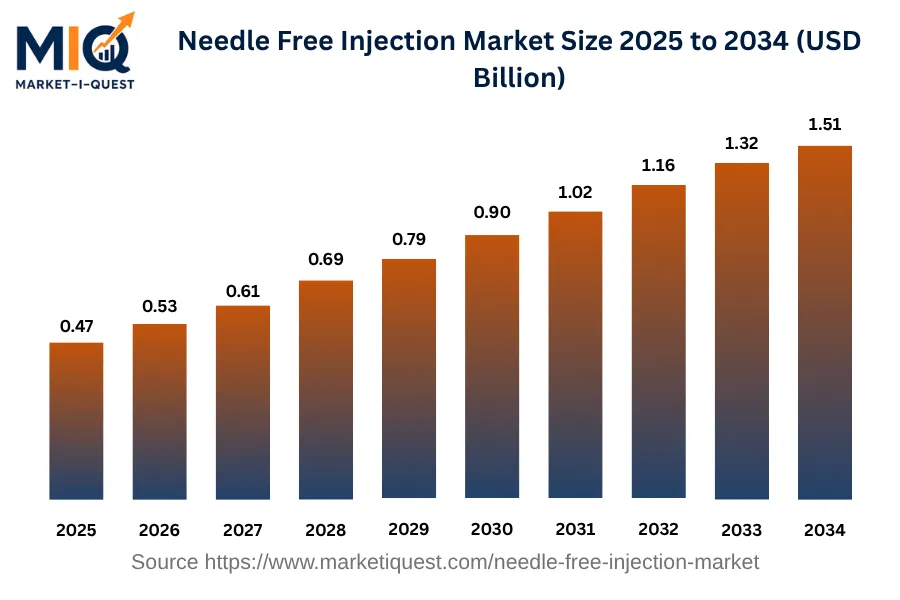
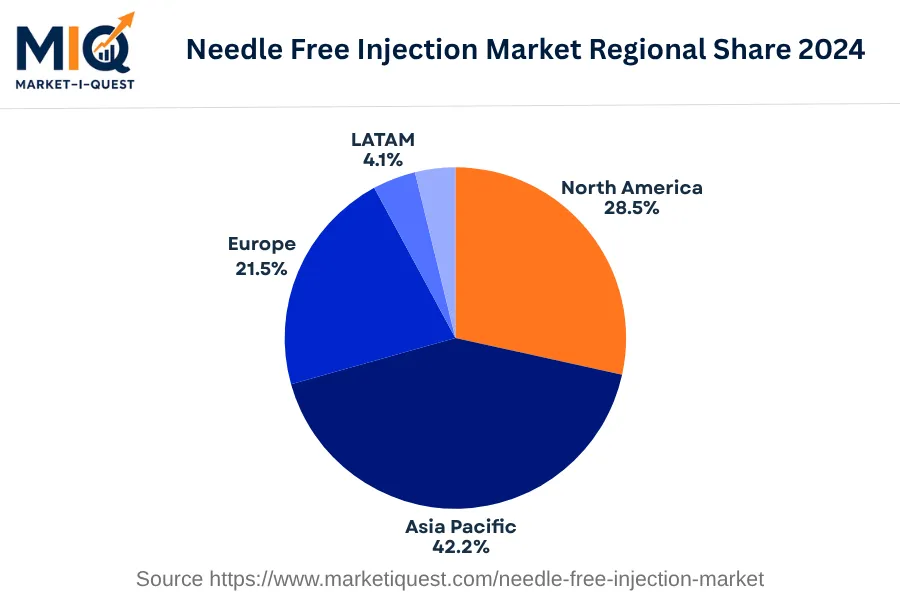
The Needle Free Injection Market reached a size of USD 0.47 billion in 2025 and is projected to grow to USD 1.51 billion by 2034, expanding at a CAGR of 13.92%. The market experienced growth from USD 0.41 billion in 2024 to USD 0.47 billion in 2025, evidencing a positive trajectory in its early phase. This upward trend continued over the years and is expected to culminate in a substantial increase by 2034. In 2024, the regional share mix for this market was as follows: North America held a 28.5% share, Asia Pacific had a majority share at 42.2%, Europe accounted for 21.5%, LATAM held 4.1%, and MEA had the smallest distribution with 3.8%. The data indicates diverse geographic utilization of needle-free injection technology, with the highest uptake in the Asia Pacific region.

Key Takeaways

  • By Technology - Gas-Propelled Technology led the Needle Free Injection Market.
  • By Distribution Channel - Distributors held the major chunk of the market in the base year.
  • By Application - Insulin Delivery dominated with a substantial share in last accounted year.
  • By End Use - Hospitals accounted for the highest share in the base year leading the Needle Free Injection Market.
needle-free-injection-market market size

Key Driving Factors

Infection Prevention Policies in Health-care Settings

In the healthcare sector, one of the primary challenges is preventing infections caused by needle-stick injuries. Needlestick injuries pose risks of transmitting diseases like HIV and Hepatitis B. To manage this issue, healthcare institutions worldwide are adopting stringent infection control policies and advocating safer practices. As part of these practices, the adoption of needle free injection systems is gaining prominence. These injection systems eliminate needle-stick injuries and the subsequent infection risks, making them a preferred option in compliance with infection prevention regulations. For instance, the U.S. Occupational Safety and Health Administration (OSHA) enforce employers in healthcare to implement practices that limit needle-stick injuries. Needle free injection systems, thus, align with such regulations and drive market growth.
Growing Preference for Painless Drug Delivery

The growing demand for painless drug delivery methods presents a significant driving factor. Studies show that needle phobia affects around 10% of the population and can lead to avoidance of necessary medical procedures and vaccinations. Needle free injection technology offers a solution to this problem by offering a painless and efficient method for drug administration. The technology employs a high-speed, pressurized liquid stream able to penetrate the skin without the use of a needle. It aids compliance in patients with chronic conditions that require regular self-administration of medication, like diabetes. Therefore, the increasing customer preference for comfort and painless medical procedures is propelling the needle free injection market.

Market Evolution by Timeline

2019-2023
During this period, North America was a significant buyer in the Needle Free Injection Market due to the online sales platforms and the demand for a painless, safer alternative to the conventional needle injections. The demand in Asia-Pacific was also notable, mainly due to countries like China where population ageing dynamics have increased healthcare needs. A common technology that emerged was the Jet Injector, offering high-speed delivery of drugs. Still, acceptance among end-users was constrained by high device costs. The FDA provided guidance documents to help manufacturers understand regulatory requirements, hence influencing adoption. Pricing patterns mainly involved high upfront costs for the devices and lower costs for supporting consumables. A significant blocker was the need for training for healthcare providers to correctly use these devices.
2024
In 2024, the vaccine distribution efforts amid the COVID-19 pandemic saw a rise in the demand for Needle-Free Injection technologies, especially in Europe and North-America. A key released product was the 'Zeta Jet', now recognized for delivering insulin and vaccines without pain. Vaccines were typically sourced via pool procurement models. Adoption was challenged by supply chain disruptions caused by the pandemic. Government bodies across the globe emphasized the need for safety in immunization, which created a favourable environment for market growth. Partnerships between device manufacturers and pharmaceutical companies were common. Out-of-pocket payments by consumers remained high due to the high device costs.
2025-2029
Much demand, in this range, was seen from patient populations requiring regular drug delivery, such as diabetics. Growing integration of Needle Free Injection technology with smart devices was typically to facilitate dosage tracking and health data collection. In the United States, FDA regulation '21 CFR 880.6300' offered clarity on design and performance standards for jet injection devices. A shift in business model was observed as the number of partnerships between device manufacturers and health insurers increased. Insurers typically sponsored part of the device cost for policyholders. A prevalent risk was the susceptibility of these devices to cyber-attacks due to their internet-connected nature.
2030-2034
Demand was driven primarily by middle-income countries that were now focussed on healthcare improvements. An interesting development was the use of Needle Free Injection technology for gene therapy applications. Production capabilities of manufacturers grew significantly in this period with the successful integration of Industry 4.0 principles. The World Health Organisation issued 'Safety Injection Global Network (SIGN)' policy to promote safe injection practices, indirectly benefiting this market. Companies often bundled devices with strip-based consumables in competitive pricing strategies aimed at customer acquisition. Market growth was constrained by concerns around product quality variations among different manufacturers.

Future Market Outlook

Future Opportunities

Future opportunities in the needle-free injection market are closely tied to the expansion of applications beyond traditional vaccinations. The ongoing partnership between medical technology firms and healthcare providers is expected to accelerate the adoption of these systems in chronic disease management. Companies like Insulet Corporation are currently engaging in trials for their Omnipod platform, which employs a needle-free delivery system for insulin, indicating a shift towards managing conditions such as diabetes. In 2023, the FDA granted breakthrough designation to a novel needle-free device for delivering monoclonal antibodies, showcasing regulatory support for expanding applications in therapeutics. With governments around the globe prioritizing public health innovation, regions such as Europe and North America are actively investing in research and development for needle-free technologies, providing strong incentives for companies to innovate. Moreover, advances in wearable technology are being integrated with needle-free systems; for instance, Medtronic’s efforts in subcutaneous delivery systems suggest a future where convenience and efficacy converge. Increased focus on patient-centric treatments will likely lead to rising demand for devices that minimize discomfort and maximize adherence. As healthcare providers aim for better outcomes, needle-free injections may represent a compelling solution for both injection and vaccination strategies. This could particularly be true in pediatric care and settings with high anxiety patients, driving an overall growth trajectory linked to patient comfort and adherence to treatment regimens.

Segmentation Analysis

By Technology

The market is divided into subsegments including Gas-Propelled Technology, Spring-Loaded Technology, and Vibration-Enabled Technology. Gas-Propelled Technology accounted for the largest revenue share while the Vibration-Enabled Technology is expected to grow at the fastest CAGR during the forecast period.

Largest Revenue Share

Gas-Propelled Technology

Market Share Leader

The Gas-Propelled Technology subsegment currently leads the market, contributing to the major share of revenues. The dominance of this subsegment can largely be attributed to its extensive application across numerous industries, complemented by the continuous effort in RD for improved, more efficient gas-propelled devices. The existing ecosystem of gas-propelled technologies, including manufacturing, logistics, and service, allows for a relatively lower switching cost, incentivizing customers to continue with this sub-segment. Additionally, regulation policies in several geographies favor gas-propelled devices primarily due to their reliability and efficiency, which contributes significantly to their market leadership. The purchasing criteria for this subsegment revolve around reliability, cost-effectiveness, and performance, which are typically delivered by gas-propelled technology. This assumption is based on typical market structure where well-established technologies lead in terms of revenue.

Fastest CAGR

Vibration-Enabled Technology

Forecast Period Growth Leader

Vibration-Enabled Technology is anticipated to be the fastest-growing subsegment during the forecast period. Despite entering the market after Gas-Propelled and Spring-Loaded Technology, it exhibits a higher CAGR due to several reasons. Technological advancements in this field and the incorporation of AI and IoT have transformed the way vibration technology is leveraged, opening up new applications. Its unique benefits such as non-invasiveness and high efficiency are accelerating its adoption across different sectors. However, the high capex associated with the adoption can be a barrier. Strategic partnerships and collaborations within the value chain could serve as a catalyst in overcoming adoption issues and opening up new opportunities. Near-term risks include technology compatibility issues and regulatory approval delays. As per traditional market movements, newer technologies usually grow at a much faster pace after its proven viability.

By Distribution Channel

The market is divided into subsegments including Direct Sales, Distributors, and Online Sales. Of these, Distributors accounted for the largest revenue share while Online Sales is expected to grow at the fastest CAGR during the forecast period.

Largest Revenue Share

Distributors

Market Share Leader

Distributors have been leading the revenue shares in the given market due to their widespread global presence and reliable supply chain networks. They play a key role in ensuring supply continuity and matching demand-supply fluctuations effectively. Broad customer base coupled with diversified inventory access has powered distributors' market dominance. Consumers prefer this segment because it offers an extended range of brands, products, and prices in one place. For businesses, distributors ease the supply chain complexity by stocking products from various suppliers and maintaining inventory levels. Additionally, distributors often provide value-added services such as after-sales support and warranty management that further enhance their appeal in the market. On the geographical front, their strategic placement in both mature and emergent markets ensures optimal reach and penetration. They can meet the specialized demands of various regions by supplying tailored products, which further adds value to their services. Regulatory compliances and consistent product quality are other important factors lending distributors a competitive edge in the market.

Fastest CAGR

Online Sales

Forecast Period Growth Leader

Online sales are expected to be the fastest-growing subsegment in the market. The segment's growth will be driven by increasing internet penetration, improving digital infrastructures, and rising consumer inclination towards online shopping. Further, the enhanced user experience, facilitated by personalization and easy navigation interfaces, is boosting online sales. The ability to compare prices, review products, and availability of a wide range of options are attracting a growing number of consumers to online platforms. Also, technology advancements such as AI and VR are promising to reshape the consumer experience and provide a significant push to online sales. On the other hand, partnerships between product companies and online retailers are set to strengthen this segment further. However, risks such as data privacy and online fraud present challenges that need to be addressed to sustain segment growth. In light of recent pandemic-led shifts in purchasing patterns, online sales are foreseen to grow at an accelerated pace in near future.

By Application

The application-based market segment is divided into subsegments including Vaccination, Insulin Delivery, Pain Management, and Hormone Replacement Therapy. In the base year of 2024, Insulin Delivery accounted for the largest revenue share while Vaccination is expected to grow at the fastest CAGR during the forecast period.

Largest Revenue Share

Insulin Delivery

Market Share Leader

There is a rising prevalence of diabetes worldwide owing to an increase in unhealthy lifestyle habits such as sedentary behavior and unhealthy dietary patterns, which stimulates the demand for insulin delivery applications. This market is driven by advanced technologies in insulin delivery devices and the rise in the diabetic population. Additionally, the robust presence of well-established healthcare infrastructure, increased healthcare expenditure, and rapidly evolving technologies contribute to the prevalence of insulin delivery applications. However, the market could face challenges due to the high cost of insulin delivery systems, which could discourage users from adopting such devices. Nevertheless, this subsegment maintains strong revenue owing to the consistent requirement and development in the healthcare sector, and the persistent need from the growing diabetic population globally.

Fastest CAGR

Vaccination

Forecast Period Growth Leader

The fastest-growing subsegment is Vaccination, driven by the increased global focus on immunization programs and rising government funding for vaccinations. There has been a surge in demand due to the prevalence of various diseases and the ongoing COVID-19 pandemic. A significant catalyst for growth in this subsegment has been technological advances, such as the development of new vaccines, as well as novel methods for vaccine delivery. This subsegment also benefits from strategic partnerships between vaccine manufacturers, and global health organizations. However, it is not without its risks. Regulatory barriers can impede quick market entry, and logistical challenges can obstruct the distribution of vaccines, especially in underdeveloped regions. However, the broader trend indicates a rapidly growing sector driven by technological advances and sheer necessity due to the global health scenario.

By End Use

The market is divided into subsegments including Hospitals, Clinics, Home Care Settings, and Research Laboratories, with Hospitals accounting for the largest revenue share, while Home Care Settings are expected to grow at the fastest CAGR during the forecast period.

Largest Revenue Share

Hospitals

Market Share Leader

The Hospital subsegment leads in terms of revenue due to multiple considerable factors. A primary driver is the sheer volume of patients that hospitals cater to, as these institutions provide a wide range of services across almost all areas of healthcare. Notifications and standards set by various geographies also impact hospital revenues, especially in developed regions where patients prefer hospital settings due to the comprehensive care available. Purchasing criteria for hospitals involve stringent requirements, often including advanced technical specifications, which can lead to higher transaction value. The cost to switch suppliers can be substantial, leading to long-term contracts that ensure steady revenue. Regulation also plays a role, including mandatory hospital accreditation and compliance rules, driving up operational costs that are eventually factored into the revenue calculations. Widespread availability and established distribution channels further contribute to hospitals' superior earnings.

Fastest CAGR

Home Care Settings

Forecast Period Growth Leader

Home Care Settings hold the impressive forecast of high CAGR growth for a variety of reasons. Chief among these is the advent of technologies enabling better at-home care. Advancements in mobile health technologies, telemedicine, and remote monitoring tools have made it increasingly feasible for patients to receive sophisticated care in the comfort of their homes. Additionally, policy modifications are pushing towards home health care as a cost-effective solution to hospital overcrowding. Capital investments in companies providing home health care services have accelerated development and adoption of innovative solutions. However, partnership strategies with traditional healthcare providers will determine the rate at which this switch to home care occurs. As for near-term risks, the ongoing need to increase the caregiver workforce and potential regulatory changes in certain geographies could pose challenges to the predicted high growth rate.

Competitive Analysis

Key Market Players

Manufacturers / OEMs

PharmaJet
US
Antares Pharma
US
Endo International
Ireland

Key Suppliers & Raw Materials

DSM Biomedical
Netherlands
DuPont
US
Evonik Industries
Germany

Distributors, Integrators & Channel Partners

InHealth Technologies
US
Becton Dickinson and Company
US
Healthcare21 Group
Ireland

Porter’s Five Forces Analysis

Analysis of the competitive forces shaping the Needle Free Injection Market.

Supplier Bargaining Power

Medium

Variety in product components gives suppliers moderate bargaining power.

Buyer Bargaining Power

High

Availability of different brands and types boost the buyer’s bargaining power.

Threat of Substitutes

Medium

Potential alternative delivery methods pose a moderate substitution risk.

Threat of New Entrants

Low

High entry barriers such as regulatory compliance and technical expertise limit new entrants.

Competitive Rivalry

High

Market is intensively competitive with several established key players.

Regional Analysis

Geographic market dynamics and growth opportunities across key regions

Global Market Outlook

needle-free-injection-market market regional share

North America

In 2024, the North American needle-free injection market witnessed heightened growth due to various incentives and demands. Patient comfort and the abolition of needlestick injuries drove increased adoption in the healthcare sector across the United States, Canada, and Mexico. Regulatory bodies promoted the wider use of this technology as part of a broader push towards improving patient safety protocols. Furthermore, increased investment fueled innovation and the expansion of product offerings, exemplified by the U.S. firm PharmaJet's striker system for intradermal, subcutaneous, and intramuscular drug delivery.

Trends in 2024 included a shift in buyer behavior, as consumers increasingly favored needle-free injections due to minimal invasiveness and reduced pain. The popularity of needle-free insulin delivery systems for diabetes management demonstrated this consumer preference. Moreover, novel partnership models emerged, such as Sanofi's agreement with U.S. biopharmaceutical company MannKind for Afrezza - an inhaled insulin product. The standardization of needle-free injection technology also played a critical role, marked by the introduction of the ISO 21649:2006 standard for needle-free injectors. Lastly, the enforcement of safety protocols across healthcare institutions solidified the market position of needle-free injections, particularly in hospital settings and vaccination campaigns.

Asia Pacific

In 2024, the Needle-Free Injection (NFI) market in Asia Pacific witnesses significant growth, primarily driven by an escalating demand for painless drug delivery and governmental initiatives promoting vaccine immunization. The market's growth is bolstered by large-scale investments in healthcare infrastructure and widespread technology adoption in populous countries like India and China. China's "Healthy China 2030" initiative, calling for enhanced services accessibility, catalyzed needle-free injection adoption across various healthcare establishments. Furthermore, competitive pricing and innovative supply dynamics are evident drivers in markets of Japan, South Korea, and key ASEAN countries.

Trends observed in 2024 underscore an increased buyer preference for seamless, needle-free injection mechanisms, especially in diabetes management and vaccine delivery sectors. There's a notable shift towards advanced bioject needle-free injectors among the region's healthcare providers. Partnerships and mergers-acquisitions, such as the collaboration between Pharmajet and Mundipharma in delivering needle-free drug delivery solutions, significantly shape the market landscape. Meanwhile, the enforcement of stringent safety standards by government bodies stimulates technological innovation and promotes needle-free injection popularity across sectors like utilities, manufacturing, and retail. In summary, the Asia Pacific NFI market's growth trajectory in 2024 is majorly driven by healthcare regulations, technology acceptance, and contributions from key industries. Market trends manifest as evolved consumer preferences, strategic partnerships amidst providers, and regulatory enforcement, shaping the market's progression.

Europe

In 2024, Europe's Needle Free Injection Market emerged significantly in the healthcare sector. Enhanced demand was driven by an increased preference for painless drug delivery, coupled with rising incidences of chronic diseases requiring regular dosing. Regulatory compliance in countries like Germany and the United Kingdom furthered adoption, as they mandated patient-friendly drug delivery systems. Moreover, healthcare investments catalysed technological advancement, providing a robust supply dynamics. Trends in 2024 included high acceptance of needle-free injections amongst the elderly population plus patients with needle phobia. Innovative product shifts were witnessed predominantly in France and Italy, with needle-free insulin devices showing a significant demand surge. Channel dynamics saw increased online purchases due to easy availability and competitive pricing. Benelux and the Nordics witnessed strategic partnerships leading to Market consolidation while Central & Eastern Europe focused on adherence to needle-free technology standards for patient safety and efficacy.

Healthcare was the predominant sector, with needle-free injections used prominently in disease management. Specific customer groups showing increased usage were government healthcare facilities, private clinics, and retail pharmacies. The market also saw a rise from the enterprise sector, with companies adopting needle-free drug delivery systems for employee healthcare programs. In conclusion, the European needle-free injection market in 2024 was driven by technology adoption, demand factors, and favorable regulations.

Latin America

In 2024, the needle-free injection market in Latin America (LATAM) witnessed significant growth attributed to a combination of key drivers and market trends. The demand was primarily driven by public health initiatives in countries like Brazil and Argentina, aiming to combat chronic illnesses and make immunization campaigns more efficient. Additionally, increased healthcare investment in Mexico and Colombia and the subsequent adoption of advanced medical technologies provided a substantial boost to the market. Several notable trends shaped the LATAM needle-free injection market in 2024. A shift in patient preferences, particularly in Chile and Peru, leaned towards minimal invasive procedures, accelerating the acceptance of needle-free injections. The increased use of home healthcare solutions as a consequence of the pandemic also led to a higher demand for user-friendly, needle-free devices in the region.

Moreover, implementing stringent safety regulations in healthcare settings across LATAM countries pushed the adoption of needle-free injection systems to reduce needlestick injuries. Prominently, needle-free injections gained traction within the healthcare sector, especially in public hospitals, private clinics, and home healthcare settings. These developments point towards a heightened awareness and acceptance of needle-free injection technology in the LATAM region by both patients and healthcare professionals. As a result, the needle-free injection market surged in 2024.

Middle East & Africa

In 2024, the Needle Free Injection Market in the Middle East and Africa showed substantial growth propelled by healthcare improvements and technology adoption. Drivers of this growth included increased demand for pain-free drug administration, government investments in health sectors of countries like Saudi Arabia and Qatar, and widespread adoption of needle-free technologies in hospitals and clinics across United Arab Emirates and Egypt. Tighter regulation of traditional needle usage due to safety and hygiene concerns also spurred the needle-free shift. Several key trends were observed in 2024. Consumers showcased altered preference towards safer and less invasive methods of drug delivery, encouraged further by awareness campaigns in countries like Israel and Kenya.

Technology advancements in the manufacturing sector, particularly in South Africa and Nigeria, supported the development of more efficient needle-free systems. The healthcare sector saw increasing partnerships between hospitals and equipment manufacturers to facilitate supply chain efficiency. Clinical practices in South Africa and Israel also began adopting needle-free systems as a standard for most immunisation and drug-delivery processes. Lastly, the governments' policy enforcement ensured the adherence to the safety standards in the needle-free injection market, particularly visible in the strong regulatory frameworks in Saudi Arabia and United Arab Emirates.

Recent Industry Developments

Latest market innovations, product launches, and strategic initiatives

July 2026

IntegriMedical continued expanding its needle-free injection system across India, backed by Serum Institute of India, targeting the huge market opportunity for pain-free child vaccinations.

December 2025

Intas Pharmaceuticals entered an exclusive agreement with IntegriMedical to introduce India's first needle-free injection system for IVF and gynaecology therapies. The N-FIS delivers medication through a high-pressure jet stream via a fine micro-orifice. Under the agreement, Intas became the first and only company in India to offer IVF and gynecology therapies with needle-free injections.

Frequently Asked Questions