Nanosensors Market Snapshot

Key Players

  • N5 Sensors Inc. (US)
  • Ablynx NV (Belgium)
  • Hitachi High-Tech Corporation (Japan)
  • Analog Devices Inc (US)
  • NT-MDT Spectrum Instruments (Ireland)
  • Nanonics Imaging Ltd. (Israel)
  • Applied Nanotech Holdings Inc. (US)
  • Nanosonics Ltd. (Australia)

Market Size

Base Year 2024
$1.08 Bn
CAGR
10.82%
Forecast 2034
$3.02 Bn

Market Segments

By Type
  • Chemical & Bacterial
  • Optical
  • Synthetic
  • Electrochemical
  • Mechanical
By Technology
  • Wind Turbines
  • Fuel Cells
  • Micro Turbines
By Application
  • Robotics
  • Healthcare
  • Food & Beverage
  • Automotive
  • Petroleum

Market Dynamics

Drivers
  • Increasing nanotechnology adoption
  • Rising IoT integration
Restraints
  • High production cost
  • Regulatory hurdles
Opportunities
  • Advanced healthcare applications
  • Rising IoT technologies

Market Size

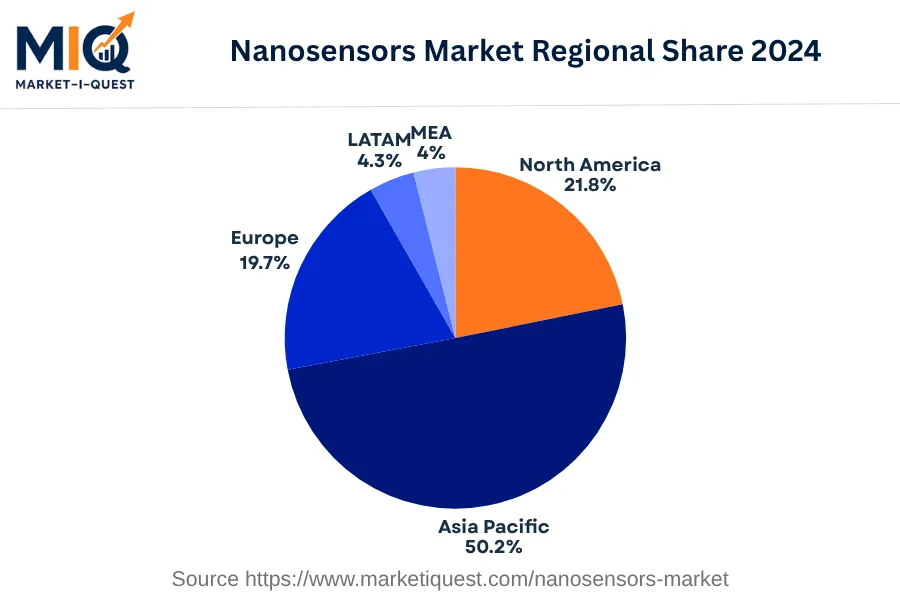
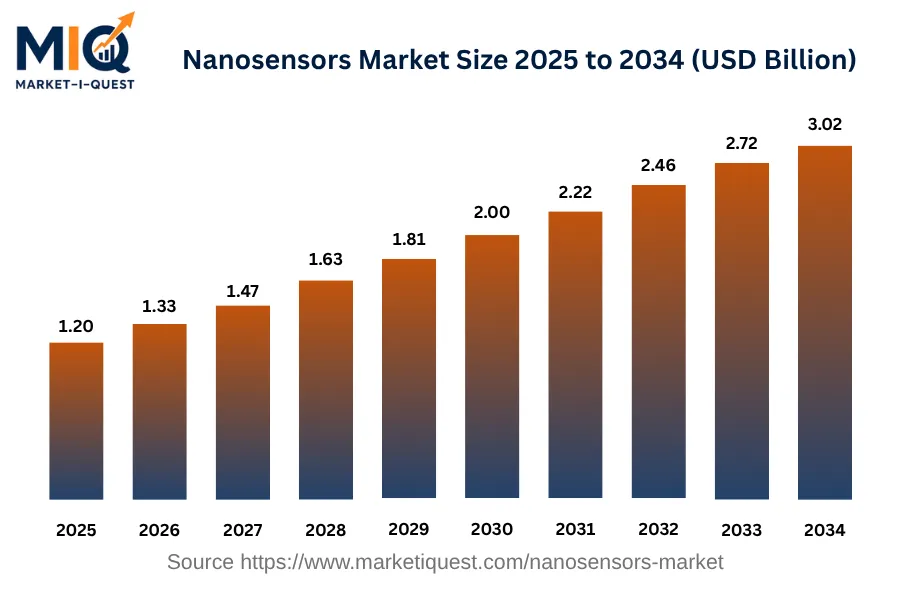
The Nanosensors Market size in 2025 is projected to be 1.20 Billion USD, rising from 1.08 Billion USD in 2024. Over the subsequent nine years, the market is expected to grow steadily, with the market size in 2034 estimated to be 3.02 Billion USD. This translates to a Compound Annual Growth Rate (CAGR) of 10.82% from 2025 to 2034. This incline in the market size can be attributed to incrementing technological advancements, accelerating market demand, and evolving applications of Nanosensors. Focusing on regional share in 2024, the market was primarily distributed between North America with a share of 21.8%, Asia Pacific contributing the most with 50.1%, Europe holding 19.7%, LATAM accounted for 4.3%, and the MEA region made up the remaining 3.9% of the total Nanosensors Market. The dominance of the Asia Pacific region suggests a concentration of industry and usage in that particular geography.

Key Takeaways

  • By Type - Electrochemical registered substantial growth leading the segment in 2024.
  • By Technology - Wind Turbines held a significant market dominance accounting for the major share in 2024.
  • By Application - Healthcare expanded as Largest segment in 2024 marking a notable position in the Nanosensors Market.
nanosensors-market market size

Key Driving Factors

Strict Environmental Regulations

Nanosensors are experiencing a surge in adoption due to the increasing imposition of strict environmental monitoring regulations from governing bodies worldwide. These nanoscale sensors are capable of detecting changes in the environment at an atomic level, providing excellent accuracy in tracking pollution and contamination levels. For example, the United States Environmental Protection Agency (EPA) prescribes stringent guidelines for pollution monitoring, which have bolstered the demand for precise detection tools such as nanosensors. Besides, many European Union directives around environmental protection also demand high accuracy monitoring, further enhancing the need for these ultra-sensitive sensors.

Increment in the Healthcare Sector

The increasing burden of chronic diseases and the need for advanced diagnostic tools is propelling the nanosensors market in the healthcare sector. Nanosensors are seeing increased adoption in diagnostics, surgical processes, and personalized treatment approaches. For instance, in cancer diagnostics and treatment, these tiny sensors allow the detection of tumors at the earliest phase due to their high sensitivity. They can also monitor the patient's response to therapy, helping clinicians to adjust treatment plans in a timely manner. Their potential to provide rapid, point-of-care diagnosis and personalized treatment has made them invaluable to healthcare providers, intensifying their market dominance.

Market Evolution by Timeline

2019-2023
Major buyers over the period were the healthcare and automotive sectors, primarily in North America and Europe, seeking nanosensors for disease detection and vehicle performance monitoring. Supply side was dominated by research labs producing prototypes, indicating a low integration maturity. Key policy influence was the ISO/IEC 17025:2017 standard, ensuring quality of testing and calibration for labs. Assumed commercial model was direct sales with no contract emphasis. High development costs posed a challenge, but research grants from bodies like the National Institutes of Health minimized the impact.
2024
Buyers in 2024 were primary from sectors of healthcare, automotive, and also from military for reconnaissance and surveillance purposes. Asia emerged as a significant market, with China leading the demand. Supply side, established tech companies started manufacturing, indicating moving from prototype to product. Program like European Union's Horizon 2020 influenced adoption by offering funding to innovative projects. Commercially, B2B type selling observed with outright purchase model. Downside risks were potential regulatory hurdles on nanotechnology posing uncertain outcome of approval process.
2025-2029
By 2025–2029, use spread to environmental monitoring, besides healthcare and automotive. Europe, Asia, and North America all had significant demand. Larger players were shipping products, but scalability was still a concern. The NanoSafety Cluster, a European initiative started having an influence on policy and adoption. Preference for annual licensing as a commercial model was seen, offering recurring revenues. However, high manufacturing cost and technology immaturity were main risks, which could be mitigated through better process control and longer-term contracts.
2030-2034
In 2030–2034, increasing demand from agriculture sector and consistent demand from healthcare were witnessed. Regions like Australia started showing demand. Large tech companies were consistently shipping products, but technology was still not fully scalable. United States NIST's NNCI program started affecting market landscape. Multiple business models seen – outright purchase, leasing, pay-as-you-go, showing more flexible pricing and contract options. Inherent technology risks still existed but, with improved manufacturing processes, higher ROI models developed, balancing the risk factor.

Future Market Outlook

Future Opportunities

The future of the nanosensors market is closely tied to ongoing research and development efforts, particularly in the fields of healthcare and environmental monitoring. In 2023, regulatory bodies in the United States, such as the Environmental Protection Agency, began promoting the use of nanosensors to monitor pollutants, indicating a pivot toward more sustainable practices. Additionally, companies like Aclara Technologies are actively working on integrating nanosensors into smart water infrastructure, enhancing leak detection and water quality monitoring. This shift aligns with global trends toward improving public health through better resource management. The growing emphasis on personalized medicine presents another significant opportunity, as seen in projects like the collaboration between Stanford University and several biotech firms focusing on nanosensors for early disease detection. Furthermore, the increasing prevalence of IoT devices creates a platform for nanosensors to deliver more interconnected solutions, particularly in agricultural monitoring as demonstrated by initiatives in the Netherlands since 2022. The convergence of artificial intelligence with nanosensor technology is also expected to drive innovation, as highlighted by research initiatives at UCLA exploring machine learning applications in sensor data analysis. Moreover, as businesses such as Siemens expand their offerings in the smart manufacturing sector, the demand for nanosensors to ensure efficiency and quality control will likely grow. These avenues suggest a dynamic landscape for nanosensors, shaped by current technological trends and regulatory support.

Segmentation Analysis

By Type

The market is divided into subsegments including Chemical & Bacterial, Optical, Synthetic, Electrochemical, and Mechanical, among which, the Electrochemical type accounted for the largest revenue share, while the Synthetic type is expected to grow at the fastest CAGR during the forecast period.

Largest Revenue Share

Electrochemical

Market Share Leader

The Electrochemical subsegment occupies a significant revenue share in the market due to its broad range of applications across industries such as energy production, environmental monitoring, and healthcare. Its technology enables the detection, analysis, and measurement of a variety of chemical substances accurately, thereby contributing to its large market share. The global drive towards emission reduction and environmental conservation has increased the demand for Electrochemical solutions, particularly in industries that deal with harmful substances. Furthermore, emerging economies are investing in infrastructure development that involves electrochemical processes, thus contributing to the subsegment's revenue. Regulatory pressure to reduce environmental footprint and enhance waste management is pushing industries to rely more on Electrochemical solutions for monitoring operations. Purchasing behavior of customers is typically influenced by the accuracy, reliability, and efficiency of Electrochemical solutions, and persistent technological improvements are solidifying its leading position in the market. However, it's essential to note that high switching costs due to entrenched systems can act as a barrier for emerging alternatives.

Fastest CAGR

Synthetic

Forecast Period Growth Leader

Despite not being the leader in terms of revenue, the Synthetic subsegment is projected to grow at a robust pace. The rise of Artificial Intelligence and robotics have catalyzed the evolution of Synthetic technology, driving adoption in several industries such as automotive, aerospace, and manufacturing due to its flexibility and adaptability. It's expected that partnerships between tech companies and Synthetic product manufacturers will further accelerate the growth. Capital investment in research and development related to Synthetic technologies is increasing significantly, which signals a positive outlook for this subsegment. Despite the promising growth trajectory, there are barriers to adoption such as high initial capital, lack of technical expertise, and operational challenges. However, continuous advancements and economies of scale are expected to mitigate these hurdles over time. As Synthetic technology becomes more affordable, adoption rates are projected to surge, contributing to the subsegment's rapid growth. Nevertheless, near-term risks such as regulatory uncertainties and economic volatility should not be overlooked.

By Technology

The market is divided into subsegments including Wind Turbines, Fuel Cells, and Micro Turbines. In 2024, Wind Turbines accounted for the largest revenue share while Micro Turbines are expected to grow at the fastest CAGR during the forecast period.

Largest Revenue Share

Wind Turbines

Market Share Leader

The wind turbine segment generated the highest revenues in the base year 2024. This prominent position can be attributed to several factors. Wind energy, being one of the most mature and well-established renewable energy sources, has experienced consistent growth due to global efforts to reduce carbon emissions. Industry friendly regulations aimed at increasing the usage of renewable energy have further propelled the growth of this segment. This segment's growth is primarily driven by developed regions like Europe and North America, characterized by their large open spaces suitable for wind farms. In addition, falling costs of wind energy production, advances in turbine technology and economies of scale all contribute to the strong revenue performance of this segment. The customers of this segment include utilities and independent power producers that purchase and operate wind turbines. The high switching costs associated with wind turbines amplify their revenue contribution.

Fastest CAGR

Micro Turbines

Forecast Period Growth Leader

Micro Turbines segment is projected to be the fastest growth of the segment during the forecast period. The growth of Micro Turbines can be attributed to the fact that they can be used in remote areas where network power supply is difficult, which drives their demand globally. They are efficient, reliable, and can be run by a variety of fuels, with flexible deployment advantages. Technological improvements and efficiencies driven by partnerships within the sector have allowed operators to utilize Micro Turbines even for lower capacity needs, thus enabling wider adoption. However, this segment is also thought to be at risk due to the high initial capital investment required for adaption. Despite this, policies promoting greener energy sources, and the overall reduction in costs over time should act as catalysts for growth for the Micro Turbines, with adoption expected to accelerate in the future.

By Application

The market is divided into subsegments including Robotics, Healthcare, Food & Beverage, Automotive, and Petroleum. In 2024, the Healthcare sector accounted for the largest revenue share, while the Robotics sector is expected to grow at the fastest CAGR during the forecast period.

Largest Revenue Share

Healthcare

Market Share Leader

Since the onset of the global health crisis, the healthcare industry's demand for technology applications has dramatically increased, driving its leading position in 2024. Hospitals and other medical facilities have started to rely heavily on technology for better and safer patient management, regulatory compliance, and real-time data exploits to enhance their services. These applications range from advanced medical devices to patient data management systems, telehealth platforms, and artificial intelligence in diagnostic procedures. Regulations encouraging the digitization of health records and hospitals seeking efficiency and cost reduction in their operations also contribute to this revenue boom. Therefore, geographical areas with robust healthcare systems and high digital adoption, like North America and Europe, contribute significantly to this segment's revenue. Technological advancements in the healthcare industry show no signs of slowing down and it's highly likely that the healthcare segment will continue being a substantial revenue contributor.

Fastest CAGR

Robotics

Forecast Period Growth Leader

Projected to be the fastest-growing segment, the Robotics sector's growth can be attributed to the increasing need for automation in various industries, including manufacturing, agriculture, automotive, and food & beverage. Developments in artificial intelligence and machine learning technologies have substantially enhanced robots' capabilities, creating an overall increase in sector utility and, therefore, driving higher adoption and growth rates. However, the high initial capital investment and risk associated with displacing human labor are potential barriers to adoption. Government policies promoting industrial automation and the formation of strategic alliances among robotics companies to share expertise and resources can act as catalysts for this sector's growth. Fluctuations in the component supply chain and potential policy restrictions regarding job displacement are near-term risks that could potentially affect this growth projection.

Competitive Analysis

Key Market Players

Manufacturers / OEMs

Texas Instruments Incorporated
US
Thermo Fisher Scientific
US
Omron Corporation
Japan

Key Suppliers & Raw Materials

Analog Devices, Inc.
US
Honeywell International Inc.
US
Johnson Matthey
UK

Distributors, Integrators & Channel Partners

Nano-and More GmbH
Germany
NanoSensors, Inc.
US
Bruker Nano Surfaces
US

Porter’s Five Forces Analysis

A comprehensive analysis of the competitive dynamics of the nanosensors market.

Supplier Bargaining Power

Low

Nanosensor raw materials are abundant with multiple suppliers lowering bargaining power.

Buyer Bargaining Power

Medium

Buyers' power is moderated by the technological expertise required and the benefits of nanosensors.

Threat of Substitutes

Low

Due to unique applications and high-precision results, alternatives to nanosensors are limited.

Threat of New Entrants

High

Low capital requirement and swift technological advancements make market entry easier.

Competitive Rivalry

High

The market is highly competitive, with several established and emerging players.

Regional Analysis

Geographic market dynamics and growth opportunities across key regions

Global Market Outlook

nanosensors-market market regional share

North America

In 2024, the North American Nanosensors market experienced significant growth, fueled by diverse drivers and observable trends. Increased government funding in nanotechnology research coupled with rising demand from healthcare sector amplified the maturation of this market. In parallel, maturing IoT technologies drove greater integration of nanosensors in devices, enhancing their effectiveness, affordability, and accessibility. Further, legislative moves in the US to ensure data privacy, such as the California Privacy Rights Act, provoked a heightened call for nanosensors in cybersecurity applications. Consumer adoption of nanosensors rapidly grew, spurred by increased health consciousness and the pervasive trend towards personalized healthcare. The healthcare sector, particularly within the subdivisions of therapeutics and diagnostics, reached for nanosensors for their high sensitivity, precision, and fast response times. Moreover, industry partnerships, such as the tie-up between Merck and IBM, innovated new applications for nanosensors. The drive toward industry standards, evidenced by ANSI’s nanotechnology standards, also harmonized the application of nanosensors across sectors.

Primary customer sectors included healthcare, followed by the manufacturing segment. Equally, retail showed enhanced interest in the inventory management applications of nanosensors. Government usage underpinned rapid technology adoption, while utility companies, specifically those in renewable energy, increased their use due to technological advancements. North America also saw a steady rise in nanosensor utilization in the automobile industry, driven by the rise of electric and smart cars in Canada, the US, and Mexico.

Asia Pacific

In 2024, the Asia Pacific nanosensors market experienced significant growth as industries increasingly adopted nanotechnology. Infrastructure investment by governments, particularly in China and India, drove the market's expansion, while regulatory incentives for green technology boosted nanosensors demand in Japan and South Korea. Rapidly evolving technology landscapes and increasing R&D expenditure, especially in the healthcare and manufacturing sectors, also influenced supply dynamics. Consumer trends in 2024 revealed a heightened focus on health and environmental consciousness, which fuelled demand for nanosensors in air quality control, pollution monitoring, and medical diagnostics. Technological shifts in Australia and key ASEAN markets saw a move towards IoT-enabled nanosensors that offered real-time data and improved operational efficiencies.

Complexities in international trade during this period influenced channel dynamics, prompting greater local partnerships and significant M&A activity. Policy enforcement in the utility sector further drove demand, with India's Smart City projects increasingly integrating nanosensors for energy management. Meanwhile, in the region's retail sector, the application of nanosensors increased in inventory tracking and quality control solutions, reflecting ongoing digital transformation efforts. The 2024 Asia Pacific nanosensors market demonstrated the symbiotic relationship between technological evolution, policy support, and industry demand.

Europe

In 2024, Europe's nanosensors market is intensifying, driven by an increased demand for enhanced diagnostic solutions and miniaturization of devices. Germany, with its stronghold in technological advances and high-end manufacturing, led the region in the utilization of nanosensors, heightening demand for applications in sectors such as healthcare, manufacturing, and retail. The rapid adoption of IoT in the United Kingdom and Nordic regions has expanded application of nanosensors, thereby fueling the market. In parallel, France's regulation on environmental monitoring accelerated the demand for nanosensors in air quality monitoring and pollution control. Despite the COVID-19 pandemic, technology adoption remained consistent, with Italy and Spain investing in nanosensors for infection control and public health safety measures. Significant changes in buyer behaviours were seen in Eastern Europe and Benelux, with industries pivoting towards nanosensors for a precision approach to business solutions.

Meanwhile, the surge in partnerships and M&A activities in the region reflected the aggressive demand situation in the market. In the public policy arena, stricter standards for environmental and health safety in Central & Eastern Europe reinforced the use of nanosensors across several sectors. While the market drivers were predominantly technology and demand-oriented, regulation and policy in the health and environmental safety sectors also contributed significantly to the dynamics of the European nanosensors market.

Latin America

In 2024, the nanosensors market in Latin America (LATAM) experienced burgeoning growth driven by sectors such as healthcare, manufacturing, and environmental monitoring. Increased demand for quick, accurate and portable diagnostic tools in healthcare fueled the market expansion. Technological innovation and adoption also played a key role, notably in Brazil and Mexico where significant investments into nanotechnology research facilities were made. Regulatory changes such as Argentina's new guidelines on nanotech product safety positively impacted the market by fostering standards and confidence. Simultaneously, the rise in nanotechnology usage in pollutant detection boosted the market in ecological-priority nations such as Colombia, Chile, and Peru.

Consumer preferences largely mirrored the global trend towards miniaturization, portability, and convenience. However, the exclusivity of nanosensors to specialized industrial applications pivoted towards personal use, forging new paths in retail consumer electronics. Technology partnerships between LATAM-based nano-tech companies and global tech giants marked a significant shift in the region's nanosensors market. The increasing presence and reinforcement of nanotechnology-related policies across LATAM, specifically in Mexico and Brazil, further endorsed and expedited the market growth. The uptake of nanosensors in manufacturing plants for process controls and safety in countries like Argentina also showed a critical turning point for the nanosensor market in 2024.

Middle East & Africa

In 2024, the Nanosensors market in the Middle East and Africa exhibited promising growth, stimulated by increased investment in nanotechnology. Enhanced governmental support in countries such as Saudi Arabia, UAE, and Qatar resulted in favorable regulations promoting nanosensor development and application and bolstered research, indicated by Saudi Arabia's significant outlay on nanotech infrastructure. Increased technology adoption in sectors like oil and gas, healthcare, and telecom also drove demand, evidenced by Egypt's utilization of nanosensors for oil exploration and Nigeria's implementation in medical devices.

Notable trends shaping this market include growing buyer preference for advanced tech solutions. This is manifest in Israel's heightened adoption of nanosensors in the manufacturing sector and South Africa's telecom industry maximization of nanosensors for data transmission systems optimization. Collaboration with academia was paramount, with UAE leading through its partnership with Khalifa University to develop energy-efficient nanosensors. Strengthened policy enforcement was also observed, particularly Kenya's stringent regulations on nanomaterial safety. Lastly, the integration of nanosensors into asset monitoring solutions in sectors such as utilities and retail underpinned increased market acceptance, particularly evident in Egypt and Nigeria respectively.

Recent Industry Developments

Latest market innovations, product launches, and strategic initiatives

June 2026

A leading nanotechnology firm launched a next-generation graphene-based nanosensor platform for real-time detection of volatile organic compounds (VOCs) in industrial and environmental applications.

October 2025

Two leading nanosensor manufacturers announced a strategic partnership to develop integrated sensor solutions for IoT and smart city applications, combining expertise in nanomaterials and microelectronics.

Frequently Asked Questions