Mobile POS Systems Market Snapshot

Key Players

  • Square Inc. (United States)
  • Lightspeed POS Inc. (Canada)
  • Zebra Technologies (United States)
  • NCR Corporation (United States)
  • PAX Technology (China)
  • TouchBistro Inc. (Canada)
  • ShopKeep Inc. (United States)
  • First Data Corporation (United States)
  • Ingenico Group (France)
  • VeriFone Systems Inc. (United States)

Market Size

Base Year 2024
$37.86 Bn
CAGR
12.4%
Forecast 2034
$121.86 Bn

Market Segments

By Component
Hardware, Software, Services
By Enterprise Size
Large Enterprises, Small & Medium Enterprises (SMEs)
By Application
Inventory Management, Billing, Customer Engagement, Reporting & Analytics, Others
By End User Industry
Retail, Hospitality, Healthcare, Food & Beverage, Others

Market Dynamics

Drivers
  • Growing retail sector
  • Technology advancements
Restraints
  • High setup cost
  • Data security concerns
Opportunities
  • Increased contactless payment adoption
  • Emerging markets penetration

Market Size

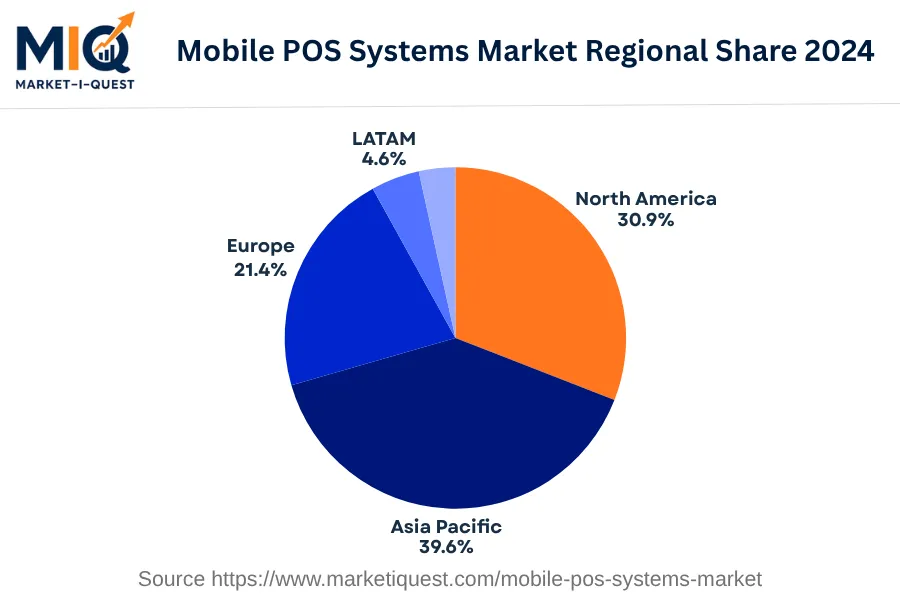
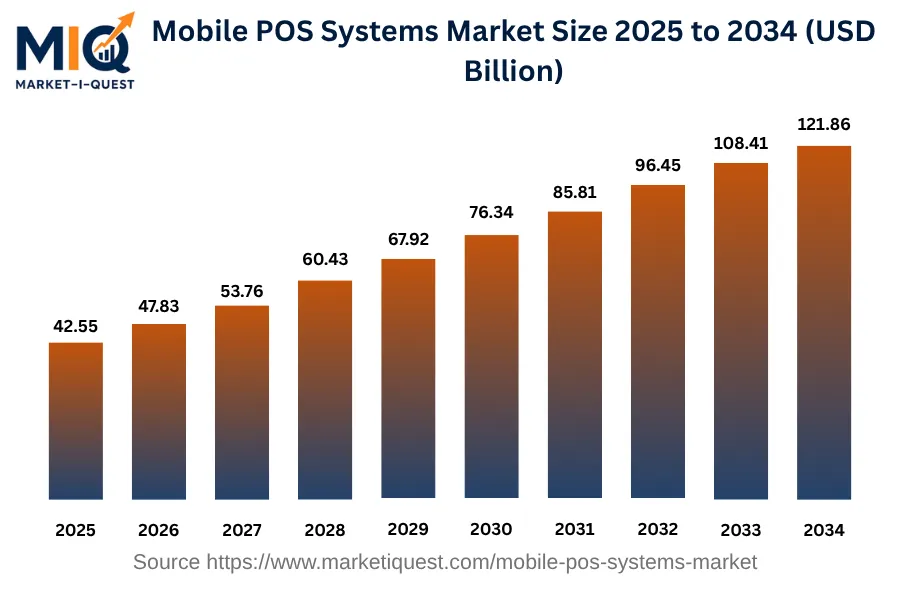
The Mobile POS Systems market was valued at $37.86 billion in 2024 before reaching $42.55 billion in 2025. Over the subsequent nine years, the market demonstrated substantial growth, culminating in a value of $121.86 billion in 2034. With a CAGR of 12.4% over the decade-long period. The growth experienced by this market from $42.55 billion in 2025 to $121.86 billion in 2034 is a testament to the increasing global demand for mobile point-of-sale solutions. In terms of regional share in 2024, the Asia Pacific region commanded the largest share at 39.6%, followed by North America at 30.9% and Europe at 21.4%. Meanwhile, the Latin American and Middle-East and Africa regions had a smaller presence in the market, with shares of 4.59% and 3.45% respectively.

Key Takeaways

  • By Component - Hardware held a dominant position accounting for the majority share in 2024.
  • By Enterprise Size - Large Enterprises led the market making up a significant portion in 2024.
  • By Application - Billing was top-ranking demonstrating prevalent use in 2024.
  • By End User Industry - Retail emerged as the leading segment with the highest penetration in 2024.
mobile-pos-systems-market market size

Key Driving Factors

Push Towards Cashless Economy

As governments worldwide are promoting a cashless economy to curb fraud, mobile point-of-sale (POS) systems are witnessing increased adoption. These systems, readily syncing with digital payment apps and mobile wallets, make cashless transactions effortless and efficient. In regions like Europe and Asia, where contactless payments are gaining traction, the need for an efficient mobile POS system is becoming vital for businesses. Retailers, restaurants, and other businesses are implementing these systems to facilitate cashless payments and maintain a competitive edge. Hence, the push towards a cashless economy is a key driver for the mobile POS systems market.

Geographic Expansion of E-commerce Businesses

The global e-commerce sector continues to expand into new regions as companies pursue growth opportunities in untapped markets. This presents a significant need for easy, quick, and secure payment processing solutions, subsequently driving demand for mobile POS systems. These systems improve transaction efficiency, help manage large volumes of sales data and support the delivery of streamlined services to customers regardless of their location. They are especially pertinent for e-commerce businesses operating in places with poor internet connectivity, as the ability of mobile POS systems to function offline ensures continuity of operations. Thus, as e-commerce businesses continue to expand their geographic footprint, the demand for mobile POS systems is set to surge.

Market Evolution by Timeline

2019-2023
The rapid rise in digitalization of businesses during 2019 to 2023 has seen a welcome upsurge in mobile POS systems market. Restaurants and retail business owners were major contributors to the demand for mobile POS. Developed regions like North America and Europe saw a steep increase in adoption of this model. Introduction of Cloud-based mobile POS which eliminated the need for heavy storage databases was a notable trend seen in the supply side. However, data security concerns acted as a constraint, prompting developers to invest in better security features. Transactions carried out via mobile POS systems started to come under rules devised by Payment Card Industry Data Security Standard (PCI DSS) to ensure consumer data protection. Competitive pricing and contractual partnerships with equipment manufacturers became common to attract buyers. High set-up costs provided a hurdle to its widespread implementation.
2024
In the year 2024, the mobile POS systems market adapted to changing business trends. Increasingly, mobile POS systems incorporated features like inventory management, staff management, customer relationship management etc., catering to a wider range of business sectors. More countries in the Asia-Pacific region started incorporating mobile POS systems into their retail and hospitality industries. Technology companies strived to make these systems more user-friendly, whilst maintaining a strict code of data security. The American National Standards Institute (ANSI) started to roll out specifications for mobile POS operation, aiming to make them more standardized. This was the phase when big tech companies started entering into contractual partnerships with retail chains, thus creating a bundled offering. Data breach remained the primary risk factor associated with the use of mobile POS systems.
2025-2029
Over the course of 2025–2029, the buying pattern shifted towards services bundled with mobile POS systems as more businesses sought to digitize multiple operations. The demand spread globally, reaching emerging economies in Latin America and Africa, fueled by the rapidly increasing number of SMEs in these regions. In response, suppliers focused on creating integrated POS solutions with widespread compatibility. Security protocols started to incorporate biometric encryption techniques factoring in user convenience as well as data security. Policymakers worldwide recognized the need to regulate this rapidly growing industry, leading to an array of regulations in this time period. Despite prevalent risks such as data breaches and cyber attacks, industries started acknowledging the advantages of adopting mobile POS systems over traditional secure systems.
2030-2034
In the period of 2030–2034, contactless payment became a norm, with mobile POS systems playing a huge role in its spread due to its ability to provide a seamless, error-free experience. Both developed and developing regions saw an increase in the use of mobile POS systems. It was common for providers of Mobile POS systems to offer multi-functionality to capture a larger market share. Technology wise, enhancements were made to ensure real-time data access, automated report generation, analytical functions, reducing the manual intervention to execute these tasks. Much of the industry was dominated by partnerships between tech firms and wholesale manufacturers to offer an integrated solution. The risks revolved around data breaches, cyber threats prompting the industry players to focus on enhancing security. Government regulations, in response, reinforced data security laws for better consumer protection.

Future Market Outlook

Future Opportunities

Future opportunities in the mobile POS systems market will likely hinge on the increasing adoption of contactless payment methods. Countries like the United Kingdom have seen a significant rise in the use of NFC technology, with regulators advocating for greater contactless transaction limits. Additionally, as consumers become more familiar with mobile wallets, companies such as PayPal are expanding their mobile POS offerings to incorporate loyalty programs and customer engagement tools by 2024, creating a more integrated retail experience. Partnerships between retailers and fintech startups are expected to grow, aiming to develop tailored solutions that meet the unique needs of specific industries. For example, in 2022, the collaboration between Verifone and various retail chains to enhance their mobile POS capabilities showcased a focus on sector-specific functionalities. Meanwhile, developments in augmented reality could open new avenues for mobile POS applications in sectors like fashion and furniture retail. Furthermore, the potential interoperability between mobile POS systems and cryptocurrency payment options is an area of considerable interest, particularly in tech-forward regions like California. Overall, the alignment of regulatory changes, consumer behavior shifts, and technological advancements indicates abundant opportunities for innovation and growth in the mobile POS landscape.

Segmentation Analysis

By Component

The market is divided into subsegments including Hardware, Software, and Services. Hardware accounted for the largest revenue share while Software is expected to grow at the fastest CAGR during the forecast period.

Largest Revenue Share

Hardware

Market Share Leader

Hardware, in the base year 2024, holds the highest revenue share within the market. This can be primarily attributed to the indispensable need for physical infrastructure to enable technological solutions and services. Physical components like processing units, controllers, sensors, and actuators form the backbone of any automated system, driving its adoption. It is also often more expensive compared to software and services, thereby translating into a higher revenue share. Specific customer segments such as enterprise clients and industrial users contribute significantly to the demand and ultimately the revenue pool. Furthermore, certain geographies with a high concentration of these user segments further propel sales. Regulatory factors also play a role, with countries prioritizing technological advancement and automation, necessitating the procurement of hardware. The purchasing criteria often revolve around aspects like durability, efficiency, and compatibility, making product quality a crucial driver, whereas factors like installation and maintenance complexities constitute switching costs, often making consumers stick with tried-and-tested hardware solutions.

Fastest CAGR

Software

Forecast Period Growth Leader

The Software subsegment, on the other hand, is poised to grow at the fastest CAGR over the forecast period. The accelerating pace of digital transformation is acting as a catalyst, driving the demand for more advanced, specialized, and diversified software solutions. It is driven mainly by tech innovations, an increased focus on policy implementation towards digitization, capital investments, and strategic partnerships. Software solutions offer customization, scalability and efficient process management, encouraging more organizations to adopt them. However, barriers such as complexity in integration, high initial investments, and a lack of skilled workforce present challenges. Near-term risks include rapid technological changes, which could render existing software obsolete, and cybersecurity threats. Nevertheless, with strategic and proactive measures, Software is expected to significantly outpace other segments in the growth trajectory.

By Enterprise Size

The market, divided into subsegments namely Large Enterprises and Small & Medium Enterprises (SMEs), reveals that Large Enterprises accounted for the largest revenue share, while Small & Medium Enterprises (SMEs) is projected to grow at the speediest CAGR during the forecast period.

Largest Revenue Share

Large Enterprises

Market Share Leader

Large Enterprises typically dominate market revenue due to their substantial financial resources and expansive capabilities in terms of infrastructure, resources, and global reach. They have the power to invest in advanced technologies and services to improve their operations and customer service. Large Enterprises also have the benefit of established brand presence and reputation, which often translates to higher trust from customers and distributors. Their ability to implement effective marketing and distribution strategies further contributes to their large revenue share. Moreover, such enterprises have a broad customer base, spanning various global regions, which assists in risk mitigation associated with market fluctuations. Economies of scale achieved by these enterprises typically result in efficient operations and high-profit margins. However, it is essential to note that this is a general observation, and dynamics might vary based on the specific industry context.

Fastest CAGR

Small & Medium Enterprises (SMEs)

Forecast Period Growth Leader

The Small & Medium Enterprises (SMEs) subsegment is projected to grow at the fastest CAGR in the forecast period, driven by various factors. These include the growing technological adoption among SMEs, availability of cost-effective cloud solutions, and government policies supporting SME growth. Modern SMEs are rapidly digitalizing their services to compete in the market and meet growing consumer demands. They are focusing on investing in advanced technologies, like AI and automation solutions, to enhance their operations. Another growth catalyst is the increasing accessibility of capital through various government programs and SME-friendly financial institutions. However, adoption barriers such as limited resources, lack of digital literacy, and high switching costs could create potential hurdles for this subsegment's growth. Thus, partnerships with technology providers, capex optimization, and investments in skill development would be crucial for accelerating growth.

By Application

The market is divided into subsegments including Inventory Management, Billing, Customer Engagement, Reporting & Analytics, and Others. Of these, Billing accounted for the largest revenue share while Customer Engagement is expected to grow at the fastest CAGR during the forecast period.

Largest Revenue Share

Billing

Market Share Leader

In the base year 2024, Billing was the subsegment with the largest revenue within the market. The primary drivers for this leading position are the universal need for accurate billing systems across all business models. Irrespective of the industry or the scale of the business, billing systems play an integral role in the financial operations. From small scale to multinational organizations, maintaining a seamless flow of transactions via reliable billing systems is crucial. Additionally, in the era of digitalization, online transactions have become commonplace. This has exponentially increased the demand for robust, secure, and efficient billing systems to cater to a high volume of transactions. Geographically, the adoption of billing systems is high in mature markets like North America and Europe due to the presence of advanced IT infrastructure, while emerging markets in Asia-Pacific show immense potential for growth. The purchasing criteria for these systems often revolve around factors like cost-effectiveness, functionality, security, integration capabilities, and user-friendliness.

Fastest CAGR

Customer Engagement

Forecast Period Growth Leader

Despite Billing being the subsegment with the largest revenue, Customer Engagement is foreseen to demonstrate the fastest CAGR during the forecast period. This is a result of increasing emphasis on personalized customer experiences and higher customer retention in competitive markets. Advancements in technology, like AI and machine learning, have made it possible for businesses to engage with their customers more effectively and on a more personal level. Barriers to adoption typically include concerns about data privacy and the cost of implementing advanced systems. Nevertheless, as companies recognize the value of strong customer relationships and the impact they have on their bottomline, these obstacles are likely to be overcome. Potential risks in the near-term may revolve around data breaches and the misuse of customer information. Companies investing in customer engagement platforms are increasingly partnering with tech providers to enhance capabilities and ensure data safety.

By End User Industry

The market is divided into subsegments including Retail, Hospitality, Healthcare, Food & Beverage, and Others. Retail accounted for the largest revenue share while Food & Beverage is expected to grow at the fastest CAGR during the forecast period.

Largest Revenue Share

Retail

Market Share Leader

The retail sector is the leading revenue contributor in end-user industries because of its extensive reach and variety of applications. Retailers use services extensively to enhance customer experience, optimize inventory, and streamline operations. The growing purchasing power of consumers, the rise of e-commerce, and the growing need to meet consumer expectations are the key factors driving its revenue growth. The implementation of adaptive pricing strategies through real-time insights into market supply and demand also contributes to revenue. The continued growth in urbanization and an increase in the middle-class population, which represents a large consumer base for retail products especially in developing countries, substantially contributes to the revenue share of this sector.

Fastest CAGR

Food & Beverage

Forecast Period Growth Leader

The Food & Beverage industry is expected to witness the fastest growth rate in the coming years. This growth can be attributed to the increasing adoption of technology that aids in better food safety, quality control, and streamlined operations. The constant push to automate manual processes in F&B supply chain owing to the rising labor costs and labor shortages stands as a major growth driver. Besides, the evolving consumer preference towards online food ordering due to convenience and easy availability is playing a crucial role in the industry's scaling and also accelerates the dynamics of competition, pushing companies to invest in advanced technologies. Risks include the initial high capital expenditure and the challenge in training the workforce to operate high tech systems, which may slow down the adoption. However, the benefits of improved efficiencies and cost savings in the longer run outweigh the initial barriers, supporting a high CAGR outlook for this sector.

Competitive Analysis

Key Market Players

Manufacturers / OEMs

Square Inc.
US
Ingenico Group
France
Verifone Systems Inc.
US

Key Suppliers & Raw Materials

Intel Corporation
US
Qualcomm Technologies
US
Ingenico Group
France

Distributors, Integrators & Channel Partners

BarcodesInc
US
BlueStar Inc.
US
ScanSource
US

Porter’s Five Forces Analysis

This analysis provides insights into the strategic factors affecting the competitive environment of the Mobile POS Systems Market.

Supplier Bargaining Power

Medium

Limited number of hardware suppliers and dependency on software developers increase suppliers' relative bargaining power.

Buyer Bargaining Power

High

Many alternatives available and low switching costs heighten buyer bargaining power.

Threat of Substitutes

High

Increasing adoption of advanced payment methods such as cryptocurrencies and digital wallets pose a significant threat.

Threat of New Entrants

Medium

Technology advancements lower entry barriers but capital intensive infrastructure can deter new entrants.

Competitive Rivalry

High

Intense competition among established players coupled with disruptive innovations amplifies market rivalry.

Regional Analysis

Geographic market dynamics and growth opportunities across key regions

Global Market Outlook

mobile-pos-systems-market market regional share

North America

In 2024, the Mobile POS Systems market in North America demonstrated robust expansion, strengthened by significant digitization efforts across all sectors. Dominant drivers of this growth included the rapid technology adoption in the retail and healthcare sectors, which implemented Mobile POS systems for streamlining processes and enhancing customer experiences. Government investments in digital infrastructures, especially in the U.S. and Canada, significantly contributed to the adoption of these systems. In Mexico, the move toward cashless transactions acted as a significant stimulus for Mobile POS market growth.

Changing buyer behaviors marked a crucial trend in 2024, with consumers showing a preference for contactless and digital payments. Furthermore, the rise in e-commerce in North America boosted the need for Mobile POS systems, facilitating secure online transactions. In terms of product and technology shifts, the prominence of cloud-based POS systems increased notably during the year. The growing alliance between Mobile POS systems providers and fintech firms sped up the integration of digital payments and advanced analytics capabilities into POS systems. From a policy standpoint, enforcement of stringent data security regulations in the U.S. pushed businesses to adopt secure digital transaction systems, thereby invigorating the Mobile POS systems market.

Asia Pacific

In the base year of 2024, the Mobile Point-of-Sale (POS) systems market in the Asia Pacific region presented a vibrant market portfolio. High consumer base in populous countries such as China and India, the rapid adoption of digitization, and the growing number of SMEs have driven strong demand for Mobile POS systems in the markets. Governments across these countries have also been instrumental in fostering technological adoption in businesses through supportive policies. Furthermore, decreased hardware costs and increased smartphone penetration in key ASEAN markets have symbiotically added impetus to the market growth.

Key trends noticed include a shift in buyer behavior, as businesses, especially in the sectors like retail, hospitality, and healthcare, increasingly preferred integrated Mobile POS systems over traditional ones. Japan, South Korea, and Australia, with advanced technology infrastructure, witnessed adoption of cloud-based Mobile POS systems. Additionally, a significant surge was observed in partnerships and M&A among POS software providers, leading hardware manufacturers, and third-party payment apps, establishing an integrated ecosystem for seamless transactions. Importantly, consistent policy enforcement played a crucial role in creating a favorable environment for mobile POS usage, which enhanced consumer trust and increased transaction volumes.

Europe

In 2024, the mobile Point of Sale (POS) systems market in Europe experienced notable dynamics due to several drivers and trends. Significant market drivers included the acceleration of digital transformation across various sectors like retail, healthcare, and enterprise. This spurred greater adoption of mobile POS systems, particularly in leading European economies such as Germany, the United Kingdom, France, Italy, and Spain. Furthermore, regulatory policies geared towards cashless transactions and data protection, such as GDPR, encouraged businesses to transition to mobile POS systems.

Key market trends included a multinational shift towards omnichannel retail experiences. Retailers in the United Kingdom and Benelux, among others, integrated their mobile POS systems with other digital platforms to provide seamless customer experiences. Additionally, the prevalence of partnerships and M&A activities among technology providers played a significant role. For instance, tech companies in the Nordics collaborated with local businesses to deploy tailored mobile POS solutions. Throughout Central & Eastern Europe, government-run utilities agencies implemented mobile POS systems to streamline payment processing and enhance consumer convenience. The 2024 mobile POS systems market in Europe demonstrated a profound pivot towards digitization and enhanced customer-oriented services.

Latin America

The Mobile Point-Of-Sale (mPOS) systems market in LATAM was notably active in 2024. Drivers included high smartphone penetration and increased demand for convenient payment solutions, primarily in the retail sector. In Brazil and Mexico, steady investment in technological infrastructure facilitated greater adoption of mPOS systems, positively impacting the market. The regulation of digital transactions by LATAM governments, particularly in Argentina and Colombia, also provided a reliable ecosystem for mPOS operations.

Market trends reflected a distinct shift towards digital transactions. Retailers across the region, especially in urban centers of Chile and Peru, initiated a shift away from traditional POS towards mPOS systems, citing ease of use, scalability, and the ability to accept a broad range of payment methods as determining factors. Partnerships between mPOS system providers and local businesses were common, providing a push for this emerging market. The introduction of new policies enforcing secure digital transactions augmented the credibility and acceptance of mPOS systems. Prominent customer sectors included retail, hospitality, and mobile businesses, where the benefits of mPOS were readily apparent. Furthermore, healthcare facilities in urban areas increasingly used mPOS systems to streamline patient transactions and documentation processes. As such, the LATAM mPOS market in 2024 exhibited robust growth, driven by progressive regulations, investment, and trend adoption.

Middle East & Africa

In 2024, the Mobile Point of Sale (POS) systems market in the Middle East and Africa was a rapidly growing segment of the retail and service industries. Core drivers included the escalating prevalence of cashless transactions across key economies such as Saudi Arabia, United Arab Emirates, Qatar, Egypt, and South Africa. Large-scale deployment of digital infrastructures, especially in Nigeria, Kenya and Israel, encouraged the increased adoption of Mobile POS systems. Regulatory policies favoring digital payments in regions like Saudi Arabia and the United Arab Emirates also drove demand.

Trends indicated a shift towards mobile transactions, with more consumers and businesses adopting digital wallets for their convenience and security. Development of high-speed internet and smartphone penetration, particularly in Saudi Arabia, United Arab Emirates and South Africa, further fueled this trend. Mergers and acquisitions, like the well publicized Kenyan POS software firm merging with a major South African tech company, had significant impacts on the regional POS landscape. Lastly, policy enforcement from central banks in Egypt and Nigeria mandated more businesses to utilize POS systems, impacting both market dynamics and user behavior.

The Mobile POS market heavily influenced a broad range of sectors, notably retail, financial services, and government services, reflecting the magnitude of change underway across the region. This transformation was facilitated by POS system providers working closely with banks and financial institutions to enhance overall customer experience.

Recent Industry Developments

Latest market innovations, product launches, and strategic initiatives

April 2026

Toast launched the Toast Go 3, a dedicated handheld mobile device for the hospitality industry. This development allows restaurant staff to take orders and process payments anywhere from the dining room to outdoor patios by seamlessly switching between Wi-Fi and cellular networks.

September 2025

These two companies partnered to launch BroadPOS. This release combined modern, portable Android payment devices with a ready-to-use processing platform, making it much faster for independent software providers to offer secure mobile checkout options to their merchants.

April 2025

Square released its next-generation Point of Sale app. Instead of forcing business owners to use different, fragmented apps for retail, food service, or appointments, Square combined all of its tools into a single mobile application that automatically adapts to how the business operates.

Frequently Asked Questions