
Microcontroller Market Snapshot

Key Players

  • Microchip Technology Inc. (US)
  • Texas Instruments (US)
  • STMicroelectronics (Switzerland)
  • Atmel Corporation (US)
  • Infineon Technologies AG (Germany)
  • Renesas Electronics Corporation (Japan)
  • NXP Semiconductors (Netherlands)
  • ARM Limited (UK)
  • Cypress Semiconductor (US)
  • Fujitsu Semiconductor (Japan)

Market Size

Base Year 2024
$ 39.75 Bn
CAGR
11.2%
Forecast 2034
$114.92 Bn

Market Segments

By Product
32 Bit Microcontrollers, 16 Bit Microcontrollers, 8 Bit Microcontrollers
By Architecture
CISC (Complex Instruction Set Computing), RISC (Reduced Instruction Set Computing)
By Packaging Type
DIP (Dual Inline Package), QFP (Quad Flat Package), BGA (Ball Grid Array), LQFP (Low-profile Quad Flat Package), Others
By Application Type
Embedded Systems, Standalone Systems
By End Use
Industrial, Automotive, Aerospace & Defence, Consumer Electronics, Healthcare & Medical Devices, Telecommunication & Networking, Others

Market Dynamics

Drivers
  • Rising automation in industries
  • Increased IoT implementation
Restraints
  • High development costs
  • Evolving technological landscape
Opportunities
  • Growing IoT applications
  • Increasing automotive electronics demand

Market Size

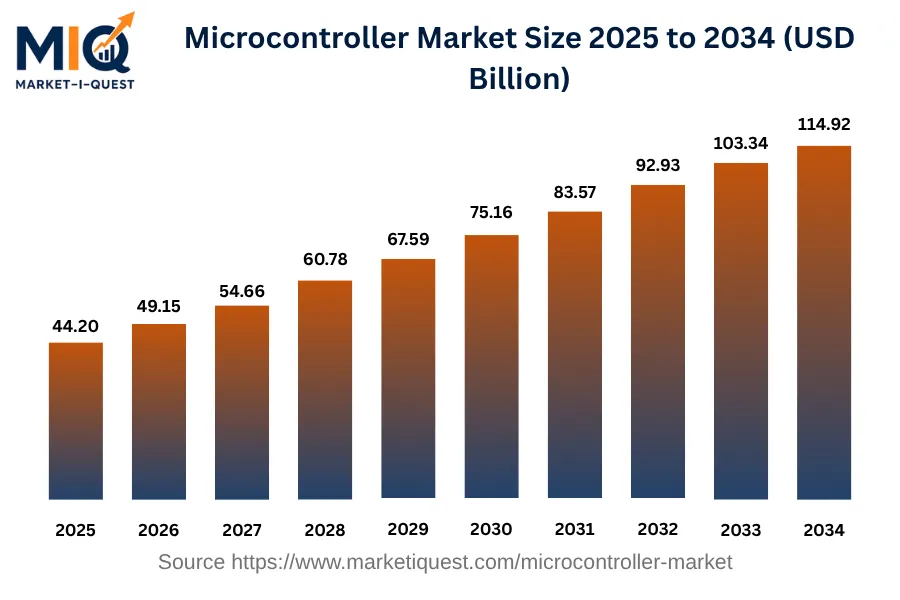
The Microcontroller Market share reached at USD 44.20 Billion in 2025, following its 2024 value of USD 39.75 Billion. By the year 2034, the market is expected to reach a value of USD 114.92 Billion. With a CAGR of 11.2% over the forecast period. The growth in advancements of the market throughout the decade, due to implementation of microcontroller in operations by increased number of industries. Additionally, a surge in demand for smart consumer electronics and technological advancements in the automotive sector further increased the growth of sector.

Key Takeaways

  • By Product - 8 Bit Microcontrollers held the leading position accounting for the largest share in the base year.
  • By Architecture - CISC led the market as per the given metrics.
  • By Packaging - QFP or Quad Flat Package emerged as the top segment accounting for a significant position.
  • By Application - Standalone Systems has been the primary driver showing strong growth in the base timeframe.
  • By End Use - Telecommunication & Networking expanded the fastest accounting for a substantial share in the last measured year.
microcontroller-market market size

Key Driving Factors

Rise in Automation in Automotive Industry

The major driver of microcontroller market demand is the shift in automotive industry towards increased complex and autonomous systems. These tiny computer chips manage communications between different systems in a car. From advanced in-vehicle dashboard systems to safety features such as advanced driver-assistance systems, majorly lean towards microcontrollers. Whereas, these systems need the high computational power, low power consumption and real-time operational capabilities that are prominently provided by microcontrollers. A large amount in usage of microcontrollers is seen in vehicles and with the continuous evolution of cars, the increase in requirement of increased internal communication and operations management has significantly rose the demand for microcontrollers in this industry. Thus, resulting in the rise of automation in automotive industry.
Increased Adoption of IoT Devices

The development of Internet of Things devices acts as a significant driver in the microcontroller market growth. With the various features including process data and execute commands, facilitating seamless communication between devices due wide usage of IoT devices in Microcontrollers. Models of IoT devices integrated with microcontrollers include home automation systems, wearable technology and industrial control systems. The expanding adoption and advancements with the IoT devices are driving developments in microcontroller technology with manufacturers developing chips with higher processing speed, enhanced connectivity and lower power consumption. Thus, as the IoT ecosystem continues to grow, the demand for the advanced microcontrollers grows simultaneously.

Market Evolution by Timeline

2019-2023
During these years, there was a significant adoption of microcontrollers in home automation and automotive electronics. Various developed regions like United States and Europe has dominated the demand. With the integration of increased memory for advanced application ARM-based microcontrollers became a common choice for manufacturers, prices remain relatively stable. The implementation of the General Data Protection Regulation (GDPR) in Europe has influenced the enhancements in data. The standard supply model was based on long-term contracts for both custom and standard microcontrollers. Thus, significantly increasing the demand during this period.
2024
In 2024, the demand for machine learning and AI applications rose with increasing demand for high-performance microcontrollers. Emerging markets in Asia-Pacific region witnessed increasing demand. The programmable microcontrollers provided features such as customization and scalability, whereas the challenges in this period were the reduction of component while the pricing model remained unchanged. Regarding increasing supply models saw partnerships and collaborations between manufacturers and AI companies. Thus, various regions saw an emergence in the market.
2025-2029
During this period, various medical and health-related applications started using microcontrollers for real-time monitoring processes. The healthcare sector witnessed increased demand from various regions including North America and Europe. With the integration of 5G technology, IoT applications became ubiquitous while the demand increased for low-power, high-speed microcontrollers. The integration of microcontrollers with IoT devices became accountable. Policy standards with HIPAA (Health Insurance Portability and Accountability Act) became key in the health sector. Procurement moved towards more strategic partnerships with vertical integration seen in larger corporations. Thus, resulting in expansion during this period.
2030-2034
With leading the global demand especially in Asia, automation and smart devices were dominant consumers for the microcontroller market growth during this period. Due to most advanced features the recognition of ultra-low power microcontrollers increased in the industry. The chips became more powerful, with the same, reflecting accountable technological integration. Compliance with environmental standards such as the Restriction on Hazardous Substances (RoHS) directive, became mandatory on a broader scale. Simultanoesly, long-term, high-volume contracts became a trend in procurement. Thus, forecasting subsequent growth during this period.

Future Market Outlook

Future Opportunities

The future of the microcontroller market opportunities is majorly influenced by recent developments and market dynamics creating new possibilities. As smart home technology continues to gain global demand, companies like Broadcom are analyzing partnerships with appliance manufacturers for integrating advanced microcontrollers with smart features. The automotive sector is also shifting towards activation and automation, with partnerships such as the collaboration between Toyota and NXP Semiconductors announced in 2022, driving the adoption of microcontrollers designed for electric vehicles. Moreover, as health-tech expanding the innovations, companies like Nordic Semiconductor are focusing on developing microcontrollers that support biometric sensors for wearable devices, highlighting the increasing intersection of health and technology. The ongoing shift towards sustainability is indicating regulatory frameworks to evolve, as seen with California’s emphasis on energy efficiency standards, driving demand for microcontrollers that reduce energy consumption. Furthermore, as cities worldwide implement smart infrastructure initiatives, for instance, Singapore’s Smart Nation program, the demand for microcontrollers capable of data analysis and management within urban systems is expected to grow. Overall, current trends indicate a future replete with opportunities for microcontroller applications in diverse markets, driven by technology integration, collaboration, and an evolving regulatory landscape.

Segmentation Analysis

By Product

The market is divided into subsegments including 32 Bit Microcontrollers, 16 Bit Microcontrollers, and 8 Bit Microcontrollers. Of these, 8 Bit Microcontrollers account for the largest revenue share while 32 Bit Microcontrollers are expected to grow at the fastest CAGR during the forecast period.

Largest Revenue Share

8 Bit Microcontrollers

Market Share Leader

8 Bit Microcontrollers contribute to the largest share of the microcontroller market expansion. The dominance can be attributed primarily to the widespread adoption across multiple industries like consumer electronics, automotive and industrial sectors, with their low unit cost and simple design structure. The proliferation of smart home devices, wearable technology and IoT appliances all of which utilize 8-bit microcontrollers, further drives market advancement in this subsegment. They also prefer the applications that require moderate control demands and power consumption due to their optimized performance. Customers leaning towards cost-effective products that meet basic requirements, leads to an increased demand for 8 Bit Microcontrollers. Regions like the Asia-Pacific, which structures developing countries with emerging electronics industries, contribute significantly to the subsegment's revenue. Thus, making it the largest market share of the segment.

Fastest CAGR

32 Bit Microcontrollers

Forecast Period Growth Leader

32 Bit Microcontrollers are expected to grow at the fastest growth rate. With features such as high processing power and speed make them ideal for technologically advanced and complex applications like robotics, AI, advanced driver-assistance systems (ADAS) and others. As industries across the globe begin on the path of digital transformation, the adoption of 32 Bit Microcontrollers is expected to grow at increased pace. Significant driver for advancement is the ongoing innovation and development in the semiconductor technology which further enhances their capabilities. Multiple industries are expected to shift from 16 Bit and 8 Bit Microcontrollers to 32 Bit owing to their superior functionality. Price reduction due to technological advancements. Thus, acting as a major driver.

By Architecture

The market is divided into subsegments including CISC (Complex Instruction Set Computing), RISC (Reduced Instruction Set Computing). In 2024, CISC accounted for the largest revenue share while RISC is expected to grow at the fastest CAGR during the forecast period.

Largest Revenue Share

CISC (Complex Instruction Set Computing)

Market Share Leader

The CISC architecture leads market with the highest revenue share. It is preferred in systems where directly commanding the hardware seems more efficient than creating routines for software. These systems contributes the majority of the desktop and laptop markets, which are the main drivers of revenue for this segment. The immense compatibility of this design with high-level languages builds upon an increased customer base, especially in regions with advanced technological infrastructure such as North America and Europe. The lowest number of instructions command in reduced consumption of memory, reducing the operational costs that similarly attracts the organizations and end-users. Thus, making it the largest revenue share of the segment.

Fastest CAGR

RISC (Reduced Instruction Set Computing)

Forecast Period Growth Leader

The RISC architecture is projected to grow at the highest CAGR in the forecasted period. RISC provides a simplified computing environment, reducing the complexity of the instruction set. It is a preferred option for industries seeking high efficiency, like cloud computing and smartphones. Moreover, with increasingly adopted due to its reduced number of clock cycles per instruction and power efficiency. With emerging regulations favor energy-use efficiency, especially in regions like the EU with stringent guidelines, which further drives the market’s outlook. Increased industries are exploring partnerships and making substantial capital investments. Thus, indicating a favorable future for the developments of the RISC-based architectures.

By Packaging Type

The market is divided into subsegments including DIP (Dual Inline Package), QFP (Quad Flat Package), BGA (Ball Grid Array), LQFP (Low-profile Quad Flat Package) and others. In 2024, QFP accounted for the largest revenue share while BGA is expected to grow at the fastest CAGR during the forecast period.

Largest Revenue Share

QFP (Quad Flat Package)

Market Share Leader

The Quad Flat Package (QFP) subsegment dominates the market primarily due to its wide range of applications and superior functionality. With providing more connections in less space and is known for its heat control capabilities, which provides enhanced performance with integrated circuits in electronics like televisions, mobiles, radios and other electronics. This widespread applications combined with the increasing demand for consumer electronics. Particularly in developing regions, with setting position of QFP as the leading revenue share. Furthermore, the popularity of QFP across various industries, including automotive, aerospace and IT, also significantly contributes to its revenue dominance. The robust design and reliable nature make them an ideal choice for various manufacturers.

Fastest CAGR

BGA (Ball Grid Array)

Forecast Period Growth Leader

The Ball Grid Array (BGA) subsegment is expected to grow at the fastest growth rate during the forecast period. Contributing in superior functionality of BGA, such as its high density and small footprint, facilitating more compact and efficient device designs. This makes it a standard solution in increasing requirement for integrated devices with high performance in sectors such as consumer electronics, telecom and automotive. The constant tech advancements in Internet of Things devices, smartphones, laptops and wearable devices. Companies are investing heavily in R&D to overcome this barrier with numerous strategic partnerships witnessed between packaging and electronic manufacturers. Thus, resulting in promising a high future adoption rate for BGAs.

By Application Type

The market is divided into subsegments including Embedded Systems and Standalone Systems. Standalone Systems accounted for the largest revenue share, while Embedded Systems is expected to grow at the fastest CAGR during the forecast period.

Largest Revenue Share

Standalone Systems

Market Share Leader

The Standalone Systems subsegment is currently leading in revenue. This could be primarily owing to the flexibility and scalability these systems offer. With features such as easy installation, maintenance and upgrade making them a preferable choice in various industries such as IT, manufacturing and healthcare. This subsegment also gains influence due to lesser dependency on other systems and capability for independent operations, hence reducing operational downtime, and further driving the revenue. Different regions, particularly developed regions like North America and Europe, represents increased demand for these systems due to the technologically advanced infrastructure. In addition, regulatory policies supporting the use of Standalone Systems have further increased their adoption. Essentially, high nee, ease of availability, and supportive regulatory framework are the key drivers for Standalone Systems commanding the largest revenue share in this market segment. Thus, making it the largest revenue share of the segment.

Fastest CAGR

Embedded Systems

Forecast Period Growth Leader

Embedded Systems are projected to experience the fastest CAGR in the forecast period. These systems are integrated into other systems, making them crucial for smooth operations across several applications. With increasing technological advancements like requirements in IoT and AI for Embedded Systems has seen a significant growth. Partnerships among technologically advanced firms have also contributed in the expansion of these systems into multiple sectors. Whereas, government policies supporting technology adoption and capital distributed to technological advancement are anticipated to be significant drivers in accelerating the growth of the Embedded Systems subsegment. Thus, making it the fastest growing subsegment of this segment.

By End Use

The market is broadly divided into sectors such as Industrial, Automotive, Aerospace & Defence, Consumer Electronics, Healthcare & Medical Devices, Telecommunication & Networking and Others. In 2024, the Industrial segment was a top revenue contributor while the Telecommunication & Networking segment is anticipated to record the highest CAGR in the following years.

Largest Revenue Share

Industrial

Market Share Leader

The Industrial subsegment is marked as the revenue leader of this segment in 2024. This dominance can be attributed to the increasing integration of advanced technologies within various industrial applications. Key drivers include expansion of industrial automation and industrial IoT resulting in reduced production costs and errors. The regional trend also contributed in the growth of this subsegment, with increased adoption rates in developed regions such as North America and Europe. These regions saw early adoption due to favorable regulatory standards with trend towards digitization and automation. Additionally, purchasing decisions in this segment were influenced by factors such as improved efficiency with reduced downtime and cost-effectiveness. Thus, this subsegment holds the largest revenue share.

Fastest CAGR

Telecommunication & Networking

Forecast Period Growth Leader

Telecommunication & Networking is expected to witness the fastest growth in the forecasted period. The rise in demand for advanced networking technologies in various businesses, particularly during the COVID-19 pandemic, drove this growth. Telecommunication technologies are increasingly integrated with cloud-based services. Consequently, driving the increased requirement for high-speed and reliable networks. Also, the ongoing global introduction of 5G technology is likely to serve as a significant factor in this growth. However, partnerships and collaborations amongst key players, combined with supportive government policies and funding, could reduce these challenges.

Competitive Analysis

Key Market Players

Manufacturers / OEMs

Microchip Technology Inc.
US
Renesas Electronics Corporation
Japan
Texas Instruments Inc.
US

Key Suppliers & Raw Materials

ARM Limited
UK
Taiwan Semiconductor Manufacturing Company Limited
Taiwan
GlobalFoundries
US

Distributors, Integrators & Channel Partners

Avnet, Inc.
US
Arrow Electronics, Inc.
US
Future Electronics
Canada

Porter’s Five Forces Analysis

This analysis provides a detailed examination of the microcontroller market competitive dynamics.

Supplier Bargaining Power

Medium

Suppliers influence is moderate due to availability of integrated circuit materials but limited skilled labor.

Buyer Bargaining Power

High

Strong buyer power due to abundant suppliers, minimal switching costs, and technical standardization.

Threat of Substitutes

Low

Low alternative threat due to specific functionality and efficiency of microcontrollers.

Threat of New Entrants

Medium

Entry is possible but constrained by R&D costs, intellectual property concerns, and specialized manufacturing infrastructure.

Competitive Rivalry

High

Intense rivalry due to tech advances, market saturation, and battle for technological supremacy.

Regional Analysis

Geographic market dynamics and growth opportunities across key regions

Global Market Outlook

microcontroller-market market regional share

North America

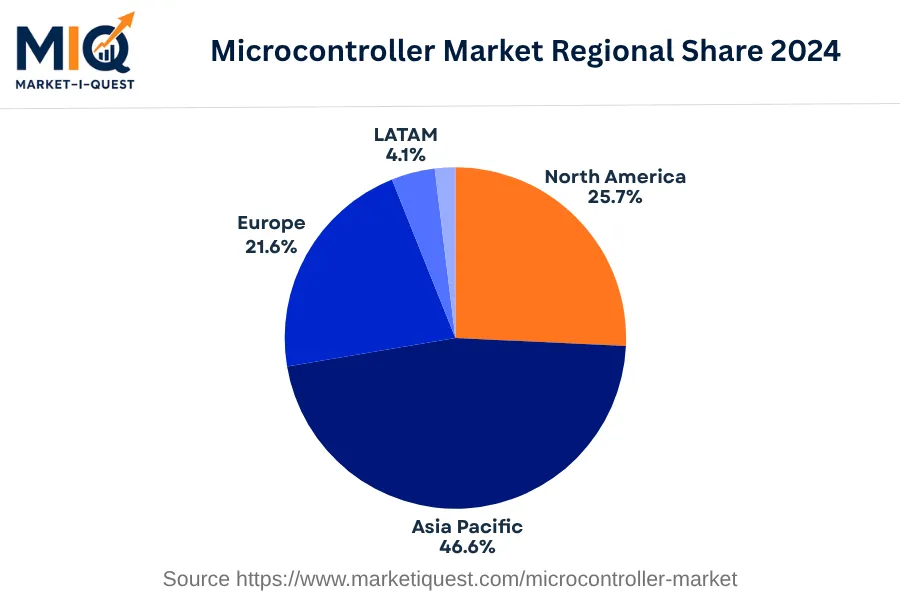
In 2024, the microcontroller market share in North America saw acceleration in the expansion, primarily driven by dynamic technological advances and significant changes in demand. Whereas the market was dominated by regulations encouraging automation in several industries, including manufacturing, automotive and utilities. With the rising investment in healthcare technology indicated a surge in demand for microcontrollers. This was further heightened by the increased adoption of IoT technology across the U.S., Canada and Mexico, which boosted the need for microcontrollers in various applications.

The notable changes experienced by the market in North America market included shifting buyer behavior, due to growing trends towards home automation and smart consumer products. The increased mergers and acquisitions in the microcontroller sector, indicated the companies strengthening their position in this competitive market. Moreover, new policy enforcements in sectors including retail and healthcare motivated companies in adopting cutting-edge microcontroller technologies for maintaining standards. Consequently, product engineering shifted towards developing power-efficient, cost-effective microcontrollers to meet emerging market demands. Thus, the North America holds the largest share of the market.

Asia Pacific

In 2024, the microcontroller market demand in the Asia Pacific region witnessed a dynamic expansion, fueled by various key drivers and emerging trends.

With the increased requirement due to significant investment in smart city project in the adoption rate of microcontrollers, particularly in India and China. The accelerated government standards on energy-efficient appliances in Japan and South Korea drove the requirement for microcontrollers, influencing the supply dynamics in these markets. With an improved landscape for technology adoption enhanced the growth opportunities in Australia and key ASEAN countries, where the pricing trends were specified by advancements in microcontroller manufacturing technologies.

Shifts in buyer behavior were seen as trend with a demand preference for advanced tech integration resulted in advancement in microcontrollers. Channel dynamics in China shifted towards online distribution platforms, while Japan saw strengthened partnerships and strategic M&A’s among leading market players. Adaptation of global technological standards noticeably impacted the market trends in Australia and South Korea.

Microcontrollers found extensive applications in healthcare for advanced medical devices and retail for cashless point-of-sale systems. Both sectors focused on advanced microcontroller deployment. Utilities and manufacturing sector shifted majorly towards smart grid systems and automation making them major consumers of microcontrollers. The Australian enterprise sector offered significant market opportunities due to the rising trend of Industry 4.0, demanding advanced microcontrollers for smart manufacturing solutions. Thus, the playing a major role in this market.

Europe

In 2024, Europe's Microcontroller Market expansion projected a robust dynamics indicating a combination of technological innovation, regulatory influence and changing consumer demands. Demand was driven by rising deployment of IoT devices in various industries including manufacturing, healthcare and utilities. Government standards for promoting automation in vehicle safety systems fueled the need for advanced microcontroller units, especially in regions including Germany and UK. Simultaneously, rising investments by firms in Italy and Spain for the smart grid solutions heightened market growth.

Evolving market trends were predominantly technology-oriented, deeply influenced by factors such as AI adoption and the surge in remote working due to the pandemic. The rapid integration of AI into microcontroller systems in sectors such as retail and enterprise was not only a key trend but it also enhanced system efficiency and predictive capabilities. The expansion in remote working across the Nordics and central & eastern Europe led businesses to adopt cloud-connected microcontrollers, adapting sales through digital channels.

Additionally, partnerships and M&As became increasingly common, enabling companies to consolidate their market positions. For instance, the European market witnessed strategic collaborations in the embedded industrial market in Benelux. Simultaneously, stringent enforcement of EN 50128 (railway application) and ISO 26262 (automotive standard) reshaped product development, necessitating inclusion of safety microcontrollers. Consequently, the interplay of various drivers and evolving trends indicated a textured panorama for the Microcontroller Market in Europe in 2024. Thus, the European market holds a significant share.

Latin America

In 2024, the Microcontroller market analysis in Latin America (LATAM) witnessed robust growth, primarily led by various regions including Brazil, Mexico, and Argentina. The boost of digitization initiatives driven by government regulation across various sectors such as healthcare, utilities and manufacturing. Simultaneously, the rising investment in autonomous vehicles across Mexico and Brazil maintained the prominence of microcontrollers.

Furthermore, integration of microcontroller units (MCUs) in modern technology also escalated the supply dynamics. During growing environmental concerns, energy-efficient MCUs gained an advantageous rise, encouraged by preferrable regulation in Colombia and Chile. Consequently, the need for these smart, energy-conserving controllers witnessed a significant surge.

Customer behavior shifted heavily towards products integrated with IoT and AI, specifically in the retail and enterprise sectors. With a shift is regions such as Argentina and Peru, where businesses started utilizing microcontrollers to accelerate workflows and automate tasks. Additionally, key player partnerships aimed at collaborating advanced microcontrollers marked as a notable trend. Data security standards also influenced in shaping the product development landscape, culminating in microcontrollers equipped with enhanced encryption features, notably in banking sector Brazil. Thus, the Brazil a marks a significant spot in the market.

Middle East & Africa

In 2024, the Microcontroller Market opportunities in the Middle East and Africa experienced significant growth due to several key drivers. In Saudi Arabia and the United Arab Emirates with increased investments in smart city projects indicated in growing demands for microcontrollers in gadget automation, utilities and telecom sectors. Adoption of advanced technologies, majorly in regions such as Nigeria and Israel in manufacturing sectors and healthcare systems in Kenya, combined with regulatory standards, motivated in the market expansion. Furthermore, in Egypt and South Africa, sustained price reductions heightened accessibility, enhancing supply dynamics and market impact.

Trending across the region, increasingly prioritizing in enhancement of tech infrastructure experienced shifting consumer preference towards increased intuitive, programmable microcontrollers. Whereas, telecom sector of South Africa with oil and gas sector in Nigeria saw a rise in need for high-performance, low-power-consuming microcontrollers. Egypt witnessed a preference for correlational interface microcontrollers in healthcare applications, while developing tech industry in Israel shifted towards system-on-chip microcontrollers for application-specific designs. With these technological shifts, there was a surge in collaborations among regional and international tech firms leading to strategic mergers and acquisitions. Furthermore, policy enforcement towards standardization of these microcontrollers. Thus, the microcontroller market in Middle East and Africa experienced several advancement.

Recent Industry Developments

Latest market innovations, product launches, and strategic initiatives

March 2026

Infineon announced an increase in its global microcontroller market share to 23.2% while detailing the integration of its newly acquired Automotive Ethernet capabilities into its AURIX, PSOC, and TRAVEO MCU families. This structural integration gives them a massive edge in targeting centralized computing architectures for software-defined vehicles (SDVs) and emerging physical AI applications like humanoid robots.

March 2026

STMicroelectronics officially launched the STM32C5 series, essentially redefining the performance baseline for entry-level microcontrollers. Built on a proprietary 40nm process and featuring an Arm Cortex-M33 core running at 144 MHz, this release brings advanced processing power and hardware-level security to highly cost-sensitive applications, such as smart home thermostats and industrial sensors, without increasing the bill of materials.

March 2026

Renesas significantly expanded its automotive microcontroller lineup with the introduction of the 28nm RH850/U2C series. This specific development is engineered to handle the complex processing and strict safety requirements of modern vehicle control systems, directly supporting the automotive industry's accelerated shift toward multi-domain electronic control units (ECUs).

Frequently Asked Questions