
Medical Nonwoven Disposables Market Snapshot

Key Players

  • Medline Industries Inc. (US)
  • Kimberly-Clark Corporation (US)
  • Mölnlycke Health Care (Sweden)
  • Hartmann Group (Germany)
  • Cardinal Health (US)
  • Unicharm Corporation (Japan)
  • KCWW (K-C Health Care) (US)
  • Domtar Corporation (Canada)
  • Essity AB (Sweden)
  • Berry Global Group (US)

Market Size

Base Year 2024
$19.73 Bn
CAGR
5.94%
Forecast 2034
$35.13 Bn

Market Segments

By Material Type
Polypropylene, Polyester, Viscose, Cotton, Blend
By Product Form
Rolls, Sheets, Pre-Cut, Shaped
By Application
Surgical Drapes, Surgical Masks, Gowns, Caps, Shoe Covers
By End Use
Hospitals, Clinics, Ambulatory Surgical Centers, Home Care, Laboratories

Market Dynamics

Drivers
  • Increasing chronic disease prevalence
  • Rising hygiene awareness
Restraints
  • High production cost
  • Stringent regulation standards
Opportunities
  • Rising healthcare awareness
  • Increasing geriatric population

Market Size

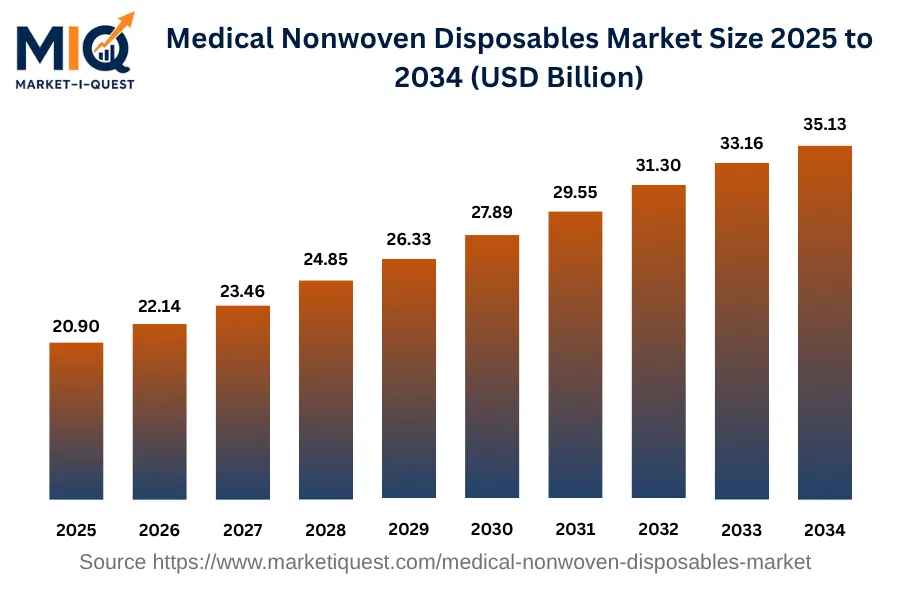
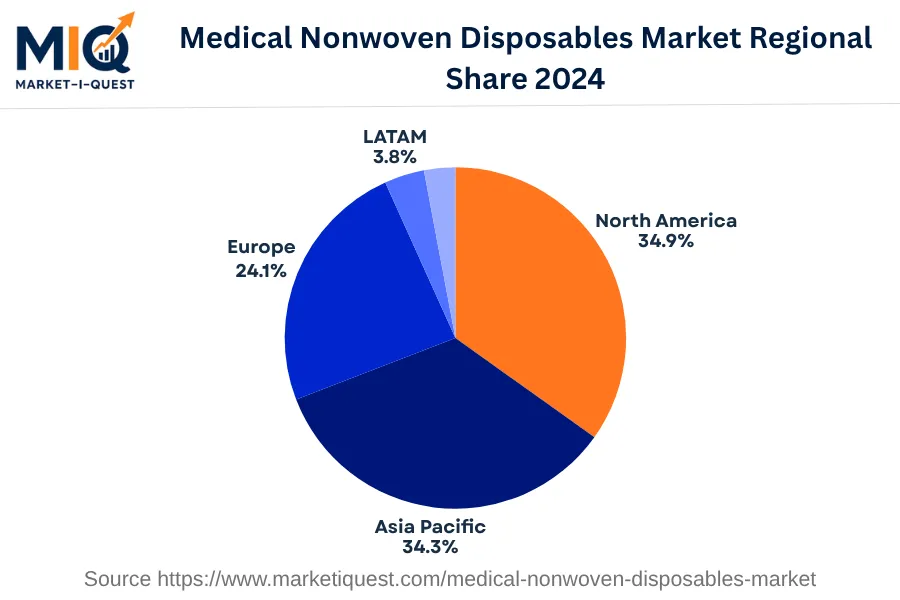
The Medical Nonwoven Disposables Market held a value of 20.90 billion USD in 2025 and is forecasted to reach 35.13 billion USD by 2034, growing at a CAGR of 5.94%. Progression over the years is consistent. The figure rose from 19.73 billion USD in 2024 to the mentioned 35.13 billion USD in 2034. This growth in the market size is primarily due to a consistent increase year after year within the given period. When observing the market's regional shares in 2024, North America held the largest portion at 34.9%, closely followed by the Asia Pacific at 34.3%. Europe represented 24.1% of the market. The regions with smaller shares were LATAM at 3.8% and MEA at 3.0%.

Key Takeaways

  • By Material Type - Cotton led the market accounting for a significant share in 2024.
  • By Product Form - Rolls held a dominant position in 2024.
  • By Application - Surgical Masks were the leading subsegment holding a substantial market share in 2024.
  • By End Use - Hospitals were the major sector accounting for the largest share in 2024.
medical-nonwoven-disposables-market market size

Key Driving Factors

Stringent Regulatory Standards for Maintaining Hygiene in Healthcare Settings

The prevalence of strict regulatory standards set by healthcare authorities worldwide is driving the demand for medical nonwoven disposables. For instance, guidelines outlined by the Centers for Disease Control and Prevention (CDC), such as their Standard Precautions for All Patient Care, emphasizes strongly on hygiene and cleanliness in healthcare settings. To meet these standards, hospitals and clinics are increasingly adopting disposable medical products including nonwoven disposable materials. These products, including surgical drapes, gowns, and face masks, are disposed of after single use, reducing the chance of cross-contamination and spread of hospital-acquired infections (HAIs). Thus, such regulatory oversight and precautions are primary factors propelling the market's growth.
Emergence of Advanced Bio-Based Nonwoven Disposables

The medical nonwoven disposables market is benefiting from the emergence of advanced bio-based nonwoven disposables. These bio-based products are made from renewable resources and have biodegradable properties. Concerns over environmental impact and waste management have prompted hospitals and clinics to explore more sustainable options. Bio-based nonwoven disposables fit perfectly into this frame as they present a greener alternative to traditional synthetic disposables. The use of these eco-friendly materials not only mitigates environmental concerns but also adheres to waste management regulations imposed in many regions. The additional advantage of these disposables is their non-allergic nature which improves patient comfort during procedures. Therefore, the rise in demand for bio-based nonwoven disposables is a significant driver for the market.

Market Evolution by Timeline

2019-2023
In this period, hospitals and clinics were the main demand drivers for medical nonwoven disposables, primarily in North America and Europe, given their growing need for sanitation and hygiene solutions. There were technological leaps in the nonwoven disposable manufacturing processes, including a shift to thermal bonding techniques, fuelled by the desire for higher product durability. However, supply constraints were typically observed due to restrictive government regulations in manufacturing standards. Prevailing commercial models displayed a rising trend towards ecommerce platforms as a primary market channel. The market encountered increased pricing pressures due to heightened competition. Major bottlenecks were increased tariffs and import restrictions sculpted by global trade wars.
2024
By 2024, broadening applications, especially home healthcare and geriatric care, spurred demand, with Asia-Pacific markets taking the lead due to high incidences of chronic diseases and an ageing population. Producers scaled up operations to meet the soaring demand. Meanwhile, biocompatibility remained a key focus in regulatory stipulations. Governments majorly invested in standardizing quality benchmarks. Over the year, partnerships between manufacturers and wholesale distributors ramped up, as both sought economies of scale to address cost-efficiencies and deal with price sensitivity among buyers. The risk of raw material scarcity began to loom large.
2025-2029
The increasing prevalence of hospital-acquired infections (HAIs) and a further surge in home healthcare in North America and Europe were the key consumption triggers in this phase. Manufacturers were seen piloting products with advanced liquid absorption capacity and adapting to nanotechnology-based production processes. Stringent implementation of environmental regulations posed challenges. While the cost-plus pricing strategy found favor, new market entrants opted for value-based contract models. The market also observed innovative partnerships, with online retailers striving for supply chain optimization. Volatility in raw material prices posed significant risks.
2030-2034
Buyers from sectors like waste management and disaster management marked a diversification of demand. Widespread automation of manufacturing processes minimized human intervention and hence reduced controllable risks. However, the industry grappled with technological complexities concerning waste disposal. Compliance to circular economy standards became mandatory, with the European Union setting new sustainability targets. Commercial models evolved to include more public-private partnerships and long-term contracts with large healthcare institutions. With increased importance on source localization due to geopolitical tensions, manufacturers typically adopted backward integration to decrease supply chain dependencies.

Future Market Outlook

Future Opportunities

The landscape of the medical nonwoven disposables market presents numerous future opportunities driven by rising healthcare demands and technological integrations. In 2023, the World Health Organization (WHO) noted an escalating emphasis on infection control in healthcare facilities, prompting a surge in usage of disposable products among hospitals, particularly in regions experiencing high infection rates. Collaborations are on the rise as evidenced by the partnership between Kimberly-Clark and Medline in 2023, aiming to expand their range of sustainable disposable products while addressing healthcare disparities. The growing aging population, particularly noted in countries like Japan and Italy, increases the demand for products tailored to the geriatric demographic, such as moisture-wicking incontinence products. Moreover, the COVID-19 pandemic has heightened awareness around hygiene, consequently fostering persistent demand for personal protective equipment (PPE) like gloves and masks. In regions such as India, government initiatives to improve healthcare infrastructure open doors for domestic production of nonwoven disposables, presenting opportunities for local manufacturers. Additionally, the introduction of advanced materials, such as those incorporating antimicrobial additives, aligns with regulatory trends promoting patient safety. These factors collectively indicate that as healthcare systems evolve globally, the medical nonwoven disposables market will likely expand to meet emerging needs and regulatory demands.

Segmentation Analysis

By Material Type

The market is divided into subsegments including Polypropylene, Polyester, Viscose, Cotton, and Blend. Among these, Cotton accounted for the largest revenue share while Polyester is expected to grow at the fastest CAGR during the forecast period.

Largest Revenue Share

Cotton

Market Share Leader

Cotton has emerged as the subsegment claiming the largest revenue share in 2024. This could be attributed to a multitude of drivers that play crucial roles in the wellbeing of this subsegment. Notably, Cotton is known for its softness and comfort, qualities that are highly desired by the consumers which make it a fundamental choice across various geographies. The wide acceptance and popularity of cotton clothing worldwide significantly contribute to the subsegment's enormous revenue. Additionally, Cotton has demonstrated impressive versatility in its application. It is extensively utilized in various household items, besides garments, boosting its prominence among customers. Suppliers benefit from a well-established and globally spread cotton industry which ensures stable production and sourcing. Stringent regulations on the use of synthetic materials also favor cotton. Another advantage lies in the reduction of switching costs. Manufacturers, familiar with cotton processing and its characteristics, prefer to stay with a trusted and well-understood material now that consumer interest refocuses on sustainability.

Fastest CAGR

Polyester

Forecast Period Growth Leader

On the other hand, Polyester stands out as the subsegment anticipated to experience the fastest CAGR in the foreseeable future. The uptick in growth is likely owing to the increasing consumer preferences for durable and Wrinkle-free clothing, traits inherent in Polyester. This subsegment faces relatively fewer barriers to adoption due to its reputation for being maintenance-friendly. Technological advancements in polyester manufacturing are playing a catalytic role in its fast-paced growth. An increasing number of partnerships and investments are being made by manufacturers to boost their capabilities, primarily due to the versatility of this material in various applications beyond clothing such as home furnishing and industrial usage. However, the pursuit of fast growth is not devoid of risks. The increasing awareness and importance of sustainability, and the subsequent policy changes, could affect the demand for synthetic materials, thus causing a shift in market strategies. Manufacturers are proactively investing in producing recycled polyester to mitigate this risk.

By Product Form

The market is divided into subsegments including Rolls, Sheets, Pre-Cut, and Shaped. Rolls accounted for the largest revenue share while Pre-Cut is expected to grow at the fastest CAGR during the forecast period.

Largest Revenue Share

Rolls

Market Share Leader

In 2024, Rolls dominated the market revenue in the product form space. This leadership stems from its widespread utilization across a variety of industries, from manufacturing to packaging. Rolls are versatile, which explains their wide adoption. They can be customized to different widths and lengths to suit diverse industrial requirements. This flexibility allows manufacturers to streamline their operational processes by adjusting the size of the rolls to meet specific demands. The primary buying criterion for rolls is their convenience and efficiency, providing high-volume users with a steady supply. Furthermore, Rolls are often sold in bulk, reducing the overall cost per unit for consumers, and are easily transportable and stored, further enhancing their appeal. The regulatory environment is also favorable, with no significant restrictions on the use of rolls in most regions, encouraging their adoption.

Fastest CAGR

Pre-Cut

Forecast Period Growth Leader

Despite Rolls' strong position in the market, the Pre-Cut subsegment is showing promise with the fastest Compound Annual Growth Rate. Key growth drivers include technological advancements, favourable policy changes, and strategic partnerships within the industry. Specifically, improvements in machinery allow for quicker, more precise cutting, leading to increased demand for Pre-Cut products. Coupled with this is a growing end-user preference for products with ease-of-handling, leading to greater adoption of Pre-Cut forms. The more precise dimensioning also reduces waste, contributing to more sustainable operations, which is an increasing concern across industries. However, the higher production cost of Pre-Cuts could present a barrier to their adoption. Also, the initial capital expenditure in machinery to manufacture Pre-Cuts may deter some producers. Nevertheless, joint ventures and partnerships among manufacturers have started to address these financial barriers, indicating positive growth prospects for the Pre-Cut sub-segment.

By Application

The market is divided into subsegments including Surgical Drapes, Surgical Masks, Gowns, Caps, Shoe Covers. Among them, Surgical Masks accounted for the largest revenue share while Gowns is expected to grow at the fastest CAGR during the forecast period.

Largest Revenue Share

Surgical Masks

Market Share Leader

Surgical masks hold a significant share of the market due to their imperative use in the medical field. The heightened need for protection against pathogens during surgeries drives their demand, reflected in their revenue share. Surgical masks also act as a barrier to the natural discharge of microbes from the mouth and nose. Additionally, the current requirement of surgical masks in response to the global health crises has skyrocketed, further pushing their sales. Specific regulatory norms mandate the use of these masks for protection, bolstering their prevalence in the market. Lastly, as surgical masks are single-use, their purchase-rate is higher than reusable alternatives like gowns or caps. This high frequency of purchases also contribute to the impressive revenue.

Fastest CAGR

Gowns

Forecast Period Growth Leader

Gowns are projected to have the fastest growth rate among all the sub-segments. This can be attributed to their high adoption rate, backed by increasing global health concerns that heighten the need for gowns, which offer full-body protection. There's a rising trend of technologically improved gowns that are more resistant yet comfortable, supporting their adoption in the medical field. Moreover, partnerships and investments in this arena are also facilitating market growth. Although, there are some barriers such as high switching costs and the adoption of reuseable gowns that may dampen the growth to a certain extent. However, amidst the current global health situation, these barriers may prove insignificant given the gravity of protective measures required.

By End Use

The market is divided into subsegments including Hospitals, Clinics, Ambulatory Surgical Centers, Home Care, and Laboratories. In terms of revenue share in the base year 2024, Hospitals accounted for the largest while Home Care is projected to grow at the fastest CAGR during the forecast period.

Largest Revenue Share

Hospitals

Market Share Leader

Hospitals emerged as the leading segment due to their extensive footprint and broad service coverage. As the heart of the healthcare system, hospitals cater to a wide range of medical needs across demographics, leveraging both general and specialized resources. Various factors drive this dominance, such as ongoing urbanization leading to concentration of services and population, advancements in hospital infrastructure, and introduction of high-end diagnostic and therapeutic technologies. Moreover, regulatory policies often mandate certain treatments to be performed only in a hospital setting, securing a captive market for this sub-segment. Hospitals' purchasing power and strong procurement networks further drive their revenue dominance. In addition, the high switching costs for patients to move outside the hospital ecosystem underpin the continuing revenue dominance of this sub-segment.

Fastest CAGR

Home Care

Forecast Period Growth Leader

The Home Care sub-segment is projected to register the fastest CAGR, owing to advancements in remote healthcare technologies and growing acceptance of home-based care. With an increasing aging population and a shift toward patient-centric care, demand for home care services is surging. The decentralization of healthcare—underpinned by telehealth, remote monitoring devices, and digital health platforms—facilitates this transition. However, adoption hurdles include regulatory uncertainties and the need for technological proficiency among both caregivers and patients. Potential barriers also stem from challenges around insurance coverage for home care services and patient safety concerns. The near-term risks include technology adoption and ensuring care quality, but strategic partnerships and policy support could fuel sustained growth in the Home Care segment.

Competitive Analysis

Key Market Players

Manufacturers / OEMs

Kimberly-Clark Corporation
US
Mölnlycke Health Care
Sweden
Paul Hartmann AG
Germany

Key Suppliers & Raw Materials

Avintiv Inc
US
Freudenberg & Co. KG
Germany
Suominen Corporation
Finland

Distributors, Integrators & Channel Partners

Cardinal Health
US
Medline Industries, Inc
US
McKesson Corporation
US

Porter’s Five Forces Analysis

An analysis of the competitive landscape for the Medical Nonwoven Disposables Market.

Supplier Bargaining Power

Medium

Supplier power is moderate due to availability of raw materials and multiple suppliers.

Buyer Bargaining Power

High

High buyer power due to multiple options, and price sensitivity among healthcare providers.

Threat of Substitutes

Low

Low threat from substitutes given the specific usage and regulatory requirements of these products.

Threat of New Entrants

Medium

Moderate threat from new entrants due to regulatory barriers, but offset by potential for technological advancements.

Competitive Rivalry

High

High rivalry due to presence of multiple established players and constant innovation in the industry.

Regional Analysis

Geographic market dynamics and growth opportunities across key regions

Global Market Outlook

medical-nonwoven-disposables-market market regional share

North America

In 2024, the North American market for medical nonwoven disposables was dynamic and tenuous. The driving factors behind this were primarily a growing geriatric population, an increase in the implementation of stringent regulations and standards, and advancements in technology offering cost-effective products. Both investment in R&D and pricing strategies were key elements influencing the speedy growth of this market, particularly in the U.S, Canada, and Mexico.

Several notable trends were observed during the year. The market witnessed a shift in consumer behavior, responding to the increasing demand for better hygiene standards and better prevention of infections in healthcare settings. Value-based purchasing contracts were furthering growth in the US, while new product launches met the demand for innovative healthcare solutions. Changes in distribution channels, from direct sales to online ordering, had become more prominent, especially in Canada and Mexico. Policy enforcements and partnerships were consistently supporting growth in the sector. The major customers for medical nonwoven disposables were notably the healthcare sector, including hospitals, clinics, and homecare settings. The increasing severity of infections acquired in hospital settings and the rising demand for improved healthcare facilities were key aspects that remained concentrated gaze of key players in the North American market in 2024.

Asia Pacific

In 2024, the Medical Nonwoven Disposables market in the Asia Pacific has shown robust growth. Driver factors such as increasing healthcare expenditures in economies like China and India, population aging in Japan and South Korea, and demand for cost-effective solutions in ASEAN markets have significantly enhanced the market's momentum. Technological adoption such as Spunbond and Meltblown technologies has improved product performance and supply dynamics. Additionally, favorable government regulations such as China's 13th Five-Year Plan and India's Mission Indradhanush stimulated investments from the manufacturer's end.

As for trends, buyer behavior swayed towards hygienic and disposable products in the healthcare sector driving the demand for nonwoven medical disposables. Notably, in markets like Australia, stringent standards on hygiene and infection control became increasingly paramount, affecting product shifts. Also, the inclination towards online sales channels was apparent, catering to a large consumer base in these populous countries. Manufacturer partnerships and M&A activities have been prevalent, particularly in China and India. Implementation and enforcement of government policies pertaining to quality standards and waste management were also a central focus across the region. Sectors such as government healthcare initiatives, hospitals, clinics, and home care settings were primary customers. Enterprises dealing in healthcare manufacturing and retail also constituted a significant part of the market.

Europe

In 2024, Europe's Medical Nonwoven Disposables market reflected an accelerating curve due to an array of drivers. Among these was the increasing consumer demand for better quality healthcare, induced by an aging demographic and the prevalence of chronic diseases in countries such as the United Kingdom, Germany, and France. This increased demand was further augmented by government efforts to strengthen public health infrastructure, coupled with sizable investments in research and development from leading medical suppliers in Nordic and Benelux countries. Additionally, healthcare facilities' adoption of advanced nonwoven technologies for disposable medical products led to an optimized supply dynamic in Italy and Spain.

In the same vein, trends shaping the market in 2024 included shifts in buyer behaviour towards sustainable nonwoven disposables due to heightened environmental awareness, pronounced in Central and Eastern Europe. There was an observed transition towards online channels for procurement, mainly within enterprise sectors. Merger and acquisition activities were prevalent, with partnerships formed between major healthcare providers in Germany and France. Importantly, adherence to European Union standards for nonwoven disposables was heavily enforced, ensuring quality control across all sectors, but especially in government, healthcare, and retail. The confluence of these trends and drivers underscore the dynamic nature of the Medical Nonwoven Disposables market in Europe for the base year of 2024.

Latin America

The Medical Nonwoven Disposables Market was a significant sector in LATAM's healthcare industry in 2024. High disease prevalence rates, favorable government policies such as Brazil's "Saúde Sem Papel" program which promotes the use of disposable products in healthcare facilities, and significant investments in healthcare technology in countries like Mexico and Argentina were evident drivers of market growth. Technology adoption further accelerated in response to sterilization needs and imperatives for infection control in medical settings, impacting supply dynamics and pricing.

Emerging trends included a shift in buyer behavior towards environmentally friendly products especially in Chile and Colombia, forcing manufacturers to produce biodegradable nonwoven disposables. Important developments in channel dynamics were seen in the increased use of eCommerce platforms by healthcare bodies to procure products. On a regional scale, partnerships and M&A were on the rise, particularly in Brazil and Peru, for companies aiming to expand their geographic reach. Stricter policy enforcement was seen around quality control and hygiene regulation. The Medical Nonwoven Disposables Market in LATAM in 2024 thus built on governmental, technological, and consumption patterns to respond to demand across retail and healthcare sectors, among others. The market dynamics were influenced by a blend of local trends, legal frameworks, and shifts in technology.

Middle East & Africa

In 2024, the Middle East and Africa's medical nonwoven disposables market maintained steady growth, underpinned by enduring healthcare requirements and increasing private sector investment. Demand extended primarily from healthcare and manufacturing sectors, as regulations for personnel safety tightened and the focus on infection control magnified, particularly in Saudi Arabia and South Africa. Technological adoption remained robust, with Nigeria and Kenya notably investing in advanced nonwoven production techniques to increase supply and drive down costs.

Market trends centered around buyer behavior favoring higher quality disposables, prompted by stringent government policies in countries like Egypt and Israel, where product standards have become more rigorous. Subsequently, there was a distinct shift towards a preference for Hygiene-grade nonwoven disposables over traditional products in these areas. Furthermore, technology shifts were predominantly towards environmentally friendly production methods, an initiative strongly enforced by governments in the United Arab Emirates and Qatar. This was evident with the increase in partnerships between local manufactures and international suppliers to adopt greener practices. Notably, a considerable number of mergers and acquisitions occurred in 2024 to meet raised standards and policy enforcement, particularly in the healthcare sectors of South Africa and Egypt.

Recent Industry Developments

Latest market innovations, product launches, and strategic initiatives

February 2026

Nonwovenn expanded its PFAS-free activated carbon filter media range for ostomy pouches, addressing growing regulatory demands under EU REACH and U.S. medical device regulations.

January 2026

Berry Global entered into strategic partnerships with Medline Industries to co-develop and manufacture a broad range of disposable medical nonwoven products, reinforcing supply resilience and reducing lead times across North America and Europe.

Frequently Asked Questions