
Medical Lifting Slings Market Snapshot

Key Players

  • ArjoHuntleigh (Sweden)
  • Invacare Corporation (United States)
  • Hill-Rom Holdings Inc. (United States)
  • Etac AB (Sweden)
  • Handicare (Sweden)
  • Prism Medical (Canada)
  • Guldmann Inc. (Denmark)
  • Silvalea Ltd (United Kingdom)
  • Surgical Synergies Pty Ltd (Australia)
  • Bestcare Medical (Taiwan)

Market Size

Base Year 2024
$1.64 Bn
CAGR
7.83%
Forecast 2034
$3.49 Bn

Market Segments

By Product
  • Seating Slings
  • Standing Slings
  • Bariatric Slings
  • Toileting Slings
  • Universal Slings
By Usage
  • Reusable
  • Disposable
By End User
  • Hospitals
  • Nursing Homes
  • Assisted Living Facilities

Market Dynamics

Drivers
  • Increasing geriatric population
  • Rising disability incidences
Restraints
  • Lack of trained professionals
  • Cost constrains
Opportunities
  • Aging global population
  • Technological advancements in sling design

Market Size

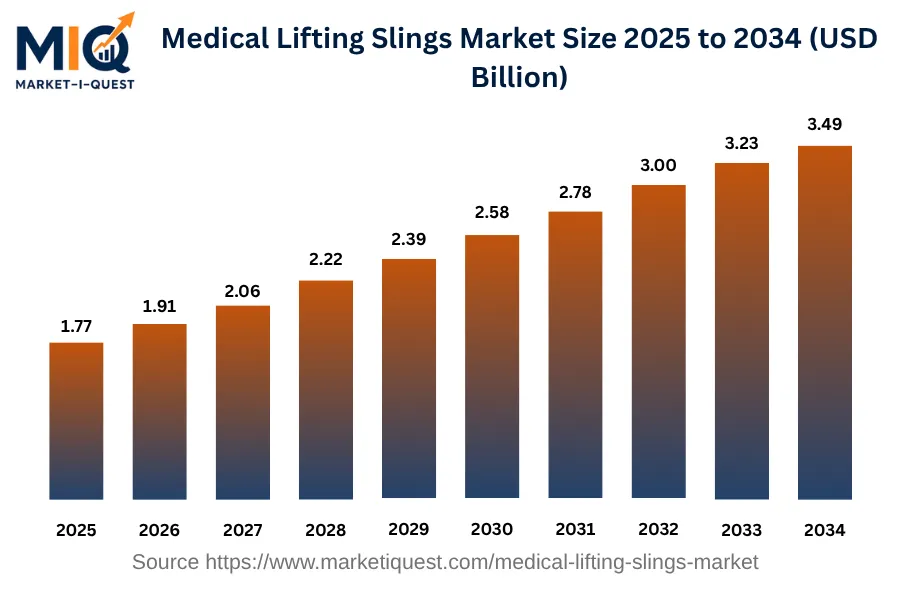
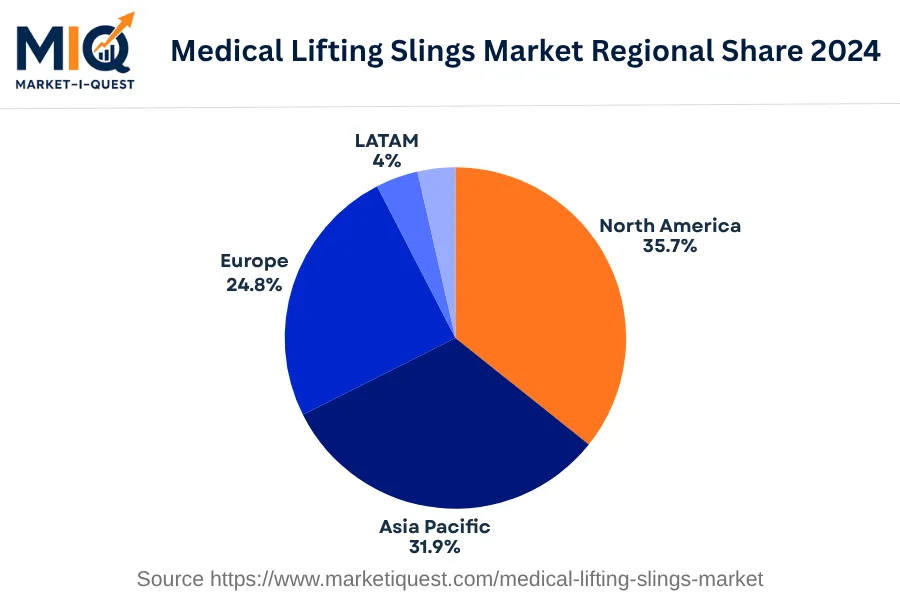
The Medical Lifting Slings Market is projected to see consistent growth over the next decade. In 2025, the market is expected to be valued at $1.77 Billion, gradually expanding to reach $3.49 Billion by 2034. This represents a compound annual growth rate (CAGR) of 7.83%. The substantial increase from 2025's $1.77 Billion to 2034's $3.49 Billion demonstrates steady and consistent growth throughout this period. The regional share of the market in 2024 shows the highest percentage in North America at 35.72% followed by Asia Pacific at 31.86%. Europe contributed to 24.84% of the market share while less substantial percentages are seen in the LATAM and MEA regions at 4.01% and 3.57%, respectively. This dispersion highlights the prominence of the Medical Lifting Slings Market in developed regions, while also indicating its emerging presence in developing areas.

Key Takeaways

  • By Product - Seating Slings accounted for a significant share in 2024.
  • By usage - Disposable subsegment held a higher market share in 2024.
  • By end user - Hospitals dominated the market in 2024.
medical-lifting-slings-market market size

Key Driving Factors

Strict Regulatory Requirements for Patient Handling

Key market growth for medical lifting slings is shaped by stringent healthcare regulations concerning patient handling in healthcare facilities. For example, OSHA (Occupational Safety and Health Administration) guidelines require healthcare providers to follow adequate safety measures during patient transfer to prevent injuries to both staff and patients. Their guidelines outline the necessity for medical lifting equipment, such as slings, in order to manage a safe process. Compliance with these regulations necessitates healthcare facilities to procure medical lifting slings, driving significant demand in the market. This is particularly relevant in developed nations with rigid healthcare norms, such as the United States and European Union countries.
Increased Prevalence of Lifestyle Diseases Leading to Disability

Another potent driver for the medical lifting slings market is the steady rise in lifestyle diseases that often result in disability and immobilization. Chronic conditions like cardiovascular diseases, obesity, and diabetes can lead to conditions like paralysis and motor function impairment, necessitating the use of medical lifting slings for routine patient movement. Additionally, conditions like arthritis and orthopedic trauma prevalent among the geriatric population also lead to an increased need for medical lifting slings. Therefore, the escalating patient base suffering from mobility impairing diseases across the globe fuels the market growth for medical lifting slings.

Market Evolution by Timeline

2019-2023
During this period, primary buyers in the medical lifting slings market continued to be hospitals and home healthcare providers. The demand was predominantly from developed countries like USA, UK, and Germany due to their greater focus on patient safety. Supply largely came from well-established medical manufacturers like Hill-Rom, Invacare, and Arjo. Due to the complexity of integrating multiple components, most of these slings were standalone products. Moreover, the adoption faced certain constraints due to unfamiliarity with the equipment among users and stringent quality compliance standards like ISO 13485. Pricing model still largely centered on outright purchase despite the increasing interest in leasing. From the regulatory standpoint, governments, specifically in Europe, started encouraging manufacturers to transition towards greener manufacturing practices.
2024
In the year 2024, the buyer segment saw an expansion. In addition to hospitals and home healthcare providers, assisted living facilities showed increased demand for medical lifting slings. Despite a growing demand, the shift in manufacturing preference towards niche, specialized products constrained the market somewhat. The necessity to conform to updated medical standards such as EN ISO 10535 also impacted the supply. The year marked the rise of mobile lifting slings developed by companies like Prism Medical due to their consumer-centric approach. Interestingly, amidst initiatives to bring down healthcare costs, per-use pricing models gained popularity.
2025-2029
From 2025 to 2029, Asia-Pacific displayed the fastest growth rate in demand. Key reasons were advanced healthcare infrastructure development, rise in number of elder care facilities, and growing awareness of worker safety. Technologies utilized to enhance patient comfort and safety further evolved with the integration of biosensors in slings from companies like Guldmann. However, the high-cost associated with advanced technologies continued to be a bottleneck for hospitals in developing countries. Regulatory institutions implemented new rules to regulate electronic lifting devices including slings, further enabling wider acceptance. Changing commercial models featured a blend of purchasing and leasing, with customization options for specific patient needs.
2030-2034
By 2030 to 2034, demand from middle-income countries like India, Brazil, and China further pushed the market. Digitally integrated smart slings that monitored patient vitals during transfers began to be norm, pioneered by companies such as Prism Medical and Etac. With rigorous enforcement of international quality standards like EN ISO 12182 and IEC 60601-1, suppliers faced challenges in attaining certification. Periodic maintenance contracts emerged as a significant component of commercial model, apart from outright purchase or leasing. Ambiguitous healthcare policies in certain regions posed risks to market development in terms of adoption and compliance.

Future Market Outlook

Future Opportunities

The future of the medical lifting slings market is poised for evolution, mainly driven by ongoing demographic changes and regulatory environments. With the global aging population projected to increase significantly over the coming decades, there is an expanding need for patient assistance products. Countries like Japan, where the number of people aged 65 and older exceeded 28% in 2022, highlight the urgency for reliable lifting solutions in elder care. In addition, regions such as North America are focused on enhancing patient recovery processes through improved lifting strategies. Hospitals and rehabilitation centers are increasingly seeking partnerships with suppliers to adopt more user-friendly and efficient lifting systems. In January 2023, the American Academy of Orthopaedic Surgeons emphasized the importance of training staff in proper lifting techniques to minimize injury, demonstrating the potential for additional training solutions connected to lifting sling usage. Online marketplaces are also evolving, with platforms such as Amazon and regional healthcare suppliers like Henry Schein actively expanding their product assortments. This shift presents opportunities for manufacturers to introduce innovative products through e-commerce channels, making them more accessible to healthcare providers. Furthermore, collaborations between technology firms and medical device companies could yield smarter lifting slings that offer enhanced features, significantly transforming healthcare environments where deployment of lifting slings is critical.

Segmentation Analysis

By Product

The market is divided into subsegments including Seating Slings, Standing Slings, Bariatric Slings, Toileting Slings, and Universal Slings. Among these, Seating Slings accounted for the largest revenue share, while Bariatric Slings are expected to grow at the fastest CAGR during the forecast period.

Largest Revenue Share

Seating Slings

Market Share Leader

With the increasing incidence of posture-related discomforts and disorders, there is a growing demand for Seating Slings in various healthcare settings. These slings serve as an integral component in patient handling equipment that provides proper posture alignment and support, thus ensuring patient comfort while preventing secondary injuries. Not only is the demand for these slings rising among hospitals, but they are also seeing an uptake in homes, considering the growing trend of in-home patient care. The segment's revenues are further spurred on by the increasing geriatric population, which generally requires more caregiving and assistance for daily activities. Plus, preferences for these slings are also high due to their ease of use and fitting with different types of sling bars, making it a versatile choice. Geographically speaking, developed markets witness a greater demand for Seating Slings given the higher awareness levels about such assistive products. Lastly, stringent worker safety regulation in healthcare institutions mandating the use of safe patient handling equipment helps underpin the revenue generation of the Seating Slings subsegment.

Fastest CAGR

Bariatric Slings

Forecast Period Growth Leader

Bariatric Slings are poised for the fastest growth as obesity rates worldwide continue to skyrocket. These slings are designed specifically for bariatric patients who are typically more challenging to handle due to their weight, which is also a significant catalyst empowering the growth of this subsegment. Manufacturers are also innovating rapidly in this sphere, yielding more comfortable and sturdy sling designs, thus encouraging adoption. Policymakers, too, are increasingly recognizing the importance of appropriate patient handling equipment, particularly for bariatric patients, and are designing policies accordingly. This subsegment is expected to benefit from such policy improvements. Meanwhile, the upfront costs of bariatric slings could pose some barriers to immediate adoption. However, with increasing awareness and policy support, this barrier is likely to be overcome in the near term. As obesity rates continue to rise, so too will the need for effective, safe handling methods like bariatric slings, thus propelling growth.

By Usage

The market, influenced by Usage, is divided into subsegments consisting of Reusable and Disposable. In 2024, the Disposable subsegment accounted for the largest revenue share, while the Reusable segment is expected to grow more rapidly.

Largest Revenue Share

Disposable

Market Share Leader

The Disposable subsegment commands the largest slice of the market as of 2024, and the reasons are varied and complex. First among them is the convenience factor. Disposable products can be used once and then discarded, saving the consumer the time and effort required for maintenance that reusable products demand. Also, Disposable products can usually be bought in bulk, which makes them an attractive option for commercial users who value efficiency and, by extension, time-saving. Furthermore, in some industrial sectors, regulations stipulate the usage of disposable items to maintain hygiene standards and prevent cross-contamination, thus fueling demand. Geographically, the demand is particularly high in developed regions that are conscious of health and safety standards. Nevertheless, the usage of disposable products is also growing in developing countries as they adapt stricter health and safety norms. Another driving force is the ever-improving supply chain and distribution channels, which make disposable products readily accessible across diverse markets.

Fastest CAGR

Reusable

Forecast Period Growth Leader

Despite the dominance of the Disposable subsegment, the Reusable category is projected to experience the fastest growth rate. This can be attributed to a heightened awareness of environmental sustainability among users. Reusable products come with the advantage of reduced waste generation, a factor that's becoming increasingly crucial given the ongoing global discussions about environmental conservation. Furthermore, advancements in technology are leading to the production of more robust, efficient and long-lasting reusable products. Not only does this cut down replacement costs, but it also offers advantages such as improved ROI for businesses and potential savings for individual users. However, adoption barriers exist, such as the upfront cost of reusable items and the lack of proper sanitization facilities in certain regions. However, initiatives for waste reduction and policies favoring green products are expected to overcome these barriers and in turn, provide a significant impetus to the segment's growth.

By End User

The market is divided into subsegments including Hospitals, Nursing Homes, and Assisted Living Facilities, with Hospitals accounting for the largest revenue share while Assisted Living Facilities are expected to grow at the fastest Compound Annual Growth Rate (CAGR) during the forecast period.

Largest Revenue Share

Hospitals

Market Share Leader

As of 2024, the Hospitals subsegment dominates the market and accounts for the highest revenue. This is primarily due to the inherent nature of hospitals in healthcare services across the globe. Hospitals are generally well-funded, have a wide range of services, and serve a vast number of patients, which fundamentally assures a continuous stream of revenue. The increasing prevalence of various chronic diseases necessitates frequent hospital visits for treatment, additional diagnostic tests, and follow-up, which typically results in high-profit margins. Region wise, developed countries like the USA and Western European nations heavily invest in their healthcare systems which boosts the revenue. In the developing economies, improving healthcare infrastructure, significant investment in public and private hospitals, and growing health awareness are driving growth. However, regulatory oversight can often pose as a challenge for this subsegment.

Fastest CAGR

Assisted Living Facilities

Forecast Period Growth Leader

Assisted Living Facilities are projected to witness the fastest growth during the forecast period. The major driver for this trend is the aging global population, especially in developed countries. Older individuals often require assistance for their day-to-day activities and healthcare supervision, which is precisely provided at these facilities. Moreover, the increasing occurrence of disabilities amongst seniors indirectly propels the market growth. Besides, technological advancements have made assisted living facilities more attractive by providing enhanced care, thus promoting their adoption. Particularly the advancements in telehealth have transformed how care is administered in these facilities. On the flip side, high costs associated with assisted living can be a barrier to market expansion. Further, setting up these facilities requires significant investment initially, which can act as a deterrent. However, partnerships between care providers and real estate organizations along with supportive regulatory policies could serve as catalysts to overcome these challenges.

Competitive Analysis Medical Lifting Slings Market

Key Market Players

Top Manufacturers/OEMs

Invacare Corporation
US
Arjo
Sweden
Hill-Rom Holdings
US

Key Suppliers & Raw Materials

Getinge Group
Sweden
Joerns Healthcare LLC
US
Handicare
Sweden

Distributors, Integrators & Channel Partners

Drive DeVilbiss Healthcare
US
Guldmann
Denmark
Sunrise Medical LLC
US

Porter’s Five Forces Analysis

This analysis evaluates the competitive dynamics and structural aspects governing the Medical Lifting Slings Market.

Supplier Bargaining Power

Medium

Suppliers exhibit some influence due to the technical nature and cost of materials needed to manufacture slings.

Buyer Bargaining Power

High

Buyers have high power due to the availability of multiple vendors and the standardization of sling products.

Threat of Substitutes

Low

Substitution threat is low as there are few alternatives that offer the same safety and convenience as medical lifting slings.

Threat of New Entrants

Medium

The market has prototype development and certification barriers, yet opportunities exist in the ageing global population.

Competitive Rivalry

High

Numerous established players with substantial market shares engender fierce competition within the market.

Regional Analysis

Geographic market dynamics and growth opportunities across key regions

Global Market Outlook

medical-lifting-slings-market market regional share

North America

In 2024, North America's Medical Lifting Slings Market exhibited steady growth, largely driven by an aging population, regulatory influences, and technological advances. United States, Canada, and Mexico witnessed increased demand for patient handling equipment due to a rise in musculoskeletal disorders among geriatric patients. In response, government policies promoting safety standards and minimizing manual patient handling were implemented, encouraging the healthcare sector to invest in these products. Moreover, technological advancements offered unique, sophisticated sling designs with enhanced durability and comfort, which increased adoption among healthcare providers. Yet manufacturers faced supply chain challenges stemming from high raw material costs, impacting the market pricing structure.

Evolving buyer behavior was witnessed during the year, with a shift towards more user-friendly, versatile slings. There was a notable trend towards home healthcare utilization, attributing to higher purchases from retail channels. Shifts also occured in companies' strategies; mergers and acquisitions were observed among leading manufacturers to expand their product portfolio and geographical reach. In terms of sectors, hospitals remained the largest customers, alongside long-term care facilities and home healthcare providers. Interestingly, government bodies engaged in bulk procurement of medical lifting slings, supporting injury prevention initiatives in public health facilities. All these players navigated within a heavily regulated environment emphasizing patient safety and stringent product specifications.

Asia Pacific

In 2024, the Medical Lifting Slings Market in Asia Pacific saw significant activity, driven by an array of factors. Aging populations in China and Japan led to increased demand for geriatric care and, subsequently, lifting slings. India's augmented allocation for healthcare infrastructure and China's policies encouraging domestic manufacturing amplified the supply dynamics favorably. Technological adoption was prevalent within developed nations like Australia and South Korea, as hospitals embraced digitally advanced sling systems.

Simultaneously, clear market trends were recognizable. In response to the rising trend of home healthcare in Japan and key ASEAN markets, there was enhanced buyer preference for lightweight and portable slings. New safety standards initiated by governments across the regions stipulated the adoption of slings for patient mobility in hospital settings, strengthening market growth. Additionally, partnerships emerged between medical equipment suppliers and local distributors, particularly in India and China, leading to improved distribution channels for lifting slings. These markets also witnessed heightened policy enforcement in terms of product certification and quality check to ensure patient safety. Sectors significantly impacted by these drivers and trends included healthcare, manufacturing, retail and, indirectly, the government due to the role it played in policy-making and regulation.

Europe

In 2024, the European Medical Lifting Slings market witnessed significant dynamics. Drivers included heightened demand due to the aging population, particularly in countries like Germany and Italy. Increased investment in healthcare infrastructure, notably within the UK’s National Health Service, bolstered the industry. Regulatory standardization across the European Union, specifically the Medical Devices Regulation, prompted a push for quality and safety, impacting suppliers. Technology adoption was instrumental; digitalization in Spain's healthcare sector expanded usage of advanced lifting slings.

Emerging trends encompassed shifting consumer preferences towards home healthcare, which was pronounced in the elderly population of the Nordics. There was a noticeable shift towards technologically advanced products offering more comfort and safety, underpinned by partnerships and M&A activities across the region. Demand was concentrated in healthcare facilities, notably hospitals and nursing homes, but the retail sector played a crucial role in serving home healthcare needs. In the eastern and Central Europe, reimbursement policies encouraged product uptake, but in France, strict regulatory enforcement posed a market challenge. Universal standards in product design and performance were crucial in navigating regional differences in Benelux. Overall, the market was driven by demand, regulation, technology, and explored new channels to facilitate the accessibility of medical lifting slings in Europe in 2024.

Latin America

In 2024, the medical lifting slings market in Latin America (LATAM) experienced significant dynamics driven by industry factors and changing trends. Demand increased due to the rising geriatric population, increased occurrence of lifestyle diseases, and growth in hospital infrastructure in nations like Brazil, Mexico, Argentina, Colombia, Chile, and Peru. Strict patient safety regulations across LATAM also compelled the healthcare sector to adopt technologically advanced slings thereby driving up investment in the market.

Trends identified in 2024 included a shift toward home healthcare services, resulting in an increased demand for personal use lifting slings. The adoption of newer sling technologies featuring smart sensors and automation found acceptance, notably in urban healthcare facilities across all major LATAM nations. Moreover, partnerships and M&A activities intensified, with companies aiming to expand their footprint in key markets and broaden their product portfolio. The primary customers driving this market were healthcare facilities, including hospitals, nursing homes, elderly care facilities, and private clinics. The retail sector also saw a surge in demand for personal use slings amidst the growing trend of home healthcare services. While government-led healthcare initiatives have shaped the market to an extent, it was the significant investment by private healthcare facilities and increasing consumer orientation towards home healthcare management that defined the LATAM medical lifting slings market in the base year, 2024.

Middle East & Africa

In 2024, the Medical Lifting Slings Market in the Middle East and Africa showed buoyant dynamics due to various drivers and new trends. Favorable regulations, escalating investment in healthcare, and the adoption of advanced technologies drove market growth. Saudi Arabia implemented healthcare reforms stimulating increased demand for medical lifting slings. Rising elderly population across United Arab Emirates, Qatar, Egypt, South Africa, Nigeria, Kenya, and Israel also propelled demand. Furthermore, African nations like Kenya and Nigeria saw an influx of healthcare investment stimulating local markets.

Consumer preference shifted towards high-quality, durable slings. The healthcare sector showed increased demand for 'patient lateral transfer' type of slings. In response, manufacturers in the region amped up the production of such models. Partnerships among local manufacturers and international healthcare equipment firms were noted, enhancing product quality standards. Governments across the region, especially the United Arab Emirates and Saudi Arabia, enforced strict policy adherence to maintain quality standards. Evidently, while healthcare was the prime consumer, the Middle East oil and gas industry also regularly utilized lifting slings during emergency situations. Also, manufacturers saw opportunity in retail, gearing marketing towards countries like South Africa where home healthcare services significantly gained traction. Therefore, the region’s market responded promptly to drivers and trends, notably the demographic shift, investment wave, and regulatory standards.

Recent Industry Developments

Latest market innovations, product launches, and strategic initiatives

January 2026

Bahrain's National Health Regulatory Authority (NHRA) enforced Medical Devices Regulations, 2018 mandating all lifting slings be registered and meet ISO 10535 safety standards before use in healthcare facilities

March 2025

Drive DeVilbiss Healthcare announced a strategic partnership with Patterson Medical to co-develop and distribute disposable lifting slings across North America.

Frequently Asked Questions