Medical Animation Market Snapshot

Key Players

  • Random42 Scientific Communication (United Kingdom)
  • Infuse Medical (United States)
  • Ghost Productions (United States)
  • Invivo Communications Inc. (Canada)
  • Medmovie (United States)
  • Elara Systems (United States)
  • Understand.com (United States)
  • Hybrid Medical Animation (United States)
  • Visible Body (United States)
  • AXS Studio (Canada)

Market Size

Base Year 2024
$0.494 Bn
CAGR
18.26%
Forecast 2034
$2.64 Bn

Market Segments

By Animation Type
2D Animation, 3D Animation, 4D/Real-Time Animation, Interactive Animation, Augmented Reality (AR)/Virtual Reality (VR) Animation, Others
By Therapeutic Area
Oncology, Cardiology, Neurology, Orthopedics, Gastroenterology, Infectious Diseases, Others
By Application
Drug Mechanism of Action (MoA), Patient Education, Surgical Training, Medical Device Demonstration, Cell & Molecular Animation, Others
By End User
Life Science Companies, Medical Device Manufacturers, Pharmaceutical Companies, Hospitals & Healthcare Providers, Academic & Research Institutes, Others

Market Dynamics

Drivers
  • Increasing healthcare digitalization
  • Rapid technological advancements
Restraints
  • High production costs
  • Limited trained professionals
Opportunities
  • Rise in virtual medical simulations
  • Advancements in 3D technology

Market Size

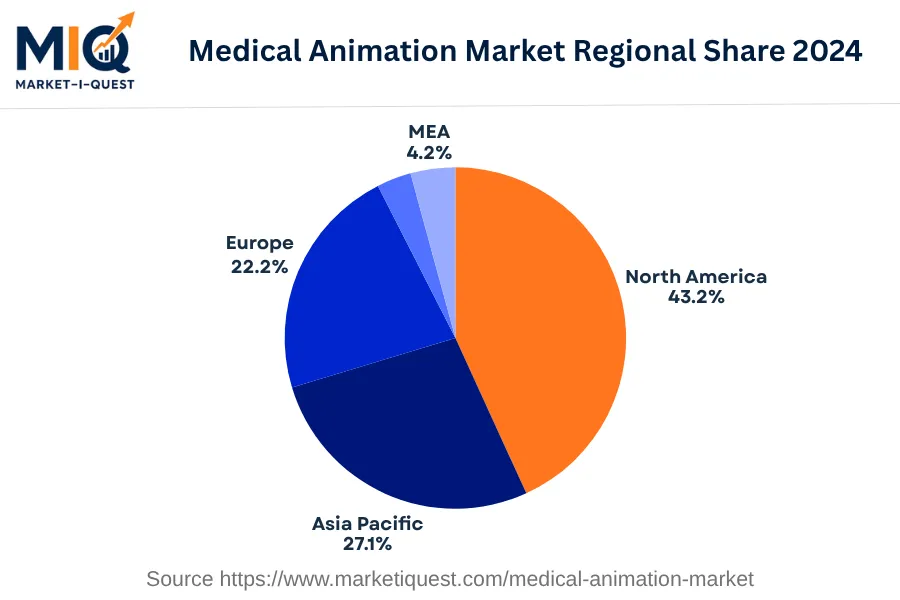
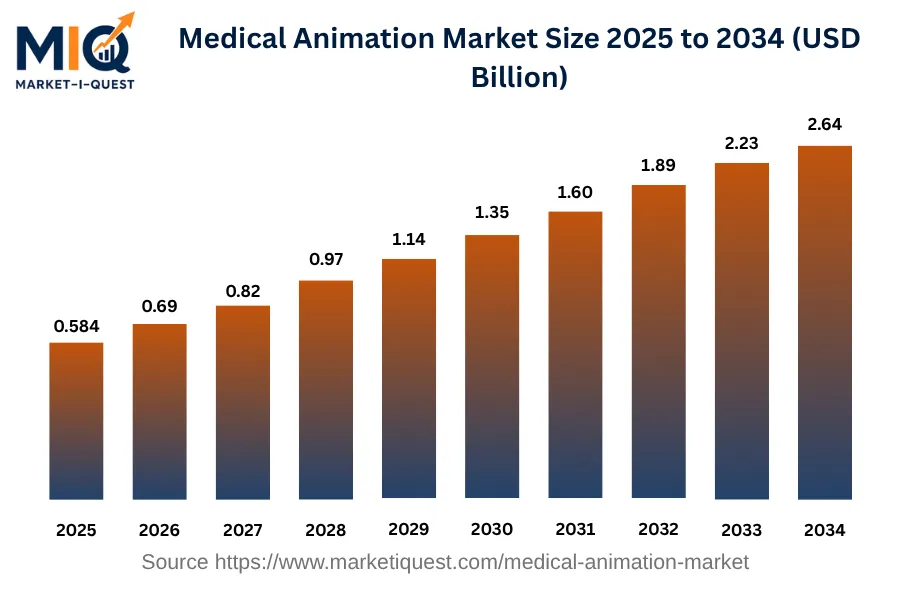
The Medical Animation Market is projected to grow from a size of 0.58 billion USD in 2025 to 2.64 billion USD by 2034, representing a Compound Annual Growth Rate (CAGR) of 18.3%. This significant increase depicts a progressive growth trajectory over the forecasted period. The year 2024 was a stepping stone for the market with a value of 0.49 billion USD, stimulating consistent growth seen in subsequent years. The key reason for this market expansion is the continuous advancement in 3-D animation technology, providing more detailed and realistic models, along with the rising demand for animated education in the medical sector. In terms of regional share in 2024, North America held the largest portion with 43.2%, followed by Asia Pacific at 27.1% and Europe at 22.2%. LATAM and MEA regions accounted for a lower share of the market, with 3.3% and 4.2% respectively.

Key Takeaways

  • By Animation Type - 3D Animation held the leading position in 2024 showcasing the pervasive use of this technology.
  • By Therapeutic Area - Oncology led emphasizing the critical need for visual interpretation in cancer care and research.
  • By Application - Medical Device Demonstration dominated in 2024.
  • By End User - Pharmaceutical Companies held the major share in 2024
  • highlighting their continual investment.
medical-animation-market market size

Key Driving Factors

Increased Application in Drug Mechanism Understanding

Medical animations have become significantly important in the pharmaceutical industry for explaining complex drug mechanisms to healthcare professionals, new recruits, and even patients. This increasing adoption is driven by the pressing need for effective communication methods that explain cellular or molecular processes efficiently. As a result, pharmaceutical companies are investing more in medical animations to clearly demonstrate the mechanism of their drugs, potentially increasing understanding and improving marketing efficiency. A well-illustrated and briefed animated medical video can help carve out a clear, comprehendible pathway for target audiences, proving to be a major driver in the current medical animation market.

Growing Utility in Virtual Surgical Training

Increasingly, medical animations are being used in surgical training and education. Medical school curriculum and hospital training programs are incorporating more animations to present complicated surgical procedures in a vivid, step-by-step manner. This trend responds to the need for enhanced theoretical understanding before practical implementation in real surgeries. It helps fill knowledge gaps, making surgical training more efficient and safer for students and patients alike. This potential in transforming medical education and surgical practices is another critical driver fueling the evolution and growth of the medical animation market.

Market Evolution by Timeline

2019-2023
During this period, pharmaceutical companies and academic institutions primarily drove demand for medical animations. North America, with its concentration of leading pharmaceuticals and edtech firms, emerged as the key buyer region. Major suppliers, including Infuse Medical and Ghost Productions, delivered diversified animations ranging from procedural guidelines to MOA (Mechanism of Action) explanations, despite facing constraints like long production time. In terms of regulations, the FDA (Food and Drug Administration) guidelines impact the content of medical animation, being careful about accuracy in depicting drug interactions. Production companies mostly adopted fixed pricing models depending on the complexity and length of the animation. Blockers included high initial investment and the intricacies involved in representing medical procedures accurately.
2024
The key highlight of 2024 was a sharp spike in demand driven by surgical and emergency training programs. The COVID-19 pandemic's lingering effects resulted in healthcare sectors worldwide intensifying their training efforts. Medical animations became an indispensable tool for training purposes. Suppliers incorporated advances in VR and AR technologies into animations to enhance training effectiveness, with the US and Europe serving as key consumer bases. Regulatory bodies such as the FDA maintained strict standards regarding medical information presentation accuracy. Bundling contracts, involving multiple animations for training modules became common. The main risk revolved around the rapid technological advancements outpacing the providers' innovation capability.
2025-2029
Industry trend of 2025-2029 witnessed a growth in patient education and telemedicine, fuelled by increasing public health awareness and smartphone penetration. Demand shifted towards Asia and Africa, with developing countries increasing their healthcare spending. Medical animation providers aimed to create more user-friendly animations with interactive elements, supported by emerging technologies like haptics and immersive audio. The WHO (World Health Organization) and local governments introduced regulations ensuring animations' accessibility, nudging suppliers towards multilingual content. Subscription models became the norm for pricing, providing hospitals and institutions access to vast libraries of animations. The major risk involved maintaining quality assurance during rapid scaling.
2030-2034
The trend in 2030-2034 leaned towards more personalized medical animations tailored to individual patient's pathology. The increased integration of big data and AI analytics enabled customized content provision. Demand rose globally, with an emphasis on personalized healthcare growing in all regions. Localized content became standard, taking into account cultural nuances and language proficiency under the guidelines set by international health organizations and local bodies. As suppliers fine-tuned their algorithms over time, cost efficiencies improved, leading to a potential decline in prices. Major risks revolved around data security and privacy issues relating to the handling of personal medical data.

Future Market Outlook

Future Opportunities

As the medical animation market evolves, myriad future opportunities arise from current trends and demands. The increasing integration of artificial intelligence (AI) in production workflows signifies a shift towards personalization in medical animations, addressing diverse patient needs. In January 2023, IBM announced its focus on AI-enhanced creative processes, which aligns with health organizations’ goals to provide tailored communication. Furthermore, the growing emphasis on telehealth services following the widespread adoption of telemedicine during the COVID-19 pandemic presents a particularly ripe area for development. Healthcare providers are seeking engaging methods to convey information remotely, highlighting the opportunity for animated content tailored to virtual consultations. Additionally, global regulatory trends are pushing for clearer patient education materials, as evidenced by the World Health Organization's guidelines released in 2021 that advocate for improving patient understanding through effective communication. Partnerships between tech firms and healthcare providers are likely to increase, as seen with collaborations like Nvidia's partnership with medical institutions aimed at advancing 3D imaging and animation technologies. This convergence opens doors for leveraging data analytics in creating highly relevant and targeted educational initiatives. Ultimately, medical animation has the potential to enhance patient outcomes by making complex medical concepts accessible, which aligns with ongoing health initiatives focused on patient engagement and education.

Segmentation Analysis

By Animation Type

The market is divided into subsegments including 2D Animation, 3D Animation, 4D/Real-Time Animation, Interactive Animation, Augmented Reality (AR)/Virtual Reality (VR) Animation, and others. 3D Animation accounted for the largest revenue share, while AR/VR Animation is expected to grow at the fastest CAGR during the forecast period.

Largest Revenue Share

3D Animation

Market Share Leader

3D Animation holds the largest revenue share in the animation market, primarily because of its widespread use across multiple sectors ranging from movies, games, to educational content. Its popularity can be attributed to the aesthetic appeal and realistic experience it offers, making it a critical component in the media and entertainment industry. Today's audience is increasingly demanding high-quality content, driving the demand for 3D animation. It has been seamlessly integrated into our digital lives, producing captivating experiences across multiple platforms. Its adaptability in various geographies attributes to the market share domination as it overcomes language barriers by providing a universal mode of communication. Moreover, the continued progression in technology and the gradual decrease in production costs have further accelerated its market penetration. However, it is worth noting that the high initial investment can act as a potential market restraint.

Fastest CAGR

AR/VR Animation

Forecast Period Growth Leader

Augmented Reality (AR) and Virtual Reality (VR) Animation is predicted to record the fastest growth in the coming years. This growth is propelled by technological advancements and an increase in user interactivity and immersive experiences that these animations offer. Despite the higher initial costs, companies are investing in AR/VR due to its potential in engaging customers in an innovative manner across multiple sectors including education, gaming, marketing, and real estate. Overcoming adoption barriers such as need for technological infrastructure, partnerships with tech giants such as Google and Apple are expected to catalyze growth. However, apprehensions regarding data privacy and the need for high-speed internet could pose as near-term risks. The market shows potential for sustainable growth if the risks are efficiently addressed, making AR/VR Animation the fastest-growing subsegment in the animation sector.

By Therapeutic Area

The market is divided into subsegments including Oncology, Cardiology, Neurology, Orthopedics, Gastroenterology, Infectious Diseases, and Others. Among these, Oncology accounted for the largest revenue share while Neurology is expected to grow at the fastest CAGR during the forecast period.

Largest Revenue Share

Oncology

Market Share Leader

Oncology, as a subsegment, dominates the market revenue in 2024 because of the high prevalence of cancer globally, and the significant cost associated with cancer treatments. A growing patient pool, together with rising awareness and early detection strategies, has been driving the oncology market growth. Also, advancements in technology such as precision medicine and personal genomics have revolutionized cancer therapy and thus influenced revenue uptick. Several landmark drug approvals alongside the robust oncology pipeline of many pharmaceutical companies, have increased access to more effective solutions. Additionally, public and private funding for cancer research along with the growing importance of oncology in academic research and clinical trials have underpinned the subsegment’s dominance.

Fastest CAGR

Neurology

Forecast Period Growth Leader

Despite a smaller share of the market, Neurology is projected to exhibit the fastest CAGR. The expanding aging population worldwide is a significant growth driver, as age increases the risk of neurological disorders such as Alzheimer's and Parkinson's disease. Additionally, advancements in technology and an evolving understanding of the brain have sparked the development of more effective and innovative treatment options for these conditions. Notable breakthroughs in neuroimaging and neurosurgical techniques have further facilitated quick diagnoses and efficient therapies. However, the neurology subsegment does face issues, like the high cost of treatment and limited patient access to novel therapies. Lastly, successful investments, collaboration amongst pharmaceutical companies for R&D, new product launches, and regulatory support will act as catalysts in the subsegment's growth.

By Application

The market is divided into subsegments including Drug Mechanism of Action (MoA), Patient Education, Surgical Training, Medical Device Demonstration, Cell & Molecular Animation, and Others. In the base year of 2024, the Medical Device Demonstration subsegment accounted for the largest revenue share, while Patient Education is expected to grow at the fastest CAGR during the forecast period.

Largest Revenue Share

Medical Device Demonstration

Market Share Leader

Medical Device Demonstration holds the highest revenue share in the market attributed to key factors such as expanding healthcare sector and innovation in medical devices. This subsegment revenue is driven by hospitals and clinics that continually invest in new medical devices as a part of their commitment to deliver more effective treatments. The demand for better and precise demonstrations of how these new and existing devices function is persistently high, making it a lucrative subsegment. Rapid adoption of technologically advanced medical devices in developed and emerging economies, such as the United States, Europe, and APAC countries further boost its market share. The stringent regulatory landscape showcases the imperative for precise demonstration of medical devices, further validating the dominance of this subsegment. Additionally, changing patient lifestyle and aging global population constitute for recurrent demand for new and improved medical devices.

Fastest CAGR

Patient Education

Forecast Period Growth Leader

Patient Education subsegment is projected to hit the highest CAGR during the forecast period. The growth is driven by the increased consumer health awareness, easier access to information, and the rising emphasis on preventive healthcare. Educational content that empowers patients to understand their health and treatments more effectively improves their compliance with medication and lifestyle modifications, thereby enhancing treatment outcomes. As health literacy grows, so does the implementation of patient education, specifically in emerging countries where the internet penetration is high. However, the dependency on the spread of accessibility to proper internet connections and digital literacy can form a barrier to the growth. Strategic partnerships with digital platforms and healthcare providers may be a prospective growth catalyst for companies targeting this subsegment. In the near term, pandemic related disruptions in the healthcare sector may pose risks to this growth, however, these disruptions could also potentially catalyze a faster shift towards digital patient education.

By End User

The market is divided into subsegments including Life Science Companies, Medical Device Manufacturers, Pharmaceutical Companies, Hospitals & Healthcare Providers, Academic & Research Institutes, Others. In base year 2024, Pharmaceutical Companies lead the way by generating the highest revenue, while Medical Device Manufacturers manifest the most rapid growth prospects.

Largest Revenue Share

Pharmaceutical Companies

Market Share Leader

Pharmaceutical companies took the lead in 2024, vastly due to their critical role in the discovery, development, and manufacturing of medications vital for treating various medical conditions. The burgeoning global disease burden coupled with the relentless pursuit for effective treatments, have catalyzed the substantial growth and revenue generation of these companies. Their relevance is underpinned by key drivers such as expanding disease prevalence, aging population, and technological advancements allowing more sophisticated drug-development methods. Geographically, mature markets like North America and Europe consistently contribute significant proportions of the segment's revenue, given their established pharmaceutical infrastructure and higher disease incidence. Stringent regulatory landscapes also act to preserve profitability, as they raise barriers to entry, diminishing competitive pressures, and sustaining revenue streams. The purchasing decision hinges on drug efficacy, safety, cost, and the credibility of the companies. Customer loyalty remains relatively high, given that any switch in medication is usually necessitated by clinical considerations rather than individual choice.

Fastest CAGR

Medical Device Manufacturers

Forecast Period Growth Leader

Medical Device Manufacturers stand out as the fastest-growing subsegment as they harness the transformative power of technology to revolutionize patient care, diagnosis, and treatment. The growth drivers revolve around increasing demand for innovative medical devices due to an aging population, chronic diseases, and the need for better patient outcomes. With the advent of home healthcare trend and minimally invasive surgeries, these companies are at the forefront of providing devices that meet these needs. They also face less regulatory scrutiny compared to their pharmaceutical counterparts, accelerating their speed to market and boosting growth perspectives. However, high capital expenditure may deter some players, making partnerships, and capital influx crucial for growth. Transient risks could include sudden policy shifts and localized legal disputes, yet these are normally outweighed by opportunities in the global health arena.

Competitive Analysis

Key Market Players

Manufacturers / OEMs

Infuse Medical
US
Random42 Scientific Communication
UK
XVIVO Perfusion
Sweden

Key Suppliers & Raw Materials

Adobe Systems Incorporated
US
Pixologic, Inc.
US
Corel Corporation
Canada

Distributors, Integrators & Channel Partners

MedMovie, Inc.
US
Biovotion
Switzerland
Ghost Productions, Inc.
US

Porter’s Five Forces Analysis

This is a detailed analysis of the competitive forces in the Medical Animation Market.

Supplier Bargaining Power

Medium

Specialized expertise and proprietary technology can increase suppliers' negotiating power.

Buyer Bargaining Power

High

With multiple vendors offering differentiated solutions, buyers can demand better pricing.

Threat of Substitutes

Low

Owing to the complex technology and high investment, substitute products pose a low threat.

Threat of New Entrants

Medium

The significant initial investment and required expertise restrict the threat of new entrants.

Competitive Rivalry

High

The presence of several major players intensifies the competitive rivalry in the market.

Regional Analysis

Geographic market dynamics and growth opportunities across key regions

Global Market Outlook

medical-animation-market market regional share

North America

In 2024, the North American Medical Animation Market experienced noticeable growth due to various critical drivers and evolving trends. The demand for advanced medical procedures, particularly in the US, coupled with significant investments in high-quality healthcare technologies were crucial drivers. Noteworthy was the adoption of 3D animation in medical training in Canada and Mexico, which created an increased demand for innovative medical animation tools. Affordability and comparably lower production costs further escalated the market expansion. Trends included a shift towards more sophisticated medical animation technologies that resulted in interaction between healthcare providers and patients. This was particularly prevalent in the US where hospitals increasingly sought dynamic visual content. In Canada, regulatory policies enforced higher standards of patient education, fostering a demand for effortless understanding of complex medical information through animations. The US and Mexico witnessed partnerships and mergers between tech companies and health organisations seeking to leverage advanced animations for patient care and health education.

Key customer sectors included healthcare, government and education. Medical animation became a prevalent tool in education sector for teaching complex topics, while health organizations used it to improve patient compliance and procedural understanding. Governments introduced it in public health initiatives for facilitating wider understanding of health issues. Despite this, the market’s continued growth heavily depended on the simultaneous development of the computer graphics industry in all three countries.

Asia Pacific

In 2024, Asia Pacific's Medical Animation Market saw significant progression, driven by diverse factors including increased adoption of technology, surging investments and regulations. The adoption of medical animation technologies in countries like China, India and Japan was propelled by heightened demand for advanced surgical proceedings and a rise in chronic disease prevalence. In Australia, South Korea and key ASEAN markets, government-backed healthcare initiatives and increased digital literacy amplified tech adoption rates. This proliferation was further supported by swelling investments in healthcare facilities from multinational corporations.

Despite escalating operating costs, consumers were attracted to the enhanced visual clarity and simplified disease comprehension offered by medical animation, indicating a shift in their buying behavior. Pioneering collaboration models emerged as healthcare firms from across the region indulged in strategic partnerships and M&A activity to leverage specialized expertise. In India particularly, the sudden surge in mobile health services demanded the adoption of medical animations for raised understanding of health conditions. Regulatory enforcement pertaining to patient information confidentiality intensified across the region, thereby stimulating the market evolution. Dominant market players, specifically those in retail and healthcare sectors, swiftly adopted this technology to deliver patient-centric, transparent, and simplified communications. These factors dominated the medical animation landscape in the Asia Pacific during 2024.

Europe

In 2024, Europe's Medical Animation Market was experiencing notable growth, primarily powered by advancements in health technology and a surge in healthcare investments. The adoption of medical animation in the educational sector prompted a substantial demand increase, particularly in major economies such as Germany, the UK, France, Italy, and Spain. Aided by government regulatory support from the EU, medical animation investment was robust, echoing the sector's increasing reliance on visual aids for complex surgical processes and patient consultations. Simultaneously, trends reflecting a shift in buyer behavior were apparent in the Nordics and Benelux regions. Medical practitioners flocked to medical animation services, driven by a preference for virtual training for surgical procedures and awareness campaigns. This growing demand nudged several medical technology companies towards strategic partnerships and acquisitions to expand their service portfolios. For example, France witnessed an increase in M&A activities, signalling a competitive market environment.

Central and Eastern Europe, albeit late adopters, extensively implemented medical animations, predominantly fueled by governmental healthcare digitalization initiatives. This policy enforcement played a critical role in market dynamics, with healthcare providers progressively recognizing the value of animated demonstrations for patient understanding. Therefore, healthcare and educational sectors stood out as prominent customers for medical animation services in 2024. Companies like 3D Systems in Italy capitalized on these trends, offering comprehensive medical animation solutions to various enterprises and governments.
Latin America

The Latin American (LATAM) medical animation market in 2024 was shaped by various factors. Significant demand for detailed visual aids in medical education and surgical planning spurred market growth. Moreover, advances in computer graphics technology adopted by Brazilian and Mexican animation studios amplified production capacity while reducing costs. Additionally, the adoption of digital records in Chilean and Peruvian hospitals stimulated their investment in related systems, including animated patient education modules. Consumer trends in 2024 were dominated by the increasing sophistication of buyers. Hospitals and clinics, particularly in Brazil and Mexico, demanded high-quality advanced animations for patient education and surgical planning.

Meanwhile, the widespread use of mobile health apps in Argentina and Colombia opened new channels for medical animation, particularly micro-animations for patient self-management programs. Several LATAM animators partnered with U.S. tech firms to tap into this growing trend. The regulatory environment, in countries such as Argentina and Chile, tightened, with increased scrutiny on accuracy and ethical use of medical animations, setting a high operating standard for industry players. Government initiatives in counties like Mexico boosted the use of animations in public health awareness campaigns, underscoring the sector's broad customer base. Thus, various sectors within LATAM, including governmental health agencies, education, and healthcare, have been significant consumers of medical animation in 2024.

Middle East & Africa

In 2024, the Medical Animation Market in the Middle East and Africa was characterized by increased uptake in sectors like healthcare, education, and pharmaceuticals. Government investment in digital healthcare infrastructure was a significant driver, particularly in nations like Saudi Arabia and the UAE. Technological adoption, particularly in VR and AR, stimulated demand in Nigeria and Egypt, where smartphone penetration continued to rise. Deregulation in South Africa's pharmaceutical sector simultaneously spurred demand and increased competition, operating as both a driver and a trend. The expanding internet connectivity in Kenya and Israel trended towards an increase in online medical training solutions, encouraging the use of medical animations. Mergers and acquisitions played a substantial role in market dynamics, as regional tech firms sought partnerships with local healthcare providers, noticeably in Saudi Arabia and the UAE.

In response to international standards for medical training and pharmaceutical marketing, Qatar, Egypt, and South Africa adopted animation as a means to visualize complex medical procedures and concepts efficiently. In conclusion, increased investment in digital health infrastructure, widespread technological adoption, and deregulation in pharmaceuticals notably drove the medical animation market in the Middle East and Africa in 2024. The trends of increased online training solutions, merger and acquisition activities, and compliance to international standards further impacted market dynamics in the base year.

Recent Industry Developments

Latest market innovations, product launches, and strategic initiatives

June 2026

VOKA, a Warsaw-based medical CGI studio, announced an exclusive strategic partnership with mmpro media AG, a Berlin-based global video production provider for MedTech, pharmaceutical, and biotech companies. The partnership combines VOKA's medically accurate 3D animations and scientific visualizations with mmpro's international production network spanning 100+ countries.

September 2025

Graphene Medical Animation officially launched, specializing in 3D CGI animation, VR, and holographic experiences for pharmaceutical and biotech companies.

Frequently Asked Questions