Mechanical Ventilators Market Snapshot

Key Players

  • Medtronic PLC (Ireland)
  • Koninklijke Philips N.V. (Netherlands)
  • Becton
  • Dickinson and Company (US)
  • Drägerwerk AG & Co. KGaA (Germany)
  • Hamilton Medical AG (Switzerland)
  • Smiths Group plc (UK)
  • General Electric Company (US)
  • Asahi Kasei Corporation (Japan)
  • Teleflex Incorporated (US)

Market Size

Base Year 2024
$4.63 Bn
CAGR
6.82%
Forecast 2034
$8.96 Bn

Market Segments

By Product Type
Conventional Ventilators, Portable Ventilators, High-Frequency Ventilators, Bi-level Positive Airway Pressure (BiPAP) Ventilators
By Mode of Operation
Volume-Controlled, Pressure-Controlled, Dual-Controlled, Assist-Controlled
By Application
Emergency Care, Chronic Respiratory Diseases, Anesthesia, Neonatal Care
By End User
Hospitals, Home Care, Ambulatory Surgical Centers (ASCs), Long-Term Care Facilities

Market Dynamics

Drivers
  • Rising respiratory disease prevalence
  • Advancements in ventilator technology
Restraints
  • High cost of ventilators
  • Regulatory compliance challenges
Opportunities
  • Increased healthcare investments
  • Rising respiratory disorder rates

Market Size

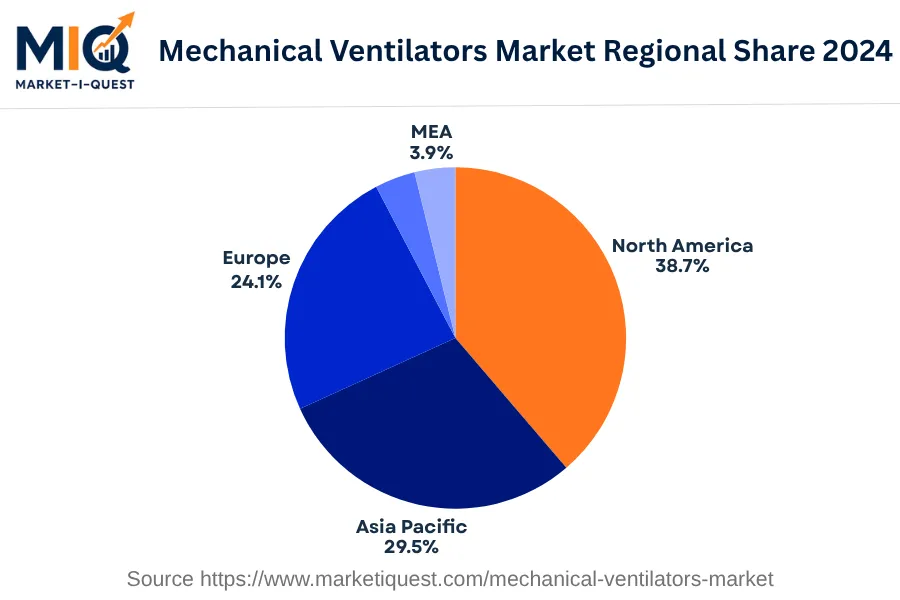
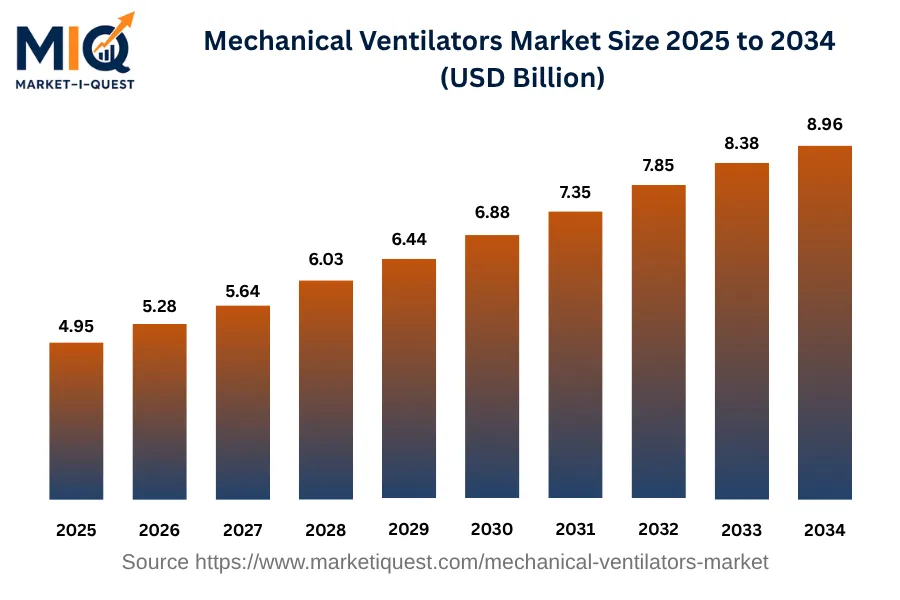
The Mechanical Ventilators Market, estimated to be worth USD 4.95 billion in 2025, is expected to grow to a size of USD 8.96 billion by 2034, exhibiting a compound annual growth rate (CAGR) of 6.82%. This market expansion traces a substantial growth path that begins with a base market value of USD 4.63 billion in the year 2024. The factors contributing to the growth of the market include increased demand for mechanical ventilators, improvements in ventilator technology, and expanded access to ventilators in emerging markets. A regional breakdown of the market share in the year 2024 reveals that North America captured the largest percentage, with a share of 38.74%. This was followed by the Asia Pacific region, which accounted for 29.46% of the market. Europe claimed the third-largest market share at 24.12%, while both Latin America and the Middle East & Africa had relatively smaller shares, at 3.82% and 3.86% respectively.

Key Takeaways

  • By Product Type - Conventional Ventilators led the market with significant share in 2025.
  • By Mode of Operation - Volume-Controlled held the major share in the market in 2025.
  • By Application - Neonatal Care grew fastest with notable trajectory in 2025.
  • By End User - Hospitals accounted for the dominant position in 2025.
mechanical-ventilators-market market size

Key Driving Factors

Implementation of the 'Emergency Use Authorization' by the FDA

The Mechanical Ventilators Market is significantly driven by the 'Emergency Use Authorization' issued by the U.S. Food & Drug Administration (FDA) in response to the COVID-19 pandemic. The authorization allows for the temporary use of medical devices that are not previously approved, to help mitigate shortages. As a result, companies not traditionally in the medical device sector have entered the market to produce mechanical ventilators, broadening market dynamics. This includes major players from the automotive and aerospace sectors. This influx creates a competitive landscape, with various designs and models being produced, thereby providing a wide array of options to healthcare providers.

Global Rise in Intensive Care Units (ICUs)

Another significant driver of the Mechanical Ventilators Market is the global increase in Intensive Care Units (ICUs) in hospitals, where mechanical ventilators are typically required. Governments and health agencies worldwide are emphasizing the need to expand their ICUs to adequately handle situations that require urgent, intensive care, such as pandemics or disasters. These ICUs are incomplete without essential equipment like mechanical ventilators necessary for patient survival, thus spurring the need for more comprehensive and advanced mechanical ventilation solutions. As more ICUs are established, the demand for mechanical ventilators climbs, therefore propelling the market forward.

Market Evolution by Timeline

2019-2023
In this period, the demand for mechanical ventilators saw an unforeseen surge due to the COVD-19 pandemic. Hospitals and ICUs were the major buyer segments, predominantly in hard-hit regions like Europe, North America and parts of Asia. The rapid implementation of emergency-use ventilators diverged from standard medical procurement models. They were less integrated due to urgency, resulting in operating limitations. Countries like the US, under the Defense Production Act, mandated domestic manufacturers increase production. Pricing saw considerable fluctuation, often rising due to demand and supply imbalance. Contract types were typically short-term, emergency procurements. Supply risks included component shortages and logistics delays due to global lockdowns.
2024
2024 marked a moderate contraction in ventilator demand in comparison to previous years, attributable to the decrease in COVID-19 cases globally. However, technological advancements in ventilators contributed to continued demand from hospitals and ERs, particularly in developing regions where healthcare infrastructure was improving. Domestic manufacturing of ventilators was also encouraged in areas previously reliant on imports, such as India under the Make in India initiative. The standard procurement models and pricing stability had been largely restored. Increasing regulations on manufacturing standards post the pandemic crisis was a pressing concern.
2025-2029
During these years, mechanical ventilators' market started witnessing routine demand cycles. Hospitals, long-term care facilities, and home healthcare became the prominent buyer segments. Supply side saw the advent of smart ventilators with AI-based features for optimized ventilator management. Supply was characterized by a mix of feature-rich and low-cost ventilators with the former more prevalent in developed regions and the latter in emerging economies. The UN's Affordable and Appropriate Ventilators program in 2026 to ensure availability of ventilators at reasonable prices globally played a significant role. Long term supply contracts and partnerships with medical device manufacturers became common.
2030-2034
In this period, non-invasive ventilators gained popularity due to their minimal risks and improved patient comfort. Technologies like telemonitoring became integrated into the ventilators to cater to the growing home healthcare sector. Buyers typically included home healthcare service providers and hospitals in developed countries. Companies started putting more emphasis on ease of operation leading to the introduction of self-adjusting ventilators. Tender-based multi-year procurements dominated this period. Despite matured production, supply disruptions due to raw material scarcity posed a significant risk. Regulatory compliance with updated ISO standards for ventilators was a critical factor influencing the market.

Future Market Outlook

Future Opportunities

The present trajectory of the mechanical ventilators market reveals numerous opportunities poised for expansion. As of 2023, ongoing technological advancements enable manufacturers to explore portable and lightweight designs, appealing to both hospital and home care settings. Collaborations between companies like ResMed and various research institutions aim to enhance patient-centered care through innovative features. For example, a partnership formed in 2022 between GSK and several hospitals focuses on developing personalized ventilation strategies, boosting the market’s adaptability for different patient populations. Moreover, an increasing emphasis on telehealth solutions has prompted companies to integrate their ventilator systems with telemedicine platforms, enhancing patient access to specialist care, particularly in rural areas of the United States. Regulatory shifts, including the recent updates by the Centers for Medicare and Medicaid Services, have broadened funding avenues for ventilator procurement in home care settings, indicating a growing acceptance of this care model. The demand for volume-control modes and improved alarm systems highlights the need for advanced clinical functionalities, suggesting that manufacturers need to invest in software improvements. As countries worldwide prepare for potential future health crises, proactive investments in mechanical ventilator technology can ensure healthcare systems are better equipped to respond effectively to surges in respiratory illness, fostering ongoing market growth through innovation and adaptability.

Segmentation Analysis

By Product Type

The market is divided into subsegments including Conventional Ventilators, Portable Ventilators, High-Frequency Ventilators, Bi-level Positive Airway Pressure (BiPAP) Ventilators, among which Conventional Ventilators accounted for the largest revenue share while Portable Ventilators is expected to grow at the fastest CAGR during the forecast period.

Largest Revenue Share

Conventional Ventilators

Market Share Leader

Conventional Ventilators secure the largest proportion of the market's revenue. This dominance is chiefly driven by their widespread adoption in the healthcare sector, particularly in hospitals and clinics. These ventilators play a critical role in management of critically ill patients who faced breathing difficulties. They have been regarded as a time-tested treatment modality due to their established efficacy and, therefore, have become virtually a standard of care in intensive care units globally. Moreover, Conventional Ventilators are marked by robustness, reliability, and suitability for long-term usage, further cementing their position as the preferred choice of healthcare professionals. Also, their usefulness in neonatology and for acute respiratory distress syndrome patients contribute to their solid standing in the market. However, it should be noted that while these ventilators generate the lion's share of revenue currently, other sub-segments are rapidly gaining ground due to technological advancement and changing healthcare paradigms.

Fastest CAGR

Portable Ventilators

Forecast Period Growth Leader

The Portable Ventilators subsegment is expected to register the highest growth rate in the forecast period. The key driver for this growth is the increasing demand for home healthcare services, especially by the geriatric population. The portability of these machines allows easy administration of respiratory therapy outside healthcare facilities, giving patients a sense of independence and freedom. Additionally, technological breakthroughs have led to the development of lighter, more compact, and smarter devices with intuitive interfaces and longer battery lifespans, making them increasingly suitable for home use. At the same time, these ventilators are portable making them essential during emergencies and transportation of critical care patients. Partnerships between ventilator manufacturers and technology companies are further expected to spur innovative solutions in this rapidly growing market. It is expected that the growth rate may encounter short-term hindrance due to the current reliance on conventional ventilators, but the long-term CAGR outlook for portable ventilators remains very promising.

By Mode of Operation

The market is divided into subsegments including Volume-Controlled, Pressure-Controlled, Dual-Controlled, Assist-Controlled. Among these, Volume-Controlled accounted for the largest revenue share while Dual-Controlled is expected to grow at the fastest CAGR during the forecast period.

Largest Revenue Share

Volume-Controlled

Market Share Leader

The Volume-Controlled subsegment leads the pack in revenue generation due to its widespread utilization across the market. The ease of operation and compatibility with a variety of applications is driving the adoption of this modality. The system typically assures a specified volume to patients, ensuring consistent treatment making it an ideal choice over others. Its design supports a large customer base, ranging from infants to adults, offering broader market coverage. Additionally, key geographical markets prioritize Volume-Controlled systems due to its proven reliability and cost-effectiveness. Regulatory bodies, noting its safety profile, have preferred this mode, adding further to its demand. The decision-making for purchasing in this segment is often driven by these factors, alongside the system's proven performance. Established supply chains and minimal switching costs also contribute to this segment's domination.

Fastest CAGR

Dual-Controlled

Forecast Period Growth Leader

The Dual-Controlled subsegment, despite not leading in revenue, poses a significant growth rate and is forecasted to enjoy the fastest compound annual growth rate. This can be attributed to its ability to adapt and provide either volume or pressure controlled breaths, adding to its appeal. Technological advancements are expected to further enhance its features, driving its adoption. The investment required for these improvements is gradually being offset through partnerships and alliances, easing the path to market. However, adoption barriers such as lack of awareness and high initial capital requirement remain. In the near-term, market narrative around these systems needs to focus on highlighting the long-term cost benefits and operational efficiencies to overcome resistance. Regulatory changes in favor of dual-mode systems are a potential catalyst paving the way for growth in this segment.

By Application

The market is divided into subsegments including Emergency Care, Chronic Respiratory Diseases, Anesthesia, and Neonatal Care. In 2024, Chronic Respiratory Diseases accounted for the largest revenue share while Neonatal Care is expected to grow at the fastest CAGR during the forecast period.

Largest Revenue Share

Chronic Respiratory Diseases

Market Share Leader

The leading revenue contributor in 2024 was the Chronic Respiratory Diseases subsegment. This is attributed to the rising prevalence of respiratory conditions such asthma and chronic obstructive pulmonary disease (COPD) globally. Increase in pollution and lifestyle changes have exacerbated these diseases, demanding more hospital admissions and thereby contributing significantly to this subsegment's revenue. Another driver is the aging population worldwide, who are more prone to respiratory issues and chronic diseases. The customer base for this subsegment is largely hospitals, which have seen an influx of patients requiring respiratory care services. The regulatory environment, which increasingly emphasizes effective and time-bound treatment of chronic diseases, and affordability of care have also supported revenue growth.

Fastest CAGR

Neonatal Care

Forecast Period Growth Leader

The subsegment exhibiting the fastest growth is Neonatal Care. Higher birth rates in developing countries, frequent preterm births, and the increasing prevalence of neonatal diseases are driving the growing need for neonatal care services. Technological advancements in neonatal care equipment, such as incubators and ventilators, offer better care for neonates and thus catalyze the subsegment's market growth. However, high equipment costs pose a barrier to adoption in low to middle income countries. Governments and companies are increasingly forming partnerships to tackle this, providing ways to cheaply manufacture or lease these expensive machines. The primary risk is potential regulation around care standards that could limit the use of certain types of equipment or mandate expensive upgrades. With increasing focus on reducing neonatal mortality rates, this is a crucial area for market growth.

By End User

The market is divided into subsegments including Hospitals, Home Care, Ambulatory Surgical Centers (ASCs), and Long-Term Care Facilities, with Hospitals accounting for the largest revenue share, while Home Care is expected to grow at the fastest CAGR during the forecast period.

Largest Revenue Share

Hospitals

Market Share Leader

Hospitals, as a subsegment, represent the highest revenue driver in our analysis for 2024. This can be largely attributed to the extensive use of specialized medical devices and consumables in hospital settings, coupled with the high admission rate of patients. Hospitals typically have a broad spectrum of specialized departments - each leveraging unique equipment and supplies, therefore, the demand is always on a high. In terms of geographical contribution, developed regions with well-established healthcare infrastructure like North America and Europe are the main contributors to this subsegment's revenue. Regulatory standards in these regions also mandate the use of advanced medical devices in hospitals, further driving demand. Another critical driving force is the purchasing criteria which pivot around 'value over cost' given the scale and magnitude of operations which necessitates reliable, efficient, and durable medical equipment.

Fastest CAGR

Home Care

Forecast Period Growth Leader

Despite contributing less to the overall revenue in the base year, the Home Care subsegment is expected to grow at the fastest rate in the forecast period. This trend is driven by numerous factors, including an aging population, increased focus on reducing healthcare costs, and advances in telemedicine and connected health technologies. The increased preference of patients for home care over hospital stays to reduce the risk of hospital-acquired infections and for the comfort and convenience of their home environment is fueling this growth. In addition, the rising prevalence of chronic diseases, which require long-term care and frequent monitoring, also contributes to the adoption of home care. On the regulatory front, health insurance providers' policies are becoming favorable for home care treatments. Despite these drivers, barriers such as the high costs of home healthcare devices and the lack of skilled professionals could be potential risks that might slow the growth rate.

Competitive Analysis

Key Market Players

Manufacturers / OEMs

Philips Healthcare
Netherlands
Medtronic
Ireland
ResMed
US

Key Suppliers & Raw Materials

Honeywell International Inc.
US
NXP Semiconductors
Netherlands
Panasonic Corporation
Japan

Distributors, Integrators & Channel Partners

Cardinal Health
US
Henry Schein Medical
US
Kohl Medical AG
Germany

Porter’s Five Forces Analysis

Analysis of the mechanical ventilators market using Porter’s Five Forces

Supplier Bargaining Power

Medium

Suppliers have moderate power due to specialized components and manufacturing standards.

Buyer Bargaining Power

Low

Buyer power is low due to the life-saving nature of mechanical ventilators and limited alternatives.

Threat of Substitutes

Low

Limited substitutes available due to regulatory hurdles and complex functionality of ventilators.

Threat of New Entrants

Low

High entry barriers due to stringent regulations, patent protection, and high capital investment.

Competitive Rivalry

High

Intense rivalry driven by technological advancements, brand reputation, and global presence of key players.

Regional Analysis

Geographic market dynamics and growth opportunities across key regions

Global Market Outlook

mechanical-ventilators-market market regional share

North America

In 2024, the North American market for mechanical ventilators was characterized by significant technological advancements and heightened demand due to the ongoing need for respiratory support devices. Key drivers included increased investment in healthcare infrastructure across the U.S., Canada, and Mexico, leading to more substantial procurement of advanced bracing devices. Regulatory policies such as the U.S. Affordable Care Act boosted accessibility and insurance coverage for ventilatory support, augmenting demand. Technological advancements in non-invasive ventilation also spurred market growth by offering a more comfortable alternative to intubation.

Trends observed in 2024 involved shifts in buying behavior, as healthcare facilities prioritized ventilators with remote patient monitoring capabilities for increased efficiency in critical care. Technological innovation was also a crucial trend, with companies like Medtronic and ResMed leading in the use of AI-based predictive analytics for ventilator settings. Government and private partnerships, such as the collaboration between Vyaire Medical and the U.S. Department of Health and Human Services, were notable for scaling production and supply. Customers included hospitals, emergency medical services, and home healthcare providers, with a particularly strong demand from the expanding segment of ICU departments treating patients with severe respiratory diseases. The mechanical ventilators market was further bolstered by increasing geriatric population and the prevalence of chronic obstructive pulmonary disease in North America.

Asia Pacific

In 2024, the Mechanical Ventilators market in Asia Pacific demonstrated considerable traction. A key driver was the increased investment in healthcare infrastructure across countries such as China, India, and Japan, leading to a surge in demand for high-end mechanical ventilators. The uptake of advanced technology in countries like South Korea and Australia similarly influenced market dynamics, with a particular emphasis on remote patient monitoring systems, thus increasing demand further. Additionally, governmental policies, like China's plan to improve its healthcare system, stimulated the market expansion.

Market Trends included a shift towards portable and Home Mechanical Ventilators, triggered by an aging demographic in Japan. The significant rise in chronic respiratory diseases across India instigated demand for non-invasive ventilation, marking another key trend. Emerging online sales channels also changed buying behavior across the Asia Pacific, supported by the increase in digital literacy and internet penetration. Industry partnerships and M&A activity in ASEAN nations, specifically to expand products and services, were noticed and shaped the market. The governments' proactive stance on adhering to international ventilatory standards can be cited as another significant trend, influencing purchasing decisions in healthcare organizations across the region. Thus, the Asia Pacific's Mechanical Ventilators market in 2024 was characterized by investment, technology adoption, governmental policies, emerging sales channels, and the application of global standards.

Europe

In 2024, the European mechanical ventilator market experienced a significant escalation due to acute respiratory diseases and an aging population. Rising incidences of chronic obstructive pulmonary disease (COPD), lung cancer, and asthma, especially in countries like the UK, Germany, and Spain, accelerated demand for advanced ventilation systems in healthcare institutions. Regulatory bodies such as the Medicines and Healthcare products Regulatory Agency (MHRA) in the UK enforced stringent rules for safety and quality, boosting investment in upgraded ventilator models. New technology adoption, particularly in Germany and France, saw the preference for portable and non-invasive ventilators increase.

Emergent buyer behavior trends showed a shift towards value-based healthcare, with Italy and Benelux leading in affordability concerns. This hailed increased usage of tele-ventilation systems, presenting an evolved path for outpatient care. Furthermore, notable M&A activities fortified market leadership; for instance, Germany-based Dräger's acquisition of medical equipment providers. Standards imposed by the European Commission mandated energy-efficient ventilators, influencing product design. While policy enforcement for healthcare equality in Central & Eastern Europe widened ventilator accessibility, it also posed supply chain challenges. The market saw government, healthcare, and manufacturing sectors as the main customer bases, with significant purchases by hospitals and homecare services. The robust medical infrastructure in the Nordics rendered them early adopters of the latest technologies.

Latin America

In 2024, the mechanical ventilator market in Latin America (LATAM) demonstrated steady growth, especially within prominently observed healthcare sectors in Brazil, Mexico, Argentina, Colombia, Chile, and Peru. Primary market drivers included increased healthcare investments, particularly in intensive care units (ICUs) and in addressing chronic obstructive pulmonary disease (COPD) prevalence. Government regulations seeking to upgrade and expand healthcare facilities also stimulated demand while technological adoption saw the incorporation of more sophisticated ventilator models improving both patient outcomes and resource management.

Trends in the LATAM mechanical ventilator market were primarily defined by changes in buyer behavior and product shifts. Buyers leaned towards ventilators with advanced monitoring systems and easy user interfaces, manifesting the product shift towards more intelligent and easy-to-use machines. Changes in channel dynamics were also observed, with online sales channels gaining market traction as healthcare providers sought streamlined purchasing processes. Furthermore, partnerships and M&A activities significantly increased, particularly in Argentina and Mexico, infusing growth dynamics into the market. On the policy front, stringent enforcement of medical equipment standards became a prominent trend, with governments across LATAM implementing stricter controls to maintain high patient safety levels.

Middle East & Africa

In 2024, the Mechanical Ventilators Market across the Middle East and Africa witnessed robust growth propelled by various factors. Regulatory interventions, especially relating to patient care and safety, necessitated greater use of mechanical ventilators across healthcare establishments in countries like Saudi Arabia, Egypt, and South Africa. In addition, increased government spending on healthcare infrastructure, particularly in the UAE, Israel, and Qatar, led to greater investment in advanced medical equipment including mechanical ventilators. Techoogical adoption took shape in Nigeria and Kenya with high demand for less invasive ventilation devices, encouraging supply dynamics towards the production of such devices. Diverse pricing strategies across countries also shaped the market landscape, with afforadability being a key consideration in price-sensitive markets.

Consumer behavior indicated a growing preference for mult-functional mechanical ventilators with advanced features and remote monitoring capability, endorsed by widespread digitalization in healthcare. Governments and healthcare institutions pushed for better ventilator standards to ensure patient safety and reduce instances of ventilator-induced lung injuries. There was a notable inclination towards operational leasing of ventilators, a trend majorly seen in Egypt and South Africa driven by concerns of high investment costs. Policy enforcement geared towards maintaining quality and performance standards saw a rise in the Middle East, with Saudi Arabia at the forefront. The region also witnessed partnerships and proactive collaboration between local and international market players to enhance product portfolios and market reach.

Recent Industry Developments

Latest market innovations, product launches, and strategic initiatives

June 2026

Draeger, Inc. received FDA 510(k) clearance for its Evita V800 ventilator software version 3.10, introducing decelerating flow during volume control ventilation with ARDSnet safeguards to better match patient demand.

December 2025

Vapotherm, Inc. announced a strategic partnership with Flight Medical Innovations Ltd. to bring the VentO2ux™ ventilator to U.S. hospitals, expanding Vapotherm's portfolio beyond high-velocity therapy devices to a broader platform of respiratory support solutions.

Frequently Asked Questions