Material Handling Equipment Telematics Market Snapshot

Key Players

  • Caterpillar Inc. (United States)
  • Komatsu Ltd. (Japan)
  • JCB Service (United Kingdom)
  • Hitachi Construction Machinery Co. Ltd. (Japan)
  • Mitsubishi Nichiyu Forklift Co. Ltd. (Japan)
  • Curtis Instruments Inc. (United States)
  • The Morey Corporation (United States)
  • Cummins Inc. (United States)
  • The Raymond Corporation (United States)

Market Size

Base Year 2024
$3.26 Bn
CAGR
12.34%
Forecast 2034
$10.44 Bn

Market Segments

By Equipment Type
Forklifts, Cranes, Automated Guided Vehicles (AGVs), Conveyors, Reach Stackers, Automated Storage & Retrieval Systems (AS/RS), Others
By Solution Type
Asset Tracking, Fleet Management, Predictive Maintenance, Remote Diagnostics, Utilization Monitoring, Safety & Compliance Management, Others
By Technology
GPS, IoT Sensors, AI-Based Predictive Systems, RFID, Cellular Communication, Cloud-Based Telematics, Others
By End-User Industry
Manufacturing, Logistics & Warehousing, Retail, Construction, Mining, Food & Beverage, Other End-Users

Market Dynamics

Drivers
  • Increasing Automation Trends
  • Rising Demand for Efficient Fleet Management
Restraints
  • High installation costs
  • Data security concerns
Opportunities
  • Increasing automation demands
  • Surge in e-commerce sector

Market Size

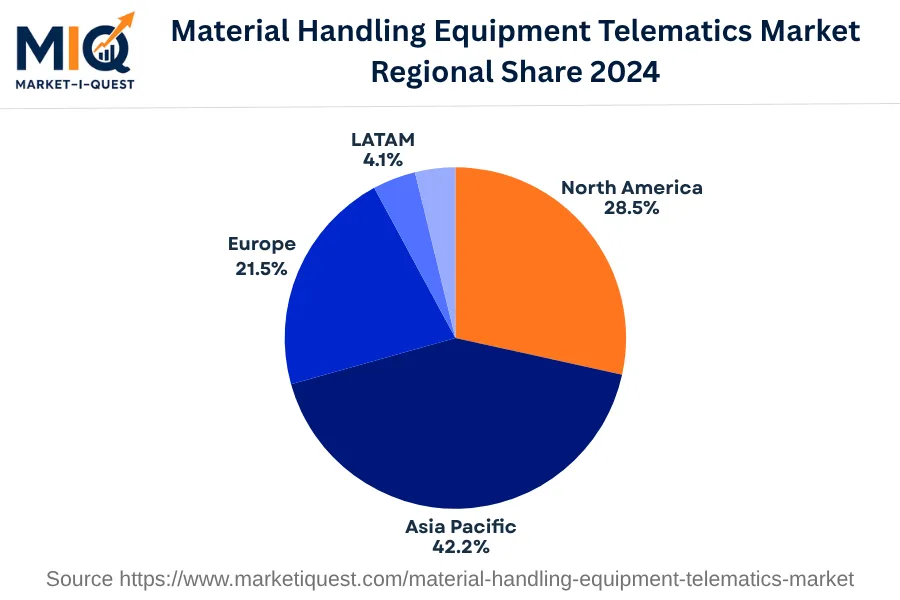
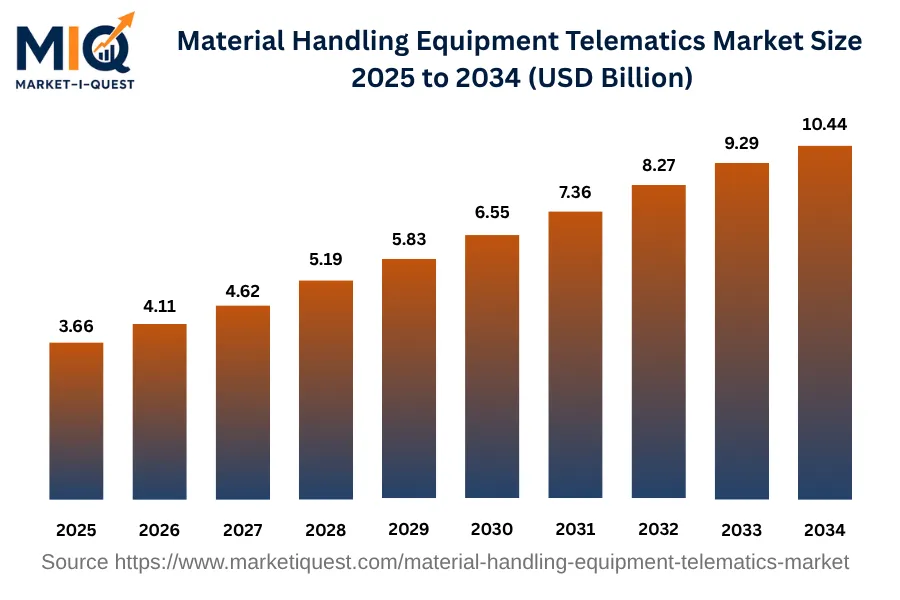
The Material Handling Equipment Telematics Market was valued at $3.66 billion in 2025 and is projected to expand reaching $10.44 billion in 2034 with a CAGR of 12.34% over the forecasted period. The market is set to follow a sizable growth path from the starting year 2025 to the year 2034. This increase in market value is due to advancements in technology enabling improved efficiency and management in material handling operations coupled with the growing demand for real-time tracking and monitoring services within industries utilizing material handling equipment. On a regional basis in 2024, the market share was disbursed with Asia Pacific holding the largest share at 42.2%, followed by North America at 28.5%, Europe at 21.5%, LATAM at 4.1%, and MEA at 3.8%.

Key Takeaways

  • By Equipment Type - Forklifts led the equipment segment in the Material Handling Equipment Telematics Market.
  • By Solution Type - Fleet Management held the leading position accounting for a significant share.
  • By Technology - Cellular Communication dominated in terms of technology utilized accounting for a substantial share.
  • By End-User Industry - Manufacturing sector led contributing to the majority market share in Market.
material-handling-equipment-telematics-market market size

Key Driving Factors

Implementation of stringent safety regulations

One driving factor is the implementation of stringent safety regulations in industries such as construction, manufacturing, and logistics. Regulatory bodies like the Occupational Safety and Health Administration (OSHA) require employers to ensure a safe and healthful workplace for their employees. These regulations necessitate safety measures like real-time tracking and monitoring systems which can be provided by telematics. Using telematics in material handling equipment helps companies to comply with these regulations as it provides operational visibility, ensures operator safety and reduces equipment damage.

Increasing need for operational efficiency in supply chain management

The increasing need for operational efficiency in supply chain management is another pronounced driver. Material handling plays a critical part in the smooth functioning of the supply chain. Telematics systems in material handling equipment provide real-time data on metrics like equipment utilization, fuel consumption, routine maintenance schedules, and more. This data aids in making informed decisions, reduces operational costs, and improves overall efficiency. E-commerce giants like Amazon and logistic companies are heavily investing in this technology to streamline their supply chains and improve their bottom-line performance.

Market Evolution by Timeline

2019-2023
In the 2019–2023 period, manufacturing industries, specifically the automotive and aerospace sectors, were the main buyer segments of material handling equipment telematics, due to the need for optimized workflow and real-time monitoring. European countries evidenced substantial growth in procurement. Noteworthy advancement in integrated telematics solutions to manage inventory and scheduling was observed. However, high implementation costs and limited technical knowledge posed challenges. A regulatory push in safety with the implementation of the EU's General Data Protection Regulation (GDPR) influenced adoption. Most contracts were typically long-term with flexible maintenance provisions. Partnerships with technology providers for advanced solutions were common among manufacturers. The risk of data breaches posed a major threat that was typically mitigated with encryption and backup solutions.
2024
By 2024, airports and warehouses largely adopted material handling equipment telematics for efficient logistics and cargo handling. The US and Asia-Pacific showed increased demand. Supply featured telematics with AI, enhancing predictive maintenance and operational efficiency. Nonetheless, data security and interoperability challenges persisted. In response, US Cybersecurity and Infrastructure Security Agency (CISA) issued guidelines on telematics use. Monthly subscription model pricing for cloud-based solutions was prevalent. Collaborations with AI technology companies amplified, contributing to innovation. Cyberattack threats heightened, catalyzing cybersecurity improvements in telematics systems.
2025-2029
The use of deep learning in telematics became more prevalent between 2025–2029, with the food and beverages industry noticeably adopting the technology for refrigerated transportation. Latin American countries also indicated interest. Some advancements in telematics were aimed towards energy efficiency, despite facing R&D funding constraints, particularly in emerging markets. Energy Efficiency Directive amendment in 2027 by EU impacted adoption in Europe. Pay-per-use commercial models were introduced. Companies frequently integrated renewable energy systems with telematics, despite limited success. Data hacking continued to pose risks with industry adopting various protective measures like multi-factor authentication for networks.
2030-2034
The period of 2030–2034 saw healthcare and pharmaceutical sectors drive demand for material handling equipment telematics for inventory matching, particularly in Middle-East and Africa. Emerging technologies like IoT and blockchain were incorporated into the supply. Still, the lack of industry-wide standards for integration raised issues. Regulatory bodies worldwide started working on harmonized safety standards for telematics. Blockchain-based smart contracts emerged, and joint ventures with blockchain technology firms became common. The introduction of IoT increased system vulnerability, amplifying focus on robust security mechanisms within telematics.

Future Market Outlook

Future Opportunities

As organizations continue to prioritize operational efficiency, the material handling equipment telematics market is poised for growth driven by increased regulation and technological advancements. In 2024, the European Commission is expected to introduce the General Data Protection Regulation (GDPR) updates that will impact data handling practices, prompting companies to adopt secure data management practices within telematics solutions. Furthermore, companies like Volvo are investing in automation technologies that rely on telematics data for improving operational workflows. The shift towards sustainable practices is evident with initiatives like the United Nations’ Sustainable Development Goals encouraging enterprises to leverage real-time insights for reducing carbon footprints. Additionally, in Asia-Pacific regions, expanding manufacturing capabilities are creating substantial demand for telematics systems. Countries like Japan and South Korea are facilitating partnerships between academia and industry to foster innovation in material handling solutions. The integration of AI and machine learning in telematics platforms is further anticipated, as evidenced by recent collaborations between Siemens and IBM, aimed at enhancing predictive analytics functionalities. This synergy is believed to open avenues for developing smarter warehouses and logistics centers. Overall, regulatory pressures, technological advancements, and sustainability goals are creating a landscape ripe for substantial opportunities in the material handling equipment telematics market.

Segmentation Analysis

By Equipment Type

The market is divided into subsegments including Forklifts, Cranes, Automated Guided Vehicles (AGVs), Conveyors, Reach Stackers, Automated Storage & Retrieval Systems (AS/RS), and Others, with Forklifts accounting for the largest revenue share, while Automated Guided Vehicles (AGVs) is expected to grow at the fastest CAGR during the forecast period.

Largest Revenue Share

Forklifts

Market Share Leader

Forklifts emerge as the leading subsegment in terms of revenue generation, and this can be attributed to a multitude of factors. The primary driver is the pivotal role that forklifts play in the workflow of any warehouse or factory. By enabling efficient transportation of heavy and bulky items within a facility, forklifts significantly improve operational productivity. In terms of geography, emerging markets show a higher propensity for forklift adoption given their pace of industrial development and the consequent need to improve efficiency in handling materials. Moreover, regulations advocating safer work environments have enforced the usage of equipment like forklifts for heavy-duty tasks in these settings, further bolstering demand. Key purchasing criteria include load capacity, fuel type, and price, which cater to varying needs of clients from diverse sectors. This widens the customer base and in turn, enhances revenue generation. High switching costs associated with operator training and maintenance also contribute to persistent use and ultimately, a sustained revenue stream for this subsegment.

Fastest CAGR

Automated Guided Vehicles (AGVs)

Forecast Period Growth Leader

Automated Guided Vehicles (AGVs) are forecasted to grow at the fastest CAGR. The primary catalyst for this rapid adoption is the rising trend of automation in industries fueled by advancements in AI and IoT technologies. The need for efficient material handling and logistics solutions in industries such as manufacturing, warehousing, and retail is driving the adoption of AGVs. They reduce labour costs, improve safety, and enhance operational efficiency, making them an attractive option for businesses. However, challenges exist in terms of high initial capex and technical complexities in integration with existing systems. Yet, partnerships are being formed between AGV manufacturers and technology companies to improve functionality, thus aiding uptake. Adoption barriers could include a lack of skilled workforce to operate and maintain AGVs and resistance from labor unions considering potential job loss. Near-term risks encompass the heavy reliance on technology, which makes these vehicles susceptible to cybersecurity threats. While these factors may slow adoption, the overall growth trajectory for AGVs remains positive.

By Solution Type

The market is divided into subsegments including Asset Tracking, Fleet Management, Predictive Maintenance, Remote Diagnostics, Utilization Monitoring, Safety & Compliance Management, and Others. Fleet Management accounts for the largest revenue share, while Predictive Maintenance is poised to grow the most rapidly during the forecast period.

Largest Revenue Share

Fleet Management

Market Share Leader

Fleet management held the largest revenue share in 2024, mainly driven by the increased adoption in commercial and logistics enterprises. As businesses optimize costs and operational efficiencies, there is a rising need for management and tracking of vehicle fleets to reduce fuel costs, ensure vehicle maintenance, improve routing and dispatching, and enhance driver management. Demand is particularly strong in regions with large logistics sectors, such as North America and Asia-Pacific, due to the substantial need for efficient transportation systems. Regulatory compliance, namely regulations pertinent to vehicle emissions and safety, is another significant driver leading to high demand for sophisticated fleet management solutions. Customer purchasing revolves largely around solution reliability, real-time tracking capabilities, and cost-effectiveness, especially as competition stiffens.

Fastest CAGR

Predictive Maintenance

Forecast Period Growth Leader

The subsegment predicted to grow the fastest is predictive maintenance, a change driven by an industry-wide transition toward proactive system management strategies. Growing recognition of the cost-saving potential of predictive over reactive maintenance is likely the main catalyst for this shift. More specifically, the ability to prevent system failures and costly downtime has become an imperative in many industries, from manufacturing and healthcare to logistics and transportation. Technology advancements, particularly in artificial intelligence and machine learning, have significantly enhanced the predictive capabilities of these solutions, further propelling adoption. Partnerships between solution providers and end-user industries are also a major growth catalyst. However, hurdles remain in the form of high initial implementation costs and the need for skilled analysts, which could slow near-term growth.

By Technology

The technology market is segmented into GPS, IoT Sensors, AI-Based Predictive Systems, RFID, Cellular Communication, Cloud-Based Telematics, and Others. In the base year 2024, Cellular Communication accounted for the largest revenue share while AI-Based Predictive Systems is expected to grow at the fastest CAGR during the forecast period.

Largest Revenue Share

Cellular Communication

Market Share Leader

The Cellular Communication dominates the technology market in terms of revenue generation. This dominance is primarily due to widespread use across different sectors such as automotive, logistics, and transportation. Its high revenue share can be attributed to the rising demand for real-time tracking and monitoring solutions for various applications, fostering the pervasive adoption of this technology. Cellular Communication enables high data transmission rates, facilitating seamless connectivity and communication necessary for modern applications. Moreover, the regulatory push towards the implementation of various safety standards across several regions has amplified its demand. This technology is indeed an integral part of telematics, IoT, and other network-reliant applications, ensuring a consistent demand and revenue growth. Therefore, the Cellular Communication segment continues to be the key revenue driver of the technology market.

Fastest CAGR

AI-Based Predictive Systems

Forecast Period Growth Leader

The subsegment expected to exhibit the fastest growth rate is the AI-Based Predictive Systems. This strong growth projection is driven by the increasing integration of AI into various business operations. These systems are being widely adopted as they offer valuable predictive insights for effective decision-making and proactive problem-solving, fundamentally transforming business operations. AI-Based Predictive Systems streamline processes, maximize efficiency, and reduce costs, providing companies with a significant competitive advantage. However, some potential barriers to adoption include high initial investment costs and data security concerns. The emergence of new technological advancements, supportive policy regulations, and strategic partnerships may serve as catalysts accelerating the adoption of AI-based predictive systems. However, the near-term risk of tech redundancy and fast-paced technological advancements can also pose challenges to the growth of this segment.

By End-User Industry

The market is divided into subsegments including Manufacturing, Logistics & Warehousing, Retail, Construction, Mining, Food & Beverage and Other End-Users. In 2024, Manufacturing accounted for the largest revenue share while the Food & Beverage subsegment is expected to grow at the fastest CAGR during the forecast period.

Largest Revenue Share

Manufacturing

Market Share Leader

The manufacturing sector commands the largest revenue share in the market given its crucial role in modern economies. Manufacturers are the backbone of global supply chains, producing the goods essential for many of the other subsegments in this analysis. Key drivers behind the manufacturing sector’s dominance include rising global consumption, ongoing technological advancements, and consistent capital investment. Regulations, particularly those related to environmental and safety standards, necessitate constant instrumentation and equipment upgrades, further driving revenue growth for suppliers. Productive assets and skilled labour underpin a high switching cost, which consolidates customer bases. Additionally, the purchasing behavior of manufacturers is both complex and substantial, lending stability to their market position. Manufacturers also operate in all geographies, reinforcing their influence. Despite potential headwinds, such as cyclical economic downturns and geopolitical uncertainties, the manufacturing sector remains paramount.

Fastest CAGR

Food & Beverage

Forecast Period Growth Leader

The Food & Beverage subsegment is the fastest growing among the entire market and is expected to record the highest CAGR. Growth in this sector is fueled by increasing population, global urbanization, a shift towards healthier eating habits, and a growing middle class with more disposable income. Regulatory changes such as more stringent food safety standards propel companies in this sector to invest in new technologies and processes. Capital expenditure in machinery, logistics, and automation solutions will undoubtedly trigger a rising growth trajectory. Partnerships with technology providers are also foreseeable, as businesses strive to enhance efficiencies and reduce costs. The near-term risks include fluctuating commodity prices and possible resistance to adopting new technologies, which could potentially hamper growth. However, the growing demand for quality processed and packaged foods is a promising sign for the expansion of this sector.

Competitive Analysis

Key Market Players

Manufacturers / OEMs

Caterpillar Inc.
US
Komatsu Ltd.
Japan
Hyster-Yale Materials Handling, Inc.
US

Key Suppliers & Raw Materials

Bosch Rexroth AG
Germany
Honeywell International Inc.
US
Siemens AG
Germany

Distributors, Integrators & Channel Partners

KION Group AG
Germany
Manitou Group
France
United Rentals, Inc.
US

Porter’s Five Forces Analysis

Analysis of the competitive intensity and attractiveness of the Material Handling Equipment Telematics market.

Supplier Bargaining Power

Medium

Moderate due to various manufacturers available yet some hold proprietary technology.

Buyer Bargaining Power

High

High due to variety of offerings and low switching costs.

Threat of Substitutes

Low

Low due to the unique benefits of telematics technology for material handling.

Threat of New Entrants

Medium

Medium due to technology development but restrained by certification and compliance barriers.

Competitive Rivalry

High

Intense due to rapidly evolving technology and existence of international brands.

Regional Analysis

Geographic market dynamics and growth opportunities across key regions

Global Market Outlook

material-handling-equipment-telematics-market market regional share

North America

In 2024, the North American market for material handling equipment telematics experienced significant growth due to various drivers and trends. The increasing emphasis on warehouse automation and advanced manufacturing techniques triggered strong demand in the United States, Canada, and Mexico. Simultaneously, government regulations around operational efficiency and safety, like the U.S. Occupational Safety and Health Administration (OSHA) guidelines, prompted the adoption of advanced telematics systems. Additionally, technology adoption grew, driven by significant investments in sectors like manufacturing, retail, and logistics for real-time tracking, fleet management, and maintenance purposes. Noticeable trends in 2024 included increased customer preference for cloud-based telematics solutions, driven by its cost-effectiveness and scalability. There was a shift towards integrating IoT into these systems to enhance data accessibility and decision-making processes. Partnerships and mergers between telematics providers and tech firms were prevalent, aiming to offer comprehensive solutions with advanced features.

Restructuring of supply chains post-pandemic led to the reformation of channel dynamics leaning towards online sales of telematics. Institutions like healthcare, utilities, and government agencies started deploying telematics for better asset management and operations. Retail giants adopted these systems for efficient intra-logistics operations, and manufacturing companies integrated them into their production lines for real-time monitoring and control, ultimately driving the North American telematics market in 2024.

Asia Pacific

In 2024, the Asia-Pacific region experienced robust growth in the Material Handling Equipment Telematics market, influenced by several key drivers and trends. Rising industrialization and increasing demand for automation in countries such as China and India spurred growth while lean manufacturing practices, especially in Japan and South Korea, necessitated the utilization of telematics in material handling. High rates of investment in infrastructure development and enhanced supply chain capabilities across the region, specifically China and key ASEAN markets, triggered the demand for more sophisticated equipment. Advancements in IoT technologies and their swift adoption in India and Australia also stimulated the market.

Changing customer behaviors favored real-time tracking and monitoring of equipment, pushing companies to incorporate telematics into their operations. Shifting product preferences were primarily towards equipment integrated with advanced technologies such as AI and machine learning. Moreover, a noticeable trend was the growth in partnerships and M&A activities in the region, with companies aiming to enhance their value proposition. In tandem with these trends, several sectors emerged as major adopters of telematics in material handling equipment. These included manufacturing—primarily automotive and pharmaceutical—as well as retail, driven by e-commerce growth and the requirement for efficient warehouse management. On the policy front, increasing regulatory pressures for workplace safety and efficiency were seen as enforcement and standard-setting gained momentum across Asia Pacific markets.

Europe

In 2024, the Material Handling Equipment Telematics market in Europe underwent significant transformations. Key drivers included escalating demand from sectors such as manufacturing and retail, motivated by advantages in operational efficiency and cost effectiveness. Regulatory policies such as Germany's Industry 4.0 also encouraged broad spectrum adoption of such telematics solutions. Moreover, investments from major economies like France and the UK further stimulated market growth. Technological adoption was accelerated by Italy and the Nordics, with solutions leveraging artificial intelligence and machine learning for intelligent product sorting and transport.

Emerging trends in 2024 revealed an increased buyer interest in telematics with comprehensive analytics for data-driven decision making. A shift towards eco-friendly solutions was observed in Spain, as driven by the “Circular Economy Strategy. Product and technology shifts saw an increased implementation of autonomous vehicles in warehouse management within Central and Eastern Europe. Partnerships and mergers were also prominent, enabling businesses in the Benelux region to scale their operations more rapidly developing a robust infrastructural network. Lastly, stricter policy enforcement in areas such as workplace safety and emission standards significantly impacted purchasing decisions of material handling equipment telematics. On the whole, the market landscape demonstrated a promising scope for further growth and innovation.

Latin America

In 2024, the Material Handling Equipment Telematics Market in Latin America experienced significant growth due to a combination of market drivers and new trends. Increased infrastructure investment in countries like Brazil and Mexico, along with modernization initiatives, propelled the demand for material handling telematics systems that offer operational efficiency and process automation. Moreover, industry-specific safety regulations and automated technology adoption in countries such as Chile and Argentina influenced the market dynamics, making telematics an essential tool within the manufacturing sector. In terms of trends, buyer behavior shifted towards the adoption of IoT-based technology in material handling equipment telematics, with a prominent rise seen in Colombia and Peru.

Companies like Columbia's Luces Electronics and Peru's Metropolis Global S.A started to emphasize digital channel dynamics and collaborative ventures to enhance product offerings. Policy enforcement around environmental impact and emissions also reshaped buyers' preferences, favoring equipment with technology that promotes energy efficiency and reduces CO2 footprint. Sectors that heavily utilized these telematics services in 2024 included manufacturing, retail, and utilities due to their need for optimized logistics and inventory management. Overall, the increased investment in technology, regional regulations, and changing buyer preferences solidified the growing presence of Material Handling Equipment Telematics in the Latin American market.

Middle East & Africa

The Material Handling Equipment Telematics Market in the Middle East and Africa in 2024 was defined by a surge in demand, enveloped by rapid technology adoption and investment. E-commerce growth, particularly in countries such as Saudi Arabia, UAE, and South Africa, contributed to an increased demand, reflecting the necessity for supply chain efficiency in retail sectors. Strict regional environmental regulations in the Gulf Cooperation Council, combined with governments' investments in smart city projects - particularly in Qatar and UAE - drove technology adoption in waste management and utilities sectors. These dynamics led to higher demand for solutions capturing real-time data on equipment, such as lift trucks.

Buyer behavior in 2024 shifted towards favoring equipment efficiency and operational safety, particularly in the oil, gas, and manufacturing sectors in Nigeria, Egypt, and Kenya. Consequently, cloud-based telematics products were under elevated demand due to their real-time diagnostics advantages. Differentiation through M&A had become a predominant strategy among market players, with a view to integrating advanced telematics in material handling equipment. Meanwhile, enforcement of International Material Handling Standards, particularly in Israel, inclined the market towards products delivering enhanced user convenience and reduced carbon emissions.

Recent Industry Developments

Latest market innovations, product launches, and strategic initiatives

April 2026

Jungheinrich and I.D. Systems signed a technology agreement to integrate I.D. Systems’ PowerFleet fleet management applications, expanding Jungheinrich’s range of digital systems for material handling equipment.

June 2025

CLARK Material Handling Company announced the official launch of CLARK SMART Telematics, a factory-installed platform with GPS tracking, real-time accident alerts, automated pre-shift inspections, remote shutdown, and direct operator messaging. Available on four popular models from July 16, 2025, the platform includes no recurring fees and a five-year service plan.

Frequently Asked Questions