Maritime Security Market Snapshot

Key Players

  • 3SI Security Systems (US)
  • Leonardo S.p.A. (Italy)
  • Northrop Grumman Corporation (US)
  • Thales Group (France)
  • Elbit Systems Ltd. (Israel)
  • Havelsan Inc. (Turkey)
  • BAE Systems (UK)
  • Rheinmetall AG (Germany)
  • Rolls-Royce Holdings (UK)

Market Size

Base Year 2024
$29.47 Bn
CAGR
8.52%
Forecast 2034
$66.75 Bn

Market Segments

By System
  • Screening & Scanning
  • Communications
  • Surveillance & Tracking
  • Access Control & Detectors
By Threats & Vulnerabilities
  • Deep Water Security
  • Perimeter Security
By Application
  • Port & Shipyard
  • Vessel Security
  • Coastal Surveillance
  • Others

Market Dynamics

Drivers
  • Increasing pirate threats
  • Heightened maritime terrorism risks
Restraints
  • High operational costs
  • Regulatory compliance complexities
Opportunities
  • Increased offshore activities
  • Advances in maritime security technology

Market Size

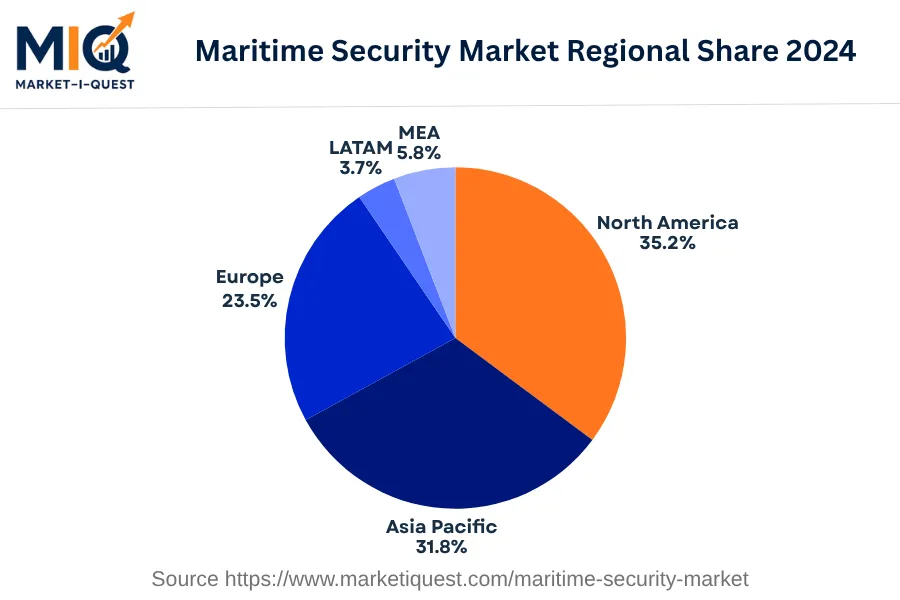
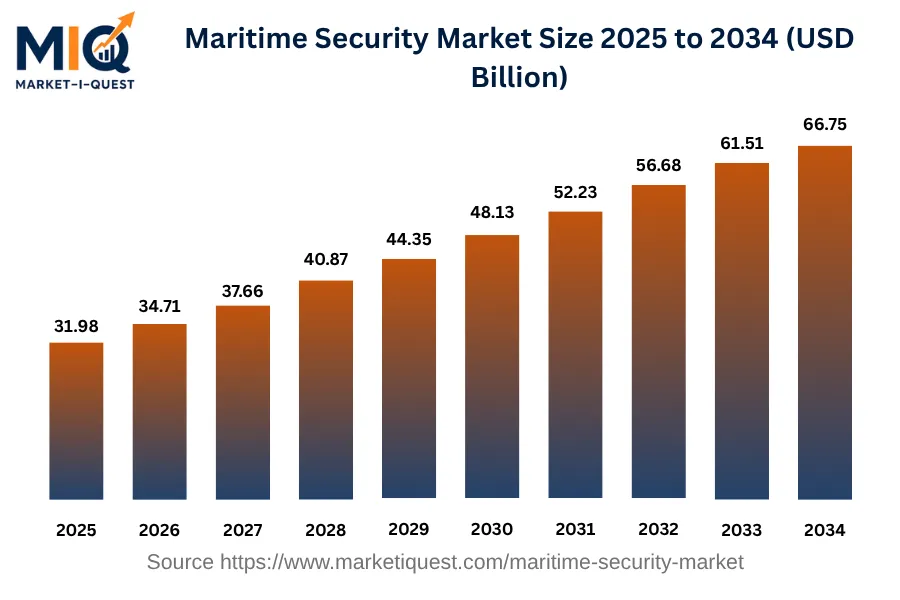
The Maritime Security Market was valued at USD 31.98 billion in 2025, and it is anticipated to reach USD 66.75 billion in 2034, demonstrating a Compound Annual Growth Rate (CAGR) of 8.52%. Over this period, the market witnessed steady growth. For instance, in 2024, the market value stood at USD 29.47 billion, showing a significant increase in 2025. The growth between 2025 and 2034 is a result of increased maritime threats, which necessitates bolstered security measures. The growing concern for safe and secure maritime trade also contributes to an increase in market size. In terms of regional distribution in 2024, North America held the most substantial share of 35.2%, followed by Asia Pacific at 31.8%, Europe at 23.5%, Middle East and Africa at 5.8%, and Latin America holding the smallest share at 3.7%. This data underscores the global scale of the Maritime Security Market.

Key Takeaways

  • By System - Surveillance & Tracking held the leading position in Market in the base year.
  • By Threats & Vulnerabilities - Perimeter Security had the highest prevalence indicating its importance in the Market.
  • By Application - Coastal Surveillance led the way occupying a key role in the Maritime Security Market during the base year.
maritime-security-market market size

Key Driving Factors

Stringent International Maritime Regulations

Enforcement of meticulous international maritime rules and standards like the International Ship and Port Facility Security (ISPS) Code is distinctly driving growth in the maritime security market. These regulations require all ocean-going vessels to strictly comply with defined security standards, ensuring they are equipped with necessary security systems and procedures. This pushes commercial shipping companies to invest in and adapt advanced security measures that align with these standards. This regulatory overlay has created a significant demand for updated security systems, surveillance equipment, and services specific to the maritime industry. In turn, this rising need is responsible for accelerating growth and adoption levels across the maritime security market.

Escalation in Piracy and Terrorist Activities

The recent upsurge in piracy and terrorist attacks at sea has intensified safety concerns in maritime transportation. Incidents involving hijacking or attacks on vessels in key trading routes or piracy hotspots like the Gulf of Aden and the Straits of Malacca are alarmingly imperative. Shipping companies, along with national and international authorities, are thus emphasizing enhancing security mechanisms to counter these threats. These real-life concerns have sparked a surge in demand for advanced security measures including state-of-the-art surveillance and detection systems, armed security personnel, and risk assessment services. The need to safeguard maritime assets and personnel from such escalating threats has, therefore, emerged as a powerful driving factor for the maritime security market.

Market Evolution by Timeline

2019-2023
In this period, buyers from Asia-Pacific region were the primary drivers of Maritime Security Market. These nations, specifically China and India, had increased maritime activities aimed at safeguarding commercial routes. This demand led suppliers to invest in radar systems and maritime patrol aircrafts. Over time, the integration between radar and camera systems matured. This convergence proved beneficial in monitoring large sea areas. Nonetheless, limited satellite coverage in the open sea was a significant constraint. Changes in maritime laws under the United Nations Convention on the Law of the Sea (UNCLOS) further influenced market dynamics. The pricing was typically based on system complexity and geography-dependent risks. Insurance companies' engagement structured contracts around shared-risk models. Although piracy posed a constant risk, militaries' increasing presence in piracy-inflicted waters helped manage the situation.
2024
By 2024, the US and European nations increased their investments in Maritime Security due to geopolitical reasons, thus diversifying buyer segments. Policies like the European Union Maritime Security Strategy (EUMSS) fueled this demand. Subsequently, the supply side introduced advanced maritime drones, aiding in better surveillance. However, the surveillance potential was restricted due to the unavailability of advanced drones in large batches. Amid this, pricing remained dynamically dependent on technology sophistication. Contract types saw a shift towards long-term agreements with equipment providers and operators, fostering partnerships. Despite risks due to geopolitical tensions, collaborations between nations helped prevent flare-ups.
2025-2029
During this phase, Middle East countries emerged as new buyer segments driven by increasing threats to oil transportation. Advancement in AI technologies shaped the supplier landscape with automatic identification systems (AIS) and unmanned surface vehicles (USV). Despite achieving high integration maturity, issues such as high costs and data security concerns acted as constraints. Policies like the Safety of Life at Sea Convention (SOLAS) encouraged broader maritime safety. In commercial aspects, a rise in performance-based contracts was noticed. Although the constant threat of unmanned vehicles being hacked raised security concerns, tech companies responded by enhancing cybersecurity measures.
2030-2034
Bloc-wide initiatives in ASEAN region increased market demand from 2030 to 2034. Suppliers mainly shipped satellite-based systems and advanced USVs with trend towards cooperation among suppliers for mass production. High costs of advanced systems and increased cyber threats continued to be a constrain. Initiatives like ASEAN's Regional Plan of Action on combating piracy and armed robbery mitigated risks. Amidst these developments, contracts with a mix of flat-fee and performance-based pricing became popular. Surmounting the risk of cyber attacks, tech companies, and governments undertook collaborative efforts to strengthen cybersecurity of maritime systems.

Future Market Outlook

Future Opportunities

The maritime security market presents numerous future opportunities driven by evolving threats and regulatory compliance demands. The implementation of the IMO's 2021 targets for reducing greenhouse gas emissions is pushing shipping companies to explore sustainable security solutions, potentially opening avenues for partnerships between traditional security firms and green technology providers. In 2023, advancements in artificial intelligence are being incorporated into surveillance systems, enabling predictive analytics that can enhance threat detection in real-time. Additionally, countries such as Australia are increasing their maritime domain awareness efforts through collaborative initiatives with private tech firms, indicating a strong future for public-private partnerships in maritime security. The growth of global trade is paralleling rising concerns over illicit activities at sea, prompting the establishment of regional task forces, such as the 2022 Gulf of Guinea Joint Maritime Task Force, that highlight the need for coordinated security efforts. Moreover, the emphasis on digital transformation and cybersecurity has led nations to invest significantly in cyber training for maritime personnel, pointing to a strong demand for educational services and platforms focusing on cyber threats. As these dynamics evolve, stakeholders in the maritime security space must remain agile, developing solutions that address both traditional threats and emerging challenges in an interconnected global maritime environment.

Segmentation Analysis

By System

The market is divided into subsegments including Screening & Scanning, Communications, Surveillance & Tracking, and Access Control & Detectors. Surveillance & Tracking accounted for the largest revenue share while Screening & Scanning is expected to grow at the fastest CAGR during the forecast period.

Largest Revenue Share

Surveillance & Tracking

Market Share Leader

The Surveillance and Tracking subsegment holds the largest market share thanks to its irreplaceable benefits and wide application choices. With advances in technology, surveillance and tracking systems have become a critical component within industries for protecting valuable resources, both in terms of assets and manpower. These applications range from low-level security necessities to complex, high-end security management. Key drivers include increasing safety concerns to prevent incidents such as illegal activities and terrorism which escalate the need for advanced surveillance systems. Surveillance system's applicability in public safety, traffic management, and asset tracking also boosts demand. Moving further, location-based tracking services for goods transportation are gaining traction, ensuring product security and quality control, bringing it higher use cases. Lastly, the government sector also brings substantial revenue, given the use of tracking systems for border security and policing. As various industries realize the benefits and value of high-quality surveillance and tracking systems, demand is expected to continue to grow.

Fastest CAGR

Screening & Scanning

Forecast Period Growth Leader

Screening and Scanning is pinpointed as the fastest-growing subsegment. Key growth drivers include the rise in technological advancements and increased purchasing power, leading consumers to transition from outdated manual processes to automated scanning systems. Along with convenience, these systems also provide improved efficiency and accuracy, contributing to their high adoption rate. However, high initial capital expenditure and maintenance costs may impede growth, although the continued evolution of technology drives down such constraints in the long run. In the near term, partnerships with tech stalwarts will additionally provide a substantial impetus to the growth of this subsegment. With the globalization of commerce and travel, security screenings at transit points are becoming more stringent, necessitating efficient and accurate scanning solutions. However, potential risks could arise from data privacy and protection issues that need careful consideration and adequate precautionary measures.

By Threats & Vulnerabilities

The market is divided into subsegments including Deep Water Security and Perimeter Security. As of 2024, Perimeter Security accounted for the largest revenue share while Deep Water Security is projected to grow at the fastest CAGR during the forecast period.

Largest Revenue Share

Perimeter Security

Market Share Leader

Known for its scalability and the broad range of threats it can thwart, Perimeter Security consequently takes the lion's share of the market. This subsegment is driven by a growing need to prevent unauthorized access and incidents across both public and private sectors. The booming demand in high-risk industries including military facilities, commercial spaces, and Government buildings is fueling the market's growth. Additionally, the integration of advanced technologies such as facial recognition and AI further bolsters the market. High preference for this technology can be associated with increasing safety concerns, coupled with regulatory mandates on the implementation of security measures in various sectors across the globe. Once consumers integrate Perimeter Security solutions, their high switching costs have a stagnation effect, thereby helping this subsegment maintain its revenue dominance.

Fastest CAGR

Deep Water Security

Forecast Period Growth Leader

Despite being a smaller portion of the market in 2024, the Deep Water Security sector is expected to demonstrate the fastest CAGR in the subsequent years. This subsegment is largely driven by the increasing threat of underwater intrusions and the rising importance of maritime security across naval forces worldwide. Technological advancements, such as the improvement of sonar systems and underwater drones, serve as catalysts for fast-paced growth, improving the effectiveness and efficiency of Deep Water Security solutions. However, the high capital expenditure could impede rapid adoption across all geographies. Nevertheless, potential strategic partnerships between tech and defence companies could offset this barrier, ultimately spurring the growth rate of this subsegment. Still, near-term volatility in defense budgets, particularly in developing economies, poses a risk to this otherwise robust growth outlook.

By Application

The Application-based market is fragmented between sub-segments including Port & Shipyard, Vessel Security, Coastal Surveillance, and others, with Coastal Surveillance claiming the largest revenue share, whereas Vessel Security is projected to experience the most rapid growth.

Largest Revenue Share

Coastal Surveillance

Market Share Leader

Coastal Surveillance stands at the forefront of the market in terms of revenue, primarily due to the critical role it plays in maintaining maritime security. Coastal surveillance caters to the necessity of monitoring and mitigating illicit activity at the borders, such as smuggling, human trafficking, and illegal fishing, which constitutes a high share of market revenue. Given the stringent regulations and the need for national security across geographically strategic regions and trade routes, the demand for advanced coastal surveillance systems is ever-persistent. It is also driven by the need for situational awareness during extreme weather events and natural disasters, thus necessitating effective coastal surveillance. Continued purchasing by government entities globally, due to the high switching costs associated with national security and the intricate regulatory environment, also contributes to the significant revenue share.

Fastest CAGR

Vessel Security

Forecast Period Growth Leader

Vessel Security, on the other hand, is expected to be the fastest-growing segment. Continuous advancements in technology and the increasing need for advanced security measures on commercial and defense vessels are acting as prime catalysts for this growth. As maritime commerce continues to expand, it brings along a host of security challenges that comprise both physical and digital threats. In response, vessel operators are investing heavily in robust, sophisticated security systems, driving adoption rates and segment growth. Further driving this growth is the increase in partnerships between security tech companies and vessel operators, as well as proactive regulations from maritime authorities demanding enhanced safety protocols on-board. However, the high initial capex and complexities in integration could pose short-term obstacles to faster adoption.

Competitive Analysis for Maritime Security Market

Key Market Players

Manufacturers / OEMs

Thales Group
France
Northrop Grumman Corporation
US
Elbit Systems Ltd.
Israel

Key Suppliers & Raw Materials

Raytheon Company
US
Kongsberg Gruppen
Norway
Fuji Electric Co. Ltd.
Japan

Distributors, Integrators & Channel Partners

Harris Corporation
US
Signalis GmbH
Germany
Indra Sistemas S.A.
Spain

Porter’s Five Forces Analysis

A comprehensive analysis of the Maritime Security Market using Porter's Five Forces Model.

Supplier Bargaining Power

Medium

Suppliers are specialized organizations and governments, limiting the room for price negotiation.

Buyer Bargaining Power

Low

Buyers, mainly governments and shipping firms, have limited alternatives due to specific security requirements.

Threat of Substitutes

Low

Land-based security services and technologies do not offer comprehensive alternatives to maritime security.

Threat of New Entrants

Medium

Regulatory compliance and high capital investments act as entry barriers, yet the market remains attractive for well-funded entrants.

Competitive Rivalry

High

Fierce competition among existing players to provide unique, advanced maritime security solutions.

Regional Analysis

Geographic market dynamics and growth opportunities across key regions

Global Market Outlook

maritime-security-market market regional share

North America

In 2024, the North American Maritime Security Market was largely dictated by rising geopolitical tensions, advancements in technology, and increased cargo trade. Increased demand was fuelled by complex geopolitical dynamics across the globe, leading to a boost in U.S., Canadian and Mexican naval budgets, speeding up equipment upgrades and dedicating more resources to maritime safety. The rapid adoption of technologies designed to enhance maritime security, including advanced surveillance systems and IoT applications, also played a critical role. Significant investment flowed in bolstering port infrastructure against potential risks, further stimulating the market.

Concurrent trends shaping this market included soaring end-user expectations for enhanced maritime surveillance, automation, and integrated solutions. This has been especially evident in sectors such as manufacturing, logistics, and government entities that depend heavily on maritime trade. Driven largely by the desire for robust and secure trade activities, governments across the U.S., Canada, and Mexico, as well as large-scale enterprises, have shown increased interest in sophisticated surveillance systems and multifunction naval platforms. Partnerships and M&A activities were on the rise, with industry leaders aiming to expand their presence and technological prowess in the market. The enforcement of international maritime policies, such as the International Ship and Port Facility Security (ISPS) code, had a significant impact on market dynamics, pushing for stricter security measures and accelerated technology adoption.

Asia Pacific

In 2024, Asia Pacific's Maritime Security Market was defined by distinct dynamics and trends spanning across key regional markets. Drivers of the market included the escalating shipping activities in China and India, igniting demand for enhanced maritime security. Australia's stringent maritime regulations and South Korea's substantial investment in naval defense technology also influenced the market movement positively, as did Japan's evolving supply-chain infrastructure necessitating robust maritime security solutions. Market trends were shaped by shifts towards advanced technology applications. For instance, the increased adoption of Artificial Intelligence in maritime surveillance in China and Australia became prominent. Channel dynamics saw a surge in direct-to-consumer technology distribution in India, enhancing access to advanced security solutions. The consolidation of major players in the sector was seen in key ASEAN markets through strategic partnerships and M&As, strengthening their capacities to deliver premium security services.

Customers were majorly drawn from the government, logistics, and retail sectors, with emphasis on Japan's retail giants and ASEAN's burgeoning ecommerce industry demanding increased maritime security. Clear policy enforcement was evident with India's Sagarmala Initiative promoting port-led development. Transpiring concurrently, innovations in surveillance technology resonated across sectors in South Korea, substantiating the comprehensive dynamism of the 2024 Maritime Security Market in the Asia Pacific region.

Europe

In 2024, the European Maritime Security Market experienced remarkable activities driven by various factors and trends. Increased geopolitical tension, stringent regulatory frameworks like SOLAS, IMO and ISPS, and growing investments in upgraded infrastructures, especially from naval defence sectors in Germany, the UK, France, and Italy propelled market expansion. Further, the adoption of advanced technology, including AI and IoT for maritime surveillance, heightened security concerns around Eastern and Central Europe’s waterways, and shifts in supply dynamics due to Brexit negotiations profoundly impacted the market.

Significant trends in the sector included a rise in buyer preference for integrated and autonomous maritime security systems, dominated by government, enterprise, and utility customers. A clear shift towards digital transformation and AI-based predictive analytics in the UK, Germany, and France reshaped the product and technological landscape, with Spain and Italy quick in following. Changes in channel dynamics were evident with industries prioritizing online platforms for procurement amid Covid-19 precautions. Aggressive strategic partnerships and M&A activities were evident among leading companies to enhance their market reach and capabilities. Enforcement of stricter maritime security policies like the EU's Integrated Maritime Policy kept the market under check, stimulating players to invest more in technology and process upgradation.

Latin America

In 2024, the Maritime Security Market in Latin America (LATAM), including key markets like Brazil, Mexico, Argentina, Colombia, Chile, and Peru, was characterized by an increased focus on safeguarding maritime assets and addressing emerging threats. Security measures heightened as a result of escalating piracy incidents, illegal trafficking, and territorial conflicts, primarily driving market growth. The adoption of advanced surveillance and detection technologies by maritime authorities and commercial entities escalated. Increasing investments towards port infrastructure development and vessel modernization, coupled with stringent government policies, facilitated market expansion. However, regional pricing challenges resulted from an interplay of varied cost structures across the LATAM region.

Market trends were influenced by digitized practices. An inclination towards adopting Artificial Intelligence (AI) and Internet of Things (IoT) solutions in the maritime security apparatus was observed. Given the significant increase in cyberattacks, cybersecurity found a central role in maritime security strategies. There was a surge in partnerships and M&A activities among defense enterprises and tech firms, aiming at integrated, technologically advanced security solutions. Notably, emphasis on compliance with the International Ship and Port Facility Security (ISPS) Code, enforced by the International Maritime Organization (IMO), prevailed across the sector. Significant market sectors included government maritime agencies, port authorities, shipping companies, and offshore oil and gas enterprises. A flourished e-commerce sector led to a boom in the retail industry, mandating robust security measures.
Middle East & Africa

In 2024, the Maritime Security Market in the Middle East and Africa continued to thrive due to intensified geopolitical tensions and augmenting trade volumes. Drivers included the surge in investment by governments such as Saudi Arabia, United Arab Emirates, and Israel in advanced maritime security technologies, fueled by increasing threats to the coastal and offshore assets. Enhanced regulatory frameworks across the region also prompted higher compliance with maritime security standards, boosting industry growth. Additionally, the rising oil and gas exploration activities in areas like Nigeria and Egypt necessitated robust maritime security, amplifying market momentum.

Trends reflected a shift towards automation and AI to enhance maritime security operations across the region. Increased adoption of integrated security systems was evident in South Africa and UAE, offering enhanced surveillance and threat response capabilities. The emphasis on public-private partnerships became noticeable, with countries like Qatar entering agreements with private firms to bolster maritime defenses. Furthermore, the enforcement of strict anti-piracy policies in the Gulf of Aden displayed governments' commitment to secure maritime boundaries. Key customers included the public sector primarily, followed by the oil and gas industry and logistics providers who saw increased need for such services. The market's health demonstrated the crucial role of maritime security in these regions' socioeconomic stability.

Recent Industry Developments

Latest market innovations, product launches, and strategic initiatives

June 2026

Lloyd's launched a new marine war risk consortium to provide additional insurance capacity for vessels and cargo transiting the Strait of Hormuz. The consortium provides up to $200 million** of capacity separately for hull and P&I risks, with an additional **$200 million of dedicated cargo capacity.

March 2026

German arms manufacturer Rheinmetall completed the takeover of Naval Vessels Lürssen (NVL), establishing a dedicated German systems house for developing and manufacturing navy and coastguard vessels, as well as maritime autonomous surface systems.

Frequently Asked Questions