Marine Lubricants Market Snapshot

Key Players

  • Total SA (France)
  • ExxonMobil (United States)
  • Royal Dutch Shell (Netherlands)
  • British Petroleum (United Kingdom)
  • Chevron Corporation (United States)
  • Sinopec Corporation (China)
  • Lukoil (Russia)
  • Idemitsu Kosan (Japan)
  • Gulf Oil Marine (Hong Kong)
  • Petroliam Nasional Berhad (Malaysia)

Market Size

Base Year 2024
$8.93 Bn
CAGR
4.71%
Forecast 2034
$14.15 Bn

Market Segments

By Base Oil Type
Mineral Oils, Synthetic Oils, Bio-Based Oils
By Vessel Type
Commercial Vessels, Passenger Vessels, Military Vessels, Recreational Vessels
By Performance Characteristics
Anti-Wear, Anti-Corrosion, Anti-Oxidation, Detergency, Dispersancy
By Additives
Anti-Foaming Agents, Anti-Scuffing Agents, Viscosity Index Improvers, Corrosion Inhibitors, Detergents
By Application
Engine Oils, Gear Oils, Hydraulic Oils, Greases, Others

Market Dynamics

Drivers
  • Rising maritime trade activities
  • Increasing marine vessel longevity
Restraints
  • Regulatory compliance hurdles
  • Environmental concerns
Opportunities
  • Rising aquatic transportation
  • Expansion in offshore activities

Market Size

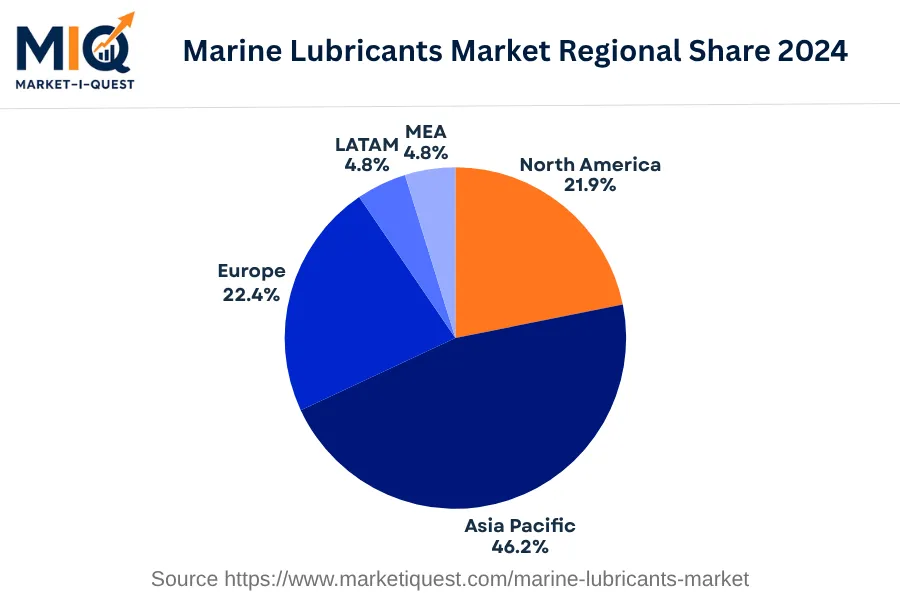
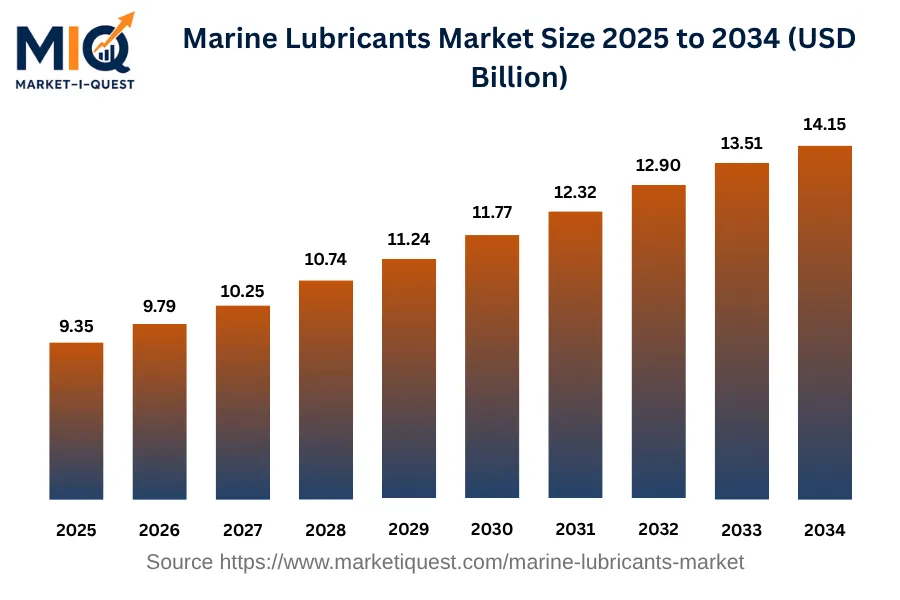
The Marine Lubricants Market is anticipated to be at USD 9.35 billion in 2025, from its previous USD 8.93 billion value in 2024. By 2034, the market is projected to grow to USD 14.15 billion, demonstrating a CAGR of 4.71%. This growth is fueled by several factors. A gradual yet constant increase in the market capacity over these years illustrates a steady growth path. In terms of the global share in 2024, the Asia Pacific holds the major fraction, at 46.18%, followed by Europe and North America, owning 22.43% and 21.86% respectively. On the other hand, the Middle East & Africa (MEA) and Latin America (LATAM) regions accounted for 4.77% and 4.76% respectively of the overall Marine Lubricants Market.

Key Takeaways

  • By Base Oil Type - Mineral Oils held the leading position showcasing pronounced usage in the industry.
  • By Vessel Type - Commercial Vessels stood out making up a substantial section of the marine operations.
  • By Performance Characteristics -Anti-Wear took up the majority showcasing the high importance.
  • By Additives - Viscosity Index Improvers expanded at an impressive rate.
  • By Application - Engine Oils marked the predominance accounting for the highest usage in marine engines.
marine-lubricants-market market size

Key Driving Factors

Strict Environmental Regulations

In recent years, the International Maritime Organization has passed stringent environmental restrictions, enforcing the reduction of sulphur emissions from marine vessels. This has pressured shipping companies to change their method of operation, pushing them into adopting low-sulphur fuels. The transition to these low-sulphur fuels demands the usage of different types of lubricants which can work efficiently with this new type of fuel. The traditional high-sulphur fuel compatible lubricants cannot perform optimally with these new fuel types due to their different combustion characteristics. Thus, driving the demand for new varieties of marine lubricants.

Increase in Seaborne Trade

The recent rise in seaborne trade activities globally is fueling the demand for marine lubricants. More vessels participating in the shipping industry equates to more machinery in operation. The consumption of marine lubricants is directly linked to the operation of these waterborne vessels. As international trade and global supply chain activities expand, there is increased need for efficient cargo transportation over marine routes. The rise in seaborne trade, therefore, pushes marine operators to use more fuel and lubricants to maintain operations, thus driving the marine lubricants market.

Market Evolution by Timeline

2019-2023
During this time, the marine lubricants market saw traction primarily from commercial ship operators in regions like Asia Pacific, with China leading the demand. The driving factors were naval expansions and increased trade activities. However, technology-related constraints like inefficient waste management systems were prevalent. The ISO 8217 standards influenced adoption, requiring lower sulfur content in marine fuels. Pricing was mostly contract-based, with large oil companies forming partnerships to fulfill demand.
2024
In this year, the supply side was strengthened as companies introduced eco-friendly lubricants to comply with the new IMO 2020 emissions standards. The demand was high in North America due to an increased emphasis on environment-friendly practices. The switch to low sulfur marine lubricants also led to an increase in prices. Major partnerships took place between oil companies and shipping firms to maximize coverage. However, the primary concern remained the handling and discharging of lubricant wastes into the ocean, a problem confronting ship owners worldwide.
2025-2029
During this period, the marine lubricants market will likely be dominated by the European region due to rapid growth in cargo transportation and naval activities. Additionally, with bio-based marine lubricants making their market entry, a shift is expected to witness from synthetic to bio-based solutions. These will likely be driven by strict EU regulation on marine pollution and hazardous substances. Most deals are expected to be in the form of long-term contracts with prices steadily rising due to increasing research and development costs.
2030-2034
This time period is expected to witness expanded market for marine lubricants in the Middle East and Africa, due to reviving shipping activities after political unrest. The market will likely be well-integrated, offering greener and more efficient technologies like organic lubricants. Regulations might become stricter with IMO2020 further enhancing sulfur limit rules. Direct partnerships between vessel operators and lubricant manufacturers will likely become common, ensuring a fixed supply of products. However, the adaptation to changes in regulations and lubricant compositions presented a challenge to all players, demanding advanced technical capabilities.

Future Market Outlook

Future Opportunities

With increasing environmental regulations shaping the marine lubricants market, numerous pathways for future opportunities are emerging. The global push towards sustainability is evident, as evidenced by the European Union’s Green Deal established aiming to achieve climate-neutral shipping by 2050. This initiative has prompted marine lubricant manufacturers to enhance their product offerings with eco-friendly options, which are expected to gain traction among ship owners and operators focused on compliance. Collaborations among industry stakeholders are already taking shape, as seen with a partnership initiated between a leading lubricant company and several shipping conglomerates to pilot bio-lubricants that meet new eco-regulations. Furthermore, the rise in digital transformation within the marine sector, driven by Industry 4.0 principles, opens up opportunities for predictive maintenance solutions that utilize advanced lubrication systems, improving overall vessel performance while optimizing lubricant usage. Additionally, as the maritime industry increasingly shifts towards electrification, the demand for specialized lubricants for hybrid and electric vessels is anticipated to grow. In countries such as Norway, where electric ferries operate under stringent efficiency mandates, lubricant innovation will play a critical role in enhancing energy efficiency and system longevity. Emerging markets in Asia and Africa are also poised for development, as countries look to upgrade their maritime infrastructure, offering a growing market for advanced marine lubricants that meet evolving performance and regulatory needs.

Segmentation Analysis

By Base Oil Type

The market is divided into subsegments including Mineral Oils, Synthetic Oils, and Bio-Based Oils. Mineral Oils accounted for the largest revenue share while Bio-Based Oils are expected to grow at the fastest CAGR during the forecast period.

Largest Revenue Share

Mineral Oils

Market Share Leader

Mineral Oils lead the base oil market in revenue. Mineral Oils are long-established in the industry and have a wide range of applications from automotive to industrial machinery, accounting for a significant portion of the market. The global reach and extensive use of mineral oil products, coupled with the economies of scale that manufacturers gain, contribute to their dominance. In addition, mineral oils are tolerant of a wide range of operating conditions, including high temperatures and pressures. However, it's worth noting that this market stance may be challenged due to the increasing environmental concerns and stringent regulations favoring cleaner, more sustainable alternatives.

Fastest CAGR

Bio-Based Oils

Forecast Period Growth Leader

Bio-Based Oils are forecasted to grow at the fastest rate in the base oil market. This growth is propelled by increasing environmental consciousness, shifting market preferences, and tightening regulations favoring more sustainable products on a global scale. Bio-Based Oils offer a lower environmental impact, as they are biodegradable and often produced through sustainable methods. They also potentially offer enhanced performance, such as superior lubricity and higher flash points. To expedite their adoption, advancements in bio-refinery technologies, strategic partnerships ushering in the scale-up of bio-based oil production capacity, and favorable policy measures are seen as necessary catalysts.

By Vessel Type

The vessel submarket can be understood by dissecting it into Commercial Vessels, Passenger Vessels, Military Vessels, and Recreational Vessels. In 2024, Commercial Vessels held the highest revenue while Military Vessels are projected to witness the most rapid growth rate.

Largest Revenue Share

Commercial Vessels

Market Share Leader

Commercial Vessels significantly outperforms the revenue of other subsegments in the vessel market. This is mainly because of their critical role in the global economy. They are the backbone of international trade, shipping billions of dollars worth of goods across the world. Key factors that contribute to their lead in revenue include a high-volume demand for transporting goods, the vastness of seaborne trade, and economies of scale achieved by deploying large vessels for bulk transport. Commercial vessels cater to various industries such as oil and gas, mining, and retail, thereby diversifying their customer base and broadening the revenue pool. Moreover, their utility in developing economies, where they serve as a crucial link to global trade networks, further accentuates their importance. Initiatives and agreements promoting global trade, coupled with the liberalisation of emerging economies, also stimulate the market growth of commercial vessels. Lastly, the replacement or retrofitting of older vessels drives demand and consequently the revenue growth.

Fastest CAGR

Military Vessels

Forecast Period Growth Leader

Military vessels are expected to grow at the fastest rate. This growth is driven largely by rising global tensions, the race for naval superiority, and the continuous technological upgrades in naval warfare. Governments worldwide invest heavily in naval forces as they represent a significant part of strategic defense initiatives. Thus, the procurement of advanced and efficient military vessels is increasingly becoming a priority for many nations. Additionally, the shifting focus towards unmanned naval systems is likely to provide new growth opportunities. There is a clear need for strategic partnerships and collaboration between governments and private shipbuilding companies to manage these challenges and further boost the uptake and growth of the military vessels subsegment.

By Performance Characteristics

The Performance Characteristics market can be parsed into subsegments including Anti-Wear, Anti-Corrosion, Anti-Oxidation, Detergency, and Dispersancy. Among these, Anti-Wear accounted for the largest revenue share, while the Anti-Oxidation subsegment is expected to grow at the fastest CAGR during the forecast period.

Largest Revenue Share

Anti-Wear

Market Share Leader

The Anti-Wear subsegment outperforms the rest in terms of revenue. This dominance can be traced back to the universal requirement for prolonging equipment lifespan and integrity, driving the demand for anti-wear solutions across a range of industries. Predominantly, industries such as automotive, aviation, and manufacturing are noted for their substantial utilization of anti-wear additives due to the enormous cost implications associated with machinery wear and tear. Geographically, regions with a significant industrial manufacturing base, like North America and Asia, contribute massively to this segment's revenue. Regulatory standards mandating the prevention of unnecessary equipment degradation in many of these industries serve to further amplify demand. The critical purchasing criteria for these solutions involve their effectiveness in wear prevention, cost, and compliance with environmental regulations, reinforcing the revenue pull in the Anti-Wear subsegment.

Fastest CAGR

Anti-Oxidation

Forecast Period Growth Leader

The Anti-Oxidation subsegment is pegged to register the highest growth rate. A prominent driver is the increasing need for effective oxidation control to enhance equipment lifespan across various industries. Additional external catalysts propelling growth include rapid advancements in technology, leading to the development of more effective anti-oxidation solutions. The adoption of these solutions is not without challenges, primarily the higher initial cost. Policy initiatives promoting the use of anti-oxidants, especially in regions with stringent environmental and industrial safety regulations, also play a vital role in influencing the growth in this segment. On balance, the pace of growth in this segment is susceptible to the influence of global economic conditions and their impact on industrial production and investment.

By Additives

The market is divided into subsegments including Anti-Foaming Agents, Anti-Scuffing Agents, Viscosity Index Improvers, Corrosion Inhibitors, and Detergents, with Viscosity Index Improvers accounting for the largest revenue share and Anti-Scuffing Agents expected to grow at the fastest CAGR during the forecast period.

Largest Revenue Share

Viscosity Index Improvers

Market Share Leader

The Viscosity Index Improvers subsegment leads the market in terms of revenue due to its importance in maintaining the consistency and efficiency of engine oils and lubricants across myriad industries. These additives play an important role in ensuring the viscosity of the oil doesn't fluctuate too widely with temperature changes, preventing wear and tear, and improving the overall lifespan of machinery. The increasing demands from automotive and industrial sectors, especially in developing regions like Asia-Pacific, are further driving the growth in this segment. Preference for high-grade lubricants in these sectors directly translates to an increased demand for viscosity index improvers. Regulatory bodies emphasize improving energy efficiency and reducing emissions, thus encouraging the use of these additives.

Fastest CAGR

Anti-Scuffing Agents

Forecast Period Growth Leader

The Anti-Scuffing Agents subsegment is projected to be the fastest-growing part of the additives market. Primary drivers of the growth are the increasing demands from the manufacturing industry and the continually evolving requirements of higher-performing engines. These agents are crucial in preventing metal surfaces in machinery from rubbing together and reducing the chances of engine seizure, which directly contributes to extending equipment life and reducing operational costs. Catalysts for growth are likely to include technological innovations aimed at improving the performance and cost-effectiveness of these agents, strategic partnerships among major players, and policy changes favoring the adoption of additives that improve machine efficiency and lifespan.

By Application

The market of Application can be subcategorized into Engine Oils, Gear Oils, Hydraulic Oils, Greases, and Others. Among these, Engine Oils generate the largest revenue, while Gear Oils are expected to experience the fastest growth in terms of Compound Annual Growth Rate (CAGR) during the forecast period.

Largest Revenue Share

Engine Oils

Market Share Leader

Engine Oils hold the largest share in terms of revenue for the 2024 base year. The primary reason for this dominance is the product's indispensable usage in various transport and industrial machinery sectors, acting as a lubricant. It mitigates friction, reduces wear and tear, and extends the life and efficiency of engines, making it a vital component. Consumer demand for better fuel economy and prolonged engine life is driving the demand for high-quality engine oils. Other key factors include the steady increase in vehicle ownership, commercial fleets, and growth in the industrial sector. Additionally, stringent emission norms across many countries encourage the use of high-grade engine oils, supporting the segment's revenue generation. Also, the regular oil change norms, along with the specific usage of engine oils in heavy-duty vehicles, boats, and motorcycles, further assure a steady revenue stream.

Fastest CAGR

Gear Oils

Forecast Period Growth Leader

Gear Oils are projected to grow at the quickest CAGR. Several factors contribute to their rapid adoption. Firstly, the increased use of gear systems in industrial operations and vehicles necessitates the use of gear oils, contributing to its increased market demand. Technological advancements in gear systems that require specialized oils for optimal operation serve as catalysts for this subsegment's growth. Capital investment in industries such as manufacturing, mining, and construction, where gear systems are used immensely, is also driving the growth. The main obstacles for this segment could be the high costs associated with the development and manufacturing of these specialized oils and fluctuating raw material prices.

Competitive Analysis

Key Market Players

Manufacturers / OEMs

ExxonMobil
US
Chevron
US
Total SA
France

Key Suppliers & Raw Materials

BP Plc
UK
Royal Dutch Shell Plc.
Netherlands
Sinopec
China

Distributors, Integrators & Channel Partners

Gulf Oil Marine Ltd.
Hong Kong
Valvoline Inc.
US
Eni SpA
Italy

Porter’s Five Forces Analysis

The following assessment focuses on competitive dynamics affecting the Marine Lubricants Market.

Supplier Bargaining Power

Medium

Limited number of suppliers and presence of specialized lubricant manufacturers moderate supplier power.

Buyer Bargaining Power

Low

High switching costs and lack of alternatives limit buyer bargaining power.

Threat of Substitutes

Low

Low threat due to the specific technological requirements of marine engines.

Threat of New Entrants

Low

High capital costs, complex technology, and rigorous regulations inhibit new entrants.

Competitive Rivalry

High

Intense rivalry due to the presence of numerous global and regional players.

Regional Analysis

Geographic market dynamics and growth opportunities across key regions

Global Market Outlook

marine-lubricants-market market regional share

North America

In 2024, the North American Marine Lubricants Market was driven by a confluence of industry demands, regulatory measures, technological advances, and pricing dynamics. Notably, the U.S., Canada, and Mexico saw heightened demand in marine transportation, shipping, and fishing sectors, compelling a shift towards superior marine lubricants, subsequently invigorating market growth. Environmental regulations, particularly the measures enacted by the U.S. Environmental Protection Agency (EPA), spurred investments in the development and adoption of biodegradable and water-resistant lubricants.

In terms of trends, the heightened focus on sustainable operations was markedly visible, with companies leveraging advancements in lubricant technology to reduce environmental impact. The use of digital platforms for sales and support also marked a significant change in buyer behavior. Lastly, a noticeable trend was consolidation via strategic mergers and acquisitions, and partnerships to enhance supply chain efficiency and meet stringent environmental standards. For instance, key market players like ExxonMobil and Chevron delved into partnerships with local suppliers to circumvent traditional logistical challenges.

In summary, the North American Marine Lubricants Market in 2024 was propelled by environmental concerns, technology adoption, market consolidation, and the evolving needs of marine-based sectors such as transportation, shipping, and fishing.
Asia Pacific

In 2024, the marine lubricants market in the Asia Pacific region experienced robust activity. High drivers of demand can be traced back to amplified shipping activities in key nations, including China, India, Japan, and South Korea. China's Belt and Road Initiative significantly bolstered trade routes across the region, thereby impacting the demand for marine lubricants. Furthermore, stricter environmental regulations implemented in India and Japan kickstarted increased investment in bio-based marine lubricants, while technological adoption in Australia and ASEAN markets transformed supply dynamics.

In terms of trends, China and South Korea witnessed burgeoning partnerships between public and private entities to meet demand without compromising ecology. New industry standards in Japan catalyzed product innovations and heralded the wide acceptance of synthetic marine lubricants. Traditional distribution channels challenged by e-commerce in Australia and ASEAN markets changed the way companies handle their logistics. Regulatory bodies across the Asia Pacific clamped down on policy enforcement, particularly regarding emission standards in India and South Korea, which impacted the marine lubricant compositions.

Demand from sectors like manufacturing, retail, and government agencies substantially influenced the marine lubricants market, with China's Belt and Road Initiative acting as a major catalyst. Manufacturers, in particular, emerged as key consumers as the shift towards global sourcing of materials continued to gain momentum.

Europe

In 2024, the European marine lubricants market was characterized by diverse supply dynamics, strong demand, and stringent regulations. A surge in shipbuilding activities in Germany and the United Kingdom primarily drove demand for these lubricants. In Italy and Spain, governmental regulations promoting environmental sustainability forced suppliers to invest in bio-based lubricants. Meanwhile, Central and Eastern European nations like Poland and Hungary adopted newer technologies for processing synthetic marine lubricants, intensifying competition among suppliers, thereby affecting pricing.

Trends reflected a shift towards environmentally friendly products due to the implementation of stricter marine pollution standards (MARPOL) across Europe. Buyers, particularly from sectors like shipping, oil & gas and fishing, showed increased preference for biodegradable lubricants. Manufacturers were forming partnerships for technology sharing and were investing in M&A activities to expand their market reach, as seen in the Nordic and Benelux regions. There was a heightened focus on improving distribution channels to meet the specific requirements of a wide-ranging customer base, including those from the enterprise and retail sectors. Lastly, the rigorous enforcement of environmental policies, especially in France, impacted the market making players double down on efforts to produce low emission bio-based lubricants.

Latin America

In the base year of 2024, the marine lubricants market in Latin America was seen to be strongly influenced by maritime commerce and environmental regulations. The increasing trade volume via sea routes, especially in countries like Brazil and Mexico, significantly upped the demand for high-performance marine lubricants. Strict environmental regulations implemented by countries like Chile and Colombia also drove the adoption of bio-based and synthetic lubricants over mineral-based ones. The market also saw notable investments in technological advancements in Argentina and Peru to optimize lubricant use in maritime operations.

Numerous trends shaped the market in 2024. A notable pattern was the buyers showing an inclination towards lubricants with lower emission rates and longer life, triggering a shift from traditional products towards innovative solutions. A surge was seen in collaborations & mergers between major marine lubricant suppliers and local vendors to improve supply chains, especially in Brazil and Mexico. There was also an increase in standards enforcement regarding the biodegradability and toxicity of lubricants in Argentina and Chile. Sectors that predominantly leaned towards the marine lubricants market were energy, manufacturing, and transportation, with a noticeable boost in demand from government sectors driven by the enhancement in maritime defense systems.

Middle East & Africa

In 2024, the Middle East and Africa's Marine Lubricants Market experienced substantial growth. Three main drivers fuelled this. Firstly, an increase in shipping operations in Saudi Arabia, UAE, and Qatar underpinned by an expanding oil and gas sector necessitated higher usage of marine lubricants. Secondly, evolving environmental regulations across Egypt and South Africa demanded a transition towards bio-based lubricants, while investment in relevant technology aided this transition. Finally, supply dynamics, particularly in Nigeria and Kenya, with an increase in local production units, improved the availability and pricing of marine lubricants.

Notable trends included a shift in buyer behavior led by government authorities and oil & gas companies towards eco-friendly lubricants, especially in Israel due to stringent environmental policies. Adherence to international marine lubricant standards previously overlooked in the region became paramount, particularly in South Africa and Egypt. Moreover, partnerships within the sector proliferated to facilitate technology transfer and streamline production. For instance, collaborations between regional oil & gas firms and international lubricant manufacturers were increasingly commonplace. Distribution channels evolved too, with a notorious growth in online sales platforms servicing utilities, telecoms, and retail sectors, with traditional methods adapting to fit changing customer demands across the region.

Recent Industry Developments

Latest market innovations, product launches, and strategic initiatives

June 2026

Chevron Marine Lubricants announced that its Taro Ultra Advanced 40 formulation has been granted LNG Validation status by WinGD, a leading Swiss marine power company. The lubricant offers enhanced protection for marine engines while maintaining piston cleanliness at moderate BN and oil ash levels.

August 2025

Amendments to MARPOL Annex VI Appendix IX entered into force, requiring ships to collect and report additional fuel oil consumption data in a calendar year. The annual operational CII required amendments to be approved by December 31, 2025.

Frequently Asked Questions