Marine Grease Market Snapshot

Key Players

  • ExxonMobil (US)
  • Total SA (France)
  • Royal Dutch Shell (Netherlands)
  • Chevron Corporation (US)
  • Sinopec Corporation (China)
  • BP P.L.C. (UK)
  • Castrol Ltd. (UK)
  • Fuchs Petrolub AG (Germany)
  • Lukoil (Russia)

Market Size

Base Year 2024
$0.645 Bn
CAGR
4.86%
Forecast 2034
$1.04 Bn

Market Segments

By Product Type
  • Metal Soap Based
  • Others
By Ship Type
  • Cargo/Container Ships
  • Passenger Ships
  • Tankers & Bulkers
  • Others

Market Dynamics

Drivers
  • Increasing marine activities
  • Advancements in grease technology
Restraints
  • Environmental regulations
  • Fluctuating raw material costs
Opportunities
  • Growing marine industry
  • Increasing environmental regulations

Market Size

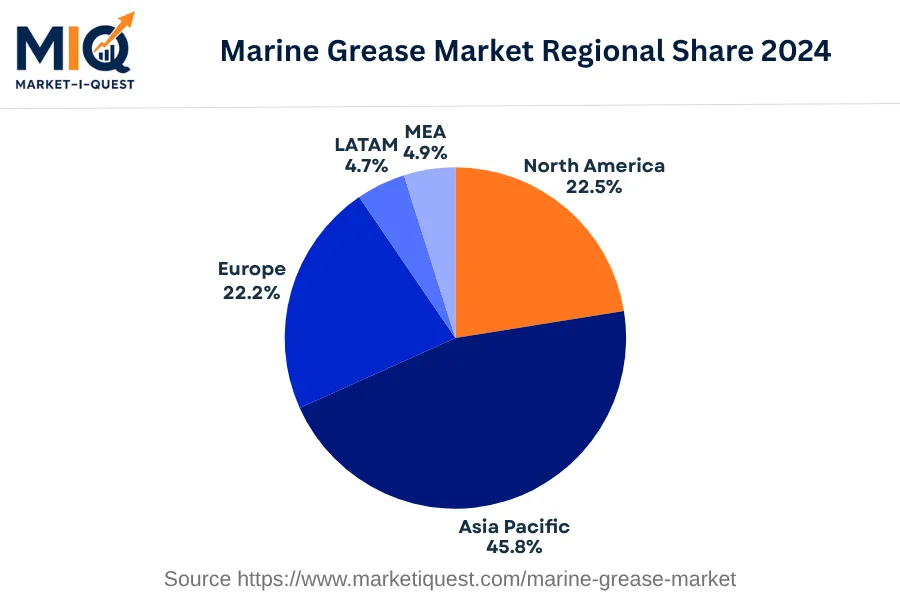
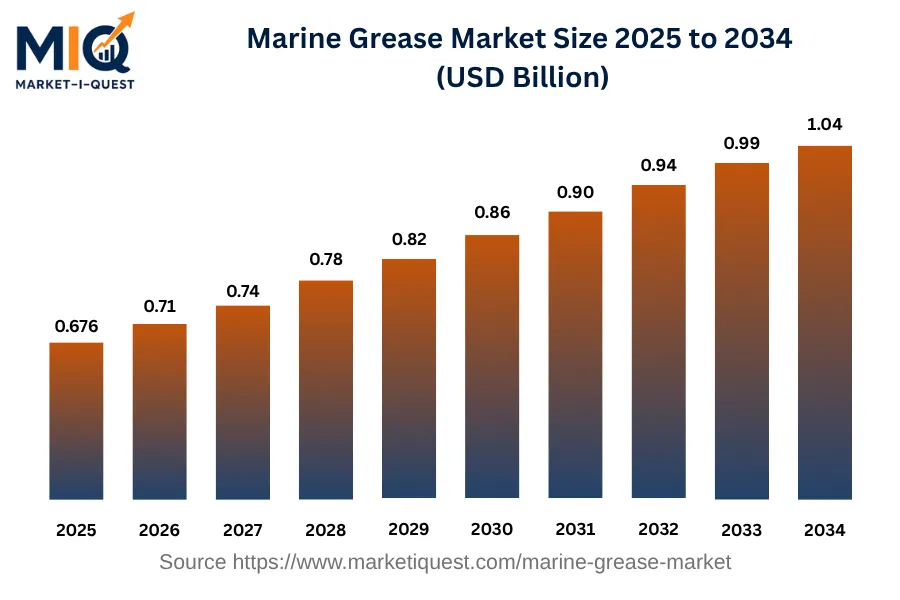
The Marine Grease Market size in 2025 is expected to stand at USD 0.68 billion, up from USD 0.65 billion in 2024. By 2034, it is projected to reach USD 1.04 billion, growing at a compound annual growth rate (CAGR) of 4.9% during the period spanning 2025 to 2034. This increase across the decade is likely to be a result of technological advances in marine grease production, growing demand from marine transport activities, and increasing regulations on environmentally friendly lubricants. Additionally, there is a rising interest in sustainable marine grease products that boast improved performance in extreme conditions, ultimately enhancing the lifespan of marine equipment. Examining regional shares in 2024, the majority stake is held by the Asia Pacific with 45.8% of the market, followed by North America and Europe, which have 22.5% and 22.2% respectively. The remaining parts of the world, Latin America (LATAM) and the Middle East and Africa (MEA), represent modest shares of 4.7% and 4.9%, respectively, in the Marine Grease Market.

Key Takeaways

  • By Product Type - Metal Soap Based held the majority with 57.2% share in 2024.
  • By Ship Type - Tankers & Bulkers led the market accounting for a 52.3% share in 2024.
marine-grease-market market size

Key Driving Factors

Increasing Fishing Vessel Regulatory Compliance

In the maritime industry, harsh operating conditions expose marine vessels' machinery and equipment to intense stress, driving the need for superior, high-performance lubricants such as marine grease. Fishing boat engines, equipments and all moving parts have to comply with international maritime organization's regulations which demand high-performance lubrication to reduce equipment failure and ensure safety. This specific regulatory requirement is a driving factor in the marine grease market, as fishing vessels need to utilize efficient and high-quality marine greases to comply. Consequently, compliance efforts from fishing vessel operators substantially contribute to the increased demand in the marine grease market.

Intensification of Offshore Wind Turbine Installation

The global acceleration of renewable energy initiatives, especially the installation of offshore wind turbines, is another significant driver for the marine grease market. Offshore wind turbines require reliable lubrication to handle challenging sea conditions and ensure efficient operation. Their maintenance schedule, determined by manufacturers and stipulated in contracts with developers, reflects the need for durable marine grease with high water resistance and load-carrying capacity. Hence, the surge in offshore wind energy deployments has not only led to an increased demand for marine grease, but also requirements for the development of greases with specific properties, hence driving expansion and innovation in the marine grease market.

Market Evolution by Timeline

2019-2023
During this period, the Asia Pacific region, particularly China, was the leading buyer in the marine grease market due to significant growth in the shipbuilding and shipping industries. On the supply side, companies such as Total, FUCHS, and ExxonMobil remained market dominants. A technological setback was the maturity of integration and production processes. As for policy and regulation, the adoption of the Marine Environment Protection Committee's 2020 sulfur limit policy influenced the production and usage of marine grease, prompting greener initiatives. In commercial terms, companies adopted competitive pricing strategies to stay ahead, with long-term contracts being the most common practice. The risk faced in this time frame was the raw material prices' fluctuations, often responded to by adjusting product pricing.
2024
In 2024, European markets, specifically the Nordic region, saw a significant increase in marine grease demand due to shipping industry expansion. In response, leading producers like Total and Shell expanded their supply chains. Technologically, the focus shifted towards the creation of higher performance, biodegradable greases. In terms of policy, the European Union's increasing environmental regulations steered the market towards eco-friendly marine grease. Commercial models remained largely unchanged, favoring long-term contracts and competitive pricing. Market uncertainties revolved around the impact of these stricter regulations on production costs and, consequently, product pricing.
2025-2029
During this period, the maritime industry's increasing demands drove the global marine grease market, particularly in fast-growing shipping markets like Asia and the Middle East. FUCHS, Total, and ExxonMobil led as suppliers, emphasizing producing biodegradable, high-performance marine grease. The International Maritime Organization's stricter oil pollution regulations further reinforced market trends towards greener solutions. Commercially, manufacturers leaned more into strategic partnerships with end-users for direct supply. Price instability of raw material remained the significant risk, cornering manufacturers to management strategies like enhancing operational efficiency and forward purchasing contracts.
2030-2034
In this period, rising environmental consciousness globally amplified the demand for eco-conscious marine grease, with regions like North America and Europe leading. Suppliers continued to compete on environmental impression besides the product's performance. Technological advancements were aimed at maximizing biodegradability and minimizing ecological impact. Policies got stricter, pushing the market further for green solutions, and the commercial model shifted dramatically with companies adopting subscription-based models for regular deliveries, thus enabling better cost management. The dominant risk remained as regulatory uncertainties around sanctions for environmental non-compliance and fluctuating raw material prices, prompting companies to fortify their risk management strategies.

Future Market Outlook

Future Opportunities

The evolving marine grease market presents substantial opportunities for companies focused on sustainability and innovation in formulations. The push towards eco-friendly products, spurred by regulations from the European Chemicals Agency in 2023, is likely to encourage manufacturers to invest in more sustainable raw materials. Companies such as Fuchs Lubricants are already exploring bio-based alternatives to mineral oils, potentially setting up partnerships with agricultural sectors to secure supply chains for raw materials. Furthermore, the shift toward electric and hybrid marine engines requires tailored lubricants, offering opportunities for research and development in new grease formulations specifically for these technologies. As seen with the regulatory push in the U.S. for low-emission marine vessels, builders like Sunseeker are increasingly demanding high-performance greases that can withstand the operational requirements of these systems. The integration of smart technology in marine applications creates a potential market for services that provide real-time monitoring and condition-based maintenance, aligning with the predictive maintenance trend observed in various industries. Collaboration opportunities exist amongst established grease manufacturers and tech companies, aiming for innovations in product longevity and performance transparency. Partnerships such as those being developed between Kongsberg and various vessel operators to enhance operational analytics highlight pathways to expand service offerings in the marine sector, enhancing overall performance and reliability.

Segmentation Analysis

By Product Type

The market is divided into subsegments including Metal Soap Based and Others, with Metal Soap Based subsegment accounting for the largest revenue share while Others subsegment is expected to grow at the fastest CAGR during the forecast period.

Largest Revenue Share

Metal Soap Based

Market Share Leader

The Metal Soap Based subsegment claims the largest revenue share due to a variety of industry-specific factors. Given that this subsegment encompasses wide-ranging uses in diverse sectors such as plastics, rubber, textiles and oil, its stable and robust demand across these sectors generate a substantial revenue. Furthermore, this subsegment benefits from a well-established customer base which encompasses not just industries, but also various commercial and domestic consumer markets, contributing to its sizable revenue share. It is worth noting that, due to its widespread applications, the reach of this subsegment extends to both developed and emerging economies worldwide, further bolstering its contribution to the total revenue. Market drivers for this industry are evolution in end-use sectors and the reliable, high-performance features of these products. However, it’s important to note that the demand stability for this product is also dependent on stringent regulatory guidelines, specifically pertaining to environmental concerns, which could lead to an unpredictable business environment.

Fastest CAGR

Others

Forecast Period Growth Leader

The second subsegment, loosely categorized as 'Others', is expected to demonstrate the fastest growth in the coming years. A variety of factors support this anticipated surge. The breadth of this categorization allows room for innovative products, non-traditional applications and emerging technologies, augmenting its growth potential. The entry of cutting-edge products, supported by government policy, advancing technology, strategic partnerships, and increasing capital expenditures stand as significant catalysts to this fast-paced growth. Several barriers to adoption such as high-cost and low-awareness of these innovative products also exist, and pose near-term risks. Yet, these barriers are diminishing with a growing emphasis on marketing, education and regulatory policies that encourage the adoption of diverse product types. The growth of this subsegment requires careful monitoring due to its potential in shaping future market trends.

By Ship Type

The market is divided into subsegments including Cargo/Container Ships, Passenger Ships, Tankers & Bulkers, and Others. In 2024, the Tankers & Bulkers subsegment accounted for the largest revenue share, while the Cargo/Container Ships segment is expected to grow at the fastest rate during the forecast period.

Largest Revenue Share

Tankers & Bulkers

Market Share Leader

The Tankers & Bulkers subsegment holds the largest share of revenue in the ship type market. The key drivers of this dominance are the global demands for oil, gas, and dry bulk commodities. These types of vessels are especially beneficial for large volume of transport of these commodities across different geographies. The strategic locations of main shipping routes, particularly in regions rich in natural resources like the Middle East, parts of Asia, and North America, largely contribute to the demand and hence, revenue of the Tankers & Bulkers subsegment. The impact of regulatory frameworks, such as the International Maritime Organization's regulations regarding the safety and efficiency of these ships, also plays a significant role in shaping the subsegment. Lastly, the crucial purchasing criteria of reliability and capacity, along with high switching costs, deter customers from diverting to other ship types, further solidifying this segment’s leading position in revenue terms.

Fastest CAGR

Cargo/Container Ships

Forecast Period Growth Leader

The Cargo/Container Ships subsegment is forecasted to be the fastest growing within the overall ship type market. The drivers for this growth include the ongoing expansion of global trade, technological advancements in ship design and operational efficiency, and the increasing penetration of e-commerce. The demand for container shipping is directly tied to the volume of goods being traded globally, making this subsegment poised for substantial growth as trading activities expand. Meanwhile, the adoption of more efficient, larger vessels coupled with the digitization of operational processes has increased the segment's attractiveness. There is also an increasing prevalence of partnerships and alliances forming in this sector, which is positively impacting growth. However, growth could be challenged by potential trade disputes and policies, and sudden shocks in the global economy. Notwithstanding, the overall outlook for the Cargo/Container Ships segment remains promising, and it is expected to witness the fastest growth during the forecast period.

Competitive Analysis

Key Market Players

Manufacturers / OEMs

Chevron Corporation
US
ExxonMobil Corporation
US
Shell International B.V.
Netherlands

Key Suppliers & Raw Materials

Dow Chemical Company
US
BASF SE
Germany
Ineos Group
Switzerland

Distributors, Integrators & Channel Partners

Motion Industries
US
Applied Industrial Technologies
US
Industrial Supply Company
US

Porter’s Five Forces Analysis

The Marine Grease Market is shaped by varied supply chains, consumer demands, substitute products, new entrants and intense competition.

Supplier Bargaining Power

Medium

Varied chemical ingredients supply chains impact supplier bargaining power.

Buyer Bargaining Power

High

Buyers have significant power due to vast availability of alternative suppliers and products.

Threat of Substitutes

Medium

Potential for bio-based and synthetic substitutes may disrupt traditional marine grease products.

Threat of New Entrants

Low

High start-up costs, established brand loyalties and strict industry regulations pose barriers to entry.

Competitive Rivalry

High

Strong rivalry exists between established suppliers competing on price, quality and innovation.

Regional Analysis

Geographic market dynamics and growth opportunities across key regions

Global Market Outlook

marine-grease-market market regional share

North America

In 2024, the North American marine grease market experienced considerable growth due to demands from various sectors and regulatory changes. The driving factors included heightened demand for marine grease in the shipping industry, led by the United States and Canada; increased attention to marine pollution regulations in the United States, stimulating cleaner, environment-friendly lubes production; and elevated investment in offshore wind farms, especially in Mexico, necessitating higher uptake of marine grease. A significant trend observed was a shift towards biodegradable marine greases owing to stricter environmental regulations and the pressure on sustainability. For instance, U.S. Environmental Protection Agency regulations indirectly encouraged this alternative.

Additionally, digital sales channels were adopted increasingly due to the COVID-19 aftermath, which affected traditional distribution mechanisms. The market also witnessed major partnerships, such as those between lubricant manufacturers and shipping companies for exclusive supply contracts. Key customer sectors of this market were shipping industry, offshore wind utilities, water recreation equipment manufacturers, and seafood harvesting companies. Regulators also played a critical role in shaping the market, primarily through environmental and safety policies. The market changes in 2024 reiterated the interplay of environmental considerations and technological advancements in the marine grease industry.

Asia Pacific

In 2024, the Asia Pacific Marine Grease Market exhibited significant activity due to various factors stimulating its growth. Drivers included increased demand from emerging economies like China and India, spurred by their expanding shipping industries. Regulatory norms, notably the IMO 2020 Sulphur Limit, persuaded companies to adopt compliant lubricants, such as marine grease, enhancing market growth. In Japan and South Korea, major shipbuilding nations, surging investments in maritime infrastructure meant increased requirement for marine grease. Rapid technology adoption, particularly in Australia and key ASEAN markets, led to improved grease formulations contributing to market dynamism. Prevailing trends featured shifts in buyer behavior, characterized by preferences for bio-degradable marine grease due to increasing environmental concerns. Technological advancements, focused on increasing efficiency in harsh marine conditions, brought about a change in product dynamics.

In terms of channel dynamics, e-commerce emerged as a popular platform due to its convenience and accessibility, even impacting the traditional sales routes. Partnerships and Mergers & Acquisitions characterized the market’s landscape, with multinational players like Shell and Total reaching strategic agreements for expansion in the Asia Pacific region. Policing of environmental standards had tightened, necessitating compliant lubricants and influencing market trends. Key sectors impacted involved those reliant on maritime activities, including shipping, oil and gas, manufacturing and fishing industries.
Europe

In 2024, the European marine grease market witnessed noticeable fluctuations due to multiple drivers and trends. Increasing maritime trade demands, rigorous marine pollution norms, and the encouraging investment influx in marine infrastructure significantly fuelled the market growth. Furthermore, technological advancements promoting the production of environmentally-friendly and bio-based grease, along with favourable supply dynamics, entrenched the market's performance. However, volatile pricing imposed a constraint on the otherwise thriving expansion.

Simultaneously, environmental consciousness among consumers accelerated shifts towards non-toxic, bio-degradable greases. This trend was particularly visible in regions like the UK, Germany, and the Nordics. Buyers from utilities and manufacturing sectors markedly preferred these variants. E-commerce also emerged as a key distribution channel across Europe, with Italy and Spain seeing a major chunk of online marine grease transactions. Remarkably, the Central and Eastern Europe regions experienced several initiatives towards policy enforcement for ensuring quality and sustainability in the marine grease market. This enforcement noticeably amplified the regional market's integrity. Moreover, the collaboration of international companies with local market players, as in the case of Benelux, contributed significantly to the market dynamics. Overall, the panoramic view of the European marine grease market in 2024 underscores the relentless interplay of regulatory frameworks, technological strides, and shifts in buyer behaviours.

Latin America

In the base year of 2024, the Marine Grease Market in Latin America demonstrated significant growth, driven by different dynamics. The increasing demand for numerous ship types, such as cargo ships, tankers, and passenger ships, powered the market. Furthermore, tightening environmental regulations related to marine pollution in countries like Brazil and Argentina led to a demand surge for bio-based grease, thus increasing investment in this area. Meanwhile, swift adoption of advanced grease technology in Mexico and Chile propelled the market. And, volatile oil and gas prices, key inputs for marine grease production, influenced overall pricing across the region.

Market trends showed a shift towards eco-friendly products, with buyers in Colombia and Peru exhibiting a preference for bio-based marine greases, triggering major adjustments in product portfolios. The rise of e-commerce in the region saw a shift in distribution dynamics, with increasing online sales of marine grease. Consolidation marked the industry, with numerous partnerships and M&A activities, particularly in Brazil and Argentina. Stricter enforcement of the MARPOL Annex V regulation led to industry-wide standards for marine grease. The main users of marine grease were the shipping sector, followed by the fishing and offshore drilling industries.

Middle East & Africa

In 2024, the Marine Grease market in the Middle East and Africa was characterised by a robust demand in maritime activities. Regulations concerning environmental impacts spurred demand, with countries like Saudi Arabia, United Arab Emirates, and South Africa initiating stringent environmental regulations, leading to increased need for eco-friendly marine greases. Investment played a pivotal role, with countries such as Qatar and UAE investing heavily in marine industry upgrades, thus escalating marine grease demand. Technology adoption too, was prominent, specifically in Nigeria and Israel, where modern shipbuilding methods necessitating advanced lubrications were observed.

Market trends were shaped predominantly by buyer behavior and technology shifts. For instance, South Africa and Israel showed a pronounced inclination towards synthetic and bio-based marine greases in alignment with global environmental awareness. Channel dynamics indicated a significant shift towards online platforms for marine grease procurement in Egypt and Kenya. In terms of partnerships, Saudi Aramco's collaboration with Hyundai Heavy Industries in Saudi Arabia exemplified the market's evolution. Policy enforcement reflected in stringent implementation of marine pollution prevention measures by nations like UAE and Qatar, influencing product standards in the marine grease market. Key sectors driving this market included government agencies, oil and gas industry, and manufacturing companies, given the predominant role these sectors play in maritime activities in the region.

Recent Industry Developments

Latest market innovations, product launches, and strategic initiatives

February 2026

RSC Bio Solutions announced that its EnviroLogic 802 environmentally acceptable grease met the requirements for approved use in AEGIR-Marine PRIME rudderstock seals. The company also confirmed its high-performance EALs are now available through Drew Marine's global supply chain network, capable of delivering to more than 900 ports worldwide.

May 2025

Renewable Lubricants® joined the Green Marine network as a new partner. The U.S.-based manufacturer offers high-performance EALs including greases that are readily biodegradable, non-toxic, and engineered to meet or exceed the EPA's Vessel General Permit (VGP) requirements.

Frequently Asked Questions