
Managed Hosting Market Snapshot

Key Players

  • Rackspace Technology (United States)
  • Linkbynet (France)
  • PhoenixNAP (United States)
  • Techarex Networks (United States)
  • LiquidWeb (United States)
  • Interoute Communications Ltd (United Kingdom)
  • OVH (France)
  • GoDaddy (United States)
  • 1&1 IONOS (Germany)
  • Hostway Services Inc. (United States)

Market Size

Base Year 2024
$18.76 Bn
CAGR
13.24%
Forecast 2034
$65.05 Bn

Market Segments

By Service Type
Web Hosting, Application Hosting, Database Hosting, Network Hosting, Email Hosting, Others
By Deployment Mode
On-Premises, Cloud, Hybrid
By Organization Size
Large Enterprises, Small & Medium Enterprises (SMEs)
By Industry Vertical
IT & Telecom, BFSI, Retail, Manufacturing, Healthcare, Government, Others

Market Dynamics

Drivers
  • Increasing demand for secure data storage
  • Growing shift towards cloud services
Restraints
  • High initial investment
  • Increasing security concerns
Opportunities
  • Increasing demand for cloud services
  • Rising cybersecurity concerns

Market Size

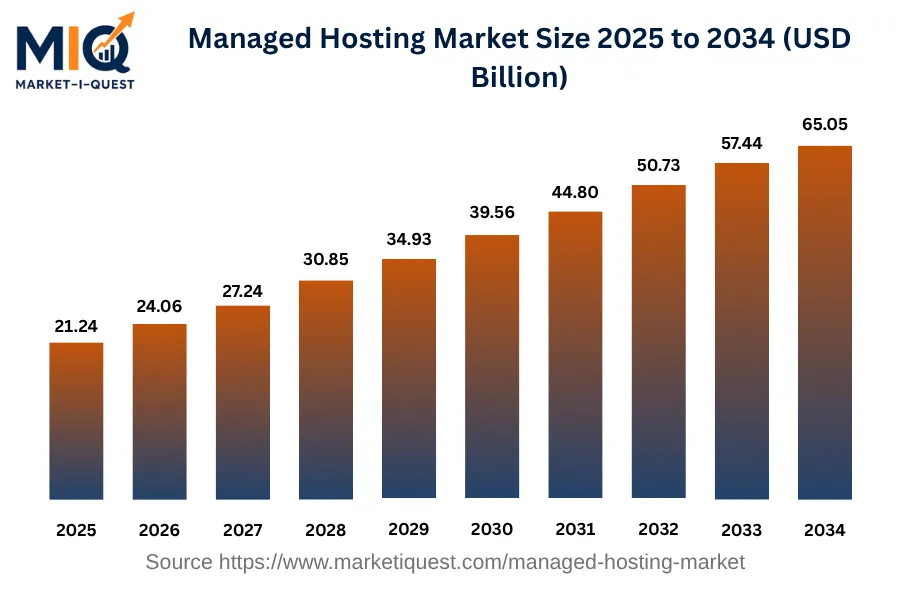
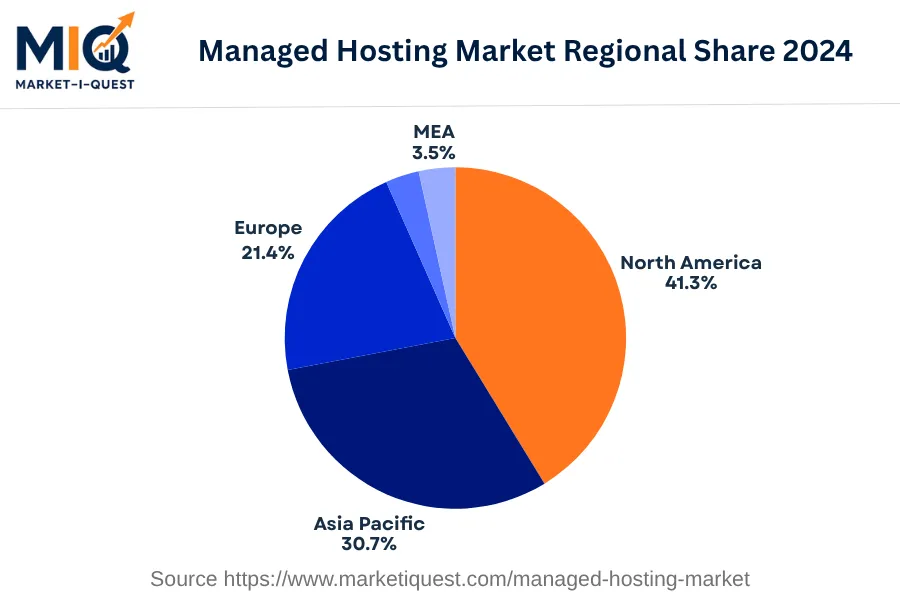
The Managed Hosting Market was valued at $21.24 billion in 2025, and it is forecasted to increase to $65.05 billion by 2034, charting an annual growth rate of 13.24%. This upward trend in market value signifies a steady expansion over a nine-year period, with the market's size increasing year over year from 2025 onwards. The driving factors behind this continuous growth include increased consumer demand and advancements in technology. Furthermore, the regional share of the market in 2024 indicated a heavier leaning towards North America, which held 41.3% of the market. It was followed by Asia Pacific with 30.7%, Europe with 21.4%, and lesser shares in LATAM and MEA, which accounted for 3.2% and 3.5% of the market, respectively.

Key Takeaways

  • By Service Type - Web Hosting held the leading position forming a substantial fraction of the market in the base year.
  • By Deployment Mode - On-Premises outperformed other methods taking the leading spot in the fiscal year.
  • By Organization Size - Large Enterprises dominated securing a significant market share in the given period.
  • By Industry Vertical - IT & Telecom led the market occupying a substantial position in the last fiscal year.
managed-hosting-market market size

Key Driving Factors

Increasing complexity of corporate IT architecture

The shift towards more complex and specialized IT architectures in corporate environments is a strong driver for the managed hosting market. With businesses increasingly shifting onto digital platforms, the need to manage, monitor, and maintain complex IT infrastructures in-house is becoming increasingly difficult. Tasks such as server maintenance, network management, cybersecurity, and disaster recovery require specific expertise and resources. A managed hosting allows businesses to handover these tasks and responsibilities to a third-party service provider, maximizing productivity by allowing them to focus on their core business operations instead. Further, it ensures optimal performance of IT systems, which is critical for the smooth running of day-to-day operations and maintaining business continuity.
Stringent Data Protection and Privacy Regulations

Enforcement of stringent data protection and privacy regulations worldwide is another major factor driving the managed hosting market. For instance, regulations such as General Data Protection Regulation (GDPR) in Europe and the California Consumer Privacy Act (CCPA) in the USA demand strict compliance from companies for data management, protection, and storage practices. Managed hosting service providers are equipped to help businesses fulfill these compliance requirements by offering secure data centers, robust data protection measures, and regular system audits. As such, businesses are increasingly turning to managed hosting solutions to effectively manage their regulatory compliance and avoid potential fines and reputational damage associated with data breaches and non-compliance.

Market Evolution by Timeline

2019-2023
During this period, midsize enterprises were major consumers of managed hosting services, seeking server space and reliability to accommodate growing online presence. Primary regions of demand included North America and Europe. The supply side showcased increased capacity with companies such as RackSpace and AWS shipping large quantities of server space. Technological constraints, however, included security and high-energy consumption. The widespread adoption of GDPR in Europe influenced data protection implementation. Pricing showed tendencies towards usage-based models and long-term contracts were the norm. Partnerships between hosting providers and application developers grew. Risks during this period included data breaches and server downtime.
2024
In 2024, firms offering hybrid cloud solutions witnessed significant growth, providing both on-premise and cloud hosting. Demand came primarily from large corporations shifting towards digitization. Large technology hubs in Asia joined North America and Europe as significant demand regions. Technologies such as AI and Machine Learning were beginning to be implemented to improve hosting efficiency. Policy-wise, the California Consumer Privacy Act made its impact, pressing providers for greater data security. The commercial model shifted towards more performance-based contracts. Increase in data breaches prompted stringent safety measures.
2025-2029
This period saw large corporations increasingly migrate to private cloud hosting, where suppliers like IBM and Google provided advanced features such as AI-based services. Customers globally prioritized data security and uptime commitment. Standards such as ISO/IEC 27001 gained prominence for secure data management. Further, the market saw a substantial increase in managed services partnerships, where tech giants joined with industry-specific software firms to deliver specialized hosting solutions. Contracts were based on data volume and integration complexity. The major risk factor was managing complexity in migrating to cloud hosting.
2030-2034
In these years, the demand was dominated by industries like fintech and e-commerce requiring high-level security. This resulted in the enhanced supply of security-focused hosting services. New technologies like quantum computing were piloted, promising improved speed and safety. Privacy regulations across various regions became stricter, mandating high levels of compliance from hosting providers. Pay-as-you-go pricing models gained popularity, and partnerships between hosting providers and cybersecurity firms became prevalent. High migration and maintenance costs were identified as significant constraints in this period.

Future Market Outlook

Future Opportunities

Future opportunities in the managed hosting market are expected to manifest in enhanced offerings tailored to specific industries. For instance, the healthcare sector, guided by the Health Insurance Portability and Accountability Act, continues to require robust data management and security measures since its establishment in 1996. As of 2023, more managed hosting providers are expected to develop specialized solutions that comply with healthcare regulations, enhancing market appeal. Furthermore, the rise of artificial intelligence and machine learning applications will create unique opportunities. Organizations like IBM are actively integrating AI into their managed hosting services, illustrating a pathway for future developments required to meet evolving client needs. The increased demand for scalable solutions in sectors such as e-commerce and finance also presents a strong opportunity, as these industries are notably dependent on reliable and adaptable managed hosting services. The partnership between SAP and Microsoft announced in late 2020 signifies a movement towards integrated services that leverage both companies' strengths. Additionally, the ongoing emphasis on sustainability will further open avenues for providers that focus on eco-friendly data centers and energy-efficient technologies. As more businesses prioritize environmental impact, pursuing green certifications will become vital, leading managed hosting companies to innovate in energy consumption and waste management. Thus, these emerging trends indicate a diversified landscape for managed hosting solutions, directed by compliance, technology, and sustainability.

Segmentation Analysis

By Service Type

The market is divided into subsegments including Web Hosting, Application Hosting, Database Hosting, Network Hosting, Email Hosting, and Others. Among these, Web Hosting accounted for the largest revenue share while Application Hosting is projected to grow at the fastest CAGR during the forecast period.

Largest Revenue Share

Web Hosting

Market Share Leader

Web Hosting reigns supreme as the largest earning subsegment in 2024. This is primarily due to the ever-increasing dependency of businesses on websites to establish their online presence and reach out to a larger customer base. Businesses across all industry sectors, irrespective of their size, are driving the demand for robust web hosting services to ensure website accessibility and functionality 24/7. Geographically, regions with substantial business activities such as North America and Asia-Pacific contribute significantly to the revenues of web hosting services. Moreover, the buying decision is predominantly influenced by a plethora of factors, including cost, scalability, reliability, customer support, and overall service quality. It’s worth highlighting that customers are usually reluctant to switch their web hosting service providers due to the potential technical difficulties and the risk of website downtime. This inertia contributes positively to the subsegments' recurring revenue structure.

Fastest CAGR

Application Hosting

Forecast Period Growth Leader

Forecast for the future shows Application Hosting as the fastest-growing subsegment. A plethora of factors contributes to this steep growth trajectory. The increasing adoption of cloud-based solutions across organizations of all sizes is a significant growth driver. As businesses move towards digitization, the demand for application hosting services is ostensibly on a higher scale. The need for managing and maintaining numerous applications has led organizations to seek managed application hosting services, creating significant growth opportunities. Despite the promising growth perspective, barriers such as security and privacy concerns could pose challenges. Yet, tech advancements focusing on enhanced data security, supportive policies, and strategic partnerships are expected to act as catalysts leading to a rapid adoption rate. Any significant downturns in the global economy or technology sector specifically, however, can impose near-term risks on this subsegment's growth pace.

By Deployment Mode

The market is divided into subsegments including On-Premises, Cloud, and Hybrid. In 2024, the On-Premises segment accounted for the largest revenue share, while the Hybrid segment is expected to grow at the fastest CAGR during the forecast period.

Largest Revenue Share

On-Premises

Market Share Leader

On-Premises holds the largest market share in terms of revenue in the base year 2024 within the segmentation by deployment mode. This is mainly due to several factors. Firstly, it offers full control over data and infrastructure, a crucial attribute preferred by many large enterprises. Often, it's imperative for these organizations to gain full control over the data due to regulatory norms or business policies. Secondly, there is a critical aspect of data security, and on-premises deployment reduces the chances of data breaches. Furthermore, the direct availability of in-house IT teams for troubleshooting and facilitating maintenance gives companies more control over their operations, ensuring that the processes are tailored to their specific requirements. Geographically, companies in regions with infrastructure to support on-premises software, like North America and Europe, are driving the adoption. Despite the increasing popularity of the cloud, on-premises solutions continue to command significant revenue due to these factors.

Fastest CAGR

Hybrid

Forecast Period Growth Leader

Despite on-premises deployment capturing substantial market share, the fastest-growing subsegment is projected to be Hybrid. Offering a mix of both on-premises and cloud infrastructures, hybrid deployments offer businesses the best of both worlds - flexibility and security. The balance of flexibility and control that hybrid deployments offer makes them an attractive choice for a range of businesses. Hybrid infrastructures allow companies to keep their sensitive data in-house while exploiting the scalability of the cloud for less-sensitive information. In addition, hybrid approaches provide a safety net for disaster recovery and maintain business continuity. Further, the perceived risk mitigation in a hybrid strategy could attract late adopters into the market, spurring growth. However, complex data management and interoperability issues could be potential growth-limiting factors. Overcoming these barriers through technological advancements and effective data governance strategies is thus vital for the growth of this segment.

By Organization Size

The market is divided into subsegments including Large Enterprises and Small & Medium Enterprises (SMEs). Large Enterprises accounted for the largest revenue share while Small & Medium Enterprises (SMEs) is expected to grow at the fastest CAGR during the forecast period.

Largest Revenue Share

Large Enterprises

Market Share Leader

The reason Large Enterprises is the dominant subsegment derives largely from their purchasing power and requirement for complex solutions. Such enterprises generally have vast resources at their disposal, which allows them to invest in advanced technologies and solutions. Additionally, their need for effective solutions to manage data across different departments of the organization further fuels demand in this segment. The business structure of large enterprises also necessitates efficient systems which can improve productivity and ensure seamless operations. Regulation is often easier within this segment due to the relative uniformity of larger organizations, and they typically attract more sophisticated, high-value solution and service vendors. Lastly, purchasing and switching costs are also less prohibitive for this segment, creating an environment of relatively vigorous innovation and competition.

Fastest CAGR

Small & Medium Enterprises (SMEs)

Forecast Period Growth Leader

The Small & Medium Enterprises (SMEs) subsegment is expected to grow with the highest CAGR. The growth in this area can be attributed to the increased need to streamline operations in these businesses amid increased competition. SMEs, previously held back by budget constraints and limited awareness, are today increasingly adopting advanced solutions due to the growing recognition of their potential return on investment. Accelerated by pressure from competitors and encouraged by government initiatives, they are leaning into digitization. Additionally, improvements in technology have reduced costs and eased the adoption process, which further fuels growth in this segment. Potential risks to this forecast may include economic downturns which disproportionately affect smaller businesses, or a slower-than-expected technological learning curve within these enterprises. However, the overall trend towards increasing tech adoption in this segment paints an optimistic picture.

By Industry Vertical

The market is divided into subsegments including IT & Telecom, BFSI, Retail, Manufacturing, Healthcare, Government, and Others. In the base year 2024, IT & Telecom accounted for the largest revenue share while Healthcare is expected to grow at the fastest CAGR during the forecast period.

Largest Revenue Share

IT & Telecom

Market Share Leader

In the base year 2024, the segment with the largest revenue share in this market was IT & Telecom. This can largely be attributed to the role of IT & Telecom in enabling digital transformation and the centralized management of products and services. The widespread utilization of high tech IT systems and Telecom services across various industries worldwide is another primary driver for the segment’s leader position. Advances in cloud computing, big data analytics, and AI have elevated the demand for IT & Telecom. Moreover, the pervasiveness of smart devices and the growth of global internet penetration has further amplified the need for reliable and advanced IT & Telecom services. The geographical regions with higher levels of technological adoption, such as North America and Europe, significantly contribute to the revenue of this segment. Regulatory environments favoring digitalization and the growth of the technology sector provide additional support. Purchasing decisions for IT & Telecom services are increasingly prioritized based on the providers' ability to offer advanced, scalable, and secure solutions.

Fastest CAGR

Healthcare

Forecast Period Growth Leader

Projected to grow at the fastest CAGR during the forecast period is the Healthcare subsegment. This growth is driven by the increasing adoption of technology in healthcare and the rise of telemedicine, especially highlighted during the global pandemic. In addition, the massive investment in digital health and the increasing shift toward patient-centric care models has catalyzed the demand for smart healthcare solutions. There are, however, barriers to adoption, including the high cost of implementation and the need for data security and privacy regulations. While these might slow growth in the short term, the need for efficient healthcare solutions, policy supports favoring digitization in healthcare, and significant capital expenditure for advanced healthcare infrastructure act as catalysts for growth. Near-term risks include regulatory changes, cybersecurity threats, and the challenges associated with data management and interoperability. Effectively addressing these risks is crucial for the continued growth of this subsegment.

Competitive Analysis

Key Market Players

Manufacturers / OEMs

Amazon Web Services, Inc.
US
IBM Corporation
US
Microsoft Corporation
US

Key Suppliers & Raw Materials

Dell Inc.
US
Intel Corporation
US
Cisco Systems, Inc.
US

Distributors, Integrators & Channel Partners

GoDaddy Inc.
US
Rackspace Inc.
US
Cloudflare, Inc.
US

Porter’s Five Forces Analysis

This analysis evaluates the competitive dynamics within the Managed Hosting Market.

Supplier Bargaining Power

Medium

Power of suppliers is moderated by their limited number and significant hardware requirements.

Buyer Bargaining Power

High

Buyers have high power due to the availability of multiple hosting providers and easy switching.

Threat of Substitutes

High

The existence of cloud-based solutions poses a considerable threat to managed hosting services.

Threat of New Entrants

Medium

Though costly initial infrastructure and expertise can prevent entry, the market is attractive due to rising cloud adoption.

Competitive Rivalry

High

Rivalry is aggressive given the numerous providers fighting for market share, driven by technological advancements.

Regional Analysis

Geographic market dynamics and growth opportunities across key regions

Global Market Outlook

managed-hosting-market market regional share

North America

The North American managed hosting market in 2024 was distinguished by a surge in demand for organized, secure data storage and efficient website management. Increasing cybersecurity threats drove significant adoption of managed hosting services across key sectors including retail, healthcare, and government. Cost-saving aspects amplified this demand, particularly among small- and medium-sized enterprises that shifted toward these services to mitigate the need for internal technical personnel. Technological advancements further energized the market with the advent of modern hosting solutions offering superior performance, security and ease of use. Customer preferences leaned toward comprehensive, customized solutions instead of out-of-the-box offerings. Rising trend of adopting hybrid cloud solutions indicated an inclination toward flexible and scalable systems. Partnership and M&A activity accelerated among market players, aiming to diversify service offerings and consolidate market positions. Additionally, compliance with strict regional data privacy policies, like the California Consumer Privacy Act, influenced market operation.

In geographical terms, the U.S. notably led the pack given its advanced technological infrastructure and high adoption rates among businesses. Canada followed suit, leveraging robust infrastructure and growing technological adoption among enterprises. Mexico, however, lagged slightly behind, hindered by a less mature technology landscape, but showed significant progress through strong government-led digitalization initiatives and increased investment into technology infrastructure.

Asia Pacific

In 2024, the Managed Hosting Market in Asia Pacific demonstrated a robust upheaval structured by technological advancement and market dynamics. Driven by demand growth, markets like China, India, Japan, South Korea, and Australia, along with key ASEAN markets, integrated novel technologies with an increased inclination towards cloud-based solutions. China's Cybersecurity Law influenced hosting providers to invest in complying infrastructure, boosting the market. Moreover, e-commerce expansion influenced businesses to adopt managed hosting for efficient online platforms, especially in retail and manufacturing sectors. The Indian government’s 'Digital India' initiative also fuelled market growth by promoting digitalization within public and private enterprises.

Significant market trends included a rise in partnerships and M&A among hosting providers, like the celebrated alliance between Alibaba Cloud and Tata Communications. Data localization policies enforced in various countries led providers to localize data centers increasing market expansion. Notably, businesses indicated a shift towards hybrid hosting solutions for enhanced security and flexibility, particularly in sensitive sectors like healthcare and utilities. Furthermore, strict data protection regulations in Australia enforced businesses to adopt managed hosting solutions. On the supply front, the market saw a decline in pricing due to intense competition and technological evolution, thus encouraging adoption among SMEs and startups, primarily in South Korea and ASEAN markets. Nevertheless, managed hosting services market experienced a productive year in Asia Pacific in 2024.

Europe

In 2024, the Managed Hosting Market in Europe bolstered its significant presence in the technology sector. Various drivers power this market trend, such as increased demand for advanced digital infrastructure stemming from remote work and learning across industries like enterprise, government, and healthcare. Regulations like GDPR have also compelled organisations to prioritize hosting services for data protection and compliance, especially in regions like Germany, the UK, and France. Furthermore, these advancements have encouraged a surge in technology adoption and investment in sectors like retail and manufacturing.

Key trends shaping this space include shifts in buyer behavior with increased inclination towards scalable and flexible hosting solutions, evident in Spain, Italy, and Central & Eastern Europe. Notably, managed hosting partnerships and M&A activities have been witnessed, with a key focus on enhancing data security standards. Entities’ increasing reliance on big data and AI has underlined the necessity for robust and secured hosting services, an aspect strongly evident in the Nordics and Benelux region. As for policy enforcement, strict adherence to data security norms has been observed across this market, a direct response to the punitive financial consequences of non-compliance and the existential threat posed by catastrophic data breaches.

Latin America

In 2024, Managed Hosting Market in Latin America (LATAM) presented a landscape marked by technology evolution and adoption. Significant drivers included an increasing demand for cloud-based solutions, led by sectors like government, healthcare, and retail in countries like Brazil and Mexico. Regional regulations favoring data localization also impacted the market, elevating the demand for local hosting services. Additionally, noteworthy investments in network infrastructure by Argentina and Colombia bolstered the growth of this market. As for trends, a shift towards green hosting solutions was observed as organizations across LATAM aimed to reduce their carbon footprint. Brazil and Chile saw a higher adoption of these solutions due to a proactive approach towards environmental sustainability. Furthermore, the drive for operational efficiency led to an increased interest in automated managed hosting services, primarily in Peru and Argentina. Acquisition of local hosting providers by larger multinational companies also emerged as a prevalent trend.

Lastly, important policy enforcements were seen in Mexico to secure data privacy and integrity, leading to stricter compliance adherence in managed hosting services. Enterprise customers, aiming for constant connectivity and real-time data management without worrying about server maintenance, emerged as the primary customers. The utility sector and manufacturing verticals also reported an increased requirement of managed hosting services.

Middle East & Africa

In 2024, the Managed Hosting Market in the Middle East and Africa showed a significant expansion fueled by multiple factors. In Saudi Arabia, ambitious national programs like Saudi Vision 2030 were digitally transforming sectors across the board, driving demand for robust hosting solutions. Similarly, a surge in digital transformation initiatives like Smart Dubai in the UAE and TASMU in Qatar triggered a substantial increase in the demand for managed hosting services across government, telecom, and retail sectors. Rapid technology adoption within these economies also amplified the growth. A discernible trend was the shift in buyer behavior, with more sectors in Egypt, South Africa, Nigeria, Kenya, and Israel opting for managed hosting to focus on core operations. Connected with this, partnerships between local and international hosting corporations were bolstering market dynamics. A case in point is the numerous tech start-ups in Israel turning to multinational managed hosting firms for services.

Cybersecurity regulations in nations like Saudi Arabia and UAE were enforcing stringent industry standards, pushing entities to seek managed hosting providers compliant with these regulations. Meanwhile, in sectors with heightened data sensitivity like healthcare and financial services, the necessity for secure, reliable, and compliant hosting solutions was notably driving the market. Additionally, the oil, gas, and manufacturing industries benefited greatly from improved operational efficiency and security provided by managed hosting solutions, further expanding the market in these regions.

Recent Industry Developments

Latest market innovations, product launches, and strategic initiatives

January 2026

The Protection of Critical Infrastructure (Computer Systems) Ordinance came into force in Hong Kong, representing a fundamental change in the rules of operating a hosting business in Asia.

September 2025

The EU Data Act (Regulation (EU) 2023/2854) became fully applicable on September 12, 2025, introducing significant new obligations for cloud service providers, including requirements around interoperability, termination rights, and switching between providers.

Frequently Asked Questions