
Man Portable Communication Systems Market Snapshot

Key Players

  • Harris Corporation (US)
  • Thales Group (France)
  • Rockwell Collins (US)
  • BAE Systems (UK)
  • Cobham plc (UK)
  • ITT Corporation (US)
  • Ultra Electronics (UK)
  • General Dynamics (US)
  • Raytheon Technologies (US)
  • Rohde & Schwarz (Germany)

Market Size

Base Year 2024
$5.48 Bn
CAGR
6.84%
Forecast 2034
$10.62 Bn

Market Segments

By Product Type
Handheld Radios, Smartphones, Portable Satellite Phones, Wireless Communication Devices
By Technology
Satellite Communication, Radio Frequency Communication, Wi-Fi Communication, Mesh Networking
By Application
Military, Public Safety & Security, Emergency Services, Commercial
By End User
Government Agencies, Military Organizations, Civil Defense, Private Sector

Market Dynamics

Drivers
  • Rise in defense expenditures
  • Technological advancements in communication systems
Restraints
  • High equipment cost
  • Operational complexity
Opportunities
  • Increasing demand in defense sector
  • Emerging technologies' integration possibilities

Market Size

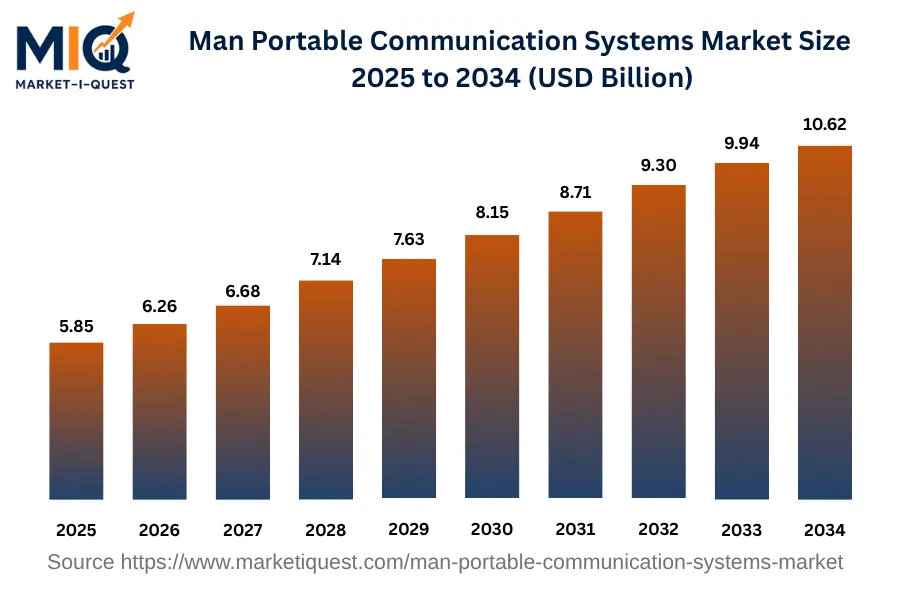
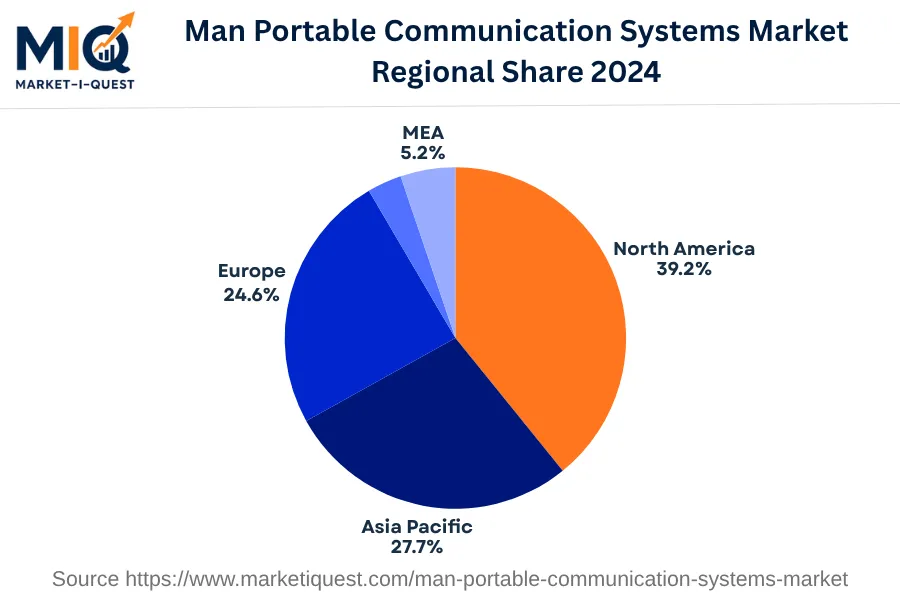
The Man Portable Communication Systems Market size was $5.85 billion in 2025 and is projected to grow to $10.62 billion in 2034, posting a compound annual growth rate (CAGR) of 6.84%. From 2025 to 2034, the market will see a steady progression, showing almost a two-fold increase by the end of the period. This growth trend signifies an increase in demand for portable communication systems, resulting from the need for reliable, compact, and secure communication tools, widely utilized in various sectors such as military and emergency services, among other applications. As of 2024, the regional market shares were as follows: North America held 39.2%, the Asia Pacific had 27.7%, Europe had 24.6%, while Latin America and the Middle East & Africa held smaller shares at 3.3% and 5.2% respectively. This share distribution indicates the dominant demand for these systems in North America, followed closely by Asia and Europe. The smallest demand comes from Latin America and the Middle East & Africa due to lower technology penetration and other associated factors.

Key Takeaways

  • By Product Type - Smartphones held the largest market share in the Man Portable Communication Systems Market.
  • By Technology - Satellite Communication accounted for the largest segment in Market.
  • By Application - Military dominated contributing to a significant market portion in the Market.
  • By End User - Government Agencies held the market leading position in the Man Portable Communication Systems Market.
man-portable-communication-systems-market market size

Key Driving Factors

Implementation of IP Standards

The adoption of Internet Protocol (IP) standards in the defense sector is a critical driver of the Man Portable Communication Systems market. The military is increasingly utilizing digital IP-based communication systems because they allow for more secure and rapid data transmission. These systems can help improve decision making, led by real-time situational awareness. Tactical communication, which previously relied heavily on traditional radios, is now being advanced by these IP-based systems, thereby giving a boost to the man portable communication systems market. Furthermore, these IP based systems enable consistent communication even in remote locations with harsh weather conditions, which increases their attractiveness and demand.
Adoption of Lightweight, Wearable Tech by Security Forces

A spur to the Man Portable Communication Systems market comes with the growing requirement for lightweight and wearable technology among the world's security forces. Combat troops are frequently stationed in hostile and challenging terrains, requiring equipment that they can comfortably carry with them. As such, man portable communication systems that are lightweight, flexible, and durable are preferred. Devices that are compact and can be easily attached to gear or uniforms, while providing reliable connectivity, are shoring up demand in this market. The increased adoption of these systems is crucially driven by the need for efficient communication and data sharing among various teams of the defense sector during operations.

Market Evolution by Timeline

2019-2023
In this period, the primary demand for Man Portable Communication Systems was driven by the defense sector, particularly by the armies in the U.S., Russia, and China, due to heightened border tensions. Suppliers primarily used digital and software-defined radio technologies in providing units with IP-based interfaces and interoperable communication options. During these years, there weren't significant regulatory constraints. However, the U.S. Department of Defense initiated the Enhanced Mobile Satellite Services (EMSS) program, influencing military adoption. In commercial terms, contracts usually were government-awarded, fixed-price models. Partnerships were primarily with military hardware manufacturers for integrated supply. The main risk highlighted was the high cost tied to technology upgrade cycles.
2024
This year witnessed major defense budgets cuts, leading to decreased procurement of Man Portable Communication Systems especially in European countries. The technology saw a shift towards more lightweight, miniature devices with increased bandwidth. Despite budget constraints, integration with unmanned aerial vehicles and ground sensors matured. The International Telecommunication Union introduced further frequency allocation, regarding the use of certain GHz bands for defense communications. Commercially, suppliers faced severe pricing pressure and had to adopt flexible contract structures. The inability to upgrade existing systems with lesser budgets was a pronounced risk.
2025-2029
The period saw demand resurgence due to recovery in defense spending worldwide, with Asia-Pacific countries notably increasing procurement. Advancements in communication technology resulted in more affordable, power-efficient, and reliable systems. Influential programs included the U.S.'s Integrated Tactical Network and NATO's Federated Mission Networking initiative, focusing on interoperable communication systems. With recessed defense budgets, long-term lease contracts, and service-based procurement models became prevalent. The increasing sophistication of cyber threats led to a greater focus on system security.
2030-2034
Increase in asymmetric warfare scenarios and counter-insurgency operations across the Middle East and Africa boosted the market. There was significant technological advancement, particularly the integration of AI and quantum encryption for secure communication. Regulatory bodies worldwide noted a shift towards open standards to promote interoperability. The rising need for secure yet interoperable systems resulted in more partnerships among suppliers, software developers, and defense organizations. Despite advances, potential vulnerabilities from increasingly sophisticated cyber threats remained a persistent risk.

Future Market Outlook

Future Opportunities

As the landscape for Man Portable Communication Systems evolves, several key opportunities for growth and innovation emerge. For instance, the adoption of augmented reality in communication systems, as demonstrated by Northrop Grumman’s collaboration with various military contracts starting in 2022, opens avenues for operational efficiency by facilitating real-time data overlay. The need for enhanced communication capabilities in disaster relief efforts is underscored by initiatives like the United Nations’ ongoing commitment to deploying advanced communication technology since 2020. Moreover, expanding compliance with emerging global standards, including those from the International Telecommunication Union focusing on spectrum sharing, presents a significant opportunity for manufacturers to enhance their product offerings. Partnerships between tech companies and governmental agencies can facilitate further advancements in artificial intelligence and machine learning applications within portable communication, as evidenced by Lockheed Martin’s investment in AI solutions for communication networks in 2023. Additionally, the potential for civilian applications in remote work settings mirrors developments in military sectors, allowing for broader market penetration. The shift toward sustainability and energy efficiency, highlighted by recent partnerships between tech firms and renewable energy developers, is also set to influence product design and functionality. These opportunities will shape the trajectory of the Man Portable Communication Systems market as it adapts to dynamic demands and technological advancements.

Segmentation Analysis

By Product Type

The market is divided into subsegments including Handheld Radios, Smartphones, Portable Satellite Phones, Wireless Communication Devices. Smartphones accounted for the largest revenue share while Portable Satellite Phones are expected to grow at the fastest CAGR during the forecast period.

Largest Revenue Share

Smartphones

Market Share Leader

The dominance of the smartphone subsegment can be attributed to a number of factors. The proliferation of digital services, including e-commerce, online entertainment, and remote work solutions have been key in driving the demand for smartphones, leading them to account for the highest revenue in 2024. The prevalence of these services has made smartphones a necessity in individuals' personal and professional lives. Another key driver is the increasing purchasing power in emerging markets. As disposable incomes rise, consumers are increasingly able to afford smartphones, further driving market growth. The smartphone subsegment is also supported by an established supply chain, reducing costs and barriers to entry for new entrants. Regulatory support, particularly in developing economies, has also led to increased smartphone adoption. Additionally, the vast majority of smartphones are sold through retail channels, which reach a wide customer base and generate significant revenue. These factors together explain the dominance of the smartphone subsegment in revenue generation within the market.

Fastest CAGR

Portable Satellite Phones

Forecast Period Growth Leader

The Portable Satellite Phones subsegment is projected to grow at the fastest rate in the coming years. The growth is largely attributed to the increasing need for effective communication in remote areas where traditional cellular networks fail to provide coverage. As mounting exploration activities and expeditions across the world rise, the demand for portable satellite phones continues to grow. The advancements in technology have also reduced the prices of these devices, making them more affordable and accessible to a wider audience. However, the high possibility of regulatory changes can pose risks to this robust growth projection. Regulatory bodies could introduce new rules or modify existing ones that could restrict the use and breadth of satellite communications. Accelerated growth can also be possible through strategic partnerships with application developers to widen the usability and appeal of portable satellite phones, which could break down adoption barriers and accelerate the CAGR of the segment.

By Technology

The market is divided into subsegments including Satellite Communication, Radio Frequency Communication, Wi-Fi Communication, and Mesh Networking. Satellite Communication accounted for the largest revenue share while Mesh Networking is expected to grow at the fastest CAGR during the forecast period.

Largest Revenue Share

Satellite Communication

Market Share Leader

Satellite Communication dominates in terms of revenue largely thanks to its broad geographical coverage, reliability, and versatility in applications. It has become an integral part of global telecommunications systems, providing crucial connectivity to remote and underserved areas, facilitating international data broadcast and emergency communication networks. In 2024, the demand for satellite communication has surged owing to rapid digitalization, increased internet penetration, and transition from traditional broadcast to direct-to-home (DTH) services. Military and government are significant customers, requiring secure, robust communication channels across vast distances. Advances in technology, such as high-throughput satellites, have also enhanced data speed and volume, strengthening its commercial appeal. Regulatory support for satellite spectrum allocation and integration of satellite and terrestrial networks have further propelled growth. Despite rich competition, switching costs are high due to the requirement of specialized hardware and infrastructure.

Fastest CAGR

Mesh Networking

Forecast Period Growth Leader

Mesh Networking is projected to show the fastest growth. This can be attributed to its decentralized nature which makes it robust as there's no single point that can fail and disrupt the entire network. It's especially useful in areas where installing a traditional Wi-Fi network might not be feasible. Catering to modern urban challenges, Mesh Networking is gaining momentum in the realm of smart city projects, providing efficient, reliable connectivity for IoT devices and sensors. However, the adoption faces barriers such as high setup costs and complex maintenance. Potential growth catalysts include the rising deployment of IoT, favorable policies encouraging low power wide area networks, and strategic partnerships for developing large-scale mesh networks. Conversely, risks such as security vulnerabilities and technical issues concerning multicasting need to be mitigated for more significant adoption.

By Application

The market is divided into subsegments including Military, Public Safety & Security, Emergency Services, and Commercial. In 2024, the Military application accounted for the largest revenue share while Commercial is expected to grow at the fastest CAGR during the forecast period.

Largest Revenue Share

Military

Market Share Leader

The Military subsegment is leading in revenue generation in 2024 due to multiple factors influencing its demand. The increasing geopolitical tensions worldwide have ensured steady growth in defense budgets, leading to consistent demand for related applications. The cyber threats facing nations have further leveraged this subsegment. The drive to modernize the armed forces, including advanced communication systems and upgraded equipment, has also spurred growth. The demand is further heightened in regions with significant political unrest, such as the Middle East, and those with substantial military spending like the United States. Regulatory support is also a significant factor, as governments typically prioritize national safety and defense. As a result, the military subsegment has a stable supply chain, devoid of major disruptions. The procurement process, steeped in regulation and policy, denotes significant switching costs, which further strengthens the standing of this subsegment.

Fastest CAGR

Commercial

Forecast Period Growth Leader

On the other hand, the Commercial subsegment is projected to demonstrate the fastest growth in the coming years. This is driven by an increasing adoption of advanced technology by businesses to enhance operations and efficiency. Knowingly, businesses are investing heavily in digital transformation, creating a fertile ground for robust growth in this subsegment. However, barriers to adoption such as high cost and resistance to change may impede its growth. Partnerships with tech firms and favorable government policies can act as a catalyst for growth in this subsegment. This segment's growth also comes with near-term risks such as data breaches and unpredictable shifts in technology trends. Therefore, businesses toughen their security measures and are poised to quickly adapt to these rapidly evolving trends. The coming years may reveal the full potential of the commercial subsegment of the market.

By End User

The market end users are segmentized into Government Agencies, Military Organizations, Civil Defense, and Private Sector, with the Government Agencies accounting for the largest revenue share and Civil Defense anticipated to grow at the fastest CAGR during the forecast period.

Largest Revenue Share

Government Agencies

Market Share Leader

Government Agencies are the leading revenue contributors of this market in 2024. This is fundamentally due to several key factors. First, governments globally invest significantly into societal infrastructure, including defense and public safety, leading to high demand for relevant products and services across numerous markets, driving revenue for this subsegment. Second, Government Agencies are typically equipped with robust budget allocations, which allows for consistent spending and subsequent market growth. Geographically, major global capitals and significant municipalities also drive this demand due to their massive population, strategic importance, and consequent need for stringent security and organizational measures. Furthermore, governmental regulation and policy-making can directly influence market dynamics, creating an ever-present need for these services. While purchasing criteria can vary, factors such as quality, reliability, and advanced features are often prioritized over cost considerations. Lastly, the significant switching costs involved due to the integral role these products and services play in governmental operations further solidifies this subsegment’s market position.

Fastest CAGR

Civil Defense

Forecast Period Growth Leader

While not being the largest in revenue, the Civil Defense segment is anticipated to grow at the fastest rate. Several catalysts spur on this growth. For one, the increasing embrace of technological advancements, such as artificial intelligence and automation, is set to catalyze growth in the sector. These technologies can significantly augment the capabilities of civil defense organizations, driving adoption. Additionally, governments worldwide are increasingly recognizing the importance of civil defense in dealing with a variety of scenarios like natural disasters, terrorist attacks, and maintaining general public safety, which lead to increased investments in this area. This heavy capital expenditure, coupled with strategic partnerships with technology providers, pushes the growth of this segment. Nevertheless, adoption barriers such as bureaucratic inefficiencies and budget constraints pose significant challenges. Near-term risks include possible pushback from public opposition to increased surveillance or potential missteps in implementing such advanced systems. Overall, however, the sector's growth prospect remains promising as societies worldwide continue to grapple with increasing complexity and emerging threats.

Competitive Analysis

Key Market Players

Manufacturers / OEMs

Aselsan
Turkey
General Dynamics Corporation
US
Harris Corporation
US

Key Suppliers & Raw Materials

Northrop Grumman
US
Thales Group
France
Raytheon
US

Distributors, Integrators & Channel Partners

Rockwell Collins
US
SAAB AB
Sweden
Cobham Plc
United Kingdom

Porter’s Five Forces Analysis

This analysis focuses on the competitive landscape of the Man Portable Communication Systems Market.

Supplier Bargaining Power

Medium

Suppliers have moderate power due to the specialized nature of products but prevalence of multiple providers.

Buyer Bargaining Power

High

Buyers possess high power owing to the availability of multiple suppliers and low switching costs.

Threat of Substitutes

Low

Threat of substitutes is low due to the technical specificity and unique applications of the products.

Threat of New Entrants

Medium

Entry barriers include high R&D costs and stringent military specifications, but market growth offers opportunities.

Competitive Rivalry

High

Intense competition among existing firms due to advancements in technology and price-based competition.

Regional Analysis

Geographic market dynamics and growth opportunities across key regions

Global Market Outlook

man-portable-communication-systems-market market regional share

North America

In 2024, the North American Man Portable Communication Systems market witnessed robust growth. Market drivers included increased defense spending, particularly in the U.S., where government investments in advanced communication technologies ramped up within the military sector. Moreover, the mounting demand for secure and real-time communication systems triggered the expansion in both public and private sectors. Regulatory changes, such as the adoption of stringent defense communication standards in Canada, also influenced the market. Several trends emerged across this sector, notably a significant shift towards satellite-based communication systems. Buyers, particularly from the government and defense sectors, showed a strong preference for these systems' dependability and real-time data transmission capabilities.

Furthermore, product innovations from key players influenced market dynamics- a prominent instance was the U.S. Army's utilization of advanced radio systems fusing Artificial Intelligence for secure communications. The market saw a surge in strategic partnerships and M&As aimed at broadening product portfolios and strengthening regional presence. Rigorous policy enforcement around cybersecurity standards was characteristic of 2024, particularly in Mexico's government and utility sectors, where the demand for secure communication systems was high. In summary, 2024 depicted a thriving North American Man Portable Communication Systems market, bolstered by hefty defense spending, increased demand, technological progress, strategic collaborations, and stringent policy enforcement.

Asia Pacific

In 2024, the man portable communication systems market in Asia Pacific flourished, fortified by increasing military expenditure, evolving regulations, and rapid tech enhancements throughout China, India, Japan, South Korea, Australia, and key ASEAN markets. China’s government-led investment in advanced tactical communication systems significantly invigorated the market, while India’s updated procurement policies for defense communication tools catalyzed growth. Japan and South Korea saw surges in tech adoption led by their respective defense sectors – assimilating cutting-edge radio and satellite communication devices. Pertinent trends included shifts towards encrypted systems in military organizations, driven by rising cybersecurity threats. Australia strongly embodied this development, elevating their defense sector's resilience against potential intrusions.

Cooperative agreements between nations also spurred market growth, with tech-sharing partnerships amongst ASEAN members playing a pivotal role. Channel dynamics observed a pronounced transition towards digital channels, boosting systems accessibility across retail and enterprise customers. Additionally, policy enforcement around radio frequency use induced modifications in communication devices, ensuring adherence to regulations, particularly across manufacturing and utilities sectors. The market's dynamism resulted from the intersection of multifaceted drivers and prevailing trends. As sectors across the Asia Pacific region continue to embrace these advanced communication tools, the man portable communication systems market gears towards sustainable expansion and regional cooperation.

Europe

In 2024, the European man-portable communication systems market experienced significant activity. Demand was driven by heightened security concerns in regions like Central and Eastern Europe, prompting increased investment in military communication equipment. New regulations were formulated in Germany and the United Kingdom to enhance communication reliability in defense and emergency services. Adoption of advanced communication technologies like Li-Fi and 5G substantially improved operational efficiency in countries like France, Italy, and Spain. The trend towards digitization and interoperability of communication systems across Europe was visible in sectors including enterprise, utilities, and government services.

Changing buyer behavior reflected a preference for portable, lightweight, and multifunctional communication systems. Notably in the Nordics and Benelux, industry players aimed for product innovation, focusing on low-power and long-range devices catering to remote areas. Partnerships and mergers and acquisitions continued with industry-oriented firms in a bid to consolidate market share and broaden their range of services. Italy and Germany enforced stringent policies on data protection and security standards in communication systems used in healthcare, manufacturing, and retail sectors. These trends underscored the dynamic nature of the man-portable communication systems market in Europe that year.

Latin America

In 2024, the Man Portable Communication Systems market in Latin America (LATAM) was characterized by significant expansion. Drivers for this growth included increased defense spending, particularly in countries like Brazil and Mexico, that facilitated investment in modern military technology. The enforcement of stringent regulations for secure communication in defense and security agencies across LATAM, such as in Colombia and Chile, also impelled demand for these systems. Another significant driver was the swift adoption of innovative communication technologies in the region, especially in Argentina and Peru, noted for their growing tech industries.

Trending in the market in 2024 was a shift toward more decentralized and mobile communications in sectors such as defense, security, and disaster management. In Brazil, for instance, next-generation military exercises saw these systems sharing the spotlight. Additionally, the pursuit of partnerships and mergers & acquisitions involving major industry players was evident throughout the year. In Mexico, examples of this were defense agreements fostering product development, aiming at competitive advantage. Moreover, the enforcement of international communication standards across LATAM was consistently observed. Key customers for the Man Portable Communication Systems market in 2024 encompassed government and defense entities across LATAM. Additionally, industries such as utilities and manufacturing expressed interest due to their need for secure, reliable, and mobile communication.

Middle East & Africa

In 2024, the Man Portable Communication Systems Market in the Middle East and Africa witnessed robust growth. Key drivers were increased defense spending, notably in Saudi Arabia, Qatar, and the UAE, fostering demand for advanced military communication systems. Secondly, the surge in disaster management initiatives in countries like Egypt and South Africa stimulated the need for reliable portable communication. Thirdly, prosperous oil and gas sectors, especially in Nigeria and Saudi Arabia, necessitated robust communication networks for smooth operations. Trends in 2024 included state-of-the-art technology adoption among military agencies and oil companies. The emergence of partnerships focused on system advancements was notable, particularly between Israeli defense companies and UAE telecom firms.

Increased focus on policy enforcement relating to communication standardization was observed in countries like South Africa and Kenya, positively influencing the market dynamics. The sectors heavily demanding these services included government agencies, defense organizations, and energy firms. In retail, healthcare, and financial services, the usage remained somewhat limited. Furthermore, intensified investment in infrastructure development projects by countries like Saudi Arabia, UAE, and Qatar contributed to a significant demand surge for Man Portable Communication Systems, further buoying market growth in the region.

Recent Industry Developments

Latest market innovations, product launches, and strategic initiatives

April 2025

The U.S. Air Force awarded Indra Air Traffic a contract ceiling of US$198.36 million to provide man-portable Tactical Air Navigation (TACAN) systems. The systems are designed for operations in GPS-denied environments and can be transported by two personnel.

January 2026

A comprehensive market forecast estimated the global Man-Portable Communication Systems Market at USD 4.10 billion in 2025, projecting growth to USD 4.43 billion in 2026 at a CAGR of 8.43%. The market is expected to reach USD 7.23 billion by 2032.

Frequently Asked Questions