Maleic Anhydride Market Snapshot

Key Players

  • Huntsman Corporation (US)
  • Mitsubishi Chemical Corporation (Japan)
  • Bartek Ingredients (Canada)
  • Sasol Limited (South Africa)
  • Lanxess AG (Germany)
  • CEPSA Química (Spain)
  • Thirumalai Chemicals (India)
  • Polynt-Reichhold Group (Italy)
  • Zibo Qixiang Tengda Chemical (China)
  • Nippon Shokubai Co. Ltd (Japan)

Market Size

Base Year 2024
$3.84 Bn
CAGR
5.92%
Forecast 2034
$6.83 Bn

Market Segments

By Raw Material
  • Benzene
  • N-Butane
By Application
  • Copolymers
  • Lubricant Additives
  • Unsaturated Polyester Resin (UPR)
  • Alkenyl Succinic Anhydrides
  • Malic Acid
  • Fumaric Acid
  • Others
By End User
  • Construction
  • Automotive
  • Food & Beverages
  • Textile
  • Pharmaceuticals
  • Personal Care
  • Agriculture
  • Others

Market Dynamics

Drivers
  • Rising demand in automotive industry
  • Increase in construction activities
Restraints
  • Fluctuating raw material prices
  • Stringent environmental regulations
Opportunities
  • Increasing chemical industry growth
  • Evolving automotive sector demand

Market Size

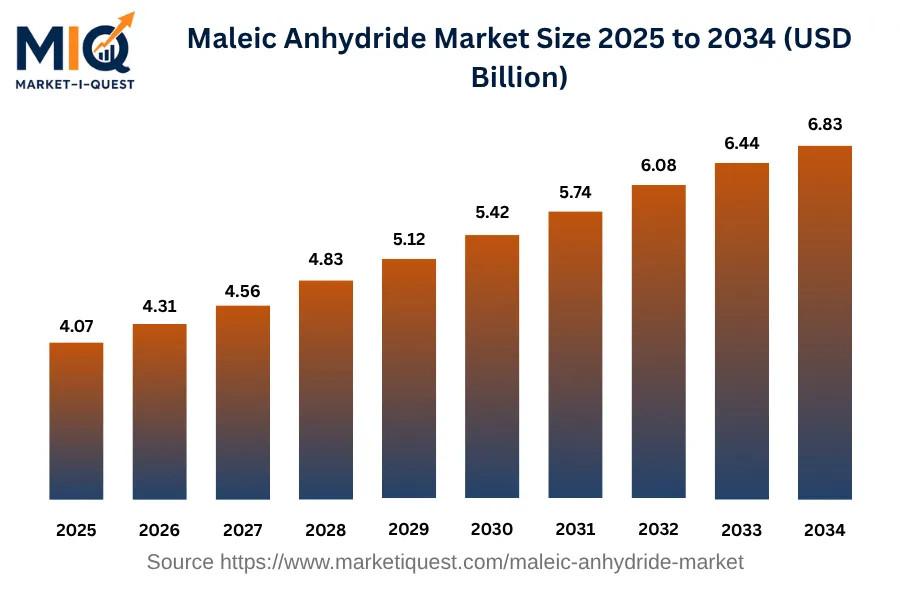
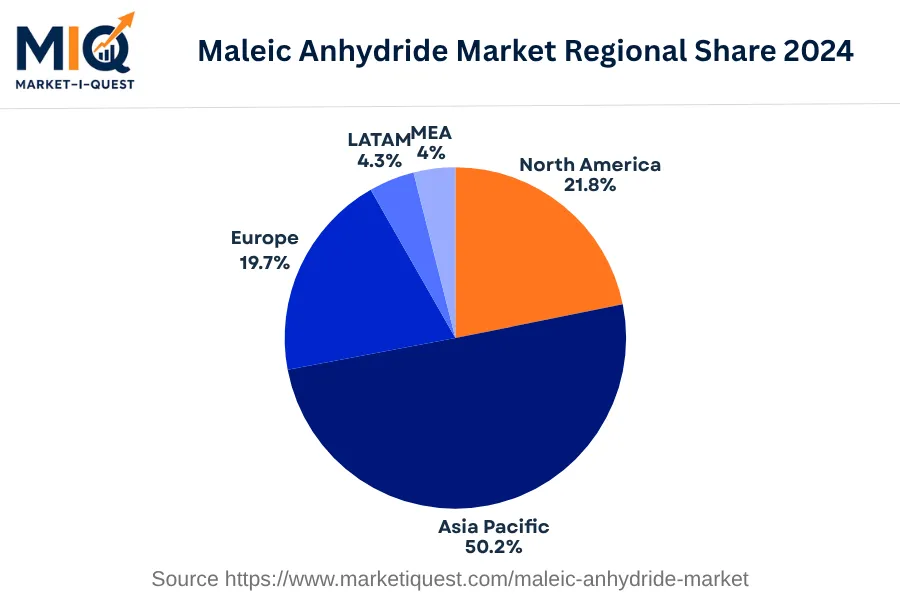
The Maleic Anhydride Market size increased from USD 4.07 billion in 2025 to USD 6.83 billion by 2034, generating a CAGR of 5.92%. Tracing the growth path in this nearly ten-year period, it was seen that the initial market value was USD 3.84 billion in the year 2024. The significant growth over the decade can be attributed to the increasing demand for maleic anhydride in the production of unsaturated polyester resin, 1, 4-butanediol, additives, and copolymers. Moreover, the rising usage of maleic anhydride in the agriculture industry as a pesticide also contributed to the expansion of this market. As of 2024, Asia Pacific accounted for the largest regional share of 50.18%, followed by North America with 21.84%, Europe with 19.72%, LATAM with 4.31%, and MEA with 3.95%.

Key Takeaways

  • By Raw Material - Benzene held the leading position in the Maleic Anhydride Market in 2025.
  • By Application - Lubricant Additives accounted for the highest market share in 2025.
  • By End User - Construction sector led the market dominating the majority share in 2025.
maleic-anhydride-market market size

Key Driving Factors

Heightened use in Unsaturated Polyester Resins Production

Maleic Anhydride is an important compound in the production of unsaturated polyester resins (UPR), which are prevalent in industries like automotive and construction due to their adaptability and cost-effectiveness. From creating insulating materials for buildings to crafting lightweight, corrosion-resistant parts for cars, UPRs rely heavily on Maleic Anhydride. Thus, the sustained growth in these end-user industries directly bolsters the Maleic Anhydride market. To meet these needs, manufacturers are investing in the expansion of their production capabilities, particularly targeting markets where automotive and construction industries are booming.

Increased Application in Agrochemicals Manufacturing

Maleic Anhydride is progressively being utilized in the agrochemical industry to produce herbicides and insecticides. Its properties enable it to effectively destroy pests without causing harm to the crops or the environment. As global food demand continues to rise, particularly in developing countries, so too does the pressure on farmers to increase crop yields efficiently and sustainably. This has led to a surge in demand for effective agrochemicals, hence boosting the market for Maleic Anhydride. Therefore, agrochemical manufacturers are developing new formulations leveraging Maleic Anhydride, thereby spurring growth in this market.

Market Evolution by Timeline

2019-2023
During this period, demand for maleic anhydride was significantly driven by its application in the unsaturated polyester resin industry, particularly in Asia and North America. A trend towards lightweight composite materials for automotive and aerospace sectors underlined consistent procurement. Supply was largely dictated by n-butane based technology, though constraints arose due to environmental challenges and cost-efficient feedstock availability. Notably, the European Union's REACH regulation mandated limited exposure to workers in the manufacturing process. Standardized contracts majorly governed supply transactions with long-term agreements being common. Risks pertained largely to volatility in crude oil prices, thereby impacting the cost of feedstock. An industry response included exploring possible alternatives for feedstock sources.
2024
The market saw a shift in focus to maleic anhydride use in lubricant additives and oil field chemicals, majorly driving the demand. While n-butane remained a prominent technology, efforts were increased towards maleic anhydride production via bio-based feedstock to address the supply-side constraints. Growth continued to be seen in Asia, specifically in China and India. Policy-wise, investments into research for eco-friendly production methods were incentivized by government initiatives globally. Commercial models evolved to include more strategic partnerships for technology sharing and knowledge transfer. Challenges with feedstock price volatility persisted and industry players made investments into developing more efficient manufacturing processes in response.
2025-2029
More stringent environmental regulations induced a surge in the demand for eco-friendly, bio-based maleic anhydride. This demand was primarily concentrated in Europe and North America. Supply technology faced transformation as bio-based production processes matured, loosening the dependency on n-butane. Various Bioeconomy strategies introduced at governmental level, such as the European Bioeconomy strategy, supported this shift. Standardized contracts remained predominant, but there was growing interest in collaborative models between chemical manufacturers and technology providers. Practical challenges included the scale-up of bio-based production processes and managing the initial higher costs. Responses often included co-product value marketing and improvements in supply chain efficiencies.
2030-2034
Demand dynamics metamorphosed into an emphasis on high-performance, low-emission bio-based maleic anhydride, accentuated by the decarbonization agenda in key regions like Europe and Asia. Supply saw early adoption of synthetic biology approaches for efficient bio-based production. Policy support grew more specific, with the EU's Climate Law setting clear decarbonization targets influencing market dynamics. Commercial arrangements showed inclination towards long-term agreements with emphasis on sustainable sourcing clauses. Blocking hurdles were primarily down to the cost-competitiveness of bio-based manufacturing methods in comparison to traditional ones. As a response, industry stakeholders invested in innovation and process optimization for cost-effective bio-based production technologies.

Future Market Outlook

Future Opportunities

As environmental regulations become stricter, opportunities in the maleic anhydride market are set to expand for companies focusing on sustainability. In 2022, the U.S. Environmental Protection Agency announced new regulations aimed at reducing VOC emissions from chemical manufacturing, prompting firms to seek greener alternatives in their production lines. This regulatory pressure is fostering innovation among manufacturers who are exploring the production of bio-based maleic anhydride, capitalizing on the growing demand for eco-friendly materials. In Europe, the European Commission's Green Deal, introduced in 2019, is a significant driver for businesses to invest in sustainable chemical production processes. Companies like Corbion are actively developing bio-based processes that can replace traditional petrochemical methods. Furthermore, strategic partnerships and collaborations are rising; for instance, in 2023, a major collaboration between a leading petrochemical firm and a biotechnology company aimed at developing renewable maleic anhydride solutions is poised to capitalize on changing market dynamics. The expansion of application sectors, notably in automotive and coatings, presents additional avenues for growth. The automotive industry’s increasing demand for lightweight materials drives the need for maleic anhydride applications in composite materials. Given the alignment of regulatory frameworks and market needs, there is a clear pathway for companies investing in sustainable practices to capitalize on these emerging opportunities.

Segmentation Analysis

By Raw Material

The market is subdivided into key subsegments such as Benzene and N-Butane. Among these, Benzene yields the largest revenue share while the N-Butane segment is projected to experience the most rapid growth during the forecast period.

Largest Revenue Share

Benzene

Market Share Leader

The benzene subsegment holds the majority of the market's revenue share due to a variety of factors. It is largely used in the production of a number of chemicals, rubber, resins, synthetic fibers, plastics, and dyes, thereby driving its wide applicability and high demand. A vital factor leading to benzene’s market dominance is its necessity across diverse industries, especially the automobile and construction sectors. As a precursor to heavy-duty materials such as polystyrene and epoxy resins, benzene becomes indispensable in these industries, thus ensuring stable revenue flow. The concentration of these industries in Asia-Pacific jurisdictions, particularly China and India, has further propelled demand. However, there is a nuanced balance, as regulatory restrictions due to benzene’s direct link to adverse health effects may pose risks to the segment’s growth.

Fastest CAGR

N-Butane

Forecast Period Growth Leader

The N-Butane subsegment is anticipated to have the fastest Compound Annual Growth Rate in the market. N-Butane's significant role as a feedstock for producing ethylene and other petrochemicals makes it a vital commodity in a world relying heavily on these materials. Strategic partnerships among key players could represent a growth catalyst, as companies seek secure supply chains and long-term agreements for the raw material. Advances in the extraction and processing technologies have also played an essential role in the increasing adoption of n-butane. Nevertheless, this segment has some adoption barriers, including potential environmental impacts and stricter regulation on flammable substances. Although the subsegment presents near-term growth potential, these factors should be carefully evaluated by stakeholders.

By Application

The market is divided into subsegments including Copolymers, Lubricant Additives, Unsaturated Polyester Resin (UPR), Alkenyl Succinic Anhydrides, Malic Acid, Fumaric Acid, and Others. In the base year 2024, Lubricant Additives accounted for the largest revenue share while Unsaturated Polyester Resin (UPR) is expected to grow at the fastest CAGR during the forecast period.

Largest Revenue Share

Lubricant Additives

Market Share Leader

Lubricant Additives emerged as the most lucrative subsegment in 2024 due to multiple contributing factors. The increasing demand for high-performance engines in the automotive industry has driven demand for high-quality lubricants, which in turn, has accelerated the need for effective lubricant additives. Further, lubricant additives play a crucial role in maintaining engine efficiency by reducing friction and wear, which is an essential purchasing criterion across several industries. Additionally, stringent regulations mandating reductions in carbon emissions are pushing manufacturers to incorporate additives into lubricants. Geographically, the Asia-Pacific region, and particularly countries like China and India, have been substantial contributors to this segment's revenue due to the rapid growth of their manufacturing sectors. It is also worth noting that the switching costs from lubricant additives to alternatives are quite high due to retooling requirements, resulting in sustained demand.

Fastest CAGR

Unsaturated Polyester Resin (UPR)

Forecast Period Growth Leader

The Unsaturated Polyester Resin (UPR) subsegment is expected to experience the highest growth rate. The forecasted acceleration is driven by its broad application in numerous industries including automotive, building and construction, and marine, amongst others. UPR offers exceptional features such as resistance to water, chemicals, and heat, which make it an ideal choice for varied applications, meaning demand is high. In particular, growth in the construction industry, which frequently uses UPR in panels, fixtures, sanitary ware, and roofing, has been a key driving force. With respect to the adoption barriers, the processing technique of UPR is complex and requires skilled labor, which could hinder growth. However, advancements in technology and industry policies aimed at improving labor skills could circumvent this drawback. Potential future risks include fluctuations in raw material supply and the cost associated, although strategic partnerships and advancements in material science technology may mitigate such concerns.

By End User

The market is divided into subsegments including Construction, Automotive, Food & Beverages, Textile, Pharmaceuticals, Personal Care, Agriculture, and Others. The Construction industry accounted for the largest revenue share while the Pharmaceuticals industry is expected to grow at the fastest CAGR during the forecast period.

Largest Revenue Share

Construction

Market Share Leader

The leading position of the Construction industry is driven by several key factors. This end user segment's consumption is heavily tied to global macroeconomic factors such as population growth, urbanization, and government spending on infrastructure projects. The construction industry’s ability to generate large amounts of revenue can be attributed to consistent demand due to population growth and the need for improved infrastructure. Furthermore, developed and emerging markets are seeing an increase in building activities driven by economic growth and an increase in disposable income. Other factors aiding the Construction industry's growth include technological advancements for construction materials and equipment, which further drive the demand. Regulation and supply also play a crucial role, particularly in timelines and cost, making the sector both capital-intensive and profitable.

Fastest CAGR

Pharmaceuticals

Forecast Period Growth Leader

The Pharmaceuticals subsegment is projected to grow at the fastest rate during the forecast period. This industry continues to expand at a rapid pace due to the growing global demand for new and advanced drugs, especially in light of current and ongoing health crises. Technological advancements, coupled with a deepening understanding of diseases on the molecular level, have ushered in a new era of targeted treatment options, thus driving the market's growth. Moreover, policy changes like expedited drug approvals, and the wave of patent expiry of blockbuster drugs, is encouraging R&D investments and partnerships leading to market expansions. However, this growth can be threatened by potential adoption barriers such as high cost of medications, regulatory hurdles, and social/cultural opposition to certain types of drugs. Nevertheless, the outlook remains optimistic due to the critical nature of pharmaceuticals in healthcare.

Competitive Analysis of Maleic Anhydride Market

Key Market Players

Manufacturers / OEMs

Huntsman Corporation
US
BASF SE
Germany
Polynt Group
Italy

Key Suppliers & Raw Materials

INEOS Chemicals
UK
Thirumalai Chemicals Ltd.
India
Nippon Shokubai Co., Ltd.
Japan

Distributors, Integrators & Channel Partners

Ishita Drugs & Industries Limited
India
Sierra Chemical Co.
US
Petrochem Middle East
UAE

Porter’s Five Forces Analysis

This analysis reveals the competitiveness and attractiveness of the Maleic Anhydride Market.

Supplier Bargaining Power

Medium

Controlled by few producers, yet diversified usage suppresses their bargaining power.

Buyer Bargaining Power

Medium

Widespread applications make buyers varied, with significant price sensitivity.

Threat of Substitutes

High

Potential of substitutes like fumaric acid increase the threat considerably.

Threat of New Entrants

Low

High capital expenditure acts as a barrier to market entry.

Competitive Rivalry

High

Market dominated by established firms creating a highly competitive environment.

Regional Analysis

Geographic market dynamics and growth opportunities across key regions

Global Market Outlook

maleic-anhydride-market market regional share

North America

In the base year 2024, the Maleic Anhydride Market in North America exhibited distinctive market dynamics and buying trends. Significant demand from the construction, automotive and agriculture sectors served as the primary drivers due to the requirement for unsaturated polyester resins, 1,4-butanediol, and additives. From a supply perspective, investments into high performance, environmentally responsive production systems stimulated market dynamism. Enhanced business viability was observed as a result of companies adopting proprietary N-butane-based technology for improved production efficiency. Furthermore, a favorable pricing environment backed by stable contracts supported the industry. On the regulatory front, strict emission guidelines in the US urged key manufacturers to adopt sustainable measures, affecting the market pace.

Trends shaping the North American market included increasing buyer preference for eco-friendly options and effective waste management. Shifting focus towards bio-based maleic anhydride production showcased a notable trend as companies responded to consumer demand. Strategic partnerships and mergers and acquisitions burgeoned, enhancing industry competition landscape with notable instances like Huntsman Corporation’s acquisition of Icynene-Lapolla. Corporations enforced stringent air quality standards by imposing fines for non-compliance to limit the release of hazardous air pollutants from the manufacture of maleic anhydride. The industrial and retail sectors remained consistent consumers of maleic anhydride, drawn to its use in surface coatings, lubricant additives and in the production of agricultural pesticides.

Asia Pacific

In the base year of 2024, the Maleic Anhydride Market in the Asia Pacific exhibited significant dynamism. Enhanced demand from burgeoning industries like automotive and construction, coupled with developing regulations favoring polymer recyclability, galvanized market expansion. Focused investments, especially in China and India, to improve infrastructure and establish local manufacturing units accelerated the region's market proliferation. Additionally, the adoption of advanced technology in Japan and South Korea for improved Maleic Anhydride production efficiency bolstered market performance. Concurrent market trends involved shifting consumer preferences toward sustainable products, prompting manufacturers to leverage biodegradable polymers produced from Maleic Anhydride. Industry players in China and ASEAN markets increasingly partnered for better market penetration and supply chain improvements, while technology transformations like intensified ChemRec process dominated in Japan and South Korea.

Policy enforcement around environmental sustainability and chemical safety standards remained a pivotal market driver, particularly in Australia. Dominating sectors included automotive, due to a rise in demand for lightweight yet durable automobile parts and construction, drawn from the increasing infrastructure development projects across the Asia Pacific, specifically in India. The utility sector, with the mounting requirement for heat transfer fluids and antifreeze agents across China and Japan also fueled market uptake, demonstrating the Maleic Anhydride market's multifarious applicability in the Asia Pacific in 2024.

Europe

In 2024, the European Maleic Anhydride Market experienced a dynamic shift, primarily triggered by increasing market drivers from various sectors such as manufacturing, chemicals, and plastics. Regulations fostering the use of bio-based substitutes spurred demand, solidifying trends towards greener industrial processes. An uptick in investment, particularly from Germany and the UK, invigorated supply dynamics. Additionally, the ready adoption of improved catalyst technologies across the region, especially in Italy and Spain, spurred market mobilization. Furthermore, favorable pricing fueled the market, with the Central & Eastern Europe region seeing significant benefits.

Major trends observed included widespread changes in buyer behavior favoring bio-based Maleic Anhydride, largely driven by policy enforcement suppressing the use of their petroleum-derived counterparts. A rush of M&A activities in Benelux and France also redrew the landscape, consolidating market power and technology capabilities. Germany's relentless push for high purity standards shaped products and procedures across the region. Moreover, enterprises across Europe sought greater technology integration into their supply chains, evident in the rising interest for data-driven tool adoption. Lastly, escalating consumer awareness about eco-friendly materials ensured the retail sector’s active participation, exemplifying the amplified role of sustainability in driving market trends.

Latin America

In 2024, the Maleic Anhydride Market in Latin America became increasingly dynamic. Market drivers included rising demand in the automotive industry, specifically in Brazil and Mexico, where technological advancements in auto parts manufacturing necessitated more Maleic Anhydride. Argentina's rapidly expanding construction sector contributed to this growth, leveraging Maleic Anhydride in various building materials. Regulatory frameworks, especially in Chile and Colombia, promoted responsible, eco-friendly production processes, stimulating investment in cleaner technologies. Drop in prices in Peru, due to an oversupply, incentivized increased domestic consumption and import by neighboring countries. Trends in the market pointed to a shift towards sustainable production methods, with more manufacturers adopting greener technologies in response to stricter environmental regulations in Colombia and Brazil.

Demand surge in the medical sector, particularly in Argentina and Mexico, for making disinfectants underlined a notable shift in user behavior. Partnerships between regional manufacturers were increasingly prevalent, with a focus on sharing research and development efforts to innovate production methods. In Peru and Chile, strict enforcement of quality standards led to increased demand for high-grade Maleic Anhydride in the manufacturing and retail sectors. The governments’ push for local production also shaped the market dynamic across LATAM. The year 2024, thus, saw a vibrant and adaptive Maleic Anhydride market catering to diverse sectors from automotive to healthcare.

Middle East & Africa

In 2024, the maleic anhydride market in the Middle East and Africa experienced substantial development due to its increasing local applications. Government regulations such as Saudi Arabia's Vision 2030 encouraging industrial diversification spurred demand as maleic anhydride became an essential chemical in various industries including oil and gas, manufacturing, and retail. Its adoption in the production of lubricating oil additives in UAE had a substantial impact on market growth. Additionally, increased investments in Nigeria's petrochemical sector boosted supply dynamics across the African region.

On the trend front, buyer preferences shifted towards greener products, driving the adoption of bio-based maleic anhydride in countries like Kenya and South Africa. The market also observed significant technological shifts in manufacturing processes in Israel where safer and cost-effective methods were being implemented. Moreover, several Egyptian telecom companies increasingly used maleic anhydride for the production of unsaturated polyester resins in fiber-reinforced plastics. Strategic collaborations were prominent in Qatar's chemicals sector, spotlighting a growing preference for shared resources and expertise. Lastly, stricter enforcement of environmental policies in regions such as Saudi Arabia reinforced the market's trend towards sustainability. Thus, the various drivers and changing trends considerably reshaped the maleic anhydride market in 2024.

Recent Industry Developments

Latest market innovations, product launches, and strategic initiatives

June 2026

MarketsandMarkets published a report projecting the global maleic anhydride market to grow from $1.96 billion in 2026 to $3.79 billion by 2035, at a CAGR of 7.62%. The Asia-Pacific region accounted for 59.6% of the global market share in 2025. Key players include Wanhua Chemical, Huntsman, Changzhou Yabang Chemical, Qixiang Tengda, and Petronas Chemicals Group.

May 2025

Huntsman Corp. announced the closure of its maleic anhydride production plant in Moers, Germany. The closure was driven by continued losses in the European market, with the business recording an adjusted EBITDA loss of approximately $10 million in 2024. Closure work was expected to be completed by the end of the quarter.

Frequently Asked Questions