
Machine Tools Market Snapshot

Key Players

  • DMG Mori (Germany)
  • Mazak (Japan)
  • Trumpf (Germany)
  • Amada (Japan)
  • Haas Automation (United States)
  • Okuma Corporation (Japan)
  • Doosan Machine Tools (South Korea)
  • Makino (Japan)
  • Hurco Companies (United States)
  • JTEKT Corporation (Japan)

Market Size

Base Year 2024
$ 85.38 Bn
CAGR
5.76%
Forecast 2034
$ 149.48 Bn

Market Segments

By Type
  • Metal Cutting
  • Metal Forming
By Technology
  • Computer Numerical Control (CNC)
  • Conventional
By End Use
  • Automotive
  • Aerospace & Defense
  • Others

Market Dynamics

Drivers
  • Technological advancements in CNC machinery
  • Rising demand from automotive sector
Restraints
  • High capital investment requirements
  • Skilled labor shortage
Opportunities
  • Adoption of smart manufacturing
  • Expansion in emerging economies

Market Size

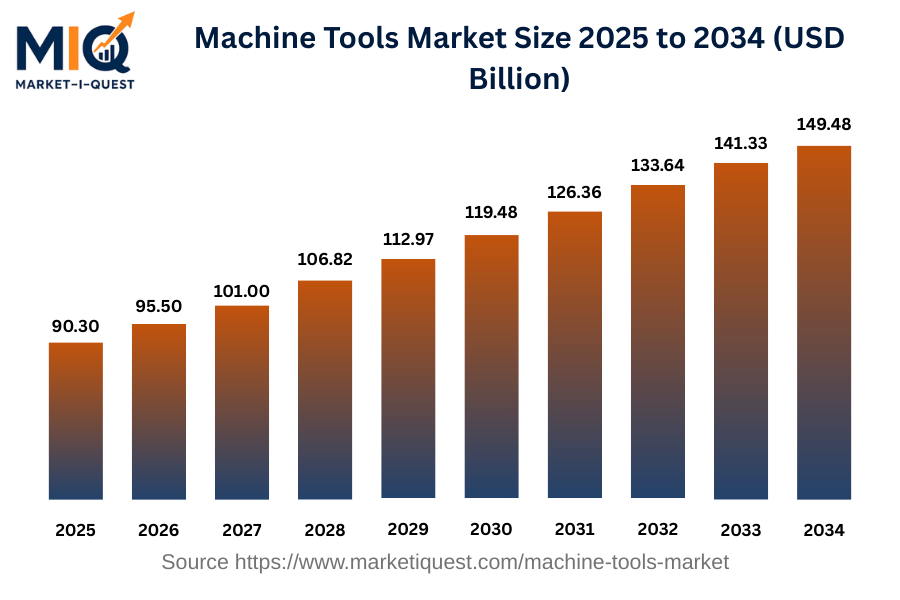
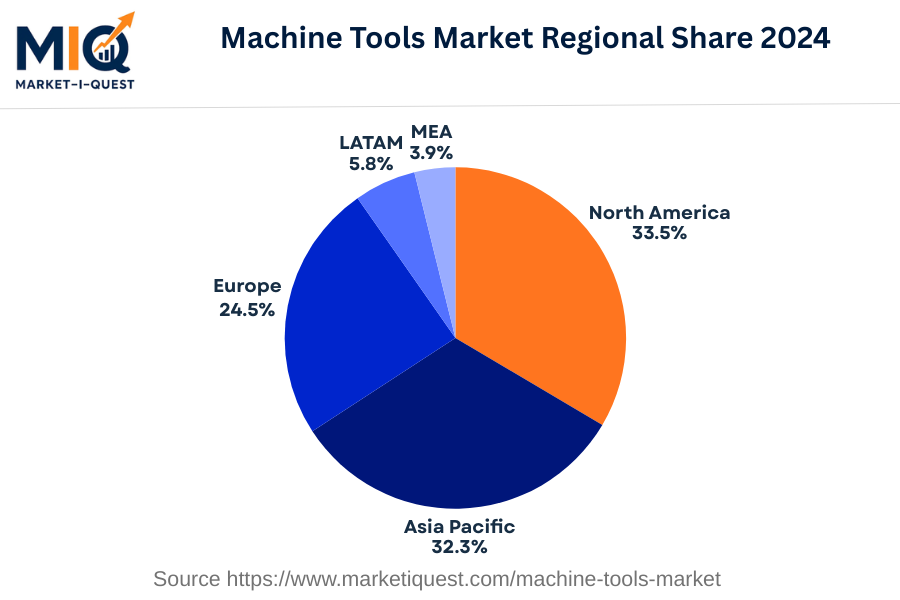
The Machine Tools Market size is 90.30 billion USD in 2025 and is projected to reach 149.48 billion USD by 2034, with a CAGR of 5.76%. The market starts at 85.38 billion USD in 2024, indicating a steady growth trajectory. This growth is attributed to increasing demand for advanced manufacturing technologies and automation solutions, alongside rising investments in industrial processes. Additionally, the expansion of various end-use industries, such as automotive and aerospace, contributes to the market's development. In 2024, the regional share mix is as follows: North America at 33.8%, Asia Pacific at 32.6%, Europe at 24.7%, LATAM at 5.9%, and MEA at 3.9%.

Key Takeaways

  • By Type - Metal Cutting is the leading segment accounting for a significant share in 2024.
  • By Type - Metal Forming is expanding rapidly reflecting increasing demand across various industries.
  • By Technology - Computer Numerical Control (CNC) grew fastest capturing a notable position in 2024.
  • By Technology - Conventional technology held a sizable market share showcasing its established use in the industry.
  • By End Use - Aerospace & Defense is experiencing robust growth indicating strong market potential moving forward.
machine-tools-market market size

Key Driving Factors

Shift Towards Automation in Manufacturing Industries

A prominent factor driving the machine tools market growth is the increasing shift towards automation in various manufacturing industries. As businesses attempt to increase efficiency and reduce labor-intensive processes, they turn to automated machine tools. This not only speeds up production but also improves accuracy, reducing errors associated with manual operations. Moreover, automated machine tools allow for 24/7 production, eliminating the constraints of human labor hours. Industries such as automotive, aerospace, and consumer electronics which require precision and high-volume production are pushing the adoption of machine tools. Additionally, increasing production capabilities in developing regions, particularly in Asia, further bolsters the market demand.
Promotion of Domestic Manufacturing Policies

Nationwide initiatives to promote domestic manufacturing are also significantly driving the growth of the machine tools market. Governments, especially in countries like India and China, are strongly encouraging local manufacturing through various policies and subsidies to reduce dependency on imports and boost economic growth. These policies stimulate the demand for machine tools, as they are fundamental for the development and expansion of manufacturing sectors. For instance, China's 'Made in China 2025' policy aims to upgrade the country's manufacturing industry, including a target to source 70% of basic core components and materials domestically, thus fuelling the machine tools market growth.

Market Evolution by Timeline

2019-2023
The Machine Tools Market during this period saw demand mainly from the automotive, aerospace, and electronics sectors, significantly in Asia-Pacific and North America. Automotive manufacturers in Germany, such as BMW and Volkswagen, adopted advanced CNC machines to enhance precision and efficiency in production. In 2021, the global shift to electric vehicles required new manufacturing capabilities. Supply-side constraints emerged due to chip shortages and shipping delays experienced in regions like Southeast Asia. In terms of technology maturity, Industry 4.0 principles began integrating into operations, with firms like Siemens implementing digital twins for process optimization. Regulation, such as ISO 9001, pushed for quality management in production. Commercial models shifted towards leasing equipment rather than outright purchasing, driven by capital constraints. Partnerships formed between manufacturers and tech companies, like Fanuc and Google Cloud, to streamline operations. Risks included volatility in raw material prices and labor shortages in skilled trades, prompting investments in automation as a countermeasure.
2024
In 2024, demand for machine tools focused on sustainable manufacturing practices, particularly in Europe and North America. Initiatives like the EU's Green Deal influenced manufacturers to invest heavily in equipment that minimized waste. The sector saw increased interest from small to medium enterprises (SMEs), particularly in regions like Italy, which needed affordable yet efficient tooling options. On the supply side, 3D printing and additive manufacturing technologies gained traction, with companies like Stratasys launching new material options suitable for industrial applications. The integration of AI in predictive maintenance tools matured, allowing firms to forecast equipment failures more effectively. Regulations, such as the Machinery Directive in the EU, emphasized safety compliance and environmental standards. Pricing models became more flexible, with pay-per-use contracts gaining popularity among customers. However, risks remained in managing supply chain disruptions due to geopolitical tensions, leading many firms to localize their supply bases in response to earlier experiences.
2025-2029
From 2025 to 2029, the Machine Tools Market experienced a paradigm shift towards highly automated and interconnected systems. Industries in China and India ramped up investment in smart manufacturing technologies, driven by government initiatives like Made in China 2025. Demand surged for machine tools compatible with IoT, as manufacturers sought real-time data analysis for production optimization. Supply chains became more resilient, with firms diversifying suppliers to mitigate risks highlighted by previous shortages. The integration of software solutions, like CAD and CAM, with machine tools saw significant advancements in usability. Regulatory frameworks began mandating cybersecurity protocols in industrial systems, leading to new compliance needs. Commercial models expanded to include subscription-based services, supporting continuous upgrades and maintenance. Obstacles in skilled labor persistence continued, prompting investments in workforce training programs tailored for machine tool usage. Partnerships between machine tool manufacturers and educational institutions became common to bridge the skill gap, essential for effective operations in increasingly complex environments.
2030-2034
In the period from 2030 to 2034, the Machine Tools Market likely evolved into a fully integrated ecosystem, capitalizing on advances in robotics and AI. Demand from sectors like renewable energy, especially wind and solar, grew significantly as these industries required specialized tooling for component manufacturing. Regions in Latin America, particularly Brazil and Mexico, began attracting investments as emerging markets for machine tools. New technologies focused on automating the entire supply chain, with systems capable of self-optimizing based on predictive analytics. Regulatory developments pushed for stricter oversight on sustainability practices, impacting machine design and production processes. Commercial structures might see a trend towards cooperative business models, where companies share equipment and resources to achieve better efficiency. However, risks related to digital security could pose challenges as dependency on interconnected systems increases. Firms likely invested in robust security frameworks to mitigate potential threats, preserving operational integrity in an increasingly complex landscape.

Future Market Outlook

Future Opportunities

Several key trends currently observed within the machine tools sector point toward future opportunities for growth and development. Given the emphasis on automation and technology integration, companies that are involved in R&D, such as DMG Mori and Okuma, are expected to expand their offerings in smart machinery, including features like AI and machine learning capabilities. As industries shift toward sustainable practices in response to the European Union's Green Deal enacted in 2020, the demand for eco-friendly machine tools utilizing less energy and materials is projected to rise. The increasing prevalence of e-commerce and demand for customization within manufacturing sectors opens avenues for businesses to develop flexible machining solutions. Simultaneously, the rise of electric vehicles, as demonstrated by companies like Tesla and Rivian, indicates a growing market for specialized machine tools focused on battery production and automotive components. Moreover, market players should consider partnerships with tech firms to bolster their digital transformation strategies, emulating collaborations seen between traditional manufacturers and software developers. Regulatory changes worldwide concerning safety and emissions standards, including those set by the International Organization for Standardization, will create additional openings for innovation and investment in future machine tool technologies.

Segmentation Analysis

The machine tools market is segmented by Type (Metal Cutting, Metal Forming), by Technology (Computer Numerical Control (CNC), Conventional), and by End Use (Automotive, Aerospace & Defense, Others).

By Type

The market is divided into subsegments including Metal Cutting and Metal Forming. Metal Cutting accounted for the largest revenue share while Metal Forming is expected to grow at the fastest CAGR during the forecast period.

Largest Revenue Share

Metal Cutting

Market Share Leader

Metal Cutting leads the market due to the widespread demand across various industries, including automotive, aerospace, and manufacturing. This subsegment benefits from the increasing need for precision components, which are critical for high-performance applications. Technological advancements, such as CNC machining and laser cutting, have significantly improved the efficiency and accuracy of metal cutting processes, driving up production rates and reducing costs. Customers in sectors that prioritize quality and performance are willing to invest in state-of-the-art cutting technologies, allowing manufacturers to capture higher revenue shares. Geographically, regions with robust manufacturing bases, such as North America, Europe, and parts of Asia, contribute substantially to this subsegment's revenue, bolstered by established supply chains and skilled labor forces. Regulations related to environmental impacts have further prompted manufacturers to adopt efficient and sustainable cutting techniques, enhancing market dynamics. The relatively low switching costs when choosing among different metal cutting technologies also facilitate market entry and expansion, ensuring Metal Cutting remains a dominant player in the market landscape.

Fastest CAGR

Metal Forming

Forecast Period Growth Leader

Metal Forming is projected to experience the fastest growth due to several factors that are reshaping industry demand. The rise of electric vehicles and renewable energy sectors requires advanced forming techniques to create complex shapes and structures, driving innovation in the subsegment. However, adoption barriers such as the need for initial capital expenditure and specialized workforce may impede swift uptake. Recent policy changes aimed at boosting domestic manufacturing and sustainability are acting as catalysts for growth, enabling more companies to pursue metal forming solutions. Collaborations and partnerships among industry players to develop hybrid technologies can also enhance capabilities and reduce costs in metal forming operations. In the near term, risks include fluctuating raw material prices and potential supply chain disruptions, which could impact production schedules and profitability. Nevertheless, companies that adapt quickly to market shifts and continuously invest in technological advancements are likely to capitalize on the burgeoning opportunities present in this dynamic subsegment.

By Technology

The market is divided into subsegments including Computer Numerical Control (CNC) and Conventional. The Computer Numerical Control (CNC) subsegment accounted for the largest revenue share while Conventional is expected to grow at the fastest CAGR during the forecast period.

Largest Revenue Share

Computer Numerical Control (CNC)

Market Share Leader

The Computer Numerical Control (CNC) subsegment leads in revenue due to its efficiency, precision, and increasing application across multiple industries such as aerospace, automotive, and manufacturing. Customers gravitate towards CNC solutions because they enable high-volume production with minimal human error, reducing labor costs and increasing output consistency. Geographically, regions with a strong industrial base, particularly North America and Europe, have seen a significant uptake in CNC technology as companies aim to modernize their equipment and enhance operational capacity. Regulatory standards promoting automation and safety in manufacturing further drive the adoption of CNC machines. Companies often prioritize purchasing based on technical specifications, return on investment, and the capability of technology to integrate with existing systems. Additionally, low switching costs between conventional and CNC systems contribute to high competitiveness, with CNC providing a compelling argument for companies seeking to enhance their productivity and maintain quality, thereby solidifying its dominance in revenue generation.

Fastest CAGR

Conventional

Forecast Period Growth Leader

The Conventional subsegment is poised for the fastest growth due to several factors, including the rising need for cost-effective and flexible machining solutions among small to medium-sized enterprises (SMEs). While CNC machines dominate high-volume production, many SMEs find conventional machinery more accessible due to lower initial investment costs and ease of use. Additionally, there is a renewed interest in manual machining techniques and hybrid models that combine manual and automated processes, allowing for more tailored production approaches. However, several barriers to adoption exist, including the perception that conventional machines may not yield the same efficiency as CNC solutions. To address these concerns, strategic partnerships and technology enhancements are emerging to modernize conventional systems, focusing on adaptability rather than outright replacement. Near-term risks such as fluctuating raw material prices and labor shortages may influence growth, but the overall push for diversified machining capabilities positions the Conventional subsegment favorably for future expansion in a complex manufacturing environment.

By End Use

The market is divided into subsegments including Automotive, Aerospace & Defense, and Others. The Automotive subsegment accounted for the largest revenue share while the Aerospace & Defense subsegment is expected to grow at the fastest CAGR during the forecast period.

Largest Revenue Share

Automotive

Market Share Leader

The Automotive subsegment leads in revenue due to the ongoing transformation in the industry towards electrification and advanced driving technologies. Major automotive manufacturers are investing significantly in research and development to innovate electric vehicles, which are becoming increasingly popular among consumers seeking sustainable alternatives to traditional vehicles. Additionally, stringent governmental regulations aimed at reducing carbon footprints are accelerating the shift toward electric and hybrid vehicles, further boosting demand in this segment. Key customers include large automotive OEMs and Tier 1 suppliers who are looking for advanced materials and components to meet new performance and safety standards. Geographically, regions with strong automotive manufacturing ecosystems, such as North America and Europe, continue to dominate the market, driven by established supply chains and a well-developed infrastructure. Purchasing criteria have shifted towards energy efficiency, safety enhancements, and sustainability, leading automotive companies to prioritize collaborations with technology providers that offer innovative solutions. Manufacturers face relatively low switching costs when exploring new technology or materials, fostering a competitive environment that drives revenue in this subsegment.

Fastest CAGR

Aerospace & Defense

Forecast Period Growth Leader

The Aerospace & Defense subsegment is poised for the fastest growth driven by increasing global defense expenditures and a surge in air travel demand as economies recover from recent disruptions. Technological advancements in both commercial and military applications are creating new opportunities for the adoption of innovative materials and systems that enhance performance and efficiency. Partnerships between private aerospace firms and government entities are catalyzing investments that accelerate research and development, particularly in sustainable aviation technologies and unmanned aerial vehicles. However, adoption barriers include high capital expenditures and lengthy regulatory approval processes that can delay innovation implementation. Additionally, fluctuating defense budgets in key markets may introduce uncertainty for some firms. Nevertheless, the push for modernization in military capabilities and advancements in commercial aircraft technologies provides a robust growth outlook. Near-term risks such as geopolitical tensions and supply chain disruptions can impact growth rates, but strategically aligned companies that navigate these complexities effectively will likely capture a significant share of the expanding market.

Competitive Analysis

Key Market Players

The machine tools market is competitive, with a mix of large established companies and smaller regional players. Most companies focus on improving their products/services, keeping prices attractive, and strengthening relationships with key customers. They also use partnerships, acquisitions, and new launches to expand their presence in existing and new markets. Overall, players compete on quality, reliability, and value, and competition is expected to remain strong over the forecast period.

Manufacturers / OEMs

DMG Mori
Germany
Mazak Corporation
Japan
Haas Automation
US

Key Suppliers & Raw Materials

Sandvik Coromant
Sweden
Kennametal
US
Seco Tools
Sweden

Distributors, Integrators & Channel Partners

MSC Industrial Direct
US
Motion Industries
US
Fastenal
US

Porter’s Five Forces Analysis

This analysis examines the competitive dynamics within the Machine Tools Market. It identifies various forces that influence the industry's profitability.

Supplier Bargaining Power

Medium

Suppliers have moderate power due to specialized components and limited alternatives.

Buyer Bargaining Power

High

Buyers wield high power due to numerous choices and low switching costs.

Threat of Substitutes

Medium

Substitutes exist, but strong brand loyalty and performance needs limit their impact.

Threat of New Entrants

Low

High capital requirements and technical expertise create significant barriers to entry.

Competitive Rivalry

High

Intense competition driven by innovation, product differentiation, and price wars among established players.

Regional Analysis

Geographic market dynamics and growth opportunities across key regions

Global Market Outlook

machine-tools-market market regional share

North America

In 2024, the North American machine tools market growth is characterized by robust demand driven primarily by the manufacturing sector, critical to economic growth in the U.S., Canada, and Mexico. Key drivers include a surge in automation investments, driven by the need for increased efficiency, particularly in automotive and aerospace industries. Regulatory policies aimed at enhancing manufacturing resilience and sustainability, such as the U.S. government’s Manufacturing USA initiative, bolster investment in advanced machine tools. Furthermore, supply chain challenges seen post-pandemic continue to drive localized sourcing strategies, increasing the demand for domestic machine tool manufacturing.

Trends indicate a shift towards advanced manufacturing technologies, including additive manufacturing and CNC machining, which are reshaping product offerings. Buyers are increasingly favoring suppliers with integrated solutions that combine machine tools with software capabilities, indicating a significant shift in buyer preferences towards solutions over standalone products. Partnerships between software companies and machine tool manufacturers are becoming prevalent, facilitating better customer service and product innovation. Additionally, ongoing enforcement of quality standards, like ISO 9001, is influencing procurement decisions across government and enterprise sectors, ensuring compliance and operational excellence in machine tool usage.

Asia Pacific

In 2024, the machine tools market in the Asia Pacific is characterized by an increasing demand driven by robust manufacturing activity across key sectors such as automotive, aerospace, and electronics. China's commitment to enhancing its manufacturing capabilities through initiatives like "Made in China 2025" has fueled investment in advanced machine tools, influencing regional supply dynamics. India is experiencing similar growth, supported by government initiatives aimed at boosting domestic manufacturing under the "Make in India" program, which drives local investment and technology adoption.

Trends indicate a marked shift towards automation and smart manufacturing technologies. Buyers are increasingly prioritizing precision and efficiency, leading to a rise in demand for CNC machines and integrated manufacturing solutions. The proliferation of 3D printing technology within key ASEAN markets is reshaping traditional machining practices, fostering new partnerships between technology providers and manufacturers. Additionally, regulatory standards concerning safety and environmental impact are prompting manufacturers to comply with stricter policies, which in turn influences market dynamics. Japan and South Korea remain leaders in cutting-edge technology, focusing on R&D to enhance product offerings while maintaining their competitive advantage in high-precision tools. Overall, these factors collectively define the Machine Tools Market landscape in the Asia Pacific for 2024.

Europe

In 2024, the machine tools market expansion in Europe is characterized by robust demand driven primarily by the resurgence of manufacturing activities and a strong focus on automation technologies. The increasing complexity of manufacturing processes across sectors such as automotive and aerospace fuels investment in advanced machine tools. Regulatory initiatives, including the EU’s Green Deal, stimulate the shift towards sustainable manufacturing, prompting investments in energy-efficient equipment. Moreover, the supply chain adaptations post-COVID-19 continue to influence pricing dynamics and availability.

Trends indicate notable shifts in buyer behavior, with enterprises prioritizing flexibility and customization in machine tool purchases, reflecting a growing emphasis on Industry 4.0. There is a significant uptick in the adoption of CNC (computer numeric control) systems, supporting precision and efficiency. Additionally, partnerships between technology providers and manufacturers are expanding, enhancing collaborative innovation and market access. In regions like Germany and Italy, the prevalence of SMEs is redefining distribution channels, with local suppliers gaining prominence in providing tailored solutions. In Central and Eastern Europe, rising manufacturing hubs demonstrate increasing investments in machine tools as companies seek to modernize production capabilities and meet quality standards in line with EU regulations.

Latin America

In 2024, the machine tools market demand in Latin America is characterized by increased manufacturing activity and investment in industrial automation. Brazil's surge in automotive and aerospace production drives demand, while Mexico benefits from its proximity to the U.S. and a strong manufacturing base. Argentina's government initiatives, such as the "Plan for National Production," bolster local machine tool production. Regulatory frameworks in Colombia and Chile enhance technology adoption and compliance standards, prompting manufacturers to upgrade equipment.

Trends indicate a shift toward advanced technologies, with growing interest in CNC machinery and automation solutions to improve efficiency. As sustainability gains traction, manufacturers increasingly prioritize energy-efficient machines, impacting purchasing decisions. Buyers, particularly in automotive and consumer goods sectors, are gravitating towards suppliers capable of providing integrated solutions rather than standalone products. Partnerships are forming among local firms and global machine tool manufacturers, particularly in Brazil and Mexico, aiming to enhance service offerings and local capabilities. Policy enforcement regarding industrial safety and emissions standards in several countries also compels manufacturers to invest in more sophisticated and compliant machinery, driving the overall market evolution in the region.

Middle East & Africa

In 2024, the machine tools market opportunities in the Middle East and Africa are characterized by significant regional investment and industrial growth. Driven by the expansion of the manufacturing sector in Saudi Arabia and the United Arab Emirates, there is an increased demand for CNC machines and automation technologies. Regulatory frameworks such as Saudi Vision 2030 encourage local production and diversification, leading to heightened investment in advanced machinery. Technological adoption, particularly in sectors like oil and gas and construction, further stimulates demand for precision tools and manufacturing solutions.

Trends reflect a shift towards digitalization and Industry 4.0 practices. Buyers are increasingly seeking smart manufacturing solutions, enhancing connectivity and efficiency in operations. Partnerships between local firms and international machinery manufacturers are becoming common, facilitating knowledge transfer and technology exchange. Moreover, policy enforcement in countries like Egypt and South Africa is steering investments into more sustainable manufacturing practices, impacting purchasing standards. The automotive and aerospace sectors are notably active, demanding high-precision tooling and machining capabilities. In Nigeria and Kenya, the burgeoning construction market is also driving machine tool investments, emphasizing the necessity for scalable and adaptable manufacturing systems to meet local needs.

Recent Industry Developments

Latest market innovations, product launches, and strategic initiatives

Jul 2025

Siemens and DMG MORI announced a strategic partnership to integrate Siemens’ digital manufacturing software with DMG MORI machine tools, aiming to deliver end‑to‑end digitalized production and improved efficiency for machine‑tool users globally.

Apr 2025

UNITED GRINDING Group completed the acquisition of GF Machining Solutions, creating UNITED MACHINING SOLUTIONS with about USD 1.5 billion in sales and a 15‑brand portfolio, positioning the combined Swiss group as one of the largest machine‑tool manufacturers worldwide.

Apr 2025

DMG MORI acquired KURAKI Co., Ltd., a specialist in CNC horizontal boring and milling machines, and began rebranding the combined operation as DMG MORI Precision Boring Co., Ltd., expanding its portfolio in high‑end machining centers for automotive and heavy industry.

Frequently Asked Questions