
Machine Condition Monitoring Market Snapshot

Key Players

  • Schaeffler AG (Germany)
  • SKF (Sweden)
  • Rockwell Automation (United States)
  • Emerson Electric (United States)
  • Honeywell International (United States)
  • General Electric (United States)
  • National Instruments (United States)
  • Meggitt (United Kingdom)
  • Bruel & Kjaer (Denmark)
  • Azima DLI (United States)

Market Size

Base Year 2024
$ 3.47 Bn
CAGR
6.42%
Forecast 2034
$ 6.46 Bn

Market Segments

By Material
Plastic, Metal, Rubber, Ceramic, Others
By Machine Type
Electric, Hydraulic, and Hybrid
By Clamping Force
0 - 200 Ton Force, 201 - 500 Ton Force, and Above 500 Ton Force
By End-use Industry
Packaging, Automotive, Electronics and Telecommunication, Healthcare, Infrastructure, Others

Market Dynamics

Drivers
  • Increasing industrial automation
  • Advancements in predictive maintenance technology
Restraints
  • High installation costs
  • Limited skilled workforce
Opportunities
  • Rise in predictive maintenance
  • Growing industrial automation

Market Size

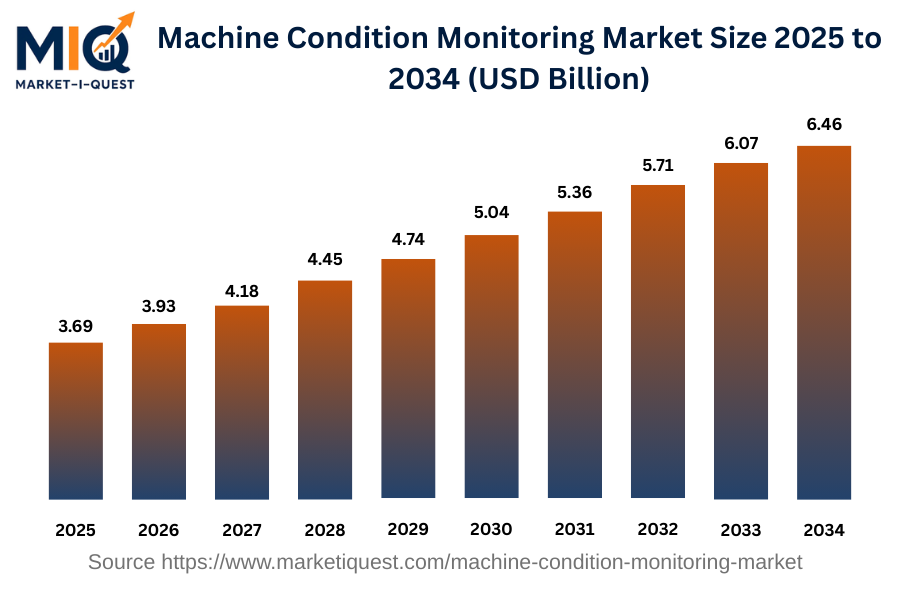
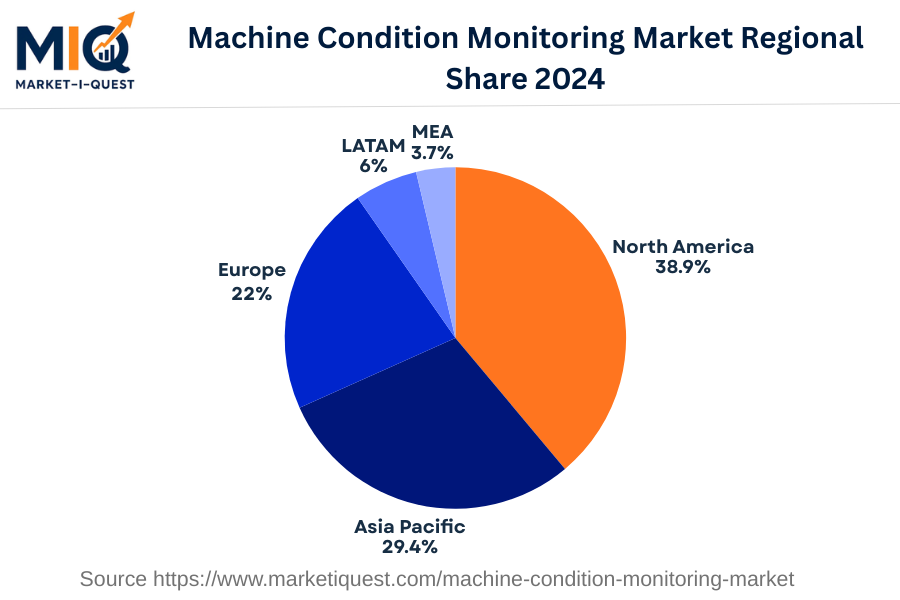
The Machine Condition Monitoring Market share in 2025 is projected to reach USD 3.69 Billion and will grow to USD 6.46 Billion by 2034, at a CAGR of 6.42%. With a starting size USD 3.47 Billion in the base year 2024. The market continues to grow consistently over the years resulted increasing the size nearly around USD 2.77 Billion within the period of 2025 to 2034. This marks a substantial expansion in the Machine Condition Monitoring market expansion over the period. In terms of regional shares in the year 2024, North America holds the largest market share at 38.9%, followed by the Asia Pacific at 29.4%. Continuing with Europe at 22% of the share, while the Latin America and Middle East & Africa regions with 6% and 3.7% of the market share respectively.

Key Takeaways

  • By Material - Plastic segment governed with a leading share during the base year.
  • By Machine Type - Hydraulic machinery showcased the highest growth indicating a strong market preference.
  • By Clamping Force - 201-500 Ton Force category dominated reflecting the demand for lighter equipment.
  • By End-use Industry - Automotive sector emerged as the leader underscoring the critical need for machine monitoring in this industry.
machine-condition-monitoring-market market size

Key Driving Factors

Implementation of Predictive Maintenance Strategies

The growing importance of predictive maintenance in industrial operations has emerged as a key driving factor for the Machine Condition Monitoring Market growth. The increased usage of condition monitoring tools is due to predicting the factors such as potential equipment failure, minimizing downtimes and reducing maintenance costs are majorly shift towards predictive maintenance. With shifting the industry focus from reactive maintenance routines which result in higher cost and low inefficiency toward the ones with more efficiency. The recognition of predictive maintenance is increasing particularly in sectors where equipment failures costs are higher, such as manufacturing, mining, oil and gas and power generation industries. As a result, these sectors are swiftly implementing machine condition monitoring systems, positively impacting the machine condition monitoring market growth.
Rising focus on Energy Efficiency

The drive towards energy efficiency and sustainability throughout the globe has been consistently influencing the Machine Condition Monitoring Market share. With effective monitoring of machine conditions with identifying the inefficiencies and correcting them resulting in reducing the power consumption are been effectively recognized by businesses. This makes machine condition monitoring a crucial tool for any organization aiming to reduce carbon footprint and meet sustainability goals. Regulations like the Energy Efficiency Directive from the European Union further complicate this by setting binding measures for EU countries to use energy more efficiently. Therefore, organizations across various sectors are investing in machine condition monitoring technologies to meet regulatory standards and contribute to the global effort of mitigating climate change.

Market Evolution by Timeline

2019-2023
Between 2019 and 2023, manufacturers in the automotive and aerospace industries primarily implemented machine condition monitoring systems. The demand emerged from North America and Western Europe. Within this period, suppliers successfully integrated these systems into larger plant automation and control systems using industrial internet of things (IIoT) technology. However, this implementations were limited due to bandwidth and security issues. Governments started establishing safety and operational efficiency regulations with a demand for machine health information most providers sell hardware and associated services, with pricing models based on up-front hardware costs including ongoing service fees. With businesses continuously seeking for partnerships with providers to manage better implementation and maintenance. The major challenges were related to the integration with existing systems and the costs involved.
2024
In 2024, use of machine condition monitoring equipment spread within various sectors including the renewable energy and healthcare sectors, with Asia and Eastern Europe regions experienced an increased demand. Major technology shifts including wireless connectivity and use of artificial intelligence for predictive maintenance. With the constant improvements in these technologies still the level of adoption were limited due to several delay and data integrity issues. Implementation was guided by newly established IIoT cybersecurity standards such as ISA/IEC 62443. Pricing shifted towards a more service-oriented model, including predictive maintenance services. The main identified risk was the reliance on a single vendor for maintenance due to proprietary technology.
2025-2029
The period of 2025-2029 various sectors including construction and mining saw an increase in the adoption of machine condition monitoring systems, particularly in the Middle East and Africa. The development of technology into edge computing and fog networks for effectively addressing downtime issues and enhancing the accuracy of condition prediction. Industrial efforts directed towards achieving Industry 4.0 saw governments in countries like Germany setting mandatory compliance for predictive maintenance in industries. The commercial model experienced a shift towards full-service contracts, including both predictive and corrective maintenance. However, equipment compatibility with a wide range of older machines remained a question till the end of this period.
2030-2034
Between 2030-2034, the largest buyers of machine condition monitoring systems were from logistics and transportation sectors, majorly from South America and Southeast Asia regions. With a notable increase in integration with cloud-based infrastructure and AI-based decision-making models. The matured technology allowed for smooth integration, increased data storage capacity and enhanced data privacy. Governments throughout the global widely adopted predictive machinery maintenance as an industry standard. Budgets were mostly allocated to filter out vendor lock-in, favouring open-source or interoperable solutions. The commercial model shifted towards pay-per-utilisation contracts, with additional charges for data storage. Potential risks included data breaches resulting in negative developments.

Future Market Outlook

Future Opportunities

The machine condition monitoring market opportunities are largely influenced by current technological adoption and regulatory developments. The integration of automated monitoring solution is projected to accelerate with increasing adoption of Industry 4.0 standards. Notably, the European Union has established regulations highlighting the need for improved safety in industry, efficiently aligning with enhanced monitoring capabilities. In 2023, multiple automotive manufacturers started implementing condition monitoring systems to adapt with stricter emission regulations. Similarly, in the U.S., the Occupational Safety and Health Administration (OSHA) encouraging businesses for the adoption of digital monitoring tools, creating path for new market entrants. Additionally, the growing firms of data analytics specializing in predictive tools represents the channels for collaboration indicating partnerships between software developers and machinery manufacturers in 2023. The focus on sustainability is motivating companies to prioritize efficiency, which open opportunities for condition monitoring solutions contributing to energy savings and reducing waste, identified by various sustainability initiatives launched in North America and Asia. The interconnected nature of machinery and systems is set to redefine operational standards, enhancing performance and driving consistent compliance standards while reducing operational costs.

Segmentation Analysis

By Material

The market by material is divided into subsegments including Plastic, Metal, Rubber, Ceramic, and Others. Plastic accounts for the largest revenue share, while the Ceramic segment is expected to grow at the fastest CAGR during the forecast period.

Largest Revenue Share

Plastic

Market Share Leader

The Plastic subsegment leads the market in terms of revenue due to its widespread in applications across various industries. Due to its factors such as cheaper in cost of production compared to other materials, versatile and offers significant benefits for performance ratio. Its properties makes it a critical resource across industries like construction, electronics, packaging, and automobile. This widespread application drives its adoption, reducing the high demand. In particular, markets such as packaging, electronics and construction increasing contribute to its revenue, due to the massive quantities involved in those operations. Swapping plastic with alternatives also sustains substantial switching cost, providing further stability to its revenue. Demand is widely distributed regionally, with APAC regions, particularly China, and North America leading the segment with their massive manufacturing and consumption. Regulatory changes, particularly those related to environmental impact, are the biggest downtimes for this subsegment's future.

Fastest CAGR

Ceramic

Forecast Period Growth Leader

The Ceramic segment is positioned as a fastest growth engine within the material market. The specific factors contributing to this development are varied. Technological advancements in ceramic production have allowed for a broader range of applications, from electronics to bio-ceramics applied in medical procedures. As ceramics have excellent heat resistance and endurance properties, their adoption has grown in demanding applications such as aerospace and defense. Following with, policy changes have been favorable towards materials with a lower environmental impact, resulting in increased industrial preference for ceramic-based products. Unfavourably, the high capital expenditure related with starting ceramic manufacturing could act as a restriction with the entering of new players in the machine condition monitoring market opportunities. This high entry barrier and the need for effective partnerships with future users to ensure market advantage, contributes to its dynamic market structure. It is important to note that the regional focus of ceramic growth may shift towards developed markets with a robust industrial framework for high-end ceramic production and usage.

By Machine Type

The market is divided into subsegments including Electric, Hydraulic, and Hybrid machines. The Hydraulic machines accounted for the largest revenue share while the Electric machines are expected to grow at the fastest CAGR during the forecast period.

Largest Revenue Share

Hydraulic

Market Share Leader

The Hydraulic machines have been the leading segment in terms of revenue generation. Several drivers are behind this substantial dominance. The reliability of Hydraulic machines resulted in increasing demand in various sectors such as construction, mining, and manufacturing. With factor such as generation of greater force compared to Electric and Hybrid machines, thus making them suitable for heavy-duty applications. These machines have a wider market interest due to their lower initial cost and maintenance requirements. Regionally, the Asia-Pacific region, particularly countries like China and India has witnessed high demand for Hydraulic machines due to a surging construction industry and growing industrialization. The purchasing decision is driven by the high productivity and durability of these machines, which are of primary importance for end-users.

Fastest CAGR

Electric

Forecast Period Growth Leader

The Electric subsegment is projected to experience the fastest CAGR. With several factors can resulting this accelerated expansion. The worldwide shift towards cleaner and sustainable industrial methods is increasing the adoption of Electric machines. Considered as eco-friendly with lower carbon emissions, aligning with global trends to climate change. The improvements in battery technologies and reduction in electric machinery prices, especially in developed economies, are drivers for this adoption. Furthermore, partnerships with technologically adopted firms and governmental policies are also supporting the adoption of Electric machines. High initial investments and supply chain disruptions could pose near-term risks.

By Clamping Force

The market is divided into subsegments including 0 - 200 Ton Force, 201 - 500 Ton Force, and Above 500 Ton Force. The 201 - 500 Ton Force subsegment accounted for the largest revenue share while the Above 500 Ton Force subsegment is expected to grow at the fastest CAGR during the forecast period.

Largest Revenue Share

201 - 500 Ton Force

Market Share Leader

The 201 - 500 Ton Force subsegment holds the largest share in terms of revenue in the machine condition monitoring market analysis. A principal factor behind this dominance is its versatility in a range of applications across various industries, including automotive, aerospace, and manufacturing. Meanwhile, this clamping force range is ideal for medium-sized mold products, making it a preferred choice compared with other categories. The mentioned industries have seen increased development in recent years adapting into higher demand for medium clamping force machinery. In addition, as per the common market structure, the balance can be inferred between cost and performance that machines in this range offer would be a key purchasing criteria, thereby contributing to its leading revenue share. Regionally, manufacturing hubs like China and India likely have increased demands shifting toward this category given their focus on mass production of mid-sized products.

Fastest CAGR

Above 500 Ton Force

Forecast Period Growth Leader

Above 500 ton force is projected to experience the fastest growth in the market. The adoption of larger machinery, specifically those with a clamping force above 500 tons, are driven by growth in industries requiring large and complex moldings like the production of major home appliances, automotive parts and large electronics. The projection for rapid growth in these industries in developing countries, indicating in the expansion of this subsegment. Furthermore, advancements in technology and shift towards automated and AI-driven machinery are major drivers, with increasing the adoption rates of higher force machinery even with higher initial costs. However, near-term risks may involve economic changes and unpredictable shifts in industry preferences.

By End-use Industry

The market is divided into subsegments including Packaging, Automotive, Electronics and Telecommunication, Healthcare, Infrastructure, and Others. The Automotive subsegment accounted for the largest revenue share in 2024, while the Electronics and Telecommunication segment is expected to grow at the fastest CAGR during the forecast period.

Largest Revenue Share

Automotive

Market Share Leader

Automotive holds the largest subsegment in terms of revenue in the market, various drivers attributed in the dominance. The automotive industry has been rapidly integrating technologically advanced features with demand of innovative solutions. Increasingly fuelling the income, combined with rising expectations of consumer and purchasing power are the major drivers for increased automobile sales, with growing revenue generation from this segment. The major regions contributing to this evolution include North America and Europe, where adoption of advanced automotive technologies is common. Including stricter regulatory standards related to vehicle safety in these regions have promoted the use of high-quality products in vehicles, further fuelling the development of this subsegment. A reliable supply chain with low switching costs due to the varied provider base and efficient channels have also been significant contributing to this trend.

Fastest CAGR

Electronics and Telecommunication

Forecast Period Growth Leader

The Electronics and Telecommunication subsegment is projected the fastest growth in terms of CAGR. In the electronic industry this acceleration can be attributed to the rapid spread and expansion, fueled by technological advancements and changing demands of the consumers. Drivers include the increased accessibility of smartphones and other electronic devices, with increasing competition leading to a quick product upgrade cycle and governments and enterprises adopting digital transformations. However, adoption barriers such as data security concerns and high initial investment for setting up advanced electronic systems with expansion in 5G and IoT technology acts as a driver for this segment, whereas risks sustain in the form of potential regulatory changes and technical issues. The rise in partnerships between industry players can be seen as an attempt to overcome these barriers and increase the market growth.

Competitive Analysis

Key Market Players

Manufacturers / OEMs

SKF Group
Sweden
Emerson Electric Co.
US
Rockwell Automation, Inc.
US

Key Suppliers & Raw Materials

National Instruments Corporation
US
Siemens AG
Germany
Honeywell International Inc.
US

Distributors, Integrators & Channel Partners

Azima DLI Corporation
US
Bruel & Kjaer Vibro GmbH
Germany
Fluke Corporation
US

Porter’s Five Forces Analysis

Analysis of the competitive environment of the Machine Condition Monitoring market.

Supplier Bargaining Power

Medium

Controlled by few but not many suppliers, especially for advanced sensors and software solutions.

Buyer Bargaining Power

High

Buyers have strong negotiating leverage due to the variety of vendors offering similar products.

Threat of Substitutes

Low

Few substitutes exist due to the necessity of machine maintenance for business operations.

Threat of New Entrants

Medium

Advancements in technology can lower barriers, but need for domain expertise can deter newcomers.

Competitive Rivalry

High

Intense competition exists due to numerous well-established players offering similar products.

Regional Analysis

Geographic market dynamics and growth opportunities across key regions

Global Market Outlook

machine-condition-monitoring-market market regional share

North America

In 2024, the Machine Condition Monitoring market experience significant growth across North America.

Including various industrial sector such as manufacturing, utilities, oil and gas drives the high demand for predictive maintenance solutions. With contributions such as allowing real-time condition monitoring and reducing system downtime these factors are resulted in increasing adoption of Internet of Things (IoT) technology. OSHA enforced strict regulations for ensuring proper proper maintenance of machinery in U.S. which further fueled the expansion of market.

The acceleration of trends included increasing shift towards integration of AI and machine learning with condition monitoring systems, particularly in U.S. tech companies. In attempt to maximize monitoring capabilities and reducing operational costs, with a visible increasing trend of partnerships and mergers, particularly in Canada's oil and gas landscape. Lastly, the increased focus on sustainability led to a surge in demand for energy-efficient monitoring systems, particularly from enterprise customers.

Sectors such as enterprise, manufacturing and oil & gas continued to dominate the machine condition monitoring market demand across North America in 2024, with increased adoption rates in sectors such as utilities, healthcare, and retail. With technology providers and monitoring service providers in the U.S., Mexico, and Canada witnessed a significant increase in their customer base. Due to high adoption rates and mature industrial sector U.S. remains the most promising market.

Asia Pacific

IIn 2024, the Machine Condition Monitoring market in the Asia Pacific region experienced significant growth.
The machine condition monitoring market expansion was fueled with increasing investments in predictive maintenance in manufacturing sectors majorly in countries such as China and India driven by the interest for optimized productivity. With the strict government regulation influenced the factors such as machinery safety and efficiency due to the adoption of condition monitoring technology particularly in Australia and South Korea. Meanwhile, the rapid adoption of Internet of Things technology across Japan's industrial sector increased the need for remote machine condition monitoring.

The year witnessed a substantial shift in buyer behaviours, majorly due to growing awareness about minimizing equipment downtime. In terms of technology, increasing reliance on wireless condition monitoring was notable with benefits of real-time data collection. In terms of channel dynamics, there was increase in direct manufacturer sales, driven by increasing online presence. Moreover, countries like China and ASEAN machine condition monitoring market analysis saw an increase in M&A activities with the aim of broadening their technological capabilities.

Significant adoption of machine condition monitoring was seen across various sectors. While the manufacturing sector remained the key adopter, utilities and the enterprise sector also showed increased application, particularly in India.

Europe

In 2024, the machine condition monitoring market in Europe showed a growing digitization with Industry 4.0 revolution. The key drivers were the increasing demand from manufacturing, utilities and including other industrial sectors for predictive maintenance technologies aiming to increase efficiency and reduce downtime. Government regulations, particularly in Germany and UK, preferred the adoption of Industry 4.0 standards with boosting the machine condition monitoring market demand. Increased investment in data analytics techniques and IIoT technologies, resulting in greater supply.

Particularly, customers in sectors like retail and healthcare, experienced an increase towards cloud-based monitoring solutions contributing real-time data with easier scalability. Technological advances included AI and machine learning which transformed condition monitoring into a more predictive tool. Meanwhile, a marked increase in strategic partnerships between monitoring solution providers and industrial companies, leading to specialized solutions customized according to specific industry needs. In regions like Benelux and the Nordics, dynamic policy enforcement driving the standardization in machine condition monitoring, allowing for a more suitable market environment. The machine condition monitoring market trends in Europe in 2024 was thus, characterized driven by growing regulation, technological innovation and increasing customer demand for advanced customized solutions.

Latin America

In 2024, the Machine Condition Monitoring market in Latin America experienced notable growth. Driving the adoption of technology rise in countries such as Brazil, Mexico, Argentina, Colombia, Chile, and Peru with the usage of condition monitoring tools by industries for prevention of machinery failures and reduce maintenance costs. With increasing investments by the key players such as Petrobras and Vale in Industry 4.0 technologies supported this increase, while strict safety regulations within the manufacturing and energy sectors for superior equipment performance standards and reliability.

Oil and Gas companies in Mexico and Colombia influenced the machine condition monitoring market trends with increasingly turning to vibration analysis and thermography to maintain pipelines and infrastructure, experiencing a trend towards predictive maintenance solutions. Additionally, a rise in strategic partnerships was observed, such as between Argentina's YPF and SKF with highlighting a move towards service-based business models in the region.

Simultaneously, the retail sector showed increased demand for monitoring technologies, integrating towards data-driven strategies for optimizing operational efficiency. Meanwhile, enforcement focused on energy-efficiency policies in Chile increased the adoption of condition monitoring systems within utilities, contributing in reduced energy consumption

Middle East & Africa

In 2024, the Machine Condition Monitoring market in the Middle East and Africa was diverse and evolving. In response with critical need for reliable equipment operation, the key drivers included technological adoption seen within investments in Saudi Arabia for predictive maintenance technology whereas, infrastructure development in growing countries like Nigeria and Kenya, which created high demand for machine condition monitoring services with increasing industrial automation in regions like United Arab Emirates and South Africa. Meanwhile, fluctuating oil prices majorly affected the market within the oil-rich countries such as Qatar, impacting the purchase decisions of condition monitoring equipment.

The high requirement for machine efficiency leading this trends showing a shift towards real-time monitoring with industries like manufacturing, oil & gas. The companies operating within the region increasing partnerships as seen in multiple collaboration in Egypt to contribute innovative solutions and improve service offerings. Especially in Israel, strict policy enforcement by the government resulted in higher adoption of condition monitoring systems by the regulatory sectors. Increasing trend in the preference for wireless condition monitoring systems, particularly in telecom sectors of the UAE and Kenya, thereby saving cost and enhancing efficiency.

Recent Industry Developments

Latest market innovations, product launches, and strategic initiatives

January 2026

Schaeffler aggressively expanded its multi-modal diagnostic capabilities by launching the FAG OPTIME E-CM platform. This release indicates a broader market transition toward automated, wireless monitoring ecosystems over manual data collection, fundamentally changing how predictive algorithms are continuously fed.

November 2025

At the ADIPEC 2025 exhibition, ABB launched embedded Electrical Signature Analysis (ESA) technology directly into legacy low-voltage drives (the ACS600 and ACS800 series). This allows facility operators to extract machine health data through electrical current variations without needing to retrofit the physical assets with new sensor nodes.

June 2025

Alfa Laval released Clariot, an AI-driven condition-monitoring system engineered specifically for hygienic process equipment. This launch targets a critical data-collection blind spot in the pharmaceutical and food processing sectors, where traditional external sensors often fail to meet strict sanitation and washdown regulations.