
Location of Things Market Snapshot

Key Players

  • HERE Technologies (Netherlands)
  • Google (United States)
  • Apple (United States)
  • Esri (United States)
  • MapQuest (United States)
  • Mapbox (United States)
  • Trimble (United States)
  • Pitney Bowes (United States)
  • TomTom (Netherlands)
  • Foursquare (United States)

Market Size

Base Year 2024
$27.41 Bn
CAGR
23.15%
Forecast 2034
$219.91 Bn

Market Segments

By Location Type
  • Indoor
  • Outdoor
By Application
  • IoT Asset Management
  • IoT Location Intelligence
By Vertical
  • Retail
  • Healthcare
  • Media
  • Transport & Logistics
  • Others

Market Dynamics

Drivers
  • Increased IoT adoption
  • Growing need for location-based services
Restraints
  • High setup costs
  • Data-concern issues
Opportunities
  • Growing IoT adoption
  • Smart city initiatives

Market Size

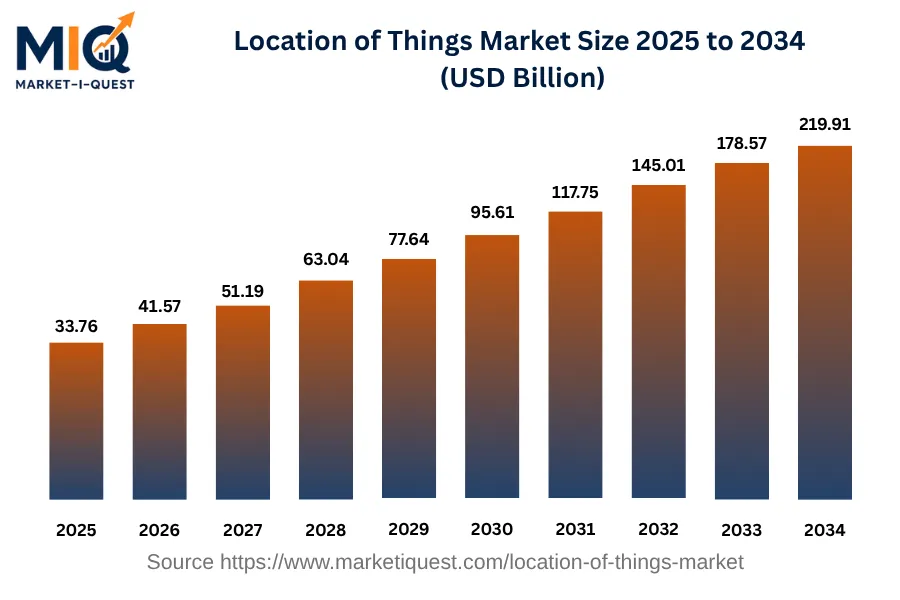
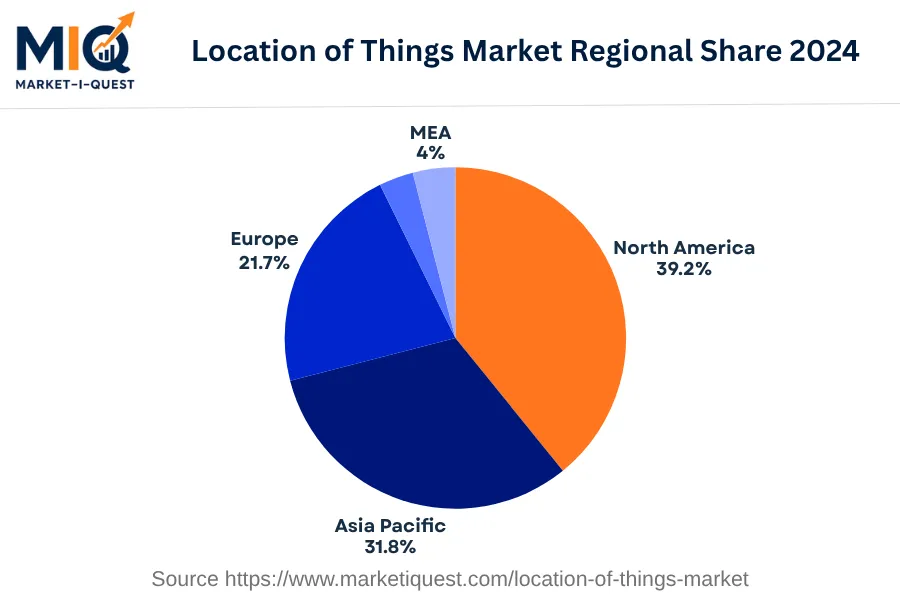
The location of things market was worth $27.41 billion in 2024, growing to $33.76 billion in 2025. By 2034, the market is projected to increase substantially to approximately $219.91 billion, a Compound Annual Growth Rate (CAGR) of 23.15%. This growth can be attributed to the widespread adoption of location of things solutions across various industries over the ten-year period. The adoption has been driven by the need for real-time tracking of assets and the necessity of accurate location data in business decision-making processes. In 2024, the regional market share was divided with North America holding the largest share at 39.16%, followed by Asia Pacific at 31.82%. Europe contributed 21.74% to the global Location of Things market in the same year, while the Latin America and Middle East & Africa (MEA) regions commanded smaller shares, with 3.26% and 4.02% respectively.

Key Takeaways

  • By Location Type
  • Outdoor held a dominant position exhibiting notable growth in the base year.
  • By Application
  • IoT Asset Management led
  • accounting for the largest share in the base year.
  • By Vertical
  • Retail emerged as the top segment
  • holding a significant market share.
  • In the Vertical segment
  • Healthcare experienced the fastest growth.
  • In the Vertical sector
  • Media held the prime position in the market in the base year.
  • By Vertical
  • Transport & Logistics demonstrated substantial growth
  • expanding its market presence.
  • In the Vertical domain
  • Others noted an upward movement
  • enhancing their business footprint.
location-of-things-market market size

Key Driving Factors

Implementation of Real-Time Data Analytics in Various Industries

The Location of Things market is largely influenced by the increasing reliance on real-time data analytics across diverse industries like logistics, retail, and healthcare. Companies are progressively utilizing the Location of Things solutions to streamline their operations and deliver enhanced customer experiences. For instance, in logistics and supply chain industry, real-time tracking of goods being transported is crucial for efficient functioning. Location of Things provides key insights which facilitate the monitoring of routes, control delays in delivery, and improve customer satisfaction. Similarly, in the retail sector, understanding the shopping behavior and customer flow in a store can contribute to more targeted marketing and sales strategies. Hence, the application of real-time data analytics incorporating location-based data collected is a significant driving factor for the Location of Things market.
Smart City Initiatives and Urban Planning

The global Location of Things market is benefiting from the increased emphasis on smart city initiatives and urban planning. Municipalities worldwide are leveraging Location of Things technology to optimize utility management, enhance public safety, and improve the quality of life. For instance, Location of Things technology plays a vital role in efficient waste management through route optimization for garbage collection vehicles, thereby conserving fuel and reducing CO2 emissions. Moreover, it supports the creation of safer cities by monitoring regions with high crime rates and strategizing police patrol routes. It also aids in successful urban planning, facilitating the creation of well-designed public transportation routes and parking solutions. Therefore, the expanding focus on smart city projects serves as a potent driving force in the Location of Things market.

Market Evolution by Timeline

2019-2023
Between 2019-2023, the Location of Things implementation was high among logistics and transportation firms, primarily for asset tracking. Asian regions, including China and Japan, became major players due to large-scale infrastructure initiatives. While GPS still led tracking technology, the uptake of other techs like RFID and Wi-Fi IP address tracking increased. Integration was challenging though, due to lack of skilled resource and technology costs. Policy-wise, GDPR in Europe imposed strict data privacy regulations affecting location tracking. The commercial model leaned towards cost-effective SaaS contracts providing integrated tech solutions, but pricing varied significantly across regions. Risks included poor tracking accuracy and data security breaches.
2024
In 2024, the use of Location of Things diversified to urban planning and environmental monitoring, especially in developed nations like the USA and EU countries. Satellite technology for location tracking made its entrance, offering a higher level of precision. However, the high investment for satellite infrastructure posed a constraint. At government levels, Smart City projects encouraged use of location-based services. Commercial models shifted towards partnerships that bundled diverse technologies into a single offering. Data privacy continued to pose a risk, particularly for sensitive applications like medical tracking.
2025-2029
The period from 2025–2029 saw expansion of the Location of Things in security and emergency services, as precision technology improved. The Middle East region, notably Saudi Arabia and United Arab Emirates, became prominent due to smart city initiatives. Technologically, indoor positioning systems rose to the front of location tech, though the lack of indoor GPS standards impeded seamless integration. Regulatory-wise, INSPIRE directive in Europe promoted sharing of spatial information. Contracts shifted towards open-ended agreements with tech providers to allow adoption of evolving tech. The main risk was ecosystem fragmentation due to lack of universal standards.
2030-2034
From 2030-2034, the Location of Things found majority application in autonomous vehicles sector, largely in the USA. Also, space-based Internet of Things solutions started to emerge, strengthening the location capabilities. The lack of global policy frameworks for autonomous vehicle tracking was a challenge though. The trend for public-private partnerships gained traction, supporting large infrastructure and satellite-based projects, typically through revenue-share models. As for risks, location spoofing and data manipulation threatened to undermine integrity and safety of applications, like autonomous vehicles and drones.

Future Market Outlook

Future Opportunities

Looking ahead, the integration of augmented reality (AR) with location services presents dynamic possibilities in sectors like retail and tourism. Companies like Niantic are already leveraging AR to enhance user engagement through location-based games, encouraging exploration of physical environments. As urban centers continue to expand, smart city initiatives could increase significantly; for instance, Singapore's Smart Nation initiative, started in 2014, aims to integrate LoT technologies to enhance urban living. Additionally, partnerships between tech giants and automotive manufacturers, such as the 2021 collaboration between Ford and Google focusing on data and AI for driving experiences, signal opportunities for LoT applications in everyday transportation. The rise in consumer interest for health-related location tracking solutions, accelerated during the COVID-19 pandemic, has sparked innovations like real-time contact tracing applications, fostering advancements in public health technologies. Initiatives from organizations such as the International Telecommunication Union will likely further standardize LoT technologies, making them more accessible globally. Moreover, the potential for using locational analytics in environmental monitoring is gaining traction, as demonstrated by initiatives like the one from the European Space Agency, which utilizes satellite data for tracking climate impacts. All of these factors, rooted in existing technologies and regulatory conditions, illustrate the expanding landscape for location-based services and their integration into everyday life.

Segmentation Analysis

By Location Type

The market is divided into subsegments including Indoor and Outdoor locations. The Indoor segment accounted for the largest revenue share while the Outdoor segment is expected to grow at the fastest CAGR during the forecast period.

Largest Revenue Share

Indoor

Market Share Leader

The primary reason that the Indoor segment leads today in terms of revenue is the control, convenience, and adaptability it offers to organizations. Users tend to favor interior environments as they provide protection from outdoor weather impacts, enabling year-round utilization and potentially increased revenue. Additionally, regulations and zoning laws may often favor indoor activities, thereby driving growth. Given that indoor spaces are designed for specific purposes, businesses in this segment can price higher compared to their outdoor counterparts, contributing to a larger overall revenue share. Buying preferences and switching costs are another significant aspect that informs this trend. Consumers are generally less willing to shift from interior to outdoor activities due to perceived inconvenience or discomfort. This customer behavior reinforces the current market dominance of the Indoor segment.

Fastest CAGR

Outdoor

Forecast Period Growth Leader

While the Indoor segment currently holds the majority of overall markets, the Outdoor segment shows more rapid growth potential. Several factors contribute to this trend, including growing consumer awareness about the benefits of outdoor activities and a broader push towards sustainability. Technological advancements in weather-resistant equipment and the growing popularity of outdoor leisure activities pave the way for the Outdoor segment's market growth. Additionally, a positive shift in government policies towards more outdoor-oriented activities and the increase of capital expenditure in related infrastructure further stoke this growth. However, weather unpredictability and potential regulatory resistance present potential barriers to this sector. Continued development and partnership within industry stakeholders will likely overcome these hurdles, driving the momentum for the Outdoor segment.

By Application

The market is divided into subsegments including IoT Asset Management and IoT Location Intelligence. Of these, IoT Asset Management accounted for the largest revenue share while IoT Location Intelligence is expected to experience the fastest growth during the forecast period.

Largest Revenue Share

IoT Asset Management

Market Share Leader

IoT Asset Management has emerged as a substantial revenue generator in 2024 largely due to the increasing adoption of IoT devices for organizational operations across sectors. Companies readily invest in this technology to optimize their assets, generate cost savings and enhance productivity. Enterprises are finding better ways to manage their physical assets to avoid losses and make informed decisions through predictive maintenance, enabled by this technology. Moreover, IoT Asset Management offers substantial return on investment which proves attractive to business proprietors. The stringent regulatory landscape also played a role. Certain regions have regulations that necessitate companies to maintain their assets effectively, driving the demand. Lastly, inherent advantages like automated asset tracking, predictive maintenance and remote diagnosis are fueling its adoption across the globe.

Fastest CAGR

IoT Location Intelligence

Forecast Period Growth Leader

IoT Location Intelligence represents the subsegment with the fastest CAGR outlook. While still in its relative infancy in the base year 2024, market dynamics suggest that rapid growth is on the horizon. A plethora of growth drivers can be attributed to this trend. Increasing demand for customized services and personalized marketing, coupled with an upsurge in smart city initiatives have accelerated the adoption of IoT Location Intelligence. Businesses are making concerted efforts to understand consumer behavior in real-time situations, contributing to growth. Meanwhile, strategic partnerships between IoT Location Intelligence providers and other tech firms speed up technology dissemination. However, concerns about privacy and data security act as potential barriers to adoption. But with improving regulatory framework and investment in robust cybersecurity measures, these challenges are expected to be mitigated, fueling further growth.

By Vertical

The market is divided into subsegments including Retail, Healthcare, Media, Transport & Logistics, and Others. As of the base year 2024, the Retail sector accounted for the largest revenue share while the Healthcare sector is expected to grow at the fastest CAGR during the forecast period.

Largest Revenue Share

Retail

Market Share Leader

In the base year 2024, the Retail sector claims the largest revenue share. This is largely influenced by the increased convenience that technological advancements bring to both businesses and consumers in this segment. Advances in digital payment methods, alongside increased internet penetration, have simplified purchasing for consumers, leading to a boost in retail sales. Geographic diversity is also a factor, with strong e-commerce growth rates in regions such as Asia-Pacific and North America. Regulation, though having a certain impact, has largely played a facilitative role, with initiatives to digitalize economies acting as an enabler for the growth of online retail. What determines success in this segment is largely the ability of a retailer to offer a seamless and integrated shopping experience that combines the physical store with the retailer's digital presence.

Fastest CAGR

Healthcare

Forecast Period Growth Leader

The Healthcare sector stands out for its expected high CAGR. Despite numerous adoption barriers, particularly those linked to data security, interoperability, and system implementation, growth drivers far outnumber these challenges. The increasing worldwide health expenditure, expanding patient volume owing to the rising incidence of chronic and infectious diseases, surging demand for technologically advanced equipment and solutions for effective health service delivery, and the ongoing trend of home healthcare are some factors propelling the growth. Furthermore, the catalytic effect of the recent pandemic has underscored the need for an overhaul in healthcare systems worldwide, pushing for the adoption of more tech in Healthcare. Risks, though present, such as regulatory changes, and policy adjustments remain, but the overall trend points to robust growth for this segment.

Competitive Analysis

Key Market Players

Manufacturers / OEMs

HERE Technologies
Netherlands
Bosch Software Innovations GmbH
Germany
Microsoft Corporation
US

Key Suppliers & Raw Materials

ESRI
US
Qualcomm Technologies, Inc.
US
Wirepas Ltd
Finland

Distributors, Integrators & Channel Partners

MapR Technologies, Inc.
US
Teldio Corporation
Canada
Ubisense Group
UK

Porter’s Five Forces Analysis

A strategic evaluation of competitive forces and factors shaping the Location of Things market.

Supplier Bargaining Power

Medium

Limited number of suppliers providing location-tracking tech can set competitive terms.

Buyer Bargaining Power

High

High diversity of location-based services provides more choice and purchasing power to buyers.

Threat of Substitutes

Low

Distinctive technology and service, substitutes do not offer comparable functionality.

Threat of New Entrants

Medium

Tech advancements may reduce barriers to entry but initial setup costs and brand recognition limit entry.

Competitive Rivalry

High

Intense competition between established firms and constant technology advancements keep rivalry high.

Regional Analysis

Geographic market dynamics and growth opportunities across key regions

Global Market Outlook

location-of-things-market market regional share

North America

In 2024, the Location of Things (LoT) market in North America is significantly impacted by digital transformation strategies across multiple sectors. Rapid digitalization, coupled with critical legal mandates for data provenance like the California Consumer Privacy Act (CCPA) of 2018, are primary market drivers. Increased investment in cloud-based technologies has promoted wide adoption of LoT, hence expanding its reach across the region. On the supply side, the prevalence of affordable, sophisticated location-aware hardware drives the pricing dynamic favoring consumers. Prominent trends shaping the market include a surge in demand for personalized retail experience, leveraging location-based services to fine-tune their customer engagement strategies. In the healthcare sector, LoT enables real-time tracking of assets and personnel, improving operational efficiency. The growing interconnectivity of devices, through IoT, facilitates seamless integration of LoT with various digital ecosystems enhancing user convenience.

Technological shifts such as 5G rollout have empowered high-speed, accurate location data processing, rendering it an indispensable tool in industries, including utilities and manufacturing for efficient asset management. Partnerships and mergers like Google's acquisition of Fitbit further underscore LoT's importance, especially in the wearable tech market. Subsequently, rules enforcement for transparent data usage, privacy, and security has intensified, shaping the LoT market policy landscape in North America.

Asia Pacific

In 2024, the Location of Things (LoT) market in the Asia-Pacific region showed significant growth due to various drivers and trends distinct to this geography. Technological advancements and mounting investment in the Internet of Things sector, particularly in China and India, catalyzed the market's expansion. Government initiatives such as ‘Digital India’ spurred wider technology adoption, thus propelling demand for LoT applications. Pricing dynamics in Japan and South Korea, including competitive pricing strategies and product differentiation, contributed to an increase in supply. Notably, the market met shifts in buyer behavior, where an increasing number of enterprises and government bodies sought location-based services for efficient resource allocation and streamlined operations. Technology shifts, especially in Australia's retail sector and in key ASEAN markets, brought LoT into the mainstream, with a particular focus on personalized customer interactions and targeted marketing.

A wave of M&A activities underpinned these movements, while strict policy enforcement in sectors such as healthcare and utilities bolstered LoT applications to ensure compliance. Despite this, the APAC LoT market remained fragmented, with heterogeneous standards across countries posing challenges. Major players included enterprise customers from manufacturing and utilities sectors who leveraged LoT for optimized workflows and predictive maintenance. The strong growth in 2024 confirmed the region's potential as a significant contributor to the global LoT market.

Europe

In 2024, the Location of Things (LoT) market in Europe demonstrated significant growth, driven by a confluence of technological advancement, market demand, regulatory support and strategic investment. Rapid adoption of IoT technologies across various sectors fueled the need for LoT solutions, with notable demand from retail, utilities, manufacturing, government, and healthcare sectors. Enhanced location precision and real-time analytics offered by LoT technologies have proved invaluable, particularly in retail and healthcare. Moreover, government regulations favouring digitization and data transparency have indirectly propelled investment in LoT.

Several dominant trends in the European LoT landscape were identified in 2024. Firstly, the widespread incorporation of LoT in smart city projects, particularly in the UK, Benelux, and the Nordics. In addition, there was a pronounced shift towards LoT-enhanced supply chain management, demonstrated by companies like Deutsche Post DHL in Germany. Another observed trend was a growth in strategic partnerships, like the one between Telefonica, Spain and Geotab, a part of their broader push for digital transformation. A renewed focus on data security and privacy concerns in policy enforcement, primarily within the GDPR framework, shaped the design and deployment of LoT technologies. The LoT market in Europe during 2024 underscored the central role of location-based technologies in the continent’s drive for digitalization and efficiency.

Latin America

In 2024, the Location of Things Market (LoT) in Latin America saw significant growth driven by several key factors and showcased notable industry trends. Technological adoption was a primary driver for the market expansion, with Brazil and Mexico leading in implementing LoT technology for both enterprise and government applications. As well, regulatory encouragement, particularly in Argentina and Peru, spurred increased investment in LoT technology, contributing to market growth. Moreover, cost-efficient supply dynamics promoted the market expansion throughout the region. Among the emerging trends, a shift in buyer behavior towards higher demand for LoT services was evident throughout various sectors, especially in healthcare, manufacturing, and retail.

This was particularly noticeable in Chile and Colombia, where enterprises leveraged LoT for enhanced operational efficiency. Extensive partnerships and mergers and acquisitions were also witnessed, indicating consolidation within the industry and a more codified marketplace. Furthermore, a significant focus on policy enforcement and standardization across LATAM ensured streamlined and ethical use of LoT technology. Thus, the LATAM Location of Things Market in 2024 was shaped by drivers such as technology adoption, regulatory reforms, and thriving supply dynamics, and was characterized by trends like changing buyer behavior, the consolidation of businesses, and a strong focus on policy enforcement and standardization.

Middle East & Africa

In 2024, Location of Things (LoT) Market witnessed significant growth in the Middle East and Africa region. Driving this growth were increased smartphone penetration and Internet connectivity, notably in Saudi Arabia and South Africa, and stricter regulatory compliances for improved security and privacy such as the Cybercrime law in UAE. Further, large-scale investments from the governments in strengthening technology infrastructure, exemplified by Qatar's National Vision 2030, boosted the LoT market. Emerging trends included a shift towards digitalization of public services, especially in sectors such as government, healthcare, and utilities, as seen in Nigeria's digital switchover strategy.

Also, increasing adoption of Internet of Things (IoT) technology in the oil and gas industry, most notably in Saudi Arabia, amplified the demand for LoT solutions. The integration of LoT technology in retail, manufacturing and financial sectors, like the Israel-based Bank Leumi's digitization efforts, shaped the trends in this market. Furthermore, tech collaborations, such as the Africa-Israel tech transfer deal, increased the spread of the LoT market, setting new standards in regions lacking earlier technology exposure. The enforcement of strict technology policies in Egypt, geared towards strengthening national cybersecurity, further intensified the market presence—making the Middle East and Africa a significant player in the LoT Market in 2024.

Recent Industry Developments

Latest market innovations, product launches, and strategic initiatives

March 2025

Microsoft announced a strategic partnership with Siemens to integrate Azure IoT with MindSphere, enabling joint location-aware asset tracking and advanced digital twin capabilities across industrial facilities.

Frequently Asked Questions