Liquid Laundry Detergent Market Snapshot

Key Players

  • Procter & Gamble Co. (US)
  • Unilever PLC (UK)
  • Henkel AG & Co. KGaA (Germany)
  • Church & Dwight Co. Inc. (US)
  • Lion Corporation (Japan)
  • Kao Corporation (Japan)
  • S.C. Johnson & Son Inc. (US)
  • Godrej Consumer Products Limited (India)

Market Size

Base Year 2024
$39.18 Bn
CAGR
5.08%
Forecast 2034
$64.31 Bn

Market Segments

By Product Type
  • Enzyme-Based Detergents
  • Non-Enzyme Detergents
  • Organic/Natural Detergents
  • Other Product Types
By Application
  • Household
  • Commercial & Industrial

Market Dynamics

Drivers
  • Increasing consumer awareness
  • Demand for eco-friendly products
Restraints
  • High production costs
  • Environmental concerns
Opportunities
  • Increasing population
  • Growing awareness on hygiene

Market Size

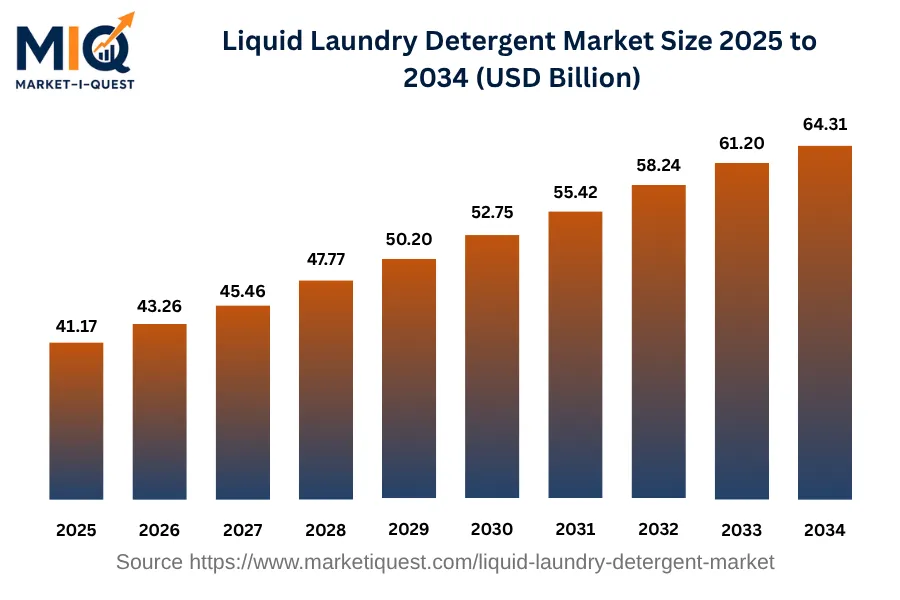
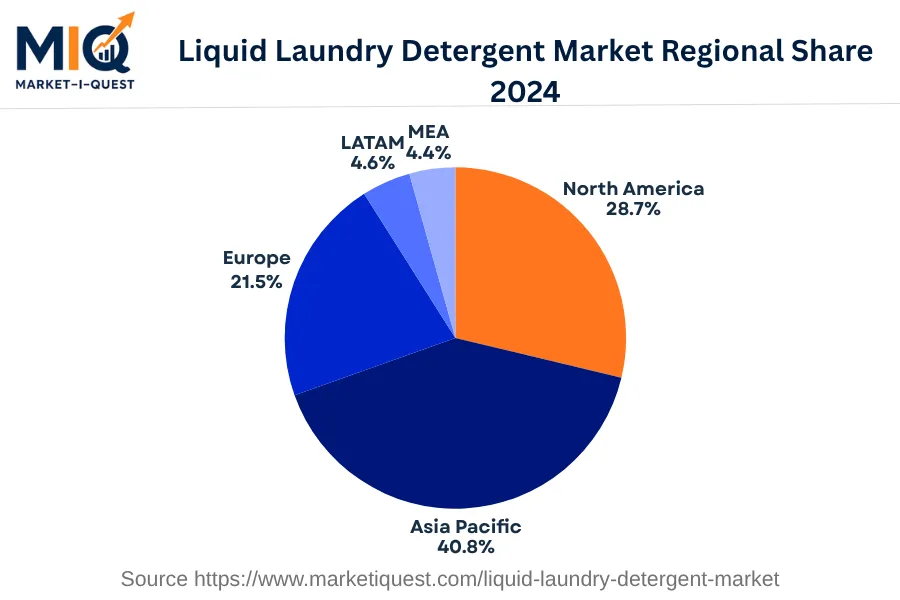
The Liquid Laundry Detergent market, with a value of 41.17 billion USD in 2025, is projected to reach 64.31 billion USD by 2034, growing at a CAGR of 5.1%. This increase reflects a steady annual expansion in the market size. For instance, the market size in 2024 was 39.18 billion USD, which increased to 41.17 billion USD in 2025. This progression signals a consistent growth path leading up to the predicted value for 2034. The upturn in the market size is due to changes in consumption patterns and purchasing power, resulting in the increased use of liquid laundry detergents. Regionally in 2024, the market was predominantly shared by Asia Pacific with a share of 40.82%, followed by North America and Europe accounting for 28.74% and 21.46% respectively. On the other end of the spectrum, MEA and LATAM held smaller shares in the market at 4.35% and 4.63% respectively.

Key Takeaways

  • By Product Type - Non-Enzyme-Based Detergents led the market accounting for 50.1% share in 2024.
  • By Application - Commercial & Industrial is projected to expand at a CAGR of 4.7% (2025–2034).
liquid-laundry-detergent-market market size

Key Driving Factors

Incorporation of Enzyme Technology

The liquid laundry detergent market is highly influenced by the application of enzyme technology. The technology involves using enzymes, such as proteases and amylases, to achieve better cleaning performance. This primarily caters to consumers who prefer efficient laundry cleaning products, with the ability to eliminate stubborn stains and dirt. Manufacturers invest in R&D to capitalise on this by developing detergents with powerful enzymatic action, hence promoting product variety and innovation in the market. Branding and marketing campaigns emphasizing superior cleaning prowess due to the enzyme-technology often also resonate well with consumers, giving this factor a notable impact on market trends.
Sustainable and Eco-friendly Products Demand

Another pivotal stimulus for the liquid laundry detergent market is the escalating consumer demand for sustainable and eco-friendly products. This is a direct response to increased awareness about the adverse environmental impacts of chemical-heavy cleaning products and a global shift towards sustainable living. Many consumers now gravitate towards liquid detergents made from plant-based materials and free from harsh chemicals, phosphates, and dyes. Production companies respond to this by creating lines of greener, biodegradable detergents with eco-friendly packaging, thus setting a robust growth trajectory for the liquid detergent market aligned with sustainability objectives.

Market Evolution by Timeline

2019-2023
In 2019-2023, millennials preferred liquid detergent due to its convenience and effectiveness. Europe was a significant consumer due to high awareness about hygiene. PH-neutral liquid detergents gained traction offering less color safety. Concentrated liquid detergents were introduced reducing packaging cost and environmental footprints. High operational cost hindered expansion plans of several brands in Africa. Consumer advocacy groups raised concerns about phosphates harming the water bodies, leading to tighter regulations. Bulk buying of liquid detergents via yearly contracts became commonplace in the U.S with large retail chains. Counterfeit products posed a significant risk, prompting companies to adopt secure packaging.
2024
In 2024, customers switched to eco-friendly detergents due to growing environmental concerns. Low-income groups in Asia preferred cheaper, local brands. Hypoallergenic detergents for skin-sensitive users gained popularity. Companies faced challenge in sourcing biodegradable ingredients limiting launch of greener alternatives. New EU regulations stipulated strict guidelines for chemical content. In response, brands revised formulations in compliance. Sales soared in e-commerce channels due to pandemic-induced confinement. To leverage high online demand, partnerships between brands and e-commerce giants were seen. Lax regulatory enforcement in developing countries exacerbated the counterfeit product issue.
2025-2029
During 2025-2029, detergents with natural ingredients attracted health-conscious consumers. Latin America saw a surge in demand due to rising middle-class. Manufacturers started launching AI-enabled, custom-formula promising personalized cleaning experiences. Supply chain disruptions due to climate change posed production challenges. Governments began incentivizing bio-based detergents with subsidies. Fair-Trade agreements were seen as a popular commercial model, protecting raw material suppliers in South Asia. Older population found it challenging to adapt to hi-tech detergent offerings, creating a demographic divide. Brands started to integrate QR codes in packaging to combat counterfeits.
2030-2034
In 2030-2034, minimalistic lifestyle trends triggered demand for multi-purpose detergents. Developed countries led this trend with Japan at the forefront. Subscription-based laundry detergents emerged, promising regular, hassle-free supply. Delayed product patents impeded innovation in enzyme development. ISO's new standards for eco-labeling facilitated informed buying. Pay-per-litre model surfaced as a novel approach, eliminating plastic waste and saving cost for low-volume users. Lack of standard guidelines for personalising detergents limited their potential. Detergent industries in collaboration with tech companies devised sophisticated anti-piracy technologies, reducing counterfeit risks.

Future Market Outlook

Future Opportunities

Future opportunities in the liquid laundry detergent market are expected to be driven by the increasing prevalence of e-commerce and direct-to-consumer model adoption. As of 2023, 40% of laundry detergent purchases in the United States are made online, indicating a clear shift toward digital retailing strategies that companies like Unilever are embracing. The shift presents significant growth avenues, as detergent brands can leverage online platforms to reach consumers directly and establish subscription models for convenience. In addition, partnerships between detergent brands and laundry machine manufacturers are likely to emerge, following the 2023 collaboration between Samsung and a leading detergent brand to promote compatible cleaning products for smart washing machines. Moreover, as consumer preferences continue to incline toward eco-friendly and ethically sourced products, detergent brands that prioritize clean ingredients and sustainable practices could capture a growing market share. In 2021, 85% of millennials indicated a preference for environmentally friendly products, giving rise to a potential market segment expansion for brands that highlight sustainability. Overall, the intersection of technology, retail shifts, and consumer preferences creates a fertile landscape for innovation and market growth in the global liquid laundry detergent industry in the coming years.

Segmentation Analysis

By Product Type

The market is divided into subsegments including Enzyme-Based Detergents, Non-Enzyme Detergents, Organic/Natural Detergents, and Other Product Types. Non-Enzyme Detergents accounted for the largest revenue share while Organic/Natural Detergents are expected to grow at the fastest CAGR during the forecast period.

Largest Revenue Share

Non-Enzyme Detergents

Market Share Leader

Non-Enzyme Detergents dominated the market share in 2024 due to several factors. First, these detergents are traditionally more established and widely recognized among the customer base. They are known for their durability and efficiency in cleaning dirt and stains. Second, availability is a key factor to the leading position of Non-Enzyme Detergents. They are readily available in stores across various geographies. In areas where modern retail is not fully established, Non-Enzyme Detergents are often the go-to choice for consumers due to their ubiquity and consistent performance. Furthermore, the regulation and supply chain favour these types of detergents. They are relatively easy to manufacture and distribute compared to other types, reducing the overall costs for both producers and end-users. Another important factor is the minimal switching costs associated with Non-Enzyme Detergents. Customers are less likely to shift from a product that has served their needs consistently over time. Lastly, these detergents typically have a broader reach through different channels, both offline and online, maximizing their customer base.

Fastest CAGR

Organic/Natural Detergents

Forecast Period Growth Leader

Organic/Natural Detergents, while not having the largest market share in 2024, is projected to demonstrate the fastest CAGR in the forecast period. This growth can be attributed to several factors. Consumers are becoming increasingly aware of the effects of products on their health and the environment, leading to an increased preference for organic or natural solutions. Regulatory bodies are supportive of the shift towards environmentally friendly products, which further accelerates the adoption of Organic/Natural Detergents. In terms of technological advances, improvements in plant-based ingredient efficacy are contributing to the growing popularity of Organic/Natural Detergents. While there are barriers to adoption, such as higher price points and potential allergic reactions, these are being addressed through increased availability, consumer education, and formulation advancements. Partnerships with eco-conscious brands and businesses could provide additional growth momentum. Risks to this growth outlook include potential regulatory changes and the acceptance rate among traditionalist consumers.

By Application

The market is divided into subsegments including Household, Commercial and Industrial. In the base year 2024, the Commercial subsegment accounted for the largest revenue share while the Industrial subsegment is expected to grow at the fastest CAGR during the forecast period.

Largest Revenue Share

Commercial

Market Share Leader

The Commercial subsegment led the market in terms of revenue in 2024. This dominance can be ascribed to the extensive seminal role of commercial entities in the broader economy. The large commercial infrastructure, encompassing diverse businesses from retail to corporate services, had a constant and robust demand for products or services, thereby boosting revenue generation. In addition, regulatory factors also played a part where standards set in different regions ensured a steady stream of demand from commercial businesses seeking compliancy. Increased spend on capital assets and aggressive expansion strategies by businesses also contributed to revenue growth. Moreover, the purchasing criteria in the commercial subsegment are largely based on quality and reliability, leading to an increased willingness to pay a higher price, thus boosting overall revenue. The commercial subsegment continues to leverage its robust distribution channels, strategic partnerships, and consumer base to maintain market dominance.

Fastest CAGR

Industrial

Forecast Period Growth Leader

The Industrial subsegment is expected to exhibit the fastest growth. The growth in this sector is driven by ongoing technological advancements, leading to improvements in production techniques and processes that significantly increase the demand for industry-specific products or services. Additionally, potential regulatory changes, capital investments, and strategic partnerships are expected to serve as catalysts, fueling the growth of the Industrial subsegment. For instance, strict emission standards and the push towards sustainability and energy efficiency propel the industrial sector to adopt technologically advanced systems, generating substantial business opportunities for this market. However, risks associated with volatile raw material prices and trade policies could pose challenges to the segment's growth. Despite these potential barriers, the promise of improved operational efficiency and higher return on investment promises strong demand and consequently, fast-paced growth in this subsegment.

Competitive Analysis

Key Market Players

Manufacturers / OEMs

Procter & Gamble Co
US
Unilever
UK
Henkel AG
Germany

Key Suppliers & Raw Materials

BASF SE
Germany
Stepan Company
US
Kao Corporation
Japan

Distributors, Integrators & Channel Partners

Amazon
US
Walmart
US
Tesco
UK

Porter’s Five Forces Analysis

The liquid laundry detergent market is characterized by competitive rivalry, high supplier and buyer power, and threats from substitutes and new entrants.

Supplier Bargaining Power

Medium

Balance of power lies in favor of prominent chemical suppliers, though many alternatives are available.

Buyer Bargaining Power

High

High competition allows buyers to effortlessly switch among brands, making their bargaining power high.

Threat of Substitutes

High

Eco-friendly solutions, powder detergents, and DIY solutions raise the threat of substitutes.

Threat of New Entrants

Low

Strong brand loyalty, high economies of scale, and substantial capital investments deter new entrants.

Competitive Rivalry

High

Several global players with similar product offerings result in high competitive rivalry in the market.

Regional Analysis

Geographic market dynamics and growth opportunities across key regions

Global Market Outlook

liquid-laundry-detergent-market market regional share

North America

In 2024, North America's liquid laundry detergent market defined an integral section of the region's consumer goods sector. Policy changes, driven by environmental concerns, catalyzed a shift towards eco-friendly formulations. In the U.S. and Canada, strict regulations on chemicals present in detergents enhanced the demand for organic, phosphate-free options. Technological advances further empowered this shift, with innovative enzyme-based detergents gaining traction. Meanwhile, supply chain disruptions due to trade uncertainties led to short-term pricing adjustments. Consumer trends in North America reflected a preference for convenience and sustainability. The demand for single-dose liquid capsules grew, led by time-pressed consumers seeking ease of use. This trend emerged strong in the U.S., where busy urban lifestyles prevailed. Simultaneously, a shift toward e-commerce offered an expanding distribution channel. Notably, consumer-facing partnerships increased; Amazon's collaboration with Tide to offer subscription services exemplified this strategy.

Furthermore, brand trust played a significant role across all sectors, whether retail or institutional (that includes the bulk purchasers such as hotels, hospitals, and schools). Recalls on products tainted with harmful chemicals reminded North American consumers and regulators alike of the importance of safety and integrity in manufacturing processes. Conclusively, in 2024, North America's liquid laundry detergent sector saw a push towards green standards, innovative forms, and a move to digital purchasing channels.

Asia Pacific

In 2024, the Liquid Laundry Detergent Market in Asia Pacific reached a watershed moment due to various stimulating factors. Rapid urbanization in major countries like China and India, coupled with increased disposable income, fueled demand for advanced cleaning solutions, significantly driving the market's expansion. Regulatory initiatives such as China's Green Labeling on cleaning products encouraged manufacturers to develop more eco-friendly products, further bolstering market growth. Advancing technology and growing adoption of e-commerce platforms strongly supported supply dynamics, offering a broad range of products to consumers.

A pronounced trend in the market in 2024 was the decisive shift towards bio-based and eco-friendly products, reflecting evolving consumer consciousness on sustainability. Technological changes also carved out a new trend in the form of concentrated liquid detergents, offering the same efficacy but using less quantity. Partnerships between manufacturers and e-commerce giants, like Alibaba in China and Flipkart in India, prospered, granting wider market reach. Rigorous policy enforcement in regards to eco-friendly liquid detergents significantly helped ASEAN markets, such as Indonesia and Thailand, to thrive in this sector. Customer sectors that showed prominent engagement in 2024 included retail, healthcare, and manufacturing. The retail sector, in particular, contributed substantially due to a rising lifestyle-oriented middle class willing to invest in superior-quality cleaning solutions.

Europe

In 2024, the European liquid laundry detergent market was in flux. On the driver side, heightened health awareness catalyzed by COVID-19 and its aftermath influenced a shift towards more hygienic laundry practices, resulting in increased demand. Tightening EU regulations towards chemical usage in detergents were seen as directly spurring industry innovation and investment into eco-friendly products. Supply dynamics were influenced as significant advancements in detergent technology, especially regarding concentrated formulas, enhanced industry competition and shifted the pricing landscape. In terms of trends, consumer behavior displayed greater inclination towards eco-friendly and ‘free from’ products, catering to sensitive skin or allergy-prone users. Technological shifts leaned towards incorporation of natural active ingredients into formulas, while the online channel strength continued to grow, with e-commerce giants and manufacturer direct-to-consumer websites gaining substantial markets.

M&A activities were limited but interestingly, partnerships between detergent manufacturers and washing machine providers to offer complementary products were observed. Stricter enforcement of policy towards reducing single-use plastic containers was also evident in the sector. This market landscape broadly affected sectors such as retail, manufacturing, and utilities, due to shifts in product offerings and consumer demands. For instance, retail sector had to adapt by stocking up more eco-friendly and concentrated products, while manufacturing had to invest in new technology to meet regulation standards. The changes also impacted utilities due to modified wastage and recycling mechanisms.

Latin America

In 2024, the Latin American liquid laundry detergent market saw robust expansion fueled by a combination of demand factors and pricing dynamics. Ascending middle classes in Brazil, Mexico, Argentina, Colombia, Peru, and Chile drove increased demand for liquid laundry detergents, supported by rising average household incomes. Simultaneously, regulatory changes concerning water usage and pollution in Brazil and Mexico accelerated the shift toward concentrated detergent forms, enhancing market growth. Economies of scale in manufacturing and increasing supplier competition also suppressed retail prices, boosting the market's volume.

On the trends front, consumers gravitated towards e-commerce platforms for their detergent purchases, facilitated by advancements in digital infrastructure and increased internet penetration in LATAM societies. Additionally, the market witnessed an uptick in environment-friendly, biodegradable detergent options, aligning with end-users' heightened ecological consciousness. Corporate partnerships between leading detergent brands and retail chains emerged as a prominent strategy to enhance brick-and-mortar sales post the e-commerce boom. Finally, standards for phosphate content in detergents became stricter, particularly in Argentina and Chile, compelling players to reformulate their products, reshaping the market landscape. The impacts of these drivers and trends were felt most acutely in the retail industry, which had to adapt to changes in consumer behavior and policy transformations. And in manufacturing, these shifts led to a reassessment of production methodologies and ingredient sourcing.

Middle East & Africa

In 2024, the Middle East and Africa's liquid laundry detergent market exhibits robust growth fueled by various drivers and trends. Proactive investment in enhancing product quality escalated industry growth, as major manufacturers such as P&G and Unilever focus on technology adoption to curate eco-friendly, skin-sensitive options. Increasing hygiene awareness found particularly in rapidly urbanizing regions like Saudi Arabia, UAE and South Africa, stimulated demand. Regulations endorsing environmental sustainability catalyze the surge towards biodegradable detergents, notably in Israel.

Trend-wise, an evident uptick in online retail channels, supported predominantly by the tech-savvy population in UAE and Qatar, fosters convenient purchase of liquid laundry detergents. In regions like Nigeria and Kenya, the rise in washing machine penetration has seen a shift in buyer preference from powdered to liquid detergents. Collaborations, seen between manufacturers and local retails giants, aim to increase market presence. Stricter policy enforcement pertaining to detergent composition, as seen in Saudi and Egypt, precipitates the adoption of products with less phosphate. Affordability continues to play a key role in market dynamics, affecting consumption patterns in financially diverse regions like Egypt and South Africa. Collectively, these factors signify an evolving market landscape driven by technology, regulation, and changing consumer behavior.

Recent Industry Developments

Latest market innovations, product launches, and strategic initiatives

February 2026

Syensqo officially launched Rhodasurf® B7 UP, a natural laureth-7 surfactant enabling more sustainable liquid laundry detergent formulations with a lower carbon footprint.

July 2025

Unilever’s OMO brand launched Wonder Wash liquid detergent in Australia, engineered to clean laundry in just 15 minutes—even in cold water—with Usain Bolt appointed as brand ambassador. The product is available in two variants: Speed Clean for everyday wear and Odour Refresh for sportswear and activewear.

Frequently Asked Questions