
Liquid Applied Membranes Market Snapshot

Key Players

  • Sika AG (Switzerland)
  • GCP Applied Technologies Inc. (United States)
  • Saint-Gobain (France)
  • Fosroc Inc. (United Kingdom)
  • BASF SE (Germany)
  • RPM International Inc. (United States)
  • Parex USA Inc. (United States)
  • Mapei SpA (Italy)
  • Polyglass U.S.A. Inc. (United States)
  • Paul Bauder GmbH & Co. KG (Germany)

Market Size

Base Year 2024
$8.71 Bn
CAGR
7.24%
Forecast 2034
$17.52 Bn

Market Segments

By Product Type
  • Siloxane-Based Liquid Applied Membranes
  • Acrylic-Based Liquid Applied Membranes
  • Polyurethane-Based Liquid Applied Membranes
  • Hybrid Liquid Applied Membranes
By Substrate
  • Concrete
  • Metal
  • Wood
  • Others
By Application
  • Roofing
  • Underground Structures
  • Tunnels & Bridges
  • Swimming Pools & Water Features
  • Others

Market Dynamics

Drivers
  • Increasing construction activities
  • Rising water management concerns
Restraints
  • High application costs
  • Limited product awareness
Opportunities
  • Increased infrastructure development
  • Advancements in membrane technology

Market Size

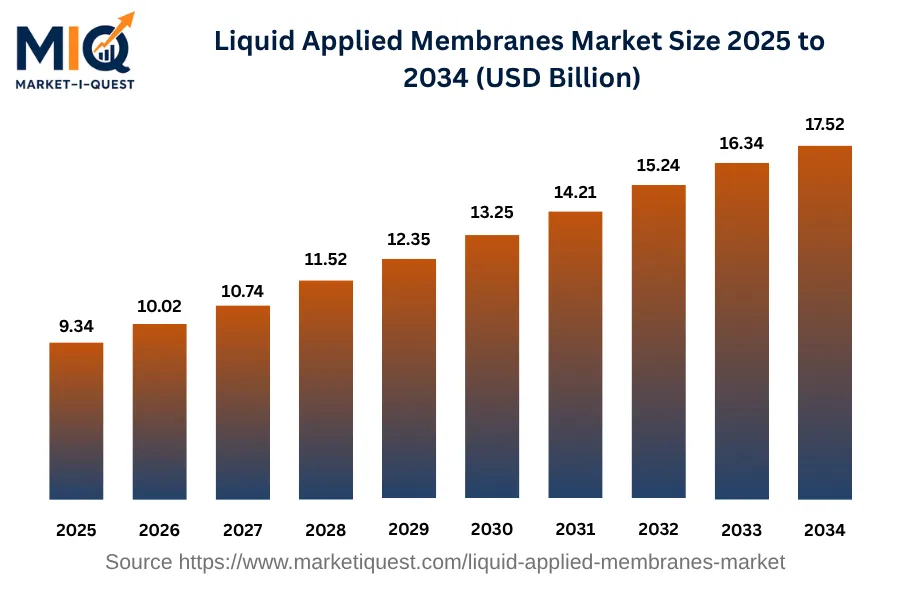
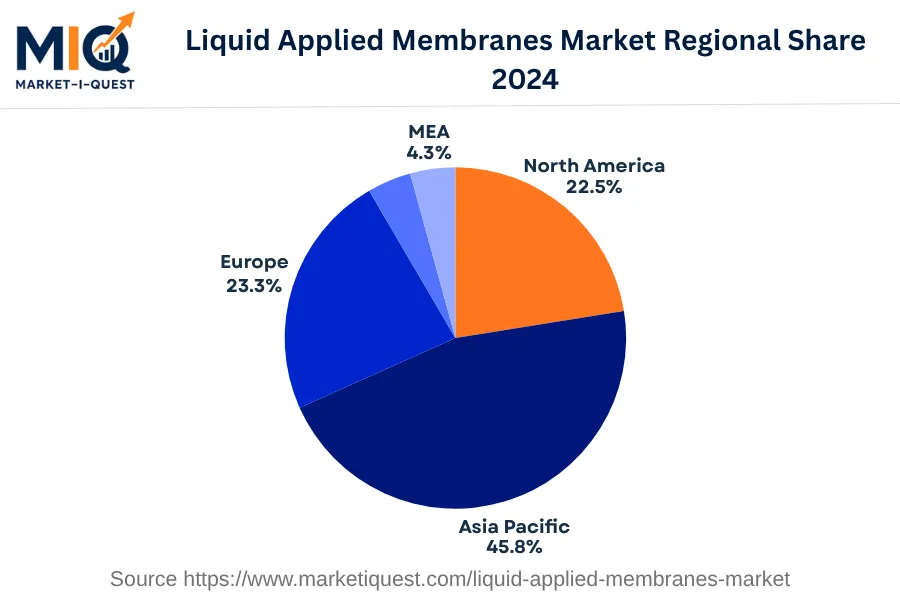
The Liquid Applied Membranes market size stood at USD 9.34 billion in 2025, progressing to USD 17.52 billion by the end of 2034. This development represents a cumulative annual growth rate (CAGR) of 7.24% over the years. Several factors propelling this growth include efficiency benefits and extensive applications of liquid-applied membranes in various industry sectors. A steady rise in the period between initial and final evaluations attributes the overall upward trajectory of this market. In terms of geographic market share in 2024, the Asia Pacific region held the majority with 45.8%, followed by Europe at 23.3%, and North America at 22.5%. The remaining market shares were held by LATAM and MEA regions with 4.2% and 4.3% respectively. These figures provide an accurate representation of the regional distribution within the Liquid Applied Membranes market.

Key Takeaways

  • By Product Type - Polyurethane-Based Liquid Applied Membranes held a notable position in 2024.
  • In the Substrate - Metal led the market accounting for the highest share in 2024.
  • By Application - Swimming Pools & Water Features expanded fastest accounting for a major share in 2024.
liquid-applied-membranes-market market size

Key Driving Factors

Implementation of energy efficiency regulations in the construction industry

The global push towards energy efficiency has led to the implementation of strict regulations in the construction industry. These laws necessitate the use of high-performance insulation solutions, contributing to the rise in adoption of liquid applied membranes. In practice, these materials improve thermal insulation in buildings, ensuring compliance with energy-saving standards. For instance, the introduction of the EU Energy Performance of Buildings Directive pushes builders towards the use of these membranes to reduce energy requirements for temperature regulation. This legal standard, while encouraging eco-friendly practices, has inadvertently driven the growth of the liquid applied membranes market due to its superior insulative properties compared to traditional materials.
Cost-effective rehabilitation in aging infrastructure

Aging infrastructures, especially in developed countries, present a significant demand driver for the liquid applied membranes market. The need for cost-effective rehabilitation methods is crucial due to constrained budgets in public infrastructure maintenance. In this context, liquid applied membranes are preferable as they allow for surface-level renovation without the need for complete structural overhaul. As such, municipal governments and private property owners lean towards these materials to prolong the lifespan of their structures, reducing the need for more expensive replacement procedures. This need for cost-effective, restorative solutions, particularly in economies with older infrastructure, has increased the demand for liquid applied membranes, stimulating market growth.

Market Evolution by Timeline

2019-2023
During this period, construction industries, especially in Asia-Pacific regions such as China and India, increased their adoption of the Liquid Applied Membranes (LAMs). It was primarily for waterproofing, due to benefits like cost-effectiveness and adaptability to complex geometry. Suppliers offered diverse formulations, including cementitious, bituminous, polyurethane, and acrylic categories. Industry standard EN 1504-2 approved LAMs as a crucial material in concrete surface protection. Average LAM pricing was competitive, often with flexible term contracts emphasizing project-based partnerships. However, application proficiency became a constraint due to a shortage of skilled labor. To counter this, companies started conducting in-house training programs.
2024
In 2024, LAMs found increased applications in the repair and rehabilitation of infrastructure in the UK and the US, enhancing market penetration. Tactical shifts toward more environmentally friendly and low-VOC-emitting LAMs were apparent to comply with stringent regulations such as the European Union's REACH. Due to escalated demand, there was a momentary surge in the price of LAMs. Shortages in raw materials like polyurethane and cementitious compounds were a significant supply issue, making long term contracts more challenging. A new risk was the fluctuation in the cost of raw materials affecting final product pricing.
2025-2029
In this phase, the transportation sector, especially tunnels and bridges, became potential buyers across European countries due to increased infrastructure investments. The introduction of LAMs with enhanced application properties, such as quick-drying and long-lasting protection, was noticed. Effectiveness against chemical reactions and carbonation led to TS EN 1504-2 certification. Manufacturers initiated strategic alliances with distributors and local service providers to ensure consistent product availability. They also started offering usage and maintenance training as part of their service package. However, the upsurge in raw material prices posed an uncalled risk to the LAM industry.
2030-2034
By 2030, use of LAMs in residential and commercial segments became more widespread, predominantly in countries like Brazil and Mexico, due to increased urbanization. The market saw the launch of LAMs with unique features like UV resistance and weather durability. A typical contract now included installation services. The ASTM D5957 standardized LAMs as an integral part of roofing structures. Rising environmental concerns led to the promotion of more sustainable methods of production and solvent-free products to comply with regulatory measures. Though suppliers increased their production capacity, supply remained inconsistent due to unpredictable weather patterns affecting material availability and transportation.

Future Market Outlook

Future Opportunities

The continued shift towards sustainable construction presents numerous opportunities in the liquid applied membranes market, particularly as awareness of climate change increases. Beginning in 2023, the European Commission introduced the European Green Deal, incentivizing the use of green technologies in construction. This regulatory environment encourages manufacturers to innovate within eco-friendly material categories, opening avenues for products that utilize recycled components. Regions like North America and Asia Pacific, with burgeoning construction markets, are expected to elevate demand for high-performance liquid applied membranes that adhere to emerging building standards. Additionally, government initiatives in Australia and Canada focusing on energy efficiency are likely to drive investment in advanced waterproofing systems. As industries collaborate on large-scale infrastructure projects, like the construction of new highways and bridges in the Middle East, the need for reliable liquid applied membranes capable of withstanding harsh environmental conditions will be paramount. Innovations in adhesive technologies and rapid-curing agents create potential for quicker installation timelines, addressing labor shortages that many regions currently face. Moreover, partnerships between product manufacturers and construction firms, seen in collaborations like those between Soprema and leading architecture firms in Europe, are likely to foster the development of custom solutions tailored to specific project needs, facilitating market growth and technological advancements within the liquid applied membranes sector.

Segmentation Analysis

By Product Type

The market is divided into subsegments including Siloxane-Based Liquid Applied Membranes, Acrylic-Based Liquid Applied Membranes, Polyurethane-Based Liquid Applied Membranes, and Hybrid Liquid Applied Membranes. The Polyurethane-Based Liquid Applied Membranes subtype accounted for the largest revenue share while the Hybrid Liquid Applied Membranes are expected to grow at the fastest CAGR during the forecast period.

Largest Revenue Share

Polyurethane-Based Liquid Applied Membranes

Market Share Leader

Polyurethane-Based Liquid Applied Membranes account for the largest share of revenues due mainly to their wide-ranging applications and superior resistance characteristics. These membranes demonstrate excellent elasticity and durability, making them ideal for use in a variety of applications. They are largely preferred in residential, commercial, and public infrastructure projects due to their high resistance to wear and tear, and weathering; thereby, providing high cost effectiveness over the long term. In terms of geography, the increasing construction activities in emerging economies contribute significantly to their demand. Additionally, stricter regulations concerning building safety and durability have led to an increased adoption of Polyurethane-Based Liquid Applied Membranes, thereby driving revenues. Other factors like strong distribution channels and low switching costs for consumers also support the robust sales of these membranes.

Fastest CAGR

Hybrid Liquid Applied Membranes

Forecast Period Growth Leader

Hybrid Liquid Applied Membranes are anticipated to grow at the fastest rate during the forecast period. This growth can be attributed to their distinctive characteristics which combine the benefits of multiple materials, thereby creating a multifunctional solution. These membranes are gradually gaining traction due to their environmental friendliness, and the ability to combat problems like leakage and seepage more effectively. Adoption barriers such as higher initial costs are gradually subsiding with increasing awareness about the long-term benefits of these membranes and supportive regulatory policies. Technological advancements and substantial capital investments in R&D are anticipated to fuel this growth further. However, potential near-term risks could stem from the dependency on global supply chains which may be affected by unforeseen disruptions.

By Substrate

The market is divided into subsegments including Concrete, Metal, Wood and Others. The Metal subsegment accounted for the largest revenue share while the Others subsegment is expected to grow at the fastest CAGR during the forecast period.

Largest Revenue Share

Metal

Market Share Leader

Metal stands out as the subsegment with the most revenue in 2024, driven largely by its versatility, durability, and wide applicability across various industries. It is a remarkably resilient material well-suited to a range of applications, which increases its marketability. Industries like construction, automotive, and manufacturing, among others, greatly contribute to its high demand. Its robustness and longevity also make it a favored substrate in areas prone to harsh environmental conditions, fuelling its revenue generation. Metal's recyclability is an added advantage, conforming to the increasing trend for sustainable options in material selection across sectors. Economic growth in developing regions and the consequent expansion of infrastructure is further expected to keep the demand for Metal high. However, the cost and availability of raw materials along with fluctuating prices could pose a potential challenge to this subsegment.

Fastest CAGR

Others

Forecast Period Growth Leader

The 'Others' category, which covers a variety of substrates beyond Concrete, Metal, and Wood, is projected to witness the fastest growth. Its projected escalation can be attributed to the continuous innovations in the field, resulting in the creation of new, improved materials better suited to specific applications. This segment's growth can also be spurred on by the shifting regulatory landscape advocating for more sustainable and environmentally friendly materials. Furthermore, strategic partnerships and increasing investments in R&D by key players in the market could serve as a catalyst for its growth. However, the adoption of these newer substrates could be hampered by doubts surrounding their performance and reliability, compared to their traditional counterparts. Factors such as high production costs and the lack of awareness, might also serve as barriers to growth, particularly in emerging markets.

By Application

The market is divided into subsegments including Roofing, Underground Structures, Tunnels & Bridges, Swimming Pools & Water Features, and Others. Among these, Roofing accounted for the largest revenue share while Swimming Pools & Water Features is expected to grow at the fastest CAGR during the forecast period.

Largest Revenue Share

Roofing

Market Share Leader

The roofing subsegment drove the most revenue in 2024. This is predominantly due to the constant demand for new housing developments and the pressing need for maintenance or renovation of existing buildings. The popularity of this subsegment is also enhanced by its variety, with a range of materials and styles available to meet customer preferences and the structural requirements of different climates and geographies. Regular fluctuations in weather elevate the need for regular roof repairs or replacements, ensuring a steady revenue stream. Government regulations requiring specific roofing standards have also driven sales, as customers seek to comply with these mandates. High switching costs make it favorable for roofing materials manufacturers and suppliers to retain customers at potentially profitable levels.

Fastest CAGR

Swimming Pools & Water Features

Forecast Period Growth Leader

The Swimming Pools & Water Features subsegment is projected to grow at the fastest CAGR. Despite its relatively small size, this market has substantial growth potential due to a combination of factors. The most prominent catalyst is the increasing disposable income among consumers leading to a rise in residential pool installations. Meanwhile, public spaces like municipalities and hotels are enhancing their facilities with aesthetic water features to attract more visitors. Additionally, the integration of advanced technologies like automated cleaning and energy-efficient heating systems is facilitating adoption by minimizing maintenance efforts and costs. However, high capital expenditure and regulation-compliance pose adoption barriers that could slow down the growth rate. In the near term, partnerships with construction firms and real estate developers could be an effective strategy for accelerating market expansion.

Competitive Analysis

Key Market Players

Manufacturers / OEMs

BASF SE
Germany
Sika AG
Switzerland
Saint-Gobain
France

Key Suppliers & Raw Materials

Dow Chemical Company
US
Wacker Chemie AG
Germany
Kemira
Finland

Distributors, Integrators & Channel Partners

Brenntag AG
Germany
Univar Solutions
US
Nexeo Solutions
US

Porter’s Five Forces Analysis

This analysis determines the competitive intensity and attractiveness of the Liquid Applied Membranes Market.

Supplier Bargaining Power

Medium

Few suppliers with proprietary technologies hold considerable bargaining power.

Buyer Bargaining Power

Low

High switching costs and the criticality of product quality limit buyer bargaining power.

Threat of Substitutes

Low

Substitution threat is low due to the product’s technical performance requirements.

Threat of New Entrants

Medium

Capital investment and technical know-how create barriers to new entrants.

Competitive Rivalry

High

Intense competition exists due to multiple well-positioned market players.

Regional Analysis

Geographic market dynamics and growth opportunities across key regions

Global Market Outlook

liquid-applied-membranes-market market regional share

North America

In 2024, the North American liquid applied membranes market exhibits substantial activity. Drivers of growth primarily encompass three: firstly, the construction sector has ramped up demand for waterproofing materials, making the utilization of liquid applied membranes increasingly necessary in the U.S., Canada, and Mexico. Secondly, stringent building regulations in all these countries require superior quality construction materials, out of which liquid applied membranes hold a substantial stake. Lastly, technology innovation and increased investment have led to the development of more effective and easy-to-apply liquid applied membranes, further stimulating market growth.

Meanwhile, established trends highlight an increasing buyer inclination towards eco-friendly liquid applied membranes, as leading manufacturers keep focusing on lowering environmental impact. There is also a discernible shift towards polyurethane-based membranes due to their high durability and chemical resistance. Additionally, significant channel dynamics have surfaced, with e-commerce playing an increasingly pivotal role in the purchase and supply of these membranes. Moreover, strategic partnerships and mergers have become common among companies to share expertise, leading to product enhancements. In terms of policy enforcement, energy efficiency regulations are influencing manufacturing standards, pushing companies to align products with policy requirements. Key customer sectors remain construction, manufacturing, and utilities, aided by a focus on energy-efficient buildings and infrastructure.

Asia Pacific

In 2024, the Asia Pacific Liquid Applied Membranes (LAM) market exhibited notable dynamism, underpinned by robust industrial growth and stringent regulatory norms. Key market drivers include an uptick in infrastructure development, especially in emerging economies like India and China, stimulating LAM demand in construction, and marine sectors. Additionally, a surge in environmental consciousness precipitated regulatory changes, compelling manufacturers to adopt eco-friendly waterproofing solutions in South Korea and Australia. Market participation also intensified with Chinese enterprises increasing investment in research and advanced technology adoption, incentivizing cheaper and more efficient LAM production.

Prominent market trends encompass behavioral shifts amongst buyers towards more sustainable LAM solutions, noticeable in Japan and key ASEAN markets, and growing preference for cost-effective, high performing membranes in manufacturing and retail sectors. The technological advancements saw a proliferation of innovative, more durable LAM products, enhancing applicability in healthcare, utility, and government sectors. Partnership and M&A activities intensified as players sought to acquire frontline technologies and broaden their geographic reach, notably in China. Heightening scrutiny on policy enforcement was visible, especially in relation to China’s “Blue Sky Defense” policy and India’s stringent construction norms, shaping business strategies. These drivers and trends underscored the vibrant LAM market landscape in Asia Pacific in 2024.

Europe

In 2024, the Liquid Applied Membranes (LAM) market in Europe saw a significant uptake due to various drivers and trends across sectors such as construction, manufacturing, and utilities. High demand was fueled by emerging requirements for water and waste management systems, predominantly in Germany, the UK, and France. Strict environmental regulations, especially the European Union’s Water Framework Directive, encouraged adoption of LAM products, as it fosters sustainable water management. Furthermore, investment in infrastructural projects was robust in the Nordics and Benelux region, stimulating the need for LAM in construction and utilities.

Simultaneously, buyer behavior shifted towards eco-friendly and energy-efficient products. This trend was observed across Spain, Italy, and Central & Eastern Europe. Technological advancements in LAM products to provide enhanced durability and versatility gained traction, with leading players focusing on R&D in innovative membrane technology. There was also a noticeable rise in partnerships and M&A activities, driven by a need to diversify product offerings, especially in the UK and Germany. For example, the strategic partnerships between local manufacturers and global LAM suppliers were prevalent. Policy enforcement in terms of standards and certifications also played a crucial role, particularly in countries like Germany and France, with regulations enforcing the use of certified products.

Latin America

In 2024, the Latin American (LATAM) Liquid Applied Membranes (LAM) market was characterized by growing construction sector demand and wide-ranging industrial applications. Strict environmental regulations in countries like Brazil and Chile fueled demand for eco-friendly LAM products. Significant investments flowed into LATAM's technological innovation; Mexico spearheaded the implementation of smart coatings in the area of LAM. In Argentina, the volatility of raw material costs impacted supply dynamics and pricing of LAM, creating market fluctuations.

Buyer behavior significantly changed as awareness of product sustainability grew—enterprises in Argentina, Colombia, and Peru preferred LAMs with higher durability and low environmental impact. There was a noticeable shift towards water-borne technology in LAM products due to regulation enforcement in Brazil and Mexico aimed at lowering VOC emissions. The complexity of LAM applications led to increased partnerships and mergers & acquisitions, especially in Brazil's construction segment, fostering technological exchanges and market consolidation. High product standard adherence became increasingly important in retail and manufacturing sectors across the region. Government policies, such as Brazil's National Solid Waste Policy, drove the focus on waste minimization, further fostering the demand for sustainable LAM products.

Middle East & Africa

In 2024, the Liquid Applied Membranes (LAM) market in the Middle East and Africa was primarily driven by burgeoning construction activities, stringent environmental regulations, and technological advancements. Countries like Saudi Arabia, United Arab Emirates, Qatar, and Egypt, with their proliferating infrastructure and industrial sectors, exhibited significant adoption of LAM, attributing to enhanced durability and cost-effectiveness. Regulatory bodies in these nations pressed for environmental sustainability, prompting businesses to adapt LAM for ecological benefits. The oil and gas sector was notably prevalent in this, utilizing these membranes across their diversified operations. Furthermore, the growing investment in technological adoption amplified the market growth, with the development of waterproof and vapor-permeable LAMs ramping supply dynamics.

In the same year, particular customer behavior trends emerged in the market. A marked preference for high-quality LAMs led to companies shifting focus to the production of technologically advanced composites. South Africa, Nigeria, Kenya, and Israel exhibited this trend, emphasizing product durability and resistance as primary concerns. Likewise, strategic partnerships were seen resurfacing, with companies collaborating to expand their LAM portfolios, notably in the fast-paced retail sector. Finally, policy enforcement such as the Saudi Arabia Vision 2030 played a critical role, driving the construction industry for government and private structures alike, thus influencing the high demand for LAMs.

Recent Industry Developments

Latest market innovations, product launches, and strategic initiatives

February 2026

Sika announced a CHF 108 million investment in its “Fast Forward” digitalization program, aimed at optimizing the application and performance of liquid membranes through improved precision, reduced waste, and enhanced project efficiency.

June 2025

Tremco announced a strategic partnership with Sika Group to co-develop advanced liquid-applied membrane systems for commercial roofing.

Frequently Asked Questions