Liquid Analytical Instrument Market Snapshot

Key Players

  • Endress+Hauser AG (Switzerland)
  • ABB Process Automation Division (Switzerland)
  • Thermo Fisher Scientific Inc. (US)
  • Danaher Corporation (US)
  • SI Analytics GmbH (Germany)
  • Mettler-Toledo International Inc. (US)
  • Emerson Electric Co. (US)
  • Hach Lange GmbH (Germany)
  • Metrohm AG (Switzerland)

Market Size

Base Year 2024
$0.840 Bn
CAGR
6.65%
Forecast 2034
$1.60 Bn

Market Segments

By Instrument Type
Chromatography Instruments, Spectroscopy Instruments, Mass Spectrometry Instruments, Electrochemical Analyzers, Titrators
By Technology
Traditional Analytical Techniques, Advanced Analytical Techniques, Automation in Analytics
By Application
Chemical Analysis, Environmental Monitoring, Pharmaceuticals, Food & Beverage Testing, Water Quality Testing
By End User
Research Laboratories, Pharmaceutical Companies, Food & Beverage Industry, Environmental Agencies, Academic Institutions

Market Dynamics

Drivers
  • Increasing environmental regulations
  • Advanced healthcare diagnostic needs
Restraints
  • High maintenance costs
  • Lack of skilled professionals
Opportunities
  • Emerging industries' demand
  • Technological advancements in instrumentation

Market Size

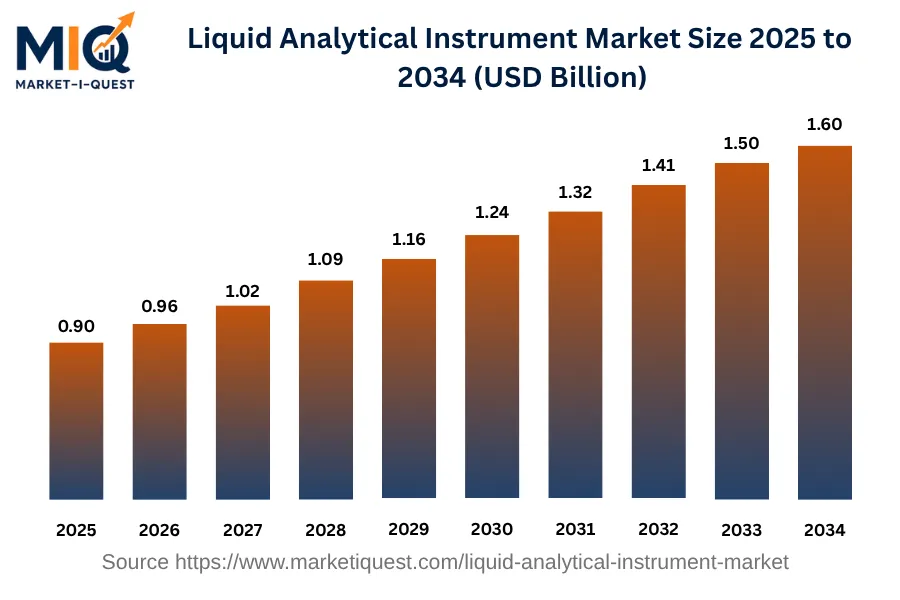
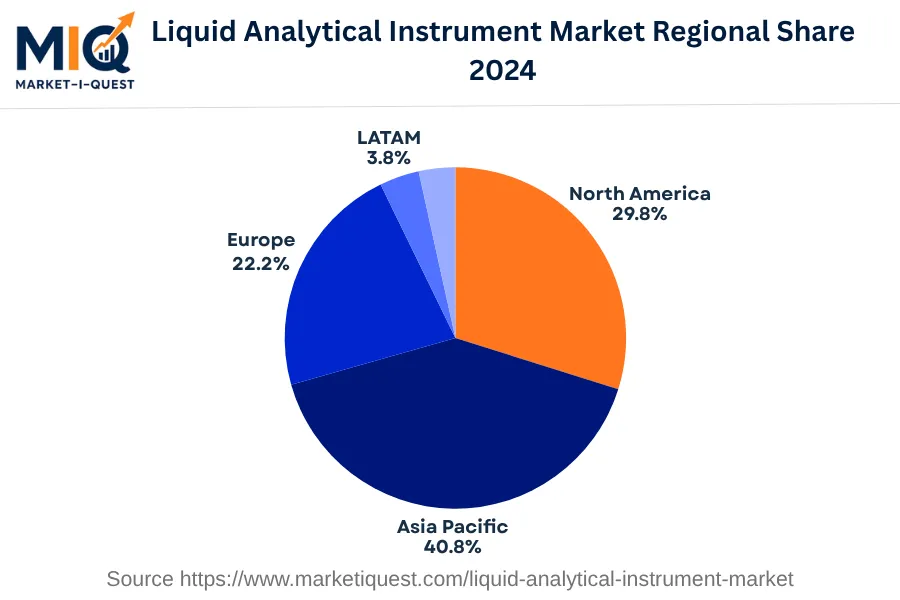
The Liquid Analytical Instrument Market was valued at $0.84 billion in 2024, then increased slightly to $0.90 billion in 2025, and is predicted to further grow to $1.60 billion by 2034, presenting a Compound Annual Growth Rate (CAGR) of 6.65%. This growth over a decade is due to technological and methodological advancements, leading to higher demand for precise analysis in sectors such as pharmaceuticals, environmental testing, and many more. Further contributing factors to the market's expansion include the development of advanced liquid analytical instruments and the rising need for water & wastewater treatment globally. The regional shares in the Liquid Analytical Instrument market in 2024 were as follows: Asia Pacific had the highest share at 40.8%, followed by North America at 29.8%, Europe at 22.2%, Latin America at 3.8%, and the Middle East and Africa with 3.5%, indicating the various demand scenarios across geographies.

Key Takeaways

  • By Instrument Type - Chromatography Instruments held the leading position in the Liquid Analytical Instrument Market in 2024.
  • By Technology - Automation in Analytics grew the fastest signaling a surge in technological innovation.
  • By Application - Pharmaceuticals accounted for the majority use-case in 2024.
  • By End User - Pharmaceutical Companies were the prominent users in 2024.
liquid-analytical-instrument-market market size

Key Driving Factors

Stricter Environmental Regulations

Strict environmental regulations have emerged as a potent driving factor for the liquid analytical instrument market. Countries across the globe are enacting stringent water quality standards to protect human health and ecosystem integrity. For instance, the Clean Water Act in the US and the EU Water Framework Directive guide member countries to monitor water bodies regularly. These legal frameworks necessitate the deployment of precise and dependable liquid analytical instruments for continuous water quality monitoring. Importantly, environmental agencies and utilities must assess parameters such as pH, conductivity, dissolved oxygen, turbidity, and specific contaminants. These comprehensive testing requirements have amplified the need for diverse liquid analytical instruments, thereby propelling the market forward.
Evolving Quality Standards in Biopharmaceutical Industry

The accelerated pace of development in the biopharmaceutical industry has resulted in the raising of quality standards, yielding an increased demand for advanced liquid analytical instruments. The production of biopharmaceuticals involves complex biological processes that require highly precise monitoring and control systems. Strict regulations from organizations such as the US Food and Drug Administration and the European Medicines Agency demand rigorous quality control standards during production. Additionally, principles outlined in the Current Good Manufacturing Practices stress the need for accurate testing of all bio-produced materials. Given these circumstances, the biopharmaceutical industry heavily relies on liquid analytical instruments such as pH meters, conductivity sensors, and turbidity analyzers for process optimization and quality assurance. This demand has significantly fueled the liquid analytical instrument market.

Market Evolution by Timeline

2019-2023
During this period, demand significantly rose in the pharmaceutical industry, due to the need for liquid analytical instruments for accurate and precise substance measurement. Major players contributing to market supply included Siemens AG, Emerson Electric, and ABB, providing tools integrating advanced analytics for improved decision-making. A stark constraint upon this market was the high price of certain instruments. In relation to policy, the European Union tightened regulations concerning food safety, indirectly impacting instrument demand for testing purposes. Common commercial models took the form of long-term contracts with guaranteed aftersales services. However, concerns about data privacy associated with digital communication systems emerged as a potential risk.
2024
In 2024, unsurprisingly, water treatment plants represented the leading buyer segment, given the increasing global emphasis on water quality. The same key players continued to dominate the supply chain, expanding their portfolio with instruments offering advanced features, like cloud-based data management. The US Environmental Protection Agency's (EPA) introduction of stricter rules regarding water quality positively affected market demand. Manufacturers typically offered flexible pricing options to attract smaller industries. However, the increasing complexity of these instruments kept raising concerns about the need for highly skilled operators, posing potential adoption challenges.
2025-2029
Throughout this timeframe, the brewing industry showed a rise in uptake of these instruments for meticulous quality control. Chemical manufacturers, such as Honeywell and Endress+Hauser, featured prominently in terms of supply, leaning heavily on automation and digital solutions to overcome operational challenges. The World Health Organization's (WHO) updated standards on drinking water necessitated increased use of liquid analytical instruments for regulatory compliance. Pricing models moved towards software-as-a-service (SaaS) subscriptions due to cloud integration. The prevalent risk was cybersecurity threats to networked instruments and the concomitant potential loss of sensitive data.
2030-2034
Over this phase, a surge in demand was seen from biotech companies, seeking for higher precision in recombinant DNA technology. The supply side saw a trend toward decentralization, with several new players entering the market, notably from Asia. EU's new stringent guidelines on pharmaceutical waste treatment were likely to cause a boost in demand. Increasingly, subscriptions to software updates for improving hardware performance became a typical procurement model. Despite the advancements, a significant challenge was managing the extensive datasets generated by sophisticated instrument designs, which required expertise in data analytics.

Future Market Outlook

Future Opportunities

Future opportunities in the liquid analytical instrument market are largely shaped by current technological advancements and evolving regulatory landscapes. For instance, the ongoing emphasis on environmental sustainability is prompting manufacturers to develop instruments that support greener practices, as highlighted by the European Union’s focus on eco-design regulations effective in 2023. This regulatory environment encourages innovations towards more energy-efficient devices that minimize waste. The pharmaceutical sector, which is increasingly adopting automated solutions to comply with Good Manufacturing Practices (GMP), presents significant growth potential as seen with Roche's automation systems introduced in 2021, which streamline liquid handling processes. Similarly, advancements in biotechnology, marked by the rise of personalized medicine, are driving the need for precise analytical methods, leading labs like the Mayo Clinic to invest in high-throughput liquid analytical devices for genomic studies beginning in early 2023. The growing market for point-of-care testing, accelerated by the COVID-19 pandemic, has also opened avenues for rapid, portable liquid analysis devices, exemplified by Abbott's introduction of the BinaxNOW product in 2020. Enhancements in cybersecurity measures for these instruments, following the implementation of the NIST Cybersecurity Framework in 2021, will be pivotal to ensuring data integrity, thereby fostering trust in liquid analytical solutions. As these trends unfold, companies that align their strategies with these evolving demands will find significant opportunities for growth.

Segmentation Analysis

By Instrument Type

The market is divided into subsegments including Chromatography Instruments, Spectroscopy Instruments, Mass Spectrometry Instruments, Electrochemical Analyzers, and Titrators. Of these, Chromatography Instruments accounted for the largest revenue share while Electrochemical Analyzers are expected to grow at the fastest CAGR during the forecast period.

Largest Revenue Share

Chromatography Instruments

Market Share Leader

Chromatography Instruments dominate the market revenue-wise due to their extensive use across industries. Food and beverage, pharmaceuticals, biotechnology, and environmental industries drive a significant demand for these instruments, using them for routine quality checks, R&D, and regulatory requirements. Increased health practices and quality control measures in chemical and pharmaceutical sectors spawn the need for chromatography instruments to produce accurate and reliable results. Geographic factors also favor this subsegment, with developed regions like North America and Europe having large-scale industries reliant on these instruments, thus driving the higher share of revenue. Regulatory factors, like the stringent standards enforced by FDA and EMA, further enhance the demand. Lastly, purchasing criteria play crucial roles. Companies prefer high-quality, efficient instruments to avoid costly mistakes; hence, the market leans towards reputed manufacturers that cater to these needs. These factors place Chromatography Instruments as the ­high-revenue subsegment in this sector. Note: This is based on the general industry structure; specific data is not provided.

Fastest CAGR

Electrochemical Analyzers

Forecast Period Growth Leader

The Electrochemical Analyzers subsegment is projected to undergo rapid growth within the market, marking it as the fastest growing subsegment. Industry-wide trends towards automation and digitization act as the catalyst spurring the demand for advanced analysis techniques, such as those provided by Electrochemical Analyzers. These analyzers offer precise, repeatable measurements making them an ideal choice for technologically progressive industries. The ongoing shift towards green and sustainable processes presents another growth opportunity by entailing strict emission regulations needing such analyzers for monitoring. Barriers to their adoption, such as high initial costs and lack of skilled personnel, are being gradually eroded by industry partnerships, vendor finance schemes, and increased training. However, the near-term risk includes market economic volatility that may affect the capital expenditure on new technologies. Despite these barriers, the subsegment of Electrochemical Analyzers offers significant growth promise due to its alignment with global technological and environmental trends.

By Technology

The market, by technology, is divided into subsegments including traditional analytical techniques, advanced analytical techniques, and automation in analytics. Out of these, traditional analytical techniques account for the largest revenue share, while automation in analytics is expected to grow at the fastest CAGR during the forecast period.

Largest Revenue Share

Traditional Analytical Techniques

Market Share Leader

Traditional analytical techniques have the largest revenue share within the tech-based market sectors. The enduring market demand for these techniques is primarily due to the widespread use of conventional methods in various industries such as healthcare, finance, marketing, and manufacturing. These industries rely heavily on these techniques to evaluate their raw data and deduce valuable insights. The reliability of these techniques, ease of use, and easy integration into existing systems make them a preferred choice, attracting significant investment. The versatility and applicability of these techniques, despite the rise of new technologies, offer a substantial revenue stream in different regions. Additionally, government regulations that mandate the use of certain standard analysis techniques in specific sectors are also contributing to the revenue of this segment. The purchasing criteria usually involve proven effectiveness, robustness and reliability that these traditional techniques offer which ensures this segment retains its leading position in the revenue chart.

Fastest CAGR

Automation in Analytics

Forecast Period Growth Leader

While traditional techniques lead in revenue, the subsegment poised for the fastest growth is automation in analytics. A strong catalyst for this growth is the ongoing digital transformation across industry sectors, aiming to streamline operations and achieve efficiency. As businesses accumulate vast amounts of data, the need for automation becomes crucial to handle such volume and gain accurate insights in a timely fashion. The adoption of artificial intelligence and machine learning technologies also propels this trend, offering potential for advanced analytics that require minimum human intervention. However, significant initial investment and concerns over data security pose challenges to its adoption. In the near term, the progress in cloud technology and strategic partnerships can help overcome these barriers and drive the growth of automation in analytics.

By Application

The market is divided into subsegments including Chemical Analysis, Environmental Monitoring, Pharmaceuticals, Food & Beverage Testing and Water Quality Testing. Out of these, Pharmaceuticals garnered the highest revenue in 2024, while Food & Beverage Testing is projected to expand at the most significant pace over the forecast period.

Largest Revenue Share

Pharmaceuticals

Market Share Leader

In the base year of 2024, the pharmaceutical sector leads in revenue generation amongst the specified segments. The primary driver for this is the continuous growth in healthcare expenditure as the ageing population increases the demand for pharmaceutical products. Furthermore, the global surge seen in chronic diseases necessitates extensive drug discovery processes, stimulating the demand for analytical instrumentation associated with chemical analysis, thus fuelling the segment's growth. Stricter regulatory guidelines and quality control measures have also augmented the adoption of high-end analysis techniques in the pharmaceutical sector. Significant growth has been witnessed particularly in emerging economies, with their expanding healthcare sectors and intensified focus on quality assurance, further providing momentum to the pharmaceutical subsegment revenue generation.

Fastest CAGR

Food & Beverage Testing

Forecast Period Growth Leader

Although not leading in revenue, the journey of Food & Beverage Testing is not slow and steady. In fact, it is predicted to report the fastest CAGR in the upcoming years. This accelerated growth rate can be traced back to multiple factors. Increasing awareness among consumers regarding the food quality coupled with tighter food safety regulations worldwide are driving the need for elaborate food and beverage testing methods. Moreover, recent technological advancements have made it possible to detect pollutants and allergens more efficiently, leading to higher adoption rates in this segment. Furthermore, potential partnerships between food industry players and analytical instrument manufacturers could lead to the development of faster, more efficient testing methods. However, high costs and a lack of skilled professionals present barriers to adoption, thereby offering some near-term risks.

By End User

The market is divided into subsegments including Research Laboratories, Pharmaceutical Companies, Food & Beverage Industry, Environmental Agencies, and Academic Institutions. Pharmaceutical Companies accounted for the largest revenue share while Food & Beverage Industry is expected to grow at the fastest CAGR during the forecast period.

Largest Revenue Share

Pharmaceutical Companies

Market Share Leader

Pharmaceutical Companies hold the largest share in market revenue, hugely driven by the increasing research & development in drug discovery and clinical studies in the year 2024. The critical role of pharmaceutical companies in managing diseases through medication makes these entities pivotal in market uptake. Moreover, the robust pharmaceutical sector, characterized by intense competitiveness and continuous innovation, solidifies this subsegment's revenue leadership. Regulatory policies also contribute to this, creating high barriers to entry thus concentrating market activity to major players. Buyers are mainly healthcare providers and patients, where switching cost is high due to trust barriers, standardized processes, and treatment adherence. Geographically, this spans a global market with notable influences from North America and Europe dominating the industry.

Fastest CAGR

Food & Beverage Industry

Forecast Period Growth Leader

The Food & Beverage Industry is expected to experience the fastest growth in this segment. A surge in food safety standards, consumer demand for quality assurance, and the need for food producers to ensure regulatory compliance act as primary growth catalysts. With emergent technologies, the time and cost associated with testing are reducing, boosting market adoption and industry growth. Nonetheless, there are implementation barriers, particularly in developing regions where technical expertise and high initial investment may slow down adoption. However, partnerships with international bodies, regulatory push, and increased capacity for capital expenditure are expected to make the adoption easier for entities in these regions. That said, a near-term risk exists in the potential for global economic downturns that may stifle food consumption levels and, subsequently, growth in this market subsegment.

Competitive Analysis: Liquid Analytical Instrument Market

Key Market Players

Manufacturers / OEMs

ABB
Switzerland
Emerson Electric
US
Endress+Hauser
Switzerland

Key Suppliers & Raw Materials

Honeywell
US
Siemens
Germany
Thermo Fisher Scientific
US

Distributors, Integrators & Channel Partners

VWR International
US
Phoenix Contact
Germany
Festo
Germany

Porter’s Five Forces Analysis

This analysis explores the competitive intensity and attractiveness within the Liquid Analytical Instrument market.

Supplier Bargaining Power

Medium

Suppliers have moderate influence due to specialized components required for instrument manufacture.

Buyer Bargaining Power

High

Buyers, mainly large industries, have high power due to availability of multiple instrument vendors.

Threat of Substitutes

Low

Low substitution threat due to the specialized and unique nature of liquid analytical instruments.

Threat of New Entrants

Low

Significant regulatory barriers and high R&D costs deter new entrants.

Competitive Rivalry

High

Fierce competition as players continuously innovate to produce more accurate and efficient instruments.

Regional Analysis

Geographic market dynamics and growth opportunities across key regions

Global Market Outlook

liquid-analytical-instrument-market market regional share

North America

In the base year 2024, the North American market for Liquid Analytical Instruments demonstrated remarkable resilience amid the diverse demands of industries such as healthcare, environmental testing, and manufacturing. Key market drivers include stringent government regulations, especially in the U.S. and Canada, that require regular monitoring and testing of water and air quality, propelling demand for advanced analytical instruments. Investment in R&D across the region, particularly from pharmaceutical and biotech companies, boosted requirements for these high-precision instruments for various applications like drug discovery and quality control. Likewise, advanced technology adoption, such as IoT-embedded devices, reflected a surge in operation efficiency and reliability of these instruments. The robust supply chain and competitive pricing dynamics contributed to the market's sustainability.

Simultaneously, clear trends shaped the market landscape. Buyers showed a marked preference for automated, user-friendly instruments offering quicker and more accurate analysis. Technology shifts centered around smart sensors and data analytics tools were noteworthy, revolutionizing field testing procedures and real-time data analysis. There was also a wave of growth in strategic partnerships, particularly in the U.S., as instrument manufacturers sought to diversify their offerings and expand their market reach. Lastly, there was a persistent focus on meeting ever-evolving standards, reinforced by strict policy enforcement by regulatory bodies across healthcare, utilities, and manufacturing sectors.

Asia Pacific

In 2024, the Asia Pacific market saw a surge in demand for Liquid Analytical Instruments primarily driven by escalating industrialization and stringent regulatory norms. Increased investment, particularly in the pharmaceutical sector and adoption of technologically advanced machinery in India, China, and South Korea, stimulated the market's growth. Australia's focus on quality assurance in brewing industries further amplified the demand for these instruments, contributing to an upswing in pricing due to supply-demand dynamics. Trends observed include behavioral changes in buyers, favoring automated Liquid Analytical Instruments that offer accuracy and efficiency. Japan led this shift due to its technological prowess and emphasis on precision.

Furthermore, partnerships and mergers among key players such as ASEAN governments and enterprise sectors ensued to enhance technological capabilities, aligning with the sustainability standards enforced region-wide. Massive uptake was seen in various sectors including healthcare for diagnostic and research purposes, government bodies for environmental monitoring, and manufacturing industries for quality control processes. Furthermore, the retail sector greatly capitalized on the technology adoption trend, employing these instruments for maintaining product standards. Thus, a clear rise of Liquid Analytical Instruments was observed in the Asia Pacific region in the base year of 2024.

Europe

In 2024, Europe's liquid analytical instrument market was characterized by robust demand fuelled by a surge in health, environment, and industrial applications. German chemical and pharmaceutical industries drove demand, capitalizing on precise, automated analytics for fluid quality control. France’s energy sector heightened the adoption of these instruments for processing nuclear and renewable energy, with a focus on stringent waste management. UK regulations on water treatment fostered compliance to standards, hence reinforcing precision-oriented demand. Benelux countries also saw a wave in technological adoption for intricate brewing operations, where real-time analysis is vital for product quality. Industrial automation played a crucial part in the Italian and Spanish markets, primarily in the food sector. The proliferation of IoT devices enabled efficient monitoring of liquids, boosting operational efficiency in these nations.

The market was further propelled by shifts towards cloud-based systems and partnerships in the Nordics and Central & Eastern Europe. Digital transformation in healthcare paved the way for remote patient monitoring services, buoyed by these instruments' diagnostic abilities. In retail, online platforms championed delivery of these analytical instruments, observed through an uptick in web-based sales. Meanwhile, standardization policies tightened in the region, necessitating adoption of compliant, high-performing devices across sectors. This move upheld stringent product and environment safety parameters, positioning liquid analytical instruments as an integral component in Europe’s market blueprint.

Latin America

In 2024, the Liquid Analytical Instrument Market made significant strides in Latin America, influenced by several market drivers and trends. A surge in demand for water and wastewater treatments in countries such as Mexico and Brazil led to a higher need for accurate liquid analysis, promoting growth in the sector. Regulatory compliance for wastewater disposal, notably in Argentina and Chile, fostered investment in liquid analytical instruments, propelling the market further. Adoption of advanced technologies, such as automated liquid handlers in Colombia's healthcare sector, also bolstered market dynamics.

Shifting trends in buyer behavior impacted market fluctuations. The growing importance of precise analytical processes in industries such as food & beverage (Brazil), pharmaceutical (Peru), and utility operations (Mexico) encouraged the use of these instruments. The market observed a shift toward product offerings facilitating real-time analysis, delivering improvements in operational efficiency. Notable channel dynamics included a growth in online platforms for procurement of these instruments. High-profile partnerships, such as the one between Brazil’s state-run oil company Petrobras and technology providers, showcased the increased focus on oil & gas analysis. These dynamics solidified LATAM's place as a prominent region in the Liquid Analytical Instrument Market in the year 2024.

Middle East & Africa

In 2024, the Liquid Analytical Instrument Market in the Middle East and Africa saw pronounced activity, energized by distinctive drivers and trends across its unique dynamics. Major drivers included robust demand in oil and gas, manufacturing, and healthcare sectors in countries like Saudi Arabia, Qatar, and the United Arab Emirates, underpinned not only by regulations favoring novel technology adoption but also by substantial investment inflows. Particularly in Nigeria and South Africa, demand stemmed from both telecom and utility sectors striving to implement rigorous quality control standards and efficient system monitoring.

Regarding trends, buyers exhibited a noticeable shift towards AI-powered instruments for increased precision and efficiency, especially in Israel and Egypt. Additionally, multiple partnerships and mergers between regional and international manufacturers unfolded to augment market penetration and offer enhanced solutions to satisfy stringent policy enforcement in the healthcare sector across Kenya and South Africa. Moreover, channels underwent dynamic change as key players took advantage of e-commerce growth in the region to directly reach customers. Lastly, recent policies for water quality monitoring in Egypt and South Africa contributed to the expansion of the market, with the governments actively seeking advanced liquid analytical instruments.

Recent Industry Developments

Latest market innovations, product launches, and strategic initiatives

January 2026

Endress+Hauser acquired SOPAT GmbH, a Germany-based specialist in inline process measurement technology for particle characterization, effective January 1, 2026. SOPAT and its subsidiary Parsum now operate under Endress+Hauser's liquid analysis product center in Gerlingen, Germany. SOPAT's photo-optical image-based inline technology analyzes particles, droplets, and bubbles in real time without sampling or dilution. The acquisition complements Endress+Hauser's existing portfolio and strengthens its process analysis capabilities across life sciences, food & beverage, and mining industries.

Frequently Asked Questions