Last-Mile Delivery Market Snapshot

Key Players

  • UPS (United States)
  • FedEx (United States)
  • DHL (Germany)
  • DPD Group (France)
  • Deliv (United States)
  • Postmates (United States)
  • Shipt (United States)
  • Go-Jek (Indonesia)
  • Delhivery (India)
  • CJ Logistics (South Korea)

Market Size

Base Year 2024
$ 173.54 Bn
CAGR
8.4%
Forecast 2034
$ 388.77 Bn

Market Segments

By Service Type
  • B2B (Business To Business)
  • B2C (Business to Customer)
  • C2C (Customer to Customer)
By Technology
  • Autonomous
  • Non
By End Use Industry
  • Food & Beverages
  • Retail & Ecommerce
  • Healthcare
  • Other

Market Dynamics

Drivers
  • E-commerce growth
  • Urbanization rate increase
Restraints
  • High operational costs
  • Regulatory challenges
Opportunities
  • E-commerce growth
  • Urbanization increase

Market Size

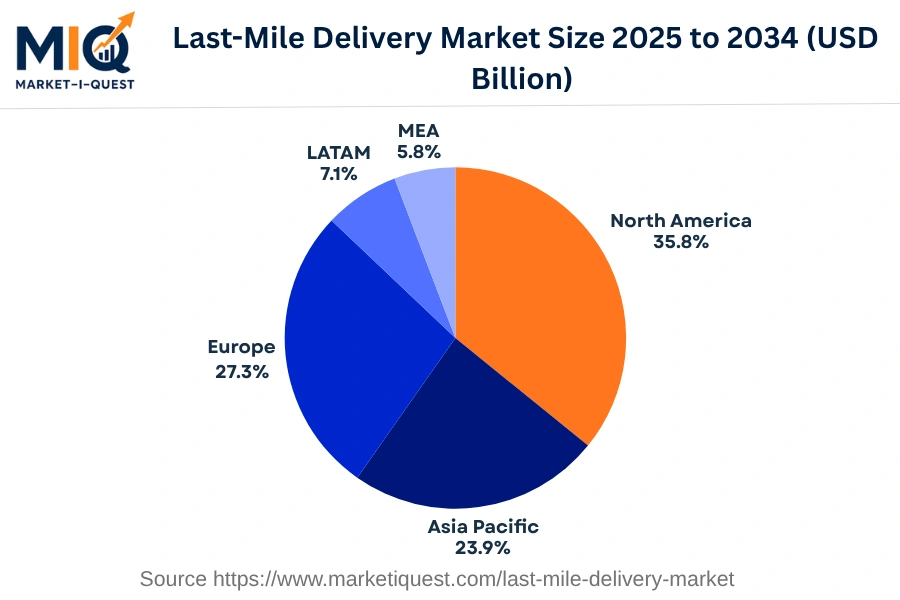
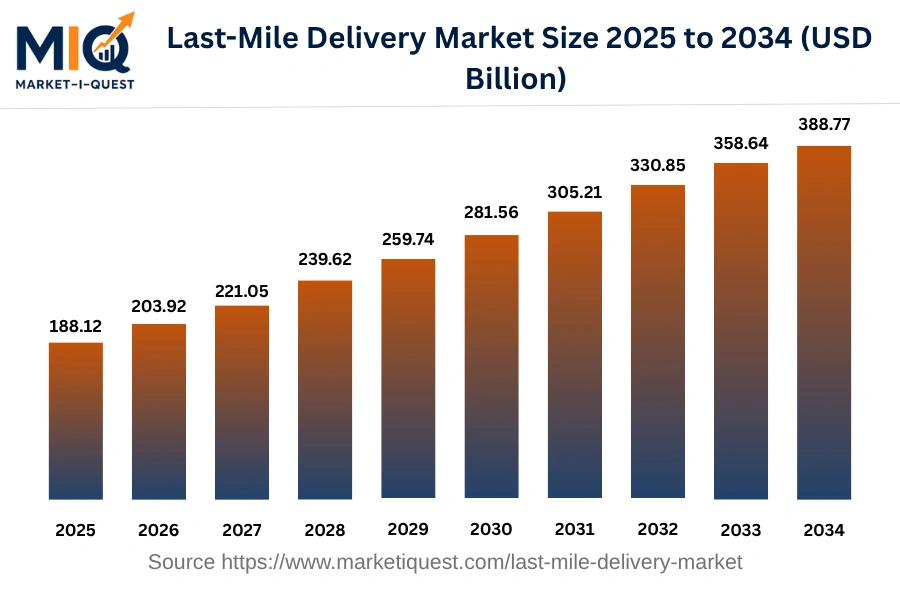
The Last-Mile Delivery Market share was worth $188.12 billion in 2025 and it witnessed substantial growth to reach a market size of $388.77 billion in 2034, showing a steady CAGR of 8.4% throughout the period. The market indicated an increased value of $14.58 billion between 2024 to 2025, introducing a rising trend over the upcoming years. By 2034, the market value will be doubled more than it valued in 2025 showing expansion. This growing trend was supported by various factors such as increasing demand and transforming the industries leveraging last-mile delivery services. Whereas, the regional market shares in 2024, North America accounted for 35.8% of the market as the highest regional segment. Europe followed with 27.3%, with the Asia Pacific region accounting for 23.9%. Latin America accounted for a share of 7.12%, while the Middle East and Africa accounted for 5.8% of the market in 2024.

Key Takeaways

  • By Service Type - B2B held the majority stake contributing to a significant market share in 2024.
  • By Technology - Non-Autonomous led the growth accounting for a substantial percentage in the base year.
  • By End Use Industry - Retail and E Commerce segment was the top contributor in 2024.
last-mile-delivery-market market size

Key Driving Factors

Implementation of Drone Delivery Systems

Market leaders in e-commerce like Amazon and logistics companies such as UPS and DHL have started testing and implementing in some instances, the drone delivery systems, especially for last-mile delivery market share. The use of drones for delivery provides an option to reroute in urban areas, including features such as speed and efficiency to logistics operations. This shift towards drone technology also focus on challenge of access in rural and difficult routes, effective delivery of goods to the customer. Even with regulatory concerns, drone usage in last-mile delivery is gaining pace due to potential cost savings, faster delivery times and reducing carbon emissions from traditional modes of transportation.

Adoption of Electric Vehicles in Last-Mile Delivery

Environmentally friendly solutions to logistics are increasingly becoming the standard in the industry. Many logistics and delivery service providers are now swiftly converting to electric vehicles for last-mile delivery. Companies like FedEx and UPS have made significant investments to switch to electric vehicles (EVs) as response to growing consumer consciousness about sustainability as well as meeting corporate sustainability goals. EV adoption also provides long-term cost saving on fuel and maintenance. The growing shift towards EVs is a major driver in the last-mile delivery market expansion, also, it addresses the environmental concerns which also offers operational efficiency and cost-effectiveness.

Market Evolution by Timeline

2019-2023
In this period, the rise of eCommerce businesses significantly drove the demand for Last-Mile Delivery services in technologically advanced regions like North America and Asia. Major buyers in the sector are online retailers, food delivery and consumer electronics companies. Major players used drones and electric vans for delivery, but faced certain barriers due to limitation in battery capacity and regulatory approval. Regulatory bodies like the Federal Aviation Administration (FAA) of the United States has placed certain restrictions on drone deliveries pushing some companies to focus on ground-based delivery robots. Delivery service pricing was mostly based on distance and weight of goods. The main risk came from inefficiency in route planning that led to increased fuel cost and delivery delays.
2024
In 2024, urbanization and increased internet reach expanded the buyer segment to include a rising number of small-and-medium sized enterprises from emerging last-mile delivery markets trends that started offering online shopping options. The supply side saw increased adoption of electric and automated delivery vehicles. Continuous resistance from labor unions against autonomous deliveries was a common problem. Regulatory bodies such as the European Union started analyzing standards for autonomous vehicle safety. The partnerships between delivery service providers and eCommerce platforms became a standard business model. Unpredictable fuel prices and delivery route disruptions, due to weather conditions remained the major risks.
2025-2029
In this period, demand from healthcare and grocery sectors joined the list of prominent buyer segments due to the rise of online medicine and grocery shopping. Companies started piloting hydrogen fuel cell delivery vehicles as a solution to limited battery life issue. However, the high cost of hydrogen fuel cells posed as a constraint. Regulation for autonomous vehicles became more defined, with policies like the European General Safety Regulation coming into effect. The commercial model shifted visibly towards pay-per-delivery pricing that attracted smaller businesses. Apart from the increasing cost of advanced technologies, cyber-attacks on autonomous vehicle systems emerged as a new risk in this period.
2030-2034
By this time, demand for Last-Mile Delivery services has spread across several business sectors. The use of AI-driven delivery management systems to search optimal routes became frequent, reducing human drivers for deliveries. The implementation of the Clean Vehicles Directive in Europe encouraged companies to invest in sustainable delivery solutions. The business framework was a subscription-based contracts for regular deliveries, especially recognized among large enterprises. The risk of job loss due to automation increased in countries with strict labor laws, driving some providers to maintain a balance between manual and automatic deliveries. Effects of climatic changes on delivery schedules and routes emerged as a certain risk.

Future Market Outlook

Future Opportunities

The future of last-mile delivery market growth is essentially a combination with emerging consumer preferences and regulatory frameworks. The need for efficient delivery options play a major role in the expansion of e-commerce within this sector. Companies like Instacart are adapting by offering one-hour delivery services in selective cities with rising demand for quicker service. In 2023, cities like San Francisco adopted regulations for reducing traffic and enable increased options for sustainable delivery methods such as bike couriers or electric vehicles. Various businesses like FedEx and UPS are positioned to enhance their delivery processes due the integration of AI in logistics offering enhanced route optimization and predictive analytics. Meanwhile, urban warehousing solutions are gaining pace with firms like Amazon exploring last-mile hubs to support rapid deliveries in densely populated areas, With increasing need for green logistics solutions by various governments. Supported by policies such as the California Air Resources Board's 2022 regulations, encourages stakeholders to invest in eco-friendly delivery methods. During the pandemic, the increased usage of app-based payment showed a changing consumer preference towards increased adoption of contactless and cashless payment systems. With these major factor businesses who adapted the change and strategies accordingly are likely to have a dynamic future in this sector.

Segmentation Analysis

By Service Type

The market is divided into subsegments including B2B (Business To Business), B2C (Business to Customer), and C2C (Customer to Customer), among which B2B accounted for the largest revenue share while B2C is projected to grow at the fastest CAGR during the forecast period.

Largest Revenue Share

B2B (Business To Business)

Market Share Leader

In 2024, the B2B subsegment held the largest market share due to various factors. Before, businesses had larger purchasing in comparison with individual customers, which has driven the market size transaction and revenue. B2B transactions are likely to be repetitive and higher in volume. Meanwhile, B2B customers commonly seek to generate a steady revenue stream with long-term contracts. In developed regions such as North America and Europe offers strong economic positions and increased focus on businesses that use these services resulted in contributing in high revenue for the subsegment. With multiple businesses driving rising demand are increasingly seeking to improve productivity and efficiency as the rise in automated supply chain operations has also been a crucial driver for the B2B segment.

Fastest CAGR

B2C (Business to Customer)

Forecast Period Growth Leader

The B2C segment is projected to grow at the fastest pace. The increasing consumer requirements for combination of professional services and product with the expansion of e-commerce platform is the primary driver for the development of this trend. Rapidly developing economies such as India and China are emerging as the primary drivers, with a growing middle-class population is increasingly utilising business services. Due to the advancements in technology and an increased digital literacy rates globally have eliminated traditional adoption barriers, making these services more accessible to general consumers. The rise of innovative marketing strategies used to focus on personalization of communication and allowing businesses to reach individual directly also act a driver for expansion. However, despite a promising outlook, near-term risks such as data security issues and changing customer behaviours could potentially slow the expected escalation pace.

By Technology

The market is divided into subsegments including Autonomous and Non-Autonomous technologies. Of these, Non-Autonomous accounted for the largest revenue share while Autonomous is expected to grow at the fastest CAGR during the forecast period.

Largest Revenue Share

Non-Autonomous

Market Share Leader

The Non-Autonomous technology segment held the largest share of market revenues, mainly due to the established nature of the technology and wide adoption across various industries. The lower initial cost makes it a preferable option for businesses on early stage for integrating technology within their operational model. Moreover, compared to autonomous technology non-autonomous technology has a lower risk profile, without having to navigate the open-ended regulation environment of autonomous tech. It benefits from a mature supply chain, reducing costs and ensuring steady availability. The purchasing criteria of a non-autonomous technology are established while the switching costs are higher while moving towards a new technology. These factors help to establish a strong position for non-autonomous technology in the last-mile delivery market demand. Moreover, there are vast distribution channels for non-autonomous technology, allowing wide-scale adoption and heightened access for customers.

Fastest CAGR

Autonomous

Forecast Period Growth Leader

The Autonomous technology segment, shows the fastest growth potential due to various factors. The major driver for this expansion is the increasing need for smarter, more efficient technological solutions. The technology's potential to fundamentally improve efficiency and productivity, particularly in sectors such as manufacturing, transport, and logistics is a significant adoption drivers. However, barriers such as public viewpoint and regulation presents as challenges. An evolving regulatory landscape is slowly leading the way for wider public acceptance of autonomous technology as driver of this development. Significant investments in AI and machine learning further drive the growth of this segment. Near-term risks still exist, including technical bugs, security issues, are the primary challenges for job shifting. These factors are important for aiming the future development of this segment.

By End Use Industry

The market is divided into subsegments including Food & Beverages, Retail & Ecommerce, Healthcare, and Others. Of these, the Retail & Ecommerce subsegment accounted for the largest revenue share while the Healthcare subsegment is expected to grow at the fastest CAGR during the forecast period.

Largest Revenue Share

Retail & Ecommerce

Market Share Leader

In 2024, The Retail & Ecommerce subsegment is leading in terms of revenue majorly driven by the widespread digital transformation and consumer shift towards online shopping. Customers are increasingly seeking accessibility with a variety of options and competitive pricing that various e-commerce platforms offer. There are various factors that drove the retailers in adoption of e-commerce including various factors such as operational efficiency, smooth inventory management and efficient interactions with customer through digital platforms. Which resulted in increased revenues from the Retail & Ecommerce segment. Additionally, with the introduction to various new business models in the sector are leading to revenue growth. A favorable regulatory environment encourages e-commerce activities, further contributing to the stability in the sector.

Fastest CAGR

Healthcare

Forecast Period Growth Leader

The Healthcare subsegment is expected to witness the fastest growth in this segment. The major growth drivers include the increasing needs for precision medicine with increasing healthcare expenditure and advancements in technology. Healthcare providers are leveraging digital platforms to improve patient care, optimize workflows and increase operational efficiencies. Additionally, the emerging development of telemedicine and electronic health records are gaining requirement in modern healthcare environment. Government policies encouraging digitalization of healthcare has accelerated. But the barriers to adoption such as strict data privacy regulations, high initial investment and lack of skilled people could present near-term risks. Technology partnerships, including collaborations with fintech and edtech sectors for tech advancements and employee training.

Competitive Analysis

Key Market Players

Top Manufacturers / OEMs

FedEx Corporation
US
United Parcel Service Inc.
US
DHL International GmbH
Germany

Key Suppliers & Raw Materials

Wabash National Corporation
US
Dongfeng Motor Corporation
China
J.B. Hunt Transport Services
US

Distributors, Integrators & Channel Partners

Alibaba Group
China
Amazon.com, Inc.
US
Walmart Inc.
US

Porter’s Five Forces Analysis

This analysis evaluates the competitive forces impacting the Last-Mile Delivery Market.

Supplier Bargaining Power

Medium

Access to transportation and logistics infrastructure influences supplier power.

Buyer Bargaining Power

High

Due to increasing service providers, customers have high bargaining power.

Threat of Substitutes

Low

Limited viable substitutes for last-mile delivery due to e-commerce dependency.

Threat of New Entrants

Medium

Rising eCommerce popularity but initial logistic investments pose barriers.

Competitive Rivalry

High

High competition due to presence of traditional couriers and new tech entrants.

Regional Analysis

Geographic market dynamics and growth opportunities across key regions

Global Market Outlook

last-mile-delivery-market market regional share

North America

In 2024, various factors like rising e-commerce trends, regulatory shifts and technological adoption resulted the growth of Last-Mile Delivery Market in North America.
In regions like the U.S., Canada and Mexico with rising need in ecommerce drove the market while consumer preferences shifting towards contactless shopping with evolving retail landscape. With rising emission standards eventually increased the investments in electric and hybrid delivery vehicles where regulations in urban areas played a significant role. Technology adoption increased, marking a shift towards digital transformation, as logistics firms leveraged AI and big data for predictive analytics.

A rising shift in consumer behaviour with a preference for faster deliveries and regular tracking updates supported last-mile delivery market trends. In response companies optimized the efficiencies with investing in automated distribution systems and drone technology. Omnichannel retail strategies such as, connecting physical stores to online environments to optimize last-mile deliveries. Partnerships saturated due retail giants like Amazon broadened their logistics networks through associations with local players. Enforcement of strict data protection policies additionally categorized the sector, impacting data sharing across supply chains.
With such drivers and trends, sectors like healthcare, government, retail, and manufacturing in North America adapted their delivery chain strategies, focusing on timely delivery and tracking of goods.

Asia Pacific

In 2024, the Last-Mile Delivery market in Asia Pacific experienced a major expansion in growth, driven by various factors and trends. Particularly in India, China and ASEAN market opportunities increased due to digital advancements highlighted a major need for efficient and timely delivery services which resulted a surge in e-commerce. With developments such as digital infrastructure growth in China and Startup India initiative in India reflected the investment with promoting technological adoption in last-mile delivery operations. Moreover, regulatory policies such as initiative such as reducing carbon emission standards in South Korea with major contribution due to the adoption of electric delivery vehicle.

A significant shift in buyer behavior towards prioritizing speedy and trackable deliveries . For instance, JD.com promised a guaranteed same-day delivery in China. Tech adoption saw widespread use of drones for delivery in Japan, supported with its gentle regulatory environment. Delivery partnerships accelerated as observed collaboration between Australia Post and major retailers for streamlined services. Policy enforcement remained firm as emerged within strict compliance norms in Singapore for e-delivery vehicles.

Key sectors including retail and manufacturing witnessed logistics optimization, specifically in China and India, boosting the last-mile delivery market opportunities. With a notable requirement from the healthcare sector, boosted a shift on telemedicine sector in Australia requiring speedy delivery for medical supplies. Overall, the last-mile delivery market analysis in 2024 was largely shaped by consistently adaptive regulations, tech advancements, and changing consumer behaviors.

Europe

In 2024, a dynamic growth was seen in the Last-Mile Delivery market growth driven factors such as expansion in e-commerce, consumer demand for speedy delivery and continuous technological integration. Particularly, Germany and United Kingdom adopted the on-demand and same-day delivery services with increasing strain on urban logistics resulting in rising digital consumer culture. France and the Nordics made various investment in green last-mile initiatives for promoting the usage of electric/hybrid vehicles and sustainable regulations for delivery. In contrast, Central & Eastern Europe adopted automation and AI for optimizing sorting and delivery processes with managing their increasing parcel volumes.

The shifting preference of consumers towards retailers-based delivery options with rising surge within the e-grocery market in Italy and Spain. With Benelux leads the market due to technological advances like drones, bots, and click-and-collect services supported in reshaping the infrastructure of last-mile delivery market. Partnerships and Acquisitions allowing optimization of routes and scalability, such as DPD group's acquisition of Geis Parcel in Germany. Policy enforcement against road-jams and pollution drove companies for exploring downtime and shared delivery hubs, particularly in urban areas. The primary sectors served included e-commerce, retail, and healthcare industries.

Latin America

In 2024, the Last-Mile Delivery Market trends in Latin America established significant pace due to a variety of factors. In countries like Brazil and Mexico with increased e-commerce activities resulting in expanded the need for quick and reliable delivery services. While countries such as Colombia and Chile drove the technological adoption in the sector with notable investment in digital infrastructure, supporting in efficient parcel tracking and route optimization. Meanwhile, areas with regulatory environment such as Peru and Argentina played a major role for encouragement in the use of low-emission vehicles with transformed supply dynamics further promoting sustainable last-mile delivery services.

Several emerging trends according to the LATAM Last-Mile Delivery Market analysis. The increasing shift in customer preference towards same-day delivery, largely driven by online retail and healthcare sectors. In countries such as Argentina and Brazil, due to increased usage of electric vehicles and drones noticed a significant technological shift. Whereas, in countries such as Colombia and Mexico a notable growth in partnerships and acquisitions within delivery networks and e-commerce platforms aiming for expansion throughout geographic reach. With enforcement of stricter policy in Chile and Peru relating to delivery personnel's work conditions and compensation surface. Together these factors influenced performance of the market of last-mile delivery services.

Middle East & Africa

In 2024, the Last-Mile Delivery Market demand in the Middle East and Africa presented a dynamic landscape for logistic solutions.

In regions such as Saudi Arabia, United Arab Emirates and South Africa drove this transformation leading in expansion of e-commerce sectors, demanding encouragement for efficient delivery services. With various friendly regulatory framework are increasingly motivating the technological adoption in delivery processes with policies like new logistics policy in Egypt. The increased adoption of advancements in cloud-based logistics and real-time tracking with notable investments from firms like Israel and Nigeria gave a push to the last-mile delivery market expansion. Whereas, Qatar and Kenya saw significant improvement in their supply chain dynamics preparing for competitive pricing in the delivery market.

During this trend the shift in the consumer behaviour highlighted the increasing preference towards quick and trackable deliveries majorly in retail and healthcare sector. With increasing automated deliveries, a notable technological shift mainly in regions with extensive usage of drones such as United Arab Emirates. The collaboration between telecom provider Etisalat and logistics firm Aramex introduced new channel dynamics in last-mile delivery. Financial regulatory enforcement in countries like Saudi Arabia and South Africa reinforced the complaince of last-mile services to standards, giving a push to merger and acquisition activities.

Recent Industry Developments

Latest market innovations, product launches, and strategic initiatives

January 2026

Amazon published the results of its massive network overhaul, having successfully partitioned its entire U.S. fulfillment network into eight interconnected, self-sufficient regions. This strategic redesign increased in-region fulfillment from 62% to 76%, reducing the distance between sites and customers by 15% and cutting middle-mile touchpoints by 12%.

March 2025

Operational routing paradigms advanced significantly with the deployment of heterogeneous assistant frameworks, integrating both aerial drones and autonomous delivery robots alongside traditional vans. These heterogeneous configurations demonstrated up to a 49.71% improvement in delivery efficiency over van-only models.

January 2025

A critical development for operational management emerged via comprehensive Lifecycle Assessments (LCA), targeting the environmental and economic impacts of drone-truck parallel delivery systems. This framework provides operators with the exact cost and greenhouse gas emission quantification needed to transition fleets without facing unexpected regulatory penalties.

Frequently Asked Questions