
Laser Processing Market Snapshot

Key Players

  • Trumpf Group (Germany)
  • Coherent Inc. (US)
  • IPG Photonics Corporation (US)
  • Amada Co. Ltd. (Japan)
  • Jenoptik AG (Germany)
  • Han's Laser Technology (China)
  • Lumentum Holdings Inc. (US)
  • MKS Instruments (US)
  • Eurolaser GmbH (Germany)
  • Bystronic Laser AG (Switzerland)

Market Size

Base Year 2024
$25.32 Bn
CAGR
9.73%
Forecast 2034
$64.08 Bn

Market Segments

By Type
  • Gas Lasers
  • Solid-State Lasers
  • Fiber Lasers
  • Others
By Application
  • Marking
  • Cutting
  • Welding
  • Drilling
  • Others
By End User Industry
  • Aerospace & Defense
  • Automotive
  • Electronics
  • Manufacturing
  • Healthcare
  • Others

Market Dynamics

Drivers
  • Increasing industrial applications
  • Technological advancements in laser processing
Restraints
  • High equipment costs
  • Regulatory compliance issues
Opportunities
  • Increased industrial automation
  • Advancements in laser processing technologies

Market Size

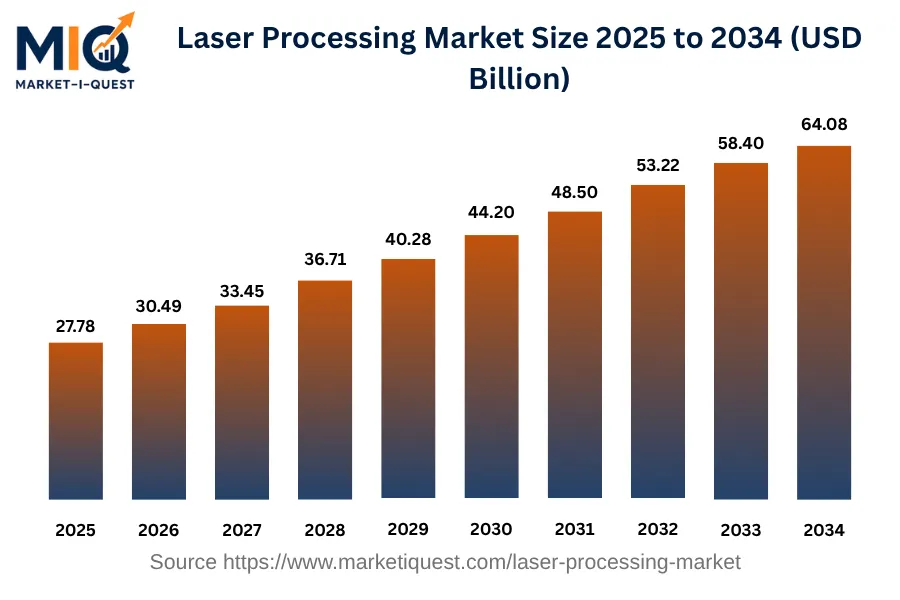
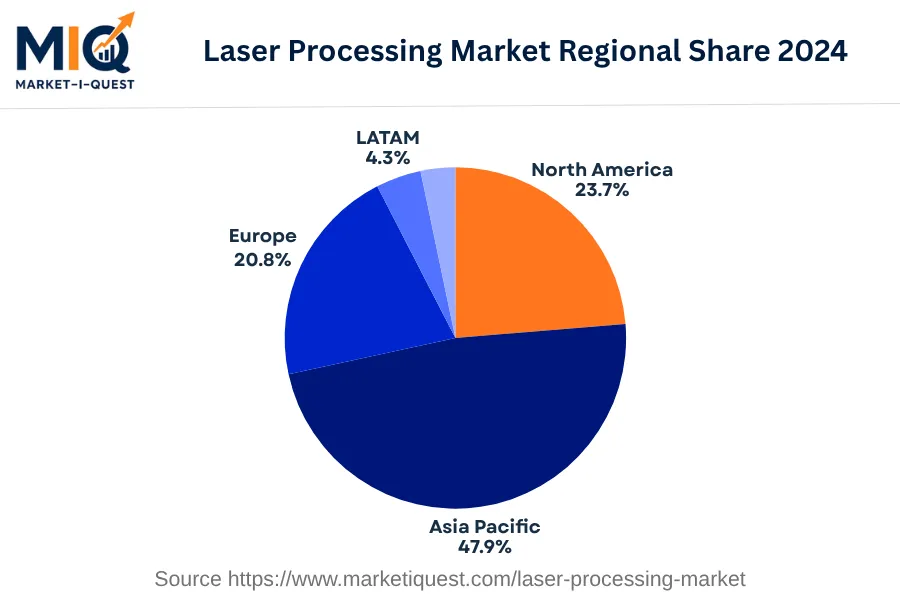
The Laser Processing Market is expected to grow from 27.78 billion USD in 2025 to 64.08 billion USD in 2034, with a CAGR of 9.73%. The key driver behind this significant growth is an increased demand within various sectors utilizing laser processing technology. In 2024, the regional share of the market with North America at 23.7%, Asia Pacific at 47.9%, Europe contributing 20.8%, Latin America with 4.3%, and the Middle East and Africa contributing at 3.3%. This distribution indicates a major share of the global market is held by the Asia Pacific region.

Key Takeaways

  • By Type - Solid State Lasers accounting for a major share in the base year.
  • By Application - Cutting sector dominated holding a leading position for the same period.
  • By End User Industry - Automotive industry held the top spot making it a key growth driver of the market.
laser-processing-market market size

Key Driving Factors

Precision manufacturing requirements

With industries such as automotive, electronics and aerospace constantly pursue precision in manufacturing for enhancing performance and reliability of the product, laser processing emerges as an essential tool. In sectors like the automotive industry majorly prioritizing precision in processes such as parts manufacturing where laser processing provides the required precision with reducing the damage of components subsequently increased technological adoption. Furthermore, in the electronics industry, the trends miniaturization trend subsequently reduced traditional manufacturing processes. Laser processing offers a method with reduced risks and enhanced precision for producing these small-scale parts with significantly driving the market growth.
Thus, the increased importance in aerospace applications for ensuring high reliability of components under extreme conditions resulted in spurring its adoption.
Regulatory compliance pressures in the medical device industry

The medical device industry meets stringent standards from regulatory bodies, such as the U.S. Food and Drug Administration and the European Medical Device Regulation. These standards necessitate the usage of advanced manufacturing technologies like laser processing, to ensure device safety, efficacy and traceability. Specifically, laser processing plays a major role in medical procedures such as laser encasing, used for air-tight sealing medical implants, and laser cutting, needed for producing precision components. Furthermore, the technology supports in observing the Unique Device Identification (UDI) requirements through precise laser engraving. Thus, the demand for reliable and regulatory- compliant medical devices increases concurrently increases usage and significance of the laser processing technology in this sector.

Market Evolution by Timeline

2019-2023
The automotive industry has been a major buyer of laser processing technologies within this period due to its use in metal cutting, drilling and welding processes. With Significant demand witnessed in Asia-Pacific regions such as China and India, attributing in the increased demand in automotive sectors. Whereas, 2019 saw the launch of laser welding solutions by Laserline highlighting improved integration with existing manufacturing systems. According to the policies the EU's Eco-Design Directive subsequently influenced the market adoption by promoting energy-efficient laser technologies. Thus, pricings were majorly depended on negotiation between vendors and buyers with frequent long term contracts.
2024
By 2024, the electronics industry was recognized as a significant buyer due to the application of the laser technology for precise microfabrications. With North America showing major demand, especially the United States, due to its robust electronics manufacturing sector. In terms of supply, vendors such as Trumpf and Prima Industries launched new multi-purpose laser processing machines. Whereas, the regulatory standards such as OSHA's safety standards influenced adoption rates by specifying safety measures. Thus, the partnerships between suppliers and user industries started gaining increased popularity.
2025-2029
In these period, renewable energy sectors, especially solar cell manufacturers, have been the major buyers of laser processing technologies for precision ribbon bonding. Demand rose predominantly from Europe motivated by its strong drive towards renewable energy. Suppliers introduced more automated and AI-assisted solutions. Policies related to environmental and energy, particularly in Europe's Renewable Energy Directive, spurred market adoption of energy-efficient laser technologies. Thus, commercial agreements subsequently included leasing contracts resulting in reducing the initial costs on technologies.
2030-2034
Healthcare and life science sectors emerged as significant buyers of laser processing technology in this period, using it for micro-machining and precision surgical equipment. Demand predominantly came from developed regions such as North America and Western Europe, driven by their advanced healthcare infrastructure. Technologically, providers moved towards highly specialized sector-specific solutions, with well-structured release of laser systems optimized for clinical applications. Regulatory controls came under stringent FDA regulations, affecting industry-wide adoption. Thus, trend towards flexible rental and pay-per-use models was observed in commercial agreements.

Future Market Outlook

Future Opportunities

As the laser processing market progresses, future opportunities are emerging that may reshape industry dynamics. With the growing emphasis on automation and Industry 4.0, businesses are investing in laser technology to streamline production processes. This trend is observable in the automotive sector, where global leaders like Tesla and BMW are leveraging laser cutting techniques to increase fabrication efficiency. In addition, the aerospace industry is increasingly recognizing the advantages of lasers for precise material processing, particularly in lightweight material applications, as highlighted by Boeing's adoption of laser technologies in aircraft manufacturing. The demand for customized solutions is further driving market evolution, with companies developing tailored laser processing systems to serve unique customer needs. Enhancements in laser engraving and marking technologies are also gaining traction, especially in the consumer goods sector, where brands aim to enhance product traceability and branding. This increasing customization aligns with regulatory requirements on product marking in various regions including the EU and North America. Moreover, partnerships between tech firms and academic institutions, like the collaboration between Fraunhofer ILT and RWTH Aachen University in Germany, are paving the way for innovative applications of laser technologies in medical devices. The ongoing push towards sustainable practices is presenting opportunities for the market to develop eco-friendly laser systems that align with global trends toward environmentally responsible manufacturing processes. This convergence of technology and market needs is poised to create pathways for significant advancements within the industry.

Segmentation Analysis

By Type

The market is divided into subsegments including Gas Lasers, Solid-State Lasers, Fiber Lasers, and Others. Solid-State lasers accounted for the largest revenue share while Fiber Lasers are expected to grow at the fastest CAGR during the forecast period.

Largest Revenue Share

Solid-State Lasers

Market Share Leader

Solid-State Lasers have held the largest share in the laser market because they consistently provide a high level of performance compared to other types. They're predominantly used in manufacturing industries due to their exceptional beam quality and high output power. Solid-State Lasers' practicality in various applications such as drilling, cutting, marking, welding, and surface treatment has propelled their demand significantly. Industrial sectors such as automotive, aerospace, electronics, and healthcare predominantly use solid-state lasers, contributing to its high market share. Furthermore, these lasers' compact size, enhanced safety, and cost-effectiveness make them attractive to consumers. Geographically, industrial powerhouses like China and Germany, with their robust manufacturing sectors, contribute to the dominant share of the Solid-State Laser market. It's worth mentioning that any changes to international trade regulations can impact this segment due to its intense global integration.

Fastest CAGR

Fiber Lasers

Forecast Period Growth Leader

Fiber Lasers are predicted to be the fastest-growing subsegment in the laser market. The rapid adoption of fiber lasers in various industries and its increasing application in material processing, marking applications, and microprocessing is driving its growth. Innovations such as high beam quality, high optical gain, and flexible operation have overcome key barriers in the adoption of fiber lasers. Significant improvements in fiber lasers, such as production of high-power laser beams and the development of double-clad fibers, have skyrocketed their usage. Additionally, the expenditure on research and development is escalating along with the establishment of strategic partnerships with end-use industries, including medical, printing, and manufacturing, which aids in overall growth. However, near-term risks such as the transitioning trade policy and potential disruption in supply chains due to recent global events may slightly affect the growth trajectory of this subsegment.

By Application

The market is divided into applications such as Marking, Cutting, Welding, Drilling, and Others. Of these, Cutting accounted for the largest revenue share while Welding is expected to grow at the fastest CAGR during the forecast period.

Largest Revenue Share

Cutting

Market Share Leader

The cutting subsegment leads the market in terms of revenue. This dominance can be attributed to the widespread application of cutting technologies across various industries such as manufacturing, aerospace, automotive, and constructions. These industries require precision cutting for various components, causing a significant demand for cutting technologies. Factors such as the evolution of technology and the increasing need for high speed and accuracy in operations, majorly drive the revenue in this segment. The trend of miniaturization and high power density has also enhanced the demand for technological advancements in cutting, further leading to increased revenues. Geographically, regions with robust industrial sectors such as North America and Asia Pacific generate the most revenue in the cutting application segment. The introduction of supportive government policies, and the existence of well-established distribution channels has further boosted revenue generation in this subsegment.

Fastest CAGR

Welding

Forecast Period Growth Leader

Despite not being the largest revenue driver, the Welding subsegment presents the fastest growth opportunities. This rapid growth in the welding segment is forecasted due to several factors. The primary driver is the increasing demand for welding applications in emerging markets due to continuous industrialization, especially in the automotive and construction industries. Rapid technological advancements have resulted in the development of laser welding that offers advantages such as high speed, precision, and quality, thereby attracting increased adoption. Moreover, initiatives to reduce the environmental impact have led to the increased use of welding technologies as they produce less waste and have low energy consumption. However, the high initial investment and maintenance costs of advanced welding technologies may act as a barrier to the growth of this subsegment. In the near term, partnerships among key players and increase in capital expenditure in various industrial sectors can serve as catalysts for the growth of the welding application segment.

By End User Industry

The market is divided into subsegments including Aerospace & Defense, Automotive, Electronics, Manufacturing, Healthcare, and Others. The Automotive sector accounted for the largest revenue share while the Electronics sector is expected to grow at the fastest CAGR during the forecast period.

Largest Revenue Share

Automotive

Market Share Leader

The Automotive sector emerged as the largest revenue contributor in 2024, reflecting the ever-increasing global demand for vehicles, especially electric and autonomous ones. This subsegment's growth is primarily driven by technological advancements in vehicle production and a surge in consumer preferences for sophisticated automobile features, promoting higher spending on automotive components and parts. Furthermore, rapid urbanization and rising disposable incomes globally have boosted vehicle ownership, thereby propelling the automotive market. Additionally, stringent governmental regulations regarding vehicle safety and emissions push manufacturers to invest more in research and innovative product developments, further driving the subsegment's revenue. The global automobile market is also evolving with various new models and designs, broadening the customer base and increasing revenue share.

Fastest CAGR

Electronics

Forecast Period Growth Leader

The Electronics sector is projected to experience the fastest growth during the forecast period, driven primarily by rapid advancements in technology and the increasing integration of electronic devices in daily lives. The relentless consumer demand for newer, faster, and more efficient electronics is a contributing factor to this rapid growth. Additionally, the transition toward smart homes and cities is massively impacting the electronics industry by stimulating the growth of IoT devices. Furthermore, strategic partnerships across the supply chain, along with substantial investments in R&D, are fueling the development of innovative products and solutions. However, potential obstacles to this growth include data security concerns and stringent regulations related to electronic waste. Despite these challenges, the potential for growth in this segment is substantial, driven by factors such as digitization, automation, and the advent of advanced technologies like AI, machine learning, and IoT.

Competitive Analysis

Key Market Players

Manufacturers / OEMs

TRUMPF GmbH + Co. KG
Germany
Coherent, Inc.
US
Han's Laser Technology Industry Group Co., Ltd.
China

Key Suppliers & Raw Materials

nLight, Inc.
US
II-VI Incorporated
US
MKS Instruments, Inc.
US

Distributors, Integrators & Channel Partners

Jenoptik AG
Germany
Sodick Co., Ltd.
Japan
LaserStar Technologies Corporation
US

Porter’s Five Forces Analysis

An examination of the competitive landscape and market forces within the Laser Processing Market.

Supplier Bargaining Power

Medium

Reliant on specialized raw materials which are controlled by few suppliers affecting prices.

Buyer Bargaining Power

Low

High switching costs and technical expertise required gives buyers lower bargaining power.

Threat of Substitutes

Low

Few substitutes exist due to the specificity and precision offered by laser processing.

Threat of New Entrants

Medium

Lowered costs and improved technology create opportunities for new entrants, but capex and expertise requirements act as barriers.

Competitive Rivalry

High

Intense rivalry due to the presence of many established companies and emerging market players.

Regional Analysis

Geographic market dynamics and growth opportunities across key regions

Global Market Outlook

laser-processing-market market regional share

North America

In 2024, the North American laser processing market has consistently grew its trajectory driven by multiple factors. With significant technological adoption with industries such as manufacturing, healthcare, automotive and electronics industries increasingly integrating laser processing due to its features such as precision and efficiency. Increased investment in research and development further boosted market growth with innovations improved laser performance and versatility. Demand driven due to increased industrial activity significantly played a major role in market expansion.

Various trends supported in shaping the market with enhanced awareness of the end-user awareness towards laser processing techniques triggered adjustments in buyer behavior. After recognizing the potential these of procedures for their processes multiple industrial and manufacturing companies started integrating them into their operational frameworks. With a notable shift toward fiber and ultrafast lasers, indicating advancements in technology and evolving industry requirements. A surge in partnerships and M&A activities resulted in companies pursued to enhance their market presence and capabilities. With frequent strict compliance for safety standards and regulations in laser operations, ensuring safe implementation of the process across sectors. The market primarily included sectors such as manufacturing, healthcare and automotive. Thus, simultaneously government-supported initiatives, particularly in the U.S, spurred demand for laser processing in the public sector.

Asia Pacific

In 2024, the Asia Pacific laser processing market witnessed significant activity due to multiple factors. Key drivers included the adoption of laser processing technologies in China's automotive industry and India's expansive manufacturing sector. Moreover, the South Korean government's investment in laser tech developments drove national defense and security areas. Furthermore, the healthcare sector in Australia and ASEAN markets experienced an increased laser equipment demand, driven by an increase in minimally invasive procedures.

Simultaneously, trends shaping the market landscape were dominated by increased usage of laser processing in microelectronics, specifically in Japan and metal fabrication sectors across the region. Newer applications of laser technology were observed in China's retail and e-commerce sectors, offering personalized laser marking services on a wide range of products. Strategic M&A activities took place, while larger entities pursued to merge the market by acquiring smaller and specialized laser processing firms. For instance collaboration between India's leading manufacturing firms and Japanese laser technology providers, highlighting a global expansion trend. Additionally, with a significant focus on policy enforcement in relation to laser safety measures, prominently in Australia's healthcare sector and various manufacturing units across India. Thus, the base year reflected a period of substantial growth and varied adaptations for the laser processing market within the Asia Pacific region.

Europe

In 2024, Europe's laser processing market experienced significant growth due to various factors. Technology adoption was paramount, with countries like Germany, the United Kingdom, and France making robust investments in laser technology for applications in sectors like manufacturing, healthcare, retail, and utilities. Regulatory factors also drove the market, as stricter safety standards in countries like Italy and Spain increased demand for precision-based laser processing machines.

The market saw emerging trends related to buyer behavior and technology shifts. For instance, the quest for efficiency in manufacturing across Central & Eastern Europe motivated a shift towards automated laser processing machines. Meanwhile, in the Nordics, an inclination towards sustainable practices influenced the adoption of energy-efficient laser technology. Notably, the Benelux countries saw a trend in mergers and acquisitions, with companies aiming to gain a competitive edge in the laser processing market.

Consequently, key customers such as enterprise-level businesses and the government have been propelled to integrate laser technology. In healthcare, the growing popularity of non-invasive laser procedures was apparent, while in the retail sector, there was increased use of laser engraving for personalized goods. Overall, Europe's laser processing market demonstrated compelling dynamism, backed by diverse driving factors and evolving trends within 2024.

Latin America

In 2024, the Laser Processing Market in Latin America (LATAM) posed an evolving technological landscape across multiple supporting industries. Key drivers behind this growth were investments by local players, such as Brazil’s WEG Industries, in laser processing equipment with applications in their expansive automotive parts manufacturing units. Additionally, Mexico's regulatory emphasis on laser safety standards increased adoption of laser processing in medical labs, facilitating precise surgical procedures.

Rising demand for laser-etched products in Argentina's retail industry significantly influenced market dynamics. Collaborative practices also proliferated, particularly between Chilean mining companies and laser processing services providers, to enhance mineral exploration. Further, in Peru and Colombia, burgeoning laser adoption was witnessed in the utilities sector, mainly aiming to improve the accuracy of measurements in energy industries.

Consumer behavior shifts were notable as well, with an increased preference for laser-processed precision tools among Brazilian enterprises. Technology-wise, fiber laser processing emerged as the prevalent choice among Mexican manufacturers, due to its efficiency and low environmental impact. In Chile’s utilities sector, a shift towards more compact and versatile handheld laser meters was observed. Notably, partnership between Argentina’s Rofin-Sinar and Colombia's Antilaser, fused local manufacturing expertise with advanced international laser technology, indicating a strategic move in the region. The regulatory landscape in LATAM also evolved, with enforcement of safety standards for lasers used in healthcare industries.

Middle East & Africa

In 2024, the Laser Processing Market was seeing noteworthy growth in the Middle East and Africa, driven by several key factors. The combination of technological advancements, increasing adoption, and strategic investments was propelling the demand in sectors like oil and gas, healthcare, telecom, and manufacturing. Particularly, Saudi Arabia was investing heavily in advanced laser technologies for its manufacturing and oil and gas sectors, while in South Africa, the healthcare industry was embracing laser technologies for precise medical procedures.

Simultaneously, several trends were shaping the market. In the United Arab Emirates and Qatar, buyer behavior leaned towards high-quality, durable laser equipment, driving manufacturers to innovate. There was a shift towards partnership models in Egypt, helping local companies to adopt advanced laser processing machines. Meanwhile, strict policy enforcements were observed in Nigeria and Kenya, which prioritized safety and efficiency standards in the laser processing industry.

The uptake of laser technology in Israel's telecom sector was significant, setting a precedent in the region. Interest from the financial services sector was also noticeable across the region, particularly in Saudi Arabia and the United Arab Emirates, which were exploring automation and data security possibilities via laser technologies. In a nutshell, the market context in the base year 2024 was marked by adoption, investment, regulations, and shifting trends in the Middle East and Africa.

Recent Industry Developments

Latest market innovations, product launches, and strategic initiatives

January 2026

At the IMTEX Forming & MOLDEX INDIA 2026 exhibition, Laser Technologies launched a new 5-axis CNC tube bending machine alongside their Smart Weld Pro system. This rollout reflects a heavy industry push toward integrated, automated laser fabrication ecosystems within rapidly expanding manufacturing hubs.

November 2025

Exail launched the IXF-2CF-EY-10-130-SMX, a new erbium/ytterbium co-doped optical fiber designed for next-generation fiber lasers. This material science development allows for 30W output with exceptional beam quality and immunity to photodarkening, which is a critical requirement for LiDAR and free-space communication systems.

October 2025

Bystronic signed a definitive agreement to acquire the Tools for Materials Processing business unit from Coherent Corp. This acquisition is a strategic maneuver by Bystronic to aggressively expand its footprint beyond traditional macro-cutting into high-margin micro-material processing for the medical device and semiconductor sectors.

Frequently Asked Questions