Intumescent Coatings Market Snapshot

Key Players

  • Sherwin-Williams (United States)
  • Jotun (Norway)
  • Hempel (Denmark)
  • Akzo Nobel (Netherlands)
  • R. Brothers (United States)
  • Carboline (United States)
  • PPG Industries (United States)
  • 3M (United States)
  • KANSAI PAINT (Japan)
  • Nullifire (United Kingdom)

Market Size

Base Year 2024
$1.08 Bn
CAGR
4.37%
Forecast 2034
$1.66 Bn

Market Segments

By Type
Thick film, Thin film
By Technology
Solvent Based, Water Based, Epoxy Based
By Substrate
Wood, Structural Steel & Iron, Others
By End Use
Construction, Oil & Gas, Automotive, Others

Market Dynamics

Drivers
  • Increasing fire safety regulations
  • Growth in construction industry
Restraints
  • High production costs
  • Stringent environmental regulations
Opportunities
  • Increasing construction activities
  • Need for fire safety enhancements

Market Size

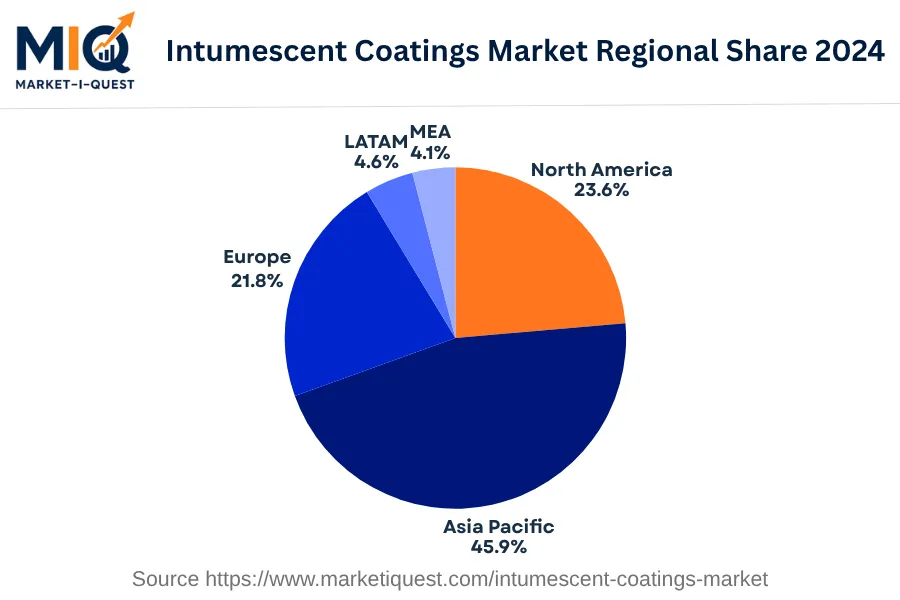
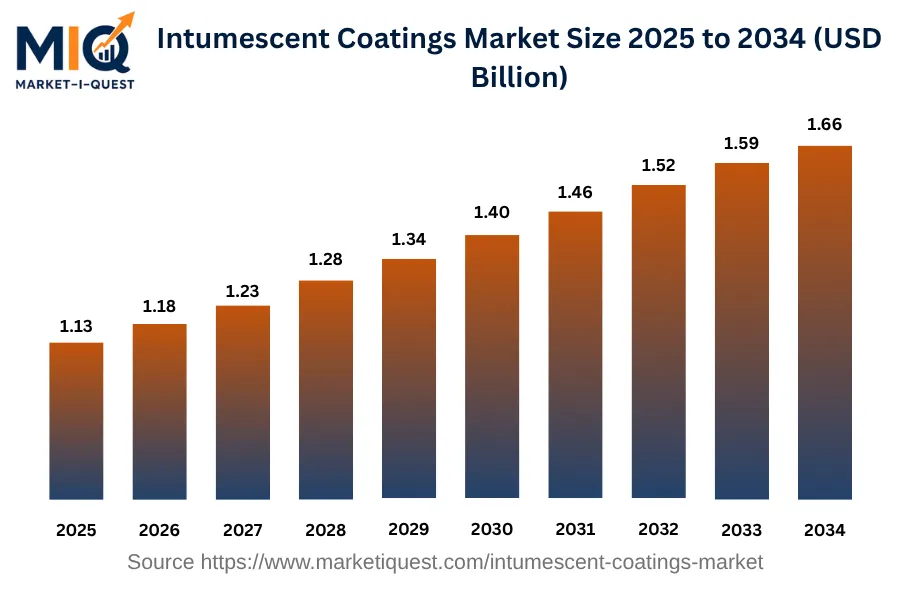
The Intumescent Coatings Market is projected to have a size of $1.13 billion in 2025, and it escalates to $1.66 billion by 2034, which is reflective of a CAGR of 4.37%. The growth from $1.08 billion in 2024 demonstrates a persistent upward trajectory over 10 years. The steady expansion within this period is indicated by the increase in market size from the $1.13 billion in 2025 to reach an estimation of $1.66 billion in 2034. The amplified market value showcases substantial development within the Intumescent Coatings Market. In a regional context in 2024, Asia Pacific had the highest share in the market at 45.9%, followed by North America at 23.6%, and Europe with 21.8% of the share. The remaining portion of the market was divided between LATAM at 4.6%, and MEA, holding 4.1% of the total market.

Key Takeaways

  • By Type - Thick film held the largest market share in 2024.
  • By Technology - Solvent Based led the market in 2024.
  • By Substrate - Structural Steel & Iron category accounted for the highest share in 2024.
  • By End-Use - Oil & Gas emerged as the leading sector in 2024.
intumescent-coatings-market market size

Key Driving Factors

Stringent Fire Safety Regulations in Construction

Today, several regions, including Europe and North America, are enforcing sterner fire safety regulations in the construction sector. For instance, the European Union's Construction Products Regulation mandates the use of fire retardant materials in new, public, or large-scale buildings. Contingent on these guidelines, constructors rely heavily on intumescent coatings for their unrivalled flame resistance. These materials expand when subjected to high temperatures, forming a protective layer that safeguards the structure's core elements. Consequently, the rigorous adoption of these rules is compelling more builders to implement intumescent coatings, precipitating the substantial expansion of the market.

Surge in Exploration Activities in Oil and Gas Industry

Companies in the oil and gas industry are increasingly exploring new reserves to meet the global energy demand. These exploration activities often involve risky environments, where the probability of fire-related incidents is significant. This escalating exploration has necessitated more robust fire protective systems. Intumescent coatings become a paramount choice due to their excellent flame-resistant properties. They are applied on steel structures used in these explorations, where the coating could bloat in response to high heat, creating a protective shield against fire. The surge in the oil and gas exploration activities positively impacts the intumescent coatings market.

Market Evolution by Timeline

2019-2023
The demand for intumescent coatings in this period was primarily from the construction and oil and gas industries. Building regulations required increased fire protection for high-rise buildings, particularly in Asia. At the same time, oil and gas companies worldwide needed coatings for offshore facilities to meet safety standards. While solvent-based coatings dominated the market, water-based options increased due to environmental regulations. Challenges included limited availability and skilled applicators, affecting project timelines and costs. Trade barriers, fluctuating raw material prices and currency exchange rates also posed supply chain risks.
2024
Specifically, in 2024, the construction industry in Europe drove the demand, thanks to heightened regulations following fires in skyscrapers. Solvent-based products maintained dominance, but water-based options continued growing due to their lower VOC levels complying with stringent environmental norms. The supply chain was disrupted due to the COVID-19 pandemic. Companies had to negotiate procurement contracts to ensure steady supplies. The challenges remained in the limited applicators skillset and project delays.
2025-2029
From 2025 to 2029, the public sector in North America and Europe increasingly used intumescent coatings in renovation projects for public facilities. The trend towards eco-friendly products pushed water-based itumescent coatings adoption. Better training programs solved some of the applicators skillset issues, reducing project delays. However, the market faced disruption from supply shortages of raw materials particularly titanium and rising costs for both production and procurement.
2030-2034
During 2030 to 2034, the high demand for intumescent coatings came from the Asia Pacific infrastructure and construction sector. With accelerated urbanization, the need for these coatings for fire safety rose sharply. Despite supply chain disruptions and increasing raw material costs, manufacturers shifted towards more sustainable alternatives. Water-based intumescent coatings became more widely used due to stricter pollution controls. Technology advances made application easier, reducing previous concerns about skilled specialist applicators.

Future Market Outlook

Future Opportunities

The global intumescent coatings market presents substantial opportunities as regulatory frameworks continue to tighten in response to fire safety concerns. In 2023, the International Building Code (IBC) mandates highlighted the necessity for enhanced fireproofing measures in commercial buildings, influencing architecture and construction industries across North America. Companies such as PPG Industries and RPM International are strategically positioning themselves to capture market share by expanding their product lines to meet these stringent requirements. Additionally, the growing trend towards sustainable construction practices, influenced by initiatives such as LEED certification in the United States, will drive demand for eco-friendly intumescent coatings. The shift in consumer preferences towards green building materials is prompting manufacturers to invest in R&D for less toxic and more sustainable options. Geographically, regions like Europe and Asia-Pacific are poised for growth due to increased urbanization and infrastructure development, which correlate with rising fire safety regulations. In 2021, the implementation of stricter fire regulations in countries like Germany and Australia has heightened awareness and adoption of intumescent coatings. Furthermore, potential applications for intumescent technologies in emerging sectors such as marine and aerospace are being explored, thus broadening market reach. These trends indicate a future where compliance with safety regulations and sustainability will shape purchasing decisions and drive innovation in the intumescent coatings market.

Segmentation Analysis

By Type

The market is divided into subsegments including Thick film and Thin film. Of these, Thick film accounted for the largest revenue share while Thin film is expected to grow at the fastest CAGR during the forecast period.

Largest Revenue Share

Thick film

Market Share Leader

Thick film technology represents the largest revenue-generating subsegment owing to its broad range of applications and mature market presence. This technology has widespread usage due to its compatibility with diverse substrates, thicker conductor functionality, and relatively low cost, thus holding a significant share of the market. From automotive electronics to military and defense, its robust nature makes it a preferred choice amongst different industries. The increased emphasis on product durability and efficiency has led companies and manufacturers to invest heavily in this technology, creating a surge in its demand and revenue generation. Specific regulatory norms favoring advanced technology adaptation in sectors like defense also work in favor of this subsegment's growth. The ability to deliver high performance in harsh environmental conditions also provides it a competitive advantage, contributing to its dominant revenue share. However, this is an inference made based on typical market structure, and specific sector data may vary.

Fastest CAGR

Thin film

Forecast Period Growth Leader

Although currently holding a smaller share as compared to its counterpart, the Thin film technology is predicted to see rapid growth in the coming years. This can be attributed to its higher efficiency, precision, and miniaturization capabilities. As industries continue to move towards sophisticated, precise, and smaller product design, the demand for Thin film is expected to increase. Additionally, advancements in technology and growing investments in research and development are acting as catalysts for this subsegment's growth. However, initial investment costs for Thin film technology remain a challenge. Partnerships and collaborations across the value chain could provide impetus for overcoming these barriers. While demand for this technology is growing across all regions, emerging economies are expected to be key growth drivers. This scenario could potentially change subject to market-specific factors and trends.

By Technology

The market, divided by Technology, includes subsegments such as Solvent Based, Water Based, and Epoxy Based. The Solvent Based segment accounted for the largest revenue share in 2024 while the Water Based segment is projected to grow at the fastest rate during the forecast period.

Largest Revenue Share

Solvent Based

Market Share Leader

The Solvent Based segment, known for its widespread application in various industries, stands out as the largest revenue earner in the market. The broad scope of usage is underpinned by its extraordinary performance attributes including strong adhesion, flexibility, and resilience, thus making it an irreplaceable choice in critical applications. Customers in industries such as automotive, construction, and manufacturing prefer solvent-based technologies for their superior performance and reliability, translating into high demand and, consequently, substantial revenue. Furthermore, established supply chains and well-connected channels contribute to the easy availability of solvent-based solutions, underpinning its market dominance. Despite the persistent regulatory constrains and environmental concerns, solvent-based technologies continue to lead due to their unrivalled performance and deep-rooted presence in the market.

Fastest CAGR

Water Based

Forecast Period Growth Leader

The Water Based segment is predicted to be the fastest-growing subsegment. The growth is primarily driven by the increasing environmental and health concerns associated with solvent based products. Given these issues, regulatory bodies worldwide are tightening restrictions on the use of solvent based products, nudging industries towards the adoption of low VOCs emitting water-based technologies. Furthermore, advancements in water-based technology have led to improved performance, durability, and life of the coatings offering a comparable alternative to solvent based counterparts without compromising on quality. Barriers to adoption such as concerns about the efficiency and effectiveness of water-based technologies are being overcome by these improvements, facilitating more rapid adoption. Looking ahead, partnerships in technology development and capacity expansion will likely catalyze the segment's growth. Nevertheless, transitioning from traditional solvent-based processes to water-based ones could pose challenges in the short term.

By Substrate

The market is divided into subsegments including Wood, Structural Steel & Iron, and Others, with Structural Steel & Iron accounting for the largest revenue share, while 'Others' is expected to grow at the fastest CAGR during the forecast period

Largest Revenue Share

Structural Steel & Iron

Market Share Leader

Structural steel & iron forms the backbone of construction and infrastructure projects due to its durability, load-bearing capabilities, and cost-effectiveness, making it the largest revenue-generating subsegment. Its versatility for use in a range of applications, from construction to automotive, enhances its demand dynamics. Additionally, the urbanization trend, especially in emerging economies, and revitalization of infrastructure in developed countries, feed the demand for structural steel & iron. Consumers' purchasing decision heavily tilts towards structural steel & iron due to its ease of fabrication, speed of construction, and sustainability benefits. Regulatory bodies encourage the use of steel due to its recyclability, further promoting its purchase. Finally, supplier capabilities and distribution channels have matured significantly over the years, allowing for streamlined access to structural steel & iron throughout the market.

Fastest CAGR

Others

Forecast Period Growth Leader

The 'Others' subsegment, encompassing a diverse range of substrates beyond wood and structural steel & iron, is predicted to experience the fastest CAGR. Technological advancements resulting in novel materials with enhanced properties are driving this growth. These substrates, often composites or novel alloys, offer higher strength, durability, or sustainability, addressing the mounting pressure for environment-friendly construction practices. However, adoption barriers include the high initial cost and lack of extensive, long-term performance data. Key catalysts for growth encompass increasing research & development efforts and public policies favoring sustainable and resilient infrastructure. Strategic partnerships between material science companies and construction firms could expedite adoption. Yet, volatile raw material prices and supply chain disruptions pose near-term risks to growth.

By End Use

The market is distributed into subsegments including construction, oil & gas, automotive, and others. In 2024, the Oil & Gas sector accounted for the largest revenue share while the Automotive sector is likely to grow at the fastest CAGR during the forecast period.

Largest Revenue Share

Oil & Gas

Market Share Leader

The Oil & Gas sector was the highest revenue-yielding subsegment in 2024, driven largely by its demand in wide variety of industries for its derivative products. Oil and gas products serve as a key element in the manufacturing of plastics, synthetic materials, and chemicals which have large-scale applications in various sectors. Furthermore, oil and gas are the backbone of the transportation sector, accounting for a large percentage of the world's total energy consumption. Weather patterns, geopolitics, and the global economy also play a significant role in the demand and supply chain which directly affect the revenue. Regulations concerning environment protection due to emissions from fossil fuels do impose some barriers, however, the world's major economies are heavily reliant on oil and gas, contributing to consistently stable demand and revenue generation.

Fastest CAGR

Automotive

Forecast Period Growth Leader

The automotive sector is predicted to be the fastest-growing segment. This growth is mostly fueled by rapid technological advancements, increase in vehicle production, and rising consumer demand for innovative and efficient vehicles. Companies in the automotive sector are investing heavily in research and development to offer vehicles that boast of new-age technologies like autonomous driving, electrification, connectivity, and shared mobility. Government regulations and policies that promote green and sustainable modes of transportation are driving the demand for electric and hybrid vehicles, encouraging growth in the automotive sector. However, the high cost of advanced technology vehicles and lack of charging infrastructure in many countries are some of the obstacles limiting more rapid growth. Overcoming these barriers, perhaps through partnerships or favourable government policy could significantly boost the growth of this sector.

Competitive Analysis

Key Market Players

Manufacturers / OEMs

Akzo Nobel N.V.
Netherlands
PPG Industries, Inc.
US
The Sherwin-Williams Company
US

Key Suppliers & Raw Materials

RPM International Inc.
US
Jotun Group
Norway
Nippon Paint Holdings Co., Ltd.
Japan

Distributors, Integrators & Channel Partners

3M
US
Henkel AG & Co. KGaA
Germany
BASF SE
Germany

Porter’s Five Forces Analysis

This analysis evaluates the competitive intensity and attractiveness of the Intumescent Coatings Market.

Supplier Bargaining Power

Medium

Suppliers gain power through the limited availability of key raw materials used in manufacturing intumescent coatings.

Buyer Bargaining Power

High

Buyers have high bargaining power due to availability of different suppliers and similar products.

Threat of Substitutes

Low

The threat of substitutes is low due to the specific application of the coating and its durability.

Threat of New Entrants

Medium

New entries are challenged by high capital investment and stringent industry regulations.

Competitive Rivalry

High

Competitive rivalry is high due to the presence of several major manufacturers competing on quality and price.

Regional Analysis

Geographic market dynamics and growth opportunities across key regions

Global Market Outlook

intumescent-coatings-market market regional share

North America

In 2024, North America's Intumescent Coatings Market saw substantial activity, driven by specific demand factors, regulations, and technology adoption. Significant drivers included stringent fire-safety regulations in the United States, pushing for greater use of intumescent coatings in both new constructions and refurbishment projects to reduce fire-related hazards. In Canada, wide-scale adoption of innovative intumescent products that offer better fire resistance and longevity than traditional options spurred demand. Meanwhile, notable investments by key players (e.g., Sherwin-Williams) into R&D for advanced intumescent solutions drove growth in Mexico.

Trends encompassed shifts in buyer behavior, with a growing emphasis on tailored solutions. While the manufacturing sector sought products for industrial equipment protection, the retail sector focused on enhancing their store infrastructure safety. Further, the healthcare sector across North America showed increased preference for these protective coatings to enhance patient safety from fire hazards. Channel dynamics also underwent changes, with increased focus on direct sales and online platforms. Additionally, several strategic partnerships and M&As (like PPG acquiring Hemmelrath, a leading coatings manufacturer) fueled expansion into untapped markets and diversified product portfolios. Strict enforcement of fire safety standards by government and industrial utilities was a significant trend impacting the market landscape. These factors played critical roles, shaping the markets across U.S., Canada, and Mexico in 2024.

Asia Pacific

In the base year of 2024, the Intumescent Coatings Market in Asia Pacific was characterised by evolving regulatory scenarios and technological adoption. Strict fire safety regulations in major markets such as China, India, Japan, South Korea, and key ASEAN countries spurred demand for intumescent coatings. Governments' increased investment in infrastructure, particularly in India and China, also drove market growth. Technological advancements in coating formulations benefited market players in Japan and South Korea.

Buyer trends included a move towards eco-friendly and low VOC intumescent coatings, a shift particularly evident in Australia and ASEAN markets where environmental regulations are becoming more binding. Digital channels for sales and distribution gained traction, with manufacturing companies leveraging e-commerce platforms for procuring these coatings. Additionally, there was a noticeable trend of strategic partnerships and M&A activity, particularly in China and India, to expand product offerings and geographical reach. The prime sectors driving demand were construction, oil & gas, and manufacturing due to the high risk of fire and the critical need for fire protection systems. Government-backed projects for public utilities and infrastructure, especially in China and India, also significantly contributed to the market expansion in the Asia Pacific Intumescent Coatings Market in 2024.

Europe

In 2024, the European intumescent coatings market was significantly shaped by stringent safety regulations, increased investment in infrastructure, and technological advancements. Key drivers of the market included demand for compliance with EU fire safety standards (EN 45545-2), prompting widespread use of intumescent coatings in sectors such as construction and manufacturing. The market also benefited from increased investment in infrastructural developments, particularly in Germany and France, fostering demand for fire-protective materials in large-scale projects. Additionally, adoption of innovative coating technology, like solvent-free intumescent coatings, improved operational efficiency, impacting supply dynamics favorably.

Identifiable trends within the market reveal shifts in buyer behavior towards environmentally friendly and sustainable products. This was noticeable in public sectors, like government and healthcare, prioritizing 'green' coatings to reduce their carbon footprint. Concurrently, partnerships and acquisitions, like the one between UK's Sherwin-Williams and Italy's Sayerlack, enhanced market penetration and expanded product portfolios. Furthermore, enforcement of the Construction Products Regulation (CPR) affected marketing and use of construction products, including intumescent coatings, across the European Union. Overall, the European intumescent coatings market of 2024 was defined by regulatory compliance, infrastructural expansion, technological innovation, sustainability concerns, and strategic partnerships.

Latin America

In 2024, the Latin American intumescent coatings market exhibited remarkable growth, driven primarily by increasing demand from the construction and oil & gas sectors. This surge was spurred by elements such as stringent safety regulations in Brazil, Mexico, and Colombia that mandate high standards for fire protection in buildings, reflecting a wider regional trend towards adherence to international safety norms. Furthermore, significant industrial investments in Argentina and Peru have led to an increase in the need for intumescent coatings in manufacturing facilities. At the same time, Chile's advanced technology adoption has accelerated market growth, with the use of nanotechnology in the production of intumescent coatings becoming increasingly prevalent.

Buyer behavior has shifted markedly towards eco-friendly and high-performance intumescent coatings, aligning with broader sustainability policies in the region. Partnerships and M&A activities were observed, as companies aim to meet the rapidly growing demand. Notably, the enforcement of the International Building Code (IBC) in select LATAM countries has driven the demand for more standardized intumescent coatings. Additionally, the market witnessed a trend in channel dynamics with an increased online sales presence, notably in Brazil and Mexico, maintaining a constant supply of products even with emerging e-commerce regulations in the region. Lastly, government infrastructure projects have also supported market demand, especially in Colombia and Chile, underscoring a robust market trend towards enhanced safety standards.

Middle East & Africa

In the base year 2024, the Intumescent Coatings Market emerged as crucial in the Middle East and Africa due to its significance in safety and construction industries. Drivers of growth include substantial investments in the construction sector, particularly in Saudi Arabia, UAE, and Qatar, where rapid urbanization has amplified demand for fire protection systems. Strict safety regulations were another key driver, notably Israel's Emergency and Rescue Authority policies, making intumescent coatings mandatory in public buildings. Technological adoption has also escalated, with Nigeria's oil and gas sector extensively deploying these coatings to protect against high temperatures.

Trends in the market are characterized by shifting buyer behavior, favoring eco-friendly and long-lasting products - a change most notable in South Africa's consumer market. As incipient technologies arose, a shift was observed towards water-based intumescent coatings for their environment-friendly attributes. Furthermore, distribution channels in Egypt underwent a transformation, moving away from traditional methods towards online platforms. Mergers and acquisitions were also frequent, with the acquisition of local companies by global entities, particularly in the UAE. Strict policy enforcement by governments, such as Kenya, to comply with fire safety standards has also been a remarkable trend. In 2024, the primary consumers of intumescent coatings included the government, oil and gas sector, constructors, and healthcare facilities, driven by the necessity of meeting fire safety regulations and standards.

Recent Industry Developments

Latest market innovations, product launches, and strategic initiatives

May 2025

Huntsman launched POLYRESYST EV5005, a new intumescent polyurethane coating specifically made for electric vehicles. This coating provides direct fire protection for the materials used to house EV battery cells, addressing strict new safety regulations designed to stop battery fires from spreading.

Frequently Asked Questions