
Intraoperative Neuromonitoring Market Snapshot

Key Players

  • NuVasive Inc. (United States)
  • Medtronic Inc. (Ireland)
  • Nihon Kohden Corporation (Japan)
  • IntraPace Inc. (United States)
  • Moberg Research Inc. (United States)
  • Biotronic NeuroNetwork (United States)
  • Sentient Medical Systems (United States)
  • Dr. Langer Medical GmbH (Germany)
  • SpecialtyCare (United States)
  • Accurate Monitoring (United States)

Market Size

Base Year 2024
$3.79 Bn
CAGR
5.18%
Forecast 2034
$6.28 Bn

Market Segments

By Product
  • Systems
  • Disposables
By Source Type
  • Insource Monitoring
  • Outsource Monitoring
By End Use
  • Hospitals
  • Ambulatory Surgical Centers
  • Others

Market Dynamics

Drivers
  • Rising neurological disorders prevalence
  • Technological advancements in neuromonitoring
Restraints
  • High equipment costs
  • Lack of skilled professionals
Opportunities
  • Technological advancements in monitoring devices
  • Increasing global neurosurgery procedures

Market Size

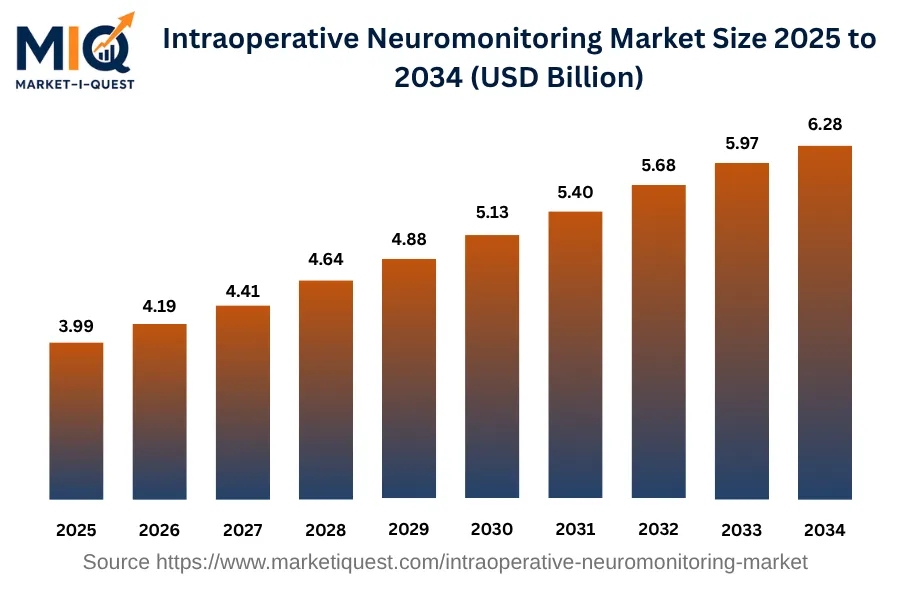
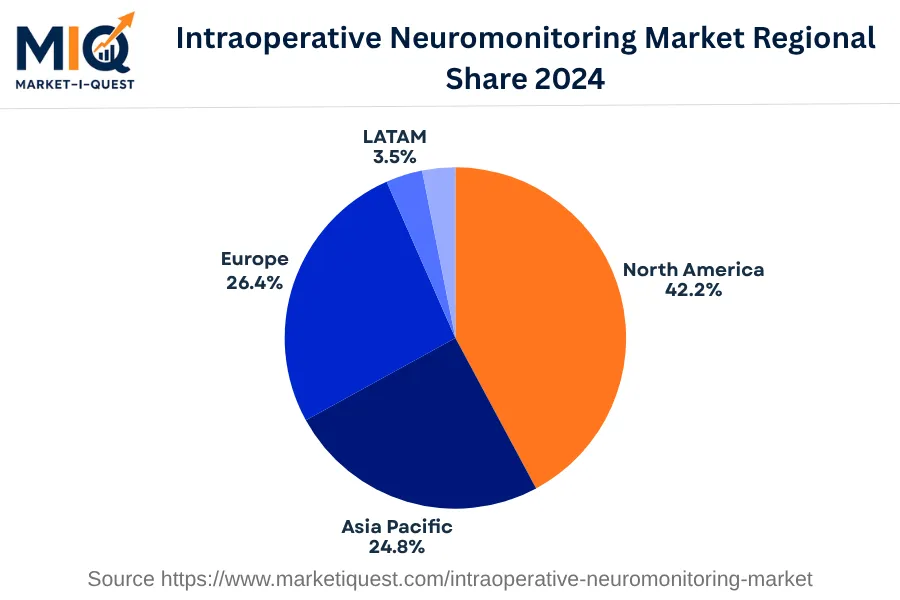
The Intraoperative Neuromonitoring Market was sized at $3.99 billion in 2025, growing to a projected $6.28 billion by 2034, representing a CAGR of 5.18%. This noticeable growth trajectory from $3.79 billion in 2024 indicates the market's ascending augmentation path over the decade. The expansion owes to the increasing application and adoption of intraoperative neuromonitoring practices in a variety of neurosurgeries and other surgical procedures. The regional share mix in 2024 showed North America holding a dominant 42.16% of the total market, followed by Europe with a sizable 26.41% and the Asia Pacific at 24.83%. The remaining shares were held by LATAM and the MEA regions, with a considerably smaller percentage at 3.47% and 3.13% respectively.

Key Takeaways

  • By Product - Systems subsegment held a significant share in recent years.
  • By Source Type - Insource Monitoring gained a leading share among its competitors during the period.
  • By End Use - Hospitals stood as the dominating sector showing substantial market share.
intraoperative-neuromonitoring-market market size

Key Driving Factors

Integration with Artificial Intelligence-driven Tools

Intraoperative Neuromonitoring is increasingly being integrated with cutting-edge Artificial Intelligence (AI) tools in the surgery ecosystem. Surgeons and healthcare professionals worldwide are recognizing the potential of AI in enhancing the precision and effectiveness of intraoperative neuromonitoring. AI-enabled algorithms, for instance, can assess real-time patient data during operations, identifying patterns and risks otherwise overlooked. Prediction of potential neurological complications prevents long-term patient impairment, aiding in better patient outcomes post-surgery. This ongoing integration is especially prominent in countries with robust healthcare technology infrastructure, like the United States, Germany, and Japan, propelling the global intraoperative neuromonitoring market.
Implementation of Strict Workflow Standards by Regulatory Bodies

Regulatory bodies governing healthcare and patient safety, such as the U.S. Federal Drug Association (FDA) and the European Medicine Agency (EMA), are implementing tighter workflow standards around intraoperative procedures. These regulations aim to improve neurological complication detection during real-time surgery, prompting hospitals and clinics to increasingly adopt intraoperative neuromonitoring. These standards involve specific requirements for monitoring equipment, trained specialists, and defined monitoring protocols during surgery. Measures by these regulatory authorities assure improved surgical outcomes, reduce malpractice litigation risks, and ultimately help to save lives. This regulatory push forms a substantial driving factor for the intraoperative neuromonitoring market.

Market Evolution by Timeline

2019-2023
During this period, the Intraoperative Neuromonitoring(IONM) Market faced a significant demand from neurosurgeons, orthopedic surgeons and cardiovascular surgeons, majorly in North America and Europe due to higher surgical cases in these regions. Suppliers primarily included big hospital chains and specialized surgical centers that piloted advanced IONM systems. Integration with imaging systems like MRI occurred, but challenges like interoperability persisted. The regulatory environment remained stringent, with organizations like FDA and EU MDR, impacting adoption rates. Payer systems deferred, with a shift towards value-based care contracts from traditional fee-for-service model. Prices varied based on technology sophistication and insurance coverage. The typical risks involved were technical glitches in the system and resistance from surgeons due to the learning curve.
2024
In 2024, the dominant buyers were from emerging markets in Asia-Pacific region due to increasing healthcare expenditure and surgical volume. Suppliers' landscape started to include tech giants teaming up with healthcare providers to create accessible and efficient IONM systems. More sophisticated integration of IONM with AI algorithms marked the year, though challenges like expensive updates remained. FDA implemented 'The Unique Device Identification' system, making traceability of devices easier. Contract-based partnerships with healthcare facilities became prevalent, influencing the commercial structure. System errors due to faulty algorithms and poor data quality were identified as key risks.
2025-2029
Demand in this period peaked for paediatric surgeries and spinal procedures mostly in developing countries. Suppliers began offering a wider range of IONM devices with improved AI capabilities. The focus shifted towards cloud-enabled IONM devices, although it faced bandwidth and cybersecurity concerns. The implementation of AI in clinical practice guideline by the WHO influenced the adoption of AI-integrated devices. Bundled payment contracts became popular due to cost effectiveness. The advent of 3D printing for manufacturing IONM devices led to pricing changes in the market. Data breach and device malfunctions constituted key risks in this period.
2030-2034
During 2030–2034, global demand increased due to a rise in the average lifespan. Supply included customized IONM devices based on individual patient needs, made possible by successful integration of data analytics. Advances like real-time patient monitoring became possible but faced deployment issues. Regulatory bodies promulgated standardized protocols for using AI in diagnostics, driving greater adoption. Providers opted for pay-per-use models for IONM, impacting pricing dynamics. Risks involved potential bias in AI algorithms and inaccuracies in real-time monitoring.

Future Market Outlook

Future Opportunities

The intraoperative neuromonitoring sector presents numerous future opportunities rooted in current developments and trends. With the increasing prevalence of neurological disorders and the aging population in regions like North America and Europe, there is a growing need for effective monitoring during surgical operations. In 2022, the World Health Organization reported a significant rise in neurological conditions, which will likely lead to more surgical interventions requiring IONM. Furthermore, partnerships among hospitals and IONM service providers are becoming more common, as seen in 2023 when Boston-based Brigham and Women's Hospital collaborated with a leading IONM company to improve surgical outcomes in neurosurgery. Regulatory advancements also create new pathways for the market; for example, recent changes by the Centers for Medicare & Medicaid Services indicate a potential reimbursement shift favoring IONM services, which may enhance service viability. In addition, educational initiatives aimed at training healthcare professionals in IONM are gaining traction, with several universities adding specialized courses and certifications. This trend could expand the skill sets of medical professionals and build confidence in utilizing IONM technology, subsequently increasing demand. Ultimately, as healthcare focuses on patient safety and outcome optimization, investing in intraoperative neuromonitoring presents clear opportunities for both current players and new entrants in this evolving market landscape.

Segmentation Analysis

By Product

The market is divided into subsegments including Systems and Disposables, with Systems holding the most substantial revenue, while Disposables is projected to be the fastest-growing sector during the analysis period.

Largest Revenue Share

Systems

Market Share Leader

Systems, the more complex part, constitute the lion's share of the revenue in the market. This domination can be attributed mainly to a few key factors. Firstly, Systems require sophisticated manufacture, and this applies proprietary technology, leading to higher price points. Secondly, Systems often embody the centerpiece of operations and function as a pivotal product around which the rest of the portfolio evolves. Consequently, customers prioritize these investments and allocate substantial budget share. Another driver is the lower propensity to switch between System providers. Once installed and integrated, a System typically embeds deeply into customer operations, becoming a cost, time, and risk deterrent to pulling out. Moreover, regulations often favor established, tried-and-tested Systems over new players, narrowing competition and maintaining hefty pricing and profit margins. Customers demand stable, reliable performance, and system failures can lead to severe operational disruption, further cementing the incumbent Systems in place and curbing the threat of substitution.

Fastest CAGR

Disposables

Forecast Period Growth Leader

Despite holding a smaller portion of revenue share, Disposables demonstrate significant potential as the fastest-growing subsegment. This growth is picqueted by several drivers. Undoubtedly, a primary catalyst is the technological advancements, leading to improved efficiency and performance of Disposables, which attracts an ascending number of users. Similarly, new policies are increasingly favoring the use of Disposables over more permanent or non-recyclable options, thereby indirectly boosting market demand. Additionally, capital investments in this area are comparatively lower, making it easier for even smaller firms to enter and diversify the market. On the adoption barrier front, the single-use nature of Disposables constitutes a more frequent repurchase cycle, offering a steady revenue stream for the businesses. However, the rising raw material prices and the looming environmental concerns are potential risks that could impede near-term growth.

By Source Type

The market, divided by source type, includes subsegments such as insource monitoring and outsource monitoring. In 2024, outsource monitoring accounted for the highest revenue share while insource monitoring is expected to grow at the fastest rate.

Largest Revenue Share

Outsource Monitoring

Market Share Leader

Outsource monitoring emerged as the largest revenue-generating subsegment due to several factors. Companies are increasingly relying on specialized third-party service providers for monitoring to achieve greater efficiency and optimize operating costs. Outsourced monitoring services utilize advanced techniques and tools, such as AI and predictive analytics, that help businesses forecast potential issues and rectify them before they negatively affect the operation. Additionally, the expertise offered by these service providers contributes to a reduction of errors compared to in-house teams. The swift response and 24/7 service also stand as a significant contributor to the subsegments growth. Moreover, regulatory compliances encourage many businesses to opt for outsource monitoring, thus, boosting its market share.

Fastest CAGR

Insource Monitoring

Forecast Period Growth Leader

Insource monitoring, although not a leader in terms of revenue, is projected to grow at a robust rate. The growing preference for in-house monitoring solutions can be attributed to their potential for customization, greater control over information security, and better alignment with unique business requirements. Increasingly, organizations recognise the value of building their own technology stacks and are, therefore, investing more in hiring talent and developing proprietary solutions rather than relying entirely on third parties. Additionally, technological advancements and the decreasing cost of investment in infrastructure further facilitate the adoption of insource monitoring. Consequently, reduced dependence on third-party providers eliminates possible communication gaps and offers more adaptability during complex situations. However, it's worth noting that successful implementation depends heavily on sufficient expertise and robust systems architecture.

By End Use

The market by end use is divided into subsegments including hospitals, ambulatory surgical centers and others, with hospitals accounting for the largest revenue share while ambulatory surgical centers are expected to grow at the fastest CAGR during the forecast period.

Largest Revenue Share

Hospitals

Market Share Leader

In 2024, hospitals account for the largest share of the end-use market. Hospitals, due to their broader reach, more comprehensive facilities, and variety of services, typically have more demand for products and services in this area. They often serve a larger patient population, encompass a wide range of medical departments, and offer a more diverse range of procedures and treatments. Moreover, hospitals usually have the financial sustainability to acquire expensive devices or services, and often have the requirement to offer the latest in medical technology and treatment options, thus contributing to their dominant market share. Regulation, another important factor in the medical industry, also favors these larger establishments, as they are often better equipped to meet regulatory demands. Operations of such large magnitude require vast amounts of supplies and hence hospitals are crucial to drive major business. They show a high investment rate, which has contributed to the significance of their revenue share in 2024.

Fastest CAGR

Ambulatory Surgical Centers

Forecast Period Growth Leader

Ambulatory Surgical Centers (ASCs) represent the fastest growing subsegment in the end use market. The growth of the ASCs is powered by several factors. Principal among them is the drive towards outpatient care - a lower cost alternative to hospital stays - driven by both policy and advancements in medical technology. Rising healthcare costs have led policymakers to encourage procedures in ASCs when possible, as they often provide a more cost-effective treatment option. Furthermore, innovation and evolution of surgical technologies and techniques have expanded the range of procedures that can be performed in these settings, thus increasing adoption. However, there are barriers to adopting ASCs, such as regulatory restrictions and high initial setup costs. Overcoming these barriers will likely require investment, policy changes and strategic partnerships. Moreover, there is a risk involved due to the ongoing healthcare reforms and constant changes in payment models. Despite these challenges, their growth outlook remains robust.

Competitive Analysis

Key Market Players

Manufacturers/OEMs

Natus Medical Inc
US
Cadwell Industries Inc
US
Nihon Kohden Corporation
Japan

Key Suppliers & Raw Materials

Ambu A/S
Denmark
Medtronic PLC
Ireland
Koninklijke Philips N.V.
Netherlands

Distributors, Integrators & Channel Partners

Accurate Monitoring LLC
US
SpecialtyCare Inc
US
Sentient Medical Systems
US

Porter’s Five Forces Analysis

Analysis of competitive dynamics in the intraoperative neuromonitoring market using Porter's Five forces.

Supplier Bargaining Power

Medium

Specialized knowledge restricts number of potential suppliers, slightly elevating their bargaining power.

Buyer Bargaining Power

High

Many alternative providers and low switching costs increase buyer negotiation power.

Threat of Substitutes

Low

The specificity and critical nature of intraoperative neuromonitoring limit substitute availability.

Threat of New Entrants

Low

High regulatory and certification requirements create entry barriers for new participants.

Competitive Rivalry

Medium

A wide range of providers, but competitive differentiation based on quality, leaves the rivalry at a moderate level.

Regional Analysis

Geographic market dynamics and growth opportunities across key regions

Global Market Outlook

intraoperative-neuromonitoring-market market regional share

North America

In 2024, the North American market for intraoperative neuromonitoring (IONM), a key tool in mitigating risks during complex surgeries, was defined by robust demand from the healthcare sector and advancements in technology. Driving this demand were factors such as growing awareness of IONM's benefits, primarily in the United States and Canada, leading to an increase in the usage of these monitoring services. Regulatory compliance pressures, particularly in the US, encouraged further adoption to enhance patient safety. In parallel, substantial investments in healthcare technology supported the development and proliferation of sophisticated IONM devices across North America.

Simultaneously, key trends dictated the market dynamics. There was a distinct shift towards privatized IONM services, away from traditional hospital-based ones. This was partly driven by growing demand for cost-effective and personalized health services in both major and smaller cities. In Mexico, for instance, partnerships between public hospitals and private IONM service providers became more common as it introduced a new dimension of healthcare delivery. Also, the North American market saw strict enforcement of good manufacturing practice (GMP) standards, which further spurred the demand for high-quality IONM services. A significant bulk of the clientele came from the healthcare sector with hospitals, surgical centers and clinics contributing to the majority of demand. IONM market also serviced specialized surgical departments focusing on neurology, cardiovascular, and orthopedic procedures.

Asia Pacific

In 2024, the intraoperative neuromonitoring (IONM) market in the Asia Pacific region has shown significant evolution driven by insightful factors. The intricate balance of healthcare demand due to the rising incidence of neurological disorders, especially across populous countries like India and China, has been a stimulating driver. Tightening healthcare regulations in these nations have made IONM indispensable for complex surgical procedures, adding impetus to the market. Additionally, intelligent investments into healthcare infrastructure, specifically in Japan and Australia, has strengthened the IONM supply dynamics.

The market is also witnessing transformative trends. Buyers, predominantly from healthcare and manufacturing sectors, are increasingly veering towards integrated IONM systems that offer real-time data and superior patient outcomes. The swift adoption of this technology even in ASEAN markets like Singapore and Thailand quite notable. More interestingly, cohesive partnerships are booming, particularly in South Korea, to expedite IONM advancements. For instance, the alliance between local hospitals and IONM providers to improve surgical outcomes is mutually beneficial. Enforcement of IONM utilization standards by policymakers is also noteworthy, with China taking a lead role in this aspect as part of its broader healthcare reform.

Europe

In 2024, the intraoperative neuromonitoring market in Europe showed vital dynamism, driven by increased healthcare investments and advancements in neurosurgical procedures. The market's growth was influenced by increased demand from the healthcare sector and adoption of the technology in major medical facilities throughout Germany, the UK, Spain, France, Italy, the Nordics, Benelux, and Central & Eastern Europe. Regulation changes initiated by European health authorities in 2024 emphasized enhanced patient safety, leading to a significant rise in the adoption of intraoperative neuromonitoring devices by healthcare providers. The surging investments by governments and private sector entities boosted the technology's accessibility and supply in the European market. Furthermore, competitive pricing and increased supplier dynamics contributed to the market's growth.

Trends in 2024 indicated a shift towards intraoperative neuromonitoring in minimally invasive surgical procedures, notably in Germany and the UK, where demand surged remarkably. Partnerships between tech providers and healthcare facilities increased, paving the way for more advanced intraoperative neuromonitoring services. The European market saw a considerable rise in the enforcement of standards and protocols regarding intraoperative neuromonitoring, ensuring quality and reliability in patient care. Notably, increased use was observed in the neurology and spinal surgery fields, signifying key sectors driving market dynamics.

Latin America

In the base year of 2024, the Intraoperative Neuromonitoring (IONM) market in Latin America saw significant developments and investments to better the quality of healthcare systems. Increasing awareness and demand for IONM procedures in neurosurgery, orthopedics, and ENT branches of medicine were principal market drivers across countries such as Brazil, Mexico, and Argentina. High prevalence of spinal cord disorders necessitated advanced monitoring services, fueling investments into skilled neurology professionals and cutting-edge IONM technologies. Further, favorable regulations and policies in Colombia and Chile provided a conducive environment for adoption of newer IONM services.

Trends in the market were heavily dictated by changes in buyer behavior, as an increased reliance on risk management practices in surgical procedures fostered a shift towards advanced IONM systems. Particularly in countries like Peru, clinics and hospitals engaged in partnerships or mergers and acquisitions to expand and upgrade their IONM services. Additionally, regulatory bodies strictly enforced healthcare standards in IONM in an effort to boost the quality of care. The IONM market served a broad spectrum of sectors, but the primary beneficiaries were the healthcare and government sectors, who supported and utilized these improvements to deliver efficient, higher standard public health services. In Latin America, the IONM market landscape evolved to meet growing demands and regulations in the year 2024.

Middle East & Africa

In 2024, the Intraoperative Neuromonitoring (IONM) market in the Middle East and Africa proved to be progressively robust. This growth was primarily driven by increasing investment in healthcare infrastructure, the escalating surgical intervention demand due to aging populations, and more prevalent chronic illnesses such as cardiovascular diseases and nervous system disorders. Rapid technology adoption in facilities across the region, particularly in countries like Saudi Arabia and UAE, further spurred market growth.

A notable uptake trend in 2024 was the focused shift towards real-time monitoring during surgeries, vastly improving patient safety outcomes. Countries like South Africa, Egypt, and Kenya were instrumental in driving this trend. Further, market partnerships and collaborations, primarily in Israel, spurred technological advancements and training for health practitioners on these platforms. Compliance with standard health protocols advocated by regional bodies remained critical in maintaining market integrity and boosting patient confidence.

Key customer sectors included government-funded healthcare institutions, private hospitals, and specialist nerve centers. Arguably, the oil and gas, utilities, telecom, manufacturing, and retail sectors played a vital support role, with their escalating investment in employee health safety regulations requiring detailed health checks involving nerve function tests. Essentially, in 2024, the IONM market in the Middle East and Africa was thriving, shaping a critical aspect of the region's healthcare demographics.

Recent Industry Developments

Latest market innovations, product launches, and strategic initiatives

May 2026

Cadwell Industries commercially launched the Cadwell Guardian, a new intraoperative neuromonitoring platform designed to easily adjust its capacity to monitor patient nerve health across both routine and highly complex surgeries.

March 2026

Medtronic received U.S. FDA clearance for its Stealth AXiS surgical system, a new platform that provides advanced navigation and integration for cranial and ear, nose, and throat (ENT) procedures to help surgeons avoid nerve damage.

Frequently Asked Questions