
Injection Molding Machine Market Snapshot

Key Players

  • Haitian International (China)
  • Engel Austria GmbH (Austria)
  • Sumitomo Heavy Industries (Japan)
  • Milacron Holdings (United States)
  • Arburg GmbH (Germany)
  • Nissei Plastic Industrial Co. Ltd (Japan)
  • Husky Injection Molding Systems (Canada)
  • Chen Hsong Holdings Limited (Hong Kong)
  • The Japan Steel Works Ltd. (Japan)
  • Negri Bossi S.P.A. (Italy)

Market Size

Base Year 2024
$ 14.62 Bn
CAGR
4.61%
Forecast 2034
$ 22.92 Bn

Market Segments

By Material
Plastic, Metal, Rubber, Ceramic, Others
By Machine Type
Electric, Hydraulic, and Hybrid
By Clamping Force
0 - 200 Ton Force, 201 - 500 Ton Force, and Above 500 Ton Force
By End-use Industry
Packaging, Automotive, Electronics and Telecommunication, Healthcare, Infrastructure, Others

Market Dynamics

Drivers
  • Rising demand in automotive industry
  • Increasing industrialization in developing countries
Restraints
  • High machinery cost
  • Operational skill scarcity
Opportunities
  • Rapid industrialization growth
  • Emerging economies demand

Market Size

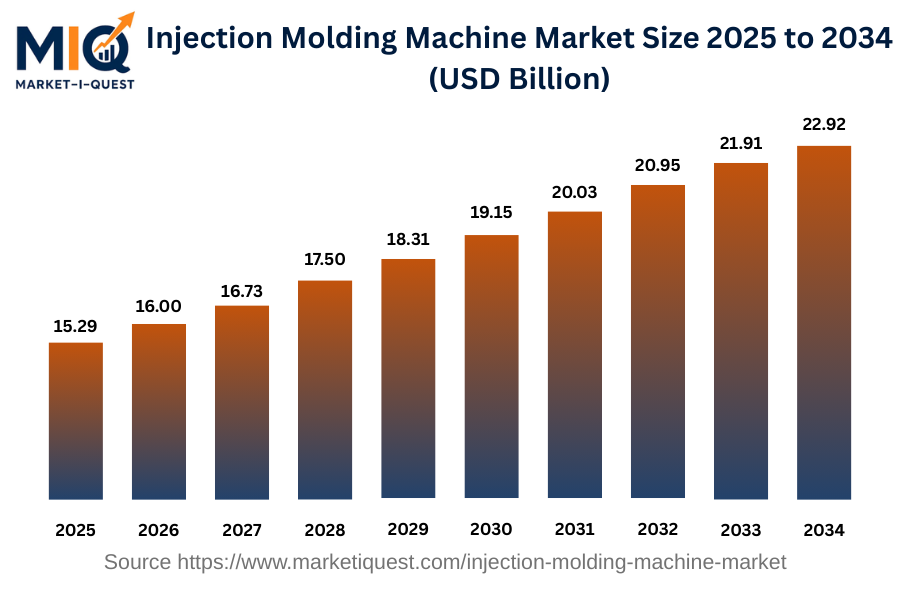
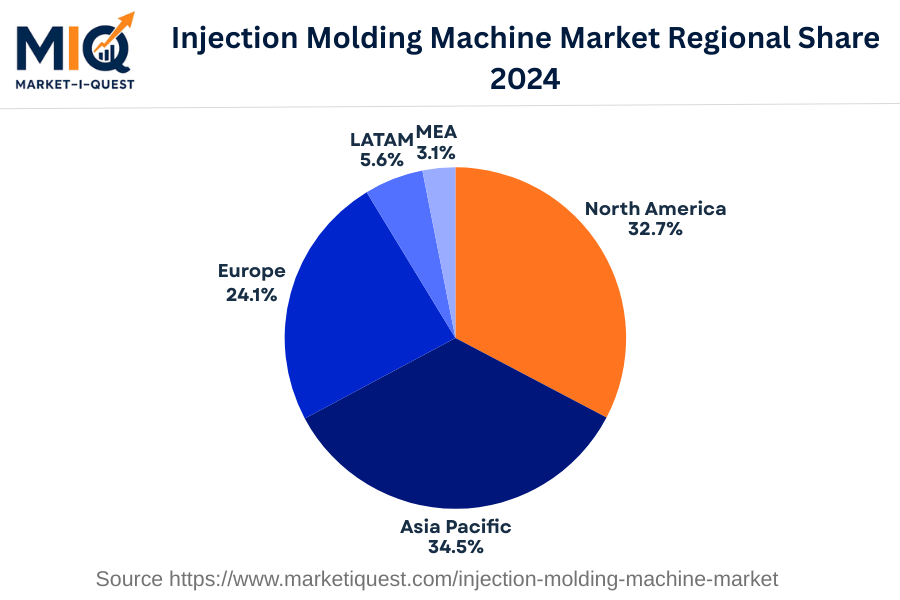
The Injection Molding Machine Market share in 2025 was valued at 15.29 billion USD, following a value of 14.62 billion USD in 2024. By 2034, this market is expected to reach 22.92 billion USD, reflecting a CAGR of 4.6% over the period of 2025 to 2034. This growth over the period can be attributed to continuous technological advancements in the field of injection molding machines. Growing developments in machinery design and adaptation of automation have led to increasing efficiency, thereby encouraging growth in the injection molding machine market. Accordingly regional shares of 2024, North America held 32.7% of market share, followed by Asia Pacific at 34.5%. Continued with Europe with share of 24.1%. Whereas, LATAM and MEA, held shares at 5.6% and 3.1% respectively.

Key Takeaways

  • By Material - Plastic led the Injection Molding Machine Market holding the largest share in the base year.
  • By Machine Type - Electric machines were the dominant type used in the Injection Molding Machine Market during the forecast period.
  • By Clamping Force - 201-500 Ton Force machinery held a prominent position in the Injection Molding Machine Market in the given year.
  • By End-use Industry - Electronics and Telecommunication segment led the Injection Molding Machine Market accounting for the highest share during the base year.
injection-molding-machine-market market size

Key Driving Factors

Shift Towards Automation in Manufacturing Industries

Globally factories and manufacturers are experiencing a shift in Industry 4.0 standards. Industry 4.0 highlights the integration of automation, digitization and data communication within the production procedures. Driving the growth in adoption of injection molding machines which can efficiently automate key tasks, improving the capabilities of production and minimize human errors. With increasing usage of injection molding machines major for production of high precision and complex parts within various sectors including automotive, consumer goods and healthcare. Therefore, the major driver in the injection molding machine market demands shift towards automation in manufacturing industries such as increasing improvement in efficiency by enterprises, enhancing the product quality and growing market demand.
Stringent Environmental Regulations

With the growing concerns for environmental protection and sustainability, governments throughout the globe are enforcing stringent regulations on waste production and management. For instance, Waste Framework Directive and Directive 2008/98/EC by European Union notably encourages member countries to reduce waste generation. Increasing pressure on industries for minimizing waste production while maintaining operational efficiency. Injection molding machines market analysis provides impactful solution to this challenge, due to factors like using precise amounts of material for the producing items, effectively reducing waste in comparison with traditional manufacturing methods. Increased acceptance of such environmental regulations therefore is making it a significant driver for the injection molding machine market growth due to increased requirement from environmentally conscious businesses.

Market Evolution by Timeline

2019-2023
This need for injection molding machine in this period was majorly for automotive, packaging and healthcare industries. In Asia-Pacific, China and India were the dominant regional market, driven by the expanding manufacturing sector combined with increasing investment in industrial automation. Technology advancements led to the introduction of all-electric injection molding machines as more energy-efficient than hydraulic options. Concerning policy, eco-design requirements under European Dir 2009/125/EC influenced adoption by requirement of less energy-consuming products. Commercially, manufacturers like Arburg and Engel offered predictive maintenance services in contracts to reduce downtime costs for users.
2024
In this year, an increasing requirement in the construction industry was seen in moldings like window frames and door components. While the Asia-Pacific largest share of market, with Europe steadily growing, due to the high adoption of biodegradable plastics. In terms of technology, suppliers started integrating machine learning and artificial intelligence into machines for efficient and precise moldings. Regulation-based, the introduction of stricter quality and safety standards by ISO drove the manufacturers for improving machine reliability. Commercial models shifted, with more manufacturers collaborating with software providers for offering the cloud-based solutions with remote monitoring and diagnostics. High-energy consumption of machines was addressed by utilizing efficient motors and optimizing machine control systems.
2025-2029
The demand in this period was driven by the need for electronics industry with high-precision, small-parts manufacturing. The industry growth shifted towards North America due to the rising domestic manufacturing sector. Further innovation in technology led to the rise of hybrid injection molding machines, with the capabilities of both electric and hydraulic systems. New regulations were introduced for utilizing recycled plastics in molding applications, supported by the increasing focus on circular economy standards. Manufacturers like Husky and Demag started experimenting with dynamic pricing models, based on molding result rather than a flat-fee structure. To reduce the risk of machine failures, predictive maintenance and machine health monitoring.
2030-2034
In this period, the need for molding machines is likely to be driven by the renewable energy sector for factors like fabricating parts like turbine blades and solar panels. The Asian market could lack in progress, whereas Africa and Latin America might show growth potential due to technological advancements and increasingly advanced local manufacturing capabilities. Robot-assisted machines are expected to become more common, steadily replacing human-assisted operations. Regulations might become more stringent, mandating utilization of renewable energy sources for advancing injection molding machines. The industry will likely shift towards a pay-per-use commercial model, due to factors such as IoT integration in machinery and economic sustainability. Heightened downtime of machine due to lack of skilled labor could act as a potential risk, reduced by training programs offered by major manufacturers.

Future Market Outlook

Future Opportunities

Future opportunities in the injection molding machine sector are associated to the recent adoption of sustainable practices and regulatory frameworks designed for minimizing environmental impact. In 2023, the plastics industry is increasingly under analysis in regions such as the European Union, where the European Plastics Strategy is driving a circular economy. Companies including KRAIBURG TPE has started the development of recycled compound solutions that integrate with these sustainability standards. Whereas in North America, the recent focus on local sourcing of manufacturing processes creates encouraging environment for investment in advanced injection molding technologies, particularly in regions with reappearing manufacturers such as Texas and Michigan. The growing necessity for lightweight and high-performance components in industries such as automotive and aerospace are the major drivers for innovations in material compatibility with current injection molding processes. Furthermore, regulatory developments, including Assembly Bill 1232 of California passed in 2022 for restricting single-use plastics with driving businesses to seek alternative for materials suitable for injection molding. Various collaborations and partnerships such as between BASF and a leading injection molder, highlights effort for enhancing the contribution of product that drives the changing consumer preferences. The introduction of new recyclable materials and bio-composites into the injection molding process represents a significant channels for development, thereby reinforcing the industry ability to innovate and adapt to evolving environmental demands while maintaining profitability.

Segmentation Analysis

By Material

The market is divided into subsegments including Plastic, Metal, Rubber, Ceramic, and Others. Plastic accounted for the largest revenue share while Ceramic is expected to grow at the fastest CAGR during the forecast period.

Largest Revenue Share

Plastic

Market Share Leader

The Plastic subsegment currently leads the market with the largest revenue share. Due to various factors including major driver is the versatility of plastic materials, which are utilized in a various industries such as manufacturing, packaging and automotive. Plastic is mainly recognized due its durability, lightweight and cost-effectiveness making it a preferred among customers. It can also be molded into various shapes and sizes, serving in diverse needs across different markets. Regions with large manufacturing sectors such as Asia-Pacific with significantly contributing in high revenue of this subsegment. Furthermore, lenient regulation, readily available supply and minimal switching costs also contribute to the market share of plastic. Customers commonly make purchases based on the adaptive characteristics of material and cost, with widespread distribution channels, such as online and offline stores promoting easy accesses.

Fastest CAGR

Ceramic

Forecast Period Growth Leader

While the Ceramic subsegment is leads market with the fastest growth rate CAGR. While the major growth is supported by technological advancement with constant innovations enhancing the performance attributes of ceramic, making it a more prominent option for various industries. For instance, in the electronics industry, superior heat resistance of ceramic makes it highly suitable in using devices. Similarly, policy incentives favoring sustainable and eco-friendly materials also positively influence ceramic's market preferences. Despite these advantages, ceramic's market evolution is restricted by higher initial capital expenditure required in its production. This represents a key barrier to ceramic adoption that must be addressed for the subsegment to fully realize its growth potential. Further partnerships and investments in the ceramic sector can help optimize production costs and stimulate market demand.

By Machine Type

The market is divided into subsegments including Electric, Hydraulic, and Hybrid machines with the Electric segment accounting for the largest revenue share, while the Hybrid segment is expected to grow at the fastest CAGR during the forecast period.

Largest Revenue Share

Electric

Market Share Leader

The Electric machine segment helds the largest revenue share, primarily driven by the rise in demand for energy-efficient and environment-friendly technology. Electrical machines are highly popular due to its features such as efficiency and no-emission, contributing to less environmental pollution and complying with strict regulatory emissions control. They use electrical energy, which reduces operational costs, as the price of electricity is usually lower in comparison with other fuels. Furthermore, increased adoption of automation in various industries has driven the need for electric machines. An expansion is seen in customer preference in electric machines due to their ability to offer improved precision, speed and productivity. While the adoption of electric machines has been heightened, key regions include emerging markets where both regulators and customers are prioritizing sustainability alongside operational efficiency and cost-effectiveness.

Fastest CAGR

Hybrid

Forecast Period Growth Leader

The Hybrid machine segment is anticipated to grow at the fastest rate, overcoming some adoption barriers such as high initial investment and relatively complex maintenance requirements. Technology innovations and progress in digitalization are expected to be the key propellants for the development of this segment. Hybrid machines offer a crossbreed solution that brings together the benefits of electrical efficiency and hydraulic power. These machines are gaining adoption due to their energy-saving potential, high level of precision, and ability to handle high-load tasks. The capital expenditure on Hybrid machines is likely to rise in response to environmental regulations and policy changes favouring energy efficiency. Moreover, strategic partnerships are on the rise as machine manufacturers collaborate with software companies to enhance the digital capabilities of these machines, thereby promoting their further development. Nevertheless, the risk of economic instability could affect investment in new technology, thereby posing a near-term risk.

By Clamping Force

The market is divided into subsegments including 0 - 200 Ton Force, 201 - 500 Ton Force, and Above 500 Ton Force. The 201 - 500 Ton Force accounted for the largest revenue share while Above 500 Ton Force is expected to grow at the fastest CAGR during the forecast period.

Largest Revenue Share

201 - 500 Ton Force

Market Share Leader

The 201 - 500 Ton Force subsegment holds the largest market share due to its wide usage across various industries. These industries require mid-range force for their clamping applications, making this range more recognized. The 201 - 500 Ton Force units are a balanced solution in terms of power and cost making them accessible and efficient within various companies. These units serve to a wide range of clamping demands from automotive to electronics industries offering robust performance and price. The purchasing decisions are often driven by capital availability, operational cost implications and the specific operational requirements.

Fastest CAGR

Above 500 Ton Force

Forecast Period Growth Leader

The Above 500 Ton Force subsegment is projected to grow at the highest CAGR. This growth is fuelled by the increasing demand from industries that require high clamping force, such as automotive, aerospace, and heavy machinery. This growth of the segment is indicating overall industrial development and the increasing advancement in product designs. However, the capital focused nature of these units presents adoption barriers for smaller firms. Future growth in this segment is significantly related with technological advancements allowing more efficient and cheaper high-force clamping methods and machinery. Yet, the risk remains in terms of regular industrial evolution, which could affect the need for these high clamping force units.

By End-use Industry

In the end-use industry, the market is parsed into subsegments such as Packaging, Automotive, Electronics and Telecommunication, Healthcare, Infrastructure, and Others. Among these, the Electronics and Telecommunication subsegment retains the highest revenue share, while the Healthcare subsegment is set to undergo the fastest growth in terms of CAGR in the upcoming years.

Largest Revenue Share

Electronics and Telecommunication

Market Share Leader

The Electronics and Telecommunication segment dominates the market in terms of revenue shares due to growing technologies and increasing global reliance on electronic devices. The current market is characterized by a communication network driven by technology leading to the current expansion of this segment. The accelerating trend towards digitalization, the expansion of smart devices and the introduction of 5G technology is primarily driving the growth of this segment. The requirement for higher bandwidth and lower delay in devices is increasing with rise in the usage of wireless devices which promotes the market share of this subsegment. Dropped with regulatory policies promoting digitalization, a range of customer requirements across varied geographies, and substantial investment in R&D activities contribute towards maintaining its leading position. While the purchasing criteria largely depend upon the quality, price and technological advancements, the switching costs are high due to the increased reliance on these services.

Fastest CAGR

Healthcare

Forecast Period Growth Leader

The Healthcare subsegment is expected to witness the fastest CAGR growth in the forecasted period. This is primarily driven by increased healthcare costs and technological shift in medical diagnostics and treatments, with growing chronic diseases. Policies supporting healthcare infrastructure with expanding the partnerships between private and public could act as significant driver for growth. However, the high cost of medical devices and strict regulations could potentially act as a barrier for the market adoption in developing economies, presenting a near-term risk. The current pandemic has highlighted the importance of robust healthcare systems and accelerated the adoption of advanced technologies in healthcare, marking a crucial period for this subsegment.

Competitive Analysis

Key Market Players

Manufacturers / OEMs

Arburg GmbH
Germany
Haitian International Holdings Limited
China
Milacron Holdings Corp.
US

Key Suppliers & Raw Materials

BASF SE
Germany
Dow Inc.
US
LyondellBasell Industries N.V.
Netherlands

Distributors, Integrators & Channel Partners

Alba Enterprises, Inc.
US
Nissei Plastic Industrial Co., Ltd.
Japan
Absolute Haitian Corporation
US

Porter’s Five Forces Analysis

The Injection Molding Machine Market is analyzed using Porter's five forces framework.

Supplier Bargaining Power

Medium

Moderate due to the presence of numerous suppliers and high raw material availability.

Buyer Bargaining Power

Low

Low due to high capital investment and specific knowledge requirements.

Threat of Substitutes

Low

Substitution threat is low due to unique features and strong functionality of injection molding machines.

Threat of New Entrants

Low

High entry barrier due to capital expenditures, technical know-how, and regulatory compliance.

Competitive Rivalry

High

Intense competitive rivalry due to a large number of global and regional players.

Regional Analysis

Geographic market dynamics and growth opportunities across key regions

Global Market Outlook

injection-molding-machine-market market regional share

North America

In 2024, the injection molding machine market in North America experienced a dynamic environment. With increased demands from healthcare, automotive and packaging sectors substantially drove the machine market with increasing businesses aiming for efficient and high-volume production solutions. Advancements in automation and robotics technology saw major investment and integration into injection molding procedures further improving result quality and productivity. Regulatory standards influences the shift towards environmental friendly machines driven by the policies for waste reduction by United States and plastic management standards in Canada.

In terms of injection molding machine market trends, a notable shift towards all-electric injection molding machines within the electronics manufacturing sectors, driven by precision, speed and energy efficiency. In Mexico, a rise in localizing supply chains showed greater reliance on domestic injection molding machine manufacturers, reducing reliance of external imports from North America. Furthermore, there was an increased emphasis on collaborative activities, with numerous machine manufacturers entering partnerships to optimize machine capabilities, streamline operations, and improve service offering. Finally, the adoption of industry 4.0 standards encouraged manufacturers to develop smarter, data-driven injection molding machines boosting operational transparency and efficiency.

Asia Pacific

In 2024, the Injection Molding Machine Market in the Asia Pacific was highlighted by robust growth. Surging requirement in key regions such as China, India and ASEAN nations was driven by increasing reach in automotive, packaging and consumer goods sectors. Government standards such as Made in China 2025 in China and Make in India in India promoted the domestic manufacturing, encouraging capital investment into modern and automated injection molding facilities. With a notable shift towards energy-efficient machines due to stricter emission regulations and increasing electricity costs.

Trends showed a visible patterns. Consumers were shifting towards high precision molded parts with quicker cycle times, indicating towards a rising trend of high frequency in precision injection molding machines. Second, a shift towards the use of biopolymers in response to regulatory necessity for environmentally-friendly materials was seen, especially in packaging. Channel dynamics showed increased online sales of molding machines, a direct outcome of the surge in e-commerce. China notably led in the market consolidation via mergers, securing its dominance in the regional market. Lastly, stricter enforcement of quality and safety standards, as seen in Japan’s case, put pressure on manufacturers to produce high-quality, reliable injections molding machines. In summary, a potent mix of requirements, regulatory pressures and shifting consumer preferences were reshaping the Injection Molding Machine market growth in the Asia Pacific in 2024.

Europe

In 2024, the injection molding machine market demand in Europe saw a growing trajectory. With key drivers for this rise included increased demand from the automotive and medical sectors, widespread adoption of advanced injection technology and supportive EU industrial standards. Germany led the market in terms of demand, boosted due to the increased automotive manufacturing and investments in advanced machinery. Regulatory standards for promoting the reduction of carbon emissions in manufacturing processes also motivated the shift towards energy-efficient injection molding machines.

The injection molding industry experienced a shift towards machines with Industry 4.0 standard technologies for maximizing the efficiency. Smart networking between machines, especially in technologically developed regions like the United Kingdom and Nordic countries. With the growing usage of recycled and biodegradable materials in molding processes was a notable trend in sustainable markets such as Benelux and France. The year also saw integrated efforts and joint ventures in manufacturing sector, resulting in improved service networks and expanding reach towards customer in regions like Italy and Central & Eastern Europe. While market growth was spread within the sectors such as automotive, packaging, medical and consumer goods sectors were primary contributors.

Latin America

In 2024, the Injection Molding Machine market trends in Latin America showed notable developments. In regions such as Mexico and Brazil leading in demand due to increased manufacturing and government incentives for promoting domestic production. In Argentina and Chile stricter environmental regulations drove the adoption of energy-efficient injection molding machines. The key driver was increasing investments in advanced technology in Colombia, where companies sought to increase productivity and reduce waste.

The increased usage of electric machines over the hydraulic machines was a significant trend while the preference for electric vehicles rose due the factors like reduced noise, improved speed and precision. Brazilian manufacturers in the automotive and consumer goods sectors spurred this shift. Direct-to-consumer sales also increased, further boosting the market. In Mexico and Peru, there was a notable trend of partnerships and acquisitions between local injection molding companies and international technology suppliers, aimed at boosting technological capabilities and market reach.

The rise in enforcement of standards to ensure product quality, particularly in the Columbia’s healthcare sector, driving the need for technologically advanced molding machines. With the increasing encouragement the governments of Brazil and Mexico in implementing policies to promote circular economy and encouraging the recycling industry, thus the demand for injection molding machines was seen growing in waste management sector. Overall, the market environment in 2024 was shaped by these evolving demands, technological shifts and policy enforcements across key sectors within the region.

Middle East & Africa

In 2024, the Injection Molding Machine Market opportunities in the Middle East and Africa experienced increased focus due to growing demand and advancements in technology. This growth was driven by increasing investments in plastic product manufacturing, government regulations preferring the usage of sustainable plastic and technological adoption in countries such as Saudi Arabia, United Arab Emirates, Egypt, South Africa, Nigeria, Kenya and Israel. The injection molding machine market expansion particularly in sectors such as healthcare, manufacturing and retail where need for high-quality, precision plastic components steadily increased.

Significant trends were seen with ensuring the market momentum. With a notable shift towards energy-efficient injection molding machines, reflecting the increased regional concerns for sustainability and cost-effectiveness. Also the increasing partnerships between local manufacturers and international technology providers, utilizing the technical expertise for enhanced production volume. Lastly, enforcement of stringent quality and safety standards by regulatory bodies led to the increased adoption of automated injection molding machines for maintaining the accuracy and minimize human error.

In terms of market specifics, Saudi Arabia's oil and gas industry extensively employed injection molding machines for valve and pipe fittings. Israel's growing medical technology sector was a notable consumer of precision molded components manufactured using such technology. Continuing with South Africa, the growing automotive industry as a significant customer for the Injection Molding Machine Market expansion in 2024.

Recent Industry Developments

Latest market innovations, product launches, and strategic initiatives

May 2026

SOUND Machinery officially launched a 9,000-ton two-platen injection molding machine at its Deqing manufacturing facility. This launch represents a major milestone for the Chinese domestic market, heavily pushing high-tonnage capabilities to allow local industrial and automotive sectors to scale their production of ultra-large parts without relying on European machinery.

March 2026

Engel commissioned the duo 12000 US, which it claims is the world's largest two-platen injection molding machine. With an immense 110,000 kN (12,364 US tons) of clamping force, this system was specifically developed to address the automotive sector's growing demand for "gigamolding"—producing massive, large-format structural components in a single shot to reduce assembly time and replace traditional metal parts.

October 2025

UBE Machinery completed the development and launched the "5500emIII" series, which it designates as the world's largest all-electric injection molding machine. Boasting a clamping force of 5,500 metric tons, this machine was engineered to tackle the growing need for large plastic components while simultaneously cutting power consumption by more than 20% compared to previous electric models.

Frequently Asked Questions