
Industrial Vending Machine Market Snapshot

Key Players

  • AutoCrib
  • Inc. (United States)
  • CribMaster (United States)
  • I.V.M. Ltd. (Italy)
  • Industrial Vending Systems (United Kingdom)
  • Fastenal Company (United States)
  • Apex Industrial Technologies LLC (United States)
  • SupplyPro
  • Inc. (United States)
  • Silkron Smart Vending & Automated Retail (Malaysia)
  • Abdex Industries (Australia)
  • Aristo Industries (Germany)

Market Size

Base Year 2024
$ 4.28 Bn
CAGR
9.84%
Forecast 2034
$ 10.94 Bn

Market Segments

By Type
  • Carousel
  • Coil
  • Cabinet
By Product
  • MRO Tools
  • PPE
  • Others
By End-use Industry
  • Manufacturing
  • Oil & Gas
  • Construction
  • Aerospace
  • Others

Market Dynamics

Drivers
  • Rising automation demand
  • Increasing inventory management efficiency
Restraints
  • High initial installation costs
  • Limited technical understanding
Opportunities
  • Emerging industrial sectors
  • Technological advancements in vending machines

Market Size

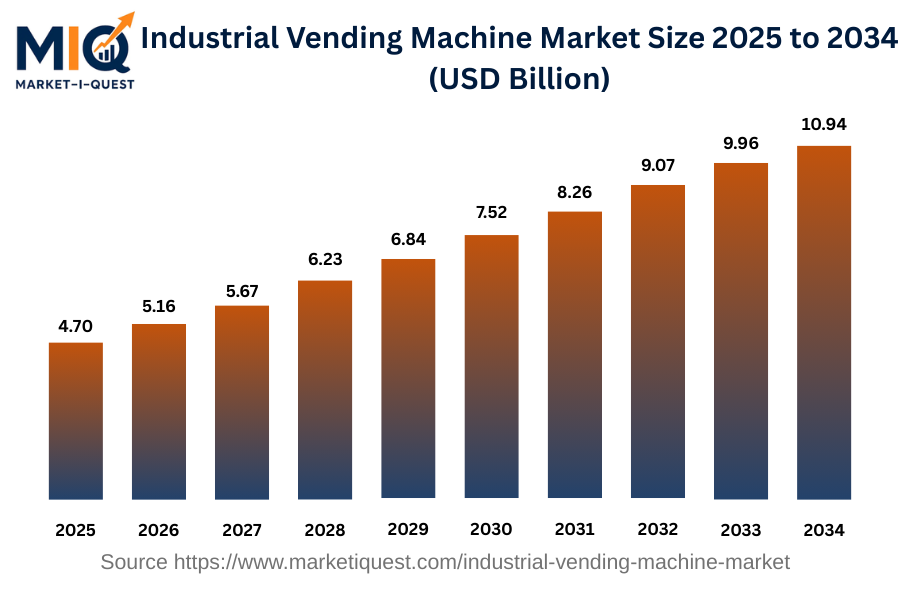
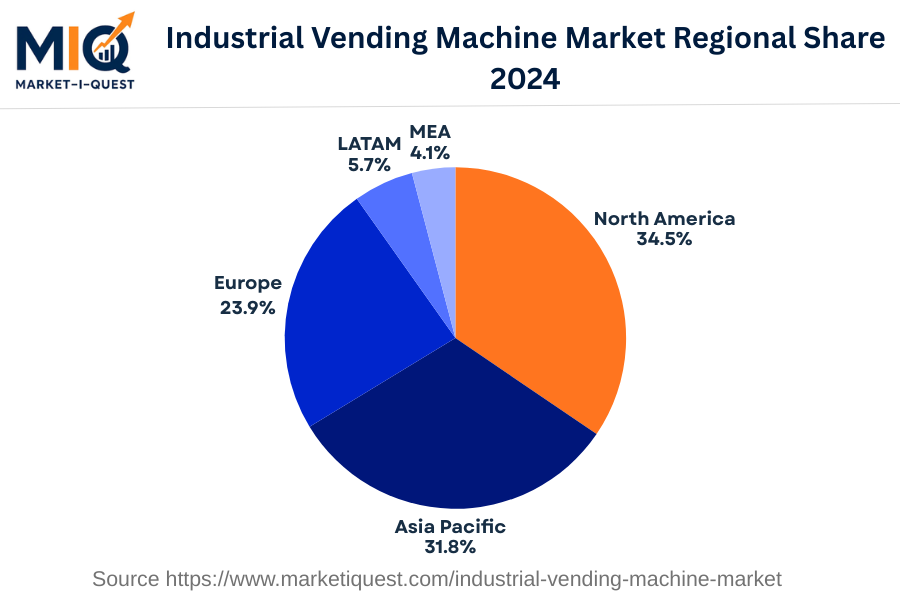
The Industrial Vending Machine Market is valued at size of $4.28 billion in 2024, growing to an estimated $4.70 billion in 2025. The market then progresses to increase considerably in value, reaching projected size of $10.94 billion by 2034, with a compound annual market growth rate (CAGR) of 9.84% from 2025 to 2034. The market growth is primarily driven by factors including advancements in automation technologies and rising demand for industrial vending machines in several industry sectors such as manufacturing and healthcare. In terms of regional market share mix for 2024, North America holds the highest share of 34.5%, followed by Asia Pacific at 31.8%, Europe at 23.9%, Latin America at 5.7%, and the Middle East and Africa at 4.1%.

Key Takeaways

  • By Type - Carousel segment led accounting for the highest market share in recent years.
  • By Product - PPE Tools held top spot in terms of product preference and usage in the Industrial Vending Machine Market.
  • By End-use - Manufacturing emerged as the top user of industrial vending machines in the recent past.
industrial-vending-machine-market market size

Key Driving Factors

Rapid Cost-Saving through Automated Inventory Management

Industrial vending machines are widely recognized as a sound solution to enhance efficiency of inventory management. They provide real-time visibility and traceability of equipment uses and help reduce stock holding and administrative costs. This particularly attracts industries like manufacturing and construction where equipment and tool handling is a significant part of their operational expenditure. Automated dispensing with these vending machines allows companies to keep track of their inventory, avoiding the overstocking or out-of-stock scenarios. It can accurately record who took what item, when, and for what job, thereby reducing theft and misuse of equipment. Further, these machines can also set restocking alerts, ensuring inventories are always filled at an efficient level. Therefore, the cost-saving benefits accomplished through improved inventory management drive several companies to adopt industrial vending machines.
Legislation Enforcing Worker Safety and Efficiency

Certain industries like automotive, heavy machinery and healthcare are controlled by stringent regulations that emphasize worker safety. For example, the Occupational Safety and Health Act (OSHA) in the United States needs employers to implement necessary measures that ensure the safety of employees at workplaces. Industrial vending machines are an effective tool that helps meet several of these regulations. They dispense safety gear and critical tools required for specific jobs and keep an account of use. This ensures that all workers have access to safety equipment, which is not only important for the employers to comply with safety standards but also helps to prevent any workplace incidents or injuries. In moreover, reduction of time spent in search of tools or equipment boosts productivity, making it more suitable amongst employers.

Market Evolution by Timeline

2019-2023
In this period, the demand for industrial vending machines was predominantly from North America, due to the commitment to minimizing operational costs and ensuring employee safety. Key drivers for motivation were better stock control and reduced downtime. Existing products mainly provided simple supply and retrieval functions, while software integration mostly supported basic inventory management. The key constraint was interoperability with various enterprise resource planning systems. The lack of appropriate certification standards limited the expansion. Commercial models were typically capital purchase with annual maintenance contracts, with little flexibility. The risk of machine outdatedness due to rapidly evolving technology was a significant barrier for potential investors.
2024
In 2024, buyers from the Asia-Pacific region started showing interest due to the positive impacts of industrial vending machines in North America. New models began to implement predictive maintenance and data analytics, although these features were still at early stage. Regulatory conditions remained uncertain as they awaited international IoT standards, implicitly affecting this sector. The shift towards equipment-as-a-service models had begun, allowing buyers to avoid upfront capital expenses. However, cybersecurity threats posed a significant risk due to the increased integration with several IT systems in companies.
2025-2029
By this time, the adoption of industrial vending machines had escalated worldwide, with maximum adoption in Europe. Rapid technological advancements led to the integration of features like AI-enabled predictive restocking and advanced data analysis for operational optimization. Besides, well-defined IoT and cybersecurity regulations advanced the supply side. Leasing and subscription-based models will become extensively used, promoting partnerships between vending machine manufacturers and software companies. A significant risk during this period was the high implementation costs associated with these advanced features, affecting adoption within small and medium-sized enterprises.
2030-2034
In this period, a rapidly growing market demand from developing industries led to global market expansion. Enhanced machine capabilities, including machine learning-enabled inventory forecasting and device interoperability, will be standard. The universal standards for IoT and AI led to increased technological maturity and regulatory clarity, driving more companies to adopt industrial vending machines. Performance-based contracts will start to shape the commercial landscape. Machine learning-driven overview creating real-time optimization, propelling market growth. However, managing the vast amounts of generated data will remain a key risk, demanding robust data governance policies.

Future Market Outlook

Future Opportunities

Looking ahead, the industrial vending machine market presents significant opportunities linked to existing developments and changing market dynamics. The increasing focus on safety in manufacturing environments is driving demand for automated dispensing of solutions that reduce human contact, a trend that began gaining traction in mid-2020 amidst public health concerns. Whereas in late 2023, manufacturers are exploring partnerships with tech firms to incorporate artificial intelligence into their machines for predictive analytics and improved supply chain management. In the European Union, regulatory frameworks are being shaped to support advanced asset management systems, paving the way for wider adoption of smart vending. Recent pilot projects in countries such as Germany highlight the integration of customizable vending solutions for specific industries like automotive and pharmaceuticals. Moreover, the rise in e-commerce logistics is influencing industrial firms to reevaluate strategies, creating a demand for on-site vending solutions that offer rapid access to essential components. Additionally, as industries strive for digitization, there is an opportunity for machines to become integral parts of broader Industry 4.0 initiatives. Companies that can effectively demonstrate how their vending solutions fit into this ecosystem will likely attract interest from manufacturers seeking enhanced operational efficiency. Overall, the integration of technology and user needs signifies a potential outlook for innovation within the industrial vending landscape.

Segmentation Analysis

By Type

The market is divided into subsegments including Carousel, Coil, and Cabinet, with Carousel accounting for the largest revenue share, while Coil is projected to grow at the fastest compounded annual growth rate.

Largest Revenue Share

Carousel

Market Share Leader

The Carousel subsegment currently dominates the market due to its robust utilization in various industries, integrating to the segment's largest revenue Carousel-style vending machines has a wide range of products in comparatively less space, rendering them an attractive choice for facility managers with limited space. Compared to other types, Carousel designs provide superior customer experience, as they offer more visibility and ease of selection. Their operational efficiency has made them popular in high-footfall areas, like shopping malls and transportation hubs, expanding their revenue contribution. Moreover, regulations favoring self-service operations have fueled the popularity of Carousel vending machines, mitigating their revenue performance. The purchasing criteria, defined by ease of use, versatility, and perceived value for money, also favor Carousel subsegment. Switching costs can be high due to the initial investment required, creating a barrier for buyers looking for cost-effective solutions. Considering distribution, a variety of channels, including direct sales and third-party e-commerce platforms, enable wide-reaching accessibility for end-users.

Fastest CAGR

Coil

Forecast Period Growth Leader

The Coil subsegment is expected to grow at the fastest compounded annual growth rate. The potential development can be credited to Coil's versatility in accommodating different sizes of products without the need for intensive customization. Despite initial resistance due to unfamiliarity, there's a growing acceptance of Coil vending machines among end users, which also aids in its growth. The introduction to innovative technologies is expected to eliminate present adoption barriers, with smart features enhancing operability and efficiency, which works as a market catalyst. Furthermore, policy changes favoring automated operations and investments in advanced Coil vending tech enhance this projected growth. However, uncertain stakeholders awaiting proven scalability and ROI may limit the near-term market growth. A significant risk involves the high dependency on power supply, any fluctuations or interruptions of which can severely impair the functionality of these machines.

By Product

The market is divided into subsegments including MRO Tools, PPE, and Others. In the base year 2024, PPE accounted for the largest revenue share, while MRO Tools is anticipated to grow at the fastest CAGR during the forecast period.

Largest Revenue Share

PPE

Market Share Leader

Personal Protective Equipment (PPE) has poised the subsegment with the highest revenue due to a variety of factors. Primarily, the need for PPE items across multiple industries, including mining, logistics, chemical, and healthcare, ensures a constant demand. As the stipulations related worker safety have become more stringent, regulated by laws worldwide, corporations are obliged to provide appropriate PPE for their employees, further increasing demand. Moreover, the COVID-19 pandemic has highlighted the critical importance of PPE in healthcare, prompting a surge in demand. This higher interest, integrated with various requirements across many industries, drives PPE to maintain a dominant market position. Also, the lifespan of most PPE products is relatively short, leading to recurring purchases. This regular rotation ensures a steady revenue flow from this subsegment. Nonetheless, emerging regions provide more increasing potential due to the developing industrial sector and rising worker safety awareness.

Fastest CAGR

MRO Tools

Forecast Period Growth Leader

Maintenance, Repair, and Operation (MRO) tools represent the subsegment projected to experience the highest growth rate. Requirement for MRO tools is driven by growing industrialization and the necessity for regular equipment maintenance. Ensuring efficient equipment performance reduces downtime, thereby improving productivity, remains a key priority for several businesses. Technological advancements are also playing a major role in the projected growth. The emergence of smart MRO tools equipped with IOT and predictive maintenance capabilities enables proactive maintenance, further driving market growth. Despite the initial high cost, companies are increasingly adopting these tools due to long-term cost savings as well as efficiency improvement. Additionally, partnerships between MRO tool manufacturers and industrial companies could accelerate adoption rates. However, rapid technological changes represent a potential risk, as companies may find it challenging to keep pace with the latest MRO solutions.

By End-use Industry

The market is divided into subsegments including Manufacturing, Oil & Gas, Construction, Aerospace, and Others. Among these, the Manufacturing subsegment accounted for the largest revenue share while Aerospace is expected to grow at the fastest CAGR during the forecast period.

Largest Revenue Share

Manufacturing

Market Share Leader

The manufacturing subsegment is positioned to generate the highest revenue in 2024, driven by several keys pivotal to overall market. The largest contributors to GDP in several countries, its importance to the overall market is not inflated. It is saturated with a wide variety of customers with several needs and requirements, each contributing to the segment's revenue. The stability of manufacturing stems from its structural adaptability. Moreover, various regulations have been placed to facilitate manufacturing processes which further supports the revenue of this sector. Purchasing criteria within the manufacturing sector is heavily scaled towards cost-efficiency, driving a competitive yet growing market. High switching costs strengthen customer loyalty, fostering steady revenue streams.

Fastest CAGR

Aerospace

Forecast Period Growth Leader

The aerospace subsegment shows the fastest CAGR outlook, this sector is expected to realize a fast-paced growth owing to several driving factors. The global drive towards modernization and increased efficiency has led to a greater adoption of aerospace for both, commercial and defense purposes. The sector faces certain barriers to adoption, including complex supply chains and high requirements for security and safety standards. But technological advancements, policy provisions, and strategic partnerships are working as catalysts in overcoming these obstacles. Capital expenditure in this sector is high due to the sophisticated nature of aviation machinery and technology, adding to the segment’s growth. Despite, the aerospace sector faces near-term risks, including fluctuating fuel costs, regulatory pressures, and environmental concerns, which will be essential for managing the sustained development of this subsegment.

Competitive Analysis

Key Market Players

The industrial vending machine market is competitive, with a mix of large established companies and smaller regional players. Most companies focus on improving their products/services, keeping prices attractive, and strengthening relationships with key customers. They also use partnerships, acquisitions, and new launches to expand their presence in existing and new markets. Overall, players compete on quality, reliability, and value, and competition is expected to remain strong over the forecast period.

Manufacturers / OEMs

Fastenal Company
US
Apex Industrial Technologies LLC
US
AutoCrib, Inc.
US

Key Suppliers & Raw Materials

Haas Automation, Inc.
US
Stanley Black & Decker
US
MSC Industrial Supply Co.
US

Distributors, Integrators & Channel Partners

W.W. Grainger, Inc.
US
Direct Supply, Inc.
US
Colfax Corporation
US

Porter’s Five Forces Analysis

Analysis of the industrial vending machine market using Porter's Five Forces.

Supplier Bargaining Power

Low

Standardized components reduce the bargaining power of suppliers.

Buyer Bargaining Power

High

Numerous suppliers and customizable solutions boost buyer bargaining power.

Threat of Substitutes

Low

Substitutes like manual inventory management are inefficient and outdated, making the threat low.

Threat of New Entrants

Medium

Technology advancements reduce barriers, but initial capex can deter new entrants.

Competitive Rivalry

High

A large number of established players fighting for market share makes rivalry intense.

Regional Analysis

Geographic market dynamics and growth opportunities across key regions

Global Market Outlook

industrial-vending-machine-market market regional share

North America

In 2024, the North American industrial vending machine market was robust and proactive. Demand dynamics driven by the manufacturing sector resulted in increased adoption, with businesses seeking to streamline operations and reduce waste. Investment was growing, especially in the United States where Industry 4.0 adoption defined a technology-first approach. Meanwhile, regulatory environments in Canada and Mexico to reduce wastage saw the vending installations rise.

Trends integrated around the convenience, traceability, and control offered by automated tech. Enterprises leaned more toward intelligent vending solutions that coupled with Internet of Things (IoT) for real-time data. This shift improved inventory management and increased efficiency too. Furthermore, partnerships fostered development: manufacturing companies aligned with vending machine providers to custom-build solutions. For instance, tool vendors in the U.S closely worked with machine providers to ensure a customized delivery mechanism.

Buyer’s behavior notably shifted towards the retail sector, with a focus on minimizing equipment downtime and reducing carrying costs. Specifically, industries with high-use consumables like automotive and healthcare saw more vending machine installations. On the other front, utilities expanded their deployment due to the ability to track usage of data for billable items. The industrial vending machine market in North America during 2024 improved more on services that optimize costs and inventory, ultimately retaining control.

Trends converged around the convenience, traceability, and control offered by automated dispensing tech. Enterprises leaned more toward intelligent vending solutions that coupled with Internet of Things (IoT) for real-time data. This shift not only improved inventory management but also increased efficiency. Furthermore, partnerships fostered growth: manufacturing companies allied with vending machine providers to custom-build solutions. For instance, tool vendors in the U.S closely worked with machine providers to ensure a customized delivery mechanism.

Buyer behavior notably tilted towards the retail sector, with an emphasis on minimizing equipment downtime and reducing carrying costs. Specifically, industries with high-use consumables like automotive and healthcare saw more vending machine installations. On the other front, utilities expanded their usage due to the ability to track usage data for billable items. The industrial vending machine market in North America during 2024 honed more on services that optimize costs and inventory, ultimately retaining control.

Asia Pacific

In 2024, the Industrial Vending Machine market in Asia Pacific saw a significant rise in implementation across diverse sectors. Rising labor costs in economies like China and India, the adoption of automated solutions across Japan and South Korea, and the need for efficient inventory management in Australia's large-scale manufacturing operations highlighted this development. The region also saw adequate investment from both enterprise and government entities to encourage technology adaptation.

In terms of trends, buyer behaviour noticeably shifted towards incorporating industrial vending machines into their workflow in industries such as manufacturing, healthcare, and retail. There was a critical acceptance of innovations, especially in inventory management and asset tracking technologies, like smart vending machines and PPE vending machines. Channels to acquire these solutions diversified with a robust online presence, alongside traditional routes with China and key ASEAN markets like Indonesia and Thailand witnessing a surge in e-commerce sales in this sector.

A greater shift towards partnerships and M&A was observed specifically in India, drawing upon collaborative benefits to meet growing demands. Policymakers also played their part, particularly in Japan and South Korea, with the enforcement of norms to promote worker safety and reduce inventory loss, further promoting the use of industrial vending machines.

In terms of trends, buyer behaviour noticeably shifted towards incorporating industrial vending machines into their workflow in industries such as manufacturing, healthcare, and retail. There was a critical acceptance of innovations, especially in inventory management and asset tracking technologies, like smart vending machines and PPE vending machines. Channels to procure these solutions diversified with a robust online presence, alongside traditional routes with China and key ASEAN markets like Indonesia and Thailand witnessing a surge in e-commerce sales in this sector.

A greater shift towards partnerships and M&A was observed specifically in India, drawing upon synergistic benefits to meet growing demands. Policymakers also played their part, particularly in Japan and South Korea, with the enforcement of norms to promote worker safety and curtail inventory loss, further promoting the use of industrial vending machines.

Europe

In 2024, the Industrial Vending Machine Market in Europe experienced substantial expansion. The key drivers include increased implementation of industrial vending machines in manufacturing plants due to their significant role in managing inventory; particularly visible in Germany and UK. Other sectors, like healthcare and utilities, started to recognize the efficiency benefits, further stimulating requirement. Increased investments in automated solutions, specifically in countries like France and Italy, also contributed to the market expansion. Critical regulatory provisions, particularly in Spain and Benelux countries, supported vendors in maintaining price competitiveness while complying with standards.

Several market trends distinctly shaped the market dynamics. Manufacturers focused on technological advancement and introduced smart vending machines, able to provide analytics for better supply management. User preference shifted towards machines offering a wide product range, seen with a particular emphasis in Central & Eastern Europe. The market witnessed a surge in partnerships and M&A activities, as companies aimed to strengthen their presence across diverse verticals, particularly the retail sector in regions such as the Nordics. Lastly, stricter enforcement of energy efficiency policies led to more vendors conceiving eco-friendly vending machine designs, reducing the electricity consumption and minimizing the environmental footprint.

Several trends distinctly shaped the market dynamics. Manufacturers focused on technological advancement and introduced smart vending machines, able to provide analytics for better supply management. User preference shifted toward machines offering a wide product range, seen with a particular emphasis in Central & Eastern Europe. The market witnessed a surge in partnerships and M&A activities, as companies aimed to strengthen their presence across diverse verticals, particularly the retail sector in regions such as the Nordics. Lastly, stricter enforcement of energy efficiency policies led to more vendors conceiving eco-friendly vending machine designs, reducing the electricity consumption and minimizing the environmental footprint.

Latin America

In 2024, the Industrial Vending Machine market in Latin America (LATAM) exhibited significant development, benefiting from several key drivers and trends of the market. Strong interest from key sectors, like manufacturing and retail, catalyzed this expansion. Businesses in these sectors sought to streamline their operations by leveraging these solutions for real-time inventory tracking and controls. Industrial vending machines also found increased use in utility companies interested in ensuring the efficient and transparent distribution of high-value equipment and tools.

Additionally, mounting international investments in LATAM's manufacturing sector supported the adoption of these solutions. For instance, Brazilian and Mexican manufacturing firms showed a consistent incline towards improved productivity, facilitated by these machines.

But the most prominent driver was technological adoption. The gradual digital transformation of enterprise operations in countries like Argentina, Colombia, Peru, and Chile directly influenced the Industrial Vending Machine market, making these machines a staple in modern industrial settings.

Trends shaping the market included a shift towards data-driven operations and machine learning-enabled vending machines. Such advancements improved machine functionality and allowed more informed decision-making, making them more appealing to potential customers. Regulatory emphases on workforce safety and accountability in several LATAM countries also popularized the use of these machines in different sectors, encouraging businesses to adopt these technology-led solutions for inventory management.


Additionally, mounting international investments in LATAM's manufacturing sector supported the adoption of these solutions. For instance, Brazilian and Mexican manufacturing firms showed a consistent inclination towards improved productivity, facilitated by these machines.

However, the most prominent driver was technological adoption. The gradual digital transformation of enterprise operations in countries like Argentina, Colombia, Peru, and Chile directly influenced the Industrial Vending Machine market, making these machines a staple in modern industrial settings.

Trends shaping the market included a shift towards data-driven operations and machine learning-enabled vending machines. Such advancements improved machine functionality and allowed more informed decision-making, making them more appealing to potential customers. Regulatory emphases on workforce safety and accountability in several LATAM countries also popularized the use of these machines in different sectors, encouraging businesses to adopt these technology-led solutions for inventory management.

Middle East & Africa

In 2024, the Industrial Vending Machine Market in the Middle East and Africa saw significant momentum. A surge in automation investment and adoption, led by countries like Saudi Arabia, United Arab Emirates, and Qatar, driven interest in core sectors such as oil and gas, manufacturing, and utilities. Expansion strategies in economies like Nigeria and Kenya further contributed, bolstered by favorable government regulations supporting digital transformation. Additionally, technology-intensive sectors like telecom and healthcare in Egypt and Israel amplified this market demand.

Simultaneously, shifts in buyer behavior were apparent, with a rising inclination towards self-service and real-time inventory management. The increased adoption of Industrial IOT technology played a huge role in shaping this trend. On a corporate level, partnerships and M&A activities were substantial, especially between global vending machine suppliers and local supply chain firms, indicating a thriving ecosystem.

In Saudi Arabia's oil and gas sector, the use of industrial vending machines for PPE management gained traction. Meanwhile, manufacturing and retail sectors in South Africa saw a surge in requirement for smart vending solutions for tool crib management, indicating the rising importance of efficiency and cost control. Though the market landscape showed intensified competition, it also presented a abundance of market opportunities for players ready to adapt to the region's unique needs and dynamic regulatory environment

Simultaneously, shifts in buyer behavior were apparent, with a rising inclination towards self-service and real-time inventory management. The increased adoption of Industrial IoT technology played a pivotal role in shaping this trend. On a corporate level, partnerships and M&A activities were substantial, especially between global vending machine suppliers and local supply chain firms, indicating a thriving ecosystem.

In Saudi Arabia's oil and gas sector, the use of industrial vending machines for PPE management gained traction. Meanwhile, manufacturing and retail sectors in South Africa saw a surge in demand for smart vending solutions for tool crib management, indicative of the rising importance of efficiency and cost control. Though the market landscape showed intensified competition, it also presented a plethora of opportunities for players ready to adapt to the region's unique needs and dynamic regulatory environment.

Recent Industry Developments

Latest market innovations, product launches, and strategic initiatives

March 2025

H-Vend Service Ltd introduced a next-generation range of digital vending machines backed by EU funding. The new systems are designed for remote monitoring and management and enable touchless operation, enhancing efficiency and user convenience.

April 2024

Lavazza announced plans to acquire a 100% stake in IVS, a major vending machine operator, for approximately US$ 197 million. The acquisition is intended to expand Lavazza’s footprint in the vending sector and support its broader omnichannel expansion strategy.

January 2024

The Tacoma, WA-based MRO supplies distributor, acquired IMC Supply, a wholesale MRO supplier specializing in cutting tools for the industrial and construction industries.

Frequently Asked Questions